The global food system stands at a critical crossroads. By 2050, the world’s population is expected to reach nearly 10 billion people, requiring food production to increase by an estimated 70 percent to meet demand. Yet the resources needed to achieve this expansion are rapidly diminishing. Arable land continues to shrink due to urbanization and degradation, freshwater supplies are increasingly strained, and climate change introduces unpredictable growing conditions that threaten traditional agricultural practices.
Traditional farming methods, which have sustained humanity for millennia, are proving inadequate for addressing contemporary challenges. Conventional agriculture consumes approximately 70 percent of global freshwater resources, occupies vast land areas, and depends heavily on chemical pesticides. Long supply chains connecting rural farms to urban consumers waste substantial amounts of food through spoilage and create carbon emissions from transportation. Extreme weather events driven by climate change make harvest outcomes increasingly unpredictable, threatening food security in vulnerable regions.
Urban populations now constitute over half of humanity, with projections suggesting this proportion will reach 68 percent by 2050. This demographic shift creates unique opportunities for food production. Cities concentrate consumer demand in limited geographical areas, making localized production economically attractive if technical obstacles can be overcome. Urban environments offer controlled infrastructure, reliable electricity, and proximity to markets, but lack the expansive land areas that traditional farming requires.
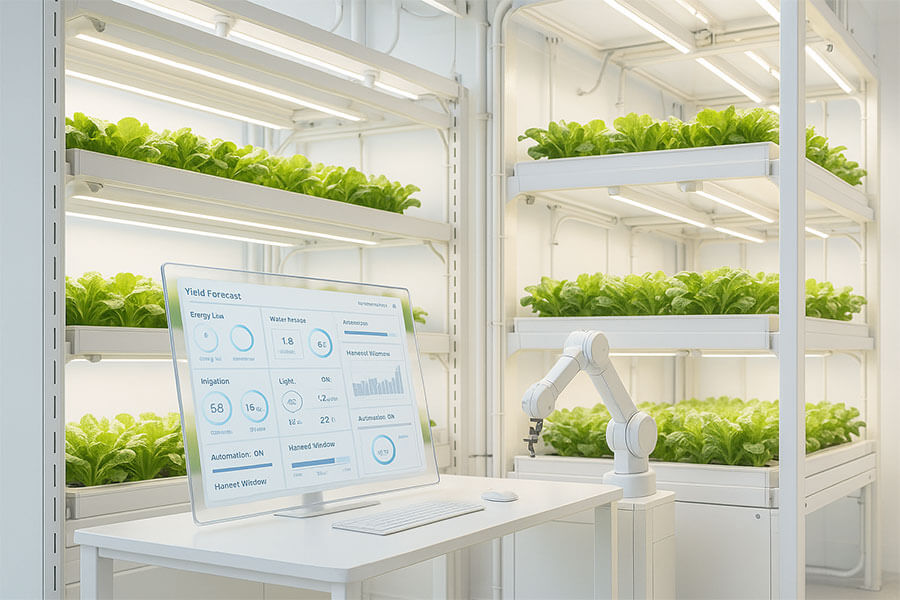
Enter AI-orchestrated vertical farming systems—a transformative approach that reimagines agricultural production for the urban age. These facilities stack crops in vertically arranged layers within controlled environment structures, using artificial intelligence to optimize every aspect of the growing process. Sophisticated sensor networks continuously monitor temperature, humidity, light intensity, nutrient levels, and dozens of other parameters, feeding data to machine learning algorithms that make real-time adjustments to maximize plant health and productivity.
The technological sophistication extends beyond simple automation. Modern systems employ computer vision to monitor individual plants for signs of stress or disease, predictive analytics to forecast optimal harvest timing, and reinforcement learning algorithms that continuously improve growing protocols. These intelligent systems can adjust light spectrums throughout the day to match specific crop requirements, fine-tune nutrient delivery with precision measured in parts per million, and maintain environmental conditions within tolerances of fractions of a degree.
This transformation carries profound implications for urban food security, environmental sustainability, and agricultural economics. By bringing food production directly into cities, vertical farms can supply fresh produce to consumers within hours of harvest. The controlled environments eliminate the need for pesticides, producing food that meets organic standards. Resource efficiency reaches remarkable levels, with some systems using 95 percent less water and producing yields per acre that exceed traditional farming by factors of ten or more.
Understanding Vertical Farming Fundamentals
Vertical farming represents a fundamental reimagining of agricultural production, moving from the horizontal land-intensive model toward systems designed for vertical urban architecture. This approach stacks crops in layers, often incorporating controlled environment agriculture technology that manages all growing conditions. The method multiplies productive capacity while enabling precise control over factors determining crop health and yield.
The core principle involves creating artificial growing environments where every variable affecting plant development can be monitored and adjusted. Modern vertical farms operate as fully enclosed systems where LED lighting provides photosynthetically active radiation tuned to specific wavelengths, HVAC systems maintain exact temperature and humidity parameters, and hydroponic or aeroponic systems deliver nutrients directly to plant roots. This comprehensive environmental control eliminates variability inherent in outdoor agriculture, enabling predictable year-round production.
The infrastructure involves sophisticated integration of multiple technological systems. Growing towers or racks typically stand between two and ten meters high, arranged to maximize cubic space utilization. LED lighting arrays provide energy for photosynthesis, with modern systems delivering specific light spectrums optimized for different growth stages. Climate control systems manage airflow, temperature, and humidity with precision. Water recirculation systems achieve closed-loop operation, minimizing consumption by capturing and reusing moisture that plants transpire.
The Evolution of Controlled Environment Agriculture
The journey toward modern vertical farming began with simple greenhouses. Ancient Romans employed specularia, primitive greenhouses constructed with translucent mica sheets, to grow cucumbers year-round. These early experiments established principles that remain relevant today, particularly understanding that managing environmental variables can dramatically improve agricultural outcomes.
Technological evolution accelerated during the Industrial Revolution when glass manufacturing improvements made larger greenhouses economically feasible. Dutch horticulturists became particularly skilled at greenhouse cultivation, developing sophisticated techniques for managing humidity, ventilation, and nutrient delivery. By the mid-twentieth century, commercial greenhouses had become substantial operations producing vegetables and ornamental plants for markets throughout Europe and North America.
The transition from greenhouses to vertical farms required several technological breakthroughs. Development of high-efficiency LED lighting in the 1990s and 2000s provided the first practical alternative to sunlight, offering controllable light spectrums while consuming far less electricity than previous artificial lighting. Hydroponic and aeroponic growing systems matured from experimental curiosities to commercially viable cultivation methods. Advances in climate control, sensor networks, and computing power made it feasible to monitor and adjust growing conditions with unprecedented precision.
Core Infrastructure and System Components
Modern vertical farming facilities integrate specialized systems working in concert to create optimal growing conditions. The structural framework consists of modular growing racks arranged to maximize volumetric efficiency while allowing access for planting, maintenance, and harvesting. These structures must support the weight of growing media, water systems, and mature plants while providing stability.
Lighting systems represent one of the most critical and expensive components. LED arrays must deliver sufficient photosynthetically active radiation to support healthy plant growth, typically requiring light intensities between 200 and 600 micromoles per square meter per second. Modern systems employ tunable LED technology capable of adjusting light spectrum throughout the growth cycle, providing blue-heavy spectrums during vegetative stages and shifting toward red-heavy spectrums during fruiting.
Climate control infrastructure maintains precise temperature, humidity, and airflow conditions. HVAC systems must remove substantial heat generated by LED arrays while maintaining uniform temperature distribution. Dehumidification equipment extracts moisture that plants transpire, preventing fungal diseases. Air circulation systems ensure uniform CO2 distribution and prevent stagnant air pockets.
Nutrient delivery systems provide minerals and compounds plants need for healthy growth. Hydroponic systems circulate nutrient-enriched water directly through plant roots, while aeroponic systems spray fine mists onto suspended root structures. Both approaches enable precise control of nutrient concentrations and pH levels. Water recirculation through filtration and sterilization enables facilities to operate as nearly closed-loop systems, dramatically reducing water consumption.
Sensor networks continuously gather data about environmental conditions, plant health, and system performance. Temperature and humidity sensors distributed throughout growing spaces ensure uniform conditions. Cameras monitor plant growth, detect diseases, and assess crop maturity. Nutrient sensors track chemical composition of hydroponic solutions, while flow meters monitor water usage patterns. The integration of these physical systems with control software creates the foundation upon which AI-orchestrated farming operates.
AI and Machine Learning Technologies in Agriculture
Artificial intelligence has emerged as the central nervous system of modern vertical farming, transforming facilities from sophisticated controlled environment systems into adaptive, learning platforms that continuously improve performance. Machine learning algorithms analyze patterns in vast datasets that sensor networks generate, identifying relationships between environmental parameters and plant responses that inform increasingly refined growing protocols.
The specific AI technologies deployed span multiple categories of machine learning, each addressing different aspects of facility management. Supervised learning algorithms train on historical data linking specific growing conditions to measured outcomes, learning to predict how different combinations of light, temperature, nutrients, and other factors will affect growth rates and yields. These predictive models enable systems to forecast harvest dates, estimate production volumes, and identify optimal conditions based on accumulated experience.
Unsupervised learning techniques excel at detecting patterns and anomalies in operational data without requiring labeled training sets. These algorithms monitor real-time sensor streams, learning normal operating patterns and flagging deviations that might indicate equipment malfunctions, disease outbreaks, or suboptimal growing conditions. By identifying subtle correlations between variables that human operators might miss, unsupervised learning systems discover optimization opportunities.
Reinforcement learning represents perhaps the most powerful application, enabling systems to actively experiment with different growing strategies and learn from results. These algorithms treat farm management as a sequential decision problem where the system takes actions affecting the environment, observes consequences, and adjusts future decisions to maximize long-term objectives. Through thousands of growing cycles, reinforcement learning systems discover counter-intuitive strategies that outperform conventional wisdom.
Machine Learning Algorithms and Predictive Models
The deployment of machine learning begins with extensive data collection capturing relationships between controllable environmental variables and measurable outcomes. Temperature, humidity, light intensity, light spectrum, CO2 concentration, nutrient composition, pH levels, and dozens of other parameters are recorded at fine temporal granularity alongside plant growth measurements and harvest data.
Random forest algorithms prove particularly effective for agricultural applications because they handle nonlinear relationships well, resist overfitting, and provide interpretable insights into which variables most strongly influence outcomes. Gradient boosting methods iteratively build ensembles of models that correct errors of previous iterations, often achieving superior predictive accuracy. Deep neural networks can capture complex interactions between environmental variables that simpler models might miss, learning hierarchical representations of growing conditions.
Beyond predicting final outcomes, machine learning models serve operational functions throughout the growing cycle. Harvest timing predictions enable facilities to coordinate logistics and labor scheduling. Quality prediction models estimate nutrient content, flavor profiles, and visual appeal before harvest, allowing operators to adjust growing conditions if predicted quality falls below standards. Yield forecasting supports inventory management by providing advance notice of production volumes.
Disease detection and plant health monitoring represent critical applications where computer vision combined with machine learning delivers substantial value. Cameras positioned throughout growing spaces capture images that algorithms analyze for visual indicators of stress, nutrient deficiencies, or pathogen infections. Convolutional neural networks trained on thousands of labeled images learn to recognize subtle color changes, leaf abnormalities, and growth patterns signaling potential problems. Early detection enables targeted interventions before issues spread.
Optimization algorithms represent the apex of machine learning application, directly controlling growing conditions to maximize defined objectives. Multi-objective optimization frameworks balance competing goals such as maximizing yield while minimizing energy consumption and maintaining target quality standards. These systems evaluate potential control strategies, predict consequences using learned models, and select actions achieving the best expected outcomes.
Environmental Control and Optimization Systems
The essence of AI-orchestrated vertical farming lies in precise manipulation of environmental variables to create optimal growing conditions that maximize crop performance while minimizing resource consumption. This control enables optimization strategies impossible in outdoor environments, but requires sophisticated management systems capable of balancing multiple objectives while accounting for complex interactions between environmental parameters.
Temperature management profoundly influences virtually every aspect of plant physiology, affecting photosynthetic rates, respiration, nutrient uptake, and developmental timing. AI systems continuously adjust heating and cooling to maintain target temperatures while accounting for heat generated by lighting systems, metabolic heat from plants, and external weather conditions affecting building thermal loads. Advanced implementations employ spatial temperature mapping across growing zones, maintaining different temperatures in different areas to accommodate crops at various developmental stages.
Humidity control interacts closely with temperature management, as the two parameters jointly determine vapor pressure deficit, the driving force for plant transpiration and nutrient uptake. AI systems monitor humidity throughout growing spaces, operating dehumidification equipment to remove excess moisture when transpiration rates are high and adding moisture when air becomes too dry. Sophisticated control systems employ distributed sensors and localized climate management to maintain uniform conditions.
Light management represents the most complex and impactful dimension of environmental control, as photosynthesis directly depends on the quantity, quality, and timing of light that plants receive. Modern LED systems enable unprecedented control over all three parameters, providing specific light spectrums optimized for different crops and growth stages.
Climate Management and Resource Efficiency
AI systems orchestrate lighting strategies that balance energy costs against crop productivity, implementing dynamic light recipes that adjust intensity and spectrum throughout each day and across the growing cycle. Intelligent lighting control extends beyond simple on-off cycles, gradually ramping light intensity up and down to simulate sunrise and sunset while providing periodic darkness that plants require for certain metabolic processes.
The energy consumption of lighting systems represents the largest operating cost for most vertical farms, making efficiency optimization critical for economic viability. AI systems continuously evaluate trade-offs between light intensity and crop growth rates, identifying optimal operating points where additional light energy no longer produces proportional increases in biomass accumulation. These analyses account for electricity pricing that varies by time of day, potentially reducing lighting during expensive peak demand periods.
Carbon dioxide enrichment provides another powerful lever for optimizing photosynthetic efficiency. Controlled environments can maintain elevated levels between 800 and 1200 parts per million that substantially enhance growth rates. AI systems manage CO2 injection equipment to maintain target concentrations while accounting for ventilation rates that remove excess heat and humidity but also allow CO2 to escape.
Water management in vertical farms achieves efficiency levels that seem almost impossible compared to traditional agriculture. Closed-loop hydroponic and aeroponic systems recirculate water, capturing moisture that plants transpire and condensing it from humid air for reuse. This recycling enables vertical farms to produce crops using just 2 to 4 liters of water per kilogram of vegetables, compared to 250 liters or more required by traditional irrigation methods.
Nutrient delivery optimization represents a sophisticated application that directly impacts both crop quality and resource efficiency. AI systems analyze plant uptake patterns from continuous monitoring of nutrient solution composition, dynamically adjusting delivery rates to match actual consumption. Machine learning models predict nutrient demands based on plant size, growth rates, and environmental conditions, enabling just-in-time delivery strategies that minimize waste.
The integration of these control systems creates synergistic effects where optimization of one parameter enables improvements in others. AI systems continuously explore these multidimensional optimization spaces, discovering parameter combinations that achieve superior outcomes. The cumulative effect of these coordinated optimizations can increase resource efficiency by 30 to 50 percent compared to conventional vertical farm management approaches.
Benefits and Opportunities
AI-orchestrated vertical farming systems deliver transformative benefits addressing multiple challenges facing global agriculture. These advantages span environmental sustainability, economic viability, food security, and public health dimensions, creating value for diverse stakeholders from consumers to investors to policymakers.
Water conservation represents one of the most dramatic advantages. Closed-loop recirculation systems achieve water use efficiency exceeding conventional irrigation methods by factors of 50 to 100, producing crops using as little as 2 percent of the water traditional farming requires. This efficiency stems from precise delivery providing plants exactly what they need without runoff losses, combined with humidity capture systems that recycle transpired moisture. For regions facing water scarcity, this efficiency could enable food production that would otherwise be impossible.
Land use efficiency multiplies productive capacity by factors of ten to twenty compared to horizontal agriculture, with some facilities achieving even greater advantages. This improvement results from vertical stacking exploiting three-dimensional space combined with year-round production enabled by controlled environments. A single vertical farm occupying one acre might produce as much food annually as ten to twenty acres of traditional farmland, and vertical farms can utilize land unsuitable for conventional farming including brownfield sites or abandoned urban buildings.
Year-round production eliminates seasonal limitations that constrain traditional agriculture, enabling consistent supply regardless of external weather conditions. This reliability benefits consumers who gain continuous access to high-quality fresh produce, and supports food businesses requiring predictable ingredient sourcing. For farmers, year-round operation generates revenue streams that traditional seasonal agriculture cannot match, improving financial stability.
Food safety improvements emerge naturally from controlled environments. The elimination of soil removes the primary vector for pathogenic bacteria like E. coli and Salmonella. Controlled access and environmental management prevent pest insects from infesting crops, eliminating the need for chemical pesticides. The absence of pesticide residues means vertical farm produce can meet organic standards for chemical-free cultivation.
Nutritional quality and freshness constitute compelling advantages differentiating vertical farm produce in competitive markets. The ability to harvest crops at peak ripeness and deliver them to consumers within hours preserves volatile nutrients and flavor compounds that degrade during multi-day supply chains. Some vertical farms employ controlled stress techniques in final growth stages to enhance beneficial phytochemicals like antioxidants and vitamins.
Supply chain simplification and transportation cost reduction result from locating production facilities near consumption centers. The average fresh vegetable travels over 1,500 miles from farm to consumer in the United States, consuming substantial energy while generating carbon emissions. Urban vertical farms can reduce this distance to mere miles, dramatically cutting transportation costs and environmental impacts while ensuring superior freshness.
Employment generation in urban areas creates economic opportunities in locations where they may be most needed, potentially revitalizing economically depressed neighborhoods. Vertical farming operations employ technicians to maintain sophisticated equipment, agricultural specialists to manage crop production, and workers for harvesting and packaging tasks. These jobs typically offer better working conditions than traditional agriculture, with climate-controlled indoor environments.
Challenges and Limitations
Despite compelling advantages, AI-orchestrated vertical farming faces substantial challenges currently limiting widespread adoption. Honestly confronting these limitations is essential for developing realistic strategies to overcome them and for setting appropriate expectations about timelines for transformation.
Capital intensity represents the most immediate barrier, with facility construction costs typically ranging from 10 million to over 100 million dollars depending on scale and sophistication. The specialized infrastructure these operations require exceeds capital requirements of traditional farming by orders of magnitude. For entrepreneurs and investors, these upfront costs create substantial risk, particularly given recent bankruptcies affecting pioneering vertical farming companies.
Energy consumption presents both economic and environmental concerns that critics frequently cite when questioning vertical farming’s sustainability claims. Artificial lighting replacing sunlight in these facilities consumes substantial electricity, with large operations drawing several megawatts of power continuously. Even with efficient LED technology, the energy required to produce equivalent yields to outdoor agriculture can exceed what sunlight provides freely to traditional farms. Economically, energy costs constitute the largest ongoing operational expense.
Technical, Economic, and Scalability Barriers
Crop limitations constrain which products vertical farms can economically produce, concentrating the industry primarily on high-value leafy greens, herbs, and increasingly strawberries. Staple crops like wheat, rice, and corn require too much space and energy relative to their market value for vertical production to compete economically with field agriculture. This limitation means vertical farming cannot directly address global food security challenges that depend primarily on calorie-dense staples.
Technical complexity creates operational challenges requiring specialized expertise many agricultural businesses lack. Managing sophisticated AI systems, maintaining precise environmental controls, and troubleshooting complex integrated systems demands skills bridging agriculture, engineering, and data science. The shortage of personnel with these interdisciplinary capabilities limits industry growth and increases labor costs.
Market acceptance and consumer education represent commercial challenges distinct from technical performance. While vertical farm produce often exceeds conventional alternatives in freshness and quality, many consumers remain unfamiliar with these products or skeptical about industrially produced food. Premium pricing, while justified by production costs and superior attributes, limits market size to affluent consumers willing to pay extra for perceived quality.
Regulatory uncertainty creates compliance risks that discourage investment and expansion. Agricultural regulations developed for traditional farming may not appropriately address vertical farms’ unique characteristics. Food safety regulations, organic certification standards, agricultural zoning laws, and environmental regulations may require clarification or modification to accommodate vertical farming operations.
Financial sustainability remains uncertain for much of the industry, as evidenced by recent bankruptcies affecting even well-capitalized companies that raised hundreds of millions in venture capital. Several factors contribute to these failures, including overoptimistic financial projections that underestimated operating costs while overestimating achievable prices and production volumes. The capital intensity creates high fixed costs that must be covered regardless of revenue levels.
Scalability questions persist regarding whether vertical farming can expand beyond niche markets to meaningfully contribute to global food security. The high costs and energy requirements currently limit facilities to supplying premium products to affluent urban markets, raising questions about whether technological improvements and economies of scale could ever make vertical farming competitive for mass-market produce.
Real-World Implementations and Case Studies
Examining concrete examples of AI-orchestrated vertical farming implementation provides essential perspective on both the technology’s practical potential and the challenges operators face translating theoretical advantages into sustainable operations. The vertical farming industry has experienced dramatic consolidation in recent years, with pioneering facilities demonstrating impressive technical achievements while the sector simultaneously weathered financial difficulties.
The past several years have witnessed sobering consolidation as economic realities tested ambitious growth plans. Several well-funded companies ceased operations or filed for bankruptcy protection between 2023 and 2025, including operations that had raised hundreds of millions in venture capital. These setbacks stemmed from various factors including underestimated operating costs, overoptimistic revenue projections, energy price increases, and difficulties achieving consistent profitability at scale.
However, focusing solely on setbacks would provide an incomplete picture. Successful operations have emerged demonstrating vertical farming’s viability when implemented thoughtfully with appropriate scale, realistic financial expectations, and focus on specific high-value market segments. These success stories often share common characteristics including emphasis on operational efficiency over rapid expansion, investment in proprietary technology providing competitive advantages, and strong relationships with retail partners.
Research institutions continue advancing vertical farming science through controlled studies that optimize growing protocols, improve resource efficiency, and expand the range of crops these systems can economically produce. Academic facilities operate without the same pressure for immediate profitability that commercial ventures face, enabling longer-term fundamental research generating knowledge benefiting the entire industry.
AeroFarms, a New Jersey-based vertical farming company, exemplifies both the promise and challenges facing the industry. Founded in 2004, the company pioneered aeroponic growing systems and became a prominent supplier of microgreens and specialty leafy greens to major U.S. retailers including Whole Foods and Costco. In June 2023, AeroFarms filed for Chapter 11 bankruptcy protection after accumulating significant debt during facility expansion. However, the company successfully restructured and emerged from bankruptcy in September 2023, focusing operations on a facility in Danville, Virginia, and emphasizing microgreens production where its technology demonstrated clearest competitive advantages. By 2025, AeroFarms reported achieving profitability for consecutive quarters while supplying over 250 Costco locations, demonstrating that focused execution on specific product categories where vertical farming excels can create viable businesses.
Research conducted at Wageningen University and Research in the Netherlands has generated valuable data quantifying vertical farming’s resource efficiency and optimization potential. Studies at their vertical farming research facility documented water consumption as low as 2 to 4 liters per kilogram of vegetables, representing 95 to 98 percent water savings compared to traditional agriculture. Research also demonstrated land use efficiency improvements of 10 to 20 times compared to conventional farming. Wageningen researchers investigated protein-rich crops including soybeans and edamame in vertical farming conditions, exploring whether controlled environments could optimize not just yield but also nutritional composition including protein concentration. Their work on dynamic climate control strategies demonstrated how AI systems can adjust environmental parameters throughout growth cycles to maximize resource efficiency without compromising crop quality.
These real-world implementations collectively illustrate that AI-orchestrated vertical farming has progressed beyond speculative concept to demonstrated technology capable of producing high-quality crops with impressive resource efficiency. The path forward requires learning from both successes and failures to develop business models and operational strategies achieving sustainable profitability.
Future Outlook and Recommendations
The trajectory of AI-orchestrated vertical farming over coming decades will likely involve gradual mainstream adoption driven by technological improvements, market maturation, and increasing pressure on traditional agriculture from climate change and resource constraints. Rather than revolutionary displacement of conventional farming, vertical farming will more probably carve out expanding niches where its advantages most clearly outweigh its costs, supplementing rather than replacing outdoor agriculture as part of an increasingly diverse food system.
Technological advancement will focus on addressing vertical farming’s most pressing limitations, particularly energy consumption. LED efficiency continues improving through ongoing research, with newer generations providing more photosynthetically active radiation per watt of electricity consumed. Integration of on-site renewable energy generation through rooftop solar panels could substantially reduce operational costs while improving environmental credentials, making facilities less vulnerable to electricity price volatility.
Automation represents another technological frontier where substantial progress appears achievable, potentially reducing labor costs that constitute a significant operational expense. Robotic systems for planting, harvesting, and packaging tasks are advancing from prototype demonstrations toward commercial deployment. Computer vision systems that identify ripe crops and guide robotic harvesting equipment continue improving through machine learning.
Crop diversification beyond leafy greens and herbs toward higher-value products will be essential for industry growth. Strawberry production has emerged as a promising area where several vertical farming operations have achieved technical success. Tomatoes, peppers, and other fruiting vegetables represent logical next targets. Research into optimizing these crops for vertical production through plant breeding programs could accelerate expansion beyond the limited product range currently defining the industry.
Business model innovation will prove as important as technological advancement for establishing vertical farming as a sustainable industry. Rather than attempting to compete directly with conventional agriculture on commodity produce, successful operations will increasingly focus on differentiated products commanding premium pricing justified by superior attributes. Vertical integration combining production with distribution could capture additional margin while ensuring reliable markets for output.
Policy support can accelerate vertical farming adoption through mechanisms recognizing and rewarding the environmental benefits these systems provide. Agricultural subsidies that currently favor conventional farming could be restructured to support more sustainable production methods. Tax incentives for renewable energy integration could improve project economics. Streamlined permitting processes for urban agriculture operations would reduce regulatory burdens currently complicating facility development.
Urban planning integration represents an emerging opportunity where forward-thinking cities could incorporate vertical farming into development plans, reserving space in mixed-use developments for food production facilities serving surrounding neighborhoods. Zoning code updates that explicitly accommodate vertical farming would provide regulatory clarity currently lacking. Infrastructure planning that considers facilities’ electrical demands could support sustainable operations.
Education and workforce development initiatives are essential for building human capital vertical farming expansion requires. University programs combining horticulture, engineering, and data science would prepare graduates for interdisciplinary work these facilities demand. Community college training programs could provide technical skills for operational roles offering good wages without requiring bachelor’s degrees.
Consumer education represents a final piece, building awareness of vertical farming benefits while addressing skepticism about industrial food production. Transparent communications about growing methods and sustainability metrics can build trust with consumers increasingly interested in understanding where their food comes from. As consumer familiarity grows and more people experience the superior freshness these products offer, market acceptance should broaden beyond early adopters.
Final Thoughts
The emergence of AI-orchestrated vertical farming systems represents more than incremental agricultural innovation—it embodies a fundamental reimagining of humanity’s relationship with food production that aligns farming with the urban, technologically advanced civilization we have become. For ten thousand years, agriculture has required vast expanses of arable land, dependable water, favorable climates, and acceptance of nature’s unpredictability. The vertical farming revolution proposes that we can transcend these ancient constraints through intelligence applied systematically to environmental control, transforming food production from an inherently uncertain biological lottery into a reliable, optimized, and sustainable industrial process.
This transformation carries profound implications extending beyond the technical achievements of growing crops without soil in climate-controlled warehouses. At its heart, vertical farming addresses one of the most pressing challenges humanity faces: feeding an expanding global population within planetary boundaries that traditional agriculture increasingly threatens to exceed. The resource efficiency these systems achieve—producing dramatically more food per unit of land and water while eliminating pesticide contamination—offers a pathway toward truly sustainable food systems that could operate indefinitely without degrading environmental foundations.
The intersection of agricultural innovation with social responsibility becomes particularly evident when considering vertical farming’s potential to democratize access to fresh, nutritious produce. Urban communities, particularly low-income neighborhoods frequently characterized as food deserts, suffer disproportionately from limited access to affordable fresh vegetables and fruits. Vertical farms strategically located within these communities could provide not merely convenient access to healthy food, but economic opportunities through employment while demonstrating that advanced technology can serve the public good rather than exclusively enriching already privileged populations.
Financial inclusion dimensions deserve particular attention as the industry matures and seeks to move beyond venture capital funding toward more diverse financing sources. The capital intensity and specialized knowledge requirements currently concentrate vertical farming development among well-funded startups and established agricultural corporations. Broadening participation to include community-owned facilities, cooperative structures, and social enterprises could democratize both the benefits and ownership of this transformative technology. Financing mechanisms including community investment funds and impact investment vehicles prioritizing social returns could enable implementations explicitly designed to serve underserved populations while maintaining financial viability.
Looking toward the future with both optimism and realism, the path to widespread vertical farming adoption will likely prove longer and more complex than early enthusiasts anticipated. Recent industry consolidation and high-profile failures provide sobering lessons about challenges of translating technical capabilities into profitable operations that can scale sustainably. Yet these setbacks reflect growing pains common to transformative technologies rather than fundamental flaws. The successful operations that have emerged demonstrate that focused execution on appropriate market segments with realistic business models can create viable enterprises that genuinely contribute to their communities.
The synergy between artificial intelligence and controlled environment agriculture promises continued innovation that will progressively expand vertical farming’s capabilities and economic competitiveness. As machine learning algorithms accumulate experience across thousands of growth cycles, they will discover optimization strategies that push efficiency boundaries. Advances in LED technology, renewable energy integration, and automation will steadily reduce cost disadvantages. Plant breeding programs developing cultivars optimized for vertical farming environments will unlock new possibilities.
Innovation and accessibility must advance together if vertical farming is to realize its full potential as a transformative force for good rather than merely a premium product serving affluent consumers. Technical sophistication means little if it prices products beyond the reach of those who most need improved food access. Balancing these imperatives requires thoughtful design of facilities, financing structures, and business models that explicitly incorporate social objectives alongside profitability requirements. The most successful vertical farming operations of the coming decades will likely be those that effectively integrate financial sustainability with measurable contributions to community wellbeing, environmental protection, and food system resilience.
FAQs
- How does AI improve crop yields in vertical farming compared to traditional methods?
AI systems continuously monitor and adjust environmental parameters including temperature, humidity, light spectrum, and nutrient delivery based on real-time plant responses and historical data. Machine learning algorithms identify optimal growing conditions that maximize yield while minimizing resource consumption, often discovering counter-intuitive strategies that exceed human intuition. These systems can individually optimize conditions for different growth stages and even different sections of a facility, achieving yield improvements of 20 to 40 percent compared to static environmental controls while simultaneously reducing energy and water consumption. - What crops are most suitable for AI-orchestrated vertical farming systems?
Leafy greens including lettuce, spinach, kale, and various Asian vegetables currently dominate vertical farming production due to their short growth cycles, compact size, and high market value. Herbs like basil, cilantro, and mint are also well-suited due to premium pricing and rapid turnover. Strawberries have emerged as a promising fruiting crop that can achieve profitability in vertical farms. The industry is gradually expanding toward tomatoes, peppers, and specialty crops, though staple grains and most root vegetables remain economically impractical due to their space requirements and lower value relative to production costs. - What are the typical startup costs for a commercial vertical farming operation?
Commercial vertical farming facilities typically require capital investments ranging from 10 million to over 100 million dollars depending on scale, technology sophistication, and location. A smaller facility producing 200 to 500 tons of leafy greens annually might cost 15 to 30 million dollars including building construction or renovation, climate control systems, LED lighting arrays, growing equipment, and automation technology. Larger operations targeting 1,000 or more tons of annual production can exceed 100 million dollars. These high capital requirements represent a significant barrier to entry and contribute to the financial challenges the industry has experienced. - How much energy do vertical farms consume, and can they operate sustainably?
Energy consumption varies considerably based on facility design, crop type, and climate, but large vertical farms typically require multiple megawatts of continuous electrical power, primarily for LED lighting. A facility producing 500 tons of leafy greens annually might consume 5 to 10 million kilowatt-hours of electricity per year, creating substantial operating costs and carbon emissions if powered by fossil fuel-generated electricity. However, integration of on-site renewable energy through solar panels, purchasing renewable electricity from the grid, and ongoing LED efficiency improvements are progressively reducing both costs and environmental impacts. Facilities powered entirely by renewables can achieve net-zero carbon emissions while still delivering dramatic water and land use efficiency advantages. - How does produce from vertical farms compare nutritionally to conventionally grown crops?
Vertical farm produce generally matches or exceeds the nutritional quality of conventionally grown alternatives due to optimal growing conditions, harvest at peak ripeness, and minimal time between harvest and consumption. The ability to control environmental stress can enhance beneficial compounds including vitamins and antioxidants, while eliminating pesticides provides safety advantages. Some vertical farms employ specialized lighting strategies specifically designed to boost nutritional content above typical levels. However, nutritional differences depend on many factors including specific growing protocols, varieties, and storage conditions, so blanket superiority claims require case-by-case validation. - Can vertical farming help address food security in developing countries?
Vertical farming could potentially contribute to food security in developing regions, particularly in rapidly urbanizing areas where land scarcity and water constraints limit traditional agriculture. However, the high capital and energy requirements create significant barriers in countries with limited financial resources and unreliable electricity infrastructure. More appropriate implementations might involve smaller-scale systems adapted to local conditions, powered by renewable energy, and focused on high-nutrition crops that provide maximum dietary value per unit of investment. Technology transfer, capacity building, and financing mechanisms specifically designed for developing country contexts would be necessary for vertical farming to meaningfully contribute to food security in these settings. - What skills and training are needed to work in vertical farming facilities?
Vertical farming operations require diverse skill sets spanning traditional horticulture, electrical and mechanical systems maintenance, data analysis, and increasingly, AI and machine learning expertise. Entry-level positions including crop care technicians and harvest workers need understanding of plant health and proper handling techniques but can be trained without advanced degrees. Technical positions maintaining climate control, lighting, and automation systems require vocational training in HVAC, electrical systems, or industrial automation. Management and optimization roles benefit from backgrounds in agronomy, engineering, or data science. The industry is developing specialized training programs through community colleges and universities to build the workforce these operations require. - How do vertical farms handle pest and disease management without pesticides?
The controlled, enclosed environments vertical farms maintain provide inherent protection against most pest insects and many plant diseases that affect outdoor agriculture. Facilities employ strict biosecurity protocols including controlled access, air filtration, and sanitation procedures that prevent pest and pathogen introduction. When issues do occur, vertical farms use integrated pest management strategies including beneficial insects, biological controls, and environmental modifications rather than chemical pesticides. Early detection through AI-powered computer vision systems enables rapid intervention before problems spread. The combination of prevention-focused design and early detection makes pesticide use unnecessary in properly managed facilities. - What are the main factors affecting vertical farming profitability?
Energy costs typically constitute 25 to 40 percent of operating expenses and directly impact profitability, making electricity pricing and LED efficiency critical factors. Labor costs for planting, harvesting, and facility maintenance represent another major expense category that automation seeks to reduce. Crop selection and market positioning determine revenue potential, with specialty high-value products enabling better margins than commodity crops. Production consistency affects profitability through its impact on reliable customer relationships and waste minimization. Facility utilization rates, reflecting how effectively growing space is used throughout the year, significantly influence whether fixed costs can be covered. Capital efficiency, including minimizing initial investment and achieving rapid payback, affects investor returns and long-term viability. - How might vertical farming integrate with existing food supply chains?
Vertical farms are gradually integrating into food supply chains through several models including direct retail partnerships where facilities supply stores within their urban regions, food service relationships with restaurants and institutions seeking ultra-fresh local ingredients, and subscription services delivering directly to consumers. The continuous year-round production these facilities provide creates opportunities for stable long-term contracts that traditional seasonal agriculture cannot offer. However, integration challenges include smaller production volumes compared to large-scale conventional farms, need for specialized packaging and handling, and retail infrastructure designed around existing supply chain patterns. Successful integration typically requires facilities to prove reliability over extended periods while educating supply chain partners about the unique advantages and requirements of vertical farm products.