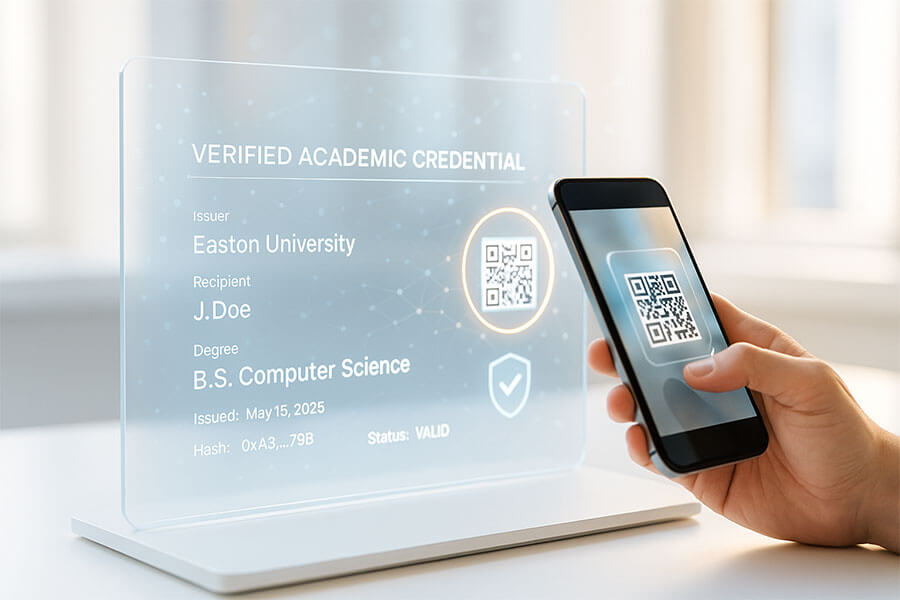
The verification of academic credentials has become one of the most persistent challenges facing educational institutions, employers, and students in our increasingly globalized world. Each year, millions of job applications, graduate school admissions, and professional licensing decisions depend on accurate verification of educational achievements. Yet the systems we rely on remain surprisingly antiquated, vulnerable to fraud, and inefficient in ways that impose substantial costs on all stakeholders.
Traditional credential verification involves manual processes where employers contact educational institutions directly, wait days or weeks for responses, and often pay significant fees for straightforward confirmation. This creates bottlenecks that slow hiring processes and impose unnecessary administrative burdens on institutions. The inefficiencies multiply when credentials cross international borders, where language barriers and varying practices can extend verification timelines to months.
More troubling is the vulnerability to fraud. Diploma mills selling worthless credentials generate billions of dollars annually while undermining public trust in educational qualifications. Even legitimate credentials can be easily forged using modern printing technology. Background check companies report that a significant percentage of résumés contain educational misrepresentation, yet detecting these falsehoods requires investigative resources that many employers lack.
Web3 technology offers revolutionary solutions through blockchain-based credential verification systems. These platforms create immutable digital records that can be instantly verified by anyone with appropriate permissions, eliminating delays and fraud vulnerabilities. By storing credentials on distributed ledgers secured by cryptographic techniques, Web3 systems make forgery virtually impossible while enabling verification in seconds rather than weeks.
Blockchain credential systems empower students by giving them direct ownership and control over their educational records, eliminating dependence on institutional intermediaries. These systems enable new forms of credential granularity, where specific skills or achievements can be verified independently rather than being bundled into opaque degree classifications. This aligns with evolving educational models that emphasize lifelong learning and competency-based assessment.
Privacy protections represent another crucial advantage. Advanced cryptographic techniques like zero-knowledge proofs enable selective disclosure where individuals can prove specific facts about their credentials without revealing complete educational records. This addresses growing privacy concerns while maintaining verification capabilities that employers and institutions require.
The transformation through Web3 technology arrives at a critical moment when educational systems face mounting pressure to demonstrate value and adapt to rapidly changing economic conditions. As employment patterns shift toward fluid career trajectories involving multiple jobs and skill acquisitions, the need for efficient, trustworthy credential verification becomes increasingly urgent.
The Crisis in Academic Credential Verification
The current state of academic credential verification represents a systemic dysfunction so normalized that many stakeholders accept its inefficiencies and vulnerabilities as unavoidable. This acceptance persists despite clear evidence that existing practices impose substantial costs, enable widespread fraud, and create barriers that disproportionately harm legitimate credential holders.
Understanding this crisis requires examining interconnected failures spanning technical limitations of paper-based systems, economic incentives that perpetuate inefficiency, and regulatory gaps that allow fraudulent credential providers to operate with impunity. These failures reinforce each other, creating a self-perpetuating system that resists reform.
The human costs extend beyond administrative inconvenience to lost opportunities, damaged careers, and erosion of trust in educational systems. Students face delays when leveraging their achievements for employment or further education. Employers waste resources on unreliable verification while remaining vulnerable to fraud. Society suffers when talent goes unrecognized and fraudsters occupy positions they are unqualified for.
The Scale of Diploma Fraud and Credential Misrepresentation
Diploma fraud operates on a scale that shocks even experienced administrators. Researchers estimate that hundreds of thousands of fraudulent degrees are purchased annually worldwide, generating revenues exceeding one billion dollars for diploma mills. These operations range from simple websites selling printable templates to sophisticated organizations that create fake transcripts, maintain verification phone numbers, and establish physical addresses appearing legitimate to casual investigation.
The FBI and Department of Homeland Security have documented thousands of cases involving fraudulent credentials, including individuals who practiced medicine, law, and engineering with falsified qualifications that endangered public safety. One case involved a healthcare administrator working for years with a purchased doctorate, making patient care decisions despite lacking legitimate medical education. Another investigation uncovered hundreds purchasing nursing credentials from a fake institution, then seeking employment at healthcare facilities across multiple states.
Companies conducting background checks spend billions annually on verification services that often fail to detect sophisticated fraud. Healthcare organizations and financial institutions face regulatory penalties when employees lack required qualifications. Insurance carriers must account for increased liability risk when verification proves unreliable, raising premiums across entire industries.
Online education and international mobility have created new fraud opportunities that overwhelm traditional verification systems. Fraudulent institutions mimic legitimate university names, create professional websites, and establish physical locations. Some purchase closed institution records and issue degrees claiming they originated before closure. Others exploit regulatory gaps in jurisdictions with minimal credential oversight.
Technology has made credential fraud easier to perpetrate and harder to detect. High-quality printers enable creation of documents visually matching legitimate credentials. Online services offer fake transcripts and verification hotlines providing false confirmations. Social engineering techniques obtain real institutional information making fabricated credentials more convincing.
Traditional Verification Systems and Their Limitations
Traditional credential verification relies on processes unchanged despite dramatic transformations in education delivery. The typical workflow requires employers to contact credential holders’ institutions through phone, email, or online portals, then wait for manual review and response from registrar staff who must locate records and confirm identity matches. This typically takes days to weeks, though timelines can extend much longer during high-volume periods or staff shortages.
Costs accumulate quickly across stakeholders. Institutions maintain registrar offices specifically for verification requests, diverting resources from educational functions. Many charge fees of ten to fifty dollars per request, creating revenue streams that incentivize maintaining manual processes. Third-party verification services add additional fees and delays. Employers bear these costs through direct fees, staff time, and delayed hiring that potentially loses qualified candidates.
Privacy concerns arise frequently in systems requiring detailed personal information and explicit authorization for each request. While regulations like FERPA establish important protections, implementation involves cumbersome consent processes that slow verification while providing limited practical privacy protection. Credential holders frequently lack visibility into when credentials are verified, who requests verification, or what information is disclosed.
Cross-border verification presents particularly acute challenges. International employers face language barriers, unfamiliar institutional structures, and varying verification processes. Time zone differences complicate phone verification, while email responses may be delayed or never arrive. Some countries lack centralized databases or standardized procedures, requiring navigation of complex institutional hierarchies.
Verification reliability depends on institutional record-keeping practices varying widely across institutions and time periods. Older credentials may exist only in paper archives requiring manual searching, while institution closures or records disasters can make verification impossible even for legitimate credentials. Digital record systems lack standardization across institutions, requiring verifiers to learn different interfaces and procedures for each one.
Web3 and Blockchain Technology Fundamentals
Web3 represents the third generation of internet architecture, fundamentally reimagining how digital information is stored, shared, and verified through decentralized systems operating without centralized control. Unlike the first generation focused on static content or the second characterized by centralized platforms controlling user data, Web3 envisions networks where users maintain ownership and control over their digital assets and identities.
Blockchain technology provides the foundational infrastructure through distributed ledger mechanisms that maintain synchronized records across multiple computers without requiring central authorities. This creates systems that are inherently transparent, as all participants can view transaction history, while being tamper-resistant, since altering historical records would require overwhelming majority control over network computing resources.
For credential verification, these characteristics translate into powerful new capabilities addressing fundamental limitations of traditional systems. When educational credentials are recorded on blockchain ledgers, they become simultaneously more secure, accessible, and privacy-preserving than conventional formats. The immutability means that once an institution issues a credential, the record cannot be altered or deleted, providing permanent verification that survives institutional changes or records management failures.
Smart contracts extend blockchain capabilities beyond record-keeping to enable programmable verification logic that automatically executes when specified conditions are met. In credential contexts, smart contracts can encode verification rules, automatically grant or revoke access based on credential status changes, and trigger actions without manual intervention.
The cryptographic foundations enable verification mechanisms working differently from traditional authentication. Rather than relying on institutional authority figures, blockchain verification uses mathematical proof techniques that anyone can validate independently. Public key cryptography allows institutions to digitally sign credentials in ways that cryptographically prove the issuing institution’s identity and the credential content’s integrity.
Key Blockchain Features for Credential Systems
Immutability stands as perhaps the most crucial blockchain feature for credential applications, ensuring that once institutions record credentials, those records become permanent and tamper-proof. This addresses fundamental vulnerabilities in traditional systems where documents can be forged and even digital records in centralized databases can be altered. Blockchain immutability derives from cryptographic chaining where each block includes a hash of the previous block, creating an interconnected chain where altering any record would break the chain’s integrity.
Transparency enables anyone to view complete transaction history and verify credential chain of custody from initial issuance through subsequent updates. This serves verification purposes by allowing employers to independently confirm authenticity without trusting third-party services. However, transparency must balance with privacy requirements, since complete public visibility would violate privacy norms. Modern systems address this through privacy-preserving architectures storing minimal identifying information on public ledgers while keeping detailed content in encrypted off-chain storage.
Decentralization distributes control across multiple participating institutions rather than concentrating power in central authorities who might abuse their position or cease operations. This makes credential systems more resilient to failures or censorship. When credentials exist on decentralized networks, verification continues even if individual institutions close, since the distributed network maintains credential records independently.
Smart contract capabilities enable automation of complex credential management processes currently requiring manual intervention. Institutions can program contracts to automatically issue credentials when students complete requirements, update credential status when achievements are recorded, or revoke credentials in fraud cases.
Cryptographic security provides mathematical guarantees about credential authenticity far stronger than physical security features in paper credentials. Digital signatures created using public key cryptography allow institutions to sign credentials proving both the issuer’s identity and the credential content’s integrity. Anyone can verify these signatures using the institution’s public key, confirming credentials genuinely originated from the claimed issuer without communicating with issuing institutions.
Privacy-Preserving Technologies in Web3
Zero-knowledge proofs represent one of the most innovative privacy-preserving technologies for credential verification, enabling individuals to prove specific facts about their credentials without revealing underlying details. These cryptographic techniques allow demonstrating, for example, possession of a computer science degree from an accredited institution without disclosing the specific university, graduation date, or grade point average. The verifier receives mathematical proof the claim is true but learns nothing beyond the specific fact being proven.
In credential contexts, institutions can issue credentials containing multiple attributes—degree type, field of study, graduation date, honors received—then enable holders to selectively prove specific attributes while keeping others private. An employer verifying minimum education requirements could receive proof that a candidate holds a bachelor’s degree without learning which institution granted it or when graduation occurred, unless those details are explicitly requested.
Selective disclosure capabilities extend privacy protection by allowing credential holders to choose exactly what information to share during each verification interaction. Rather than presenting complete credentials with all recorded achievements, individuals can present verification-specific views including only relevant information. A credential holder could present proof of a graduate degree while keeping undergraduate credentials private, or disclose only relevant courses while omitting unrelated coursework.
Encrypted credential storage protects privacy while maintaining blockchain verification capabilities through hybrid architectures storing identifying information and verification data separately. Personal information and detailed credential contents are encrypted and stored off-chain in secure systems that only credential holders and authorized parties can access, while blockchain records contain only cryptographic hashes and verification metadata revealing nothing to unauthorized observers.
Decentralized identifiers provide privacy-preserving identity mechanisms enabling credential holders to prove identity claims without depending on centralized identity providers who accumulate personal information. These identifiers use cryptographic techniques to establish identity proofs that individuals control directly through private keys. When combined with verifiable credentials, decentralized identifiers enable credential presentations where verifiers can confirm both identity and credentials without depending on centralized authentication services.
Current Web3 Credential Verification Platforms
The landscape of blockchain-based credential verification has evolved from theoretical concepts to production systems serving millions of users across diverse educational contexts. These platforms demonstrate that Web3 credential technology has matured beyond experimental status to become viable alternatives to traditional verification systems.
Several distinct platform categories have emerged addressing different verification challenges. Open-source standards like Blockcerts provide frameworks that any institution can implement independently, promoting interoperability while avoiding vendor lock-in. Commercial platforms offer turnkey solutions reducing technical implementation barriers. Consortium approaches bring together multiple institutions to jointly develop and operate credential infrastructure. Government initiatives explore national blockchain credential systems that could standardize verification across entire education sectors.
Adoption patterns reveal interesting insights about implementation drivers. Early adopters include innovative institutions seeking competitive differentiation, large institutions whose verification volumes create strong economic incentives for automation, and institutions where credential fraud poses acute challenges. The computer science and technology sectors show higher adoption rates, reflecting technical comfort with blockchain concepts.
The platforms discussed here represent verified implementations operational for multiple years and serving substantial user populations, rather than preliminary announcements or pilots that may not progress to production deployment.
Case Study: MIT Digital Credentials and Blockcerts
The Massachusetts Institute of Technology launched its blockchain credential initiative in 2017, becoming one of the earliest and most influential implementations. The university partnered with Learning Machine to develop and deploy a system based on the Blockcerts open standard. MIT began issuing digital diplomas to graduates that are cryptographically signed and anchored to the Bitcoin blockchain, providing tamper-proof verification while giving graduates direct control over their credentials.
MIT creates digital credentials that include graduate information, degree details, and cryptographic signatures, then publishes cryptographic hashes to the blockchain. Graduates receive credentials through MIT’s platform and can store them in mobile wallet applications or download credential files for long-term storage. When verification is required, graduates share credentials directly with employers or institutions, who can verify authenticity in seconds using free verification tools without contacting MIT.
By 2022, MIT had issued digital credentials to over one hundred thousand graduates, with the program expanding beyond diplomas to include certificates and micro-credentials from professional education programs. The system has processed thousands of verification requests, demonstrating scalability for a major research university’s credential volume. Verification times decreased from days or weeks to seconds, while costs decreased substantially since the automated process eliminated manual registrar involvement for routine verifications.
Graduate reception was generally positive, particularly among technically sophisticated recipients who appreciated the innovation and convenience. However, some initially expressed confusion about the new format or concern about employer acceptance. MIT addressed concerns through extensive communication, documentation, and gradual rollout. Offering digital credentials as complements to traditional paper diplomas rather than replacements helped ease the transition.
Technical challenges emerged around mobile wallet user experience and blockchain transaction costs. Early Bitcoin network congestion and transaction fee spikes created concerns about system reliability and costs. MIT and Learning Machine responded by implementing batching mechanisms that anchor multiple credentials with single blockchain transactions, dramatically reducing per-credential costs.
The broader impact extended well beyond MIT’s own verification improvements. By open-sourcing the Blockcerts standard and making verification tools freely available, MIT enabled other institutions to adopt compatible systems. This promoted interoperability and prevented incompatible proprietary standards. As of 2024, hundreds of institutions worldwide have implemented Blockcerts-based systems, creating a growing network of interoperable blockchain credentials.
Case Study: European Blockchain Services Infrastructure for Education
The European Union launched the European Blockchain Services Infrastructure in 2020 as part of its digital transformation strategy, with education credentials identified as a priority application area. The EBSI initiative aims to create cross-border blockchain infrastructure enabling secure, efficient sharing and verification of educational credentials across the European Economic Area’s diverse education systems and regulatory frameworks.
The EBSI education credential implementation began with pilot projects in 2021 involving universities in Spain, Germany, and Norway. These institutions issued blockchain-based diplomas and transcripts anchored to EBSI’s permissioned blockchain network. Unlike fully public blockchains like Bitcoin, EBSI uses a permissioned architecture where validated nodes operated by member state governments and approved institutions maintain the network. This design addresses European data protection requirements under GDPR while providing blockchain’s transparency and immutability benefits.
By 2023, the European Commission reported that over fifty universities across fifteen countries had adopted the system, with more than two hundred thousand credentials issued. The system enables students to receive digital credentials upon graduation, then share them with employers or universities in other member states for instant verification. Verification requests that previously required weeks now complete in minutes through automated processes. This improvement is particularly significant for student mobility programs like Erasmus Plus, where credential recognition across institutions and countries is essential.
Technical standardization proved more straightforward than policy harmonization, as member states had to reconcile different approaches to credential formats, recognition procedures, and data protection requirements. The European Qualifications Framework provided a foundation for mapping credentials across national systems, but significant work remained to ensure blockchain credentials contained sufficient information for recognition decisions while respecting privacy requirements.
Regulatory compliance with GDPR presented ongoing challenges requiring innovative solutions. The regulation’s right to erasure conflicts with blockchain immutability that prevents record deletion. EBSI addressed this by storing minimal identifying information on-chain while keeping personal details in encrypted off-chain storage that can be deleted upon request.
The governance model reflects European values around democratic decision-making. A consortium structure includes representatives from member state governments, educational institutions, student organizations, and employer groups, ensuring diverse perspectives inform system development. Looking toward future expansion, the European Commission aims for EBSI to become the default credential format across European higher education by 2030.
Emerging Platforms and Adoption Trends
Beyond these major case studies, numerous other platforms demonstrate the growing ecosystem of blockchain credential solutions. Learning Machine was acquired by Hyland Software in 2020 and integrated into Hyland’s credentials product suite, bringing blockchain capabilities to extensive customer bases across education, healthcare, and government sectors. This commercial integration suggests blockchain credentials are moving from specialized innovation projects to mainstream enterprise software.
National governments in multiple countries have launched blockchain credential initiatives. Malta established a national blockchain credential system in 2019 that issues all tertiary education qualifications on blockchain infrastructure. Singapore’s SkillsFuture initiative incorporates blockchain technology for verifying lifelong learning credentials across formal education, vocational training, and professional development.
Private sector platforms continue to emerge with varying approaches. Velocity Network Foundation brings together employers, educational institutions, and technology providers to develop blockchain infrastructure designed for career credential verification. The platform aims to create comprehensive career passports including educational credentials, employment history, professional certifications, and skills assessments.
Adoption trends indicate growing acceptance among employers and verifiers, though awareness remains inconsistent across industries and regions. Technology sector employers show highest adoption rates. Healthcare and financial services demonstrate increasing interest in blockchain solutions that could reduce compliance risks and verification costs.
Benefits and Opportunities
The transformation of credential verification through Web3 technology creates value across multiple dimensions that benefit students, educational institutions, employers, and society broadly. These benefits extend beyond simple efficiency improvements to enable fundamentally new capabilities in how educational achievements are documented, shared, and leveraged throughout individuals’ educational and professional lives.
Fraud prevention stands as perhaps the most immediate and impactful benefit of blockchain credential systems. The cryptographic security and immutability of blockchain records make credential forgery exponentially more difficult than with traditional paper or digital credentials. While sophisticated fraudsters might create visually convincing fake diplomas, they cannot forge the cryptographic signatures and blockchain transaction records that verify authentic credentials. This technical impossibility of forgery provides assurance levels that traditional security features like watermarks, embossing, or special paper cannot match. The reduction in credential fraud protects employers from hiring unqualified individuals, prevents unfair advantages for fraudsters over legitimate credential holders, and strengthens public confidence in educational qualifications.
Instant verification capabilities transform credential verification from a process measured in days or weeks to one completing in seconds. When credentials exist on blockchain systems with publicly verifiable signatures, anyone with verification tools can confirm credential authenticity immediately without contacting issuing institutions or waiting for responses. This speed improvement benefits all verification stakeholders by accelerating hiring processes, enabling faster admission decisions, and reducing administrative backlogs at educational institutions. The ability to verify credentials instantly also enables new use cases like real-time credential verification during application processes or automated eligibility checks for programs with credential requirements.
Cost reduction occurs across the credential ecosystem as automation replaces manual verification processes. Educational institutions reduce registrar staffing requirements for verification requests, freeing resources for more valuable activities. Employers eliminate fees paid to institutions or third-party verification services while reducing staff time spent coordinating verifications. Students avoid situations where verification delays cost job opportunities or admission chances. These cost savings accumulate to substantial amounts when multiplied across millions of annual verification transactions, creating economic efficiency gains that benefit all participants.
Student ownership and control over credentials represents a fundamental shift in power dynamics within credential ecosystems. Traditional systems require students to request transcripts or verifications from institutions whenever they need to prove their educational achievements, creating dependency on institutional responsiveness and goodwill. Blockchain credentials that students store in personal wallets provide direct control, enabling them to share credentials instantly without institutional intermediaries. This ownership extends beyond graduation, as students maintain access to their credentials regardless of institutional changes, closures, or policy modifications that might otherwise limit credential access.
Global accessibility improves dramatically when credentials exist on blockchain networks accessible from anywhere with internet connectivity. Traditional verification processes often disadvantage international students or workers whose credentials originated in countries with different verification systems, languages, or institution structures. Blockchain credentials with standardized formats and verification procedures work identically regardless of originating country, simplifying cross-border credential recognition. This accessibility is particularly valuable for refugees or displaced persons who may have lost physical credentials but can prove their educational achievements through blockchain records accessible from any location.
Granular credential representation enables documentation of specific skills, competencies, courses, or achievements rather than only broad degree classifications. Traditional credentials typically certify degree completion without detailing specific learning outcomes or distinguishing between students with significantly different skill profiles. Blockchain systems can issue stackable micro-credentials for individual courses, projects, or competencies, creating detailed records that provide more informative signals to employers and enable recognition of learning that occurs outside traditional degree programs. This granularity supports lifelong learning and competency-based education models that are increasingly important in rapidly changing labor markets.
Lifelong learning support emerges naturally from blockchain systems that enable continuous credential accumulation throughout individuals’ educational and professional lives. Rather than viewing education as completed upon degree graduation, blockchain credential wallets become repositories of ongoing learning achievements from formal education, professional development, employer training, and self-directed study. These comprehensive learning records provide better documentation of actual capabilities than traditional transcripts limited to degree program coursework, while enabling individuals to curate and present credentials tailored to specific opportunities.
Privacy enhancement through selective disclosure allows individuals to prove relevant qualifications without revealing complete educational histories. Traditional verification typically requires sharing transcripts containing all courses, grades, and personal information even when only specific facts are relevant to verification purposes. Blockchain systems with zero-knowledge proofs or selective disclosure enable sharing only necessary information, protecting privacy while satisfying verification requirements. This capability addresses growing privacy concerns while providing verification assurance levels equal to or greater than traditional approaches.
Challenges and Implementation Barriers
Despite significant potential advantages, widespread adoption of blockchain credential systems faces substantial obstacles that slow implementation and limit current impact. These challenges span technical limitations, institutional resistance, regulatory uncertainties, and practical adoption barriers that must be addressed before blockchain credentials can achieve their full transformative potential.
Technical scalability concerns arise when considering the transaction volumes required to support credential systems serving millions of students globally. Public blockchain networks like Bitcoin and Ethereum have demonstrated scalability limitations when transaction volumes increase significantly, resulting in slower transaction processing and higher fees. While batching techniques that group multiple credentials into single blockchain transactions help address these concerns, questions remain about whether current blockchain infrastructure can support credential issuance and verification at the scale required for global educational systems. Layer-two solutions and next-generation blockchain architectures promise improved scalability, but these technologies remain under development and may not be production-ready for large-scale credential deployments.
User experience barriers limit adoption among credential holders and verifiers who find blockchain systems confusing or intimidating compared to familiar paper credentials. Managing cryptographic keys, installing wallet applications, and understanding blockchain concepts require technical sophistication that many students and credential verifiers lack. Lost private keys can result in permanent loss of access to credentials, creating risks that traditional paper credentials do not present. These usability challenges are gradually improving through better interface design and user education, but they remain significant obstacles to mass adoption, particularly among less technically inclined populations.
Institutional resistance stems from multiple sources including concerns about technology risks, investment requirements for system implementation, and disruption to established workflows and revenue sources. Many educational institutions view their role in credential verification as both a service obligation and a revenue opportunity, since verification fees generate income that supports registrar operations. Blockchain systems that enable self-service verification threaten this revenue while requiring upfront investment in new technology infrastructure. Conservative institutional cultures often prioritize risk avoidance over innovation, creating preference for familiar approaches even when new technologies offer clear advantages.
Standardization challenges emerge from the proliferation of different blockchain credential platforms, protocols, and formats that may not interoperate effectively. While standards like Blockcerts promote interoperability, many institutions implement proprietary systems or choose different blockchain networks, creating fragmentation that complicates verification. Verifiers may need to learn multiple verification procedures and tools depending on which platform issued credentials they encounter. This fragmentation reduces the network effects that drive technology adoption, as each platform’s value depends partially on how many other institutions and verifiers use compatible systems.
Regulatory uncertainty creates compliance risks that deter institutional adoption, particularly in jurisdictions with strict data protection laws or undefined policies regarding blockchain technology and cryptocurrency. Educational institutions must comply with regulations governing educational records, data privacy, and financial transactions, but the application of these regulations to blockchain credential systems often remains unclear. Concerns about liability for credential accuracy, obligations regarding credential revocation or correction, and requirements for long-term record preservation create legal uncertainties that risk-averse institutions may avoid through inaction.
Awareness and education gaps prevent many stakeholders from understanding blockchain credential capabilities or recognizing potential benefits. Employers who conduct credential verification may be unfamiliar with blockchain technology and uncertain whether to trust cryptographic verification over traditional institutional confirmation. Students may not understand why blockchain credentials offer advantages over paper diplomas or how to use wallet applications and verification tools. These knowledge gaps create chicken-and-egg adoption problems where institutions hesitate to implement blockchain systems until employers accept them, while employers show limited interest until blockchain credentials become common.
Integration with existing systems creates technical complexity and costs that discourage implementation. Educational institutions typically operate student information systems, learning management platforms, and degree audit software that would need to integrate with blockchain credential systems. These legacy systems may lack APIs or technical capabilities for blockchain integration, requiring custom development or system replacements that are expensive and risky. Data migration from existing systems to blockchain formats raises questions about historical credential handling and verification continuity during transition periods.
Long-term maintenance and governance present ongoing challenges once blockchain credential systems are deployed. Blockchain networks require continuous operation and maintenance, including node operation, security monitoring, and protocol updates. Educational institutions must either develop internal blockchain expertise or depend on external vendors, with either approach creating costs and potential sustainability concerns. Governance decisions about protocol updates, dispute resolution, and policy evolution require mechanisms that balance institutional autonomy with system-wide consistency, creating complex organizational challenges that transcend technical implementation.
Equity and access concerns arise when blockchain credentials require technological access that disadvantaged populations may lack. Students without smartphones or reliable internet connectivity might struggle to access credentials stored in mobile wallets or verify credentials through online platforms. The technical literacy required to manage blockchain credentials could create new barriers that disadvantage individuals from lower-income backgrounds or older generations less familiar with digital technologies. Ensuring that blockchain credential systems enhance rather than reduce educational equity requires careful attention to accessibility and support for diverse user populations.
Future Outlook and Recommendations
The trajectory of blockchain credential verification suggests accelerating adoption over the coming decade as technical capabilities mature, awareness increases, and successful implementations demonstrate practical value. However, realizing the full potential of Web3 credential systems requires coordinated action across multiple stakeholder groups including educational institutions, employers, technology providers, policymakers, and professional organizations.
Near-term developments will likely focus on improving user experience to reduce barriers for non-technical users. Wallet applications will become more intuitive, with streamlined credential management interfaces that require minimal blockchain knowledge. Verification tools will integrate with existing HR systems and applicant tracking software, enabling seamless adoption by employers without disrupting established workflows. Mobile-first designs will accommodate the reality that many users primarily access digital services through smartphones rather than computers. These usability improvements are essential for moving blockchain credentials from early adopter communities to mainstream acceptance.
Interoperability standards will emerge as critical factors determining whether blockchain credentials achieve broad adoption or fragment into incompatible silos. Professional organizations, standards bodies, and technology consortia must develop common protocols for credential formats, verification procedures, and data exchange. These standards should balance flexibility for innovation with sufficient consistency to ensure credentials from different issuers can be verified using common tools. Government involvement in standards development can accelerate adoption by providing institutional legitimacy and coordination across educational sectors, though standards processes must avoid regulatory capture that might favor particular platforms or vendors.
Hybrid approaches combining blockchain verification with traditional credential formats will likely serve as transitional strategies during adoption periods. Institutions can issue both paper diplomas and blockchain credentials, allowing graduates to choose appropriate formats for different contexts while verifiers gradually build capacity for blockchain verification. These hybrid models reduce adoption risks by maintaining fallback options while enabling experimentation with new technologies. Over time, as blockchain credentials prove reliable and verification ecosystems mature, institutions can shift toward blockchain-primary or blockchain-only approaches.
Educational institutions should begin preparing for blockchain credential adoption through several strategic actions. Investment in staff education about blockchain technology and credential verification trends will build internal capacity for informed decision-making about technology adoption. Pilot projects with limited credential populations can provide valuable implementation experience while limiting risk exposure. Participation in consortium efforts and standards development ensures institutional perspectives influence emerging credential frameworks. Partnership with technology vendors or other institutions can share implementation costs and risks while accelerating capability development.
Employers and credential verifiers should actively engage with blockchain credential initiatives to influence system development and prepare for adoption. Participation in pilot verifications provides practical experience with blockchain tools while sending market signals to educational institutions about employer interest. Integration of blockchain verification capabilities into existing HR and recruitment systems positions organizations to leverage more efficient verification as adoption increases. Industry associations can coordinate verification practices across member organizations, creating consistent expectations that educational institutions can design systems to meet.
Policymakers have crucial roles in creating regulatory frameworks that support blockchain credential innovation while protecting privacy and preventing fraud. Clear guidance on data protection requirements for blockchain educational records would reduce legal uncertainty that currently inhibits institutional adoption. Recognition of blockchain verification as legally equivalent to traditional verification for licensing, employment, and other purposes would eliminate adoption barriers created by ambiguous legal status. Investment in public blockchain credential infrastructure could accelerate adoption while ensuring equitable access not dependent on commercial platforms.
Technology providers should focus development efforts on addressing current limitations that restrict blockchain credential adoption. Scalability improvements through layer-two solutions or next-generation blockchain architectures will ensure systems can handle global credential volumes. Privacy-enhancing technologies that enable selective disclosure and zero-knowledge proofs should become standard features rather than advanced capabilities. Interoperability with existing educational technology systems through standardized APIs will reduce integration costs and technical barriers.
Long-term visions for blockchain credentials extend beyond simple digitization of existing credentials to envision comprehensive learner records that document knowledge, skills, and competencies across formal education, informal learning, work experience, and personal development. These holistic records could replace fragmented transcripts, résumés, and credential collections with unified, verifiable documentation of individual capabilities. Artificial intelligence systems could analyze comprehensive learner records to provide personalized learning recommendations, match individuals with optimal opportunities, or identify skill gaps requiring development.
The integration of blockchain credentials with broader digital identity ecosystems represents another important future direction. Decentralized identity systems that individuals control could link educational credentials with professional certifications, employment history, and other identity attributes while maintaining privacy and user control. These comprehensive identity systems would enable seamless verification across contexts from employment to financial services to healthcare, with individuals maintaining sovereignty over their personal information.
International cooperation will be essential for blockchain credentials to achieve global adoption and enable cross-border recognition. Mutual recognition agreements between countries regarding blockchain credential standards could facilitate credential portability for international students and workers. Coordination on technical standards through international organizations ensures global interoperability rather than regional fragmentation. Capacity building support for developing countries enables equitable participation in global credential ecosystems rather than dependence on systems designed primarily for developed country contexts.
The success of blockchain credential transformation ultimately depends on demonstrating clear value propositions that justify adoption costs for all stakeholders. Research documenting efficiency improvements, fraud reduction, cost savings, and user satisfaction from blockchain implementations will build evidence supporting wider adoption. Case studies from diverse institutional contexts including community colleges, vocational schools, and institutions in developing countries will demonstrate applicability beyond well-resourced research universities. Continued innovation addressing current limitations while preserving core benefits will ensure blockchain credential technology evolves to meet stakeholder needs.
Final Thoughts
The emergence of Web3 technologies for academic credential verification represents far more than an incremental improvement in administrative processes—it embodies a fundamental reconceptualization of how educational achievements are documented, owned, and leveraged throughout individuals’ lives. As blockchain-based systems mature from experimental implementations to production deployments serving millions of users, they demonstrate the transformative potential of decentralized technologies to address systemic failures in traditional credential ecosystems while creating new possibilities for learner empowerment and educational innovation.
The intersection of blockchain technology and educational credentials illuminates broader questions about trust, authority, and ownership in digital societies. Traditional credential systems vest power in institutional intermediaries who control access to educational records and determine verification procedures, creating dependencies that can disadvantage individuals whose institutional relationships are disrupted or whose credentials originate from less prestigious institutions. Web3 credentials fundamentally shift this power dynamic by enabling individuals to own and control their educational records directly, reducing dependence on institutional goodwill while maintaining verification capabilities through cryptographic proofs rather than institutional authority.
Financial inclusion dimensions of blockchain credentials deserve particular emphasis given education’s role as a primary pathway for economic mobility and opportunity. The costs, delays, and access barriers associated with traditional credential verification disproportionately harm individuals from lower-income backgrounds who may lack resources to pay verification fees, wait through lengthy verification processes, or navigate complex institutional bureaucracies. Web3 systems that enable instant, zero-cost verification could significantly reduce these barriers, creating more meritocratic environments where individuals are evaluated based on demonstrated achievements rather than their ability to navigate credential verification obstacles.
The implications extend internationally, where credential verification challenges are magnified by language barriers, unfamiliar educational systems, and institutional capacity limitations. Refugees and displaced persons often lose physical credentials during conflict or migration, yet blockchain credentials stored in digital wallets remain accessible regardless of physical location or institutional continuity. This resilience could provide crucial documentation enabling displaced individuals to continue their education or secure employment in new countries, supporting both individual flourishing and productive contribution to host societies.
Social responsibility considerations require ensuring that blockchain credential systems enhance rather than exacerbate educational inequities. Technology deployment must attend carefully to digital access disparities, technical literacy variations, and diverse cultural contexts that shape how different populations engage with digital credentials. Success should be measured not only by technical sophistication or adoption among elite institutions but by whether these systems serve learners from disadvantaged backgrounds, smaller institutions with limited resources, and regions where traditional credential verification presents greatest challenges.
The ongoing evolution of educational models toward lifelong learning, competency-based assessment, and microcredentialing aligns naturally with blockchain credential capabilities for documenting granular achievements and accumulating learning records across diverse contexts. As traditional degree programs become just one component of broader learning journeys, credential systems must evolve beyond simple degree verification to support rich documentation of knowledge and skills acquired throughout life. Blockchain architectures designed for composable, stackable credentials provide technical foundations for these emerging educational models.
Looking forward, the next decade will likely determine whether blockchain credentials become dominant verification mechanisms or remain niche applications limited to early adopter communities. This trajectory depends on concerted efforts to address current limitations, build interoperable systems, establish clear regulatory frameworks, and demonstrate value across diverse contexts. The institutions, organizations, and policymakers who engage proactively with this technological transformation will shape credential ecosystems affecting billions of learners worldwide.
The promise of Web3 credential verification ultimately rests on its potential to create more efficient, equitable, and learner-centered educational systems where achievements are easily verified, credentials are portable across contexts, and individuals maintain ownership of their educational records. These capabilities align with fundamental values of educational opportunity and individual empowerment while addressing practical challenges that have long compromised credential verification effectiveness. Realizing this promise requires sustained commitment to innovation guided by principles of accessibility, equity, and learner sovereignty.
FAQs
- What exactly are blockchain credentials and how do they differ from traditional paper diplomas?
Blockchain credentials are digital records of educational achievements that are cryptographically signed by issuing institutions and recorded on distributed ledger systems. Unlike paper diplomas that can be forged or lost, blockchain credentials use mathematical proofs to verify authenticity and are stored in digital wallets that individuals control directly. These credentials can be verified instantly by anyone with verification tools without requiring contact with issuing institutions, while paper diplomas typically require weeks-long verification processes involving direct institutional communication. - Are blockchain credentials legally recognized by employers and educational institutions?
Legal recognition varies by jurisdiction and context, though acceptance is growing as more institutions adopt blockchain credential systems. In most cases, blockchain credentials have equivalent legal status to traditional credentials since they document the same educational achievements through cryptographic verification rather than institutional letterhead. Some professional licensing boards and government agencies have explicitly recognized blockchain credentials, while others are developing policies addressing digital credential formats. Graduates typically receive both traditional and blockchain credentials during transition periods to ensure universal acceptance. - How secure are my educational credentials on a blockchain system?
Blockchain credentials typically provide significantly stronger security than traditional paper or centralized digital credentials. The cryptographic signatures used to create blockchain credentials are virtually impossible to forge using current technology, while distributed storage across multiple network nodes prevents single points of failure that could compromise centralized credential databases. However, security depends on proper key management, as lost private keys can result in inability to access credentials. Most platforms implement backup mechanisms and recovery procedures to address this risk while maintaining security against unauthorized access. - What happens to my blockchain credentials if the issuing platform or university closes?
This is a crucial advantage of blockchain credentials over traditional formats. Because credentials are recorded on distributed blockchain networks rather than solely in institutional databases, they remain accessible even if issuing institutions or platform providers cease operations. Credential holders store copies in personal wallets that they control directly, ensuring continued access regardless of institutional continuity. The verification capability persists because cryptographic signatures can be validated using mathematical procedures that do not require the signing institution to remain operational, though best practices include institutions publishing their public keys to trusted registries for long-term verification support. - Do I need technical expertise to use blockchain credentials?
Modern blockchain credential systems are designed for users without technical backgrounds, with interfaces that abstract complex cryptographic operations behind intuitive applications. Typical users need only to download a mobile wallet application, receive credentials from their institution, and share credentials with verifiers through simple procedures similar to sharing photos or documents. While understanding basic concepts like digital wallets and verification links can be helpful, detailed blockchain knowledge is unnecessary for effective use. Institutions and platform providers typically offer support resources and tutorials specifically designed for non-technical users. - How much do blockchain credential systems cost for students and institutions?
Costs vary significantly depending on platform choices and implementation approaches. Many systems issue credentials to students at no direct cost, as institutions cover platform fees as part of normal credential management operations. Some platforms charge per-credential fees ranging from a few cents to several dollars, while others use subscription models where institutions pay annual fees for unlimited credential issuance. For students, blockchain credentials often reduce overall costs by eliminating verification fees that institutions traditionally charge for transcript requests. Long-term, blockchain systems typically reduce total credential management costs through automation and efficiency improvements. - Can employers access all my educational information through blockchain credentials?
No—one of the key advantages of blockchain credential systems is enabling selective disclosure where you share only information relevant to specific verification contexts. Advanced platforms using zero-knowledge proofs allow you to prove specific facts about your credentials without revealing complete educational records. For example, you could prove you hold a bachelor’s degree in a particular field without disclosing your GPA, graduation date, or specific institution unless you choose to share those details. This granular control over information sharing provides stronger privacy protection than traditional transcript-based verification while meeting employer needs for qualification confirmation. - How do blockchain credentials handle credential revocation if degrees are rescinded?
Blockchain credential systems implement revocation mechanisms that maintain the immutability of original issuance records while updating credential status. When institutions need to revoke credentials due to fraud, academic misconduct, or administrative errors, they publish revocation notices that verifiers check during verification processes. The original credential issuance remains permanently recorded on the blockchain, but verification tools detect the revocation status and alert verifiers that the credential is no longer valid. This approach provides transparent audit trails showing both original issuance and subsequent revocation, which can be important for legal or investigative purposes. - Are blockchain credentials compatible with international education systems and recognition frameworks?
Compatibility varies depending on specific implementations and regional recognition frameworks. Systems like the European Blockchain Services Infrastructure are specifically designed to work across multiple countries’ education systems using common standards and the European Qualifications Framework for credential mapping. International standards efforts aim to ensure blockchain credentials can be recognized globally, though practical recognition depends on individual countries’ policies and credential evaluation practices. Blockchain credentials that include sufficient metadata about programs, accreditation, and learning outcomes typically facilitate recognition processes, while institutions increasingly participate in international credential networks that promote interoperability. - What happens if I lose access to my digital wallet containing my credentials?
Most blockchain credential platforms implement recovery mechanisms to address this concern. Common approaches include backup phrases that enable wallet restoration on new devices, trusted contacts who can assist with recovery procedures, or institutional credential reissuance processes similar to requesting replacement diplomas. Best practices recommend maintaining multiple backup copies of credentials in different locations, such as cloud storage services or physical storage devices, to prevent permanent loss. Some platforms offer custodial wallet options where the platform provider maintains backup access, though this approach involves trade-offs between convenience and full self-sovereignty over credentials.