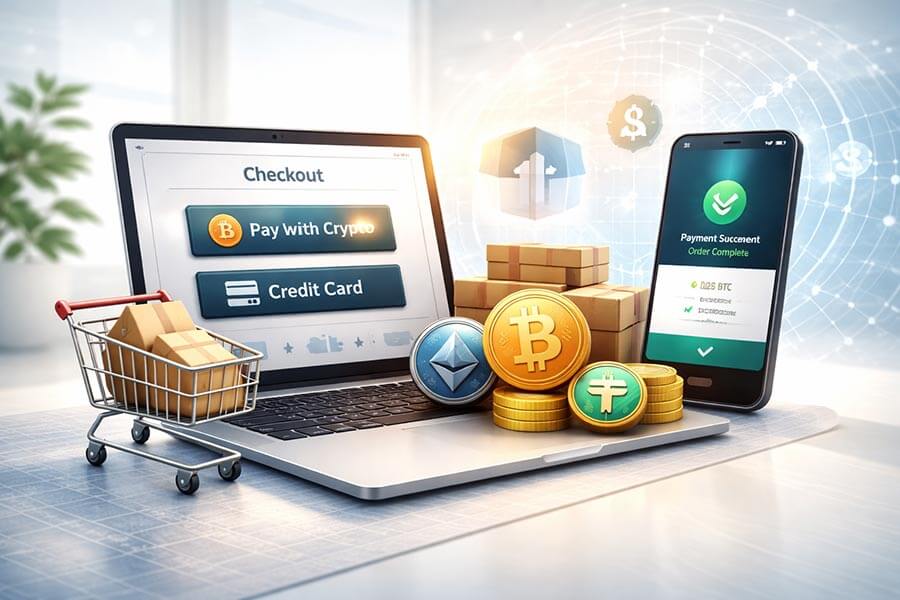
The intersection of cryptocurrency and e-commerce represents one of the most significant shifts in digital commerce since the advent of online shopping itself. As global cryptocurrency ownership reached 562 million people in 2024, representing a 34 percent year-over-year increase, online retailers are increasingly recognizing the strategic importance of accepting digital currency payments. This growth reflects not merely speculative interest but a fundamental change in how consumers and businesses think about value exchange in the digital age. The convergence of maturing payment infrastructure, growing consumer demand, and competitive pressure creates an environment where cryptocurrency acceptance has moved from experimental curiosity to strategic consideration for serious e-commerce operators.
For e-commerce businesses, the decision to accept cryptocurrency payments extends far beyond following a technological trend. Payment processors like BitPay processed over 600,000 cryptocurrency transactions in 2024, with stablecoins accounting for 40 percent of payment volume by 2025, up from 30 percent the previous year. These figures demonstrate that digital currency payments have moved from experimental curiosity to practical commercial reality. The e-commerce sector specifically drove 48 percent of BitPay transactions in 2025, highlighting the natural alignment between online retail and cryptocurrency payment systems. Travel and tourism contributed another 18 percent, while luxury goods represented 14 percent of volume, demonstrating cryptocurrency payment adoption across diverse retail categories.
The implementation of cryptocurrency payment systems, however, requires careful consideration of multiple factors that differ substantially from traditional payment integration. Online retailers must navigate price volatility that can swing significantly within hours, select appropriate payment processors from an increasingly competitive landscape, optimize checkout experiences for customers unfamiliar with crypto payment flows, and ensure compliance with evolving regulatory frameworks that vary by jurisdiction. Understanding these elements thoroughly before implementation can mean the difference between a successful integration that attracts new customers and reduces processing costs versus a costly experiment that creates operational headaches and customer service challenges. This examination provides practical guidance for e-commerce businesses considering cryptocurrency payment adoption, addressing the specific challenges and opportunities that come with accepting digital currencies in an online retail environment.
Understanding Cryptocurrency Payments in E-Commerce
Cryptocurrency payments in e-commerce operate on fundamentally different principles than traditional payment methods, yet the customer experience can be remarkably similar when properly implemented. At its core, a cryptocurrency payment involves the transfer of digital assets from a customer’s wallet to a merchant’s wallet address, verified and recorded on a distributed blockchain network. This process eliminates the need for traditional financial intermediaries, creating a direct peer-to-peer transaction that settles according to the rules of the underlying blockchain protocol rather than banking business hours. The technology enables transactions between parties who need not trust each other, with the blockchain serving as a neutral, automated arbiter of payment validity.
The cryptocurrencies most commonly used for e-commerce transactions fall into distinct categories that serve different purposes for both merchants and customers. Bitcoin remains the dominant payment cryptocurrency, accounting for approximately 42 percent of crypto transactions processed by merchants in 2025. Its status as the original and most widely recognized cryptocurrency means it enjoys the broadest wallet support and customer familiarity. Litecoin has emerged as a popular alternative for payments due to its faster confirmation times and lower fees, leading transaction counts on platforms like BitPay with over 201,000 transactions in 2024. Ethereum and its associated tokens provide additional options, particularly for customers already engaged in the broader decentralized finance ecosystem, though higher gas fees during network congestion can make Ethereum less suitable for smaller purchases.
Stablecoins have become increasingly important for e-commerce payments, representing a bridge between the cryptocurrency world and traditional currency values. These digital assets, including USDC and USDT, are pegged to fiat currencies like the US dollar and eliminate the price volatility that has historically concerned merchants about accepting cryptocurrency. In June 2025, Shopify announced that merchants using Shopify Payments could accept USDC on the Base network, an Ethereum layer-2 built by Coinbase, signaling mainstream platform acceptance of stablecoin payments. This development reflects broader market trends, with stablecoin transfer volume reaching 27.6 trillion dollars in 2024, surpassing traditional card network totals and demonstrating that blockchain-based payment infrastructure operates at genuine commercial scale.
The mechanics of a cryptocurrency payment from the customer perspective begin when they select cryptocurrency as their payment method at checkout. The merchant’s payment system generates a payment request specifying the required cryptocurrency amount, converted from the fiat price at current exchange rates, along with a destination wallet address and typically a QR code encoding this information. The customer then uses their wallet application to send the specified amount to the provided address. This transaction broadcasts to the cryptocurrency network, where miners or validators confirm its validity and include it in a block. Once sufficient confirmations accumulate, the payment processor notifies the merchant system, and the order proceeds to fulfillment.
How Crypto Transactions Differ from Traditional Payments
The technical and practical differences between cryptocurrency and traditional payment processing create both opportunities and challenges for e-commerce merchants. Credit card transactions involve multiple intermediaries including the card network, issuing bank, acquiring bank, and payment processor, each taking a portion of the transaction and introducing potential points of failure. A cryptocurrency transaction, by contrast, moves directly between the payer and payee, with the blockchain network providing verification and settlement services. This architectural difference explains many of the cost, speed, and risk profile differences between payment methods.
Settlement timing represents one of the most significant practical differences. Traditional card payments may appear instant to the customer but actually involve a complex settlement process that can take two to three business days before funds are available to the merchant. Cryptocurrency transactions settle according to blockchain confirmation times, which vary by network but typically range from ten minutes for Bitcoin to seconds for networks like Solana or payments on the Bitcoin Lightning Network. This faster settlement can improve cash flow for merchants, though the practical impact depends on how the payment processor handles conversion and disbursement. BitPay, for example, settles to merchant bank accounts the next business day, which is faster than traditional card settlement but not as immediate as blockchain finality might suggest.
The irreversibility of cryptocurrency transactions fundamentally changes the risk profile for merchants. Credit card transactions can be disputed by customers for up to 120 days after purchase, creating chargeback liability that costs merchants an estimated 18 billion dollars in lost revenue annually. Cryptocurrency transactions confirmed on the blockchain cannot be reversed without the recipient’s cooperation, eliminating chargeback fraud entirely but shifting responsibility for handling legitimate customer disputes to the merchant’s refund policies. This characteristic makes cryptocurrency particularly attractive for merchants in categories prone to friendly fraud or selling digital goods where chargebacks have been especially problematic.
Fee structures also differ substantially between payment methods. Traditional credit card processing fees in the United States average between 2.5 and 3.5 percent, with additional per-transaction fees and various assessment charges that can push effective rates even higher for certain card types or transaction patterns. Cryptocurrency payment processors typically charge around 1 percent, with some charging as low as 0.5 percent for high-volume merchants. PayPal’s Pay with Crypto service charges 0.99 percent, representing up to 90 percent savings compared to traditional cross-border card fees. The practical savings depend on transaction patterns, customer demographics, and whether the merchant chooses instant conversion to fiat or retains cryptocurrency.
Geographic limitations differ dramatically between payment methods. Traditional card payments require banking relationships and face restrictions based on card network rules, country risk classifications, and cross-border fees that can exceed 4 to 6 percent for international transactions. Cryptocurrency payments function identically regardless of customer location, with the same process, fees, and settlement timeline applying whether a customer is in New York or Nigeria. This characteristic opens markets that traditional payment infrastructure cannot efficiently serve and eliminates the international card decline rates that frustrate both merchants and customers.
The understanding of these fundamental differences enables merchants to make informed decisions about integration approaches and set appropriate expectations for both operational processes and customer experiences. Cryptocurrency payments are not simply a new payment method but a different paradigm for value transfer that requires adaptation of existing e-commerce practices to realize their full potential.
Benefits and Challenges of Accepting Cryptocurrency
The decision to accept cryptocurrency payments involves weighing substantial potential benefits against real operational challenges that vary significantly based on business model, customer base, and geographic reach. For merchants, the most immediately quantifiable benefit is lower transaction fees compared to traditional payment processing. Where credit card processors charge 2.5 to 3.5 percent plus per-transaction fees, cryptocurrency payment processors typically charge around 1 percent, and some blockchain networks enable transactions for fractions of a cent in network fees. For a business processing one million dollars annually in card payments, the savings from reduced processing fees alone could exceed 15,000 to 25,000 dollars, representing a direct contribution to profitability that scales with transaction volume.
The elimination of chargeback fraud represents another significant advantage, particularly for merchants selling digital goods, high-value items, or operating in categories prone to friendly fraud where customers dispute legitimate purchases. E-commerce businesses lose an estimated 18 billion dollars annually to chargebacks, with many legitimate merchants maintaining chargeback rates that threaten their relationships with payment processors or push them into high-risk categories with elevated fees. Cryptocurrency transactions confirmed on the blockchain are final, removing this entire category of loss and the operational overhead of managing disputes, gathering evidence, and responding to chargeback claims. The trade-off requires merchants to establish clear refund policies and customer service processes that address legitimate concerns without the chargeback mechanism as a customer recourse.
Global accessibility opens market opportunities that traditional payment methods cannot easily serve. Cryptocurrency payments function identically regardless of customer location, without the international card fees, currency conversion charges, or banking relationship requirements that create friction for cross-border commerce. BitPay supports processing in multiple currencies and enables customers to pay from over 229 countries and territories, making it possible for merchants to serve customers in regions with limited banking infrastructure or expensive international transaction fees. This capability is particularly valuable for digital goods, subscription services, software licenses, and products with international appeal where the marginal cost of serving additional geographies is minimal.
Customer acquisition potential should not be overlooked as a strategic benefit. Research by Forrester Consulting found that crypto buyers spent approximately twice as much per order as card buyers among BitPay merchants, and up to 40 percent of crypto payers were net-new customers. These customers actively seek out merchants accepting cryptocurrency and often demonstrate brand loyalty to retailers that share their interest in digital assets. Triple-A estimates that 65 percent of cryptocurrency holders want the option to pay with their digital assets, representing an underserved market segment that values cryptocurrency acceptance as a meaningful differentiator. The demographic skews toward younger, technology-forward consumers with significant disposable income, an attractive customer segment for many e-commerce categories.
Privacy benefits attract certain customer segments who prefer cryptocurrency payments for their reduced data sharing compared to traditional payment methods. Credit card transactions create records with multiple parties including the card network, issuing bank, acquiring bank, and payment processor, while cryptocurrency transactions reveal only wallet addresses that are not inherently tied to personal identity. Some customers prefer this reduced data footprint, particularly for legal purchases they prefer to keep private. Merchants serving customers in privacy-conscious demographics may find cryptocurrency acceptance valuable for competitive differentiation.
The challenges of accepting cryptocurrency center on price volatility, technical complexity, regulatory uncertainty, and customer education requirements. Bitcoin’s price can fluctuate by 5 to 10 percent or more in a single day, creating potential margin erosion for merchants holding cryptocurrency rather than converting immediately to fiat. Payment processors like BitPay address this by locking exchange rates at the moment of transaction and settling to merchants in fiat currency the next business day, but merchants choosing to retain cryptocurrency accept market exposure. During periods of high Bitcoin volatility in 2025, BitPay observed a 26 percent increase in stablecoin usage as both merchants and customers sought to avoid price swings, demonstrating market adaptation to volatility concerns.
Regulatory uncertainty adds complexity that varies by jurisdiction and continues to evolve. The European Union implemented its Markets in Crypto-Assets regulations, establishing comprehensive requirements for crypto-asset service providers. The United States maintains a fragmented regulatory landscape where merchants must navigate requirements from FinCEN, state money transmission laws, and emerging IRS reporting obligations that took effect in 2024. In 2024, companies working with cryptocurrency paid over 5 billion dollars in fines for violating anti-money laundering and know-your-customer rules, underscoring the importance of compliance infrastructure even for merchants simply accepting payments rather than providing exchange or custody services.
Customer education and support requirements represent often-underestimated operational challenges. Customers unfamiliar with cryptocurrency payments may require guidance through the payment process, experience confusion about confirmation times, or make errors in payment amounts or addresses. Customer service teams need training to handle cryptocurrency-specific inquiries effectively, and checkout processes should include sufficient guidance to reduce support burden. These requirements are manageable but represent real operational investment that merchants should plan for during implementation.
Overstock.com provides an instructive case study in long-term cryptocurrency adoption that illustrates both benefits and evolution of approach. The online retailer became the first major e-commerce company to accept Bitcoin in January 2014, processing 126,000 dollars in Bitcoin payments on its first day and reaching one million dollars in Bitcoin sales within two months of launch. Nearly 60 percent of early Bitcoin customers were new to Overstock, demonstrating the customer acquisition potential. While cryptocurrency payments represented only about 0.2 percent of total Overstock sales by 2018, the company viewed the initiative as strategically valuable for technology learning, customer expansion, and brand positioning in the emerging digital economy. Overstock further demonstrated its commitment by paying a portion of its Ohio state taxes in Bitcoin in 2019, becoming the first major US company to do so.
The integration delivered benefits beyond direct sales, as Overstock’s early experience with cryptocurrency payments informed its broader blockchain technology investments through subsidiary Medici Ventures. The average order size for cryptocurrency payments consistently exceeded that of traditional payment methods by more than two times, confirming research about the spending patterns of crypto-paying customers. These outcomes illustrate how cryptocurrency payment acceptance can deliver value beyond simple transaction processing when approached as a strategic capability rather than merely an alternative payment method added to the checkout page.
Selecting a Cryptocurrency Payment Processor
The selection of a cryptocurrency payment processor represents one of the most consequential decisions in implementing crypto payments, as this partner determines available cryptocurrencies, fee structures, integration complexity, settlement options, and ongoing support. The market includes established players like BitPay and Coinbase Commerce alongside newer entrants and self-hosted solutions like BTCPay Server, each offering distinct advantages for different merchant situations. Understanding the differences among processors enables merchants to select infrastructure that aligns with their specific requirements, technical capabilities, and strategic objectives.
BitPay stands as the largest dedicated cryptocurrency payment processor, having processed over 5 billion dollars in cryptocurrency transactions by 2025. The platform supports 14 major cryptocurrencies including Bitcoin, Bitcoin Lightning, Ethereum, and major stablecoins, with settlement available in US dollars, euros, British pounds, and other fiat currencies. BitPay’s merchant fees vary by monthly volume, with rates of 2 percent plus 0.25 dollars per transaction for merchants processing under 500,000 dollars monthly, decreasing to 1 percent plus 0.25 dollars for those processing over one million dollars. The company’s payment verification protocol achieved a 99.97 percent successful transaction completion rate in 2025, providing reliability that merchants require for production environments. BitPay’s longevity since 2011, regulatory licenses, and institutional focus make it suitable for larger merchants prioritizing compliance and stability.
Coinbase Commerce leverages the Coinbase platform’s infrastructure and brand recognition, offering merchants the ability to accept Bitcoin, Bitcoin Cash, Ethereum, Litecoin, and USD Coin. The service charges 1 percent per transaction with no monthly fees, making it cost-effective for lower-volume merchants or those testing cryptocurrency acceptance. Integration is straightforward through Shopify, WooCommerce, and other major e-commerce platforms, with documentation suitable for merchants without extensive technical resources. Coinbase Commerce provides the option for merchants to hold cryptocurrency or convert automatically to fiat, with funds accessible through the broader Coinbase ecosystem. The brand recognition of Coinbase may provide trust signals to customers familiar with the exchange, potentially improving conversion rates.
NOWPayments differentiates through support for over 300 cryptocurrencies, making it suitable for merchants targeting niche crypto communities or wanting maximum payment flexibility. The platform integrates with Shopify through a custom app installation process and offers competitive fees starting at 0.5 percent for high-volume merchants. This breadth of currency support comes with increased complexity in managing multiple asset types and potentially slower support for newer platforms, but provides unmatched flexibility for merchants whose customers hold diverse cryptocurrency portfolios.
BTCPay Server offers a fundamentally different approach as a self-hosted, open-source payment processor. Merchants run their own payment infrastructure, eliminating third-party fees entirely while maintaining complete control over their payment data and customer information. This approach appeals to technically sophisticated merchants with strong privacy preferences, those processing sufficient volume to justify infrastructure investment, or businesses in jurisdictions where third-party processor options are limited. The trade-off involves accepting responsibility for server maintenance, security updates, and integration complexity that managed services handle automatically. BTCPay Server has evolved significantly since its creation and now supports relatively straightforward deployment on cloud infrastructure.
The evaluation of payment processors should consider several key factors beyond basic fees. Settlement timing affects cash flow and financial planning; BitPay settles to bank accounts the next business day, while some processors may take longer or offer different schedules for cryptocurrency versus fiat settlement. Supported platforms matter for integration complexity, with most major processors offering Shopify and WooCommerce plugins while custom integrations may require API development and ongoing maintenance. Customer wallet compatibility affects payment success rates, as some processors work better with specific wallet applications than others, and merchants should verify compatibility with wallets their target customers commonly use.
Geographic coverage and supported currencies for settlement determine whether a processor can serve a merchant’s specific situation effectively. A merchant based in the European Union may need euro settlement and compliance with MiCA regulations, while a US-based merchant may prioritize dollar settlement and BitLicense compliance for serving New York customers. The processor’s compliance infrastructure becomes the merchant’s compliance infrastructure for payment purposes, making regulatory standing and license portfolio important evaluation criteria that affect risk beyond simple feature comparisons.
Shopify’s native integration capabilities illustrate how platform choice affects processor selection and implementation complexity. The Shopify platform supports multiple cryptocurrency payment providers including BitPay, Coinbase Commerce, CoinPayments, and others through its additional payment methods settings. Merchants can enable cryptocurrency payments within their Shopify admin panel without writing code, with setup typically requiring 30 to 60 minutes depending on verification requirements. In June 2025, Shopify announced that merchants using Shopify Payments could accept USDC directly, representing a significant step toward native cryptocurrency support without third-party processors. This development may signal a future where major e-commerce platforms handle cryptocurrency payments internally rather than through external integrations.
A practical implementation example demonstrates the evaluation process for a typical merchant scenario. Consider a mid-sized Shopify merchant processing 50,000 dollars monthly in overall sales, expecting cryptocurrency to represent 2 to 5 percent of transactions, and serving primarily US customers with some international sales. BitPay’s integration would cost approximately 2 percent plus 0.25 dollars per transaction at this volume, totaling roughly 25 to 50 dollars monthly in processing fees for crypto payments. Coinbase Commerce would cost 1 percent, or approximately 10 to 25 dollars monthly. The difference in fees is relatively small at this scale, making other factors like settlement speed, customer support quality, platform integration smoothness, and brand recognition more decisive in processor selection. For this merchant profile, both BitPay and Coinbase Commerce offer appropriate solutions, with the choice depending on preference for BitPay’s broader currency support and institutional focus versus Coinbase’s brand familiarity and slightly lower fees.
Managing Price Volatility
Price volatility represents the most frequently cited concern among merchants considering cryptocurrency payments, and for good reason. Bitcoin’s price can move significantly within hours, and a transaction accepted at one price could be worth substantially more or less by the time funds settle or inventory costs are calculated. The concern is legitimate but often overstated by merchants unfamiliar with modern payment processing solutions. The tools and strategies available to manage volatility have matured considerably, making this challenge manageable rather than prohibitive for most e-commerce applications.
The most common and effective volatility management strategy involves instant conversion to fiat currency at the point of transaction. Payment processors like BitPay lock the exchange rate at the moment a customer initiates payment, convert the received cryptocurrency to fiat immediately upon confirmation, and settle to the merchant’s bank account the following business day. This approach means the merchant never actually holds cryptocurrency and experiences no price exposure beyond the brief confirmation period, which typically lasts ten to sixty minutes depending on the cryptocurrency and required confirmation threshold. BitPay explicitly states that merchants are shielded from market volatility and never need to buy, hold, store, or take custody of any cryptocurrency. The processor assumes the exchange rate risk in return for processing fees, effectively providing a guarantee that the merchant receives the expected fiat amount regardless of market movements.
For merchants who prefer to retain some cryptocurrency exposure, partial conversion strategies offer flexibility. A merchant might convert 80 percent of received cryptocurrency to fiat while holding 20 percent as a form of treasury diversification. This approach requires more sophisticated accounting and risk management but can provide upside exposure if cryptocurrency values increase. Overstock employed this strategy during certain periods, holding half of received Bitcoin as an investment while converting the other half to dollars. The company reported making approximately 5 million dollars from its Bitcoin holdings through periodic sales, demonstrating the potential upside of retained cryptocurrency. However, this approach also exposes the retained portion to downside risk, and merchants should only implement it if they understand and accept the possibility of losses.
Stablecoin acceptance represents an increasingly popular approach to eliminating volatility concerns entirely. By accepting USDC, USDT, or other dollar-pegged stablecoins, merchants receive assets that maintain stable value by design, eliminating the conversion step and associated fees. Stablecoins made up 40 percent of BitPay’s payment volume in 2025, up from 30 percent in 2024, reflecting growing merchant and customer preference for price stability. BitPay observed a 26 percent increase in stablecoin usage during periods of high Bitcoin volatility, and their USDC Payment Mode usage rose 35 percent in 2025. Shopify’s introduction of native USDC acceptance through Shopify Payments further signals the mainstream viability of stablecoin-focused payment strategies. For customers who hold stablecoins as a digital dollar equivalent, this payment method offers the convenience of cryptocurrency with the predictability of traditional currency.
Pricing display practices affect both volatility management and customer experience. Displaying prices exclusively in fiat currency with real-time cryptocurrency conversion at checkout simplifies pricing management and provides customers with familiar reference points. The cryptocurrency amount required for payment updates dynamically based on current exchange rates, but the fiat price remains constant. This approach is standard among established payment processors and aligns with customer expectations. Some merchants targeting crypto-native customers experiment with cryptocurrency-denominated pricing for certain products, but this approach introduces inventory valuation complexity and is generally limited to digital goods with minimal marginal cost where the volatility risk is more acceptable.
Confirmation time management relates to volatility exposure during the period between payment initiation and blockchain confirmation. Bitcoin transactions typically require at least one confirmation for small transactions and three to six confirmations for larger amounts, with each confirmation taking approximately ten minutes. During this period, the exchange rate could move, potentially significantly during volatile markets. Most payment processors lock rates at payment initiation rather than confirmation, transferring this timing risk from merchant to processor. For merchants using self-hosted solutions or custom integrations, configuration of acceptable confirmation counts affects the balance between speed and security while also impacting volatility exposure.
Hedging through derivatives represents an advanced strategy available to sophisticated merchants with significant cryptocurrency exposure. Merchants can use futures contracts, options, or other derivatives to lock in future exchange rates or create downside protection on held cryptocurrency. This approach requires substantial financial expertise, introduces counterparty risk with derivative providers, and involves costs that may exceed the volatility protection benefits for typical e-commerce volumes. For most e-commerce merchants, instant conversion or stablecoin acceptance provides adequate volatility management without derivatives complexity.
The practical recommendation for most e-commerce merchants beginning cryptocurrency acceptance involves starting with instant conversion to fiat through an established payment processor. This approach eliminates volatility risk while the merchant gains experience with cryptocurrency payment operations, customer behavior patterns, and operational requirements. As comfort increases and patterns become clear, merchants can experiment with partial retention or stablecoin-focused strategies based on their specific business model, risk tolerance, and strategic interest in cryptocurrency exposure.
Checkout Optimization Strategies
The checkout experience for cryptocurrency payments requires careful optimization to minimize cart abandonment and maximize successful transaction completion. Research from Baymard Institute indicates that the average cart abandonment rate across e-commerce stands at approximately 70 percent, with checkout complexity cited as a major contributing factor responsible for over 26 percent of abandonments. Cryptocurrency payments introduce unique checkout considerations that, when poorly implemented, can increase abandonment rates substantially, but when well-designed, can actually reduce friction for crypto-native customers who prefer wallet-based payments over entering card numbers, billing addresses, and security codes.
The checkout flow for cryptocurrency payments differs fundamentally from card payments and must be designed accordingly with these differences in mind. Rather than entering card numbers and billing addresses, customers need to transfer exact cryptocurrency amounts to specific wallet addresses within defined time windows. The optimal flow guides customers through this process with clear instructions, prominent display of payment details, and real-time status updates that reduce uncertainty about whether the payment succeeded. A well-designed crypto checkout presents the required cryptocurrency amount, wallet address, and QR code simultaneously, enabling customers to complete payment using their preferred method whether desktop browser extension, mobile wallet application, or hardware device connected via USB or Bluetooth.
QR code implementation has become essential for cryptocurrency checkout optimization, particularly for mobile users who now represent the majority of e-commerce traffic. When a customer scans a checkout QR code with their cryptocurrency wallet app, the payment details populate automatically, eliminating transcription errors that cause failed payments and reducing friction that leads to abandonment. QR code payments increased 24 percent in usage for in-store cryptocurrency transactions in 2025, and the same convenience benefits apply to mobile-optimized e-commerce checkouts where customers often shop on one device while their cryptocurrency wallet resides on another. The QR code should be large enough to scan easily from typical viewing distances, accompanied by a clickable link for desktop users who have wallets installed as browser extensions, and include all necessary payment details in standard BIP-21 or EIP-681 formats that major wallets recognize and can process automatically without manual address entry.
Payment confirmation handling requires different approaches than traditional payments and significantly impacts customer confidence and conversion. Blockchain confirmations take time ranging from seconds for some networks to ten minutes or more for Bitcoin, and customers need feedback during this period to understand their payment status and feel assured their order will be fulfilled. Best practice involves immediate acknowledgment when the payment is broadcast to the network showing that the transaction was detected, progress indication as confirmations accumulate toward the required threshold, and clear completion notification when sufficient confirmations are received. The order should be created and visible to the customer even before full confirmation to provide peace of mind, with fulfillment held until confirmation thresholds are met to protect the merchant. BitPay’s payment verification protocol achieved 99.97 percent successful transaction completion in 2025 through careful management of these confirmation processes combined with clear customer communication.
Mobile optimization is particularly critical for cryptocurrency payments given that 80 percent of cryptocurrency transactions on many platforms originate from mobile devices. Mobile cart abandonment rates exceed desktop by approximately 10 percentage points, making mobile checkout optimization essential. The cryptocurrency checkout flow should render correctly on all screen sizes, with QR codes sized appropriately for scanning by another device if needed, and with clear instructions formatted for easy reading on small screens. Testing on actual mobile devices rather than simulators reveals issues that affect real customer experiences.
Timeout management affects both conversion rates and fraud prevention. Cryptocurrency payments are typically given limited windows to complete, often 15 to 30 minutes, to bound the merchant’s exchange rate exposure. Customers who do not complete payment within this window may see the order cancelled or the payment amount recalculated. Clear display of remaining time, with warnings as timeout approaches, helps customers complete payments before expiration. Too-short timeouts frustrate customers dealing with slow wallets or network congestion, while too-long timeouts increase volatility exposure and tie up inventory.
Wallet compatibility affects payment success rates and should inform checkout design decisions. The cryptocurrency payment ecosystem includes numerous wallet applications with varying levels of payment protocol support. Trust Wallet, BitPay Wallet, Exodus, and other major wallets have demonstrated high success rates with properly formatted payment requests. Ensuring checkout compatibility with popular wallets, through testing and attention to payment protocol standards, reduces failed transactions. BitPay Wallet achieved a 99.98 percent payment success rate in 2024, demonstrating that proper implementation enables reliable payment completion.
Integration with abandoned cart recovery workflows requires adaptation for cryptocurrency’s unique characteristics. Traditional abandoned cart emails prompt customers to return and complete credit card entry. For cryptocurrency, the original payment request may have expired, requiring generation of a new payment request with updated amounts. Recovery emails should clearly indicate that new payment details will be provided upon return, and the return flow should seamlessly generate updated requests rather than attempting to resurrect expired transactions.
A checkout redesign case study illustrates these principles in practice. A mid-sized electronics retailer selling audio equipment implemented cryptocurrency payments through BitPay and initially experienced cryptocurrency cart abandonment rates approximately 15 percentage points higher than credit card abandonment. Analysis revealed several issues: QR codes were too small for reliable scanning, timeout periods were only 10 minutes, and confirmation feedback was unclear. The redesign increased QR code size by 50 percent, extended timeout to 25 minutes, added real-time confirmation progress indicators, and implemented wallet-specific deep links for one-tap payment on mobile. Post-redesign cryptocurrency abandonment rates improved to within 5 percentage points of credit card rates, and average cryptocurrency order values increased 18 percent as frustrated customers converted to successful buyers.
The investment in checkout optimization pays dividends beyond cryptocurrency payments. Many improvements, including clearer progress indication, better mobile layouts, and more informative error handling, benefit all customers regardless of payment method. Approaching cryptocurrency checkout optimization as part of broader conversion rate optimization creates compounding benefits across the entire customer base.
Security and Compliance Considerations
Security and regulatory compliance for cryptocurrency payments require attention to both traditional e-commerce security practices and cryptocurrency-specific considerations that differ from conventional payment processing. The regulatory landscape continues to evolve rapidly, with significant developments in 2024 and 2025 reshaping compliance requirements for businesses accepting cryptocurrency payments. Understanding these requirements helps merchants implement cryptocurrency payments responsibly while avoiding regulatory pitfalls that have proven costly for unprepared businesses.
Anti-money laundering compliance applies to merchants accepting cryptocurrency payments, though requirements vary by jurisdiction and transaction volume. In the United States, FinCEN requires businesses that qualify as money services businesses to implement anti-money laundering programs, including risk assessment, compliance officer designation, independent audits, ongoing employee training, and suspicious activity reporting. Most e-commerce merchants accepting cryptocurrency through established payment processors do not themselves qualify as money services businesses because the processor handles the money transmission functions. However, merchants should understand their processor’s compliance status and ensure it meets applicable regulatory requirements, as the processor’s compliance infrastructure effectively becomes the merchant’s compliance infrastructure for payment purposes.
Know-your-customer requirements flow through the payment processor relationship for most e-commerce merchants. Payment processors like BitPay and Coinbase Commerce implement KYC processes for merchant onboarding and, depending on transaction characteristics, may require customer verification for certain payments. The Financial Action Task Force’s updated Travel Rule requires virtual asset service providers to share detailed sender and receiver information for transactions above certain thresholds, with implementation varying by jurisdiction. By 2025, 99 jurisdictions had adopted or were drafting legislation to enforce the Travel Rule, though only about 40 had achieved substantial compliance with enforcement mechanisms. The practical impact for merchants is that payment processors handle these requirements, but transactions may face additional verification requirements in certain circumstances.
The European Union’s Markets in Crypto-Assets regulation, which took effect in 2024, establishes comprehensive requirements for crypto-asset service providers operating within EU member states. MiCA creates a unified licensing framework that allows providers licensed in one EU country to operate across all member states under a single authorization, simplifying the regulatory landscape for cross-border operations. For merchants, this regulation primarily affects their choice of payment processor, as processors operating in the EU must comply with MiCA requirements. The regulation emphasizes investor protection, market integrity, and transparency, establishing standards that legitimate payment processors were already substantially meeting through industry best practices.
Tax reporting obligations apply to cryptocurrency transactions in most jurisdictions and require careful attention. In the United States, the IRS treats cryptocurrency as property, making every transaction potentially a taxable event. Starting in 2024, brokers and exchanges must issue Form 1099-DA to report customers’ digital asset transactions, creating documentation requirements for both businesses and consumers. For merchants, receiving cryptocurrency as payment creates ordinary income at the fair market value at the time of receipt, while subsequent disposition creates potential capital gain or loss on any appreciation or depreciation between receipt and sale. Merchants accepting cryptocurrency should establish accounting practices that track cost basis and fair market value at transaction time, either through payment processor reporting or internal record-keeping. For merchants using instant conversion, this is straightforward as the fiat amount received represents the taxable income. For merchants retaining cryptocurrency, tracking becomes more complex.
Fraud prevention differs for cryptocurrency payments because the absence of chargebacks eliminates certain fraud vectors while potentially increasing others. Merchants cannot experience chargeback fraud, friendly fraud, or card-not-present fraud in the traditional sense, removing categories of loss that significantly impact e-commerce profitability. However, cryptocurrency payments may involve funds from illicit sources that create regulatory risk or reputational concerns. Payment processors implement blockchain analytics to screen for funds associated with known illicit addresses, darknet markets, or sanctioned entities. Chainalysis’ 2025 Crypto Crime Report estimated that 40.9 billion dollars flowed into illicit crypto addresses, underscoring the importance of transaction screening. Reputable payment processors automatically screen transactions, but merchants should confirm that their processor implements appropriate blockchain analytics.
Wallet security practices affect merchants differently depending on their payment processing approach. Merchants using instant conversion through processors like BitPay never hold cryptocurrency and have no wallet security responsibilities beyond the processor relationship. Merchants retaining cryptocurrency must implement appropriate security measures including hardware wallet storage for significant balances, multi-signature authorization for transactions, strict access controls for wallet credentials, and regular security audits. Exchange account security becomes relevant for merchants converting cryptocurrency through exchanges, requiring strong authentication, withdrawal whitelisting, and regular security reviews. The self-custody of cryptocurrency carries significant responsibility, and merchants should honestly assess their technical capabilities before choosing to hold rather than convert.
Data privacy considerations apply to cryptocurrency transaction data just as they apply to traditional payment information. While blockchain transactions are pseudonymous, the association between wallet addresses and customer identities creates personal data requiring appropriate protection under applicable privacy regulations. Merchants should include cryptocurrency payment data in their data privacy policies, implement appropriate data retention practices, and ensure compliance with applicable privacy regulations like GDPR for EU customers. The blockchain itself is public and permanent, but customer identification data and purchase details should be handled according to standard privacy practices.
Insurance coverage may or may not extend to cryptocurrency holdings depending on policy terms. Traditional commercial crime policies often exclude digital assets, and even policies that include coverage may have limits or requirements specific to cryptocurrency such as custody arrangements or security certifications. Merchants retaining cryptocurrency should review insurance coverage with their providers and consider specialized digital asset insurance for significant holdings. The insurance market for cryptocurrency has matured but remains more limited than traditional commercial coverage.
Jurisdictional complexity requires attention for merchants serving customers across multiple regulatory environments. A merchant based in the United States serving customers in the European Union, Asia, and South America may face different requirements depending on customer location, transaction characteristics, and the specific cryptocurrency involved. Working with payment processors that maintain compliance across target markets simplifies this complexity considerably, as the processor handles jurisdictional compliance on behalf of the merchant.
The practical approach for most e-commerce merchants involves selecting a compliant payment processor with appropriate licenses and compliance infrastructure, maintaining accurate records for tax purposes, implementing reasonable fraud screening through the processor’s tools, and staying informed about regulatory developments in their operating jurisdictions. In 2024, companies working with cryptocurrency paid over 5 billion dollars in fines for AML and KYC violations, demonstrating that regulators enforce compliance requirements actively. For merchants, the safeguard lies in working with properly licensed and compliant payment processors rather than attempting to build compliance infrastructure independently, which requires specialized expertise and ongoing attention that most e-commerce businesses cannot efficiently maintain.
Final Thoughts
The integration of cryptocurrency payments into e-commerce represents a fundamental expansion of how online retailers can serve customers and conduct business in an increasingly digital economy. The technology has matured substantially since Overstock’s pioneering acceptance of Bitcoin in 2014, evolving from an experimental novelty to a practical payment option supported by major platforms, established processors, and growing customer demand. The 562 million global cryptocurrency owners in 2024 and the 600,000-plus merchant transactions processed by BitPay alone that year demonstrate that this is no longer speculative infrastructure but functional commerce operating at meaningful scale.
The transformative potential of cryptocurrency payments extends beyond mere transaction processing to address fundamental challenges in global commerce. Traditional payment systems impose significant costs on cross-border transactions, create barriers to participation for the unbanked and underbanked, and concentrate power in intermediary institutions whose rules and fees merchants must accept. Cryptocurrency payments offer an alternative architecture where value moves directly between parties, settlement happens on predictable timeframes regardless of banking hours, and access requires only internet connectivity rather than formal banking relationships or credit histories. For merchants, this means the ability to serve customers in 229 countries with consistent payment infrastructure, reduced exposure to fraud and chargebacks that cost the industry billions annually, and lower processing fees that improve margins and enable competitive pricing.
The financial inclusion implications deserve particular attention as e-commerce continues to grow in emerging markets where traditional financial infrastructure remains underdeveloped. An estimated 1.4 billion adults globally remain unbanked, lacking access to traditional financial services that enable participation in digital commerce. Cryptocurrency payments create a pathway for these consumers to engage with e-commerce merchants, bypassing the banking requirements that have historically limited their options to cash-based local commerce. For merchants, this represents both a social good and a business opportunity, as underserved markets represent substantial untapped demand for goods and services that e-commerce can efficiently deliver. The same infrastructure that serves crypto-enthusiast early adopters can open doors to customers for whom cryptocurrency provides their primary connection to global commerce.
The challenges remain real but manageable with appropriate strategies and infrastructure. Volatility can be addressed through instant conversion or stablecoin acceptance, with established processors providing turnkey solutions that shield merchants from price risk. Regulatory compliance can be achieved through reputable payment processors that maintain appropriate licenses and screening infrastructure. Checkout friction can be minimized through thoughtful design that guides customers through unfamiliar processes without overwhelming them. These are engineering and operational challenges rather than fundamental barriers, and solutions continue to improve as the ecosystem matures and competitive pressure drives innovation.
The broader trajectory points toward continued integration of cryptocurrency infrastructure into mainstream commerce. Shopify’s introduction of native USDC acceptance, PayPal’s expansion of cryptocurrency payment options to support over 100 cryptocurrencies, and the growing stablecoin market all indicate that major platforms see cryptocurrency payments as part of their future rather than a passing experiment. Merchants who develop cryptocurrency payment capabilities now build institutional knowledge, operational processes, and customer relationships that compound over time. Those who wait face the prospect of rushing to catch up as competitors establish advantages with crypto-native customers who demonstrate higher average order values and strong merchant loyalty.
The responsibility of businesses accepting cryptocurrency payments extends to ensuring that this powerful technology develops in ways that benefit society broadly rather than enabling harm. This means working with compliant payment processors that implement appropriate screening, maintaining transparency with customers about how cryptocurrency payments work and what protections apply, and contributing to the ecosystem’s legitimacy through responsible practices. The technology itself is neutral; its impact depends on how it is implemented and governed by the businesses that adopt it. E-commerce merchants have the opportunity to demonstrate that cryptocurrency payments can be both commercially successful and socially responsible, setting examples that influence the broader trajectory of digital commerce toward inclusive, efficient, and trustworthy global trade.
FAQs
- What does it cost to start accepting cryptocurrency payments on my e-commerce store?
Most cryptocurrency payment processors charge no setup fees or monthly minimums, making initial implementation essentially free. Transaction fees typically range from 0.5 to 2 percent depending on processor and volume, compared to 2.5 to 3.5 percent for credit cards. Integration through platforms like Shopify requires no custom development, while custom integrations may require developer time. The primary costs are transaction fees and any time invested in checkout optimization and staff training. - How long does it take to implement cryptocurrency payments?
For merchants using platforms like Shopify or WooCommerce with established processor plugins, implementation can be completed in 30 to 60 minutes including account setup and verification. Custom integrations through API require more development time, typically one to two weeks for experienced developers. Merchant account verification with processors may take one to three business days depending on documentation requirements. - What percentage of customers typically use cryptocurrency when it becomes available?
Cryptocurrency payments typically represent 0.2 to 2 percent of total transactions for most e-commerce merchants, though this varies substantially based on product category and customer demographics. Merchants selling technology products, digital goods, or targeting crypto-enthusiast demographics may see higher adoption. Research indicates up to 40 percent of cryptocurrency payers are net-new customers who specifically seek out crypto-accepting merchants. - How do I handle refunds for cryptocurrency payments?
Cryptocurrency transactions are irreversible on the blockchain, so refunds must be processed separately rather than reversed. Most merchants issue refunds in fiat currency to eliminate exchange rate complications, though some offer cryptocurrency refunds at current market rates. Payment processors typically do not handle refunds automatically; merchants must process them through their own systems and clearly communicate refund policies to customers. - Do I need special accounting practices for cryptocurrency payments?
Yes, cryptocurrency received as payment is typically treated as property by tax authorities, creating ordinary income at fair market value at receipt time. Merchants should track the fiat value of cryptocurrency at transaction time and maintain records supporting tax reporting. Payment processors like BitPay provide transaction reports that simplify this process. Consulting with an accountant familiar with cryptocurrency taxation is advisable. - What happens if a customer sends the wrong amount of cryptocurrency?
Underpayments and overpayments require manual handling. Most payment processors will flag underpayments and either mark the order as partially paid or refund the amount. Overpayments are typically refunded to the sending address, though this may incur network fees. Clear checkout displays and wallet integration reduce payment amount errors significantly. - How do cryptocurrency payments affect my liability for fraudulent transactions?
Cryptocurrency payments eliminate chargeback fraud entirely because confirmed transactions cannot be reversed. This reduces fraud-related losses common with credit cards. However, merchants should implement blockchain analytics screening to avoid receiving funds from illicit sources, which could create regulatory complications. Legitimate payment processors include transaction screening automatically. - Can I accept cryptocurrency payments while complying with anti-money laundering regulations?
Yes, by working with compliant payment processors like BitPay or Coinbase Commerce that implement required anti-money laundering programs and know-your-customer processes. The processor handles regulatory compliance for payment processing, while merchants maintain responsibility for their own business operations and customer relationships. Merchants should verify their processor’s compliance status and applicable licenses. - What is the best cryptocurrency to accept for e-commerce payments?
Bitcoin remains the most widely held and requested cryptocurrency for payments, accounting for approximately 42 percent of merchant transactions. Stablecoins like USDC eliminate volatility concerns and accounted for 40 percent of payment volume on BitPay in 2025. Most merchants benefit from accepting multiple cryptocurrencies through processors that support instant conversion, allowing customers to pay with their preferred assets. - How do I protect against cryptocurrency price volatility affecting my profit margins?
The most effective protection involves using instant conversion through payment processors that lock exchange rates at transaction time and settle to fiat currency. This eliminates price exposure entirely. Alternatively, accepting stablecoins provides price stability without conversion. Merchants choosing to retain cryptocurrency accept market risk and should treat holdings as a separate investment decision from their core retail operations.