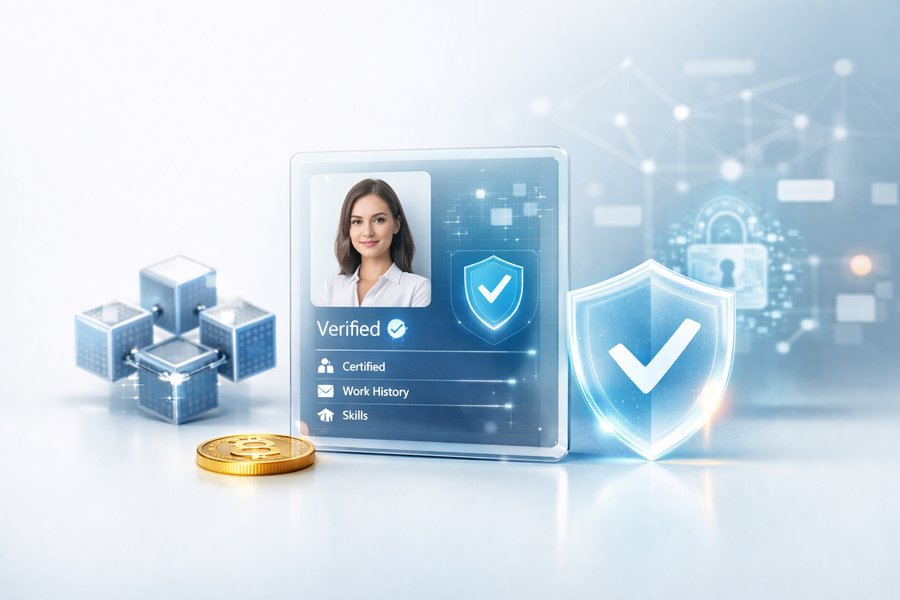
The modern hiring landscape faces an unprecedented challenge that costs businesses hundreds of billions of dollars annually while undermining trust throughout professional networks. Resume fraud and credential misrepresentation have become so pervasive that employers now operate under the assumption that a significant portion of applications contain falsified information. Traditional verification methods, which rely on manual outreach to universities, certification bodies, and former employers, consume weeks of valuable time while still leaving organizations vulnerable to sophisticated deception. This fundamental breakdown in professional credentialing demands a technological solution capable of restoring trust to the hiring process.
Blockchain technology offers precisely such a solution through decentralized systems that create tamper-proof records of professional achievements, educational credentials, and work histories. These Web3 credential verification platforms enable instantaneous authentication of qualifications while giving individuals unprecedented control over their professional identities. Rather than depending on centralized databases vulnerable to manipulation and data breaches, blockchain-based systems distribute credential information across networks where cryptographic security ensures authenticity and permanence. The transformation extends beyond mere efficiency gains, fundamentally restructuring the relationship between credential issuers, holders, and verifiers.
The emergence of industry consortiums and standardized frameworks has accelerated the adoption of blockchain credentialing across multiple sectors. Organizations ranging from healthcare systems seeking to verify nursing licenses to multinational corporations authenticating professional certifications are implementing these solutions with measurable results. Educational institutions have begun issuing digital diplomas that graduates can share instantly with prospective employers, while professional associations are creating portable credentials that accompany workers throughout their careers. The momentum behind these initiatives reflects growing recognition that traditional credentialing infrastructure cannot scale to meet contemporary demands, particularly as remote hiring becomes standard practice and global talent mobility increases.
The stakes involved in credential verification extend beyond organizational efficiency to fundamental questions of fairness and opportunity in labor markets. Workers who possess legitimate qualifications but lack institutional connections to facilitate verification face systematic disadvantages under current systems. International professionals whose credentials come from institutions unfamiliar to local employers encounter skepticism that blockchain verification could eliminate. Individuals whose educational institutions have closed, merged, or lost records may find themselves unable to prove qualifications they legitimately earned. Blockchain credentials address these inequities by creating permanent, portable records that remain verifiable regardless of institutional status or geographic location. This article examines the technology underlying Web3 credential verification, explores the platforms driving adoption, analyzes the benefits and challenges facing various stakeholders, and projects the future trajectory of professional credentialing in an increasingly decentralized digital economy.
The Credential Verification Crisis in Modern Hiring
The scale of credential fraud in contemporary hiring defies what most employers expect, revealing a systematic breakdown in how professional qualifications are represented and verified. Research consistently demonstrates that falsification occurs across all levels of the workforce, from entry-level positions to executive suites. A 2024 survey by Resume.org found that among job applicants who admitted to lying on their resumes, the most common fabrications included altering employment dates, exaggerating responsibilities, and misrepresenting current employment status. The study revealed that sixty percent of those who submitted fraudulent resumes successfully landed jobs, while ninety-six percent reported that their deception was never discovered by employers. These statistics represent only admitted falsification, suggesting the actual prevalence may be substantially higher.
The financial impact of credential fraud on organizations extends far beyond the immediate costs of hiring unqualified candidates. Industry estimates place the annual cost to employers at approximately six hundred billion dollars, encompassing expenses related to negligent hiring lawsuits, productivity losses from unqualified workers, turnover costs when deception is eventually discovered, and the administrative burden of conducting extensive background checks. The Society for Human Resource Management has documented that more than half of resumes and job applications contain some form of falsification, with particularly high rates among certain demographics and industries. Technology and finance sectors experience the most significant fraud prevalence, with studies indicating that over half of employees in these fields have admitted to some degree of resume misrepresentation.
The diploma mill industry compounds traditional resume padding with sophisticated credential fabrication services that can withstand basic verification attempts. These operations sell fake degrees from fictitious universities, counterfeit transcripts with fabricated grades, and even access to fraudulent verification services that confirm non-existent credentials. Some services employ hackers to insert fabricated graduation records into legitimate university databases, making detection nearly impossible through conventional means. The proliferation of remote hiring has further exacerbated these challenges by reducing opportunities for in-person verification and enabling candidates to misrepresent their identities during video interviews. Deepfake technology has introduced an additional layer of complexity, allowing imposters to conduct interviews using synthetic video that passes initial screening. The sophistication of modern credential fraud has outpaced the capabilities of traditional verification methods, creating an arms race where each defensive measure generates corresponding evasion techniques.
The consequences of hiring based on fraudulent credentials extend throughout organizations and, in regulated industries, can affect public safety. Healthcare facilities that unknowingly employ individuals with falsified medical credentials expose patients to risk while facing regulatory penalties and liability exposure. Financial institutions hiring unqualified personnel may violate compliance requirements and fiduciary obligations. Educational institutions admitting students based on fabricated transcripts undermine academic integrity while displacing legitimate applicants. The reputational damage when credential fraud is discovered publicly can affect organizational credibility for years, while the legal costs of negligent hiring claims can exceed the administrative expense of more thorough verification. These consequences have driven increasing demand for verification solutions that can provide certainty rather than merely reducing probability of fraud.
Traditional Verification Methods and Their Limitations
Conventional approaches to credential verification rely on a fragmented ecosystem of manual processes, third-party services, and institutional outreach that collectively fail to meet the demands of modern hiring. When an employer seeks to verify a candidate’s educational background, the process typically involves contacting the registrar’s office of each claimed institution, waiting for responses that may take days or weeks, and paying fees that accumulate across multiple verification requests. Employment history verification follows a similar pattern, requiring outreach to human resources departments that may be unresponsive, have incomplete records, or no longer exist if the company has closed or been acquired. Professional certifications add another layer of complexity, as verification must occur through disparate licensing boards and certification bodies that operate with varying degrees of accessibility and responsiveness.
The time required for comprehensive background checks creates significant friction in the hiring process, often extending timelines by weeks during which qualified candidates may accept competing offers. Background screening companies have emerged to streamline these processes, but they fundamentally operate within the same constraints of manual verification and institutional cooperation. These services report that the average background check requires five to seven business days for completion, though complex cases involving international credentials or multiple employment verifications can extend substantially longer. The delay represents more than inconvenience; it translates directly into lost productivity, extended vacancy costs, and competitive disadvantage in markets where talent acquisition speed determines organizational success.
Third-party verification services face inherent limitations that no amount of process improvement can fully address. They depend entirely on the cooperation and record-keeping practices of issuing institutions, many of which maintain paper-based archives, operate with limited staff, or simply refuse to respond to verification requests for legal or policy reasons. The decentralized nature of credential issuance means that no single entity possesses comprehensive records, forcing verification services to navigate a maze of institutional contacts for each candidate. International credentials present particular challenges, as educational systems vary dramatically across countries, degree equivalencies remain contested, and verification infrastructure in some regions is essentially non-existent. The result is a system where even well-resourced employers cannot achieve certainty about candidate qualifications without accepting substantial delays and costs.
The vulnerability of traditional verification to sophisticated fraud has become increasingly apparent as technology enables more convincing deception. Paper certificates and transcripts can be professionally forged at minimal cost, while digital documents are easily manipulated using widely available editing software. Verification calls can be intercepted by fraudulent reference services that provide scripted responses confirming fabricated employment histories. The fundamental problem lies in the architecture of traditional credentialing, which places issuers, holders, and verifiers in disconnected silos without a shared source of truth. Each verification essentially requires rebuilding the chain of custody from scratch, with no systematic way to confirm that the document presented matches the original issuance. This structural deficiency creates the opening that blockchain-based verification promises to close.
Understanding Blockchain-Based Credential Verification
Blockchain technology provides the foundational infrastructure for a new paradigm in credential verification that addresses the structural weaknesses inherent in traditional systems. At its core, blockchain functions as a distributed ledger maintained across a network of computers, where each entry is cryptographically linked to previous entries in a chain that makes tampering essentially impossible without detection. When a credential is registered on a blockchain, the record includes a digital signature from the issuing institution, a timestamp confirming when issuance occurred, and a unique identifier linking the credential to its recipient. Any attempt to modify this record would alter its cryptographic hash, immediately signaling that tampering has occurred and invalidating the credential.
The application of blockchain to credential verification follows standards established by the World Wide Web Consortium, which has developed the Verifiable Credentials Data Model as a framework for creating, sharing, and verifying digital credentials. This specification ensures that credentials created by different organizations using various blockchain platforms remain interoperable and can be verified using consistent methods. The W3C standard defines the structure of verifiable credentials to include claims about the credential subject, metadata about the issuer, and cryptographic proof that enables verification without contacting the original issuer. This architecture enables what the traditional system cannot achieve: instant verification by any authorized party without relying on the issuing institution’s availability or cooperation.
Decentralized Identifiers form the second crucial component of blockchain credential systems, providing unique identifiers that individuals and organizations generate and control without dependence on centralized registries. Unlike traditional identifiers such as email addresses or social security numbers, which are issued and controlled by third parties, DIDs exist on blockchain networks where the identifier owner maintains exclusive control through cryptographic keys. When an institution issues a credential, it signs the credential using its DID, creating a verifiable link between the credential and the issuer that can be confirmed by anyone checking the blockchain. The recipient receives the credential along with their own DID, enabling them to prove ownership when presenting the credential to verifiers.
The verification process demonstrates the efficiency gains possible through blockchain architecture. When a job applicant presents a verifiable credential to a potential employer, the verification system checks the blockchain to confirm that the credential was legitimately issued by the claimed institution, that the cryptographic signatures are valid, that the credential has not been revoked, and that it belongs to the person presenting it. This entire process occurs in seconds without any communication with the issuing institution, which may be located in a different time zone, have limited operating hours, or require payment for verification services. The permanence of blockchain records means that credentials remain verifiable indefinitely, even if the issuing institution ceases to exist, undergoes reorganization, or loses its original records. This durability addresses a significant limitation of traditional credentials, where institutional failures can leave former students or employees unable to prove legitimate qualifications.
The technical implementation of blockchain credentials involves several layers that work together to ensure security and usability. The base layer consists of the blockchain network itself, which may be a public blockchain like Ethereum or a purpose-built network designed specifically for credential management. Above this sits the protocol layer, which implements the W3C standards for decentralized identifiers and verifiable credentials, ensuring interoperability across different implementations. The application layer provides the interfaces through which issuers create credentials, holders manage their wallets, and verifiers authenticate presented qualifications. Smart contracts can automate certain credential functions, such as automatic revocation when a license expires or conditional disclosure based on verifier authorization levels. This layered architecture enables flexibility in implementation while maintaining the core security properties that make blockchain credentials valuable.
Self-Sovereign Identity and Career Passports
The concept of self-sovereign identity represents a fundamental shift in how individuals relate to their professional credentials and personal data. Under traditional models, credential holders depend on issuing institutions to maintain records and respond to verification requests, creating ongoing relationships of dependency that persist long after the original credential was earned. Self-sovereign identity inverts this relationship by placing individuals at the center of their credential ecosystem, where they maintain control over what information they share, with whom they share it, and under what conditions access is granted. The technical implementation of this model uses digital wallets where individuals store their verifiable credentials, managing them with the same autonomy they exercise over physical documents in a physical wallet.
The trust triangle architecture underlies self-sovereign identity systems, defining relationships among three parties: issuers who create and sign credentials, holders who receive and store credentials in their wallets, and verifiers who request and authenticate credentials when making decisions. This structure enables trust to flow from issuers to holders to verifiers without requiring direct communication between issuers and verifiers. When a university issues a digital diploma to a graduate, that graduate can present the credential to any employer who accepts blockchain-verified credentials, and the employer can instantly confirm authenticity without ever contacting the university. The graduate decides when and with whom to share their credentials, maintaining privacy while enabling verification.
Career passports extend the self-sovereign identity model to encompass comprehensive professional histories that accompany workers throughout their careers. Rather than assembling fragmented records from multiple employers, educational institutions, and certification bodies each time they seek a new position, individuals maintain unified digital portfolios containing all their verified credentials. These portfolios include not only formal qualifications but also verified employment histories, professional development records, skills assessments, and performance endorsements. The portability of career passports enables workers to carry their complete professional identities across employers, industries, and national borders without repeating verification processes or losing access to records when employers change systems or go out of business.
The privacy-preserving features of self-sovereign identity address legitimate concerns about data exposure during hiring processes. Traditional verification often requires sharing more information than strictly necessary, exposing sensitive details to parties who have no legitimate need for comprehensive personal data. Verifiable credentials can be designed to support selective disclosure, where holders prove specific claims without revealing underlying details. For example, a candidate could prove that they hold a valid nursing license without revealing the license number, issue date, or other identifying information that might enable identity theft or unwanted contact. Zero-knowledge proofs take this capability further, enabling mathematical confirmation of claims without transferring any actual data. These privacy features make self-sovereign identity systems attractive not only for their efficiency but for their alignment with data protection regulations and individual autonomy expectations.
Key Platforms and Industry Initiatives
The landscape of blockchain credential verification has matured significantly through the development of major platforms and the formation of industry consortiums that bring together stakeholders from across the hiring ecosystem. The Velocity Network Foundation stands as the most comprehensive initiative, operating as a nonprofit membership organization that has assembled a coalition including the Society for Human Resource Management, Aon, Korn Ferry, Randstad, SAP, and UKG among others. The foundation deployed its Velocity Network as a decentralized utility layer enabling individuals to claim, store, and share career credentials through digital wallets. Credentials issued through the network receive cryptographic signatures from authorized issuers, ensuring that relying parties can trust the authenticity of presented qualifications without independent verification.
The Velocity Network Foundation has expanded its reach through targeted industry initiatives that demonstrate the practical application of verifiable credentials. The SkillsONWARD program, launched as an eighteen-month initiative, focuses on building a self-sufficient credential ecosystem in healthcare across Florida and Texas. Participating members include AMN Healthcare, HCA Healthcare, Korn Ferry, NCSBN, Randstad, SHRM, and numerous other organizations representing different aspects of the healthcare credentialing ecosystem. The initiative addresses the particularly acute verification challenges in healthcare, where nursing licenses, certifications, and compliance credentials must be validated before professionals can begin patient care. Traditional verification in healthcare can delay onboarding by weeks, creating staffing shortages that affect patient outcomes and organizational capacity.
HCA Healthcare, one of the nation’s largest healthcare systems, has emerged as a leader in implementing verifiable credentials for workforce management. At the 2023 Velocity Network Foundation General Assembly, HCA Healthcare executives discussed how the organization is using verifiable credentials to background screen and onboard nurses, reducing time-to-hire from weeks to minutes. The initiative demonstrates how blockchain verification can address critical bottlenecks in industries where credential requirements are extensive and verification delays have direct operational consequences. By enabling nurses to present pre-verified credentials stored in digital wallets, HCA Healthcare can confirm qualifications instantly and move qualified candidates into patient care positions without the traditional waiting period for background check completion.
MIT pioneered academic credential verification through its partnership with Learning Machine, which began with a pilot program issuing digital diplomas using Bitcoin blockchain technology in 2017. The initiative made MIT among the first universities to issue recipient-owned virtual credentials that graduates could share with employers for instant verification. Using the Blockcerts open-source toolkit developed through this collaboration, employers can verify diploma authenticity without contacting the Registrar’s Office by checking the blockchain record that confirms the credential was legitimately issued and has not been altered. The program has expanded beyond initial pilots, with MIT exploring digital records for additional credentials including professional education certificates and teaching certifications. The success at MIT has generated inquiries from universities worldwide, contributing to broader adoption of blockchain credentialing in higher education.
Additional platforms serve specialized niches within the credential verification ecosystem. Dock provides infrastructure for healthcare organizations to issue and verify professional credentials, working with healthcare technology companies that have created ecosystems connecting issuers, employers, and individuals through streamlined credential management platforms. The Dock blockchain enables real-time verification and continuous compliance monitoring, helping healthcare organizations avoid regulatory penalties associated with employing individuals whose credentials have lapsed or been revoked. In the Netherlands, Randstad and Rabobank have partnered with the Velocity Network Foundation to pioneer new approaches to talent screening using verifiable credentials, demonstrating how emerging technologies can accelerate background and credential verification processes across industries. These implementations provide evidence that blockchain credential verification has moved beyond theoretical promise into practical deployment.
The India IT Services Ecosystem launched in February 2023 represents another significant regional initiative bringing together organizations including Aon, Neeyamo, SAP, and Talview to implement verifiable credentials specifically for the Indian technology workforce. Given the scale of India’s IT services sector and its role in global technology supply chains, this ecosystem has potential to affect millions of workers and thousands of employers. Neeyamo, as a global background screening provider, brings particular expertise in verification challenges across international contexts, where credential standards and verification infrastructure vary dramatically between countries. The initiative demonstrates how blockchain credentialing can address geographic-specific challenges while building toward global interoperability through common standards and protocols.
The National Student Clearinghouse, which processes millions of education verification requests annually for American institutions, has engaged with blockchain credential initiatives through participation in the Velocity Network Foundation. Chris Goodson from the National Student Clearinghouse was voted onto the Foundation’s Board of Directors, signaling the organization’s commitment to exploring how blockchain technology might enhance its verification services. The Clearinghouse’s involvement brings credibility and infrastructure expertise to blockchain credentialing efforts, as the organization has established relationships with thousands of educational institutions and extensive experience managing verification at scale. Integration between traditional verification services and blockchain infrastructure may prove essential for transitional periods when some credentials exist as blockchain records while others remain in conventional formats.
Benefits of Web3 Credential Verification
The advantages of blockchain-based credential verification extend across all participants in the hiring ecosystem, creating value through reduced friction, enhanced trust, and new capabilities that traditional systems cannot provide. Employers represent the stakeholder group most immediately affected by verification challenges, bearing direct costs from fraud, verification delays, and compliance risks. Research by IBM found that blockchain-based credential verification can reduce the time required for verification by up to ninety percent compared to traditional methods. This acceleration translates into faster hiring cycles, reduced vacancy costs, and competitive advantage in talent markets where speed determines success. The elimination of manual verification processes also reduces administrative burden on human resources departments, freeing staff to focus on higher-value activities such as candidate assessment and employee development.
The fraud prevention capabilities of blockchain credentials address one of the most persistent challenges facing employers. Traditional verification methods struggle to detect sophisticated fraud, particularly when candidates use professional services to fabricate credentials and references. Blockchain verification eliminates these vulnerabilities by creating tamper-proof records that cannot be altered after issuance. When an employer verifies a blockchain credential, they can be certain that the qualification was legitimately issued by the claimed institution on the specified date. The cryptographic signatures that secure these credentials are mathematically impossible to forge without access to the issuing institution’s private keys. This certainty enables employers to make hiring decisions with confidence, reducing the risk of negligent hiring claims and the operational disruptions caused by discovering unqualified employees after hiring.
Job seekers benefit from blockchain credentials through enhanced portability and reduced verification friction that can delay employment and career advancement. Under traditional systems, each new job application requires rebuilding verification from scratch, with candidates dependent on former employers and institutions to respond to verification requests. Blockchain credentials remain verified indefinitely, enabling workers to present authenticated qualifications instantly without waiting for institutional responses. This portability becomes particularly valuable for professionals who change jobs frequently, work across international borders, or have credentials from institutions that have closed or become difficult to contact. The career passport concept enables workers to maintain comprehensive professional identities that accompany them throughout their careers, eliminating the need to reconstruct qualification records for each new opportunity.
Educational institutions and certification bodies realize significant benefits from blockchain credential issuance through reduced administrative burden and enhanced institutional credibility. Registrar offices traditionally expend substantial resources responding to verification requests, maintaining records, and reissuing lost documents. When credentials are issued as verifiable digital records, recipients can share them indefinitely without requiring institutional involvement in each verification. The administrative savings enable institutions to redirect resources toward core educational missions while providing graduates with more valuable credentials. Institutional credibility benefits when credentials cannot be forged, as the value of legitimate qualifications increases when fraudulent alternatives are eliminated. Professional certification bodies gain similar advantages, with the additional benefit of real-time revocation capabilities that ensure employers always see current credential status rather than potentially outdated verification results.
The network effects inherent in blockchain credentialing create compounding benefits as adoption increases across the hiring ecosystem. Each institution that begins issuing blockchain credentials adds value for all credential holders who gain access to additional verified qualifications. Each employer that accepts blockchain verification creates incentive for credentials holders to obtain and maintain digital credentials. This dynamic differs fundamentally from traditional credentialing, where verification remains equally difficult regardless of how many other parties participate in the system. Industry consortiums like the Velocity Network Foundation leverage these network effects by coordinating adoption across stakeholder groups, ensuring that credentials issued by members can be verified by other members and creating the critical mass necessary for ecosystem viability. The participation of major organizations including SHRM, Randstad, Korn Ferry, and SAP signals that blockchain credentialing has achieved sufficient momentum to benefit from these network dynamics.
Compliance and audit capabilities represent an additional benefit category that affects organizations operating in regulated industries. Traditional credential verification produces records that require manual assembly and may be incomplete or inconsistent. Blockchain verification automatically creates immutable audit trails documenting when credentials were verified, who conducted the verification, and what results were obtained. These records can satisfy regulatory requirements for documentation while reducing the administrative burden of compliance reporting. Healthcare organizations, financial institutions, and government contractors subject to credentialing audits can demonstrate compliance more efficiently when verification records exist on blockchain infrastructure rather than in fragmented paper or digital files. The continuous monitoring capabilities of some blockchain credential platforms enable proactive compliance management, alerting organizations when employee credentials approach expiration or when revocations occur.
Challenges and Implementation Barriers
Despite the compelling advantages of blockchain credential verification, significant obstacles impede widespread adoption across industries and geographies. Standardization remains among the most fundamental challenges, as multiple blockchain protocols, credential formats, and verification systems have emerged without unified standards ensuring interoperability. The W3C Verifiable Credentials specification provides a foundation for credential structure, but implementation details vary significantly across platforms. An employer using one verification system may be unable to authenticate credentials issued through a different platform, fragmenting the credential ecosystem and limiting the network effects that drive adoption. The Velocity Network Foundation and similar consortiums work to address standardization through governance frameworks and technical specifications, but achieving industry-wide consensus requires coordination among competitors with potentially divergent interests.
Integration with existing human resources technology infrastructure presents practical barriers that affect implementation timelines and costs. Enterprise organizations typically operate complex ecosystems of applicant tracking systems, human resource information systems, background screening services, and learning management platforms. Adding blockchain credential verification requires technical integration with these existing systems, which may lack APIs designed for credential verification or require custom development to accommodate new data formats. Smaller organizations face even greater challenges, as they may lack the technical resources to implement blockchain solutions and the transaction volumes to justify investment in new infrastructure. The cost-benefit calculation for blockchain adoption depends heavily on organizational scale, with large enterprises better positioned to absorb implementation costs and realize efficiency gains across high volumes of hiring activity.
Regulatory compliance adds complexity to blockchain credential implementation, particularly in industries with extensive verification requirements and data protection obligations. Healthcare credentialing operates under regulatory frameworks that specify verification procedures, documentation requirements, and compliance monitoring obligations. Blockchain solutions must demonstrate equivalence to traditional verification methods to satisfy regulatory requirements, a process that requires engagement with regulatory bodies and may involve extended review periods. Data protection regulations including GDPR in Europe and various state privacy laws in the United States impose restrictions on how personal information can be stored, processed, and transferred. While blockchain credentials can be designed with privacy-preserving features, organizations must ensure that implementations comply with applicable regulations, which may vary across jurisdictions and evolve as regulators develop frameworks for emerging technologies.
The digital divide presents a barrier that extends beyond technology to questions of equity and access. Blockchain credential systems assume that participants have access to digital devices, reliable internet connectivity, and sufficient technical literacy to manage digital wallets and credentials. These assumptions may not hold for all workers, particularly those in lower-wage positions, older workers less familiar with digital technologies, and individuals in regions with limited infrastructure. The risk exists that blockchain credentialing could inadvertently disadvantage populations already facing barriers in the labor market, creating a two-tiered system where technologically connected workers enjoy verification advantages while others face additional obstacles. Addressing this challenge requires attention to user experience design, alternative access methods for those without smartphones, and support resources that enable participation regardless of technical background.
The governance of blockchain credential networks presents ongoing challenges as ecosystems grow and stakeholder interests potentially diverge. Decisions about technical standards, fee structures, membership requirements, and protocol upgrades affect all participants but may benefit some stakeholders more than others. Nonprofit foundations like the Velocity Network Foundation provide governance structures intended to balance interests across issuer, holder, and verifier constituencies, but maintaining this balance as networks scale requires ongoing attention and adaptation. The decentralized nature of blockchain technology creates tension with the need for coordinated governance, as changes that benefit the network overall may impose costs on individual participants. Experience from other blockchain ecosystems suggests that governance challenges intensify as economic stakes increase, making early attention to governance frameworks essential for long-term sustainability.
Technical scalability concerns affect blockchain credential implementations differently depending on the underlying infrastructure choices. Public blockchains that provide maximum decentralization and censorship resistance may face transaction throughput limitations and fee volatility that affect credential issuance and verification at scale. Private or consortium blockchains offer better performance characteristics but sacrifice some decentralization benefits that contribute to credential trustworthiness. Hybrid approaches attempt to balance these tradeoffs, using public blockchains for anchor transactions while conducting high-volume operations on more efficient secondary layers. The optimal technical architecture depends on specific use case requirements, regulatory constraints, and stakeholder trust models, making infrastructure selection a consequential decision with long-term implications for credential ecosystem development.
Industry-Specific Applications
Healthcare represents the sector where blockchain credential verification has achieved the most significant implementation progress, driven by regulatory requirements, staffing urgencies, and the direct impact of verification delays on patient care. The healthcare industry maintains extensive credentialing requirements encompassing medical licenses, nursing certifications, specialty qualifications, and ongoing compliance training. Traditional verification of these credentials can delay the deployment of healthcare professionals by weeks, creating staffing gaps during critical periods. The SkillsONWARD initiative demonstrates how industry collaboration can accelerate blockchain adoption, bringing together healthcare providers, staffing agencies, credential issuers, and technology vendors in a coordinated ecosystem. Participating organizations including HCA Healthcare are implementing verifiable credentials that enable nurses and other healthcare professionals to present authenticated qualifications instantly, reducing onboarding timelines and improving workforce flexibility.
The technology sector has embraced blockchain credentials for professional certifications, where major vendors including Amazon Web Services, Microsoft, and IBM issue digital badges that authenticate completion of training programs and certification exams. These credentials integrate with professional networking platforms, enabling certified professionals to display verified qualifications that employers can authenticate without contacting the issuing organization. The technology industry’s familiarity with blockchain concepts and digital platforms has facilitated adoption, while the rapid pace of technological change creates ongoing demand for credentials that demonstrate current skills. Cloud computing certifications have proven particularly amenable to blockchain issuance, with professionals earning verified credentials for AWS, Google Cloud, and Azure platforms that signal competency to employers seeking specific technical capabilities.
Financial services present both opportunities and challenges for blockchain credential verification, given the industry’s extensive regulatory requirements and conservative approach to technology adoption. Compliance officers, financial advisors, and other regulated professionals must maintain certifications and licenses that require regular renewal and verification by employers. Blockchain credentials could streamline the verification of these qualifications while providing regulators with real-time visibility into credential status across the industry. The challenge lies in regulatory acceptance, as financial regulators maintain specific requirements for credential verification that may not yet accommodate blockchain-based alternatives. Progress in this sector requires engagement with regulatory bodies to establish equivalence between blockchain verification and traditional methods, a process that typically proceeds more slowly than technology development.
Higher education continues expanding blockchain credential adoption following the model established by MIT and other early implementers. Universities worldwide are implementing digital diploma programs that provide graduates with verifiable credentials they own and control. The University of Nicosia offers blockchain-based certificates for various programs, while institutions across Europe are implementing credentials through the European Blockchain Services Infrastructure. The educational sector benefits from relatively straightforward credential structures and clear issuer authority, as universities hold unambiguous responsibility for degree issuance. The permanence of blockchain records addresses a particular concern in education, where institutions may close, merge, or lose records over time, leaving former students unable to verify legitimate qualifications. Blockchain credentials survive institutional changes, ensuring that educational achievements remain verifiable regardless of the issuing institution’s subsequent history.
The legal profession presents emerging opportunities for blockchain credential verification, particularly for bar admissions and continuing legal education requirements. Attorneys must maintain licenses across jurisdictions, track continuing education credits, and demonstrate good standing to clients and courts. Blockchain credentials could streamline the verification of attorney qualifications while enabling automated tracking of continuing education compliance. The American Bar Association and state bar associations have begun exploring how distributed ledger technology might enhance attorney credentialing, though implementation remains in earlier stages than in healthcare or technology sectors. The conservative nature of legal institutions and the complexity of multi-jurisdictional licensing create particular implementation challenges that require careful navigation.
Supply chain and logistics industries are discovering applications for blockchain credential verification beyond traditional employment contexts. Certifications for handling hazardous materials, operating specialized equipment, and maintaining food safety compliance require verification throughout supply chains. Blockchain credentials enable instant verification at multiple points in logistics operations, confirming that drivers, handlers, and facility workers possess current qualifications without delays that affect delivery schedules. The integration of credential verification with other supply chain blockchain applications, such as product tracking and compliance documentation, creates comprehensive solutions that address multiple verification needs through unified infrastructure. Companies including Deloitte have implemented blockchain for professional development credentials, enabling consultants to maintain verifiable, portable proof of specialized training that clients can authenticate when engaging advisory services.
The Future of Professional Credentialing
The trajectory of blockchain credential verification points toward comprehensive transformation of how professional qualifications are issued, managed, and verified across global labor markets. Artificial intelligence integration represents a near-term development that will enhance fraud detection capabilities and streamline credential processing. AI systems can analyze patterns across credential presentations to identify anomalies that might indicate fraudulent activity, while natural language processing can extract and standardize credential information from diverse formats. The combination of blockchain’s tamper-proof records with AI’s pattern recognition creates verification systems more robust than either technology could achieve independently. Organizations already deploying AI for other hiring functions can extend these capabilities to credential verification, creating unified platforms that assess candidates comprehensively.
Government adoption of blockchain credentialing signals mainstream acceptance and creates the regulatory frameworks necessary for widespread implementation. Arkansas has emerged as the first state member of the Velocity Network Foundation, incorporating digital career credentials into its workforce strategy announced by Governor Sanders. The state’s skills-centric approach uses Velocity Network infrastructure to provide residents with comprehensive digital records of their skills and experience, supporting better career opportunities through verified professional identities. This government adoption provides a model for other jurisdictions considering blockchain integration into workforce development programs. The European Union’s work on the European Blockchain Services Infrastructure and related digital credential initiatives demonstrates similar momentum at the supranational level, creating cross-border frameworks for credential verification across member states.
The expansion of micro-credentials and stackable certifications creates new opportunities for blockchain verification systems. Traditional credentials represent major educational milestones such as degrees and professional licenses, but the contemporary workforce increasingly values continuous learning evidenced through shorter-form credentials. Blockchain platforms can efficiently manage large volumes of micro-credentials representing completed courses, demonstrated skills, and professional development activities. The ability to stack these credentials into comprehensive professional portfolios enables workers to demonstrate evolving capabilities throughout their careers. Industry-endorsed credential consortiums are establishing quality standards and common frameworks that give micro-credentials the recognition necessary for labor market value, while blockchain verification ensures authenticity regardless of the issuing organization’s scale or longevity.
Global interoperability frameworks represent the frontier challenge that will determine whether blockchain credentialing achieves its full potential. Currently, credentials issued through different platforms and based on different blockchain protocols may not be mutually recognizable, limiting the portability that gives blockchain credentials their distinctive value. Organizations including the Velocity Network Foundation, the Global Digital Credential Network, and various standards bodies are working to establish interoperability protocols that enable credentials to be verified across systems. The emerging framework of Arya, formerly known as the Global Acceptance Network, brings together over thirty organizations working to create universal trust infrastructure for digital credentials. Success in establishing global interoperability would enable workers to carry verified credentials across national borders as easily as across employers, fundamentally changing how professional qualifications function in international labor markets.
The tokenization of professional credentials represents a speculative but potentially significant development on the horizon. Some blockchain credential frameworks are exploring how tokens might represent credential ownership, enable credential-based access to opportunities, or create economic incentives for credential verification and maintenance. While current implementations focus primarily on verification functionality rather than tokenomics, the underlying blockchain infrastructure supports more complex economic models that might emerge as ecosystems mature. The intersection of decentralized finance and professional credentialing could eventually create new mechanisms for funding education, valuing skills, and connecting credentials to economic opportunities, though such developments remain speculative and would require significant regulatory and market evolution.
The convergence of multiple verification technologies creates opportunities for comprehensive identity and credential systems that address challenges beyond professional qualifications. Blockchain credentials can integrate with biometric verification, document authentication, and continuous background monitoring to create multi-layered verification ecosystems. Government digital identity initiatives in various countries are exploring how blockchain credentials might complement national identification systems, potentially creating unified infrastructure for both civic and professional credentials. The Dubai Blockchain Strategy aims to migrate all government documents to blockchain by 2025, potentially reducing document processing time significantly while creating interoperability between government and private sector credentialing. Estonia’s e-Residency program already uses blockchain for digital identity, demonstrating how government adoption can accelerate broader ecosystem development.
Final Thoughts
Blockchain credential verification represents a transformative technology that addresses fundamental dysfunction in how professional qualifications are issued, managed, and authenticated across global labor markets. The current system, built on fragmented record-keeping, manual verification processes, and institutions that may be unresponsive, unreliable, or no longer in existence, fails to meet the needs of employers seeking qualified candidates, workers seeking fair recognition of their accomplishments, and educational institutions seeking to maintain the value of the credentials they issue. The documented prevalence of credential fraud, estimated to cost employers hundreds of billions of dollars annually, demonstrates that traditional approaches cannot adequately secure the trust that professional credentials are meant to convey. Blockchain technology offers a structural solution that places verified credentials under the control of individuals while enabling instant authentication by any authorized party.
The implications of this transformation extend beyond efficiency gains to questions of economic inclusion and opportunity access. Workers in developing regions, immigrants seeking recognition of foreign credentials, and individuals whose educational institutions have closed or lost records all face barriers under traditional credentialing systems. Blockchain credentials that remain verifiable indefinitely, regardless of issuing institution status, provide these populations with tools to demonstrate legitimate qualifications that might otherwise be impossible to authenticate. The portability of career passports enables workers to carry comprehensive professional identities across borders and employment changes, reducing the friction that currently impedes labor market mobility. These capabilities matter most for workers who lack institutional connections that can substitute for formal verification, making credential authentication a matter of economic justice as well as operational efficiency.
The intersection of technology and social responsibility demands attention to potential inequities in blockchain credential adoption. While the technology promises broad benefits, implementation must ensure that populations with limited technological access are not disadvantaged relative to early adopters. The digital divide, regulatory complexity, and standardization challenges that currently impede adoption require coordinated solutions from technology developers, industry consortiums, governments, and civil society organizations. The SkillsONWARD initiative in healthcare and government programs like Arkansas’s workforce strategy provide models for collaborative implementation that addresses equity concerns while advancing technological capability. The organizations building blockchain credential infrastructure bear responsibility for designing systems that expand opportunity rather than concentrating advantages among those already well-positioned in labor markets.
The ongoing evolution of professional credentialing will continue as artificial intelligence integration, government adoption, micro-credential expansion, and global interoperability frameworks mature over coming years. The foundations established by current implementations create pathways for broader transformation that could fundamentally restructure relationships among educational institutions, employers, workers, and governments. The verification certainty that blockchain provides enables new forms of trust that traditional systems cannot achieve, while the permanence of blockchain records ensures that credentials retain value across institutional and technological changes. The challenge ahead lies in realizing this potential through thoughtful implementation that serves all participants in the credentialing ecosystem. What emerges from this period of technological development will shape how professional qualifications function for generations of workers navigating an increasingly complex global economy.
FAQs
- What is Web3 credential verification and how does it differ from traditional background checks?
Web3 credential verification uses blockchain technology to create tamper-proof digital records of professional qualifications, educational achievements, and work histories. Unlike traditional background checks that require manual contact with institutions and can take weeks to complete, blockchain verification enables instant authentication by checking cryptographically secured records on distributed networks. The credential holder controls their digital credentials through a wallet application, sharing them with potential employers who can verify authenticity in seconds without contacting the issuing institution. - How secure are blockchain-based credentials against fraud and tampering?
Blockchain credentials achieve security through cryptographic signatures that are mathematically impossible to forge without access to the issuing institution’s private keys. Each credential is recorded on a distributed ledger maintained across multiple computers, where any attempt to alter records would be immediately detected through hash verification. This architecture eliminates the vulnerabilities present in paper certificates and digital documents that can be manipulated using common editing software. The permanence of blockchain records ensures that credentials remain verifiable even if issuing institutions close or lose their original records. - What costs are involved in implementing blockchain credential verification for employers?
Implementation costs vary based on organizational scale and existing technology infrastructure. Large enterprises may invest in custom integrations with applicant tracking systems and human resource information systems, while smaller organizations can access verification through platforms operated by industry consortiums. The Velocity Network, for example, offers a free, publicly available utility for individuals, with fees applying to organizational users. Cost-benefit analysis typically favors adoption for organizations with high hiring volumes, where verification acceleration and fraud prevention generate returns exceeding implementation investment. - How do blockchain credentials protect individual privacy during the hiring process?
Blockchain credential systems incorporate privacy-preserving features that enable selective disclosure of information. Credential holders choose what to share with verifiers, potentially proving specific claims without revealing underlying details. For example, a professional might verify that they hold a current certification without disclosing the certification number or personal information. Zero-knowledge proofs enable mathematical confirmation of claims without transferring any actual data. Importantly, personal information is not stored on the blockchain itself; only cryptographic proofs and issuer identifiers reside on the distributed ledger while credentials remain in the holder’s secure digital wallet. - Which industries are currently using blockchain credential verification?
Healthcare has achieved the most significant implementation progress, with organizations like HCA Healthcare using verifiable credentials to reduce nursing onboarding timelines from weeks to minutes. Technology companies including Amazon Web Services, Microsoft, and IBM issue blockchain-verified digital badges for professional certifications. Higher education institutions following MIT’s pioneering example now offer blockchain diplomas that graduates control and share with employers. Financial services, government agencies, and staffing firms are also implementing or piloting blockchain verification systems for various credential types. - What is a career passport and how does it benefit job seekers?
A career passport is a comprehensive digital portfolio containing all of an individual’s verified credentials, including educational qualifications, professional certifications, employment history, and skills assessments. Stored in a digital wallet under the individual’s control, the career passport accompanies workers throughout their careers regardless of employer changes or geographic moves. Job seekers benefit from instant credential presentation without waiting for institutional verification, elimination of repeated verification processes for each application, and permanent access to qualification records even if issuing institutions become unavailable. - How long does it take to verify blockchain-based credentials compared to traditional methods?
Blockchain credential verification occurs in seconds compared to days or weeks for traditional verification. When a verifier receives a blockchain credential, the system automatically checks the distributed ledger to confirm that the credential was legitimately issued, has not been revoked, and belongs to the person presenting it. This entire process requires no communication with the issuing institution. IBM research found that blockchain verification can reduce verification time by up to ninety percent, enabling same-day hiring decisions that would previously have required extended background check periods. - What happens to blockchain credentials if the issuing institution closes?
One of the significant advantages of blockchain credentials is their persistence independent of issuing institution status. Because the credential and its cryptographic proof are recorded on a distributed ledger maintained across multiple independent computers, the record remains verifiable even if the issuing institution ceases to exist. This durability addresses a real problem in traditional credentialing, where institutional closures, mergers, or record losses can leave individuals unable to prove legitimate qualifications. The blockchain serves as a permanent registry that outlasts any individual organization participating in the network. - Are blockchain credentials recognized by employers and regulatory bodies?
Recognition varies by industry and jurisdiction, with adoption accelerating as major organizations implement blockchain verification. The Society for Human Resource Management’s membership in the Velocity Network Foundation signals growing acceptance among human resources professionals. Healthcare regulators are beginning to accept blockchain-verified credentials through initiatives like SkillsONWARD, while governments including Arkansas have incorporated blockchain credentialing into official workforce development programs. Organizations considering blockchain credentials should verify acceptance by relevant employers and regulatory bodies in their specific industry and location. - How can individuals without technical expertise use blockchain credential systems?
Blockchain credential platforms are designed with user experience as a priority, presenting credential management through intuitive mobile applications that require no understanding of underlying technology. Users receive credentials directly to wallet applications, share them through simple interfaces similar to sharing photos or documents, and manage their portfolios without any blockchain expertise. Organizations implementing these systems typically provide onboarding support and user guides. However, ensuring accessibility for populations with limited smartphone access or digital literacy remains an ongoing challenge that platforms and implementing organizations continue to address through alternative access methods and support resources.