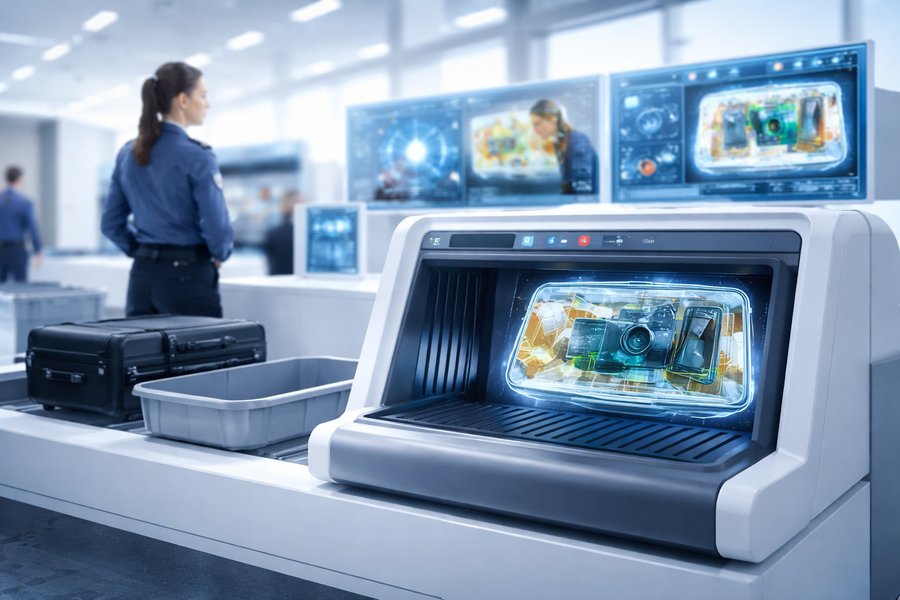
The global aviation industry processed over 9.4 billion passengers in 2024, surpassing pre-pandemic levels and placing unprecedented demands on airport security infrastructure worldwide. Every day, millions of travelers navigate security checkpoints where their belongings are scanned, their identities verified, and their bodies examined for potential threats. The traditional approach to this process relied heavily on human screeners manually reviewing two-dimensional X-ray images while making split-second decisions about whether luggage contents warranted further inspection. Transportation Security Administration officers in the United States alone review more than six million baggage images on peak travel days, a cognitive load that inevitably leads to fatigue, inconsistency, and the potential for missed threats.
Artificial intelligence has emerged as a transformative force capable of addressing these systemic challenges while simultaneously improving the passenger experience. Computer vision algorithms trained on millions of baggage images can now identify prohibited items with remarkable accuracy, flagging potential threats for human review rather than requiring screeners to maintain constant vigilance across every scan. Biometric verification systems using facial recognition technology have reduced identity confirmation from minutes to seconds, allowing travelers to move through checkpoints without repeatedly presenting physical documents. Machine learning models analyze patterns in passenger flow, predicting surge periods and optimizing staffing levels to reduce wait times during peak hours.
The integration of these technologies represents far more than incremental improvement to existing processes. Airports implementing advanced AI-powered queue management systems have reported wait time reductions of up to forty-two percent during peak hours, while computed tomography scanners with automated threat detection have decreased the number of manual bag checks by forty percent at some locations. Biometric technologies have enabled airports to reduce manual identity verification time by an average of thirty seconds per passenger, creating cumulative time savings that ripple through entire terminal operations. These efficiency gains occur alongside enhanced security outcomes, as AI systems can maintain consistent detection performance without the fatigue that affects human operators during long shifts.
The stakes involved in airport security extend far beyond operational metrics. The events of September 11, 2001, demonstrated how catastrophic failures in aviation security can reshape global policy, trigger massive government reorganization, and fundamentally alter how billions of people experience travel. Every technological advancement in this domain carries dual imperatives: the system must catch genuine threats while processing innocent travelers quickly enough to maintain the viability of commercial aviation. Artificial intelligence offers the possibility of achieving both objectives simultaneously, but realizing this potential requires careful attention to accuracy, fairness, privacy, and the appropriate balance between automated decision-making and human judgment.
The economic dimensions of airport security transformation compound the operational imperatives driving AI adoption. Global aviation authorities estimate that inefficient security processing costs the industry billions of dollars annually through missed connections, delayed departures, and the ancillary effects of passenger dissatisfaction. Airlines lose revenue when travelers avoid connecting itineraries through airports known for excessive wait times, while retail concessionaires suffer when passengers must arrive earlier and spend their buffer time in security queues rather than shops and restaurants. The airport security solutions market itself has grown substantially, with projections indicating expansion from approximately ten billion dollars in 2025 to nearly fourteen billion dollars by 2030, reflecting sustained investment in technologies that promise both security enhancement and operational efficiency.
This examination of AI-driven airport security screening explores the technologies reshaping checkpoint operations, the real-world implementations demonstrating their capabilities, and the complex considerations that will determine how these systems evolve. Understanding these developments matters not only for security professionals and aviation executives but for anyone who travels by air, as the choices made today about artificial intelligence deployment will define the airport experience for decades to come. The convergence of mature AI capabilities, pressing operational needs, and substantial investment creates conditions for rapid transformation, making this an inflection point worthy of careful attention from all who participate in commercial aviation.
The Evolution of Airport Security Screening
Airport security as a formal discipline emerged relatively recently in aviation history, with systematic checkpoint screening only becoming standard practice following a wave of aircraft hijackings in the late 1960s and early 1970s. The introduction of walk-through metal detectors and X-ray baggage scanners during this era established the fundamental architecture that would persist for decades: passengers proceed through electromagnetic screening while their belongings pass through imaging equipment, with human operators making real-time assessments about whether detected anomalies require additional inspection. This basic framework proved adequate for detecting metallic weapons but struggled to address evolving threat profiles that included plastic explosives, liquid accelerants, and increasingly sophisticated concealment methods.
The September 2001 terrorist attacks exposed critical vulnerabilities in aviation security systems and triggered the most comprehensive overhaul in the industry’s history. The United States created the Transportation Security Administration to federalize airport screening, implementing standardized training programs and deploying advanced imaging technology capable of detecting non-metallic threats. Similar reorganizations occurred worldwide as governments recognized that aviation security required dedicated agencies with specialized expertise rather than contracted services operating under minimal oversight. The post-9/11 era introduced full-body scanners, enhanced pat-down procedures, and increasingly stringent rules about liquids, electronics, and other carry-on items that might pose threats or complicate screening.
Despite these investments, traditional security screening remained fundamentally constrained by human cognitive limitations. A Transportation Security Officer reviewing X-ray images must maintain focused attention throughout shifts lasting eight hours or longer, searching for prohibited items that appear in only a tiny fraction of scanned bags. Research on visual search tasks demonstrates that humans experience significant performance degradation when targets are rare, a phenomenon that makes detecting actual threats among thousands of innocuous bags extraordinarily difficult. The TSA has documented how the constant review of images produces substantial fatigue among officers, particularly during peak travel periods when passenger volumes create pressure to process bags quickly. Administrator David Pekoske testified before Congress that officers may review over six million images on single peak travel days, a cognitive burden that the agency explicitly identified as unsustainable without technological assistance.
The international aviation community recognized these limitations and began coordinating responses through bodies including the International Civil Aviation Organization, which establishes security standards applicable to member states worldwide. ICAO Annex 17 requires that all screening personnel be certified according to national civil aviation security programs, though the diversity of training and certification systems across countries has resulted in varying skill levels that complicate efforts to establish consistent global standards. The European Civil Aviation Conference has pursued harmonization within its member states while the Asia-Pacific region has seen varying approaches reflecting different threat assessments and resource constraints across jurisdictions.
From Manual Inspection to Intelligent Automation
The transition from purely manual screening to automated assistance began with relatively simple algorithmic aids that highlighted areas of X-ray images requiring closer attention. Early threat image projection systems inserted synthetic images of prohibited items into the baggage stream, testing whether operators would detect them while simultaneously keeping screeners alert and calibrated. These systems provided valuable training feedback and performance metrics but did not fundamentally change the cognitive demands placed on human operators, who remained responsible for every detection decision.
Computed tomography technology, adapted from medical imaging applications, represented a significant advancement by generating three-dimensional representations of baggage contents rather than the flat projections produced by conventional X-ray equipment. CT scanners create volumetric images from hundreds of different viewing angles, allowing operators to rotate and examine objects from any perspective. This capability dramatically improves the ability to identify items concealed behind other objects or positioned to minimize their profile in two-dimensional views. The technology also enables automated detection algorithms that apply sophisticated analysis to identify explosives and other threats based on material density, shape characteristics, and other physical properties that distinguish dangerous items from innocuous belongings.
The European Union established a 2025 deadline for mandatory CT scanner implementation at airport security checkpoints, recognizing the technology as essential for maintaining security while accommodating passenger expectations that laptops and liquids need not be removed from carry-on bags. The United States Transportation Security Administration has taken a phased approach, deploying CT equipment to high-priority locations while projecting full integration across all airports by 2042. As of early 2025, the TSA had deployed nearly one thousand CT units across 254 American airports, with plans for continued expansion throughout the decade. These installations represent billions of dollars in infrastructure investment and require substantial training for officers accustomed to interpreting two-dimensional imagery.
Machine learning algorithms have transformed CT scanning from a tool that produces better images into a system capable of autonomous threat detection. Modern scanners apply artificial intelligence trained on vast datasets of baggage contents to identify prohibited items automatically, alerting operators only when potential threats are detected rather than requiring review of every image. This automation addresses the fundamental cognitive challenge of rare target detection by shifting human attention from continuous surveillance to focused evaluation of flagged items. The approach mirrors successful implementations in other security domains where AI handles initial screening while humans make final adjudication decisions about identified anomalies.
Core Technologies Powering AI Security Screening
The artificial intelligence systems deployed in airport security screening represent the convergence of several distinct technological capabilities that have matured significantly over the past decade. Computer vision, the field concerned with enabling machines to interpret visual information, provides the foundational ability to analyze X-ray and CT imagery. Machine learning, particularly deep neural networks, enables systems to recognize patterns and identify objects without explicit programming for every possible threat variant. Natural language processing and predictive analytics contribute to behavioral detection and throughput optimization, while biometric technologies handle identity verification with increasing speed and accuracy. Understanding how these technologies function individually and in combination illuminates both the capabilities and limitations of current screening systems.
Computed tomography scanners form the hardware foundation for advanced baggage screening, generating the detailed three-dimensional imagery that enables precise threat detection. Unlike conventional X-ray systems that produce shadow images showing objects in silhouette, CT equipment rotates X-ray sources around bags to capture data from multiple angles simultaneously. Reconstruction algorithms process this data into volumetric representations that reveal internal structures, material compositions, and spatial relationships between objects. The resulting images can be rotated, sliced, and examined from any angle, providing screeners with far more information than traditional flat projections. Modern CT systems for airport security have achieved image resolution and processing speeds suitable for high-throughput checkpoint operations, scanning bags in seconds rather than the minutes required by earlier medical-grade equipment.
The algorithms processing CT imagery have evolved from rule-based systems that flagged specific shapes or densities to sophisticated deep learning models trained on millions of examples. Convolutional neural networks, the same technology powering facial recognition and autonomous vehicle perception, excel at identifying objects in complex visual scenes regardless of orientation, partial occlusion, or variations in appearance. Training these networks requires enormous datasets of labeled baggage images showing both prohibited items and innocuous contents in countless configurations. The TSA and its international counterparts have accumulated vast libraries of such imagery through decades of checkpoint operations, providing the raw material necessary for developing increasingly accurate detection models. Vendors including Smiths Detection, Analogic, and L3Harris have integrated these AI capabilities into commercial screening equipment now deployed at airports worldwide.
Beyond baggage scanning, AI systems contribute to multiple other checkpoint functions that collectively determine how quickly and effectively passengers move through security. Biometric verification using facial recognition has reduced identity confirmation to a process requiring less than two seconds, comparing live photographs against government-issued identification documents or pre-enrolled traveler profiles. Predictive analytics models ingest historical data on passenger volumes, flight schedules, weather patterns, and special events to forecast checkpoint demand hours or days in advance, enabling airports to optimize staffing and resource allocation. Queue management systems use computer vision to monitor real-time passenger density, automatically adjusting lane assignments and providing wait time estimates that help travelers plan their airport arrival. Virtual queuing systems have been implemented at some airports to manage passenger flow more effectively during peak periods, reducing the physical space required for queues by up to forty percent while allowing travelers to receive notifications when their turn approaches.
The Low Probability of False Alarm algorithm deployed by TSA for on-person screening exemplifies the refinement of AI systems through iterative improvement. This machine learning system improves detection performance while decreasing alarm rates that would otherwise require pat-down searches. Notably, the algorithm operates in a gender-agnostic manner, eliminating the previous requirement for officers to select a passenger’s gender prior to scanning. This design choice both accelerates throughput and reduces potential for uncomfortable interactions, demonstrating how thoughtful AI implementation can address multiple objectives simultaneously. Once trained, such algorithms are locked down rather than continuing to learn in deployment, ensuring consistent behavior that can be tested and certified against established standards.
The integration of these disparate technologies into cohesive security operations represents a significant systems engineering challenge. Data from baggage scanners, body imaging equipment, identity verification stations, and surveillance cameras must flow through unified platforms that enable coordinated response to potential threats. The TSA has pursued an open architecture approach that allows algorithms from multiple vendors to operate on standardized scanning hardware, fostering competition and innovation while maintaining interoperability. This strategy enables airports to upgrade detection capabilities through software updates rather than complete equipment replacement, potentially accelerating the deployment of improved AI models as they become available. The approach also addresses concerns about vendor lock-in that might otherwise constrain procurement flexibility and limit competitive pressure on system performance.
Computer Vision and Object Detection Systems
Computer vision systems in airport security screening employ multiple complementary techniques to identify prohibited items within baggage imagery. Object detection algorithms locate items of interest within images, drawing bounding boxes around potential threats and classifying them into categories such as weapons, explosives, or prohibited liquids. Semantic segmentation divides images into regions corresponding to different materials or object types, helping distinguish between items that may appear similar in raw X-ray imagery. Instance segmentation combines these approaches to identify individual objects while understanding their material composition and spatial relationships.
The training process for these systems requires carefully curated datasets that represent the full diversity of threats and innocuous items that might appear in passenger baggage. Security agencies work with manufacturers to create synthetic training data augmenting real-world examples, generating artificial images of prohibited items in various orientations and concealment scenarios. Transfer learning techniques allow models trained on general object recognition tasks to be fine-tuned for security applications, accelerating development while reducing the data requirements that might otherwise limit progress. Continuous learning approaches enable deployed systems to improve over time as operators provide feedback on detection accuracy, refining model performance without requiring complete retraining.
The Accessible Property Screening system developed by the TSA exemplifies how AI enhances checkpoint operations through automated threat detection. This system uses machine learning trained to identify both explosive threats and non-explosive prohibited items such as firearms and bladed weapons as baggage passes through CT scanners. The AI algorithms perform image segmentation and object recognition in real-time, alerting operators to potential threats while clearing bags that contain no items of concern. By automating the initial detection process, the system allows Transportation Security Officers to focus their attention on resolving alarms rather than maintaining constant surveillance over every scanned image.
Performance validation for these systems requires rigorous testing protocols that assess detection rates across diverse threat scenarios while measuring false alarm rates that determine operational efficiency. The TSA conducts extensive evaluation at dedicated testing facilities before certifying equipment for checkpoint deployment, measuring performance against standardized threat objects and operational parameters. International bodies including the European Civil Aviation Conference have established similar certification frameworks that enable mutual recognition of approved equipment across jurisdictions. These testing regimes must balance the need for transparent performance standards against security concerns about revealing specific detection capabilities that adversaries might exploit.
Behavioral Analysis and Pattern Recognition
Behavioral detection represents a more controversial application of artificial intelligence in airport security, attempting to identify passengers who may pose threats based on observable actions, body language, or physiological indicators rather than physical items they carry. The Transportation Security Administration has operated behavior detection programs since 2006, training officers to observe passengers for signs of stress, fear, or deception that might indicate malicious intent. These programs have faced persistent criticism from government auditors and civil liberties organizations who question both their scientific validity and their potential for discriminatory application.
The Government Accountability Office has conducted multiple reviews of TSA behavioral detection activities, consistently finding insufficient evidence that the indicators used can reliably identify individuals who pose aviation security threats. A 2017 GAO report examined 178 sources the TSA cited as supporting its revised list of behavioral indicators and found that only three provided valid scientific evidence applicable to the specific indicators claimed. The report noted that behavioral indicators such as assessing how an individual swallows or the degree to which their eyes are open lack the empirical foundation necessary to justify their use in security screening. Critics have also documented patterns suggesting that behavior detection programs result in disproportionate referrals of minority passengers for additional screening.
Despite these concerns, technology developers continue pursuing automated behavioral analysis systems that might address the consistency and bias issues affecting human observers. The Automated Virtual Agent for Truth Assessments in Real-Time, known as AVATAR, represents one approach that uses sensors to analyze voice patterns, eye movements, posture, and gestures during brief interviews. The system compares observed responses against baseline expectations, flagging individuals whose behavior deviates significantly from normal patterns for further investigation. Proponents argue that automated systems applying consistent criteria across all passengers could reduce the subjective judgments that enable discriminatory enforcement, though critics counter that algorithmic systems may simply encode existing biases in less transparent forms.
International implementations of behavioral analysis vary significantly in their technological sophistication and operational integration. Israel’s Ben Gurion Airport has long employed comprehensive behavioral assessment as a central component of its security model, combining structured interviews with environmental design that facilitates observation throughout the passenger journey. The approach emphasizes human expertise and judgment rather than automated detection, though the airport employs surveillance systems and other technologies that support behavioral monitoring. Whether AI-powered behavioral analysis can achieve acceptable accuracy while avoiding discriminatory outcomes remains an open question that will likely require years of additional research and careful pilot testing to resolve.
Real-World Implementation and Case Studies
The transition from experimental AI security technologies to operational deployment has accelerated dramatically since 2020, driven by rising passenger volumes, persistent staffing challenges, and demonstrated performance improvements at early-adopter airports. Major international hubs in Asia, Europe, and North America have served as proving grounds for systems that combine computed tomography imaging, automated threat detection, and biometric verification into integrated checkpoint experiences. These implementations provide concrete evidence about what AI-driven security can achieve in practice, including both the efficiency gains that justify continued investment and the operational challenges that require ongoing attention.
Amsterdam Schiphol Airport emerged as a leader in AI security innovation following severe operational disruptions in 2022 that saw security queues exceeding six hours during peak periods. The airport partnered with technology firm Pangiam to pilot Project DARTMOUTH, an artificial intelligence system designed to analyze CT scanner imagery and automatically identify prohibited items in carry-on baggage. The technology, developed in collaboration with Google Cloud, applies machine learning algorithms trained to detect weapons, explosives, and other threats in real-time as bags pass through scanning equipment. Initial trials at Schiphol demonstrated performance matching or exceeding human screeners for certain categories of prohibited items, with the system designed to support operators rather than replace their judgment entirely.
The Schiphol transformation extended beyond AI screening to encompass comprehensive operational restructuring that addressed staffing, training, and process design alongside technology deployment. Working with external consultants, the airport optimized security agent selection and shift scheduling, improved forecasting models for passenger volumes, and redesigned checkpoint layouts to reduce bottlenecks. The results were dramatic: within eighteen months, approximately ninety percent of passengers passed through security in under ten minutes on peak days, compared to the multi-hour waits that had characterized the crisis period. Operational costs decreased by ten to twenty percent while passenger satisfaction improved substantially. This holistic approach demonstrates that AI technologies achieve maximum impact when integrated with broader operational excellence initiatives rather than deployed as isolated solutions.
Dubai International Airport has pursued aggressive automation of passenger processing, deploying facial recognition and AI-powered systems throughout the terminal experience. The airport implemented smart gates that verify traveler identities biometrically, reducing the need for manual document checks while maintaining security standards. Integrated systems track passengers from check-in through boarding, enabling personalized services and proactive intervention when individuals risk missing connections. These implementations position Dubai as a model for airports seeking to leverage AI for both security and customer experience enhancement, though they also raise questions about surveillance intensity that Western airports may approach differently given distinct regulatory and cultural contexts.
Changi Airport’s Automated Prohibited Item Detection System
Singapore Changi Airport has established itself at the forefront of AI security screening through its trial of the Automated Prohibited Item Detection System, commonly known as APIDS. The system uses artificial intelligence and machine learning to analyze X-ray images of carry-on baggage, automatically detecting prohibited items including insecticides, cigarette lighters, and sharp objects such as pocket knives. Changi Airport Group initiated the trial at Terminal 3 boarding gates, targeting a fifty percent reduction in the time required to process security screening while maintaining or improving detection accuracy.
Initial results from the APIDS trial demonstrated that the AI system performed comparably to human security screeners in flagging prohibited items, with some categories showing detection rates exceeding human baseline performance. The technology processes both two-dimensional X-ray images and three-dimensional CT imagery, providing flexibility for integration with different scanner equipment configurations. Changi recognized that cabin baggage screening represents only one component of comprehensive checkpoint security, requiring coordination with passenger screening, document verification, and other processes to achieve seamless operations. The airport has emphasized that successful deployment requires continued dialogue with regulatory bodies to ensure compliance with stringent safety standards.
The APIDS trial highlighted important implementation challenges that other airports considering similar systems must address. The interaction between AI detection algorithms and CT scanning technology requires careful calibration, as the detailed imagery that enables passengers to leave electronics and liquids in bags also increases the visual complexity that AI must navigate. False alarm rates directly impact passenger experience and operational efficiency, making continuous refinement essential for maintaining acceptance among both travelers and security staff. Alan Tan, Senior Vice President of Aerodrome Safety and Aviation Security at Changi Airport Group, noted that redesigning processes to accommodate the strengths of AI technology could revolutionize security checks, but finding the right balance between human oversight and automated efficiency requires iterative development.
Changi’s broader digital transformation provides context for understanding the APIDS deployment as part of a comprehensive innovation strategy rather than an isolated technology initiative. The airport has invested heavily in AI applications across operations, including automated immigration processing that reduced queue times by thirty percent during peak hours. These improvements contributed to Changi’s recognition as Future Enterprise of the Year at the 2024 IDC Future Enterprise Awards, acknowledging its leadership in digital transformation across the Asia-Pacific region. The success of integrated AI deployment at Changi offers a template for other airports seeking to enhance both security outcomes and passenger experience through intelligent automation.
Hartsfield-Jackson Atlanta International Airport Biometric Integration
Hartsfield-Jackson Atlanta International Airport, the world’s busiest airport by passenger volume with over 108 million travelers in 2024, has implemented one of the most comprehensive biometric security programs in the United States. The airport’s partnership with Delta Air Lines dates to 2016 when early facial recognition pilots launched for flights to Tokyo and Mexico City. These initial tests evolved into the first fully biometric terminal in the United States when Terminal F opened in November 2018, allowing international passengers to use facial recognition for check-in, bag drop, security checkpoint passage, boarding, and customs processing upon arrival.
The biometric system operates through integration with U.S. Customs and Border Protection’s Traveler Verification Service, which maintains galleries of photographs compiled from passports, visas, and previous international travel. When passengers check in with their airline, the carrier transmits manifest information that enables CBP to assemble photo galleries for each individual expected on departing flights. At boarding gates, biometric totems capture facial images and compare them against these galleries, confirming identity without requiring passengers to present physical documents. The process typically completes in under two seconds, enabling substantially faster boarding while providing CBP with departure records that support immigration enforcement.
Atlanta expanded its biometric program significantly in 2025, extending facial recognition boarding beyond Delta to all airlines operating international departures from the airport’s forty international gates. The rollout began in July with completion targeted for November, establishing Atlanta as a model for airport-wide biometric implementation. Chris Crist, the airport’s Chief Information Officer, emphasized that passengers no longer need to produce passports or boarding passes when departing internationally, dramatically streamlining the pre-flight experience. For arriving U.S. citizens, the Enhanced Passenger Processing system deployed in June 2025 replaced manual passport review by Customs officers with tablets that capture facial images and automatically compare them against government databases, reducing processing time by approximately twenty-two percent.
The Atlanta implementation extends beyond passenger processing to encompass employee access control and broader security surveillance. The airport has embarked on pilot programs exploring computer vision overlays for its security camera network, which will expand from approximately 4,000 to 7,000 cameras. These systems could automate the review of surveillance footage, identifying anomalies that warrant human attention without requiring continuous monitoring of every feed. Crist described these capabilities as representing the future direction for improving both security and operational efficiency at major airports, though privacy advocates including the Electronic Privacy Information Center have criticized facial recognition as inherently dangerous surveillance technology that has demonstrated unreliability and bias.
Benefits and Challenges Across Stakeholders
The deployment of AI-driven security screening creates distinct impacts for different participant groups in the aviation ecosystem, with benefits and challenges varying based on each stakeholder’s priorities and concerns. Understanding these differentiated effects helps explain both the momentum behind continued AI adoption and the resistance that has emerged from various quarters. The technology’s ultimate success depends on achieving acceptable outcomes across multiple constituencies simultaneously, a balancing act that requires ongoing attention as implementations mature and expand.
Travelers represent the most numerous stakeholder group and experience AI screening primarily through changes in checkpoint procedures and processing times. The elimination of requirements to remove laptops and liquids from carry-on bags at CT-equipped checkpoints reduces the preparation burden that many passengers find frustrating and time-consuming. Biometric verification enables those enrolled in programs like TSA PreCheck or Global Entry to proceed through checkpoints with minimal document handling, creating the touchless experience that became particularly valued during the COVID-19 pandemic. Wait time reductions benefit travelers directly, with data indicating that passengers in lanes equipped with advanced AI systems spend significantly less time in queues compared to those processed through conventional equipment.
However, travelers also bear the consequences of AI system limitations and failures. False alarms that trigger additional screening create delays and inconvenience for innocent passengers, with some individuals reporting that automated systems flag their belongings repeatedly despite containing nothing prohibited. The accuracy of facial recognition technology varies across demographic groups, with studies documenting higher failure rates for women and people with darker skin tones. These failures result in disproportionate referrals to secondary screening, potentially creating discriminatory experiences even when systems apply nominally neutral criteria. Passengers who prefer not to participate in biometric programs face uncertainty about whether opt-out procedures truly avoid consequences, with some reporting that declining facial scanning resulted in apparent delays or additional scrutiny.
Transportation Security Officers and their international counterparts experience AI implementation through changes in their daily work responsibilities and performance expectations. Automated threat detection shifts their role from continuous image surveillance to alarm resolution, potentially reducing cognitive fatigue while requiring different skills in evaluating flagged items. Officers receive training on new equipment and procedures as AI systems deploy, with the quality of this training significantly influencing both their effectiveness and their job satisfaction. Some security personnel have expressed concern that automation could eventually eliminate positions, though current implementations emphasize AI as a tool supporting human judgment rather than replacing it entirely. The TSA has noted that its attrition rate dropped from twenty percent to approximately eleven percent following Congressional approval of historic pay increases, suggesting that workforce stability depends on compensation and working conditions alongside technological changes.
The image-on-alarm-only capability being developed represents a significant evolution in officer responsibilities. Under this approach, screeners would only view baggage images when AI systems detect potential anomalies, eliminating the continuous surveillance that characterizes current operations. Officers would focus their attention on evaluating and resolving alarms flagged by automated systems rather than reviewing every scan. This shift could substantially reduce the cognitive burden that contributes to fatigue and performance degradation while potentially allowing reduced staffing levels at some checkpoints. However, the transition requires careful change management to ensure officers maintain the skills necessary for manual image review when system failures or unusual circumstances require it.
Airport operators invest substantial capital in AI screening infrastructure while expecting returns through improved throughput, reduced staffing costs, and enhanced passenger satisfaction. CT scanners with integrated threat detection cost significantly more than conventional X-ray equipment, requiring careful analysis of deployment priorities and implementation timelines. Airports must also invest in facilities modifications, training programs, and integration with existing systems to realize the benefits of new technology. The business case for AI security investment depends heavily on passenger volume projections, competitive positioning relative to other airports, and regulatory requirements that vary by jurisdiction. Return on investment calculations must account for both operational savings and less tangible benefits including improved customer experience scores and reduced reputational risk from security incidents or excessive delays.
Regulatory bodies including the TSA, European Union Aviation Safety Agency, and their counterparts worldwide bear responsibility for ensuring that AI systems meet security standards before deployment. Certification processes must balance thorough evaluation against the need to enable innovation, as overly lengthy approval timelines could leave airports operating with inferior legacy equipment. Regulators must also address accountability questions that arise when automated systems make or influence security decisions, establishing frameworks for oversight, audit, and remediation when problems occur. The coordination between CAA International and equipment manufacturers like Rapiscan to standardize screening assessments reflects efforts to harmonize certification across jurisdictions while maintaining rigorous performance requirements.
Privacy, Ethics, and Regulatory Considerations
The expansion of AI-powered security screening, particularly systems employing biometric identification and behavioral analysis, has generated substantial debate about privacy protection, algorithmic fairness, and appropriate limits on surveillance technology. These concerns have manifested in legislative proposals, regulatory reviews, and advocacy campaigns that collectively shape the environment in which airports deploy new capabilities. The outcome of these debates will determine not only what technologies operate at security checkpoints but how they are governed, what rights travelers retain, and what accountability mechanisms constrain potential misuse.
Facial recognition technology has attracted the most intense scrutiny, with critics arguing that building databases of traveler biometric information creates infrastructure capable of surveillance far exceeding its stated airport security purpose. Unlike passwords or identification documents, biometric identifiers cannot be changed if compromised, creating permanent vulnerability for individuals whose facial data enters government or commercial systems. Civil liberties organizations including the American Civil Liberties Union and the Brennan Center for Justice have warned that normalizing biometric tracking at airports could establish precedent for broader deployment in public spaces, fundamentally altering the relationship between citizens and state surveillance capabilities.
The Privacy and Civil Liberties Oversight Board initiated a comprehensive review of TSA facial recognition use, examining both one-to-one verification comparing passengers against their own identity documents and one-to-many matching against broader government databases. The board’s May 2025 report documented significant concerns about inconsistent terminology, inadequate privacy impact assessments, and insufficient transparency about system performance across demographic groups. Board members emphasized that TSA had not published comprehensive privacy documentation for its facial recognition program and that travelers frequently received unclear information about their ability to opt out without consequence. The report recommended that facial recognition remain voluntary for all passengers and called for regular operational testing to validate both accuracy and demographic fairness.
Legislative responses have proposed more restrictive approaches to biometric technology in aviation security. The Traveler Privacy Protection Act, introduced with bipartisan support, would require affirmative consent before any biometric data collection, prohibit passive surveillance that captures traveler information without active participation, and establish mandatory timelines for deleting stored images. The act would also mandate annual Government Accountability Office reviews examining accuracy rates and potential bias by race, age, and gender. Aviation industry groups have opposed the legislation, arguing that it would derail years of digital transformation investment, undermine security capabilities, and increase wait times for travelers who benefit from biometric processing.
Algorithmic fairness concerns extend beyond facial recognition to encompass any AI system that influences security decisions affecting passengers. Machine learning models trained on historical data may encode existing patterns of discrimination, flagging individuals from certain demographic groups at higher rates even when those disparities lack legitimate security justification. The opacity of deep learning systems complicates efforts to identify and correct such biases, as the specific features driving detection decisions may not be readily interpretable even by system developers. Regulatory frameworks requiring algorithmic impact assessments, demographic performance reporting, and ongoing bias monitoring represent potential responses, though the optimal approach remains contested among technologists, civil liberties advocates, and security professionals. The National Institute of Standards and Technology conducts testing of facial recognition algorithms that includes demographic analysis, providing independent performance data that can inform procurement decisions and regulatory standards.
The consent mechanisms employed in current biometric programs have drawn particular scrutiny from privacy advocates who question whether travelers truly have meaningful choice. Studies and accounts collected by organizations including the Algorithmic Justice League suggest that many passengers receive little or no notice about their ability to refuse facial scanning, with signage frequently using vague terms like biometric identity technology rather than explicitly stating facial recognition. The combination of ambiguous signage, time pressure, and officer presence may effectively coerce participation even when opt-out procedures formally exist. McKenly Redmon of Southern Methodist University has argued that these conditions undermine the informed consent that should justify biometric collection, particularly given the permanence of facial data that cannot be changed if compromised.
International variations in privacy regulation create additional complexity for airports operating global networks and technology vendors serving multiple markets. European data protection requirements under the General Data Protection Regulation impose strict limitations on biometric processing that exceed current American standards, influencing how systems can be designed and deployed in transatlantic operations. The European Data Protection Board has emphasized that individuals must have maximum control over their biometric data at airports, with implementations requiring careful assessment of necessity, proportionality, and data minimization. These requirements may constrain certain AI applications that would be permissible under less restrictive regulatory regimes, potentially creating divergent security experiences for travelers depending on their origin and destination. The incoming European Entry/Exit System will collect biometric data from non-EU travelers at borders, creating new considerations for how such information integrates with aviation security systems.
The Future of Intelligent Airport Security
The trajectory of AI-driven airport security points toward increasingly seamless checkpoint experiences where multiple verification and screening processes occur simultaneously and often imperceptibly. Industry leaders envision futures where passengers proceed from curb to gate without stopping at discrete security stations, with continuous monitoring replacing the checkpoint bottlenecks that currently constrain airport throughput. Achieving this vision requires continued advancement across multiple technology domains alongside resolution of the privacy and fairness concerns that could otherwise limit deployment.
Touchless processing represents the near-term frontier, eliminating remaining friction points where passengers must interact with equipment or present documents. TSA’s acting deputy administrator has described aspirations for checkpoint experiences where travelers need never remove phones from their pockets, with identity verification, threat screening, and boarding authorization occurring through integrated systems that recognize individuals and assess risk continuously. Delta Air Lines’ Digital ID program already enables enrolled passengers to complete bag drop transactions averaging thirty seconds compared to two minutes for conventional processing, with security checkpoint throughput approximately sixty percent faster than standard TSA PreCheck. Expansion of such programs across additional airports and airlines will accelerate the transition toward document-free travel for participating passengers.
Predictive analytics will increasingly enable airports to anticipate and prepare for passenger surges rather than merely responding to them. Machine learning models analyzing flight schedules, booking patterns, weather forecasts, and special events can project checkpoint demand with remarkable accuracy, in some cases forecasting passenger arrivals twenty-four hours in advance with ninety-two percent precision. These predictions enable dynamic resource allocation that matches staffing and lane configurations to actual requirements, reducing both overstaffing during slow periods and understaffing that creates excessive wait times during peaks. The integration of predictive models with automated queue management systems creates feedback loops where airports continuously optimize operations based on real-time conditions and near-term projections.
Emerging screening technologies promise capabilities beyond current CT and millimeter-wave systems. Israeli startup Scanary is developing AI-powered systems designed to detect concealed weapons and other threats using spatially deployed radar sensors that generate three-dimensional electromagnetic scanning images as individuals move through spaces naturally. The company claims capacity to screen 25,000 individuals per hour without requiring people to stop, remove clothing, or pass through gated checkpoints. If validated, such technology could fundamentally reimagine airport security by enabling threat detection throughout terminals rather than only at designated screening points. However, the system must demonstrate acceptable detection accuracy while meeting regulatory requirements before any operational deployment could occur.
The open architecture approach championed by TSA and other agencies will accelerate AI capability deployment by enabling software upgrades without hardware replacement. Under this model, airports invest in standardized scanning platforms that can host detection algorithms from multiple vendors, with TSA maintaining an interface that allows overlay of new targeting capabilities as they become available. This strategy positions airports to benefit from ongoing AI advancement without facing obsolescence of recently purchased equipment, potentially shortening the cycle from laboratory development to operational deployment. The approach also fosters competition among algorithm developers, as vendors can demonstrate improved detection performance to earn deployment on existing hardware rather than requiring airports to purchase entirely new systems.
Final Thoughts
The transformation of airport security through artificial intelligence represents one of the most significant applications of machine learning technology to critical infrastructure protection. The systems now operating at checkpoints worldwide demonstrate that AI can meaningfully enhance threat detection while improving the passenger experience, achieving objectives that seemed mutually exclusive under traditional screening paradigms. Computed tomography scanners with automated threat detection, biometric identity verification, and predictive queue management collectively enable airports to process growing passenger volumes without proportional increases in staffing or wait times. The efficiency gains documented at leading airports provide compelling evidence for continued investment and broader deployment.
Yet the promise of AI-enhanced security arrives accompanied by legitimate concerns that demand sustained attention. The expansion of biometric surveillance creates infrastructure whose potential applications extend far beyond airport checkpoints, raising questions about mission creep, data retention, and the broader societal implications of normalizing facial recognition in public spaces. Algorithmic systems that influence security decisions affecting millions of travelers must demonstrate fairness across demographic groups, with performance disparities that burden particular populations requiring identification and remediation. The appropriate balance between automated processing and human judgment remains contested, with reasonable observers disagreeing about how much discretion should rest with machines versus trained officers.
The accessibility implications of AI security technology deserve particular consideration as implementations expand. Travelers with disabilities, elderly passengers, and those unfamiliar with digital systems may struggle to navigate increasingly automated checkpoints designed around assumptions of technological fluency. Biometric systems that perform less reliably for certain demographic groups effectively create tiered experiences where some travelers proceed smoothly while others face repeated failures and additional scrutiny. Achieving the benefits of AI screening for all passengers rather than only those whose characteristics align with system design parameters requires intentional attention to inclusive development and deployment practices.
Financial inclusion considerations also merit attention, as premium programs offering expedited processing through biometric verification typically require enrollment fees and access to smartphones capable of storing digital credentials. The emergence of differentiated security experiences based on program enrollment and technological access could exacerbate existing inequalities in air travel, creating faster paths for affluent frequent travelers while leaving others in slower conventional queues. Airports and regulators must consider whether efficiency-enhancing technologies should be universally available rather than reserved for those willing and able to pay for premium treatment.
The decisions made over the coming years about AI deployment in airport security will establish patterns that persist for decades, shaping how billions of people experience one of the most regulated and surveilled environments they routinely encounter. The technology’s capabilities will continue advancing regardless of any particular policy choice, making thoughtful governance essential to ensuring that implementation serves broad societal interests rather than merely optimizing narrow operational metrics. Getting this balance right requires continued engagement among technologists, policymakers, civil liberties advocates, and the traveling public whose interests ultimately must guide the evolution of aviation security.
FAQs
- What is AI-driven airport security screening?
AI-driven airport security screening uses artificial intelligence technologies including machine learning, computer vision, and biometric verification to detect threats in baggage, verify passenger identities, and optimize checkpoint operations. These systems analyze X-ray and CT scanner imagery to automatically identify prohibited items, compare facial photographs against identity documents, and predict passenger flow to reduce wait times. - Can I opt out of facial recognition at airport security?
Yes, the TSA and most international aviation security agencies allow passengers to opt out of facial recognition scanning without penalty. You can inform the officer that you prefer traditional document verification, and you should not lose your place in line or face additional screening solely for declining biometric processing. However, signage about this option varies by airport, so travelers may need to proactively request alternatives. - How long does the TSA keep my facial recognition photo?
According to TSA policy, photographs captured during facial recognition verification are deleted within seconds after a positive identity match is confirmed, except in limited testing environments used to evaluate system effectiveness. U.S. Customs and Border Protection retains photos of non-U.S. citizens for up to seventy-five years but states that U.S. citizen images are deleted within twelve hours after verification. - Do CT scanners mean I can leave liquids and laptops in my bag?
At checkpoints equipped with CT scanners, passengers typically can leave electronics and TSA-approved liquids in their carry-on bags rather than removing them for separate screening. The three-dimensional imaging provides sufficient detail for screeners to identify these items within bags. However, not all checkpoints have CT equipment yet, so travelers should follow posted instructions at each security lane. - How accurate is AI threat detection compared to human screeners?
Studies and pilot programs indicate that AI threat detection systems perform comparably to or better than human screeners for many categories of prohibited items, while maintaining more consistent performance throughout extended operational periods. Human screeners experience fatigue that degrades detection accuracy over long shifts, a limitation that AI systems do not share. However, specific accuracy figures are generally not published for security reasons. - Does facial recognition technology work equally well for everyone?
Research has documented that facial recognition systems show different performance rates across demographic groups, a phenomenon called demographic differential performance. Studies have found higher false rejection rates for women and individuals with darker skin tones, meaning these groups may experience more frequent system failures requiring manual verification. Regulators have called for ongoing testing and reporting to identify and address such disparities. - When will all U.S. airports have AI security screening?
The TSA projects that full deployment of CT scanners across all U.S. airport checkpoints will not be complete until approximately 2042. As of early 2025, nearly one thousand CT units were operating at 254 airports, with continued expansion planned throughout the coming years. Biometric verification is available at over eighty airports with plans to reach more than four hundred airports in the coming years. - What happens if the AI system flags my bag incorrectly?
If automated threat detection flags your bag, a Transportation Security Officer will conduct additional inspection, which may include manual search of the bag contents. False alarms do not result in permanent records or consequences for travelers, though they may cause brief delays. If you believe screening outcomes are consistently problematic, you can file complaints with TSA or request supervisor review. - Are there privacy laws protecting my biometric data at airports?
Privacy protections for biometric data collected at airports vary by jurisdiction. In the United States, proposed legislation including the Traveler Privacy Protection Act would establish consent requirements and deletion timelines, though such laws have not yet passed. European airports must comply with General Data Protection Regulation requirements that impose stricter limitations on biometric processing than current U.S. standards. - How does AI help reduce airport security wait times?
AI reduces wait times through multiple mechanisms: automated threat detection decreases the time officers spend reviewing each bag, biometric verification speeds identity confirmation, and predictive analytics enable optimized staffing and lane allocation. Airports implementing comprehensive AI systems have reported wait time reductions of thirty to forty-two percent during peak periods compared to conventional screening operations.