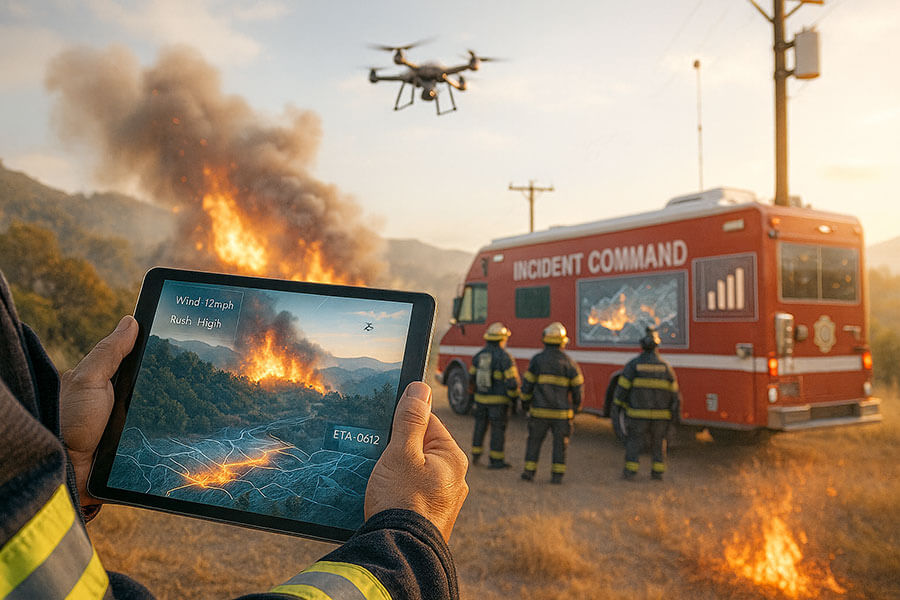
Regional fire authorities serving millions of residents across hundreds of square miles face unprecedented operational complexity. The Los Angeles County Fire Department protects four million residents across 2,300 square miles with 174 fire stations, while Miami-Dade Fire Rescue serves 2.8 million people through 71 stations. These organizations must maintain constant readiness across geographically dispersed territories while managing budgets exceeding hundreds of millions of dollars, coordinating thousands of personnel, and ensuring every emergency call receives appropriate response.
Traditional emergency response systems relied on human experience, paper procedures, and reactive resource management. Dispatchers made deployment decisions based on predetermined coverage zones with limited real-time information about traffic, weather, or incident trends. Apparatus maintenance followed fixed schedules rather than actual equipment condition, often resulting in unexpected failures during critical moments. Station placements remained static despite shifting population densities and changing community risks.
Smart fire services now transform these operations through artificial intelligence, Internet of Things sensors, machine learning algorithms, and advanced data analytics. These technologies fundamentally change how fire departments predict emergencies before they occur, deploy resources to maximize coverage, maintain equipment to prevent failures, and coordinate complex responses involving multiple agencies. Predictive analytics examine historical patterns to forecast where emergencies will occur, enabling proactive apparatus positioning that reduces response times. IoT-enabled equipment continuously monitors mechanical systems, reporting potential failures before apparatus becomes unavailable. AI-powered dispatch systems analyze emergency calls in real-time, assessing severity and recommending optimal resource deployment faster than traditional methods.
The transformation extends beyond operational efficiency to reimagine what regional fire authorities can achieve. Real-time wildland fire prediction systems use weather data, vegetation mapping, and AI algorithms to forecast fire behavior hours before ignition. Smart building monitoring detects fire hazards and automatically alerts fire departments. Firefighter safety improves through wearable sensors tracking vital signs and environmental conditions. Data-driven resource planning ensures station locations, apparatus types, and staffing levels align with actual community risks rather than historical precedent.
This technological revolution arrives when regional fire authorities face mounting pressures from growing populations, increasing call volumes, aging infrastructure, budget constraints, and emerging threats like climate change-driven wildfires. Traditional approaches to scaling fire services through adding stations and apparatus become economically unsustainable. Smart fire service technologies offer pathways to meet these challenges by optimizing existing resources, making better decisions through data analysis, and preventing emergencies before they require expensive suppressive responses.
Understanding Large Regional Fire Authorities
Large regional fire authorities represent a distinct organizational model in emergency services, characterized by enormous service territories, diverse populations, and sophisticated resource management demands. Unlike small municipal departments operating from single stations serving compact areas, regional authorities coordinate emergency response across hundreds of square miles, manage dozens of fire stations simultaneously, and protect populations from hundreds of thousands to several million residents.
The geographic scope creates unique operational challenges. Service territories include wildly diverse landscapes from dense urban cores with high-rises to suburban neighborhoods, rural agricultural areas, mountainous wilderness, and coastal regions. Each environment presents distinct fire risks requiring different equipment, training, and tactics. Urban areas generate high call volumes concentrated in small spaces, while rural regions produce fewer calls spread across vast distances requiring longer response times. Wildland-urban interface zones face catastrophic fire risks during dry seasons, demanding specialized resources and coordination with state and federal wildland agencies.
Population demographics add complexity. Large regions encompass communities with dramatically different socioeconomic characteristics, from wealthy suburbs with modern infrastructure to economically disadvantaged neighborhoods where aging buildings and higher densities increase fire risks. Language diversity requires multilingual emergency call handling. Cultural differences influence how residents interact with emergency services. Age demographics vary significantly, with some communities having large elderly populations requiring more medical responses while others serve younger families with different needs.
The organizational structure reflects operational complexity and scale. Most employ hundreds or thousands of personnel including firefighters, paramedics, fire prevention inspectors, administrative staff, mechanics, technology specialists, and executive leadership. Specialized units handle hazardous materials response, technical rescue, marine firefighting, aircraft firefighting, wildland firefighting, and advanced life support. Administrative departments manage finances, procurement, human resources, training, technology systems, and strategic planning essential for large organization operations.
Scale, Complexity, and Traditional Challenges
Annual emergency call volumes in large regional authorities often exceed 100,000 incidents, with the largest departments responding to over 300,000 calls. This translates to hundreds of simultaneous responses during peak hours, requiring sophisticated coordination to track apparatus locations, manage resource availability, and ensure adequate coverage despite heavy demand. Each call initiates complex decisions about which apparatus to dispatch, which stations need coverage adjustments, whether mutual aid is necessary, and how to handle multiple high-priority calls competing for limited resources.
Response time pressures create constant stress across vast territories where distances alone make rapid response challenging. Industry standards call for arrival within six to eight minutes for ninety percent of calls, but achieving these benchmarks across hundreds of square miles proves difficult without optimal resource positioning. Rural areas may be twenty or thirty miles from the nearest station, making fifteen to twenty-five minute response times unavoidable. Urban areas achieve better times due to higher station density, but traffic congestion, construction, special events, and geographic barriers can delay even short-distance responses.
Resource allocation decisions impact effectiveness and safety across entire regions simultaneously. Regional authorities typically operate fifty to two hundred apparatus including engines, ladder trucks, rescue units, hazardous materials vehicles, and wildland equipment distributed among dozens of stations. Determining how many apparatus per station, which equipment types serve different areas, and how to adjust positioning based on demand patterns requires analyzing complex data about call volumes, response times, equipment utilization, and community risks. Poor allocation results in idle apparatus in low-demand areas while high-demand zones face delays. Traditional approaches relied on historical precedent and subjective judgment rather than sophisticated analysis.
Apparatus maintenance across multiple stations represents another persistent challenge. Fire apparatus combine heavy vehicle chassis with specialized firefighting equipment including pumps, aerial ladders, generators, and breathing air systems. Regular maintenance prevents failures, but scheduling preventive service for dozens of apparatus while maintaining emergency readiness requires careful coordination. Traditional maintenance programs followed fixed schedules regardless of actual condition, sometimes performing unnecessary service while missing developing problems leading to unexpected failures. Maintenance temporarily reduces response capacity, requiring careful scheduling to avoid compromising coverage during high-demand periods.
Wildland-urban interface fire risks pose existential threats to many regional authorities serving territories where residential development extends into fire-prone natural areas. Interface fires can rapidly spread from wildlands into neighborhoods, threatening thousands of homes and requiring massive responses that overwhelm local resources. Predicting when and where fires will ignite, positioning resources for rapid initial attack, coordinating with wildland agencies, and implementing vegetation management require sophisticated planning exceeding traditional capabilities.
Budget constraints affect every aspect despite annual budgets reaching hundreds of millions of dollars. Personnel costs typically consume seventy-five to eighty-five percent of budgets, leaving limited funds for apparatus, equipment, facilities, and technology. Aging apparatus fleets require expensive replacements competing with other capital needs. Economic downturns force budget cuts that may reduce staffing or defer maintenance despite growing demands. Elected officials expect fiscal responsibility and measurable returns on investments, requiring departments to demonstrate efficiency through data rather than anecdotes.
Core Technologies Transforming Fire Services
The technology ecosystem revolutionizing fire services comprises interconnected systems that collect data from diverse sources, analyze information using sophisticated algorithms, and deliver actionable intelligence to firefighters, dispatchers, and command staff in real-time. These technologies form integrated platforms where information flows seamlessly between field operations, dispatch centers, administrative offices, and external data sources including weather services, traffic management, and building databases.
The data collection infrastructure extends beyond traditional computer-aided dispatch systems. Modern systems continuously gather information from hundreds or thousands of sensors distributed throughout service territories, emergency apparatus, buildings, and firefighter equipment. This data flows into centralized analytics platforms processing millions of data points daily, identifying patterns, generating predictions, and detecting anomalies. The volume and velocity would overwhelm human analysts, necessitating automated systems that instantly process information and highlight significant findings while filtering routine data requiring no action.
Data analysis capabilities transform raw information into actionable insights that improve decision-making across all organizational levels. Machine learning algorithms examine years of historical data to identify patterns in when and where incidents occur, enabling predictive models forecasting future emergencies with remarkable accuracy. Natural language processing extracts critical information from emergency call recordings to assess incident severity. Computer vision systems analyze live video feeds to detect hazards and monitor firefighter locations. These analytical capabilities continuously learn and improve as they process more data.
The decision-making cycle enabled by smart fire service technologies operates at speeds impossible for human operators alone. When emergency calls arrive, AI systems instantly analyze caller location, assess problem type, query databases for building information, evaluate traffic conditions, check apparatus availability, and recommend optimal deployment in seconds. During active incidents, real-time integration platforms combine GPS tracking, live video, building floor plans, hazardous materials information, weather, and incident communications into unified displays providing commanders with comprehensive situational awareness.
The human element remains central despite extensive automation. Technology augments rather than replaces firefighter expertise, judgment, and experience. Dispatchers receive AI recommendations but maintain final authority over deployment decisions. Incident commanders access sophisticated data displays but apply tactical knowledge to make strategic decisions. Fire chiefs use predictive analytics to inform strategic planning but exercise professional judgment weighing competing priorities. This human-technology partnership leverages computational speed and analytical power while preserving creativity, ethical judgment, and contextual understanding that only humans provide.
Artificial Intelligence and Machine Learning Applications
Artificial intelligence and machine learning enable computers to perform tasks previously requiring human intelligence and to improve performance through experience rather than explicit programming. AI refers broadly to computer systems performing tasks normally requiring human intelligence such as recognizing patterns, making predictions, understanding language, and solving problems. Machine learning is a subset where systems learn from data rather than following pre-programmed rules, identifying patterns and generalizing to make predictions about new situations.
Pattern recognition algorithms analyze years of emergency call data to identify subtle severity indicators human dispatchers might miss. When someone reports chest pain, machine learning systems trained on thousands of previous cardiac emergency calls assess dozens of factors including age, location, time of day, and symptom descriptions to predict whether the patient is experiencing life-threatening heart attack requiring immediate advanced life support or less severe cardiac issues manageable with basic support. These predictions guide dispatch decisions allocating scarce advanced units to most critical cases while ensuring basic coverage for less severe emergencies.
Predictive modeling uses machine learning to forecast when and where emergencies will occur hours or days in advance with accuracy enabling proactive resource positioning. Algorithms analyze historical patterns showing certain neighborhoods experience elevated call volumes during specific weather conditions, times, or calendar periods. Models incorporate real-time inputs including current weather, scheduled events, and recent incident trends to generate hourly predictions of expected call volumes by zone. Fire departments can use these predictions to adjust apparatus positioning before demand surges, moving units from predicted low-demand areas to high-demand zones so resources are optimally positioned when emergencies happen.
Automated risk assessment systems evaluate properties throughout territories to identify buildings with elevated fire risks requiring enhanced protection, inspection, or code enforcement attention. Machine learning models analyze property characteristics including age, construction type, occupancy classification, prior fire history, and violations to calculate risk scores for every structure. High-risk properties can receive priority for inspections, pre-incident planning, and potentially enhanced first alarm assignments that automatically dispatch additional resources when emergencies occur at these locations. This data-driven approach targets limited fire prevention resources toward properties where interventions will have greatest impact.
Resource optimization algorithms solve complex mathematical problems determining optimal apparatus placement, staffing levels, and equipment distribution across regional territories. These algorithms consider thousands of variables simultaneously including historical call locations, response time objectives, apparatus capabilities, station locations, traffic patterns, and budget constraints to calculate allocations maximizing coverage and minimizing response times within available funding. AI algorithms can find solutions closer to mathematically optimal arrangements, potentially improving system performance significantly while saving resources through more efficient utilization.
Research institutions including the National Institute of Standards and Technology have developed AI systems that demonstrate the potential for enhancing firefighter safety and operational effectiveness. Scientists have created machine learning models capable of predicting dangerous flashover conditions in burning buildings and detecting abnormal cardiac rhythms in firefighters that could indicate life-threatening medical emergencies. While these systems remain in research and development phases, they illustrate how AI technologies could eventually provide real-time warnings that protect firefighters from the leading causes of line-of-duty deaths.
IoT Sensors and Connected Equipment
Internet of Things technology fundamentally changes how fire departments monitor equipment, track resources, and maintain situational awareness by connecting physical devices to networks enabling continuous data collection and remote monitoring. IoT means everyday objects enhanced with sensors, processors, and network connectivity allowing them to collect information about their condition and environment, transmit data to central systems, and potentially receive commands modifying their behavior.
Apparatus health monitoring systems replace reactive maintenance with predictive systems identifying potential failures before causing apparatus unavailability. Modern fire engines contain dozens of sensors monitoring engine performance, transmission operation, pump function, hydraulic systems, electrical systems, and other critical components. Sensors collect data continuously while apparatus operate, transmitting measurements to fleet management systems analyzing performance trends. Machine learning algorithms trained on data from thousands of vehicles identify patterns indicating developing problems such as declining pump efficiency, transmission wear, or engine performance degradation. Maintenance personnel receive alerts about potential failures days or weeks before components fail, enabling scheduled repairs during low-demand periods rather than emergency repairs taking apparatus out of service unexpectedly during busy times.
Equipment tracking systems using GPS and IoT sensors provide real-time visibility into location and status of apparatus, specialized equipment, and individual firefighter tools throughout vast territories. GPS trackers continuously report positions to computer-aided dispatch systems displaying apparatus locations on maps and automatically calculating arrival times at incidents. Specialized equipment including ventilation fans, hydraulic rescue tools, and hazardous materials gear contains RFID tags or IoT trackers reporting locations and usage status. These systems prevent equipment loss, ensure specialized tools are available when needed, and provide utilization data informing purchasing decisions. During major incidents involving dozens of apparatus from multiple agencies, tracking systems provide incident commanders with comprehensive awareness of available resources.
Building monitoring systems deployed in commercial structures, high-rises, and critical facilities create early warning networks detecting fire hazards before they create emergencies. IoT-enabled smoke detectors, heat sensors, and flame detectors continuously monitor for fire indicators and automatically transmit alarms to dispatch centers when problems are detected. Water flow sensors on sprinkler systems detect activations instantly, allowing rapid response to fires that sprinklers cannot extinguish alone. Structural monitoring sensors in aging buildings track settlement and deterioration creating potential collapse risks during firefighting operations. These integrated systems enable fire departments to receive immediate notification of potential problems rather than waiting for building occupants to discover and report emergencies.
Weather monitoring networks using IoT sensors distributed throughout territories provide localized, real-time environmental data essential for wildland fire prediction and operational safety planning. Networks measuring temperature, humidity, wind speed, wind direction, and rainfall provide more detailed weather information than regional forecasts that may not capture microclimates. During wildland fire season, weather networks feed data into fire behavior prediction models forecasting how fires will spread under current conditions. Lightning detection sensors provide early warning of potential wildfire ignitions during dry lightning storms.
Wildland fire detection sensors deployed in forests and remote areas represent a rapidly evolving IoT application that enables early identification of fire ignitions before they grow into major conflagrations. These specialized sensors use multiple detection technologies including optical smoke detection, thermal imaging, and gas sensors to identify fires in their earliest stages when suppression remains feasible with minimal resources. Solar-powered sensor networks installed on towers, trees, or remote mountaintops continuously monitor vast wildland areas, transmitting alerts to fire dispatch centers within minutes of detecting smoke or heat signatures indicating fire activity. Some systems combine visual confirmation through pan-tilt-zoom cameras that automatically orient toward detected anomalies, allowing dispatchers to verify actual fires versus false alarms from dust, fog, or controlled burns. When sensors detect fires in remote areas where human observation is unlikely, they enable rapid initial attack responses that can contain small fires to a few acres rather than allowing them to spread undetected for hours into thousand-acre disasters. Regional fire authorities serving territories with extensive wildland-urban interface zones increasingly view these detection networks as cost-effective alternatives to fixed-wing aircraft patrols or fire lookout towers, providing continuous monitoring capabilities.
Firefighter safety devices incorporating IoT sensors and connectivity protect personnel during dangerous operations by monitoring environmental conditions, tracking locations, and detecting emergencies requiring immediate rescue. Personal alert safety systems evolved beyond simple motion detectors to sophisticated sensors monitoring vital signs, air supply levels, environmental temperatures, toxic gas exposure, and precise locations within structures. If firefighters become immobilized, run low on breathing air, or experience medical distress, automated alerts notify incident commanders who can initiate immediate rescue operations. These safety technologies reduce line-of-duty injuries and deaths by providing earlier warnings of dangerous conditions and enabling faster rescue responses.
Predictive Analytics and Resource Optimization
Predictive analytics transforms fire service planning from reactive approaches based on historical averages to proactive strategies guided by sophisticated forecasts of future emergency demands. The fundamental premise is that emergency incidents follow patterns influenced by weather conditions, times of day, calendar periods, demographic factors, building characteristics, and countless other variables creating predictable fluctuations in when, where, and what types of emergencies will occur. By identifying patterns in historical data and monitoring current conditions influencing emergency risks, predictive systems generate forecasts enabling fire departments to position resources optimally before emergencies happen.
Data foundations supporting predictive analytics are vast and diverse, combining internal department records with external information sources. Years of historical incident data form the core analytical dataset, documenting millions of emergency responses including incident locations, times, types, response outcomes, resource utilization, and environmental conditions. This reveals patterns such as increased cardiac emergencies during extreme heat, elevated vehicle accidents during rain, or concentrated fire incidents in specific neighborhoods. Computer-aided dispatch systems continuously add new incident data, allowing predictive models to incorporate recent trends and detect emerging patterns.
Weather data integration enhances prediction accuracy by accounting for environmental factors strongly influencing emergency frequencies and types. Temperature extremes correlate with medical emergencies as vulnerable populations suffer heat exhaustion or cold exposure. Precipitation affects traffic accident rates and wildland fire risks. Wind conditions impact fire behavior and spread rates. Advanced predictive systems incorporate detailed weather forecasts extending days into future, adjusting resource positioning recommendations based on predicted conditions affecting emergency demands. Real-time weather monitoring enables dynamic updates as actual conditions evolve.
Community demographic information provides crucial context about population characteristics influencing emergency service demands and optimal resource distribution. Population density maps identify areas where high resident concentrations generate more calls per square mile. Age distribution data highlights neighborhoods with elderly populations requiring more medical responses. Occupancy patterns showing where people work, shop, and spend time during different hours reveal how emergency demand locations shift throughout the day. School calendars, special events, and seasonal tourism affect population distributions temporarily, requiring short-term adjustments.
Optimization algorithms represent mathematical engines processing vast datasets to calculate resource allocation strategies maximizing coverage and minimizing response times within budget constraints. These algorithms formulate fire service planning as complex mathematical problems with millions of possible solutions, searching systematically for configurations best satisfying multiple competing objectives. Modern optimization techniques using AI and advanced mathematics find solutions closer to theoretical optimums, potentially improving system performance significantly compared to traditional planning methods that relied on simple heuristics and manual adjustments.
Smart Apparatus Placement and Wildland Fire Prediction
Dynamic apparatus deployment strategies represent a fundamental shift from static station-based resource positioning to flexible approaches continuously adjusting apparatus locations based on real-time demand patterns and predicted future needs. Traditional departments positioned apparatus at fixed stations where they remained unless responding to emergencies, even when predictable demand patterns meant resources sat idle in low-demand areas while high-demand zones faced delays. Smart deployment strategies use predictive analytics to forecast which areas will likely experience elevated demand during upcoming hours, then recommend relocating apparatus from predicted low-demand zones to high-demand areas before calls arrive.
Predictive analytics systems can analyze historical incident patterns, current weather conditions, and scheduled events to generate hourly forecasts of expected emergency calls by geographic zone. These systems recommend proactive apparatus positioning adjustments that move units between stations based on predicted demand, potentially reducing average response times compared to traditional static positioning. During high-demand periods including weekday afternoons and weekend evenings, systems might recommend moving apparatus from outlying rural stations into suburban areas where call volumes typically surge. As demand shifts overnight to different areas, recommendations adjust accordingly to maintain optimal coverage throughout the day.
Station location optimization represents another powerful application that can fundamentally reshape regional authority coverage strategies over multi-year planning horizons. As communities grow and change, optimal station locations shift due to changing population distributions, new developments, infrastructure expansion, and evolving risk patterns. Predictive analytics combined with optimization algorithms evaluate thousands of potential station configurations to identify arrangements maximizing coverage improvements per dollar invested, guiding strategic decisions about where to build new stations, whether to close underutilized facilities, and how to reallocate apparatus as territories evolve.
Wildland fire prediction systems represent perhaps the most sophisticated predictive analytics application, combining weather forecasting, vegetation monitoring, topographic analysis, and fire behavior modeling to forecast when and where wildfires will ignite and how they will spread once burning. These systems address one of the most dangerous and expensive challenges facing departments in fire-prone regions, where interface fires can rapidly grow from small ignitions into conflagrations destroying hundreds of homes and threatening entire communities. The ability to predict fire risks hours or days before ignitions occur enables proactive resource prepositioning, public warnings, temporary fire restrictions, and enhanced initial attack capabilities.
Advanced wildland fire prediction platforms can integrate data from extensive weather station networks distributed across mountainous territories with satellite imagery showing vegetation moisture content, historical fire occurrence patterns, real-time lightning detection networks, and IoT fire detection sensors deployed in high-risk wildland zones. Machine learning algorithms trained on decades of fire behavior data analyze current conditions to generate fire risk forecasts and fire weather watches guiding operational planning. When conditions indicate elevated fire risk, systems can recommend prepositioning wildland apparatus in high-risk areas, increasing staffing levels, restricting public access to dangerous areas, and alerting residents in vulnerable communities to prepare for potential evacuations.
Fire spread prediction capabilities within these systems enable incident commanders to anticipate how existing fires will grow under current and forecasted conditions, informing tactical decisions about resource deployment and community protection priorities. Computer models simulate fire behavior based on fuel characteristics, terrain features, weather conditions, and fire intensity to generate predictions of fire perimeters hours into the future. These predictions identify communities threatened by fire spread, optimal locations for establishing containment lines, and whether available resources are sufficient or additional support is necessary. Real-time updates as conditions change allow dynamic replanning as fires evolve.
Prevention strategies informed by predictive analytics target vegetation management, public education, and code enforcement efforts toward areas where interventions will most effectively reduce fire risks. Predictive models identify specific neighborhoods within wildland-urban interface zones facing highest fire risks based on vegetation density, topographic features, historical fire occurrence, and housing characteristics. Fire departments can concentrate defensible space inspections, community education programs, and vegetation clearing initiatives in these high-risk areas rather than distributing prevention resources equally regardless of actual risk levels.
Real-Time Operations and Incident Management
Real-time technology applications during active emergencies transform how fire departments coordinate responses, maintain situational awareness, and make tactical decisions under intense pressure of life-threatening situations. While predictive analytics improve preparedness before incidents occur, real-time systems directly impact outcomes during critical minutes when emergencies unfold and seconds count. These technologies must operate with absolute reliability under adverse conditions including network disruptions, extreme weather, hazardous environments, and chaos inherent in major emergencies where dozens of apparatus from multiple agencies coordinate complex operations.
Command and control systems supporting modern incident management integrate information from diverse sources into unified displays providing incident commanders with comprehensive situational awareness impossible through traditional communication methods alone. Rather than relying solely on radio reports from individual firefighters describing what they observe from limited perspectives, commanders can access real-time data feeds showing precise apparatus locations, building floor plans, hazardous materials information, water supply locations, weather conditions, traffic updates, and live video from scenes. This information integration enables commanders to understand evolving situations more completely and quickly than traditional approaches allowed.
Mobile technology enables firefighters to access critical information directly on scene without requiring radio communications with dispatchers or command staff. Tablet computers and smartphones running specialized applications provide responding crews with building floor plans, occupancy information, hazardous materials data, property access details, and pre-incident plans while enroute to emergencies. This information access speeds tactical planning and improves firefighter safety by warning of hazards before crews enter dangerous environments. Mobile devices also enable field personnel to submit incident reports, request resources, and update command staff about changing conditions.
Data integration platforms combining computer-aided dispatch systems with GPS tracking, building databases, weather services, traffic management systems, and specialized applications create the technological backbone supporting real-time operations. These platforms must process hundreds or thousands of data updates per second during major incidents while maintaining performance and reliability firefighters depend upon for safety and operational effectiveness. Modern systems use cloud computing infrastructure that scales automatically to handle varying workloads and provides redundancy protecting against single points of failure.
Incident command systems evolved from paper-based procedures and radio communications to sophisticated software platforms managing resource tracking, tactical planning, documentation, and multi-agency coordination during complex or extended operations. Digital incident command systems maintain real-time status of all assigned resources including locations, assignments, and availability while automatically generating organizational charts and resource lists that federal incident management standards require. During major incidents involving dozens of apparatus and multiple agencies, these systems prevent confusion and miscommunication that plagued traditional paper-based tracking methods.
AI-Powered Dispatch Systems and Data Integration
Intelligent dispatch systems represent perhaps the most immediate AI application in fire service operations, directly impacting response effectiveness during critical seconds between receiving emergency calls and deploying appropriate resources. Traditional dispatch approaches relied on human dispatchers to assess incident severity, determine appropriate resource assignments, and manually enter dispatch information into computer systems before transmitting alerts to crews. AI-powered dispatch augments human capabilities by instantly analyzing emergency calls, querying relevant databases, evaluating resource availability, and recommending optimal responses faster and more consistently than human dispatchers working alone.
Natural language processing algorithms underlying AI dispatch systems analyze emergency caller speech patterns, word choices, background sounds, and vocal stress indicators to assess incident severity and type with remarkable accuracy. When someone calls 911 reporting a fire, algorithms trained on thousands of previous fire calls evaluate dozens of factors to predict fire size and spread rate before firefighters arrive. The caller’s tone might indicate panic suggesting serious incident, or calm demeanor might suggest minor problem. Background sounds including smoke alarms, breaking glass, or shouting voices provide additional clues about incident severity. Specific words used to describe situations correlate with different outcome probabilities that algorithms learned from analyzing historical calls and associated incident outcomes.
Machine learning systems recommending optimal resource deployment consider vastly more factors than traditional predetermined response assignments could incorporate. Rather than simply dispatching the closest available engine company and ladder truck to every structure fire regardless of circumstances, intelligent systems can evaluate building characteristics, occupancy type, time of day, reported fire indicators, and dozens of other variables to recommend response configurations tailored to predicted incident requirements. A reported fire in single-family dwelling at night might receive standard response, while the same call in large apartment building during daytime might automatically receive enhanced assignments including additional engine companies and rescue units based on higher life risk.
Research into AI-powered dispatch systems demonstrates their potential to improve emergency medical response by identifying critical patients requiring the most experienced paramedic crews. These systems evaluate caller descriptions of patient conditions, medical history information from linked health records where available, and situational factors to score each medical call on criticality scales. Highest-priority calls could automatically receive dispatch of advanced life support units staffed by veteran paramedics, while lower-priority calls may receive basic life support responses freeing advanced resources for critical cases. This intelligent triage aims to improve advanced life support unit availability for critical cases while maintaining appropriate response to all patients.
Data integration during active incidents provides incident commanders with comprehensive situational awareness improving tactical decision-making and firefighter safety. Modern incident command platforms combine computer-aided dispatch data showing assigned resources and incident information with GPS tracking revealing exact apparatus locations and estimated arrival times. Building information systems provide floor plans, construction details, and occupancy information informing tactical planning. Hazardous materials databases warn of dangerous chemicals present at incident locations. Weather services provide real-time wind, temperature, and humidity data affecting fire behavior. This comprehensive integration creates common operating pictures that all command staff and responding crews can access, ensuring everyone works from consistent, current information.
Integration extends beyond information display to include automated analysis highlighting significant patterns and emerging problems requiring command attention. Algorithms can monitor firefighter vital signs and alert commanders when personnel show signs of heat stress or exhaustion requiring rehabilitation. Computer vision systems analyze live video feeds from incidents to detect fire spread, structural instability, or firefighters entering potentially dangerous areas. Resource tracking systems warn when response times exceed target thresholds or when available resources may prove insufficient for escalating incidents requiring additional alarms. These automated monitoring capabilities act as additional analytical support augmenting incident commander awareness during chaotic situations.
Pre-incident planning integration with real-time systems ensures critical information collected during building inspections and familiarization visits is instantly available when emergencies occur at those locations. Fire departments conduct pre-incident surveys of large buildings, industrial facilities, and other high-risk occupancies to document building layouts, fire protection systems, hazardous materials storage, utility shutoffs, and access considerations. Modern systems link pre-incident plans to property addresses in computer-aided dispatch databases, automatically displaying relevant plans on apparatus mobile data terminals when units are dispatched to surveyed locations. This automatic information delivery ensures responding crews have access to critical tactical information before arriving on scene.
Cross-agency data sharing during major incidents requiring resources from multiple fire departments, law enforcement agencies, emergency medical services, and public works organizations creates unprecedented coordination capabilities. Unified computer-aided dispatch systems allow multiple agencies to view common incident information and coordinate resource deployment without requiring redundant radio communications that can saturate frequency allocations during major emergencies. Shared GPS tracking shows apparatus locations from all responding agencies, preventing duplication of coverage and ensuring optimal resource distribution across large incident scenes. These integration capabilities prove especially valuable during disaster responses where dozens or hundreds of resources from multiple counties or states converge on incident scenes.
Benefits and Implementation Impact
Smart fire service technology adoption delivers measurable benefits across multiple dimensions of emergency service operations, improving outcomes for communities, firefighters, and fire department administration while providing returns on technology investments that justify continued modernization efforts. The most successful technology deployments achieve triple wins by simultaneously improving community safety outcomes, enhancing firefighter safety and effectiveness, and enabling more efficient resource utilization reducing costs or improving service delivery within constrained budgets.
Community benefits center on improved emergency response effectiveness translating to lives saved, reduced property losses, and enhanced quality of life through reliable emergency services. Faster response times achieved through predictive apparatus positioning and optimized dispatch decisions mean firefighters arrive sooner at medical emergencies, potentially preventing brain damage or death from delayed CPR or defibrillation. Earlier fire service intervention keeps small fires from growing into major conflagrations destroying entire structures and threatening neighboring properties. More accurate assessment of emergency severity ensures critical incidents receive appropriate resources immediately rather than requiring escalating response assignments that delay effective intervention.
Fire departments that have implemented comprehensive technology modernization programs integrating predictive analytics, IoT equipment monitoring, and AI-enhanced dispatch systems report improvements in emergency response metrics. Emergency medical response times can decrease by thirty to sixty seconds on average, while structure fire response times show similar improvements. More significantly, outcome measures including cardiac arrest survival rates and civilian fire fatalities often improve following technology implementation. While multiple factors influence these outcomes, departments implementing smart fire service technologies attribute improvements primarily to faster response times and better resource allocation enabled by data-driven systems.
Firefighter benefits extend beyond improved operational effectiveness to fundamental safety enhancements reducing injury risks and providing faster response when firefighters need assistance during dangerous operations. Real-time location tracking and vital sign monitoring systems deployed in personal protective equipment enable incident commanders to maintain constant awareness of where firefighters are operating within structures and whether they are experiencing physiological stress indicating heat exhaustion, cardiac problems, or oxygen deprivation. Automated personnel accountability systems prevent tragic errors that occur when command staff lose track of firefighters during chaotic incidents, potentially failing to recognize when personnel are missing until dangerous delays have passed.
Equipment reliability improvements achieved through IoT-based predictive maintenance prevent apparatus mechanical failures that can strand firefighters at emergency scenes or create dangerous situations when pumps fail during firefighting operations. Fire departments implementing IoT maintenance systems report thirty to fifty percent reductions in unscheduled apparatus unavailability due to mechanical failures, translating to fewer situations where firefighters face emergencies without functioning equipment. Predictive approaches that monitor thousands of sensor readings continuously identify subtle performance degradations that precede failures, enabling repairs before complete breakdowns occur.
Administrative benefits encompass direct cost savings from operational efficiencies and strategic capabilities enabling fire service leaders to make better decisions about long-term planning, resource allocation, and risk management. Fuel costs decline when optimized apparatus positioning reduces unnecessary driving distances, with large departments potentially achieving annual savings exceeding one hundred thousand dollars through reduced fuel consumption. Maintenance expenses decrease through predictive approaches preventing major component failures requiring expensive emergency repairs while extending apparatus service life by addressing problems before they cause secondary damage.
Strategic planning capabilities improve dramatically when fire service leaders have access to comprehensive data about community risks, response performance, resource utilization, and outcome trends informing decisions about station locations, apparatus purchases, training priorities, and prevention program targeting. Data-driven planning enabled by smart systems analyzes hundreds of variables simultaneously to identify patterns and relationships that human planners would never recognize, generating insights that improve decision quality across organizations. Some departments use predictive analytics to support impact analyses showing elected officials exactly how different budget scenarios would affect response times and coverage in specific neighborhoods, creating more informed public policy discussions.
Risk management and liability reduction represent increasingly important administrative benefits as fire departments face growing litigation risks from allegations of negligent training, inadequate response, or equipment failures. Smart systems provide comprehensive documentation of training completion, equipment maintenance, response times, and operational decisions that prove valuable in defending against liability claims. Automated compliance monitoring ensures departments meet applicable standards for apparatus inspections, personnel certifications, and operational procedures without requiring extensive manual tracking and documentation that consumed significant administrative time under traditional approaches.
Challenges and Considerations
Regional fire authorities face substantial challenges when implementing smart fire service technologies requiring careful planning, significant resources, and sustained commitment to overcome barriers that have slowed adoption in many organizations. These obstacles span financial, technical, organizational, and cultural dimensions, creating complex implementation environments where success demands more than simply purchasing technology products. Understanding these challenges helps fire service leaders develop realistic implementation strategies that anticipate problems, build stakeholder support, and create sustainable technology programs.
Financial challenges begin with initial acquisition costs for hardware, software, sensors, and infrastructure that can total millions of dollars for large regional authorities implementing comprehensive technology systems. IoT sensors for apparatus monitoring might cost thousands of dollars per vehicle, multiplied across fleets of fifty to one hundred emergency apparatus. Building monitoring systems require purchasing and installing sensors in hundreds or thousands of structures throughout jurisdictions. Predictive analytics platforms involve substantial licensing fees plus implementation services from specialized consultants. These upfront costs create significant budget obstacles for fire departments operating under tight fiscal constraints where competing priorities including personnel costs, apparatus replacement, and facility maintenance consume available resources.
Ongoing operational costs for technology systems including software licensing, cloud computing services, maintenance contracts, and technical support staffing add to total cost of ownership that must be sustained over multi-year periods. Unlike apparatus purchases involving large upfront investments but relatively predictable maintenance costs, technology systems often involve recurring subscription fees creating permanent budget commitments. Cloud computing costs may increase as systems process more data, creating budget uncertainty. Technical support requirements may necessitate hiring specialized information technology personnel with expertise in IoT systems, data analytics, or cloud computing that traditional fire service IT staffs may lack. These ongoing expenses can equal or exceed initial acquisition costs over typical five to ten year technology lifecycles.
Technical infrastructure requirements create additional implementation challenges when existing networks, computing systems, and data storage capabilities prove inadequate for smart fire service technology demands. IoT sensor networks require reliable wireless connectivity across entire service territories including remote rural areas where cellular coverage may be limited or unavailable. Real-time data integration platforms need high-bandwidth network connections between fire stations, dispatch centers, and cloud computing systems that can handle continuous data streams from hundreds of sources. Legacy computer systems may lack application programming interfaces necessary to share data with new platforms, requiring expensive custom integration development or complete system replacements.
Training and change management represent persistent challenges determining whether technology implementations succeed or fail regardless of technical capabilities. Firefighters and emergency dispatchers must learn new procedures, interfaces, and concepts that may seem complex compared to familiar traditional approaches practiced for years or decades. Older personnel may resist technology adoption due to discomfort with computers or skepticism about whether new systems actually improve proven traditional methods. Initial system deployments often experience bugs or performance issues frustrating early users and creating negative perceptions difficult to overcome even after problems are resolved. Successful change management requires sustained training programs, effective communication about implementation benefits, visible leadership support, and patient persistence through inevitable early difficulties.
Data privacy and security concerns create legitimate worries about protecting sensitive information collected by smart fire service systems from unauthorized access, misuse, or cyber attacks that could compromise community safety or individual privacy. IoT sensors deployed throughout communities collect information about building occupancies, emergency incidents, and infrastructure conditions that could be valuable to criminals if accessed by unauthorized parties. Personnel tracking systems know precise locations of emergency responders at all times, information that could enable targeted attacks if compromised. Medical emergency data contains protected health information subject to strict privacy regulations creating legal obligations and potential liability if security breaches occur. The interconnected nature of modern technology systems means vulnerabilities in one component might provide access to entire networks.
Interoperability challenges arise when attempting to integrate technology systems from different vendors using incompatible data formats, communication protocols, or architectural approaches. Fire departments often acquire systems incrementally from various suppliers over many years, creating heterogeneous technology environments where components cannot easily share information. Computer-aided dispatch systems from one vendor may not communicate effectively with apparatus tracking systems from different suppliers or predictive analytics platforms from third-party developers. Standard data formats and application programming interfaces exist for some fire service applications but remain limited compared to other industries with longer technology adoption histories.
Vendor selection and technology assessment difficulties arise because fire service leaders often lack technical expertise needed to evaluate competing products, assess vendor claims, or negotiate effective contracts. Marketing materials from technology vendors emphasize potential benefits while minimizing implementation challenges, costs, and limitations. Demonstration systems shown during sales processes may not accurately represent performance under actual operational conditions. Reference checks with other fire departments might not reflect honest assessments if departments are reluctant to admit implementation difficulties or if their operational environments differ substantially. Contract terms may include provisions that limit performance guarantees, create vendor lock-in preventing switching to alternative products, or allow price increases exceeding budget projections.
Maintaining human judgment in automated systems represents a critical consideration requiring ensuring that technology augments rather than replaces professional expertise, ethical reasoning, and contextual understanding that only human emergency responders provide. While AI systems excel at analyzing large datasets and recognizing patterns, they lack creativity, empathy, and moral reasoning essential for ethical emergency service delivery. Algorithms may perpetuate biases present in historical data, potentially resulting in discriminatory resource allocation if not carefully monitored. Over-reliance on automated recommendations could erode critical thinking skills among dispatchers and incident commanders who may stop questioning system outputs even when situational factors suggest alternative approaches would be more appropriate.
Digital divide issues arise when technology-dependent service delivery creates unequal outcomes for community members with different levels of technology access, digital literacy, or language capabilities. Smart fire service systems that depend on residents having smartphones to receive emergency alerts may fail to reach vulnerable populations including elderly, low-income, or immigrant communities who lack devices or technical knowledge to use them effectively. Online platforms for fire prevention information or service requests may exclude residents without reliable internet access or computer skills. Ensuring equitable service delivery requires consciously designing technology systems and procedures that accommodate diverse community needs.
Final Thoughts
The integration of artificial intelligence, Internet of Things sensors, and advanced data analytics into regional fire service operations represents far more than incremental technological improvement—it embodies a fundamental transformation in how emergency services protect communities and respond to increasingly complex challenges of modern public safety. As this evolution accelerates across fire departments nationwide, the implications extend well beyond faster response times or more efficient resource allocation to encompass questions about the very nature of emergency services in the twenty-first century.
The transformative potential of smart fire service technology lies not merely in computational capabilities but in how it democratizes access to sophisticated analytical tools previously available only to the largest, best-funded departments. Small regional fire authorities serving rural or economically disadvantaged communities can now leverage cloud-based predictive analytics and AI dispatch systems that would have required millions of dollars in capital investment just years ago. This democratization creates opportunities to reduce persistent disparities in emergency service quality between affluent suburban departments with extensive resources and struggling rural agencies operating on limited budgets. When technology enables a modest fire department to achieve response performance comparable to much larger organizations, it fundamentally challenges traditional assumptions about relationships between funding levels and service quality.
Looking toward the future, emerging technologies promise even more profound transformations. Artificial intelligence capabilities continue advancing rapidly with systems becoming increasingly sophisticated in analytical abilities. Drone technologies could provide rapid initial assessment of emergency scenes before firefighters arrive, or even deliver firefighting suppressants to inaccessible locations. Advanced sensors might detect fires in very early stages before flames even appear, enabling intervention that prevents rather than suppresses fires. Machine learning systems trained on decades of emergency data might identify subtle patterns in community conditions that predict which specific buildings will experience fires weeks before ignitions occur, enabling targeted prevention interventions.
However, ongoing challenges of implementation, integration, and maintaining human-centered values in increasingly automated systems demand thoughtful attention as smart fire services evolve. Technology must remain subordinate to the fundamental mission of protecting lives and property rather than becoming an end pursued for novelty or competitive advantage. The most sophisticated predictive analytics provide little value if implementation costs divert resources from essential firefighter training or apparatus maintenance. Real-time tracking systems that enhance situational awareness could enable excessive surveillance that erodes trust if deployed without appropriate transparency and restraint. Navigating these tensions requires fire service leaders to maintain clear focus on community protection as the ultimate goal guiding all technology decisions.
The cultural transformation within fire services represents perhaps the most significant long-term impact of smart technology adoption, challenging traditional practices and professional identities while creating opportunities for new forms of expertise and leadership. Firefighters who built careers on physical courage and technical skills must now also develop data literacy and technological competence to operate effectively in modernized departments. Fire chiefs who rose through ranks based on operational experience must become technology leaders capable of evaluating complex systems and guiding digital transformation. The profession’s culture, historically resistant to change and skeptical of innovations threatening established practices, must evolve to embrace continuous improvement and evidence-based operations that challenge traditional approaches when data suggests better alternatives exist.
The responsibility for shaping this transformation extends beyond fire service organizations to encompass the broader ecosystem of policymakers, technology vendors, researchers, and community stakeholders who collectively determine how emergency services evolve. Elected officials must appropriate adequate funding while holding departments accountable for measurable performance improvements. Technology vendors need to develop products genuinely tailored to fire service needs rather than repurposing solutions designed for other industries. Academic researchers should rigorously evaluate technology implementations to identify what works, what fails, and why, generating evidence that informs better decision-making. Communities must engage in informed discussions about acceptable trade-offs between enhanced emergency protection and concerns about privacy, surveillance, and technology dependence.
Ultimately, smart fire service technology represents powerful tools that enhance human capabilities rather than replacements for the courage, skill, and dedication defining the firefighting profession. The vision of technology-enabled emergency services is not one where robots replace firefighters but rather where data-driven insights, real-time information, and predictive capabilities enable emergency responders to make better decisions, work more safely, and protect communities more effectively than ever before. As regional fire authorities navigate this transformation, maintaining focus on this human-centered vision ensures technology serves its proper role as enabler of improved emergency services rather than becoming an end pursued for its own sake.
FAQs
- What exactly are smart fire services and how do they differ from traditional fire departments?
Smart fire services use artificial intelligence, IoT sensors, predictive analytics, and data integration to enhance emergency response beyond traditional approaches. While conventional departments rely primarily on human experience and reactive procedures, smart services leverage technology to predict where emergencies will occur, optimize resource positioning proactively, monitor equipment health continuously, and provide real-time situational awareness during incidents. The core mission of protecting lives and property remains unchanged, but technology provides tools enabling faster, more effective responses while improving firefighter safety and operational efficiency. - How much does it cost to implement smart fire service technology?
Implementation costs vary dramatically based on department size, existing infrastructure, and system scope. Small-scale implementations focusing on specific capabilities might cost tens of thousands to low hundreds of thousands of dollars initially, while comprehensive transformations at large regional authorities can require multi-million dollar investments. Beyond initial acquisition costs, ongoing expenses including software licensing, cloud computing, maintenance, and technical support typically add twenty to forty percent of initial costs annually. However, operational savings from reduced equipment failures, optimized resource utilization, and improved efficiency often offset some or all ongoing costs within three to five years. - Do firefighters need special training to use smart fire service technology?
Yes, effective use requires training on new systems, procedures, and concepts, though specific requirements vary based on personnel roles and technology complexity. Firefighters typically need training on mobile data terminals, apparatus-mounted sensors, and communications systems. Dispatchers require more extensive training on AI-powered dispatch systems, predictive analytics interfaces, and data integration platforms. Most departments report basic competency can be achieved through forty to eighty hours of initial training, with ongoing education needed as systems evolve and new capabilities are added. - How secure is data collected by smart fire service systems?
Data security employs multiple protective layers including encryption, access controls, network security, and regular security audits to protect information from unauthorized access or cyber attacks. Modern systems encrypt data both during transmission and while stored. Access controls ensure only authorized personnel can view sensitive information. Network security measures including firewalls and intrusion detection systems protect against external attacks. However, no system is completely invulnerable, requiring departments to maintain security protocols, update systems regularly, and train personnel on security best practices. - How long does full implementation take?
Full implementation timelines typically range from eighteen months to five years depending on project scope, department size, and implementation approach. Departments often adopt phased strategies deploying technologies incrementally. Initial planning and vendor selection might require six to twelve months. System deployment and integration could take another six to eighteen months. Training personnel and refining procedures based on early operational experience often continues another twelve to twenty-four months before systems reach mature, stable operation. Larger regional authorities with more complex operations generally require longer implementation periods. - Can smart fire service technology work in smaller departments?
Yes, smart technology offers value for departments of virtually all sizes, though specific applications may differ. Small departments might focus on targeted technologies addressing their most pressing challenges. Cloud-based services enable small departments to access sophisticated analytics without large capital investments in on-premise infrastructure. Regional cooperation agreements allow multiple small departments to share technology platforms and implementation costs. However, very small departments with limited budgets and minimal technical expertise may find implementation challenging without external support from regional consortiums or state agencies. - Will smart technology eliminate firefighter positions?
Smart technology augments rather than replaces firefighters, generally creating new job requirements rather than eliminating positions. While automation handles routine tasks like equipment monitoring or data analysis, core work of emergency response, fire suppression, and rescue operations remains fundamentally human-centered. Some departments have created new specialized positions including data analysts and technology coordinators, expanding total staffing. The profession evolves to require broader skill sets including technology literacy alongside traditional firefighting capabilities, but the fundamental nature remains unchanged. - How do departments measure whether technology is improving outcomes?
Departments measure impact through multiple quantitative and qualitative metrics including response time improvements, outcome statistics, cost reductions, and stakeholder feedback. Response time tracking shows whether predictive positioning and optimized dispatch reduce community wait times. Outcome measures including fire losses, civilian injuries, firefighter injuries, and medical emergency survival rates demonstrate whether faster responses improve results. Cost analysis evaluates whether operational efficiencies reduce expenses. Comprehensive evaluation requires establishing baseline measurements before implementation and tracking changes over multi-year periods. - What should departments look for when selecting technology vendors?
Vendor selection should evaluate multiple factors including product capabilities, company stability, customer support quality, integration capabilities, cost structures, and implementation track record. Departments should request demonstrations using their own data and operational scenarios. Reference checks with current customers provide insights into actual performance versus marketing claims. Contract terms warrant careful review regarding performance guarantees, pricing structures, and upgrade policies. Vendor financial stability matters because systems require ongoing support over many years. Some departments benefit from hiring independent consultants to assist with vendor evaluation. - How can departments with limited budgets get started?
Departments can begin through modest initial steps that build knowledge and demonstrate value before committing to large investments. Starting with focused applications addressing specific pain points reduces costs and complexity while generating early wins. Cloud-based services offered through subscription models eliminate large upfront capital costs. Pilot programs test technologies on limited scales. Regional partnerships allow multiple departments to share costs and expertise. Grant funding from federal or state agencies may offset some implementation expenses. Professional organizations offer educational resources about technology adoption.