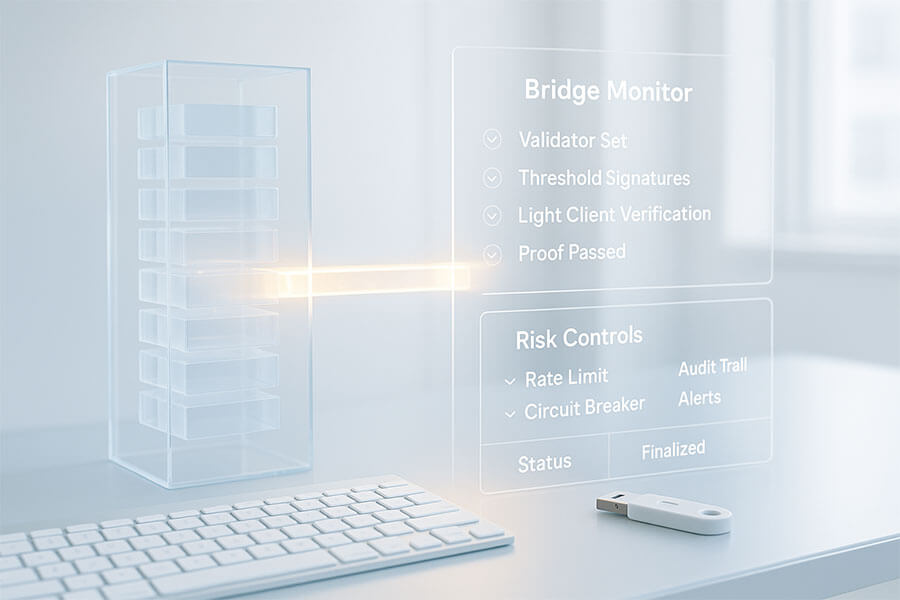
The blockchain ecosystem has evolved from a single-chain paradigm into a complex multi-chain landscape where dozens of independent networks operate simultaneously. Ethereum hosts decentralized finance applications, Solana offers high-speed transactions, Bitcoin provides secure value storage, and countless other chains serve specialized purposes. This diversity creates a fundamental problem: isolated islands of value and functionality that cannot interact or share resources.
Blockchain bridges emerged as critical infrastructure connecting these disparate networks, enabling assets and data to flow across chain boundaries. These protocols allow users to transfer tokens from Ethereum to Binance Smart Chain, move NFTs between ecosystems, or leverage DeFi applications across multiple networks. The promise is elegant: maintain the security and independence of individual chains while creating an interconnected blockchain network that amplifies utility across the entire ecosystem.
However, this promise comes with extraordinary risk. Blockchain bridges have become the most lucrative targets for hackers, suffering losses exceeding thirteen billion dollars between 2021 and 2024. The Ronin Bridge hack resulted in over six hundred million dollars stolen, the Wormhole exploit cost three hundred twenty million, and the Poly Network attack initially compromised more than six hundred million before being partially returned. These figures represent not just financial losses but shattered user trust and setbacks for blockchain adoption.
Bridge vulnerability stems from their unique position as intermediaries managing assets across multiple security domains. Unlike smart contracts operating within a single blockchain’s consensus mechanism, bridges must maintain security across different networks with varying trust assumptions, validator sets, and technical architectures. This complexity creates attack surfaces that malicious actors exploit with increasing sophistication through smart contract bugs, validator compromises, oracle manipulations, and architectural weaknesses.
Understanding bridge security requires examining technical vulnerabilities and best practices for protection. Developers must navigate complex trade-offs between decentralization, speed, and security while implementing multiple defense layers. Users need frameworks for evaluating security properties and understanding risks. The broader community must develop standards, audit practices, and security cultures that prioritize protection over rapid deployment. This examination explores bridge fundamentals, analyzes common vulnerabilities, provides detailed guidance for developers, and extracts critical lessons from real-world attacks to inform better security practices.
Understanding Blockchain Bridges
Blockchain bridges enable interoperability between networks designed to operate independently. Each blockchain operates as a sovereign network with its own consensus mechanism, validator set, and transaction format. These networks cannot natively communicate because doing so would require trusting external systems outside their own consensus guarantees.
The isolation problem becomes acute when users want to leverage capabilities across different blockchains. Without bridges, users must sell assets on one chain and repurchase on another through traditional financial systems—a slow, expensive process that defeats blockchain’s peer-to-peer purpose. Bridges eliminate this friction by locking assets on one chain while minting equivalent representations on another, maintaining one-to-one backing that preserves value across transfers.
All bridges must solve core challenges: cryptographic methods to prove assets were locked on the source chain, consensus mechanisms to validate these proofs, smart contracts to manage asset minting and burning, and security models to prevent unauthorized asset creation or theft. The diversity of approaches creates bridges with vastly different security properties and trust assumptions.
What Are Blockchain Bridges and Why Do We Need Them
Blockchain bridges are protocols facilitating asset and data transfers between blockchain networks that cannot natively communicate. Each blockchain prioritizes security and consensus within its own network by maintaining a closed system where validators verify all transactions against shared state. This provides security guarantees but prevents chains from reading or verifying external network information without compromising their security model.
The need for bridges grew as blockchain ecosystems matured beyond Bitcoin’s vision of a single dominant network. Ethereum demonstrated programmable blockchains could support complex applications, but its design trade-offs created opportunities for alternatives. Binance Smart Chain provided faster, cheaper transactions through greater centralization. Solana achieved remarkable throughput through novel consensus. Polygon offered Ethereum compatibility with improved scalability. Each network attracted users, developers, and capital by excelling in specific dimensions.
This specialization created fragmentation undermining blockchain’s potential. Developers building on one chain cannot easily access users or liquidity on others. DeFi protocols cannot leverage combined liquidity across chains, reducing capital efficiency. NFT communities remain isolated within native chains. These limitations force participants to make suboptimal choices about which single network to commit resources toward.
Bridges address these problems by creating interoperability without requiring fundamental changes to individual blockchains. Users move assets between chains in minutes rather than going through centralized exchanges. DeFi protocols aggregate liquidity across multiple chains, improving pricing. Developers build applications leveraging Ethereum’s security, Solana’s speed, and specialized chains’ unique features simultaneously, amplifying value across the entire ecosystem.
Types of Bridge Architectures
Bridge architectures make fundamentally different trade-offs between security, speed, decentralization, and trust assumptions. The most fundamental distinction separates trusted from trustless bridges, describing where security ultimately derives from in the system.
Trusted bridges rely on specific entities to facilitate cross-chain transfers. These systems require users to trust bridge operators to manage locked assets honestly and authorize token minting on destination chains. Operators might be single companies, multisignature wallet holders, or federations of known entities. Security depends entirely on these trusted parties’ honesty rather than cryptographic guarantees or decentralized consensus.
Trustless bridges eliminate dependence on trusted intermediaries through cryptographic proofs and smart contracts. These systems might employ light clients verifying blockchain headers, zero-knowledge proofs demonstrating transaction validity, or relay networks submitting proof of source chain transactions. The goal is creating systems where users don’t need to trust specific entities because the protocol itself enforces correct behavior through mathematical verification. However, many bridges described as trustless still require trust in oracle networks, validator sets, or smart contract developers.
Lock-and-mint bridges secure native assets on the source chain in smart contract vaults, then mint wrapped tokens on the destination chain representing claims on locked assets. Security depends critically on maintaining proper collateralization and preventing unauthorized minting. Burn-and-mint architectures destroy tokens on the source chain and create new tokens on the destination chain, working well for tokens existing on multiple chains without a single canonical network. Liquidity pool bridges maintain reserves of native assets on both chains, allowing users to swap between pools rather than using wrapped derivatives.
Validator network architecture dramatically impacts security. Some bridges use small validator sets of three to nine signers requiring threshold consensus. Others employ larger networks with dozens or hundreds of nodes providing Byzantine fault tolerance. Small validator sets are vulnerable to collusion or compromise, while larger sets provide better security but slower finality and higher costs. The architectural landscape continues evolving as developers experiment with hybrid approaches combining multiple verification mechanisms and optimistic designs assuming transactions are valid by default with challenge periods for fraud proofs.
Common Vulnerabilities in Bridge Protocols
Bridge protocols occupy a uniquely dangerous position, sitting at the intersection of multiple security domains while managing enormous value. The complexity of coordinating operations across different blockchain networks multiplies potential attack surfaces compared to applications operating within single chains. Historical exploits reveal recurring vulnerability patterns stemming from this inherent complexity combined with inadequate security practices.
The financial incentives for attacking bridges dwarf those for most other cryptocurrency targets. Successful bridge exploits potentially provide access to all assets locked in reserves—often hundreds of millions concentrated in single smart contracts. This concentration contrasts sharply with decentralized applications where value is distributed across many accounts. Attackers rationally focus efforts where largest payoffs exist, making bridges premier targets for sophisticated hacking operations.
Understanding common vulnerabilities requires examining both technical mechanisms attackers exploit and systemic development failures allowing these vulnerabilities to persist. Smart contract bugs remain the most frequent vulnerability class, but validator compromises, oracle manipulations, and architectural weaknesses also provide devastating attack vectors. Many successful attacks combine multiple vulnerability types.
Smart Contract Exploits and Code Vulnerabilities
Smart contract vulnerabilities represent the most common and costly source of bridge exploits. The challenge stems from implementing complex cross-chain verification logic in languages lacking robust safety features, operating in environments where code bugs cannot be easily corrected after deployment. Bridge contracts must handle intricate cryptographic verification, coordinate state across chains, and manage valuable assets within blockchain virtual machines providing limited debugging capabilities.
Reentrancy vulnerabilities continue plaguing bridges despite being well-known since the 2016 DAO hack. These attacks exploit smart contract execution ordering, allowing malicious contracts to repeatedly call victim contracts before critical state updates complete. In bridges, reentrancy might enable withdrawing locked assets multiple times or minting wrapped tokens repeatedly for single deposits.
Integer overflow and underflow arise when calculations exceed maximum representable values in integer types. Bridge contracts performing calculations on token amounts, fees, or collateralization ratios can produce incorrect results when overflow occurs. Attackers manipulate transaction amounts to trigger overflow conditions receiving far more tokens than deserved or bypassing security checks. Modern Solidity includes automatic overflow protection, but bridges in other languages remain vulnerable.
Logic errors occur when code fails to correctly implement intended security properties. Bridge contracts contain complex conditional logic governing asset withdrawal, minting authorization, and transaction validation. Minor mistakes create exploitable conditions bypassing intended restrictions. The Poly Network hack exploited this vulnerability when attackers called privileged functions to designate themselves as valid transaction approvers.
Unaudited or inadequately tested code creates fundamental risks enabling all other vulnerabilities to persist. Many bridges rush to market without comprehensive security audits from multiple firms, adequate test coverage, or rigorous formal verification. Pressure to capture market share incentivizes deploying bridges before security measures are adequate, resulting in exploits costing hundreds of millions.
Validator Compromise and Centralization Risks
Bridges relying on validator networks face significant risks when validators are compromised, collude, or operate within overly centralized structures. Unlike algorithmic security based on cryptographic proofs, validator-based bridges depend on specific entities’ honesty and competence. This introduces social engineering vectors, operational security challenges, and governance risks.
Direct validator compromise occurs when attackers gain control over private keys validators use to sign transaction approvals through phishing, malware, insider threats, or physical compromise. Once attackers control validator keys, they can sign fraudulent transactions authorizing withdrawal of locked assets or minting unbacked tokens. If the bridge requires only a small number of validator signatures, compromising few validators enables complete bridge drainage.
Centralization dramatically amplifies compromise risks by reducing the number of independent entities that must be attacked. Bridges using single signature authorization provide no security margin. Even multisignature schemes requiring threshold approvals like three-of-five provide limited security if validators consist of closely related entities sharing infrastructure or locations. The Ronin Bridge compromise occurred partly because validators failed to implement adequate operational security measures.
Collusion among validators represents another vector where multiple operators agree to approve fraudulent transactions for shares of stolen funds. Smaller validator sets with lower approval thresholds make collusion easier to coordinate. Economic incentives can be enormous when bridges hold hundreds of millions in locked assets. Insufficient validator requirements allow unsuitable or insufficiently secured entities to operate validators, degrading overall system security.
Oracle Manipulation and Data Feed Attacks
Many bridges rely on oracle networks to provide source chain state information to destination chain smart contracts, creating attack vectors where oracle manipulation enables fraudulent operations. Oracles serve as smart contracts’ eyes and ears, reporting external information that contracts cannot verify directly. Bridge security ultimately depends on oracle integrity and decentralization, introducing trust assumptions that may undermine claimed trustless properties.
Price oracle manipulation enables attackers to distort price feeds bridges use for calculating exchange rates or collateralization ratios. Attackers might exploit low liquidity decentralized exchanges to artificially inflate token prices, then use manipulated prices to extract excessive value from bridge operations. Alternatively, attackers compromise oracle nodes to report false price data, enabling withdrawal of more assets than legitimately deposited.
Transaction confirmation oracles report to destination chains that specific source chain transactions occurred, triggering asset release or token minting. If attackers manipulate oracles to falsely report non-existent transactions, they steal bridge assets without depositing collateral. This might target oracle node infrastructure through hacking or exploit weaknesses in transaction verification methods.
Oracle centralization creates single points of failure where specific provider compromise enables bridge exploits. Bridges relying on single oracle services or small oracle networks inherit those oracles’ security properties. Distributed oracle networks with multiple independent data providers, consensus mechanisms for aggregating reports, and economic stake slashing for false data help mitigate centralization risks, but many deployed bridges use insufficiently decentralized architectures.
Cross-chain oracle design complexity makes verification challenging. Interactions between oracle networks, multiple blockchains, and bridge smart contracts create intricate dependencies where subtle bugs compromise overall security. Comprehensive security requires analyzing not just bridge contracts in isolation but understanding entire cross-chain systems including oracle components and integrations.
Security Best Practices for Bridge Development
Building secure bridges requires implementing multiple defensive layers that collectively minimize attack surfaces and provide resilience against inevitable vulnerabilities. No single security measure sufficiently protects bridges, but comprehensive programs combining technical protections, operational procedures, and organizational practices create robust defenses that significantly increase attack difficulty and cost.
The security development lifecycle must begin with threat modeling systematically identifying potential attack vectors, assessing likelihood and impact, and prioritizing security investments toward highest risks. This analysis should consider technical vulnerabilities, social engineering threats, insider risks, operational security failures, and systemic vulnerabilities in dependent infrastructure. Comprehensive threat models inform architectural choices and guide security feature prioritization.
Defense in depth recognizes individual security measures will fail and designs systems where multiple independent security layers must all be breached for attacks to succeed. Bridges should implement security at smart contract code level, validator consensus level, operational security level, and governance level such that compromising any single layer doesn’t result in bridge failure. Continuous security improvement through monitoring, incident response, and iterative enhancement ensures bridge security evolves to address emerging threats.
Secure Smart Contract Development Standards
Smart contract development for bridges demands exceptional rigor given code immutability and massive managed value. Industry best practices emerged from painful lessons learned through hundreds of millions in preventable losses.
Formal verification applies mathematical techniques proving smart contract code behaves correctly under all possible conditions within specified parameters. This approach provides mathematical guarantees that certain vulnerability classes cannot exist in verified code, proving absence of integer overflows, demonstrating access control is enforced correctly, or verifying token balances remain consistent. While formal verification cannot address all vulnerability types and requires significant expertise, it provides strongest assurance for critical security properties in high-value bridge contracts.
Comprehensive test coverage spanning unit tests, integration tests, and adversarial tests helps identify bugs before deployment. Unit tests verify individual functions operate correctly, while integration tests examine interactions between contracts and external systems. Adversarial tests specifically attempt exploiting potential vulnerabilities by simulating attacker behaviors. Test suites should achieve near-complete code coverage while focusing on security-critical functions, edge cases, and boundary conditions.
Multiple independent security audits from reputable firms provide external expert review identifying vulnerabilities internal teams might miss. Different audit firms bring varied expertise, tools, and perspectives providing more comprehensive security assessment than single audits. Audits should occur at architecture review, during development, and pre-deployment stages. Public audit report disclosure builds trust and enables community security review.
Bug bounty programs incentivize external security researchers to find and responsibly disclose vulnerabilities rather than exploiting them. Well-structured programs offer substantial rewards proportional to vulnerability severity and respond quickly to submissions. Leading bridges offer bounties reaching millions for critical vulnerabilities, creating economic incentives for researchers to contribute to protocol security. Code simplicity and modularity reduce attack surfaces and make security analysis more tractable.
Multi-Signature and Threshold Cryptography Implementation
Eliminating single points of failure requires sophisticated multi-party control systems where no individual entity can unilaterally approve high-risk operations. Multi-signature schemes and threshold cryptography distribute trust across multiple independent parties who must collectively agree before critical actions proceed.
Multi-signature wallet implementations provide distributed control over bridge assets and privileged functions. Rather than single private keys controlling locked reserves or administrative functions, multi-signature wallets require threshold numbers of authorized signers to approve transactions. A five-of-nine multisig configuration requires five validator signatures, meaning attackers must compromise at least five validators rather than one to authorize fraudulent transactions.
Threshold signature schemes enable groups to collectively generate valid signatures without any single party possessing complete signing keys. Through cryptographic protocols like Shamir secret sharing, signing keys are split into shares distributed among multiple parties such that threshold numbers must cooperate to generate valid signatures. This provides both security through distributed trust and efficiency through compact signatures.
Validator selection and diversity principles ensure threshold cryptography provides genuine security rather than distributing trust among closely related parties who might collude. Effective validator selection considers geographic distribution across jurisdictions, organizational independence, technical diversity preventing common-mode failures, and economic incentive alignment through substantial stake requirements. Hardware security modules provide tamper-resistant environments for storing validator private keys and performing cryptographic operations, protecting key material through specialized hardware designed to resist physical and software attacks.
Continuous Monitoring and Incident Response Planning
Proactive security monitoring and rapid incident response capabilities enable bridges to detect attacks in progress and intervene before catastrophic losses occur. No security system is perfect—vulnerabilities will be discovered and attacks attempted. The difference between minor incidents and devastating exploits often comes down to detection speed and response effectiveness.
Real-time transaction monitoring analyzes all bridge operations for patterns indicating attacks or unusual behavior. Automated systems should flag transactions involving unusually large amounts, rapid operation sequences suggesting attempted exploits, interactions from addresses associated with previous attacks, or contract calls deviating from expected patterns. Machine learning models can establish baselines of normal activity and alert on statistical anomalies.
Automated circuit breaker mechanisms pause bridge operations when suspicious activity is detected, preventing or limiting damage from ongoing attacks. These systems might automatically halt deposits or withdrawals when abnormal transaction patterns emerge or when total transferred value exceeds expected thresholds. Circuit breakers trade availability for security, accepting temporary service disruption to prevent irreversible losses.
Incident response playbooks document step-by-step procedures for responding to various attack scenarios, security incidents, and operational failures. These playbooks should specify who has decision-making authority, what actions should be taken for different incident types, how communication should be managed with users, and what forensic data should be preserved. Regular drills exercise incident response procedures with security teams, ensuring familiarity with emergency protocols.
Post-incident analysis following any security incident provides critical learning opportunities. Comprehensive incident reports should examine not just immediate technical vulnerabilities but organizational and process failures allowing vulnerabilities to persist. Transparent communication about incidents and lessons learned builds community trust and contributes to industry-wide security improvement. Insurance and user protection mechanisms provide financial backstops limiting user losses when security measures fail.
Case Studies: Real-World Bridge Attacks and Lessons Learned
Examining specific bridge exploits provides invaluable insights into how theoretical vulnerabilities translate into actual attacks and what protective measures might have prevented catastrophic losses. The bridge exploits of 2021 through 2024 collectively represent billions in stolen funds, but they also provide the blockchain community with critical lessons that inform improved security practices. Each incident reveals unique attack vectors, technical vulnerabilities, operational security failures, or governance weaknesses that subsequent bridges can address through better design and implementation.
The Ronin Bridge exploit in March 2022 stands as one of the largest cryptocurrency heists in history, with attackers stealing over six hundred million dollars in Ethereum and USDC stablecoin. The bridge served the Axie Infinity blockchain gaming ecosystem, facilitating asset transfers between Ethereum and the Ronin sidechain. Attackers gained control of five out of nine validator private keys through sophisticated social engineering and infrastructure compromise. The attack began when hackers targeted Sky Mavis employees through fake job offers and phishing campaigns, eventually gaining access to internal systems. From this initial foothold, attackers pivoted to compromise validator infrastructure, extracting the private keys needed to approve fraudulent withdrawals.
The Ronin attack succeeded partly due to centralization in the validator set where multiple validators were operated by Sky Mavis itself or closely affiliated entities. This concentration meant compromising one organization’s security provided access to multiple validator keys. Additionally, one validator key controlled by Axie DAO had been granted to Sky Mavis on a temporary basis months earlier to handle traffic volume but was never revoked when no longer needed. This operational security failure provided attackers the fifth key necessary to reach the approval threshold. The attack went undetected for six days because monitoring systems failed to alert on the massive unauthorized withdrawals, allowing attackers ample time to move stolen funds through mixing services.
The lessons from Ronin are clear and have shaped industry best practices substantially. Validator decentralization is critical—bridges should ensure validator sets include genuinely independent entities rather than concentrating control within single organizations. Operational security procedures must be rigorous, with regular audits of which keys have access to critical systems and prompt revocation of temporary access grants. Comprehensive monitoring must flag unusual withdrawals immediately rather than relying on users or external parties to notice exploits days later. The incident also highlighted the importance of incident response capabilities, as faster detection could have limited losses by intervening before attackers fully exfiltrated funds.
The Wormhole bridge exploit in February 2022 resulted in the theft of three hundred twenty million dollars through exploitation of a smart contract vulnerability in the bridge’s signature verification mechanism. Wormhole facilitated transfers between Solana, Ethereum, Terra, and other chains using a network of guardians who signed messages approving cross-chain transactions. The vulnerability allowed attackers to forge guardian signatures without actually compromising guardian private keys. Specifically, the attacker exploited a bug in Wormhole’s signature verification logic that failed to properly validate certain function calls, enabling fabrication of messages that appeared to be validly signed by guardians.
The technical vulnerability stemmed from inadequate validation of instruction data in Wormhole’s Solana program. The attacker crafted a transaction that bypassed signature checks by manipulating the instruction data in ways the verification logic didn’t anticipate. This allowed minting one hundred twenty thousand wrapped Ethereum on Solana without providing corresponding deposits on Ethereum. The attacker then withdrew real Ethereum from the bridge’s reserves using the fraudulently minted wrapped tokens, draining the bridge. The exploit demonstrated how subtle bugs in complex cross-chain verification logic can create catastrophic vulnerabilities even in systems that underwent security audits.
Wormhole’s response highlighted both strengths and weaknesses in incident management. The team detected the exploit relatively quickly and immediately halted bridge operations to prevent further losses. Jump Crypto, a major stakeholder, chose to provide three hundred twenty million dollars to restore bridge solvency, preventing a collapse that would have stranded users with worthless wrapped assets. However, the incident revealed inadequate monitoring that didn’t prevent the initial exploit, and the vulnerability had persisted despite security audits conducted before launch. The patch required fixing the Solana program verification logic, deploying updates across multiple chains, and implementing additional security measures to prevent similar attacks.
The Poly Network hack in August 2021, while predating most major bridge exploits, provided early warnings about bridge security that the industry largely ignored until much larger losses occurred. Attackers initially stole over six hundred million dollars, though they later returned most funds in an unusual twist. The exploit targeted vulnerabilities in Poly Network’s cross-chain message verification, specifically in how the protocol validated messages supposedly signed by authorized keepers. The attacker manipulated the keeper set itself by calling privileged functions that weren’t adequately protected, effectively granting themselves authorization to approve fraudulent transactions.
The technical vulnerability involved access control failures in Poly Network’s smart contracts. The protocol allowed certain functions to modify keeper addresses without sufficient restrictions on who could call these functions or under what conditions. Attackers exploited this to designate their own addresses as valid keepers, then used their newly granted authority to approve transfers of assets from Poly Network’s reserves on multiple chains. The attack demonstrated sophisticated understanding of the protocol’s cross-chain architecture and careful planning to execute coordinated exploits across multiple blockchains simultaneously.
The attacker’s decision to return funds after initially successfully stealing them remains unusual and controversial. Various theories suggest the return was motivated by law enforcement pressure, difficulty laundering such large amounts, ethical reservations, or desire for positive publicity. Regardless of motivation, the return prevented Poly Network’s complete collapse and allowed users to eventually recover most assets. However, the incident should not be interpreted as a fortunate outcome—relying on attacker generosity is not a security strategy. The real lesson is that inadequate access controls on privileged functions represent critical vulnerabilities that must be rigorously reviewed and tested.
The Nomad Bridge exploit in August 2022 demonstrated how public visibility of successful attacks can trigger feeding frenzies as multiple opportunistic actors rush to exploit discovered vulnerabilities. The Nomad attack began when one user discovered a flaw in the bridge’s smart contract upgrade that introduced a critical vulnerability. The vulnerability allowed anyone to submit fraudulent transaction proofs that the bridge would incorrectly validate as legitimate, enabling unauthorized withdrawals. When other observers noticed the first successful exploit transaction, they quickly analyzed and replicated the attack method, leading to a chaotic free-for-all where hundreds of addresses simultaneously drained bridge reserves.
The technical cause involved an upgrade that inadrarily initialized a critical state variable to zero, which the verification logic treated as a valid proof. This meant any submitted transaction would pass validation checks regardless of whether it represented legitimate cross-chain transfers. The upgrade had been deployed without adequate testing of the state initialization, demonstrating how even small changes can introduce catastrophic vulnerabilities. The bridge’s lack of rate limiting or circuit breakers meant nothing prevented complete drainage once the vulnerability became public knowledge through visible on-chain exploits.
The Nomad incident yielded several important lessons. Smart contract upgrades require the same rigorous security review as initial deployments—bugs introduced during upgrades have caused numerous exploits across DeFi protocols. Circuit breakers that automatically pause operations when abnormal activity is detected could have limited losses by stopping additional withdrawals after initial exploits. The feeding frenzy aspect highlighted how transparent blockchain environments mean successful attacks quickly attract copycats, creating compressed timeframes for incident response. Post-incident, Nomad offered bounties for return of stolen funds and eventually achieved partial recovery, though most funds were not returned.
Collectively, these case studies reveal common themes that inform bridge security best practices. Technical vulnerabilities in smart contracts remain the most frequent attack vector, demanding comprehensive auditing, formal verification, and rigorous testing. Operational security failures, particularly around validator key management and access controls, have enabled some of the largest exploits. Centralization of validator sets or control mechanisms creates systemic risks that sophisticated attackers target. Inadequate monitoring and slow incident response have allowed attacks to proceed to completion rather than being interdicted early. Most critically, security cannot be treated as one-time effort before launch—continuous vigilance, ongoing audits, and rapid response to emerging threats are essential for maintaining bridge security in adversarial environments.
Risk Mitigation Strategies for Bridge Users and Developers
Securing the blockchain bridge ecosystem requires coordinated action from both developers building protocols and users interacting with them. While developers bear primary responsibility for implementing technical security measures and operational safeguards, users must exercise due diligence in evaluating bridge risks and adopting protective practices. The combination of robust development practices and informed user behavior creates defense in depth that significantly reduces exploit frequency and limits individual losses.
For developers, risk mitigation begins during architectural design when fundamental security properties are established. Choices about trusted versus trustless architectures, validator set size and selection, smart contract upgrade mechanisms, and monitoring capabilities shape ultimate security more than features added later. Security must be treated as a primary design constraint rather than a feature implemented after core functionality is complete. Security testing throughout development lifecycle provides continuous vulnerability discovery. Developers should implement automated testing pipelines verifying security properties with every code change, conduct regular internal security reviews, and engage external auditors at multiple development stages.
Transparent communication with users about security properties, known limitations, and risk factors enables informed decision-making. Developers should clearly document their bridge’s security model, including which components are trusted versus trustless, what assumptions security depends on, and what risks users accept. Security audits should be published publicly with clear explanations of findings and remediations.
For users, risk mitigation starts with careful evaluation of bridge security properties before conducting transfers. This includes reviewing available security audits, examining the bridge’s validator set to assess centralization risks and validator reputation, checking operational history including past incidents, and verifying monitoring and insurance mechanisms. Transfer amount limits based on bridge security assessment can protect users from catastrophic losses. Just as diversification protects in traditional investing, spreading cross-chain transfers across multiple bridges and limiting individual transfer sizes reduces exposure to any single bridge failure.
Verification of destination addresses and transaction details before confirming transfers prevents errors resulting in permanent asset losses. Users should carefully verify they’re sending assets to correct addresses on intended destination chains. Many losses occur from simple mistakes like sending tokens to incompatible addresses. Users should remain informed about bridge security status through official channels and community monitoring. Following bridge protocol announcements and security advisories provides early warnings about emerging issues. Post-transfer verification ensures transactions completed successfully and assets arrived at intended destinations.
Final Thoughts
The security of blockchain bridges represents far more than a technical challenge to be solved through better code or more sophisticated cryptography. It embodies fundamental questions about trust, decentralization, and the viability of blockchain’s multi-chain future. As billions of dollars flow across bridges daily and the entire decentralized finance ecosystem becomes increasingly dependent on cross-chain interoperability, bridge security emerges as one of the most critical infrastructure challenges facing the blockchain industry. The choice is stark—either the community collectively solves bridge security, or the multi-chain vision collapses under the weight of continued catastrophic exploits that destroy user confidence and attract regulatory intervention.
The transformative potential of secure cross-chain infrastructure extends into every corner of the blockchain ecosystem. Robust bridges enable true financial inclusion by allowing users in any region to access the full spectrum of decentralized financial services regardless of which chain they initially interact with. Artists and creators can reach audiences across all blockchain-based platforms rather than being confined to single networks. Developers can build applications that leverage the unique strengths of multiple chains simultaneously, creating functionality impossible within single-chain constraints. The economic efficiency gains from seamless value transfer across chains could unlock trillions in currently fragmented liquidity while reducing costs and friction that limit mainstream adoption.
Yet realizing this potential requires confronting uncomfortable truths about current bridge security. The industry has prioritized rapid deployment and market capture over comprehensive security, leading to entirely preventable exploits that have cost users billions. Development teams have launched bridges without adequate auditing, operated validator sets with obvious centralization risks, and failed to implement basic monitoring and incident response capabilities that might have limited exploit damage. Users have unknowingly placed trust in bridges with fundamental security weaknesses because information about actual security properties remained opaque or actively misrepresented through marketing claims.
The responsibility for improving bridge security extends far beyond protocol developers to encompass the entire blockchain ecosystem. Security auditing firms must raise standards and refuse to provide false assurance for inadequately secured protocols. Investors and venture capital firms funding bridge projects should require comprehensive security measures before deployment rather than encouraging rushed launches. Blockchain foundations and industry organizations should develop and promote security standards that establish minimum acceptable practices. Regulators, while often viewed skeptically in blockchain communities, may play constructive roles in mandating transparency, incident reporting, and user protection mechanisms that market forces alone haven’t generated.
The intersection of technology and social responsibility becomes particularly acute in bridge security given the global nature of blockchain usage and the potentially devastating impact of exploits on vulnerable users. When bridges fail, losses often fall disproportionately on less sophisticated users who lack resources to evaluate security properties or who have been misled by marketing claims about bridge safety. The promise of blockchain technology to provide financial access and autonomy to underserved populations rings hollow when unsuspecting users lose savings to preventable exploits. Ethical bridge development requires honest communication about risks, real commitment to security over rapid growth, and acceptance that some potential users should be discouraged from taking risks they don’t adequately understand.
Looking forward, the evolution of bridge security will likely follow predictable patterns of technological maturation. Early-stage chaos characterized by frequent exploits and inadequate security gives way to professional security practices as the industry learns painful lessons. Standardization efforts emerge to codify best practices and enable better security comparison across protocols. Regulatory frameworks develop that mandate minimum security requirements and user protections. Insurance and compensation mechanisms mature to provide financial backstops against inevitable failures. The bridge ecosystem eventually achieves security levels approaching traditional financial infrastructure, though this transition may require years and additional costly exploits before collective learning overcomes first-mover advantages and competitive pressures.
Innovation in bridge technology continues advancing with novel approaches potentially offering better security properties than current architectures. Zero-knowledge proof systems enable cryptographic verification of cross-chain transactions without trusted intermediaries. Threshold signature schemes and multi-party computation provide sophisticated validator security. Light client verification enables trustless transaction confirmation across chains. However, technological innovation alone cannot solve bridge security—operational practices, organizational culture, and user behavior remain critical components of comprehensive security. The most mathematically elegant bridge design fails if developers don’t implement it correctly, validators don’t secure their keys properly, or users don’t understand risks they’re accepting.
The question of accessibility remains central to bridge security’s social dimension. As security measures grow more sophisticated, they often become more complex and expensive to implement and use. This creates potential tension between security and accessibility, where the most secure bridges might be usable only by technically sophisticated users while broader populations rely on less secure alternatives. Solving this tension requires deliberate focus on security usability—designing systems that provide strong security properties through interfaces that non-technical users can understand and navigate safely. The goal must be high security that protects all users rather than creating tiered systems where only privileged participants access adequate protection.
Ultimately, bridge security succeeds or fails based on collective choices made across the blockchain ecosystem. Developers choosing to prioritize security over time-to-market, users taking time to evaluate security properties rather than blindly pursuing convenience, investors supporting projects with demonstrated security commitments, auditors maintaining rigorous standards, and communities demanding transparency and accountability—these behaviors aggregate into ecosystem-level security outcomes. No single actor can ensure secure bridges, but coordinated action across all stakeholders can create the robust cross-chain infrastructure that blockchain’s multi-chain future requires. The technology exists, the knowledge base is developing, and the financial incentives for improvement are clear. What remains is the collective will to implement comprehensive security practices even when doing so requires difficult trade-offs against other desirable goals.
FAQs
- What exactly is a blockchain bridge and why would I need to use one?
A blockchain bridge is a protocol that enables you to transfer cryptocurrency assets and data between different blockchain networks that cannot normally communicate with each other. You might need a bridge when you want to move your Ethereum tokens to Binance Smart Chain to access lower transaction fees, transfer assets to participate in applications on different chains, or use Bitcoin in Ethereum’s decentralized finance ecosystem. Bridges solve the isolation problem where each blockchain operates independently, allowing you to access opportunities across multiple networks without selling your assets and repurchasing them on different chains through centralized exchanges. - How can I tell if a bridge is secure before using it?
Evaluating bridge security requires examining multiple factors including reviewing published security audit reports from reputable firms to see what vulnerabilities were found and fixed, checking the bridge’s validator set size and independence to assess centralization risks, researching the bridge’s operational history for past security incidents and how they were handled, verifying whether the bridge has active bug bounty programs and insurance mechanisms, and examining the development team’s reputation and transparency. No bridge is perfectly secure, but bridges demonstrating commitment to security through comprehensive audits, decentralized validator sets, transparent communication, and robust monitoring provide better security than those lacking these features. - What are the most common ways that bridge attacks happen?
Bridge attacks typically exploit one of several common vulnerability categories. Smart contract bugs in bridge code enable attackers to bypass security checks, mint unauthorized tokens, or withdraw assets without proper authorization. Validator compromises occur when attackers gain control over the private keys that validators use to approve cross-chain transactions, often through phishing, malware, or social engineering. Oracle manipulation involves feeding false data to bridges about source chain transactions, enabling fraudulent operations. Centralization risks allow attackers to compromise or coerce small validator sets or single points of control. Many successful attacks combine multiple vulnerability types, using social engineering to access validator infrastructure that then enables exploitation of smart contract weaknesses. - Are some types of bridges inherently more secure than others?
Different bridge architectures involve different security trade-offs rather than some being universally more secure. Trustless bridges using cryptographic proofs theoretically provide better security by eliminating dependence on trusted intermediaries, but they can be complex to implement correctly and may have subtle vulnerabilities. Trusted bridges with reputable validator sets may be easier to secure and monitor but concentrate risk in those validators. Larger validator sets with higher approval thresholds provide better security than small validator sets but operate more slowly and expensively. The most secure bridge for your needs depends on the value you’re transferring, your risk tolerance, and the specific implementation quality of available bridges. - What should I do if I suspect a bridge I’m using has been compromised?
If you suspect a bridge has been exploited or compromised, take immediate action by withdrawing any assets you have on the bridge as quickly as possible if withdrawals are still functioning, checking official bridge communication channels for security announcements or incident reports, monitoring blockchain explorers for unusual transaction patterns or large unauthorized withdrawals, and alerting the bridge development team through their security contact channels if you have specific evidence of problems. Avoid depositing additional assets until the situation is clarified. After securing your own assets, watch for official incident reports explaining what happened and what steps are being taken to address the issue. - How much do bridge exploits typically cost users, and can stolen funds be recovered?
Bridge exploits have resulted in losses ranging from millions to over six hundred million dollars in single incidents, with total bridge exploit losses exceeding thirteen billion dollars from 2021 through 2024. Fund recovery success varies dramatically by incident. In rare cases like Poly Network, attackers returned most stolen funds, while in most cases only small portions are recovered through law enforcement action, exchange cooperation, or negotiated bounties. Some bridges or their backing organizations have chosen to reimburse users from company funds or insurance reserves. Users should assume stolen funds are permanently lost and focus on prevention through careful bridge selection and security practices rather than relying on recovery possibilities. - What security certifications or standards should bridges meet?
The blockchain bridge industry currently lacks comprehensive mandatory security standards, though several organizations are developing best practice frameworks. Bridge developers should ideally obtain security audits from multiple reputable firms specializing in blockchain security such as Trail of Bits, ConsenSys Diligence, OpenZeppelin, or Certora. The audited code should include formal verification of critical security properties where feasible. Bridges should demonstrate commitment to ongoing security through active bug bounty programs, regular re-audits after code changes, public disclosure of audit reports, and transparent incident response procedures. Industry organizations like the Enterprise Ethereum Alliance and various DeFi safety committees are working toward standardized security requirements that may eventually become baseline expectations. - How do bridge developers balance security with user experience and transaction speed?
Bridge developers face constant tension between security measures that slow operations or create friction and user demands for fast, seamless experiences. More secure validator architectures with larger threshold requirements increase transaction confirmation times. Comprehensive monitoring that flags unusual activity may occasionally halt legitimate transactions. Additional verification steps improve security but add complexity to user interfaces. Successful bridges carefully optimize this balance by implementing security layers that operate transparently without requiring user interaction, using efficient cryptographic methods that provide security without excessive computational overhead, designing emergency pause mechanisms that activate only under clear threat conditions, and communicating honestly with users about security trade-offs rather than hiding them to appear more convenient than competitors. - What role do third-party security audits play in bridge safety?
Security audits by specialized blockchain security firms provide essential external review that identifies vulnerabilities development teams might miss. Quality audits examine smart contract code for common vulnerability patterns, analyze bridge architecture for systemic weaknesses, test systems under adversarial conditions, and verify that security claims match actual implementation. However, audits have important limitations. They provide point-in-time assessment rather than ongoing security guarantees, focus primarily on code vulnerabilities rather than operational security or validator honesty, and cannot find all possible vulnerabilities in complex systems. Bridges should obtain multiple audits from different firms, address all identified issues before launch, conduct re-audits after any significant code changes, and complement audits with bug bounties and ongoing security monitoring. - What future developments might improve bridge security?
Several emerging technologies and practices promise to enhance bridge security substantially. Zero-knowledge proof systems enable cryptographic verification of cross-chain transactions without trusted intermediaries or validator sets. Threshold signature schemes and multi-party computation provide sophisticated ways to distribute trust across validator networks while maintaining efficiency. Formal verification tools are improving in capability and accessibility, enabling mathematical proof of security properties. Industry standardization efforts are developing common security frameworks and audit requirements. Insurance mechanisms are maturing to provide user protection against exploit losses. Regulatory attention may drive mandatory security disclosures and user protection requirements. However, technological advancement alone cannot solve bridge security—rigorous development practices, operational discipline, and security-conscious culture remain essential regardless of what new tools become available.