The illegal timber trade represents one of the most destructive and lucrative environmental crimes facing the planet today. Criminal networks harvest protected trees from rainforests, national parks, and indigenous territories, then launder the wood through complex supply chains that span multiple countries and continents. By the time illegally sourced timber reaches consumers as furniture, flooring, or construction materials, its origins have become virtually untraceable through conventional documentation methods. This opacity enables criminal enterprises to generate billions of dollars annually while devastating irreplaceable ecosystems, displacing indigenous communities, and accelerating climate change through the destruction of critical carbon sinks. The scope of this crisis extends far beyond environmental damage to encompass human rights violations, the undermining of legitimate economies, and the financing of organized crime networks that operate across multiple illicit markets simultaneously.
Traditional approaches to combating timber trafficking have relied on paper-based certification systems, periodic audits, and customs inspections that sophisticated criminal organizations routinely circumvent. Forged permits, falsified origin documents, and corrupt officials at key checkpoints allow illegal wood to enter legitimate supply chains where it becomes indistinguishable from legally harvested timber. The fundamental challenge lies in the fragmented nature of timber supply chains, where loggers, transporters, processors, and traders operate in separate systems with no unified method for verifying claims about where wood actually originates. Each participant maintains independent records that may or may not accurately reflect reality, creating information gaps that criminal enterprises exploit with devastating effectiveness. This systemic vulnerability has persisted for decades despite international efforts to strengthen enforcement and certification standards, demonstrating the inadequacy of approaches that rely on documents that can be forged and inspections that occur too infrequently to detect ongoing fraud.
Blockchain technology offers a fundamentally different approach to this challenge by creating immutable, distributed records that track timber from the moment of harvest through every subsequent transaction until the wood reaches its final destination. Rather than relying on paper documents that can be forged or centralized databases that can be manipulated, blockchain systems distribute identical copies of transaction records across networks of computers where no single party can alter historical data without detection. This architectural feature makes blockchain particularly well-suited for supply chain applications where multiple parties with potentially competing interests must share trustworthy information about physical goods moving across borders and through various processing stages. The cryptographic foundations of blockchain ensure that once transaction data enters the system, it becomes part of a permanent historical record that all participants can verify independently without relying on any centralized authority. The emergence of blockchain-based timber tracking systems represents a significant evolution in the fight against illegal logging, combining technological innovation with renewed regulatory pressure to create verification mechanisms that could fundamentally transform how the global timber industry operates and how consumers can trust claims about the products they purchase.
The Global Crisis of Timber Trafficking
Illegal logging has evolved from scattered local violations into a sophisticated global criminal enterprise that ranks among the largest transnational crimes by economic value. Interpol estimates the annual value of illegally traded timber between fifty-one billion and one hundred fifty-two billion dollars, placing it alongside drug trafficking and counterfeiting as one of the world’s most profitable illegal industries. This staggering figure reflects not merely the direct sale of stolen wood but encompasses the broader ecosystem of corruption, money laundering, and organized crime that facilitates the trade. Criminal organizations that traffic illegal timber often operate the same networks used for drug smuggling, wildlife trafficking, and human exploitation, making timber crime a gateway issue that strengthens criminal infrastructure across multiple illicit markets. The complexity of these criminal networks makes enforcement exceptionally difficult, as dismantling one operation often merely shifts activity to alternative routes and operators without reducing overall illegal harvest volumes.
The geographic scope of illegal logging extends across virtually every forested region on Earth, though certain areas face particularly intense pressure due to combinations of valuable timber species, weak governance, and extensive criminal infrastructure. The Amazon basin, which contains roughly one-third of the world’s remaining tropical rainforest, has become a primary target for illegal loggers who exploit weak governance and vast ungoverned territories to extract valuable hardwoods. Research from the World Wildlife Fund found that ninety-four percent of deforestation in the Amazon and surrounding rainforests has links to illegal activity, demonstrating how thoroughly criminal enterprises have penetrated the region’s timber sector. The scale of destruction in the Amazon has reached a critical threshold where the forest ecosystem has begun transitioning from a net carbon sink to a net carbon source, releasing more greenhouse gases than it absorbs and fundamentally altering its role in global climate regulation. Similar patterns emerge in the Congo Basin of Central Africa, the forests of Indonesia and Malaysia, and even protected areas within European Union member states like Romania, where illegal cutting in supposedly protected forests increased significantly in recent years despite EU regulations prohibiting such activity.
The methods employed by timber traffickers have grown increasingly sophisticated as enforcement efforts have intensified, creating an ongoing arms race between criminal innovation and regulatory response. Criminal organizations exploit the complexity of international supply chains by routing illegal wood through intermediary countries where it receives falsified documentation before entering major consumer markets. Following Russia’s invasion of Ukraine in 2022, the European Union imposed sanctions on Russian timber imports, yet subsequent investigations revealed that more than one and a half billion euros worth of restricted timber may have entered Europe through intermediary countries, with nearly half of tested samples failing to match their declared country of origin. This laundering process relies on the fundamental difficulty of distinguishing legally harvested wood from illegal timber once it has been processed, as the physical characteristics of lumber reveal little about its geographic origins or the circumstances of its harvest. Sophisticated criminal operations maintain parallel documentation systems that generate convincing permits, certificates, and chain of custody records for timber that was never legally authorized, creating paper trails that satisfy routine inspections while obscuring the true origins of stolen wood.
The consequences of illegal logging extend far beyond the immediate loss of trees to encompass cascading environmental, social, and economic impacts that affect communities worldwide and undermine global efforts to address climate change. Forests serve as critical carbon sinks that absorb atmospheric carbon dioxide and store it in biomass, making their destruction a significant contributor to climate change. When illegally logged forests are cleared or burned, the stored carbon releases back into the atmosphere while simultaneously eliminating the ecosystem’s capacity to absorb future emissions. The Amazon has already transitioned from a net carbon sink to a net carbon source due to deforestation, releasing more carbon than it absorbs and accelerating global warming in a feedback loop that threatens climate stability. Scientists estimate that tropical deforestation contributes between ten and fifteen percent of global greenhouse gas emissions, making forest destruction a major factor in climate change that cannot be addressed without controlling illegal logging. Beyond carbon impacts, illegal logging destroys biodiversity by eliminating habitats for countless species, many of which exist nowhere else on Earth. Indigenous communities that have sustainably managed forest resources for generations face displacement, violence, and the loss of their traditional livelihoods as criminal enterprises encroach on their territories with impunity.
The economic damage from illegal logging ripples through legitimate markets and government budgets alike, creating distortions that undermine sustainable development across timber-producing regions. Governments in timber-producing countries lose an estimated five billion dollars annually in unpaid taxes, permit fees, and royalties that illegal operators avoid through their shadow operations. This revenue loss cripples the ability of forest-dependent nations to invest in conservation, enforcement, and sustainable development programs that could protect remaining forests. Legitimate timber companies face unfair competition from illegal operators whose lower costs derive from avoiding regulatory compliance, environmental protections, and fair labor practices. The resulting price pressure forces even responsible companies to cut corners or exit markets entirely, creating a race to the bottom that undermines decades of progress toward sustainable forestry practices. Small-scale forest communities suffer disproportionately as illegal operators deplete shared resources, contaminate water supplies through irresponsible practices, and drive away wildlife that local populations depend upon for food security.
Blockchain Technology Fundamentals for Supply Chain Tracking
Understanding how blockchain can address timber trafficking requires grasping the core technological principles that distinguish distributed ledgers from conventional databases and make them particularly suited for tracking physical goods across complex international supply chains. At its most basic level, a blockchain consists of a continuously growing chain of data blocks, each containing a set of transactions that have been validated by network participants according to predetermined rules. Once a block joins the chain, the mathematical relationships linking it to previous blocks make any attempt to alter historical records immediately detectable, as changing even a single character in a past transaction would invalidate the cryptographic connections that maintain chain integrity. This immutability represents blockchain’s most significant advantage for supply chain applications, as it ensures that records cannot be retroactively falsified regardless of who might benefit from such manipulation. The technical architecture creates a situation where tampering with historical data would require simultaneously altering records across every copy of the blockchain maintained by every participant, a practical impossibility in properly designed networks.
The distributed nature of blockchain networks provides additional security by eliminating single points of failure or control that create vulnerabilities in conventional centralized systems. Rather than storing data on a central server controlled by one organization, blockchain systems replicate the complete transaction history across every participating node in the network. When new transactions occur, consensus mechanisms require multiple independent nodes to validate the information before it becomes part of the permanent record. This architecture means that no individual participant, however powerful or well-resourced, can unilaterally alter the ledger without the agreement of other network members. For timber supply chains involving loggers, transporters, processors, customs officials, and retailers across multiple countries with different regulatory frameworks and potentially conflicting interests, this distributed trust model offers a way to share verified information without requiring any single party to serve as a trusted intermediary. The elimination of centralized control removes a critical vulnerability in conventional systems where corruption of a single database administrator could enable wholesale falsification of supply chain records.
The transparency enabled by blockchain technology addresses one of the fundamental challenges in combating timber trafficking: the opacity of conventional supply chains that allows illegal wood to disappear into legitimate commerce without detection. Traditional documentation systems create information silos where each participant maintains separate records that may or may not accurately reflect reality, with no mechanism for downstream buyers to independently verify claims made by upstream suppliers. Blockchain-based systems can make relevant transaction data visible to all authorized participants, allowing any buyer in the chain to trace wood products back through every previous transaction to the original harvest location. This end-to-end visibility transforms timber traceability from a matter of trusting paper certificates to a verifiable chain of custody where each link can be independently confirmed against the immutable ledger. The transparency operates selectively, allowing participants to share verification-relevant data while protecting proprietary business information that competitors should not access, striking a balance between openness for compliance purposes and confidentiality for legitimate commercial interests.
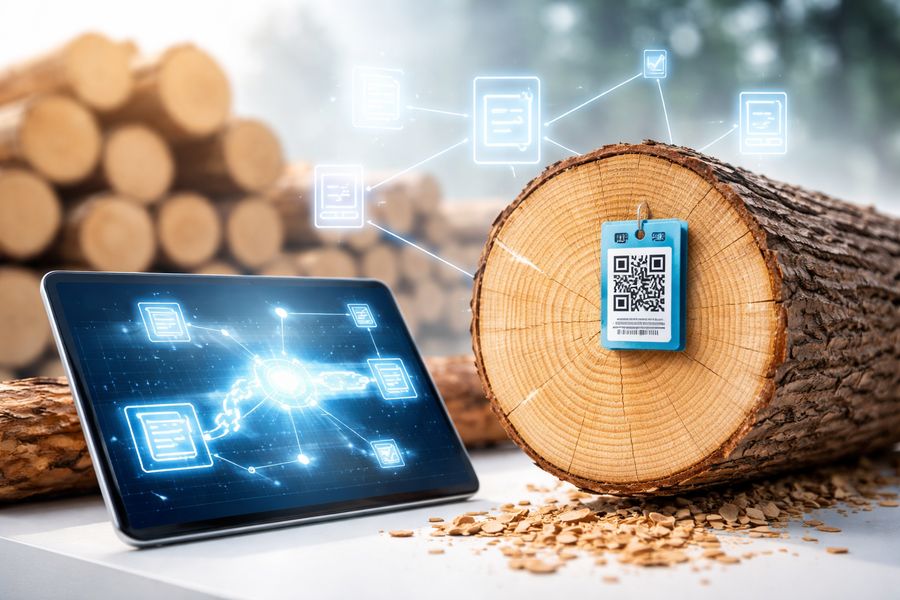
The practical implementation of blockchain for physical goods like timber requires bridging the gap between digital records and physical reality through careful system design and complementary technologies. Unlike purely digital assets that exist entirely within computer systems, timber must be tagged, identified, and tracked as it moves through the real world. Blockchain systems address this challenge by assigning unique digital identifiers to physical timber units at the point of harvest, then recording every subsequent event affecting that timber as transactions on the blockchain. These identifiers can link to RFID tags, QR codes, or other physical markers attached to logs, as well as to complementary verification technologies like DNA profiling or isotopic analysis that can independently confirm wood origins. The combination of immutable digital records with physical verification methods creates multiple layers of assurance that make fraudulent documentation far more difficult to introduce into the supply chain. The design challenge lies in creating systems robust enough to maintain verification integrity while remaining practical for use in the challenging conditions of actual forestry operations.
How Blockchain Enables Timber Traceability
The transformation of timber supply chains through blockchain technology begins at the moment a tree is harvested, where the creation of a unique digital identifier establishes the foundation for all subsequent tracking. In blockchain-enabled systems, authorized personnel record the geographic coordinates, species identification, harvest date, permit numbers, and other relevant data for each timber unit at the point of origin. This initial data entry creates an immutable record that travels with the timber through every subsequent stage of the supply chain, from forest to sawmill to manufacturer to retailer. The geographic precision enabled by modern GPS technology allows systems to verify that harvested timber originated within legally authorized concession areas rather than protected forests, indigenous territories, or other prohibited zones.
Physical verification methods complement blockchain records by providing independent confirmation that timber matches its claimed origins. DNA profiling techniques can identify the species and geographic region from which wood originated by analyzing genetic markers that vary across populations. Isotopic analysis examines the ratios of chemical isotopes in wood samples, which reflect local environmental conditions and create distinctive signatures for different geographic regions. In March 2024, Belgian authorities used isotopic analysis to identify 260 tonnes of timber imported through Latvia and Estonia as actually originating from Russia in violation of EU sanctions, demonstrating how scientific verification can expose fraudulent documentation that would have passed conventional inspections. The integration of these verification technologies with blockchain records creates a two-pronged assurance system where digital chain of custody documentation is backed by physical evidence that cannot be falsified.
Real-time monitoring capabilities enabled by blockchain systems represent a significant advancement over traditional periodic audit approaches. Conventional certification schemes rely on scheduled inspections and document reviews that may occur months or years apart, leaving ample opportunity for fraud between audit cycles. Blockchain-based systems can require transactions to occur in real-time, with immediate recording of events as timber changes hands or undergoes processing. This continuous documentation creates a complete historical record where gaps or anomalies become immediately apparent, making it far more difficult to introduce illegal timber into supply chains during periods between audits. Mobile applications enable field personnel to record transactions and upload supporting evidence like photographs directly from remote forest locations, extending blockchain documentation to the earliest stages of the supply chain where illegal activity most commonly originates.
The integration of Internet of Things sensors with blockchain platforms extends monitoring capabilities to include environmental conditions and chain of custody verification throughout transportation and storage. Smart sensors attached to timber shipments can record location data, temperature, humidity, and other parameters that provide independent verification of claimed transportation routes and handling conditions. Any deviation from expected patterns, such as a shipment that claims direct transport from forest to sawmill but shows GPS data indicating passage through unauthorized processing facilities, generates alerts that trigger investigation. This sensor integration addresses a critical vulnerability in paper-based systems where transportation documents can easily be falsified to obscure the true routing of timber through laundering operations.
Smart Contracts and Automated Compliance Verification
Smart contracts represent one of blockchain technology’s most powerful features for timber supply chain management, enabling automated enforcement of compliance requirements without relying on human intermediaries whose judgment might be compromised by corruption or error. A smart contract is essentially a self-executing program stored on the blockchain that automatically performs specified actions when predetermined conditions are met. In timber tracking applications, smart contracts can automatically verify that all required permits are valid before allowing harvest transactions to be recorded, check that sustainability certifications remain current before processing sales, and flag any transactions that violate regulatory requirements for immediate review by authorities.
The automation provided by smart contracts addresses systemic vulnerabilities in conventional compliance systems where human decision-makers at multiple points in the supply chain create opportunities for corruption or negligence. When a logging permit expires or a sustainability certification is revoked, smart contracts can immediately block any new transactions involving the affected timber, preventing the common practice of continuing illegal operations under expired authorizations. Similarly, smart contracts can enforce export restrictions, import prohibitions, and quota limitations automatically, making it technically impossible to record transactions that violate applicable regulations rather than relying on inspectors to catch violations after the fact.
The trading and matching functions enabled by smart contracts can actively promote sustainable forestry by incorporating environmental criteria into market mechanisms. Advanced blockchain systems for timber trading use algorithms that match buyers with sellers based not only on price but also on sustainability scores derived from verified practices. Research on blockchain timber trading systems demonstrated that incorporating sustainability criteria into automated matching algorithms resulted in ninety-five percent successful trade completion rates for participants with high sustainability scores, creating market incentives that reward responsible forestry practices with improved access to buyers. This integration of environmental values into market infrastructure represents a fundamental shift from viewing sustainability as a cost to be minimized toward treating it as a competitive advantage that blockchain systems can quantify and reward.
The transparency of smart contract execution creates accountability that extends throughout the supply chain. Because smart contract code is visible to all network participants and executes identically regardless of who initiates a transaction, the rules governing timber trade become consistent and predictable in ways that discretionary human enforcement cannot match. Participants can verify exactly what conditions must be met for transactions to succeed, eliminating ambiguity that sophisticated actors might otherwise exploit. When disputes arise about whether particular timber meets compliance requirements, the blockchain record provides definitive evidence of what data was submitted, what verifications were performed, and what the smart contract determined at each decision point, reducing the potential for corrupt officials to retroactively approve questionable transactions.
The combination of real-time monitoring, physical verification integration, and smart contract automation creates timber tracking systems that address vulnerabilities at every stage of the supply chain. From initial harvest through final sale, blockchain technology enables continuous documentation that cannot be falsified, automated compliance enforcement that cannot be corrupted, and transparent verification that any participant can independently confirm. These capabilities represent a fundamental advancement over paper-based systems that have proven inadequate to prevent sophisticated criminal organizations from laundering illegal timber through global supply chains.
Real-World Applications and Case Studies
The practical implementation of blockchain for timber tracking has progressed significantly in recent years, with multiple initiatives demonstrating the technology’s potential to transform supply chain transparency from theoretical possibility to operational reality. These real-world deployments provide valuable evidence about what blockchain systems can achieve under actual operating conditions, the challenges that emerge during implementation, and the results that stakeholders can expect from adopting distributed ledger solutions. Examining specific case studies reveals both the promise and the practical realities of blockchain-based timber verification in diverse regulatory and market contexts, offering lessons that can guide future implementations and policy development.
The most comprehensive recent implementation emerged from Kaunas University of Technology in Lithuania, where Professor Rytis Maskeliūnas and his research team developed a blockchain-based tracking and trading system specifically designed to address illegal timber entering the European Union market. Published in the Journal of Industrial Information Integration in late 2025, the research documented a complete system architecture that assigns unique identifiers to each timber unit and records all related events on the blockchain from the moment logging permits are issued through final sale. The system addresses the fragmented nature of current timber supply chains, where loggers, transport companies, processors, and traders all use separate platforms that make verification of true origins extremely difficult. According to Professor Maskeliūnas, the fundamental goal was creating a tracking chain that cannot be altered at any stage, ensuring that wood products can be verified as not originating from hostile countries, unnecessary cutting, or processing using dirty energy. The research emerged directly from concerns about Russian timber circumventing EU sanctions through intermediary countries, demonstrating how geopolitical developments can accelerate technological innovation in supply chain verification.
The KTU system demonstrated impressive technical performance in simulation experiments, achieving up to 550 transactions per second while maintaining the integrity guarantees that make blockchain valuable for compliance applications. This throughput capacity indicates the system could handle commercial-scale operations involving thousands of timber transactions daily without creating bottlenecks that would impede normal business operations. The smart contract architecture automatically checks and validates every action in the supply chain, confirming permit validity before cutting can begin, updating transportation details in real-time, and ensuring that no step executes unless all required conditions are met. Perhaps most significantly, the system incorporates a two-factor trading algorithm that prioritizes sustainably sourced timber rather than selecting solely based on lowest price, achieving ninety-five percent successful trade completion rates for participants with high sustainability scores. This integration of sustainability criteria directly into market matching mechanisms represents an innovative approach to creating economic incentives for responsible forestry practices, transforming environmental compliance from a cost center into a competitive advantage.
In North America, the ForesTrust blockchain network represents a pioneering effort to bring distributed ledger technology to timber tracking at commercial scale with backing from established institutional partners. Launched by the U.S. Endowment for Forestry and Communities in partnership with IBM, ForesTrust emerged from proof of concept research completed in late 2019 that established blockchain technology could provide secure transparency and traceability across complex timber value chains. The initiative specifically targets the fifteen billion dollar annual global market loss caused by illegal logging, which affects the entire supply chain from small landowners to government agencies. ForesTrust assigns blockchain-based identification numbers to felled trees and wood products, linking each identifier to information about harvest location, applicable sustainability certifications, and chain of custody documentation that updates as timber moves through the supply chain. The partnership with IBM provided access to enterprise-grade blockchain infrastructure through the IBM Blockchain Platform, ensuring the technical foundation could support commercial deployment requirements including security, scalability, and reliability standards expected by major forest products companies.
The ForesTrust network architecture provides neutral infrastructure with technical control shared among users, addressing a critical challenge in forest products industries that rely heavily on international trade involving numerous participants with potentially competing interests. This distributed governance model enables cooperation among stakeholders who must share information while protecting proprietary business data, creating trust without requiring any single party to serve as a centralized authority. The system demonstrated capability to streamline administrative components of complex certification requirements while providing means to guarantee utilization of responsibly sourced wood that could ultimately prevent illegal fiber and log entry into United States markets. Commercial deployment continues to expand as additional companies join the network and integrate blockchain tracking into their supply chain operations, building toward critical mass adoption that would make blockchain verification the industry standard rather than a premium option.
The Forest Stewardship Council, the world’s most widely recognized sustainable forestry certification organization, launched its FSC Trace platform in beta during mid-2025, representing perhaps the most significant institutional adoption of blockchain for timber verification to date. Built on blockchain technology, FSC Trace enables certificate holders to confidentially and efficiently access and exchange relevant data for verification, due diligence, and demonstrating conformity with evolving regulations including the EU Deforestation Regulation. The platform provides verifiable information about traded products, tracing them back to source forests and harvesting sites as required by new regulatory frameworks. Participation remains optional for FSC certificate holders, with rollout proceeding gradually through selected supply chains during the beta phase and continued expansion planned through late 2025. The phased approach allows FSC to refine the platform based on user feedback and operational experience before broader deployment that could eventually encompass the organization’s global network of certificate holders.
The FSC Trace development reflects recognition that even the most rigorous paper-based certification systems face inherent limitations that blockchain technology can address to maintain certification relevance in an evolving regulatory environment. Traditional FSC certification relies on periodic audits and paper documentation that sophisticated actors can potentially circumvent, while blockchain provides continuous verification through immutable records that cannot be retroactively altered. The platform positions FSC to maintain relevance as regulations like the EU Deforestation Regulation create new compliance requirements that exceed what conventional certification documentation can provide. Throughout 2024, FSC hosted regular webinars to introduce the platform and address stakeholder questions, demonstrating substantial industry interest in blockchain-based verification solutions and the organization’s commitment to transparent communication about system capabilities and limitations during the development process.
Stakeholder Benefits and Implementation Challenges
The transformation of timber supply chains through blockchain technology creates distinct advantages and considerations for different participants, from governments seeking to enforce regulations and collect revenues to consumers wanting assurance that their purchases do not contribute to deforestation. Understanding how blockchain affects various stakeholder groups illuminates both the drivers for adoption and the barriers that must be overcome for these systems to achieve their potential at commercial scale. The distribution of benefits and challenges across the supply chain ultimately determines whether blockchain timber tracking will achieve widespread implementation or remain a niche solution for premium markets where buyers willingly pay premiums for verified sustainable products.
Government agencies responsible for forest management and trade regulation stand to gain substantially from blockchain-enabled timber tracking through improved enforcement capabilities and revenue collection mechanisms. The estimated five billion dollars in annual tax revenue lost to illegal logging represents funds that could support conservation programs, enforcement operations, and sustainable development initiatives if effectively captured through better tracking systems. Blockchain systems that record transactions in real-time with immutable documentation make tax evasion and permit fraud far more difficult, as every piece of timber in the system carries verifiable records of applicable fees and compliance status that cannot be retroactively altered. Customs agencies gain tools to verify import documentation against independent blockchain records rather than relying solely on paper certificates that can be forged, enabling more effective enforcement of trade restrictions and sanctions like those imposed on Russian timber following the Ukraine invasion. The availability of comprehensive supply chain data also enables more sophisticated analysis of trade patterns that can identify suspicious activity warranting investigation.
Certification bodies and sustainable forestry organizations benefit from blockchain’s ability to strengthen the credibility of their programs against increasingly sophisticated fraud that undermines consumer confidence in sustainability claims. The proliferation of counterfeit sustainability certifications has undermined consumer confidence in labeling programs and allowed illegal timber to masquerade as responsibly sourced products, eroding the market value of legitimate certifications and reducing incentives for responsible forestry practices. Blockchain verification creates tamper-proof records of certification status that any supply chain participant can independently verify, eliminating the possibility of fraudulent certificates that pass cursory inspection. For organizations like the Forest Stewardship Council, blockchain adoption represents both an opportunity to enhance program integrity and a competitive necessity as regulations increasingly require traceability capabilities that exceed what paper-based systems can provide. The technology enables certification bodies to offer value-added services based on the rich data generated by blockchain tracking, potentially creating new revenue streams that support expanded conservation programs.
Legitimate timber producers and processors face a more complex calculation when evaluating blockchain adoption that balances implementation costs against market access and competitive advantages. On one hand, companies committed to sustainable practices can differentiate their products through verified provenance documentation that commands premium prices from environmentally conscious buyers and procurement programs with sustainability requirements. Blockchain records demonstrate compliance with regulations like the EU Deforestation Regulation, reducing due diligence burdens and potential liability for downstream buyers who face penalties for importing non-compliant products. The KTU research demonstrated that sustainability-focused trading algorithms preferentially match responsible producers with buyers, creating market access advantages for verified legal timber that translates directly to business value. On the other hand, implementing blockchain systems requires investment in technology infrastructure, staff training, and potentially modified operational procedures that represent real costs, particularly for smaller operations with limited resources and technical expertise that may struggle to achieve the same implementation efficiencies as larger competitors.
The technical challenges of implementing blockchain timber tracking in remote forest environments present significant barriers that differ markedly from blockchain applications in urban commercial settings where connectivity and infrastructure are readily available. Many logging operations occur in areas with limited or nonexistent internet connectivity, making real-time transaction recording technically challenging without specialized solutions for offline operation. Mobile applications can cache data for later upload when connectivity becomes available, but this introduces delays that create potential windows for fraud that real-time systems would prevent. Power availability, device durability in harsh field conditions, and the technical literacy of field personnel all affect practical implementation in ways that must be addressed through careful system design. Systems must be designed with these constraints in mind, accepting some limitations on real-time capabilities in exchange for practical usability in the conditions where timber tracking actually occurs.
Interoperability between different blockchain systems and with existing enterprise software represents another significant implementation challenge that could fragment rather than unify supply chain verification if not properly addressed through industry coordination. The timber industry already operates numerous tracking systems, certification databases, and trade documentation platforms that cannot simply be abandoned when blockchain solutions are adopted without significant disruption to existing operations. Effective blockchain implementations must integrate with legacy systems, share data across different blockchain platforms operated by various stakeholders, and accommodate the diverse technical capabilities of supply chain participants ranging from multinational corporations with sophisticated IT departments to smallholder forest communities with minimal technology infrastructure. The lack of universal standards for timber blockchain implementations creates fragmentation risks where different systems cannot communicate effectively, potentially recreating the information silos that blockchain was intended to eliminate rather than achieving the seamless verification that the technology promises.
The cost considerations for blockchain adoption vary substantially depending on organization size, existing technical infrastructure, and the level of verification rigor required by applicable regulations or market demands. Large timber companies with sophisticated IT departments can integrate blockchain systems as extensions of existing supply chain management platforms at relatively modest incremental cost, leveraging existing infrastructure and technical expertise. Small producers may face proportionally larger burdens to implement even basic tracking capabilities, potentially creating barriers that exclude smaller operators from verified supply chains and concentrating market access among larger players with resources to invest in compliance technology. Industry consortiums and government programs that provide shared infrastructure can reduce costs for smaller participants, but such programs require coordination and funding that may not be available in all markets. The economic viability of blockchain timber tracking ultimately depends on whether the benefits of verified provenance, reduced fraud exposure, and regulatory compliance justify implementation costs across different market segments and operator sizes.
Regulatory Landscape and Future Developments
The regulatory environment for timber trade is undergoing rapid transformation as governments recognize that voluntary certification programs and existing enforcement mechanisms have proven insufficient to stem the flow of illegally harvested wood into global markets. New regulations increasingly require the kind of detailed traceability that blockchain systems can provide, creating compliance drivers that may accelerate adoption regardless of voluntary market preferences for sustainability verification. Understanding the current regulatory landscape and emerging requirements reveals why blockchain timber tracking has transitioned from an innovative concept to a practical necessity for companies seeking to maintain market access in major consumer economies. The alignment between regulatory demands and blockchain capabilities suggests a fundamental shift in how timber supply chains will operate in the coming years.
The European Union Deforestation Regulation, which came into effect in late 2025, represents the most significant regulatory development affecting global timber trade and creates unprecedented requirements for supply chain transparency. Described by environmental organizations as historic and groundbreaking, the regulation requires any company that produces, uses, or trades covered commodities including timber within the EU to prove that products have not come from recently deforested land. Crucially, evidence of compliance with local laws in producer countries is not sufficient to satisfy the regulation’s requirements; companies must demonstrate through geolocation data and traceability systems that specific commodities originated from land that was not deforested after December 2020. This requirement creates unprecedented demand for the kind of granular, verifiable provenance documentation that blockchain systems are uniquely positioned to provide, as traditional paper-based certificates cannot reliably demonstrate the specific geographic origins of timber with the precision the regulation demands. The regulation affects not only timber itself but also derived products including furniture, paper, and packaging materials, extending compliance requirements throughout product supply chains.
In the United States, proposed legislation would strengthen existing frameworks governing timber imports and domestic trade while creating new due diligence obligations for market participants. The FOREST Act, introduced with bipartisan support in Congress, aims to prevent the import of illegally harvested wood while promoting sustainable logging practices by requiring buyers to conduct due diligence ensuring their supply chains are free from commodities linked to illegal timber trade. The 2008 amendments to the Lacey Act already prohibit trade in illegally sourced plants including timber, but enforcement has been hampered by the difficulty of proving illegal origins for wood that has passed through complex international supply chains where documentation can be manipulated at multiple points. Blockchain traceability systems that maintain verifiable records from harvest through import would substantially strengthen enforcement capabilities by providing the documentary evidence needed to demonstrate violations and support prosecution of trafficking operations. The prospect of enhanced enforcement creates compliance incentives that extend beyond companies directly subject to regulations to encompass their entire supply networks.
The integration of blockchain with complementary technologies points toward future systems with capabilities far exceeding current implementations and creating verification mechanisms that would have seemed impossible just years ago. Artificial intelligence and machine learning algorithms can analyze satellite imagery to detect illegal logging activities in real-time, identifying forest disturbance patterns that indicate unauthorized harvest and flagging affected areas for investigation before illegal timber enters supply chains. Drone surveillance equipped with high-definition cameras and LiDAR sensors enables monitoring of remote forest areas that ground-based enforcement cannot practically reach, with AI systems processing collected data to detect chainsaws, vehicles, and abnormal movement patterns indicating illegal activity. Research indicates that AI-enhanced monitoring systems can increase detection rates by up to seventy percent in monitored regions. When combined with blockchain documentation systems, these detection capabilities can trigger immediate supply chain alerts when timber appears from areas where unauthorized logging has been identified, creating proactive interdiction rather than reactive investigation after illegal wood has already been laundered through legitimate commerce.
Internet of Things sensor networks extend blockchain verification capabilities throughout the physical supply chain in ways that current implementations only partially realize, pointing toward a future of comprehensive automated monitoring. Next-generation systems envision comprehensive sensor integration where tagged timber transmits continuous location and condition data through satellite networks, creating unbroken chains of verified custody that would be virtually impossible to falsify without sophisticated technical capabilities that most criminal operations lack. Biodegradable sensor tags developed through materials science research could enable tracking of individual logs from forest to final product without creating electronic waste or requiring tag recovery, addressing environmental concerns about tracking technology itself. Carbon tracking capabilities integrated with blockchain systems could quantify the climate impact of forest products throughout their lifecycle, enabling carbon-conscious purchasing decisions and potentially supporting integration with carbon credit markets that reward forest preservation. These emerging capabilities suggest blockchain timber tracking will evolve well beyond simple documentation toward comprehensive environmental monitoring that connects forest management with broader climate and conservation objectives.
The convergence of regulatory pressure, technological capability, and market demand for verified sustainable products suggests blockchain timber tracking will transition from innovative pilot projects to industry standard practice within the coming years. Companies that develop blockchain capabilities in advance of regulatory deadlines will be positioned for competitive advantage, while those that delay may face market access restrictions as EU and other regulations take full effect. The forest products industry stands at an inflection point where distributed ledger technology offers tools to address challenges that have resisted solution for decades, provided stakeholders commit to the implementation investments and collaboration required to realize blockchain’s potential.
Final Thoughts
Blockchain technology has emerged as a potentially transformative force in the global effort to combat timber trafficking, offering capabilities that address fundamental weaknesses in the systems that have allowed illegal logging to flourish despite decades of enforcement efforts and international agreements. The immutability of distributed ledger records, the transparency enabled by shared access to verified information, and the automation possible through smart contracts combine to create verification mechanisms that could fundamentally alter the economics of timber crime by making it far more difficult and expensive to launder illegal wood through legitimate supply chains. The technology does not eliminate the human elements of corruption, enforcement, and political will that ultimately determine outcomes, but it provides tools that honest actors can use to identify and exclude bad actors in ways that paper-based systems simply cannot match.
The broader implications of blockchain timber tracking extend beyond the forest products industry to encompass critical questions about how technology can serve environmental and social goals. The destruction of the world’s forests represents one of the most urgent challenges facing humanity, with consequences for climate stability, biodiversity, and the rights of indigenous peoples whose territories contain the majority of remaining intact forest ecosystems. Technology alone cannot address the poverty, governance failures, and demand pressures that drive deforestation, but effective tracking systems can ensure that market mechanisms support rather than undermine conservation objectives. When consumers and businesses can verify that their purchases do not contribute to forest destruction, and when regulatory agencies can effectively enforce prohibitions on illegal timber, the economic incentives that currently reward environmental crime can begin to shift toward rewarding sustainable practices.
The intersection of blockchain timber tracking with financial inclusion themes emerges most clearly in considerations of how small-scale forest producers can participate in verified supply chains. Smallholder forest communities in developing countries often lack access to the certification systems and market channels that would allow them to receive fair prices for sustainably managed timber, leaving them vulnerable to exploitation by illegal operators or exclusion from premium markets entirely. Blockchain systems that reduce certification costs and provide direct market access could enable these communities to capture more value from their forest resources while maintaining the sustainable practices that have preserved their territories for generations. The design of blockchain timber systems with smallholder accessibility in mind represents both a technical challenge and a moral imperative if the technology is to serve broad social benefit rather than merely advantaging large commercial operators.
Significant challenges remain in translating blockchain’s technical capabilities into practical impact at the scale required to meaningfully reduce global timber trafficking. Infrastructure limitations in remote forest regions, the need for coordination among stakeholders with different interests and capabilities, the costs of implementation for smaller operators, and the fundamental difficulty of ensuring accurate data entry at the point of origin all constrain what blockchain systems can achieve in practice. The most sophisticated distributed ledger technology cannot compensate for false information entered at the source, making the integrity of initial data capture as important as the immutability of subsequent records. Addressing these challenges requires ongoing innovation in complementary technologies like DNA verification and satellite monitoring, continued development of user-friendly applications suitable for field conditions, and institutional frameworks that support rather than complicate adoption.
The trajectory of blockchain timber tracking from conceptual possibility to commercial implementation demonstrates how technological innovation can create new opportunities to address persistent environmental challenges. The convergence of regulatory requirements like the EU Deforestation Regulation with maturing blockchain platforms and growing consumer demand for verified sustainable products suggests conditions are increasingly favorable for widespread adoption. Whether this potential translates into meaningful reductions in illegal logging ultimately depends on choices made by governments, companies, and consumers about whether to invest in and demand the transparency that blockchain makes possible. The technology provides tools; the outcome depends on the commitment to use them.
FAQs
- What is blockchain timber tracking and how does it work?
Blockchain timber tracking uses distributed ledger technology to create immutable records that follow wood products from forest to final destination. Each piece of timber receives a unique digital identifier at harvest, and every subsequent transaction including transportation, processing, and sale is recorded on the blockchain. Because blockchain records are distributed across multiple computers and linked through cryptographic relationships, no single party can alter historical data without detection, creating a tamper-proof chain of custody that verifies timber origins. - How significant is the illegal logging problem globally?
Illegal logging represents one of the world’s largest transnational crimes, with Interpol estimating the annual value of illegally traded timber between fifty-one billion and one hundred fifty-two billion dollars. The practice accounts for fifteen to thirty percent of global timber production and contributes to more than fifty percent of tropical deforestation in Central Africa, the Amazon Basin, and Southeast Asia. Beyond economic impacts, illegal logging destroys critical habitats, accelerates climate change through carbon release, and often involves human rights violations against indigenous communities. - What regulations require timber traceability systems?
The EU Deforestation Regulation, effective from late 2025, requires companies trading timber in European markets to demonstrate through geolocation data that products did not originate from recently deforested land. The U.S. Lacey Act prohibits trade in illegally sourced timber, while the proposed FOREST Act would strengthen due diligence requirements. Australia’s Illegal Logging Prohibition Act similarly restricts imports of illegally harvested wood. These regulations create increasing demand for the detailed traceability that blockchain systems can provide. - How do blockchain systems verify timber is legally harvested?
Blockchain systems combine digital documentation with physical verification methods to confirm legal harvest. At the point of origin, GPS coordinates verify that timber comes from authorized concession areas rather than protected forests. Scientific techniques including DNA profiling and isotopic analysis can independently confirm wood origins by analyzing genetic markers and chemical signatures unique to specific regions. Smart contracts automatically check permit validity and certification status before allowing transactions to proceed. - What are smart contracts and how do they help timber compliance?
Smart contracts are self-executing programs stored on the blockchain that automatically perform specified actions when predetermined conditions are met. In timber tracking, smart contracts can verify that logging permits are valid before allowing harvest records, confirm sustainability certifications remain current before processing sales, and automatically flag transactions that violate regulatory requirements. This automation removes human discretion from compliance decisions, reducing opportunities for corruption or error. - How much does implementing blockchain timber tracking cost?
Implementation costs vary substantially based on organization size, existing technical infrastructure, and required verification rigor. Large companies with sophisticated IT systems can integrate blockchain as extensions of existing supply chain platforms at relatively modest incremental cost. Smaller operators may face proportionally larger burdens, though industry consortiums and government programs that provide shared infrastructure can reduce individual costs. The economic calculation must weigh implementation expenses against benefits including regulatory compliance, reduced fraud exposure, and potential price premiums for verified sustainable products. - Can blockchain systems work in remote forest areas with limited connectivity?
Implementing blockchain in remote forests presents technical challenges that system designers must address through practical accommodations. Mobile applications can cache transaction data for upload when connectivity becomes available, though this introduces delays compared to real-time recording. Satellite communication can provide connectivity in areas beyond cellular coverage. System designs must balance the theoretical benefits of continuous real-time recording against the practical realities of field conditions, accepting some limitations while maintaining sufficient verification integrity to meet compliance requirements. - How does blockchain timber tracking benefit consumers?
Consumers gain confidence that products carrying blockchain verification actually originate from legal, sustainable sources rather than relying solely on certification labels that can be counterfeited. Blockchain records enable any participant to independently verify claims about wood origins by tracing the complete chain of custody back to harvest location. For environmentally conscious consumers willing to pay premiums for verified sustainable products, blockchain provides assurance that their purchasing decisions actually support responsible forestry practices rather than inadvertently funding illegal logging. - What role does AI play in blockchain timber verification?
Artificial intelligence enhances blockchain timber tracking through capabilities including satellite image analysis to detect illegal logging activities, pattern recognition to identify suspicious supply chain anomalies, and automated monitoring of vast forest areas that ground-based enforcement cannot practically cover. AI systems can process drone surveillance data to detect chainsaws, vehicles, and activity patterns indicating unauthorized harvest. When integrated with blockchain documentation, AI detection capabilities enable proactive alerts when timber appears from areas where illegal activity has been identified. - How can small forestry operations participate in blockchain tracking systems?
Small operators can access blockchain systems through industry consortiums that provide shared infrastructure, certification organizations like FSC that offer platforms for certificate holders, and government programs designed to extend traceability capabilities to smallholders. Mobile applications with simple interfaces enable field personnel to record transactions without extensive technical training. Some blockchain initiatives specifically target smallholder inclusion as a design priority, recognizing that systems serving only large commercial operators would fail to address significant portions of the timber supply chain where illegal activity often originates.