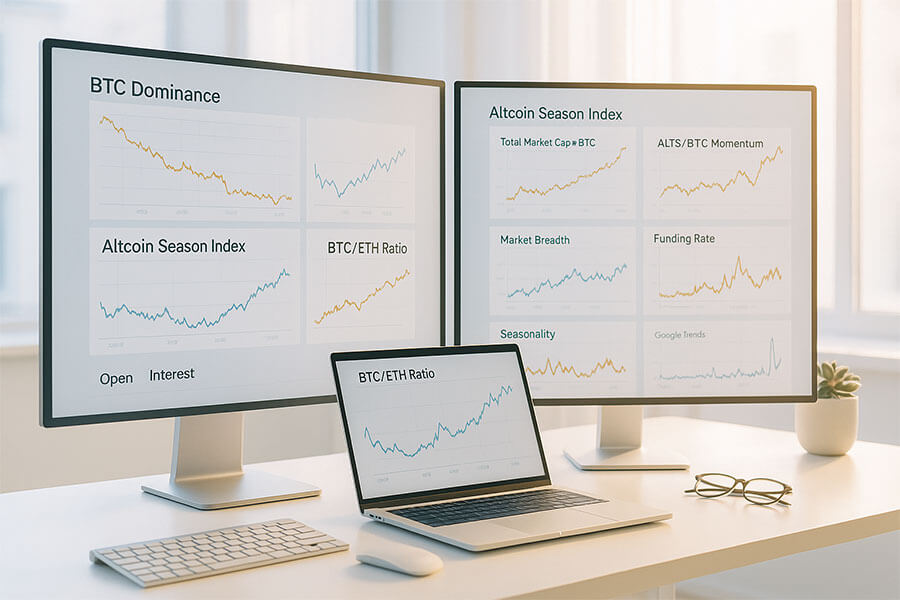
The cryptocurrency market operates in distinct cycles that can transform modest investments into substantial returns or leave unprepared traders watching opportunities slip away. Among the most profitable yet challenging periods to navigate are altcoin seasons, those remarkable phases when alternative cryptocurrencies significantly outperform Bitcoin and deliver explosive gains across the broader digital asset ecosystem. Understanding when these rotations occur and how to position portfolios accordingly represents one of the most valuable skills a cryptocurrency trader can develop.
Altcoin season describes market conditions where capital flows from Bitcoin into alternative cryptocurrencies, creating momentum that lifts hundreds or even thousands of digital assets simultaneously. During these periods, altcoins routinely deliver returns that dwarf Bitcoin’s performance, with some projects gaining hundreds or thousands of percent in value within weeks or months. The 2021 altcoin season exemplified this phenomenon, with numerous projects delivering life-changing returns to early investors who recognized the rotation signals and positioned themselves appropriately before the surge began.
However, identifying altcoin season before it fully develops remains extraordinarily difficult for most traders. The cryptocurrency market generates constant noise through social media hype, influencer predictions, and conflicting technical analysis that can mislead even experienced investors. False signals appear regularly, promising rotations that never materialize while draining capital from traders who entered positions prematurely. Meanwhile, legitimate altcoin seasons often begin quietly, gathering momentum before most market participants recognize the shift, leaving latecomers buying near peaks just before corrections eliminate their gains.
The challenge intensifies because altcoin seasons arrive unpredictably and vary significantly in character, duration, and the specific assets that benefit most. Some rotations favor large-cap alternatives like Ethereum and established platforms, while others propel obscure projects from anonymity to prominence seemingly overnight. Certain altcoin seasons last months and affect nearly all alternative assets, while brief rotations might elevate only specific sectors or narratives before capital returns to Bitcoin. Without reliable methods for identifying these transitions, traders risk missing opportunities or suffering losses by entering rotations too late or exiting too early.
This article provides comprehensive guidance on the technical indicators, on-chain metrics, and fundamental analysis techniques that successful traders use to identify altcoin season signals before they become obvious to the broader market. These tools range from simple Bitcoin dominance measurements that anyone can access freely to sophisticated on-chain analytics that reveal capital flows invisible through price charts alone. By combining multiple indicators and understanding the market dynamics that drive rotations, traders can develop systematic approaches to positioning portfolios for maximum benefit during altcoin seasons while protecting capital when Bitcoin dominance reasserts itself.
The ability to recognize and capitalize on altcoin seasons separates consistently profitable cryptocurrency traders from those who experience sporadic success mixed with devastating losses. Markets reward those who can interpret signals correctly and act decisively while punishing emotional decisions based on fear of missing out or stubborn adherence to losing positions. The indicators and strategies discussed in this article have proven effective across multiple market cycles, providing frameworks that work regardless of changing narratives, emerging technologies, or evolving market structures. Mastering these concepts requires initial effort and ongoing practice, but the potential returns from successfully navigating even a single altcoin season can justify years of study and preparation.
Understanding Altcoin Season Fundamentals
Before diving into specific indicators and trading strategies, establishing a solid foundation in the fundamental dynamics that create altcoin seasons proves essential for developing reliable analytical frameworks. Altcoin season represents more than simple price movements in alternative cryptocurrencies; it reflects complex interplays between market psychology, capital flows, investor risk appetite, and the maturation cycles that characterize cryptocurrency markets. These seasons emerge from predictable patterns in how capital moves through the cryptocurrency ecosystem, responding to changing perceptions about Bitcoin’s role, alternative investment opportunities, and the overall health of digital asset markets.
The cryptocurrency market exhibits cyclical behavior driven primarily by Bitcoin’s price movements and the resulting shifts in investor sentiment and risk tolerance. When Bitcoin enters strong uptrends, it typically attracts fresh capital from traditional markets as mainstream media coverage increases and new investors seek exposure to digital assets. This initial wave of adoption concentrates in Bitcoin because it represents the most recognized, liquid, and accessible cryptocurrency for newcomers unfamiliar with the broader ecosystem. As Bitcoin’s price rises and stabilizes at higher levels, existing holders begin searching for higher-return opportunities, while new market participants who missed Bitcoin’s initial surge seek alternative investments that might replicate or exceed its performance.
This transition creates the foundation for altcoin season as capital that initially flowed into Bitcoin gradually rotates into alternative cryptocurrencies perceived as undervalued relative to Bitcoin’s gains. The rotation typically begins with established large-cap altcoins like Ethereum that offer familiarity and liquidity similar to Bitcoin but with greater perceived upside potential. As these major alternatives gain momentum and demonstrate sustained price appreciation, investor confidence grows and capital flows accelerate into progressively smaller and riskier projects. The phenomenon feeds on itself as rising altcoin prices attract more attention, create fear of missing out among sidelined investors, and generate social media excitement that brings additional capital into the market.
Bitcoin dominance, measured as Bitcoin’s market capitalization divided by the total cryptocurrency market capitalization, provides the primary metric for understanding altcoin season dynamics. When Bitcoin dominance rises, Bitcoin outperforms altcoins and typically indicates risk-off sentiment where investors prefer the relative safety of the market’s most established asset. Conversely, falling Bitcoin dominance signals that altcoins collectively gain market share faster than Bitcoin, indicating risk-on conditions where investors seek higher returns through alternative investments. Altcoin seasons correspond to periods of sustained, significant Bitcoin dominance decline, typically from levels above sixty percent toward fifty percent or lower, though specific threshold levels vary across different market cycles.
Market Cycle Dynamics and Bitcoin Dominance
Understanding the complete cryptocurrency market cycle provides crucial context for recognizing when conditions favor altcoin season emergence. The typical cycle begins with Bitcoin recovering from bear market lows, often quietly accumulating for months while mainstream attention remains minimal and sentiment stays pessimistic. Early Bitcoin recovery phases see dominance either stable or rising slightly as cautious investors prefer the established asset while remaining skeptical about broader market recovery. This accumulation phase can persist for extended periods, building the foundation for the next bull market through gradual price increases that eventually attract growing attention.
As Bitcoin breaks through significant psychological and technical resistance levels, momentum accelerates and new capital flows into the market at increasing rates. Media coverage intensifies, search interest spikes, and discussions about cryptocurrency become commonplace in mainstream financial contexts. During this euphoric phase of Bitcoin’s rally, dominance typically remains elevated or continues rising because new market participants concentrate their investments in the asset they recognize and trust most. Experienced traders understand this phase represents the calm before altcoin season, using the time to research alternative projects and prepare portfolios for the coming rotation.
The transition from Bitcoin-focused rallies to altcoin season typically occurs after Bitcoin reaches new all-time highs or consolidates following major price increases. At these junctures, some investors take profits from Bitcoin positions while others conclude that Bitcoin’s immediate upside appears limited compared to alternatives trading far below their own historical highs. This perception shift, whether accurate or not, initiates capital rotation as traders redeploy Bitcoin profits into altcoins or new market entrants allocate fresh capital directly to alternatives rather than buying Bitcoin at elevated prices. The dominance chart reflects this transition through sustained downward movement that may accelerate dramatically once the rotation gains momentum.
Bitcoin dominance changes do not occur in isolation but reflect broader shifts in market psychology and risk appetite. Rising dominance during bear markets demonstrates flight to safety as investors abandon failed altcoin positions and return to Bitcoin’s relative stability. Declining dominance during bull markets shows increasing confidence and risk-taking as success breeds optimism and investors seek maximum returns through higher-risk alternatives. Understanding these psychological dimensions helps traders interpret dominance changes within proper context rather than mechanically responding to numerical thresholds without considering the underlying market conditions driving the metrics.
The relationship between Bitcoin price movements and dominance changes adds complexity to altcoin season identification. Bitcoin dominance can fall during Bitcoin rallies if altcoins rise faster, or during Bitcoin declines if altcoins fall more slowly. The most favorable altcoin season conditions typically emerge when Bitcoin prices remain stable or rise modestly while altcoins surge dramatically, causing dominance to plummet as alternative cryptocurrencies capture disproportionate market gains. Conversely, falling Bitcoin prices combined with falling dominance often indicates indiscriminate selling where altcoins decline even faster than Bitcoin, representing dangerous market conditions rather than genuine altcoin season opportunities.
Historical analysis reveals that altcoin seasons typically cluster around specific phases of Bitcoin’s market cycles rather than occurring randomly throughout cryptocurrency trading history. The most pronounced altcoin seasons have followed Bitcoin’s achievement of new all-time highs after extended consolidation periods, as these milestones provide psychological permission for investors to explore alternatives while maintaining overall bullish sentiment. Secondary altcoin rotations sometimes occur during Bitcoin consolidation phases within broader bull markets, creating multiple opportunities for traders who recognize the pattern repetition across different timeframes and market contexts.
Technical Indicators for Altcoin Season
Technical analysis provides accessible tools for identifying altcoin season signals through visual representations of market dynamics that can be monitored via free charting platforms. These indicators transform complex market data into actionable signals that help traders time entries and exits with greater precision than intuition alone. While no single indicator guarantees perfect accuracy, combining multiple technical signals creates robust frameworks that significantly improve trading outcomes.
The fundamental premise involves identifying when altcoins collectively begin outperforming Bitcoin through momentum, volume, and price pattern analysis. Technical indicators focus on price and volume data visible through exchange activity, assuming that all relevant information ultimately manifests in price movements that technical analysis can detect before the broader market processes the implications.
Bitcoin Dominance and Altcoin Season Index
Bitcoin dominance stands as the single most important technical indicator for identifying altcoin season, providing a clear, objective measurement of Bitcoin’s market share relative to all alternative cryptocurrencies. Charting platforms like TradingView display Bitcoin dominance as a simple line chart that can be analyzed using the same technical analysis techniques applied to individual cryptocurrency price charts. When dominance trends downward through declining peaks and troughs, altcoin season likely progresses. When dominance establishes uptrends with higher highs and higher lows, Bitcoin outperformance suggests altcoin positions should be reduced or avoided entirely.
Technical analysis of the Bitcoin dominance chart reveals specific patterns that reliably signal major market transitions. Breaking below key support levels, particularly those that held during previous corrections, often precedes accelerated altcoin rallies as the psychological barrier removal triggers additional capital rotation. Moving average crossovers provide additional confirmation, with the fifty-day moving average crossing below the two-hundred-day moving average generating particularly strong signals that sustained dominance decline has begun. Traders should monitor multiple timeframes simultaneously, as dominance trends on weekly and monthly charts provide big-picture context while daily charts reveal near-term momentum and entry timing opportunities.
The Altcoin Season Index, available through the Blockchain Center website, provides a complementary metric specifically designed to quantify whether markets currently favor Bitcoin or altcoins. This index measures how many of the top one hundred cryptocurrencies outperformed Bitcoin over the previous ninety days, expressing the result as a percentage. Readings above seventy-five indicate strong altcoin season conditions where most major cryptocurrencies exceed Bitcoin’s performance. Values below twenty-five suggest Bitcoin season where the flagship cryptocurrency dominates. Middle range readings between twenty-five and seventy-five indicate mixed conditions without clear directional advantage for either Bitcoin or altcoins.
The Altcoin Season Index methodology provides several advantages over simple Bitcoin dominance monitoring by focusing specifically on performance comparison rather than market capitalization shifts. Projects with declining prices can still increase market share if Bitcoin falls faster, but they would not register as outperformers on the Altcoin Season Index, making the metric more aligned with trader profit opportunities. The ninety-day measurement period smooths short-term volatility while remaining responsive enough to identify meaningful trends, creating a balanced approach between reactivity and stability that helps traders avoid whipsaw trades based on temporary fluctuations.
Combining Bitcoin dominance chart analysis with Altcoin Season Index monitoring creates powerful confirmation systems for identifying high-probability trading opportunities. When dominance breaks key technical support levels and the Altcoin Season Index simultaneously rises above seventy-five, strong evidence suggests genuine altcoin season has commenced and aggressive positioning becomes appropriate. Conversely, when dominance rebounds from oversold conditions and the index falls below twenty-five, reducing or eliminating altcoin exposure protects capital during Bitcoin-dominant phases. Monitoring both metrics together provides redundancy that reduces false signal risk while increasing confidence in trading decisions.
Volume and Momentum Indicators
Volume analysis confirms altcoin season sustainability by revealing whether price movements have sufficient participant engagement to continue. Rising prices with increasing volume demonstrate genuine buying pressure that typically sustains rallies, while price increases on declining volume suggest weakening momentum. Traders should monitor both individual altcoin volumes and aggregate measures like total cryptocurrency trading volume excluding Bitcoin.
Exchange volume data requires careful interpretation because absolute numbers vary dramatically across platforms and can be manipulated through wash trading. Focusing on relative volume changes within specific exchanges or comparing volume to historical averages provides more reliable signals. When altcoin trading volumes across major exchanges simultaneously increase fifty percent or more above recent averages while Bitcoin volume remains flat or declines, evidence suggests capital rotation has accelerated.
The Relative Strength Index measures the magnitude of recent price changes to evaluate overbought or oversold conditions. RSI calculates values between zero and one hundred, with readings above seventy indicating overbought conditions and values below thirty suggesting oversold scenarios. For altcoin season identification, traders should monitor RSI on Bitcoin dominance charts, watching for dominance RSI to reach overbought levels above seventy before reversing downward.
Moving Average Convergence Divergence identifies trend changes through the relationship between two moving averages of Bitcoin dominance. MACD generates trading signals when its fast-moving average crosses above or below the slower-moving average. Applied to Bitcoin dominance charts, MACD crossovers from positive to negative territory signal weakening Bitcoin strength and emerging altcoin opportunities, particularly when these signals occur with dominance breaking below key support levels.
Combining multiple momentum indicators creates confirmation systems that dramatically improve signal reliability. When RSI on Bitcoin dominance reaches overbought territory and falls below seventy while MACD simultaneously generates bearish crossover signals, the convergence provides strong evidence that dominance reversal has begun. Adding volume confirmation through rising altcoin volumes creates three-factor verification that reduces false positive risks.
On-Chain Metrics and Fundamental Analysis
While technical indicators excel at identifying trends through price and volume analysis, on-chain metrics and fundamental analysis provide deeper insights into the blockchain activity and market dynamics that drive sustainable altcoin seasons. These approaches examine transaction data, wallet behavior, network growth, and capital flows beneath the surface of price charts, often revealing significant changes before they manifest in price movements.
On-chain metrics measure actual blockchain activity rather than just exchange trading, providing ground truth data about how cryptocurrencies are being used and transferred by real network participants. This proves particularly valuable for distinguishing between speculative price pumps driven purely by exchange trading and genuine adoption-driven growth. During authentic altcoin seasons, rising prices typically coincide with expanding on-chain activity as new users enter ecosystems, while false rallies often show price appreciation without corresponding blockchain usage growth.
Wallet Activity and Network Metrics
Active address counts provide fundamental insights into cryptocurrency adoption patterns that often presage price movements. When unique addresses transacting on a blockchain network increase steadily over weeks or months, the growth demonstrates expanding user bases that typically support sustainable price appreciation. Significant increases in active addresses across multiple altcoin networks simultaneously, particularly when Bitcoin’s active addresses remain flat, signals that attention and capital are shifting toward alternatives in patterns characteristic of early altcoin season development.
Transaction count analysis complements active address monitoring by measuring total blockchain activity. Networks can show growing transaction volumes even with stable active addresses if existing users increase their activity levels. Altcoin season often correlates with surging transaction counts across numerous alternative blockchains as traders move assets between exchanges and wallets. Monitoring aggregate transaction volumes across top altcoins relative to Bitcoin provides early indication of where market energy is concentrating.
Network value to transactions ratio compares a cryptocurrency’s market capitalization to total transaction volume on its blockchain, functioning similarly to price-to-earnings ratios in traditional markets. Lower NVT ratios suggest networks are undervalued relative to their usage. During altcoin season initiations, NVT ratios on major alternatives often reach historically low levels as transaction volumes surge while prices lag temporarily.
Staking participation rates on proof-of-stake networks provide insights into long-term holder conviction. When significant portions of circulating supply become locked in staking contracts, the reduction in liquid supply can amplify price movements while demonstrating holder conviction. Rising staking rates across multiple proof-of-stake altcoins during periods when Bitcoin remains unstaked signals capital commitment to alternatives that often precedes altcoin season.
Market Sentiment and Capital Flows
Social media sentiment analysis quantifies the emotional tone and attention levels surrounding different cryptocurrencies across platforms like Twitter and Reddit. Rising positive sentiment combined with increasing mention volumes typically precedes price appreciation as growing interest attracts new buyers. When sentiment metrics show simultaneous enthusiasm spikes across numerous altcoins while Bitcoin sentiment remains neutral, the divergence suggests shifting market psychology favorable to altcoin season development.
The Crypto Fear and Greed Index synthesizes multiple data sources including volatility, momentum, and social media activity into single numerical scores ranging from zero to one hundred. Extreme fear readings below twenty-five often mark market bottoms, while extreme greed above seventy-five frequently precedes corrections. Moderate greed readings between fifty and seventy-five represent the sweet spot for altcoin season as confidence supports risk-taking without reaching euphoric excess.
Exchange inflow and outflow tracking reveals whether participants are moving coins to exchanges for selling or withdrawing them for holding. Large Bitcoin outflows from exchanges combined with altcoin inflows suggest investors are rotating out of Bitcoin positions into alternatives, creating the capital flows that drive altcoin season. Several blockchain analytics firms now offer exchange flow monitoring tools that help traders understand these capital movement patterns.
Stablecoin dominance, measured as stablecoin market capitalization divided by total cryptocurrency market capitalization, provides insights into whether capital is flowing into or out of cryptocurrency markets. Rising stablecoin dominance typically indicates risk-off behavior, while falling stablecoin dominance shows fresh buying pressure. Analyzing how stablecoin dominance changes alongside Bitcoin and altcoin price movements reveals whether new money is entering markets and which assets benefit most.
Decentralized exchange volume analysis tracks trading activity on non-custodial platforms where users trade directly from their wallets. Rising DEX volumes, particularly for altcoin pairs, demonstrates increasing interest in alternative assets. Major altcoin seasons typically feature explosive growth in DEX activity as traders seek access to newer projects and participate in yield farming opportunities.
Trading Strategies and Risk Management
Identifying altcoin season signals provides only the foundation for successful trading; implementing proper strategies and risk management separates consistent profitability from occasional lucky gains followed by devastating losses. Even traders who accurately recognize altcoin season beginnings can underperform through poor position sizing, inadequate exit planning, or failure to protect capital during corrections. Systematic approaches to entering positions, managing risk, and capturing profits transform analytical edge into realized returns.
The fundamental strategic decision involves determining what percentage of portfolio value should shift from Bitcoin to alternatives and which specific altcoins deserve allocation. Overly conservative approaches that maintain heavy Bitcoin exposure sacrifice substantial returns, while overly aggressive all-in positioning creates excessive risk. Balanced strategies that gradually increase altcoin exposure as confirming signals accumulate provide optimal risk-adjusted returns by capturing most upside while maintaining some Bitcoin position as stability anchor.
Entry and Exit Point Identification
Successful entry strategies require patience to wait for multiple confirming indicators before committing substantial capital. A robust framework might require Bitcoin dominance breaking below key support levels, the Altcoin Season Index rising above seventy, RSI on dominance charts falling below fifty, and on-chain metrics showing increased altcoin activity before initiating major position shifts. Requiring three or four independent confirmations dramatically reduces false positive risks.
Staged entry approaches that build positions incrementally as evidence accumulates provide superior risk management compared to immediate full deployment. Starting with modest altcoin exposure when initial signals appear, then adding to positions as additional confirmations arrive, allows traders to benefit if early signals prove accurate while limiting losses if they reverse. A typical staged entry might begin with ten percent portfolio rotation when dominance breaks initial support, increase to twenty-five percent when the Altcoin Season Index confirms, and reach fifty percent if all indicators align bullishly.
Identifying specific entry prices for individual altcoins requires combining macro rotation indicators with individual asset technical analysis. Even during confirmed altcoin seasons, buying altcoins after explosive rallies increases correction risks, while waiting for pullbacks to support provides better risk-reward ratios. Setting limit orders at technical support levels during confirmed altcoin seasons ensures capital deploys during temporary weakness rather than chasing strength.
Exit strategy development proves even more critical than entry planning because altcoin season endings often occur rapidly with little warning. When Bitcoin dominance establishes higher lows and begins trending upward, when the Altcoin Season Index falls below seventy-five, or when momentum indicators show negative divergences, reducing altcoin exposure quickly protects accumulated profits.
Trailing stop losses provide systematic exit mechanisms that lock in gains while allowing profitable positions to continue appreciating. Setting trailing stops ten to twenty percent below recent peak prices automatically exits positions when corrections begin without requiring constant monitoring. More sophisticated approaches might use trailing stops on Bitcoin dominance charts rather than individual altcoin prices, exiting when dominance rises above specific threshold levels.
Partial profit-taking strategies balance the desire to maximize gains if altcoin seasons continue against the need to secure profits before corrections. Taking twenty-five to fifty percent profits from positions after they double ensures some gains are realized while maintaining exposure for potential further appreciation. Scaling out of positions as prices rise through predetermined targets provides disciplined selling frameworks that remove emotional decision-making.
Portfolio Allocation Strategies
Determining optimal allocation between Bitcoin and altcoins throughout different market phases significantly impacts overall returns. Maintaining fixed allocations regardless of market conditions guarantees suboptimal performance. Dynamic allocation approaches that adjust based on indicator readings provide superior results by concentrating capital in whichever asset class shows strongest performance prospects.
A baseline structure might allocate seventy percent to Bitcoin and thirty percent to altcoins during neutral conditions. As altcoin season signals strengthen, allocation could shift toward fifty-fifty, eventually reaching thirty percent Bitcoin and seventy percent altcoins if multiple strong confirmations suggest robust rotation has commenced. When indicators suggest Bitcoin dominance will rise, allocation might become eighty percent Bitcoin and twenty percent altcoins.
Diversification within altcoin allocations prevents excessive concentration risk while capturing broad sector performance. Rather than selecting one or two projects, spreading exposure across ten to twenty different assets in various market cap categories provides protection against individual project failures. Typical approaches might allocate forty percent to large-cap altcoins like Ethereum, thirty percent to mid-cap projects in the top fifty, and thirty percent to smaller speculative positions.
Sector rotation within altcoin portfolios captures shifting narratives during different altcoin season phases. Early phases often favor established platforms as conservative capital flows from Bitcoin. Middle phases typically see gaming and DeFi tokens outperform as risk appetite increases. Late phases frequently feature small-cap speculation as euphoria peaks. Adjusting sector exposure to emphasize categories showing strongest relative momentum improves returns.
Rebalancing mechanisms ensure portfolio allocations remain aligned with strategic targets despite natural drift. When altcoins appreciate significantly and exceed target allocations, rebalancing involves selling portions to restore desired weights, automatically implementing profit-taking discipline. Scheduled rebalancing on weekly or monthly intervals provides systematic execution that removes emotional factors.
Case Studies and Historical Patterns
Examining specific historical altcoin seasons provides concrete examples of how theoretical indicators manifested in real market conditions, illustrating both successful signal identification and lessons learned from patterns that confused or misled traders. These case studies demonstrate how combining multiple analytical approaches produces robust frameworks while highlighting the limitations and false signals that challenge even experienced market participants. Learning from past cycles improves future decision-making by revealing which patterns reliably repeat and which represented unique circumstances unlikely to recur.
Notable Altcoin Seasons: 2021 and 2024
The 2021 altcoin season stands as one of the most dramatic capital rotations in cryptocurrency history, delivering extraordinary returns to traders who positioned appropriately while devastating portfolios that entered too late or held too long. Bitcoin began 2021 around twenty-nine thousand dollars after a strong late 2020 rally, then surged to sixty-four thousand in April before correcting sharply. This initial rally maintained Bitcoin dominance around sixty-five percent as fresh capital concentrated in the flagship cryptocurrency. The April correction marked a crucial turning point as Bitcoin dominance peaked near seventy percent while altcoins reached capitulation lows relative to Bitcoin, creating optimal entry conditions for those recognizing the pattern.
Between April and mid-May 2021, altcoins exploded as Bitcoin consolidated between fifty and sixty thousand dollars, with dominance plummeting from seventy percent to forty-one percent as alternatives captured disproportionate market gains. Ethereum surged from under two thousand dollars to over four thousand, Cardano rose from one dollar to over two dollars, and numerous smaller projects delivered five to ten times returns within weeks. The Altcoin Season Index exceeded ninety during this period, confirming extreme altcoin outperformance. However, this first wave ended abruptly with the May market crash that reset conditions and trapped traders who entered late near cycle peaks.
The summer 2021 consolidation provided another preparation phase as Bitcoin dominance climbed back above forty-six percent during market-wide weakness. Astute traders recognized this correction as an opportunity rather than trend reversal when Bitcoin maintained support above thirty thousand dollars and altcoins established higher lows relative to their May crash bottoms. By September 2021, Bitcoin initiated another rally that would reach sixty-nine thousand in November, but this time dominance continued declining throughout the move as altcoins rallied even harder, demonstrating mature altcoin season where alternatives decouple positively from Bitcoin.
Between September and November 2021, numerous altcoins delivered their strongest performance of the entire bull market. Layer-one alternatives like Solana, Avalanche, and Fantom surged to new all-time highs significantly above their May peaks. DeFi tokens, NFT-related projects, and metaverse coins captured mainstream attention with exponential gains. The Altcoin Season Index remained above seventy-five continuously for over two months, the longest sustained reading in the index’s history. Bitcoin dominance fell below forty percent, marking the lowest level since 2018 and confirming that capital had decisively rotated into alternatives.
The November 2021 peak marked altcoin season’s end as Bitcoin dominance established a clear bottom and began trending upward through December even as prices declined. Traders who recognized the dominance reversal and shifted back to Bitcoin or stablecoins protected their gains, while those expecting altcoin season to continue suffered severe losses as the entire market entered a bear phase that would last throughout 2022. This transition demonstrated the importance of monitoring dominance indicators even during profitable trends, as reversals often occur suddenly with little warning beyond technical indicator changes.
The 2024 altcoin season presented different characteristics that demonstrate how patterns evolve while maintaining core similarities across cycles. Bitcoin began 2024 around forty-two thousand dollars following the approval of spot Bitcoin ETFs in January, then rallied to seventy-three thousand by March on institutional buying pressure. Unlike 2021, Bitcoin dominance actually increased during this rally from fifty percent to fifty-six percent as ETF inflows concentrated in Bitcoin while altcoins lagged significantly. This divergence created frustration among altcoin holders but established classic setup conditions for subsequent rotation.
The March 2024 Bitcoin peak above seventy-three thousand dollars preceded a correction to around fifty-seven thousand in April, during which dominance continued rising to fifty-eight percent as altcoins fell harder than Bitcoin. This capitulation phase, while painful for existing altcoin holders, created the pessimism and undervaluation that fuels subsequent rotations. On-chain metrics during this period showed declining altcoin network activity and negative social sentiment, characteristics that often mark optimal contrarian buying opportunities for patient traders recognizing historical pattern similarities to previous cycle bottoms.
Beginning in May 2024, altcoin season signals emerged as Bitcoin consolidated while alternatives began outperforming. Dominance peaked near fifty-eight percent and started declining as Ethereum initiated a rally that would carry it from under three thousand dollars to over four thousand by year-end. The Altcoin Season Index rose above seventy in June 2024 and remained elevated through October, confirming sustained altcoin outperformance. Layer-two scaling solutions, real-world asset tokenization projects, and artificial intelligence-related tokens led gains as new narratives captured market attention and differentiated this cycle from previous ones dominated by different sectors.
The 2024 altcoin season differed from 2021 by showing more measured gains without the explosive parabolic moves that characterized the earlier cycle. While some individual projects still delivered exceptional returns, the broad market demonstrated more selective behavior where quality projects with genuine utility outperformed while purely speculative tokens struggled to maintain momentum. This evolution suggests market maturation and increasing sophistication among participants who scrutinize fundamentals more carefully rather than buying indiscriminately during mania phases. Despite these differences, core indicators like Bitcoin dominance reversal and the Altcoin Season Index successfully identified the rotation, demonstrating the robustness of these analytical frameworks across different market environments.
Both case studies illustrate several consistent patterns that repeat across altcoin seasons regardless of the specific year or market context. Bitcoin dominance peaks typically coincide with sentiment extremes where Bitcoin appears unstoppable and altcoins seem permanently broken, creating pessimism that marks optimal entry timing for contrarian positioning. Initial rotation phases favor established large-cap altcoins before capital cascades into progressively smaller and more speculative projects. Technical indicators including RSI divergences on dominance charts and MACD crossovers provide advance warning of dominance reversals before they become obvious through price action alone. Exit signals emerge when dominance establishes clear uptrends after testing multi-month lows, often coinciding with euphoric sentiment and extreme greed readings that precede market tops.
Tools and Resources for Traders
Accessing reliable data and analytical tools represents an essential prerequisite for implementing the indicators and strategies discussed. The cryptocurrency market offers abundant free and premium resources that provide real-time monitoring, historical analysis, customizable alerts, and educational content that accelerates learning curves for traders at all experience levels.
TradingView serves as the dominant charting platform for cryptocurrency technical analysis, offering professional-grade tools with free access to Bitcoin dominance charts with hundreds of technical indicators including RSI, MACD, and moving averages. Custom alert creation enables automated notifications when dominance breaks specific levels or indicators generate signals. Premium subscriptions unlock additional features including multiple chart layouts and extended historical data.
CoinMarketCap and CoinGecko provide comprehensive cryptocurrency data including prices, market capitalizations, trading volumes, and historical performance across thousands of digital assets. Both platforms offer free tools for tracking Bitcoin dominance and monitoring how individual altcoins perform relative to Bitcoin. Their portfolio tracking features enable monitoring of personal holdings with automatic profit and loss calculations.
The Blockchain Center website hosts the Altcoin Season Index, providing free access to this valuable metric specifically designed to quantify altcoin market conditions. The site displays current index values, historical charts, and educational content explaining calculation methodology. The site also offers related tools including Bitcoin Bull Run Index and logarithmic growth curves that provide additional market context.
Glassnode delivers sophisticated on-chain analytics revealing blockchain activity patterns invisible through price charts. While premium subscriptions are required for most advanced metrics, free tiers provide valuable data on active addresses, transaction counts, exchange flows, and miner behavior. For serious traders, Glassnode represents one of the highest-value premium subscriptions available.
Cryptocurrency exchange platforms themselves provide essential tools for executing trades and monitoring market conditions in real-time. Binance, Coinbase, Kraken, and other major exchanges offer advanced order types including limit orders, stop losses, and trailing stops that enable systematic risk management. Most exchanges provide basic charting capabilities and market depth visualizations.
Final Thoughts
The journey toward mastering altcoin season trading represents more than acquiring technical knowledge about indicators; it embodies a comprehensive transformation in how traders perceive market dynamics and make decisions under uncertainty. The cryptocurrency market’s youth and volatility create opportunities that traditional financial markets rarely offer, enabling extraordinary wealth creation for those who develop robust analytical frameworks and disciplined execution capabilities.
The transformative potential of understanding altcoin season signals extends beyond individual trading profits to fundamental shifts in how participants engage with cryptocurrency markets. Traders who successfully navigate market rotations develop confidence and capital that enable exploring new opportunities, supporting innovative projects, and contributing to ecosystem growth. The financial gains from effective trading provide resources for continued learning, portfolio diversification, and participation in the emerging decentralized economy that blockchain technology promises.
Financial inclusion considerations make altcoin season trading particularly significant for participants in developing economies where traditional investment opportunities remain limited or inaccessible. Cryptocurrency markets operate globally and democratically, enabling anyone with internet access to potentially capture returns historically available only to wealthy individuals or institutional investors. Altcoin seasons specifically create opportunities for smaller capital amounts to generate life-changing returns that would be impossible through Bitcoin alone.
The intersection between technology and social responsibility emerges prominently when considering how altcoin season patterns reflect broader democratization of finance. Traditional financial markets maintain structural advantages for wealthy participants through restricted information access and complex regulatory frameworks favoring established institutions. Cryptocurrency markets, despite their challenges, provide more level playing fields where individual traders can access the same data, analytical tools, and execution capabilities that institutional participants utilize.
Looking toward the future, altcoin season patterns will likely evolve as cryptocurrency markets mature and institutional participation increases. Growing sophistication among market participants may reduce the intensity of rotations as efficient market dynamics prevent the extreme mispricing that characterized earlier cycles. However, these changes will unfold gradually over years, meaning current patterns remain relevant for the foreseeable future. Successful traders will adapt their approaches as market structures evolve while maintaining focus on core principles of following evidence, managing risk, and protecting capital.
The ongoing challenges facing cryptocurrency traders should not be minimized despite substantial opportunities. Market manipulation, exchange failures, regulatory crackdowns, and security breaches periodically devastate traders regardless of their sophistication. The psychological demands of managing volatile positions strain emotional resilience and frequently cause traders to abandon sound strategies during temporary drawdowns. These realities require honest acknowledgment alongside enthusiasm about profit potential.
Innovation and accessibility must remain balanced priorities as the cryptocurrency ecosystem develops. The most sophisticated analytical tools provide little benefit if they require technical expertise that excludes ordinary participants or impose cost barriers. The community benefits when knowledge sharing receives emphasis alongside profit-seeking, as broader participation and improved trader competence create healthier markets for all participants.
FAQs
- What exactly is altcoin season and how long does it typically last?
Altcoin season refers to periods when alternative cryptocurrencies collectively outperform Bitcoin by significant margins, often delivering exceptional returns as capital rotates from Bitcoin into alternatives. These phases typically last from several weeks to several months, with the most pronounced altcoin seasons in 2017 and 2021 persisting for two to three months of intense outperformance. Duration varies considerably based on broader market conditions, with shorter rotations occurring during bear markets and more sustained seasons developing during strong bull markets when overall positive sentiment supports risk-taking behavior. - How can I tell if we’re entering altcoin season or if it’s just a temporary bounce in altcoin prices?
Distinguishing genuine altcoin season from temporary fluctuations requires monitoring multiple confirming indicators rather than reacting to single signals. Look for Bitcoin dominance breaking below key technical support levels and establishing clear downtrends, the Altcoin Season Index rising above seventy-five and maintaining those levels for multiple weeks, RSI on Bitcoin dominance charts showing sustained weakness below fifty, and on-chain metrics revealing increasing network activity across numerous altcoins. Temporary bounces typically show one or two of these factors briefly without sustained confirmation, while genuine altcoin seasons display convergence across multiple independent indicators that persist over extended periods. - Should I sell all my Bitcoin when altcoin season starts?
Complete Bitcoin liquidation during altcoin season represents excessive risk that most traders should avoid. Bitcoin provides portfolio stability and serves as the base currency for cryptocurrency markets, making some Bitcoin exposure prudent even during strong altcoin outperformance periods. More balanced approaches involve shifting from typical seventy percent Bitcoin allocations toward fifty percent or even thirty percent Bitcoin as altcoin season signals strengthen, while maintaining some Bitcoin position as protection against unexpected rotation reversals. Complete Bitcoin elimination only makes sense for highly risk-tolerant traders willing to accept maximum volatility in exchange for potentially greater returns, understanding they may need to reverse the strategy quickly if indicators suggest dominance resurgence. - Which specific altcoins should I buy during altcoin season?
Optimal altcoin selection depends on multiple factors including risk tolerance, portfolio size, research capabilities, and which market narratives gain traction during specific cycles. Diversified approaches that spread exposure across large-cap established projects, mid-cap platforms with strong fundamentals, and smaller speculative positions provide balanced risk-reward profiles. During altcoin seasons, leading large-cap alternatives like Ethereum typically deliver reliable gains with less volatility than smaller projects, making them appropriate for conservative allocations. Projects showing strong on-chain activity growth, increasing development activity, and positive fundamental developments often outperform pure speculation targets. Avoid concentrating excessively in any single altcoin regardless of conviction, as even strong projects experience severe drawdowns that can devastate concentrated portfolios. - What are the biggest mistakes traders make during altcoin season?
Common errors include entering positions too late after most gains have already occurred and widespread excitement signals nearing exhaustion, failing to take profits systematically as positions appreciate and hoping for maximum theoretical gains, over-allocating to high-risk small-cap projects without adequate diversification, ignoring exit signals when Bitcoin dominance reverses and altcoin season ends, and abandoning risk management discipline through oversized positions or excessive leverage. Additional mistakes involve chasing every hyped project through fear of missing out rather than focusing on quality opportunities, neglecting tax implications through excessive trading, and failing to maintain adequate stablecoin reserves for deploying during corrections. Most traders would improve results dramatically by simply taking more profits during rallies and maintaining better position sizing discipline. - How reliable are altcoin season indicators compared to other forms of technical analysis?
Altcoin season indicators demonstrate relatively high reliability because they measure actual market dynamics through dominance calculations and performance comparisons rather than attempting to predict future price movements from historical patterns. Bitcoin dominance reversals and Altcoin Season Index readings reflect observable capital flows that directly impact prices, making them more dependable than subjective chart pattern interpretation. However, no indicator achieves perfect accuracy, and false signals occur regularly enough that proper risk management remains essential. Combining multiple independent indicators dramatically improves reliability compared to single-indicator approaches. Historical analysis shows that major altcoin seasons consistently display similar indicator patterns, suggesting the frameworks maintain relevance across different market cycles despite evolving circumstances. - Can altcoin season occur during bear markets or only during bull markets?
While the most dramatic and sustained altcoin seasons develop during bull markets when overall positive sentiment supports risk-taking, shorter rotations can occur during bear markets or neutral consolidation phases. Bear market altcoin rotations typically prove more selective, benefiting specific narratives or quality projects rather than lifting all alternatives indiscriminately. These rotations often reverse quickly as deteriorating market conditions reassert risk-off behavior that favors Bitcoin. Trading altcoin season signals during bear markets requires greater caution, tighter stop losses, and more conservative position sizing than bull market strategies. The Altcoin Season Index and Bitcoin dominance metrics still provide useful signals during bear markets, though thresholds for action might differ from bull market frameworks. - How should I combine on-chain metrics with technical indicators for best results?
Effective integration involves using on-chain metrics to assess fundamental strength and identify which specific altcoins deserve positions, while technical indicators determine optimal timing for entries and exits. When technical indicators suggest altcoin season approaches, examine on-chain metrics across various alternatives to identify projects showing increasing network activity, growing active addresses, rising transaction volumes, and improving fundamental adoption. Allocate larger positions to altcoins displaying both strong on-chain trends and favorable technical setups. Use technical indicators to time specific entry points during pullbacks within broader uptrends, avoiding purchases after extended rallies even when on-chain metrics remain bullish. Exit strategies should primarily follow technical signals as rotations reverse, though deteriorating on-chain metrics might provide early warnings that support earlier profit-taking decisions. - What role does Bitcoin’s price movement play in altcoin season success?
Bitcoin price action significantly influences altcoin season dynamics, with the most favorable conditions emerging when Bitcoin prices remain stable or rise modestly while altcoins surge dramatically. Strong Bitcoin rallies can suppress altcoin performance as capital concentrates in the leading cryptocurrency, while sharp Bitcoin declines typically devastate altcoins that fall even harder during market-wide risk-off episodes. Monitoring Bitcoin price trends alongside dominance changes provides crucial context for altcoin strategies. When Bitcoin establishes stable ranges after strong advances, conditions often favor altcoin rotation as traders seek higher-return opportunities while maintaining bullish overall market outlook. Conversely, when Bitcoin shows weakness or excessive volatility, maintaining larger Bitcoin allocations or moving to stablecoins often proves prudent regardless of other altcoin season indicators. - Are there any free tools that provide everything needed to trade altcoin seasons effectively?
Comprehensive altcoin season trading can be executed using entirely free tools, though premium services enhance capabilities and convenience. TradingView’s free tier provides Bitcoin dominance charting with essential technical indicators, the Blockchain Center offers free Altcoin Season Index access, and CoinMarketCap or CoinGecko supply price data and basic portfolio tracking. Free exchange accounts enable trade execution without subscription costs beyond trading fees. Combining these resources creates functional monitoring systems for implementing the strategies discussed in this article. Premium tools like Glassnode or Santiment offer advantages through advanced on-chain analytics and superior data visualization, but determined traders can achieve success without them by focusing on free alternatives and investing additional time rather than money to gather necessary information.