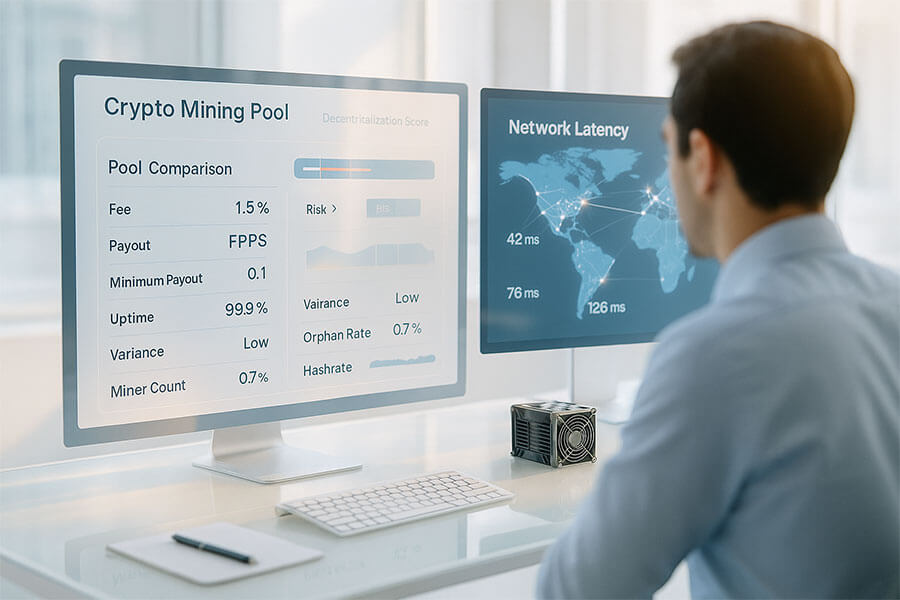
The landscape of cryptocurrency mining has transformed dramatically since Bitcoin’s early days when individual miners could successfully validate blocks using basic computer hardware. Today’s mining environment demands industrial-scale operations, sophisticated equipment, and strategic decision-making that extends far beyond simply purchasing the most powerful mining rigs. At the heart of modern mining success lies a critical choice that affects every aspect of profitability and operational efficiency: selecting the right mining pool.
Mining pool selection represents one of the most consequential decisions a cryptocurrency miner will make, yet it remains surprisingly overlooked by many participants who focus exclusively on hardware optimization and electricity costs. The pool you choose determines not only your payout frequency and fee burden but also influences your contribution to network decentralization, your exposure to operational risks, and ultimately your long-term mining profitability. A poorly selected pool can erode margins through excessive fees, inconsistent payouts, and technical inefficiencies that compound over time into significant financial losses.
The complexity of pool selection has increased alongside the maturation of the cryptocurrency mining industry. Modern miners face dozens of pool options, each employing different fee structures, payout methods, and operational philosophies that can dramatically impact returns. Some pools prioritize consistent small payouts through high hash rates, while others appeal to miners seeking to support network decentralization through smaller, geographically distributed operations. Fee structures range from simple flat percentages to complex hybrid models that reward long-term commitment or penalize frequent pool hopping. Geographic server distribution affects latency and stale share rates in ways that may seem negligible but accumulate into substantial performance differences.
Beyond immediate financial considerations, strategic pool selection carries implications for the broader cryptocurrency ecosystem. Mining pool concentration poses genuine threats to blockchain security and decentralization principles that underpin cryptocurrency value propositions. When single pools control excessive percentages of network hash rate, they gain disproportionate influence over consensus mechanisms and create potential vectors for coordinated attacks or censorship. Miners who thoughtfully distribute their hash power across multiple pools or deliberately choose smaller operations contribute to network health in ways that benefit the entire ecosystem while potentially sacrificing small amounts of individual profitability.
Understanding the interplay between these factors requires examining pool operations from multiple perspectives: financial analysis of fee structures and payout efficiency, technical evaluation of infrastructure reliability and performance, and strategic assessment of how pool choices align with personal mining goals and broader network health objectives. Successful miners develop comprehensive frameworks for evaluating pools that balance immediate profitability concerns with operational stability and network contribution considerations.
This article explores the multifaceted considerations that should inform mining pool selection decisions, providing both newcomers and experienced miners with actionable strategies for optimizing their pool choices. We examine the fundamental mechanics of pool operations, analyze key selection criteria including fee structures and payout methods, investigate geographic and network considerations, evaluate performance metrics and reliability indicators, and review real-world case studies that illustrate successful and problematic pool selection decisions.
Understanding Crypto Mining Pools
Cryptocurrency mining pools emerged as a practical solution to the growing difficulty of solo mining as blockchain networks expanded and competition intensified. In the early days of Bitcoin, individual miners could realistically expect to solve blocks and receive full block rewards using modest computing equipment. As network hash rates grew exponentially and mining difficulty adjusted upward, solo mining became increasingly impractical for all but the most powerful operations. This fundamental shift created the need for collaborative mining approaches that would allow smaller participants to receive consistent income rather than gambling on the extremely low probability of solving entire blocks independently.
Mining pools function as coordinators that aggregate computational power from multiple participants to increase the collective probability of successfully mining blocks. When a pool successfully validates a block, the rewards are distributed among contributing miners based on the amount of computational work each provided during the mining round. This approach transforms the mining income model from highly variable lottery-style payouts to more predictable steady streams that allow miners to forecast revenue and manage business operations more effectively. The trade-off for this consistency comes in the form of pool fees and the need to trust pool operators to fairly distribute rewards.
The mechanics of pool mining involve sophisticated coordination between distributed participants and central pool servers. Miners connect their hardware to pool servers that distribute work assignments representing different portions of the cryptographic puzzle that must be solved to validate blocks. As miners process these assignments, they submit shares representing completed work units back to the pool server. These shares prove that miners are actively contributing computational effort even when they have not solved complete blocks. Pool software tracks all submitted shares and uses this data to calculate each miner’s proportional contribution when blocks are successfully mined and rewards become available for distribution.
How Mining Pools Work
The technical architecture of mining pools centers on sophisticated server infrastructure that coordinates work distribution and reward allocation across potentially thousands of connected miners. Pool servers maintain connections to cryptocurrency network nodes, receive new block templates when blocks are discovered on the network, and immediately distribute updated work assignments to all connected miners. This rapid communication ensures miners always work on current block candidates rather than wasting computational resources on outdated problems that would yield no rewards even if solved.
Work distribution employs clever techniques to ensure fairness while preventing abuse. Pool servers generate unique work assignments for each connected miner by modifying specific parameters in block templates, allowing the pool to attribute any successfully mined blocks to specific participants based on the unique characteristics of the solution. This prevents miners from submitting the same work multiple times or claiming credit for solutions discovered by others. The system creates verifiable proof of work that cannot be easily forged while requiring minimal communication overhead that could create latency problems.
Share submission and validation represent critical components of pool operations that directly impact miner profitability. Miners continuously process work assignments and submit shares whenever they discover partial solutions that meet difficulty thresholds set by the pool. These thresholds are typically much lower than the actual network difficulty, allowing miners to prove consistent contribution even when complete block solutions remain rare. Pool servers validate submitted shares by checking cryptographic proofs, reject invalid submissions that might indicate hardware problems or attempted fraud, and maintain detailed records of valid contributions that form the basis for reward distribution calculations.
The Evolution of Pool Mining
The history of mining pools traces back to late 2010 when Bitcoin mining difficulty had increased sufficiently to make solo mining frustrating for smaller participants. The first pool, known as Slush Pool, introduced the fundamental concepts that would shape the industry: aggregating hash power, distributing work assignments, tracking individual contributions, and fairly allocating rewards. This pioneering pool initially faced skepticism from cryptocurrency purists who worried that pools would centralize mining power and undermine blockchain decentralization principles. However, the practical benefits of consistent payouts quickly overcame ideological objections as miners recognized that pools actually expanded participation by making mining economically viable for smaller operations.
Early pool implementations were relatively simple, using basic proportional reward systems that divided block rewards based on the number of shares each miner submitted during the round. These initial approaches created opportunities for exploitation through pool hopping, where opportunistic miners would join pools shortly before blocks were discovered and leave immediately after receiving payouts. This behavior concentrated rewards among hoppers while reducing payments for loyal miners who contributed consistently. The problem prompted development of more sophisticated payout schemes designed to discourage pool hopping by adjusting reward calculations to account for the timing and consistency of contributions.
Technological advancement in pool operations has dramatically improved efficiency, security, and feature offerings over the past decade. Modern pools implement multiple payout schemes to accommodate different miner preferences, support merged mining that allows simultaneous mining of multiple compatible cryptocurrencies, offer sophisticated monitoring dashboards that provide real-time performance analytics, and employ robust security measures to protect against distributed denial-of-service attacks and other threats. The largest pools now operate global server networks with redundant infrastructure that ensures high availability and low latency for miners regardless of geographic location.
The competitive pool landscape has driven continuous innovation in services and features beyond basic mining coordination. Many pools now offer additional services including cryptocurrency exchange integration for convenient conversion of mining rewards, detailed tax reporting tools that simplify accounting for miners in various jurisdictions, mobile applications that enable remote monitoring and management, and educational resources that help miners optimize their operations. This evolution reflects the maturation of cryptocurrency mining from hobby activity to legitimate business operation requiring professional-grade tools and support services.
Key Pool Selection Criteria
Selecting an optimal mining pool requires careful evaluation of multiple factors that directly impact profitability and operational efficiency. While fee structures often receive the most attention from miners comparing pool options, successful pool selection demands comprehensive analysis that considers payout methods, pool size dynamics, transparency practices, and long-term operational stability. Miners who focus exclusively on minimizing fees may overlook other factors that ultimately exert greater influence on actual returns, such as payout thresholds that create transaction fee burdens or pool instability that results in missed mining opportunities during server outages.
The relative importance of different selection criteria varies significantly based on individual mining operations and objectives. Large-scale miners with substantial hash rates may prioritize pool size and consistent block finding over small differences in fee percentages, while smaller miners might focus on payout thresholds and transaction cost efficiency to maximize net returns from modest mining revenues. Geographic location affects optimal pool selection through its influence on network latency and electricity costs, while personal values regarding network decentralization may lead some miners to deliberately choose smaller pools despite potential profitability trade-offs.
Developing a systematic framework for evaluating pools helps miners make informed decisions that align with their specific circumstances and goals. This framework should incorporate quantitative analysis of financial impacts from fees and payout structures, technical assessment of pool infrastructure and performance metrics, qualitative evaluation of pool reputation and operational transparency, and strategic consideration of how pool choices affect broader network health and personal mining objectives. The most successful miners regularly reassess their pool selections as market conditions evolve, new pools emerge, and their own operational scale and priorities change over time.
Fee Structures and Costs
Mining pool fees represent the most visible cost of pool participation and typically range from zero percent to three percent of gross mining revenue, with most established pools charging between one and two percent. These fees compensate pool operators for infrastructure costs, development efforts, and ongoing operational expenses while generating profits that incentivize high-quality service provision. However, the advertised headline fee rarely tells the complete cost story, as various fee structures distribute costs differently across miners and create hidden charges that may significantly impact actual net returns.
The Pay Per Share model offers miners the most predictable income by paying fixed amounts for each valid share submitted regardless of whether the pool successfully mines blocks. This approach transfers all variance risk from miners to pool operators, who must maintain sufficient capital reserves to pay miners even during unlucky periods when blocks are not found. The certainty provided by this model comes at a premium, with pools typically charging higher fees to compensate for the financial risk they assume. This structure particularly benefits smaller miners who value payment predictability over maximum theoretical returns and do not want exposure to the variance inherent in probabilistic block discovery.
Pay Per Last N Shares implements a more complex reward distribution that calculates payments based on shares submitted during a rolling window of recent activity rather than fixed mining rounds. This approach effectively addresses pool hopping by ensuring miners only receive fair compensation for actual contribution during the period when blocks are discovered. The system creates somewhat less predictable payouts than pure Pay Per Share models but typically allows pools to charge lower fees since they do not assume the same variance risk. Miners who remain with pools consistently generally prefer this model as it rewards loyalty while providing reasonable income stability.
Full Pay Per Share extends the basic Pay Per Share concept to include both block rewards and transaction fees in the fixed payment rate, ensuring miners receive their proportional share of total block value rather than just the base block subsidy. This distinction becomes increasingly important as block subsidies decline through halvings and transaction fees represent growing percentages of total mining revenue. Pools offering Full Pay Per Share typically charge slightly higher fees than basic Pay Per Share implementations to compensate for the increased variance exposure from fluctuating transaction fee income, but miners benefit from capturing the full value of their hash power contributions.
Hidden costs beyond advertised fee percentages can significantly erode mining profitability when overlooked during pool selection. Some pools implement minimum payout thresholds that force smaller miners to accumulate substantial balances before receiving payments, creating opportunity costs from delayed access to funds and exposure to cryptocurrency price volatility during accumulation periods. Transaction fees for payout transfers represent another often-overlooked cost that disproportionately affects smaller miners whose payout amounts may be eroded by significant percentages when blockchain transaction fees are high. Pools that cover transaction fees or implement efficient batched payment systems provide substantial value that may outweigh slightly higher mining fees.
Payout Methods and Thresholds
Payout methodology represents a critical but often underappreciated factor in pool selection that directly affects cash flow, transaction cost efficiency, and overall mining profitability. Different payout approaches optimize for various priorities including payment predictability, cost efficiency, or miner convenience, creating trade-offs that impact miners differently based on their operational scale and financial needs. Understanding these trade-offs enables miners to select pools whose payout structures align with their specific circumstances and maximize net returns after accounting for all costs.
Manual payout systems give miners maximum control over payment timing by allowing them to initiate withdrawals whenever account balances exceed minimum thresholds. This flexibility benefits miners who want to precisely time fund transfers to optimize tax treatment, take advantage of favorable exchange rates, or consolidate multiple payouts to minimize transaction fees. However, manual systems require active monitoring and management that may be inconvenient for miners preferring automated operations. They also create risks that miners may forget to withdraw funds before pool closures or security incidents that could result in loss of accumulated earnings.
Automatic payout schedules remove the management burden by initiating transfers to miner wallets at predetermined intervals such as daily, weekly, or whenever balances exceed specified thresholds. This convenience comes with reduced flexibility regarding payment timing and potentially increased transaction costs if automatic payments occur during periods of high blockchain congestion and elevated fees. Many pools offer configurable automatic payout settings that allow miners to adjust thresholds and frequencies based on their preferences, providing reasonable compromises between convenience and cost efficiency.
Minimum payout thresholds serve important functions for pool operators by reducing the number of transactions they must process and the associated costs, but these requirements create significant impacts on miner profitability that vary dramatically with operational scale. Smaller miners may wait weeks or months to accumulate balances sufficient to trigger payouts, during which time they face cryptocurrency price volatility risks and opportunity costs from inability to access earned funds. Pools with low minimum thresholds or flexible payment schedules provide substantial advantages for smaller operations even when their base fee structures are slightly less favorable than competitors with higher payout requirements.
The relationship between payout frequency and transaction costs creates important optimization considerations. Frequent small payouts maximize miner access to funds and minimize exposure to exchange rate fluctuations but generate proportionally higher transaction fees that can consume significant percentages of mining revenue for smaller operations. Less frequent larger payouts reduce transaction cost percentages but increase volatility exposure and delay fund availability. The optimal balance depends on individual mining revenue levels, cryptocurrency price volatility expectations, and personal cash flow requirements that vary considerably across different mining operations.
Pool Size and Hash Rate Distribution
Pool size represents one of the most consequential yet complex factors in mining pool selection, creating fundamental trade-offs between payout consistency and network decentralization that require careful consideration aligned with individual priorities and values. Large pools with substantial percentages of total network hash rate mine blocks more frequently, generating consistent predictable income streams that simplify business planning and reduce variance in mining returns. However, excessive hash rate concentration in dominant pools creates potential security vulnerabilities and centralization concerns that undermine the decentralization principles fundamental to cryptocurrency value propositions.
The mathematics of pool size effects on payout variance are straightforward but have significant practical implications. A pool controlling five percent of network hash rate will mine blocks approximately twenty times per day on Bitcoin’s network, creating relatively consistent daily income for participants. Smaller pools with one percent of network hash rate mine only four blocks daily on average, introducing greater day-to-day variability that larger miners can absorb but may create cash flow challenges for smaller operations operating on tight margins. This variance reduction benefit explains why large pools can attract substantial hash rate despite charging similar or even higher fees than smaller competitors, as many miners willingly pay modest premiums for income predictability.
Hash rate concentration risks emerge when dominant pools accumulate excessive percentages of total network capacity. Bitcoin has historically experienced concerning centralization when single pools approached or exceeded twenty-five percent of network hash rate, creating theoretical possibilities for double-spending attacks through temporary hash rate coordination. While no major pool has yet exploited such dominance for malicious purposes, the existence of such capabilities contradicts cryptocurrency’s decentralization premises and creates systemic risks that could undermine network credibility and value. Responsible mining includes consideration of these broader implications and sometimes involves deliberately choosing smaller pools to support healthy hash rate distribution.
The optimal pool size for individual miners depends on complex interactions between operational scale, risk tolerance, and values regarding network health. Large professional mining operations typically prioritize consistency and can absorb the minimal variance from mining with moderate-size pools controlling five to ten percent of network hash rate, allowing them to balance profitability with decentralization support. Smaller miners face more difficult decisions, as the increased variance from mining with small pools can create cash flow challenges, while mining with dominant pools may conflict with philosophical commitments to decentralization that originally attracted them to cryptocurrency.
Some sophisticated miners employ multi-pool strategies that distribute hash power across several pools simultaneously to balance variance reduction benefits with decentralization support. This approach requires additional configuration complexity and may sacrifice some efficiency through increased stale shares if not implemented carefully, but allows miners to enjoy relatively consistent aggregate income while contributing to healthy network hash rate distribution. Modern mining management software increasingly supports automated multi-pool configurations that optimize this balance without requiring constant manual intervention.
Geographic and Network Considerations
The physical and network infrastructure aspects of mining pools exert substantial influence on mining efficiency and profitability through their effects on communication latency, stale share rates, and overall system reliability. While these technical factors may seem abstract compared to visible costs like pool fees, they create measurable impacts on effective hash rate utilization that accumulate into significant long-term effects on mining returns. Geographic proximity to pool servers, quality of internet connectivity, and pool network architecture collectively determine how efficiently miners can submit work and receive new assignments, directly affecting the percentage of computational effort that translates into compensated shares.
Latency represents the critical metric linking geographic factors to mining performance, measuring the time required for data to travel between mining hardware and pool servers. Every millisecond of latency creates opportunities for miners to waste computational resources working on outdated problems after new blocks have been discovered on the network but before those updates reach mining hardware. This creates stale shares that pools cannot accept for payment since they represent work on problems that no longer need solving. While individual stale shares represent small losses, they accumulate over time into percentages of total hash rate that can exceed the cost savings from choosing pools with marginally lower fees.
Beyond individual miner considerations, geographic distribution of pool infrastructure carries implications for network decentralization and resilience that affect the broader cryptocurrency ecosystem. Pools operating exclusively from single geographic regions create concentration risks where localized events such as internet outages, power disruptions, or regulatory actions could suddenly remove substantial percentages of network hash rate. Geographically distributed pool architectures with servers across multiple continents and jurisdictions enhance network resilience while providing options for miners worldwide to connect to nearby servers and minimize latency-related efficiency losses.
Server Location and Latency
Understanding the relationship between server proximity and mining efficiency requires examining how the mining communication protocol functions and where delays create lost opportunities. When new blocks are discovered on cryptocurrency networks, this information must propagate to pool servers, which must then distribute updated work assignments to all connected miners. The time required for this communication chain directly determines how much computational effort is wasted on obsolete work. Miners located far from pool servers experience longer delays in receiving these critical updates, resulting in higher stale share rates that reduce effective mining rewards.
Practical measurements demonstrate that latency impacts can be substantial when mining with geographically distant pools. A miner in North America connecting to a pool with servers only in Asia might experience round-trip communication times of two hundred milliseconds or more, while connecting to a pool with North American servers could reduce this to twenty milliseconds or less. This tenfold latency reduction translates to measurably lower stale share rates that typically improve effective hash rate utilization by one to three percent, representing savings that often exceed the fee differences between competing pools and justify choosing slightly higher-fee pools with better geographic server distribution.
The concept of stale shares deserves careful examination as it represents one of the primary mechanisms through which latency affects mining profitability. Stale shares occur when miners submit valid solutions to mining problems that have already been solved by others, making these submissions worthless since the network has moved on to mining the next block. High latency increases stale share rates by delaying notification to miners that new blocks have been found, causing them to continue working on outdated problems. Most well-operated pools experience aggregate stale share rates below one percent, but individual miners with poor connectivity or geographic disadvantages may see rates of three percent or higher that significantly impact net returns.
Pool operators increasingly recognize the importance of geographic server distribution and invest in infrastructure across multiple regions to serve their global miner base effectively. The most competitive pools maintain server presence in North America, Europe, and Asia at minimum, with some operating nodes in additional locations including South America, Africa, and Oceania to serve miners in those regions. This distributed architecture requires sophisticated load balancing and work coordination to ensure all servers operate synchronously and deliver consistent service quality, but the investment pays dividends through improved miner satisfaction and retention.
Miners should systematically test latency to candidate pools before committing significant hash rate by measuring ping times and monitoring stale share rates during trial mining periods. Simple network tools can measure round-trip communication times to pool servers, while most mining software provides statistics on stale share percentages that reveal the practical efficiency of pool connections. Comparing these metrics across several pools while mining test periods of several days provides empirical data for making informed decisions about which pools offer the best effective returns after accounting for latency impacts that may not be apparent from fee structures alone.
Evaluating Pool Performance and Reliability
Assessing the operational quality and long-term reliability of mining pools requires examining performance indicators that extend beyond basic fee comparisons to encompass stability, transparency, security practices, and historical track records. Pools may offer attractive fee structures and convenient features but fail to deliver consistent value if they experience frequent downtime, suffer security breaches, or lack transparency in their operations that makes independent verification difficult. Developing comprehensive evaluation frameworks that assess multiple dimensions of pool quality helps miners avoid problematic operations and identify partners that will reliably deliver value over extended mining periods.
The financial stakes of pool reliability become clear when considering that even brief periods of downtime directly translate to lost mining revenue that cannot be recovered. A pool experiencing one hour of downtime daily eliminates approximately four percent of potential mining time, wiping out any fee advantages over more reliable competitors and creating frustration for miners whose equipment sits idle during outages. Extended outages or frequent service disruptions compound these losses while potentially indicating deeper operational problems that might lead to pool closure or security incidents that could endanger accumulated earnings.
Transparency represents another critical but often overlooked dimension of pool quality that enables miners to verify fair treatment and make informed decisions about continued participation. Pools that provide detailed public statistics about block discovery, reward distribution, and operational metrics allow miners to independently verify they receive appropriate compensation for their contributions. Conversely, pools operating as black boxes with minimal public information create opportunities for operators to manipulate reward calculations, withhold portions of earnings, or engage in other behaviors that disadvantage miners while enriching operators at their expense.
Uptime, Stability, and Transparency Metrics
Pool uptime statistics provide the most fundamental measure of operational reliability, quantifying the percentage of time that pool services remain accessible to miners and capable of distributing work and accepting share submissions. Professional pools should maintain uptime exceeding ninety-nine percent, with the best operations achieving ninety-nine point nine percent availability through redundant infrastructure and proactive maintenance practices. Miners can assess historical uptime through pool monitoring services that track availability over extended periods, providing more reliable indicators than operators’ self-reported statistics that may exclude brief outages or categorize service degradations as planned maintenance rather than failures.
The distinction between complete outages and performance degradations matters significantly for practical mining operations. Some pools may technically remain online but experience severe performance problems such as elevated latency, frequent connection dropouts, or delayed work distribution that reduces mining efficiency even when services never completely fail. These quality-of-service issues can be more problematic than occasional brief outages since they create ongoing efficiency losses that miners may not immediately recognize or attribute to pool problems rather than their own equipment or connectivity.
Block finding consistency provides another revealing performance indicator that can expose pool operational problems or fraudulent behavior. Mining follows statistical distributions where actual block discovery rates should closely approximate expected rates based on pool hash rate and network difficulty over sufficiently long time periods. Sustained deviations where pools consistently underperform statistical expectations may indicate technical problems that prevent proper work distribution, or in extreme cases, suggest operators are stealing hash power by submitting some blocks as solo finds rather than crediting pool miners appropriately.
Transparency in reward distribution represents a critical trust factor that separates reputable pools from potentially problematic operations. The best pools provide detailed public accounting showing total blocks mined, complete reward distributions, fee deductions, and per-miner payment breakdowns that allow any participant to verify calculations and ensure fair treatment. This transparency not only protects miners from potential fraud but also demonstrates operational integrity that builds confidence and attracts hash rate from sophisticated miners who value verifiable fair dealing over marginal fee advantages.
Security incident history reveals important information about pool operational practices and preparedness for threats that could endanger miner earnings. Pools that have experienced security breaches, distributed denial-of-service attacks that caused extended outages, or other incidents should be evaluated based on their responses and subsequent improvements rather than permanently dismissed. Professional pools that transparently disclose incidents, implement proper remediation, and demonstrate learning from problems may actually be safer choices than pools that claim perfect security histories that could indicate insufficient testing, security awareness, or transparency rather than genuinely superior security posture.
Warning signs that should prompt extreme caution or avoidance include pools with anonymous operators whose identities cannot be verified, operations that provide minimal public information about their infrastructure or business practices, pools experiencing frequent unexplained issues or prolonged outages, and operations where miners report difficulty withdrawing earnings or receiving payments. These red flags often indicate unprofessional management, inadequate resources, or potentially fraudulent operations designed to steal miner hash power and earnings.
Case Studies in Pool Selection
Examining real-world examples of mining pool selection decisions and their outcomes provides valuable insights into how theoretical selection criteria translate into practical results. These case studies illustrate both successful strategic approaches that maximized profitability while supporting network health, and problematic decisions that resulted in financial losses or operational difficulties. By analyzing specific situations faced by miners during recent years, we can extract lessons applicable to current pool selection decisions and develop more sophisticated frameworks for evaluating the complex trade-offs involved in choosing optimal mining partners.
The period from 2022 through 2025 has witnessed significant evolution in the mining pool landscape, with several notable events that demonstrate the importance of careful pool selection. Market volatility following cryptocurrency price fluctuations created financial pressure on mining operations that exposed differences in pool reliability and payout efficiency. Geographic regulatory changes affected pool operations in various jurisdictions, demonstrating the value of pools with distributed infrastructure. Technical innovations in pool coordination and payout systems created new competitive advantages that shifted optimal pool selections for different types of miners.
These case studies emphasize that optimal pool selection is not static but requires ongoing monitoring and willingness to adapt as circumstances change. Pools that offered excellent value in past years may decline in competitiveness as management changes, technical infrastructure ages, or competitive dynamics shift. Conversely, newer pools may improve their offerings and emerge as superior options for miners willing to evaluate alternatives rather than remaining with familiar choices purely from inertia.
The mining landscape saw significant shifts in 2023 when Foundry USA emerged as a dominant force in Bitcoin mining, particularly among North American institutional miners. By mid-2023, Foundry controlled approximately thirty percent of Bitcoin’s network hash rate, making it the largest single pool and raising concerns about centralization. The pool’s growth was driven by competitive fee structures around one percent, reliable infrastructure with minimal downtime, and strong relationships with major mining equipment manufacturers who promoted Foundry to their customers. Large mining operations appreciated Foundry’s institutional-grade service quality, sophisticated monitoring tools, and reliable daily payouts that simplified business operations and cash flow management.
However, Foundry’s concentration of hash rate created dilemmas for miners concerned about network decentralization. Some operations deliberately chose to split their hash rate between Foundry and smaller pools despite slightly reduced operational efficiency from managing multiple pool connections. This decision reflected long-term strategic thinking that prioritized ecosystem health over marginal short-term profit maximization, recognizing that excessive centralization could undermine Bitcoin’s value proposition and ultimately harm all participants including miners. The situation demonstrated how responsible mining requires balancing individual profitability against broader network considerations.
Another instructive example emerged in late 2023 when several smaller Bitcoin mining pools experienced extended outages and service disruptions that frustrated miners and resulted in significant lost revenue. Pools with inadequate infrastructure investments struggled to maintain service quality as network activity increased and they attracted growing numbers of miners during bullish market periods. Some operations that had offered attractively low fees proved unable to scale their infrastructure appropriately, resulting in frequent connection problems, elevated stale share rates, and delayed payouts that more than offset their fee advantages.
These disruptions illustrated the importance of evaluating pool operational capacity and not simply choosing based on advertised fees. Miners who had conducted thorough due diligence by testing pool performance during trial periods and researching operational histories largely avoided these problematic pools, while those who joined based primarily on low fees suffered substantial losses. The incidents reinforced that the cheapest option frequently proves more expensive over time when operational quality is inadequate to deliver reliable service.
The cryptocurrency regulatory landscape provided another revealing case study in 2024 when several pools faced complications from evolving compliance requirements in different jurisdictions. Pools with operations concentrated in single regulatory environments encountered challenges when local authorities implemented new rules around cryptocurrency transactions, user identification requirements, or mining activity reporting. Some pools responded by implementing geographic restrictions that prevented miners from certain regions from accessing their services, disrupting operations for affected participants who had to urgently migrate to alternative pools.
In contrast, pools with geographically distributed operations and multi-jurisdictional structures generally navigated these regulatory changes more smoothly by shifting operations between regions as needed and maintaining service continuity for most miners. This geographic diversification also provided latency benefits for miners worldwide who could connect to nearby servers regardless of where pool management was based. The experience demonstrated that pool infrastructure geography matters not only for technical performance but also for operational resilience in the face of regulatory evolution.
Benefits and Risks of Different Pool Strategies
Mining pool selection strategies involve inherent trade-offs between various objectives including profitability maximization, income consistency, network decentralization support, and operational simplicity. Different approaches optimize for different priorities and suit different types of mining operations based on their scale, risk tolerance, and values. Understanding the benefits and risks associated with various strategies enables miners to make informed choices aligned with their specific circumstances rather than blindly following popular wisdom that may not apply to their situations.
For hobbyist and small-scale miners operating a few devices, the primary benefits of joining established large pools include consistent predictable payouts that simplify planning and reduce variance stress, lower minimum payout thresholds that ensure regular access to earnings without long accumulation periods, and extensive monitoring tools and support resources that help less experienced miners optimize their operations. These pools offer beginner-friendly interfaces and comprehensive documentation that reduce the learning curve for newcomers who may find cryptocurrency mining technically intimidating. The main risks include contributing to potentially excessive hash rate centralization and typically paying slightly higher fees than some smaller alternatives, though these costs may be justified by the convenience and consistency large pools provide.
Medium-scale miners operating dozens of devices face different optimization criteria where the variance reduction benefits of large pools matter less since their own hash rates produce relatively consistent income even when mining with moderate-size pools. These operations can often achieve better net returns by selecting mid-tier pools offering competitive fee structures around one percent while maintaining sufficient hash rate for reasonable payout consistency. The benefits include supporting healthier network hash rate distribution while still enjoying professional-grade infrastructure and services. Risks include slightly higher day-to-day payout variance and potentially less comprehensive support resources compared to the largest operators.
Large-scale and industrial miners controlling thousands of devices or more have the hash rate to make multi-pool strategies practical and potentially beneficial. These operations can distribute hash power across multiple pools to optimize the balance between consistency and decentralization support while gaining negotiating leverage for reduced fees through their substantial contributions. Benefits include minimizing dependence on any single pool operator, supporting network decentralization through deliberate hash rate distribution, and potentially accessing volume discounts or preferential terms from pools competing for large miners’ business. The risks involve increased operational complexity from managing multiple pool configurations and potentially higher stale share rates if multi-pool coordination is not implemented efficiently.
The most significant risk cutting across all mining scales involves pool stability and security. Choosing unreliable pools wastes valuable hash time during outages and service disruptions that directly reduce revenue while equipment continues consuming electricity. Security breaches could potentially endanger accumulated earnings if pools lack adequate protections for hot wallets holding pending payments. While these risks can be mitigated through careful pool vetting and maintaining modest accumulated balances through frequent withdrawals, they remain inherent in mining pool participation and justify ongoing monitoring of pool operational quality and security practices.
Another universal consideration involves geographic and regulatory diversification that helps protect against localized disruptions. Miners relying exclusively on pools operating from single regulatory jurisdictions face risks that policy changes could suddenly restrict or eliminate pool operations, forcing urgent migrations that may cause revenue interruptions. Choosing pools with distributed operations across multiple regions provides insurance against such disruptions while typically offering latency benefits through geographically diverse server infrastructure. The trade-off may involve slightly reduced efficiency from not being able to connect to the single optimal pool, but this cost is generally minimal compared to the resilience benefits provided.
Final Thoughts
The strategic selection of mining pools represents far more than a simple operational decision about where to point hash rate—it embodies a fundamental choice about how individual miners position themselves within the broader cryptocurrency ecosystem and what values they prioritize in their participation. As blockchain networks mature and mining transitions from hobbyist activity to professional business operation, the sophistication required for optimal pool selection continues to increase, demanding comprehensive analysis that extends beyond superficial fee comparisons to encompass technical performance, operational reliability, and alignment with personal principles regarding network decentralization.
The cryptocurrency mining industry faces an ongoing tension between efficiency-driven centralization pressures and the decentralization ideals fundamental to blockchain value propositions. Mining pools represent a microcosm of this broader challenge, where individual rational decisions to maximize short-term profitability through joining dominant pools can collectively create systemic centralization risks that threaten the long-term health of networks all miners depend upon. Resolving this tension requires individual miners to recognize their role as stakeholders in ecosystem health rather than purely self-interested profit maximizers, incorporating considerations of network decentralization into pool selection decisions even when this involves modest financial trade-offs.
The evolution toward more sophisticated and diverse mining pool offerings creates unprecedented opportunities for miners to find operations aligned with their specific needs and values. Geographic server distribution improves latency and resilience while supporting regulatory diversification. Multiple payout schemes accommodate different preferences regarding consistency versus variance. Transparency initiatives enable verification of fair treatment and build trust between pools and participants. These developments suggest the mining pool landscape is maturing toward more competitive and specialized markets where miners can optimize selections based on comprehensive criteria rather than being forced into one-size-fits-all compromises.
Looking forward, the mining pool selection landscape will likely continue evolving in response to technological innovation, regulatory developments, and changing network characteristics. Layer-two protocols and merged mining opportunities may create new coordination mechanisms that blur traditional pool boundaries. Decentralized pool protocols could emerge that retain the efficiency benefits of pooled mining while eliminating single operator control. Regulatory frameworks will probably impose increasing compliance requirements that favor professionally operated pools with robust legal and accounting infrastructure over informal operations.
These coming changes underscore the importance of viewing pool selection not as a one-time decision but as an ongoing strategic process requiring regular reassessment and adaptation. Miners who develop systematic frameworks for evaluating pools, stay informed about industry developments, and maintain flexibility to adjust their strategies will be best positioned to optimize returns while contributing to healthy network evolution. The most successful mining operations will likely be those that balance profitability objectives with broader ecosystem considerations, recognizing that long-term success depends on maintaining the decentralization and security properties that give cryptocurrencies their distinctive value.
The relationship between individual mining decisions and collective network outcomes creates both responsibility and opportunity for miners committed to cryptocurrency’s original vision of decentralized financial systems. By thoughtfully selecting pools that support healthy hash rate distribution, maintaining geographic and operational diversity, and prioritizing transparency and fair dealing, miners can align their profit motives with the broader goal of maintaining robust and credible blockchain networks. This alignment between individual and collective interests represents the essence of well-designed incentive systems that make blockchain technologies viable alternatives to traditional centralized institutions.
FAQs
- What is the most important factor when selecting a mining pool?
No single factor universally dominates pool selection decisions, as optimal choices depend on individual circumstances including mining scale, risk tolerance, and values. However, the combination of fee structure and operational reliability typically exerts the greatest impact on practical returns for most miners. Pools with attractive fees but poor uptime or problematic payouts ultimately deliver worse results than slightly higher-fee operations with excellent reliability. Miners should prioritize finding pools that balance competitive costs with proven stability and transparent operations. - How do I calculate the true cost of mining pool fees?
True pool costs extend beyond advertised percentage fees to include minimum payout thresholds that delay fund access, transaction fees for receiving payments that disproportionately affect smaller miners, and efficiency losses from stale shares caused by poor geographic server distribution or infrastructure quality. To calculate comprehensive costs, miners should track net received payments over extended periods and compare actual returns against theoretical earnings based on contributed hash rate and network rewards. This empirical approach reveals hidden costs that may not be apparent from fee percentages alone. - Should I switch pools frequently to maximize profits?
Frequent pool switching typically reduces rather than increases profitability due to several factors. Many pools implement payout schemes specifically designed to discourage pool hopping by penalizing short-term participants. Switching creates administrative overhead, potential payment delays during transitions, and risks of configuration errors that could result in lost mining time. Unless significant problems emerge with current pools or substantially better alternatives appear, miners generally achieve better results through stable long-term pool relationships that eliminate switching friction and allow optimization of configurations for specific pool characteristics. - How much hash rate is too much for a single pool to control?
While no precise threshold exists, cryptocurrency communities generally become concerned when single pools exceed twenty-five percent of network hash rate due to the theoretical possibility of temporary consensus manipulation. Pools approaching or exceeding thirty percent create more acute centralization risks that could undermine network security and credibility. Responsible miners should monitor hash rate distribution and consider deliberately choosing smaller alternatives when their preferred pools grow excessively large, even if this involves modest efficiency trade-offs. Supporting healthy distribution serves long-term network health that benefits all participants. - Can I mine to multiple pools simultaneously?
Most modern mining management software supports multi-pool configurations that distribute hash rate across multiple pools simultaneously or implement automatic failover when primary pools experience problems. This approach provides benefits including improved uptime through redundancy, support for network decentralization through deliberate hash rate distribution, and potential optimization opportunities by directing different device types to pools offering better returns for specific hardware. However, multi-pool strategies require more complex configuration and monitoring while potentially increasing stale share rates if not implemented carefully. - What payment method is best for small-scale miners?
Small-scale miners typically benefit most from automatic payout systems with low minimum thresholds that provide regular payments without requiring manual withdrawal management. Pools offering daily or weekly automatic payments with minimums equivalent to a few dollars ensure consistent fund access while minimizing transaction fee impacts through efficient batched payment processing. Miners should carefully evaluate minimum thresholds against their hash rates to ensure they receive payments at reasonable intervals rather than waiting weeks or months to accumulate required balances that could be endangered by pool closure or security incidents. - How can I verify a mining pool is paying me fairly?
Verifying fair payment requires comparing actual received amounts against theoretical earnings based on contributed hash rate, network difficulty, and block rewards during the mining period. Most pools provide detailed statistics about submitted shares, rejected shares, and calculated rewards that enable independent verification. Miners should monitor these metrics regularly and investigate any sustained deviations between expected and actual payments. Pools offering transparent public accounting of blocks mined and complete reward distributions enable external verification that builds confidence in operational integrity. - What are the warning signs of a problematic mining pool?
Major warning signs include anonymous operators with no verifiable identities or business information, lack of transparent public statistics about operations and payouts, frequent unexplained outages or service disruptions, difficulty withdrawing earnings or receiving timely payments, and negative reports from other miners about unfair treatment or suspicious behavior. Pools experiencing these problems should be avoided or exited immediately to prevent potential losses. Even one or two warning signs justify extreme caution and thorough investigation before committing significant hash rate. - Do pool fees really matter compared to other factors?
Pool fees definitely matter and directly impact net returns, but their importance is often overstated relative to other factors like operational reliability, payout efficiency, and latency-driven stale share rates. A pool charging one percent fees with excellent uptime and low stale shares typically delivers better actual returns than a pool charging half-percent fees but experiencing frequent outages and poor connectivity. Miners should evaluate fees within the broader context of total cost including all hidden charges and efficiency factors rather than selecting pools based exclusively on lowest advertised percentages. - How often should I reassess my mining pool choice?
Pool selection should be reviewed systematically at least quarterly to evaluate whether current pools continue delivering optimal value and whether better alternatives have emerged. More frequent reassessment may be warranted during periods of significant market volatility, regulatory changes, or pool operational problems. However, overly frequent changes create inefficiencies and should be avoided unless clear evidence indicates substantial advantages from switching. The optimal review frequency balances staying informed about competitive options against the costs and risks of unnecessary transitions.