The traditional landscape of dispute resolution stands at a pivotal moment of transformation. For centuries, conflicts between parties have been resolved through established legal systems—courtrooms presided over by judges, arbitration panels convened by professional bodies, and mediation sessions facilitated by trained intermediaries. These conventional mechanisms, while deeply embedded in legal tradition and social practice, increasingly struggle to address the unique challenges presented by our digitally interconnected global economy. High costs, lengthy proceedings, geographical limitations, and accessibility barriers create significant obstacles for individuals and businesses seeking fair resolution of their conflicts.
Web3 technology introduces a fundamentally different approach to settling disputes through decentralized platforms that leverage blockchain infrastructure, cryptographic security, and innovative economic incentives. These systems enable parties to resolve conflicts without relying on traditional courts, arbitration institutions, or centralized authorities. Instead, they harness the collective judgment of distributed networks of jurors who are economically motivated to reach fair outcomes through carefully designed game-theoretic mechanisms. The shift from centralized authority to decentralized consensus represents more than a mere technological upgrade—it embodies a reimagining of how justice itself can be administered in digital spaces.
The promise of decentralized dispute resolution extends far beyond technical innovation. These platforms offer potential solutions to persistent problems that have long plagued traditional legal systems, including prohibitive costs that exclude ordinary people from accessing justice, delays that can stretch disputes across years, and jurisdictional complications that make cross-border conflicts nearly impossible to resolve efficiently. By creating transparent, accessible, and cost-effective alternatives, Web3 arbitration protocols could democratize access to fair conflict resolution while maintaining the essential principles of due process and impartiality.
Game theory and economic incentives form the intellectual foundation of these revolutionary systems. Rather than relying on professional judges whose impartiality stems from ethical obligations and institutional oversight, decentralized platforms create conditions where rational actors are incentivized to make honest decisions through carefully calibrated reward and penalty structures. Jurors who vote with the consensus earn fees and reputation, while those who deviate face financial penalties. This mechanism design transforms the pursuit of self-interest into a driver of collective fairness, aligning individual incentives with the goal of reaching correct outcomes.
The emergence of decentralized dispute resolution systems reflects broader trends toward disintermediation and democratization enabled by blockchain technology. Just as cryptocurrencies challenged the monopoly of central banks over monetary systems, and decentralized autonomous organizations offered alternatives to traditional corporate structures, Web3 arbitration platforms propose new models for administering justice that operate independently of state institutions. This development raises profound questions about the nature of legal authority, the role of technology in governance, and the future relationship between traditional legal systems and emerging decentralized alternatives.
Understanding these transformative platforms requires examining not only their technical architecture but also the theoretical principles underlying their design, the practical challenges they face, and the broader implications for access to justice in an increasingly digital world. As disputes migrate online and traditional jurisdictions struggle to keep pace with technological change, decentralized systems may offer pathways toward more efficient, transparent, and equitable resolution mechanisms that serve the needs of a globally connected society.
Understanding Traditional Dispute Resolution and Its Limitations
Traditional dispute resolution encompasses three primary mechanisms through which parties seek to settle conflicts: litigation in courts, formal arbitration, and mediation. Each approach has evolved over centuries to serve specific purposes, yet all share fundamental limitations that become increasingly apparent in contemporary digital environments. Court systems, while providing authoritative resolution backed by state enforcement power, require parties to navigate complex procedural rules, face unpredictable timelines, and bear substantial financial costs. Even relatively simple disputes can take months or years to resolve through litigation, with legal fees often exceeding the value of the underlying claim.
Arbitration emerged as an alternative to court litigation, offering parties more control over the process and potentially faster resolution. Commercial arbitration has become particularly popular for international business disputes, where parties prefer neutral arbitrators to national courts that might favor local parties. However, traditional arbitration still involves significant costs for arbitrator fees, administrative expenses, and legal representation. The process requires coordinating schedules among multiple parties and arbitrators, which can introduce delays. Additionally, arbitration proceedings typically remain private, limiting transparency and making it difficult for observers to assess whether outcomes are fair and consistent across similar cases.
Mediation provides a more collaborative approach where neutral facilitators help parties reach mutually acceptable solutions. This method works well for disputes where ongoing relationships matter and parties prefer negotiated outcomes over imposed judgments. Yet mediation depends heavily on parties’ willingness to compromise and the mediator’s skill in guiding negotiations. When power imbalances exist between parties or when one side seeks to delay resolution, mediation can prove ineffective. Like arbitration, mediation involves professional fees and requires coordination that can be challenging across different time zones and jurisdictions.
The cost structure of traditional dispute resolution creates significant barriers to access, particularly for smaller claims. Legal representation, filing fees, and procedural requirements make it economically irrational to pursue disputes below certain value thresholds. This reality effectively denies justice to individuals and small businesses with legitimate grievances that cannot justify the expense of formal proceedings. The emergence of small claims courts and simplified procedures provides some relief, yet these mechanisms still require physical presence, procedural compliance, and time commitments that many cannot afford.
Geographical and jurisdictional limitations present additional challenges in our globalized economy. When disputes involve parties in different countries, determining which court has jurisdiction and which law applies becomes complex and contentious. Enforcement of foreign judgments requires navigating international treaties and local recognition procedures that can be slow and uncertain. Even within federal systems, conflicts about which state or province has proper jurisdiction can delay resolution and increase costs. These territorial boundaries, once necessary for organizing legal systems, increasingly seem artificial in digital environments where transactions occur instantaneously across borders.
Transparency and accountability in traditional systems vary considerably. Court proceedings in many jurisdictions are public, allowing scrutiny of judicial decisions and building precedents that guide future cases. However, arbitration typically occurs behind closed doors, with awards often kept confidential. This privacy serves legitimate interests in protecting business confidentiality but limits accountability and makes it difficult to assess whether arbitrators apply consistent standards. The opacity of private dispute resolution can also obscure potential conflicts of interest or bias that might influence outcomes.
The centralized nature of traditional systems creates single points of control that can be subject to political influence, corruption, or institutional capture. While most developed jurisdictions maintain independent judiciaries protected by institutional safeguards, many regions lack strong rule of law traditions. Even in well-functioning systems, concerns about political appointments influencing judicial decisions, or well-connected parties receiving favorable treatment, persist. These vulnerabilities become particularly acute in cross-border disputes where parties may question the neutrality of institutions affiliated with one party’s home jurisdiction.
Speed and efficiency suffer in traditional systems due to procedural requirements designed to ensure fairness and due process. While these protections serve important purposes, they also create opportunities for strategic delay and procedural manipulation. Parties with deeper resources can exploit these dynamics to their advantage, using the cost and duration of proceedings as leverage in settlement negotiations. The result is a system where justice delayed becomes justice denied for parties who cannot afford extended legal battles.
What Are Decentralized Dispute Resolution Systems
Decentralized dispute resolution systems represent a fundamentally new approach to settling conflicts that leverages blockchain technology, cryptographic security, and crowd-sourced decision-making. Unlike traditional mechanisms that rely on centralized authorities—judges appointed by states, arbitrators selected by institutions, or mediators certified by professional bodies—these platforms distribute the dispute resolution function across networks of participants who have no pre-existing authority beyond what the system grants them through transparent, algorithmic processes. The decentralization removes single points of control, making the systems resistant to capture, censorship, or manipulation by any individual actor.
At their core, these systems operate as protocols—sets of rules encoded in smart contracts that automatically execute without requiring trusted intermediaries. When parties enter into an agreement that designates a decentralized platform as the dispute resolution mechanism, they effectively consent to having their conflict adjudicated by a randomly selected jury of token holders according to predetermined procedures. The entire process, from dispute initiation through final judgment, operates on blockchain infrastructure that provides transparency, immutability, and cryptographic verification of all actions. This architecture ensures that no party can alter evidence, manipulate juror selection, or interfere with vote tallying once the process begins.
The trustless nature of these systems represents a paradigm shift from traditional dispute resolution. Parties need not trust individual jurors, platform operators, or any centralized authority. Instead, they trust in the cryptographic guarantees provided by blockchain technology and the economic incentives that motivate rational actors to behave honestly. This trust model aligns naturally with the ethos of Web3 technologies more broadly, which seek to replace institutional trust with mathematical certainty and economic rationality. The result is a dispute resolution mechanism that can operate across jurisdictional boundaries without requiring recognition by any state authority.
Core Components and Technical Architecture
Smart contracts form the foundation of decentralized dispute resolution platforms, encoding all procedural rules and automatically executing each step of the adjudication process. These contracts hold disputed assets in escrow, randomly select jurors from eligible pools, collect and verify evidence submissions, tally votes, and distribute outcomes according to programmed logic. The self-executing nature of smart contracts eliminates the need for human administrators to oversee proceedings, reducing costs and potential sources of bias. Every action taken within the system generates an immutable record on the blockchain, creating complete transparency and auditability of the entire process.
Juror selection mechanisms employ cryptographic randomness to ensure unpredictable and fair assignment of cases. Eligible jurors typically stake tokens to signal their availability and commitment to participating in dispute resolution. The platform then uses verifiable random functions to select jurors with probability proportional to their staked amounts. This sortition process mirrors ancient Athenian democratic practices while leveraging modern cryptography to prevent manipulation. The randomness ensures that no party can predict or influence which jurors will hear their case, protecting against corruption and collusion attempts.
Evidence submission protocols allow parties to present supporting materials through cryptographically secured channels. Documents, images, and testimony can be uploaded to distributed storage systems with cryptographic hashes recorded on the blockchain to prove authenticity and timing. Some platforms support encrypted evidence that only selected jurors can access, protecting confidential information while maintaining verifiability. The immutability of blockchain records ensures that evidence cannot be altered or selectively deleted after submission, creating a reliable foundation for juror deliberations.
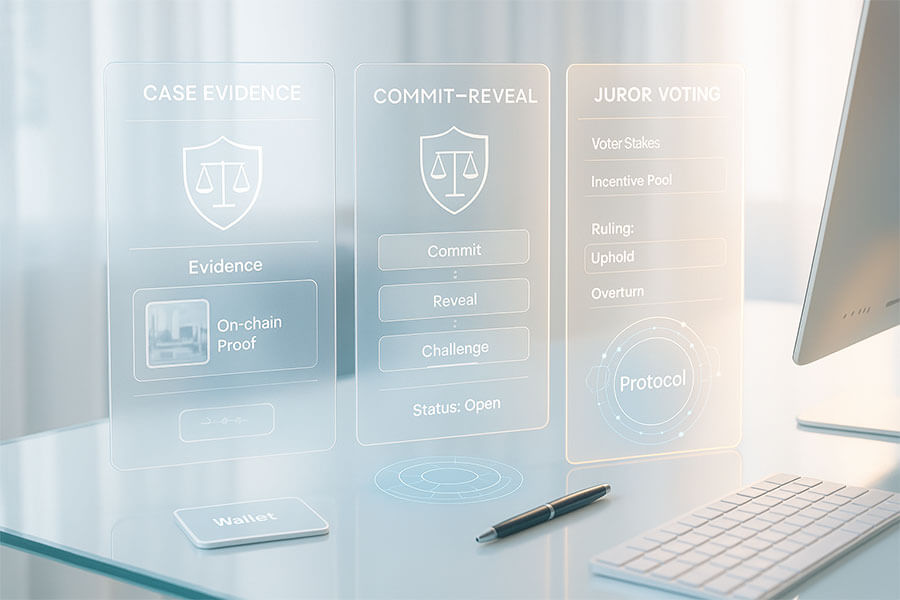
Voting systems in decentralized platforms employ commit-reveal schemes to prevent vote manipulation and coordination. Jurors first submit encrypted votes that hide their choices from other participants. Only after all jurors have committed do they reveal their actual votes, which can then be verified against the earlier commitments. This process prevents jurors from observing others’ votes before making their own decisions, reducing herding behavior and coordination attempts. Advanced platforms are integrating threshold encryption techniques that provide even stronger privacy guarantees during the voting process.
Appeal mechanisms allow dissatisfied parties to request reconsideration by larger jury pools. When a party appeals a ruling, they typically must stake additional tokens to cover the costs of summoning more jurors. The case is then heard by a significantly expanded jury—often several times larger than the initial panel—whose decision carries greater weight due to the broader consensus required. Multiple rounds of appeals can occur up to a predetermined limit, after which a final round involving all eligible jurors in the platform may be invoked to reach a conclusive judgment. This hierarchical appeal structure balances efficiency in routine cases with thoroughness for contested matters.
These components work together to create functional dispute resolution systems that operate autonomously once initiated. The technical architecture prioritizes transparency, security, and resistance to manipulation while maintaining efficiency through automation. By encoding procedural rules in auditable smart contracts and leveraging cryptographic techniques for security and randomness, these platforms achieve levels of systemic integrity that would be difficult to replicate in human-administered systems. The result is a new category of dispute resolution mechanism that operates independently of traditional institutions while maintaining essential procedural safeguards.
How Web3 Arbitration Protocols Work
The operational flow of Web3 arbitration protocols begins when parties with a dispute invoke the platform’s resolution mechanism, typically by escalating a smart contract interaction that has triggered disagreement. The smart contract automatically freezes any disputed assets, preventing either party from accessing the funds until resolution occurs. This built-in enforcement mechanism ensures that the eventual ruling can be executed without requiring external authorities to compel compliance. The parties then submit their arguments and evidence through the platform interface, with each submission cryptographically timestamped and recorded on the blockchain to establish a complete and immutable record of all materials presented.
Once evidence submission concludes, the platform’s smart contract initiates juror selection through its randomized sortition algorithm. Eligible jurors who have staked the platform’s native tokens receive notifications that they have been drafted to hear a case. The number of jurors selected depends on the dispute’s complexity and value, with more significant cases typically assigned larger panels to increase decision quality and resistance to corruption. Selected jurors must review the submitted evidence and arguments within a specified timeframe, then cast their votes according to the platform’s voting protocol. The voting period ensures jurors have adequate time for deliberation while preventing indefinite delays that could harm parties seeking timely resolution.
Game Theory Mechanisms in Decentralized Justice
Game theory provides the intellectual foundation for ensuring honest behavior in decentralized dispute resolution without relying on professional ethics or institutional oversight. The key insight is that participants can be incentivized to reveal their true beliefs about a dispute’s correct outcome through carefully designed reward structures. Rather than asking jurors to determine what is objectively right—a question that may have no clear answer—the system asks them to predict what other jurors will decide. This approach leverages the concept of focal points or Schelling points, which are solutions that people tend to converge upon without explicit communication when facing coordination games.
The Schelling point mechanism works by making it individually rational for each juror to vote for the outcome they genuinely believe is most likely correct, since that is also the outcome they expect other honest jurors to select. When a majority of jurors reaches the same conclusion, those who voted with the majority receive rewards from dispute fees and penalties collected from minority voters. This creates powerful incentives for jurors to think carefully about the evidence and vote according to their best judgment rather than attempting to game the system. The mechanism transforms the dispute resolution problem into a coordination game where honest evaluation serves each juror’s self-interest.
The brilliance of this approach lies in making truth-seeking individually rational. In traditional systems, jurors are asked to be impartial despite having no personal stake in outcomes, relying on civic duty or professional obligation to motivate careful deliberation. Decentralized systems instead align personal incentives with accurate judgment. A juror who believes the plaintiff has a strong case but votes against them hoping to collect a minority payoff from the defendant faces significant risk—if most other jurors vote based on the evidence, the strategic voter loses their stake. This dynamic makes honest evaluation the dominant strategy for rational actors.
Prediction market principles reinforce these game-theoretic dynamics. By allowing participants to stake tokens on expected outcomes and rewarding those who correctly predict the consensus view, platforms create information aggregation mechanisms similar to prediction markets. Just as betting markets often outperform expert forecasts by efficiently aggregating distributed information, decentralized dispute resolution systems can harness the collective judgment of diverse jurors to reach accurate conclusions. Each juror brings their own perspective, experience, and reasoning to their evaluation, and the voting mechanism synthesizes these inputs into a collective decision.
Strategic considerations in juror behavior extend beyond simple voting decisions. Jurors must decide how much to stake, whether to participate in appeals, and how to allocate attention across multiple concurrent cases. Platform designs must account for these strategic dimensions to prevent manipulation and ensure robust functioning. For example, appeal mechanisms must be calibrated carefully—too easy to trigger and the system becomes vulnerable to frivolous appeals that delay resolution, too difficult and legitimate grievances cannot be remedied. Token staking requirements must balance accessibility for diverse participants against the need for meaningful economic stakes that deter careless or malicious voting.
Reputation systems complement economic incentives by providing long-term consequences for juror behavior. Platforms track juror performance over time, recording how consistently individuals vote with eventual consensus outcomes. This reputation data can influence future selection probabilities, access to high-value disputes, or governance rights within the platform. The prospect of building valuable reputation capital gives jurors additional reasons to take their responsibilities seriously beyond immediate financial rewards. Conversely, consistently poor performance or evidence of manipulation can result in reputation damage that limits future earning opportunities.
The game-theoretic design of decentralized dispute resolution systems represents a sophisticated application of mechanism design principles to a challenging social problem. By carefully structuring incentives, these platforms attempt to elicit honest behavior from self-interested actors without requiring altruism or professional obligation. While no mechanism can guarantee perfect outcomes in all circumstances, the theoretical foundations suggest that properly designed systems can achieve high levels of accuracy and fairness through the rational pursuit of individual rewards.
Economic Incentive Structures and Token Economics
Token staking serves as the primary mechanism for establishing juror commitment and creating economic consequences for voting behavior. To become eligible for jury selection, participants must lock up platform tokens for a specified period, removing them from circulation and creating an opportunity cost. The staked amount determines selection probability—larger stakes mean higher chances of being drafted and greater potential rewards. This stake-weighting ensures that jurors have significant skin in the game, making the penalties for incorrect voting materially meaningful. The longer tokens remain staked, the more a juror can potentially earn through participation in multiple disputes, creating incentives for sustained engagement.
Penalty mechanisms enforce accountability for voting against the consensus. When final rulings are determined, jurors whose votes differed from the majority outcome forfeit a portion of their staked tokens. These slashed stakes are redistributed to jurors who voted correctly, creating a direct wealth transfer from those deemed to have judged incorrectly to those who reached the right conclusion. The severity of penalties must be calibrated carefully—too harsh and risk-averse jurors may refuse to participate or always vote with perceived majority sentiment regardless of evidence, too lenient and the incentive to vote carefully diminishes. Most platforms employ penalty rates that meaningfully impact juror earnings without being so extreme as to discourage participation.
Reward distribution follows the inverse pattern, with winning jurors receiving their portion of dispute fees plus redistributed stakes from minority voters. Dispute fees are typically paid by the party initiating the dispute or split between both parties based on the ruling outcome. These fees must be sufficient to compensate jurors for their time and attention while remaining affordable for users seeking dispute resolution. Some platforms implement dynamic fee structures that adjust based on dispute complexity, with more intricate cases requiring higher fees to motivate thorough juror analysis. The distribution of rewards among winning jurors may be proportional to stakes or include bonuses for jurors who consistently vote with outcomes across multiple cases.
Token economics extend beyond individual disputes to encompass platform-wide dynamics. The total supply of tokens, their distribution mechanisms, and their utility beyond dispute resolution all affect platform viability and participant incentives. Some platforms use inflationary token models where new tokens are created to reward jurors, while others rely on deflationary mechanics where tokens are burned to reduce supply over time. Governance rights typically accompany token ownership, allowing holders to vote on protocol upgrades, fee structures, and policy decisions that shape platform evolution. This governance role gives tokens value beyond their utility in dispute resolution, potentially attracting long-term investors who become stakeholders in platform success.
Vesting schedules and lockup periods prevent manipulation attempts through rapid entry and exit. Jurors typically cannot immediately withdraw staked tokens after voting, with lockup periods ensuring that tokens remain at risk until dispute outcomes are finalized including all potential appeals. Some platforms implement gradual vesting where staking rewards become accessible over time, encouraging long-term participation rather than short-term profit-seeking. These temporal restrictions make it more difficult for bad actors to quickly accumulate tokens, manipulate cases, and exit before consequences materialize.
Secondary market dynamics influence platform token values and indirectly affect juror incentives. When dispute resolution services generate consistent revenue and token holders receive valuable rewards, market prices for platform tokens tend to appreciate. This price appreciation benefits long-term jurors who accumulated stakes early, creating wealth effects that further incentivize quality participation. Conversely, if platforms fail to attract users or develop reputations for unfair outcomes, token values may decline, reducing the real value of juror rewards and potentially creating downward spirals. Platform success depends on maintaining positive feedback loops where good outcomes attract users, generating fees that reward jurors and attract more stakeholders.
The economic architecture of decentralized dispute resolution platforms represents an experiment in using financial engineering to solve social coordination problems. By carefully designing token economics, staking requirements, reward distributions, and penalty structures, platforms attempt to create self-sustaining ecosystems where rational pursuit of profit naturally generates fair dispute resolution. The success of this approach depends on numerous factors including initial token distribution, governance quality, user adoption, and the platforms’ ability to maintain integrity while scaling operations.
Major Decentralized Dispute Resolution Platforms
The decentralized dispute resolution landscape has evolved significantly since the first platforms launched in the late 2010s. While theoretical proposals and whitepapers emerged earlier, actual operational systems with real users and resolved disputes began appearing around 2018, providing valuable data about how these mechanisms function in practice. Several platforms have distinguished themselves through sustained operation, user adoption, and documented case resolutions that demonstrate the viability of Web3 arbitration protocols for real-world conflicts.
These pioneering platforms have taken different approaches to implementing decentralized justice, with variations in their technical architectures, governance models, and target use cases. Some focus primarily on disputes arising within blockchain ecosystems—smart contract disagreements, token listing verification, or decentralized autonomous organization governance conflicts. Others aspire to broader application for mainstream consumer disputes, freelance work disagreements, or general commercial conflicts. Each platform’s design reflects specific choices about juror qualifications, voting mechanisms, appeal structures, and the balance between decentralization and usability.
Case Study: Kleros – Crowdsourced Arbitration Network
Kleros emerged as the first fully operational decentralized dispute resolution platform when it launched on the Ethereum mainnet in 2018, providing a working implementation of the theoretical concepts that had been circulating in blockchain communities. The platform built on game-theoretic principles articulated by Ethereum founder Vitalik Buterin and others who explored using Schelling points to create decentralized oracles. Founders Federico Ast and Clément Lesaege developed Kleros specifically to address the dispute resolution needs emerging in blockchain-based transactions, smart contracts, and decentralized applications where traditional arbitration proved impractical or impossible.
The platform’s core mechanism employs sortition to randomly select jurors from a pool of token holders who have staked Kleros’ native PNK tokens. The amount of PNK staked determines selection probability, with larger stakes resulting in higher chances of being drawn for disputes. Kleros has organized its jury system into specialized subcourts that focus on different dispute categories including blockchain technical disputes, token listing verifications, general court for miscellaneous cases, and specialized courts for specific industries. This specialization allows jurors with relevant expertise to concentrate on cases where they can add the most value while ensuring appropriate expertise for technical disputes.
Real-world implementation began with disputes arising from token curated registries, decentralized insurance claims, and escrow transactions in cryptocurrency markets. By 2024, the platform had resolved hundreds of disputes across various categories with documented outcomes and participant feedback. One significant milestone came through partnership with Lemon Cash, a major cryptocurrency exchange in Argentina serving over two million customers. This collaboration marked Kleros’ expansion beyond blockchain-native disputes into mainstream consumer conflict resolution. The partnership agreement designated Kleros as the arbitration mechanism for disputes between Lemon Cash and its users, providing an alternative to traditional legal proceedings.
The Lemon Cash integration demonstrated practical viability for enterprise applications of decentralized dispute resolution. According to data published in 2024, over fifty cases were processed through Kleros arbitration with notably high user satisfaction. Perhaps most striking was the retention rate finding—even users who lost their disputes remained Lemon Cash customers at a ninety percent rate, suggesting that the fairness and transparency of the Kleros process maintained user trust even when outcomes went against them. This retention metric exceeded what the company typically experienced through traditional dispute resolution channels, indicating that decentralized mechanisms can actually improve customer relationships despite adverse rulings.
The technical evolution of Kleros has continued with development of version two point zero, which introduces improved scalability, enhanced privacy through integration with encryption technologies, and more sophisticated dispute kit options that allow customization for different use cases. The platform has partnered with academic institutions including the University of Oxford to research game-theoretic aspects of crowdsourced justice and has been invited to present at legal institutions including the French National School for the Judiciary, indicating growing recognition from traditional legal communities. These developments suggest maturation from experimental technology to potentially viable alternative dispute resolution mechanism.
Kleros has also expanded into curated registries for contract address tagging, token verification, and content moderation applications. These use cases leverage the platform’s crowdsourced verification capabilities beyond traditional dispute resolution, using similar game-theoretic mechanisms to validate information or moderate content through decentralized consensus. The platform continues to attract research attention, with academic papers examining its mechanism design, empirical performance data, and potential applications across various domains requiring decentralized verification or adjudication.
Case Study: Aragon Court and DAO Governance Disputes
Aragon Court launched in early 2020 as part of the broader Aragon project focused on providing infrastructure for decentralized autonomous organizations. Unlike Kleros’ broader focus on various dispute types, Aragon Court designed its system specifically to address governance conflicts within DAOs that could not be resolved through automated smart contract logic. The platform recognized that while smart contracts excel at enforcing objective rules, many organizational decisions involve subjective judgments about whether proposals align with an organization’s stated principles or constitution. These subjective disputes required human judgment but needed to occur within the decentralized framework that DAOs inhabited.
The technical architecture of Aragon Court borrowed heavily from theoretical foundations that Kleros had pioneered, including Schelling point voting mechanisms and token staking requirements. However, Aragon implemented these concepts with specific adaptations for DAO governance contexts. Jurors, termed guardians in Aragon terminology, staked ANT tokens to become eligible for selection. The platform used a curved staking mechanism where early guardians received more favorable exchange rates, incentivizing early adoption and establishing network effects. This bonding curve approach aimed to bootstrap liquidity and guardian participation during the platform’s launch phase.
The primary use case envisioned for Aragon Court involved proposal agreements where DAO members creating proposals would stake collateral that could be forfeited if the Court determined the proposal violated the organization’s agreed-upon rules. This created accountability mechanisms for DAO governance without requiring unanimous consensus or allowing majority tyranny. Minority stakeholders could challenge proposals they believed violated organizational principles, with the Court providing neutral adjudication. The process allowed both parties to present evidence and arguments, with randomly selected guardians voting on whether the challenged proposal complied with the DAO’s constitution.
Guardian selection employed similar sortition mechanisms to other platforms, with selection probability weighted by staked amounts. The commit-reveal voting scheme prevented coordination and strategic voting by hiding individual votes until all guardians had committed their positions. Appeal mechanisms allowed dissatisfied parties to request larger guardian panels, with multiple appeal rounds possible before reaching a final judgment round that involved all active guardians on the platform. This hierarchical structure balanced efficiency for straightforward cases with thoroughness for contentious disputes.
The platform achieved operational status and processed various disputes primarily related to Aragon ecosystem governance. Documentation from the 2020-2021 period indicated that Aragon Court successfully onboarded hundreds of guardians who staked significant amounts of ANT tokens to participate in dispute resolution. The platform demonstrated technical viability of decentralized arbitration for DAO governance conflicts, providing a working model that influenced subsequent projects exploring blockchain-based dispute resolution. The focus on organizational governance distinguished Aragon Court from more general-purpose platforms, demonstrating how decentralized dispute resolution could be tailored for specific institutional contexts.
The evolution of Aragon Court reflected broader developments in DAO governance and the Aragon ecosystem. As the DAO landscape matured and governance practices evolved, the platform adapted its mechanisms and fee structures to align with emerging user needs. The technical implementation provided valuable lessons about guardian incentives, appeal mechanisms, and the challenges of maintaining active guardian pools capable of handling varied dispute types. These experiences contributed to ongoing research and development in decentralized dispute resolution mechanisms.
Benefits and Advantages of Decentralized Dispute Resolution
Cost reduction represents perhaps the most immediately apparent benefit of decentralized dispute resolution for users seeking to settle conflicts. Traditional litigation or arbitration involves substantial expenses including attorney fees, arbitrator compensation, administrative costs, and procedural requirements that can quickly escalate to amounts exceeding the disputed value. Small claims that would be economically irrational to pursue through conventional channels become viable through platforms charging fees measured in tens or hundreds of dollars rather than thousands. This economic accessibility enables individuals and small businesses to seek redress for grievances that traditional systems price out of reach, effectively democratizing access to dispute resolution.
Global accessibility emerges naturally from the borderless nature of blockchain infrastructure. Parties located anywhere with internet connectivity can access decentralized platforms without requiring physical presence, travel expenses, or coordination across time zones. The platforms operate continuously without business hours limitations, allowing evidence submission and case progression according to participants’ schedules. This accessibility proves particularly valuable for cross-border disputes where traditional jurisdictional questions create complexity and uncertainty. Rather than determining which country’s courts should hear a case or whether judgments will be recognized internationally, parties can designate decentralized platforms as their agreed dispute resolution mechanism with confidence that outcomes will execute through smart contracts regardless of geography.
Transparency distinguishes decentralized systems from private arbitration while providing greater accessibility than court systems. All dispute evidence, juror votes, and outcome rationales become permanently recorded on public blockchains where anyone can verify the process followed proper procedures. This radical transparency enables external observers to audit outcomes, researchers to study system performance, and future parties to assess platform reliability before designating it for their disputes. The immutability of blockchain records ensures that outcomes cannot be retroactively altered or selectively hidden, creating accountability that exceeds what most traditional systems provide.
Speed advantages arise from automation and elimination of scheduling dependencies that slow traditional processes. Smart contracts execute each procedural step automatically upon triggering conditions being met, removing delays associated with human administrators processing paperwork or coordinating calendars. Juror selection occurs instantaneously through cryptographic randomness rather than requiring weeks to assemble panels. Evidence submission proceeds according to predetermined timelines enforced by smart contracts rather than depending on procedural motions and court availability. The result can be dispute resolution measured in days or weeks rather than months or years, providing faster certainty for parties seeking to move forward.
Censorship resistance protects parties from having their disputes suppressed or manipulated by powerful actors. Once disputes are recorded on blockchain infrastructure and juror selection occurs through verifiable randomness, no centralized authority can prevent proceedings, manipulate evidence, or alter outcomes. This protection proves especially valuable for disputes involving parties with unequal power or access to traditional institutions. Whistleblowers, political dissidents, or individuals challenging powerful organizations can potentially access neutral dispute resolution without fear that their adversaries will leverage institutional influence to bias outcomes.
Programmable enforcement through smart contracts provides automatic execution of rulings without requiring parties to seek enforcement through traditional legal systems. When disputed assets are held in escrow by smart contracts, final rulings can trigger immediate transfers without possibility of one party refusing to comply. This eliminates the often costly and uncertain process of enforcing judgments, particularly across international borders where recognition and enforcement of foreign judgments creates significant practical challenges. The self-executing nature of smart contract resolutions provides credible commitment that outcomes will be honored regardless of parties’ subsequent willingness to comply.
Democratization of justice occurs through removing professional gatekeepers and institutional barriers that limit participation in traditional systems. Ordinary individuals can serve as jurors without requiring law degrees, professional certifications, or institutional appointments. This opens dispute resolution to broader perspectives and diverse experiences rather than limiting it to legal professionals who may share similar backgrounds and biases. The incentive structures reward quality judgment regardless of credentials, allowing competence to be demonstrated through performance rather than assumed based on professional status.
Innovation and experimentation become possible when platforms operate as open protocols that developers can build upon and modify. Different communities can deploy customized versions of dispute resolution mechanisms tailored to their specific needs, cultural contexts, or risk tolerances. This permissionless innovation contrasts sharply with traditional systems where procedural changes require legislative action or regulatory approval. The result is rapid iteration and evolution of dispute resolution mechanisms as platforms compete to offer better services and new approaches emerge from distributed experimentation.
Financial inclusion benefits arise when dispute resolution becomes accessible to populations excluded from traditional legal systems due to cost, geography, or institutional barriers. Individuals in developing countries without functioning court systems can access neutral platforms to resolve conflicts. Unbanked populations engaging in cryptocurrency transactions can protect themselves through escrow arrangements backed by decentralized arbitration. Micro-entrepreneurs conducting cross-border trade can structure agreements with confidence that disputes can be resolved fairly without requiring expensive international legal expertise.
Challenges and Limitations
Technical scalability represents a fundamental constraint on decentralized dispute resolution platforms attempting to handle high volumes of cases. Blockchain networks typically process limited transactions per second, creating potential bottlenecks when many disputes require juror selection, vote recording, and outcome execution simultaneously. The computational overhead of consensus mechanisms and cryptographic operations introduces latency that may prove unacceptable for time-sensitive disputes requiring immediate resolution. Storage costs for evidence and case materials on decentralized infrastructure can exceed traditional cloud storage by orders of magnitude, making it economically impractical to store large document sets or multimedia evidence entirely on-chain. These scalability limitations may confine decentralized systems to niche applications rather than enabling replacement of traditional dispute resolution at scale.
User experience friction creates barriers to adoption for parties unfamiliar with blockchain technology and cryptocurrency operations. Participants must acquire platform tokens, set up cryptocurrency wallets, manage private keys, and navigate interfaces designed around blockchain primitives rather than user-friendly abstractions. The risk of irreversible mistakes—sending tokens to wrong addresses, losing private keys, or incorrectly executing smart contract functions—introduces anxiety and potential losses that would not occur in traditional systems with customer service departments and error correction mechanisms. These usability challenges limit platforms primarily to technically sophisticated early adopters rather than enabling mass-market accessibility that would be necessary for widespread adoption.
Juror quality and expertise cannot be guaranteed when random selection draws from anyone who stakes tokens regardless of relevant knowledge. While specialization through subcourts helps channel cases toward jurors with appropriate backgrounds, the permissionless nature of participation means unqualified individuals can influence outcomes. A juror with no understanding of software development might be selected to judge technical smart contract disputes, or someone unfamiliar with particular cultural contexts might adjudicate conflicts where local norms matter. The quantity of staked tokens provides no assurance of competence, creating risks that random selection produces panels poorly equipped to evaluate evidence and reach informed conclusions.
Regulatory uncertainty clouds the legal status of decentralized platforms and their ability to provide binding dispute resolution. Traditional arbitration achieves enforceability through frameworks like the New York Convention that obligate signatory countries to recognize and enforce arbitral awards. No comparable international framework exists for blockchain-based dispute resolution, leaving uncertainty about whether outcomes could be enforced through traditional courts if parties refuse to honor smart contract executions. Regulatory agencies may view platforms as providing unlicensed legal services or operating unauthorized arbitration businesses, potentially subjecting them to cease-and-desist orders or other enforcement actions. This legal ambiguity deters mainstream adoption and limits platforms to contexts where parties voluntarily honor outcomes without requiring state enforcement.
Enforcement limitations arise when disputed assets exist outside smart contracts in forms that cannot be automatically transferred through blockchain operations. Real-world property, traditional financial accounts, or contractual obligations not encoded in smart contracts require voluntary compliance or traditional legal enforcement mechanisms. Decentralized platforms can rule that Party A owes Party B compensation, but if Party A refuses to pay and the assets are not held in escrow, the prevailing party faces the same enforcement challenges as under traditional arbitration. This limitation confines programmable enforcement to disputes over digital assets held in smart contracts, representing only a small subset of potential conflicts.
Sybil attack vulnerabilities threaten systems where influence correlates with token holdings that can be accumulated or split across multiple identities. An attacker with sufficient resources might acquire controlling stakes allowing them to manipulate juror selection probabilities, vote outcomes, or governance decisions. While well-designed platforms implement defenses like randomized selection and appeal mechanisms, sophisticated attacks involving coordinated behavior across multiple identities remain possible. The permissionless nature that enables open participation simultaneously creates attack surfaces that would not exist in systems requiring verified identity and institutional vetting.
Privacy concerns arise from the transparency that provides accountability benefits. Public recording of all evidence, arguments, and outcomes on immutable blockchains means that sensitive information becomes permanently accessible to anyone. Parties may be reluctant to submit confidential business information, personal details, or proprietary materials knowing they will be visible indefinitely. While encryption technologies can protect some privacy interests, the cryptographic hashes and metadata recorded on-chain may reveal information parties prefer to keep private. This tension between transparency for accountability and privacy for sensitive information creates challenges for disputes involving confidential matters.
Appeal sustainability becomes questionable when dissatisfied parties can repeatedly appeal outcomes by staking additional tokens, potentially creating endless cycles that delay final resolution. Platforms must balance allowing legitimate grievances to be reconsidered against preventing abuse through frivolous appeals designed to exhaust opponents or delay inevitable outcomes. Calibrating appeal costs, limiting appeal rounds, and determining when finality is achieved requires careful mechanism design that may not achieve optimal tradeoffs for all dispute types.
Economic manipulation through vote purchasing or bribery threatens the game-theoretic foundations that incentivize honest juror behavior. If parties can profitably bribe jurors to vote in their favor, the assumption that honest voting serves jurors’ self-interest breaks down. While the commit-reveal voting schemes prevent targeted bribery of specific jurors during deliberations, generalized bribes offering payment to all jurors who vote particular ways remain possible. Reputational penalties and detection mechanisms provide some deterrence, but clever attackers might identify opportunities where manipulation payoffs exceed deterrence costs.
Integration challenges with existing legal frameworks create practical obstacles for mainstream adoption. Businesses operating under regulatory obligations or institutional risk management requirements may be unable to adopt decentralized platforms without clear legal guidance. Accounting standards for treating smart contract escrows, tax implications of token rewards and penalties, and compliance obligations under consumer protection laws all require clarification that regulatory bodies have not provided. Until these integration questions receive definitive answers, conservative organizations will avoid platforms despite potential benefits.
Final Thoughts
The emergence of decentralized dispute resolution systems marks a watershed moment in the evolution of how societies handle conflicts and administer justice. These platforms represent far more than technical innovations or incremental improvements to existing processes—they embody a fundamental rethinking of what dispute resolution can be when freed from the constraints of geography, institutional hierarchies, and centralized control. By leveraging blockchain technology, game theory, and economic incentives, Web3 arbitration protocols demonstrate that fair conflict resolution does not require traditional courts, professional arbitrators, or state enforcement mechanisms. This realization opens possibilities for reimagining access to justice in ways that could transform legal systems globally.
The transformative potential extends most profoundly to populations currently excluded from effective dispute resolution through economic or institutional barriers. When ordinary people cannot afford attorneys, cannot reach courts, or face systems biased against them, the promise of equal justice under law rings hollow. Decentralized platforms that operate at fraction of traditional costs, require no physical presence, and distribute decision-making across diverse jurors could provide pathways to justice where none previously existed. Rural communities without nearby courts, developing nations with dysfunctional legal systems, and marginalized groups facing institutional bias might all benefit from access to neutral platforms judged by distributed networks rather than local authorities.
Financial inclusion represents a particularly significant dimension of this democratization. Access to justice has always correlated strongly with economic resources—those who can afford sophisticated legal representation fare better in disputes, while the poor often cannot pursue legitimate grievances due to prohibitive costs. Decentralized systems dramatically reduce financial barriers to dispute resolution while simultaneously creating income opportunities for individuals worldwide who stake tokens and serve as jurors. This dual benefit—reducing costs for parties while distributing earnings to jurors—aligns naturally with broader Web3 themes around disintermediation and value distribution. Rather than concentrating dispute resolution profits among legal professionals and institutions, platforms distribute rewards across global networks of participants.
The intersection of technology and social responsibility becomes especially pronounced when considering how these systems might address historical inequities in legal access. Traditional institutions developed within particular cultural contexts and often reflect the values and interests of dominant groups, potentially disadvantaging minorities or those lacking institutional connections. Decentralized platforms, by contrast, can be designed from first principles to embody fairness, transparency, and equal treatment without inheriting legacy biases. The permissionless participation model welcomes diverse perspectives into decision-making processes rather than limiting authority to credentialed professionals. This inclusivity could enable more culturally sensitive and contextually appropriate dispute resolution that reflects global rather than parochial values.
Looking toward the future, the successful maturation of decentralized dispute resolution could catalyze broader transformations in governance and institutional design. If these platforms demonstrate that fair outcomes can emerge from properly incentivized self-organized systems without central authorities, the implications extend beyond conflict resolution to all forms of collective decision-making. Regulatory agencies, corporate governance, international coordination, and democratic institutions might all draw lessons from how game theory and cryptographic verification can create accountability without hierarchy. The ongoing experiments in decentralized justice serve as laboratories for understanding how human cooperation can be structured in digital environments.
Yet these possibilities depend entirely on confronting substantial challenges that currently limit platform capabilities and adoption. Technical scalability must improve dramatically before decentralized systems can handle case volumes approaching traditional courts. User experience requires simplification that abstracts away blockchain complexity and makes participation accessible to non-technical users. Regulatory frameworks need development that clarifies legal status, enforcement mechanisms, and compliance obligations. Perhaps most importantly, platforms must earn trust through demonstrated track records of fair, consistent, and thoughtfully reasoned outcomes that give confidence to potential users considering whether to rely on decentralized mechanisms for high-stakes disputes.
The path forward requires sustained collaboration among diverse stakeholders including technologists advancing platform capabilities, legal scholars examining doctrinal implications, policymakers crafting appropriate regulatory frameworks, and communities testing systems through real-world usage. Each group brings essential perspectives and capabilities necessary for transforming promising prototypes into reliable infrastructure that can serve as genuine alternatives to traditional institutions. Success will require patience as systems mature, humility about limitations and risks, and commitment to learning from inevitable failures along the way.
Innovation and accessibility must remain balanced as the field evolves. The most sophisticated technical capabilities provide little value if they create systems too complex for ordinary people to use or understand. Conversely, accessible interfaces mean nothing if underlying mechanisms cannot reliably produce fair outcomes. Achieving this balance demands attention to both technical excellence and user-centered design, recognizing that dispute resolution ultimately serves human needs rather than technological elegance. Platforms that lose sight of this purpose risk becoming isolated experiments rather than transformative infrastructure.
The ultimate measure of success will be whether these systems actually expand access to justice for people who need it most. Technical achievements, token valuations, and research citations matter less than whether farmers in rural villages can resolve disputes with suppliers, whether gig workers in developing countries can claim earned wages, whether small businesses can confidently engage in international trade knowing conflicts can be fairly adjudicated. If decentralized dispute resolution delivers on its promise to democratize access to fair conflict resolution while maintaining essential procedural protections, it will represent one of Web3 technology’s most consequential contributions to human welfare. The work of realizing this promise continues, with outcomes far from certain but potential rewards too significant to abandon.
FAQs
- What exactly is a decentralized dispute resolution system and how does it differ from traditional arbitration?
A decentralized dispute resolution system is a blockchain-based platform that resolves conflicts through crowdsourced jurors rather than appointed judges or professional arbitrators. Unlike traditional arbitration where parties select arbitrators from established institutions, decentralized systems randomly select jurors from token holders using cryptographic methods. The entire process operates through smart contracts without centralized administrators, with outcomes automatically enforced through blockchain infrastructure. These systems typically cost far less than traditional arbitration, provide radical transparency through public blockchain records, and operate globally without jurisdictional boundaries. - How are jurors selected and what qualifies someone to participate?
Jurors are selected through cryptographic sortition—a random selection process similar to ancient Athenian democracy. To become eligible, individuals must acquire and stake the platform’s native tokens, signaling their commitment to participating in disputes. The amount staked determines selection probability, with larger stakes resulting in higher chances of being drawn for cases. Most platforms do not require formal qualifications like law degrees, instead relying on economic incentives to motivate careful judgment. Some platforms offer specialized subcourts where jurors with particular expertise can focus on relevant case types, though participation remains open to anyone willing to stake tokens. - What incentives ensure jurors make fair decisions rather than voting randomly or corruptly?
Jurors are economically incentivized to vote for what they believe the majority will decide, based on the evidence presented. This game-theoretic mechanism leverages Schelling points where honest evaluation becomes each juror’s rational strategy. Jurors voting with the final consensus earn fees and rewards from minority voters whose stakes are partially forfeited. Those voting against consensus lose portions of their stakes, creating meaningful financial consequences for careless or manipulated voting. This structure aligns self-interest with truth-seeking, making it individually rational to evaluate evidence carefully and vote according to genuine beliefs rather than attempting to manipulate outcomes. - Are decisions from these platforms legally binding and enforceable in traditional courts?
The legal status varies significantly by jurisdiction and remains uncertain in many regions. For digital assets held in smart contracts, enforcement occurs automatically without requiring court intervention—the smart contract executes the ruling by transferring assets accordingly. For traditional assets outside blockchain systems, enforceability depends on parties voluntarily honoring outcomes or seeking recognition through conventional legal channels. No international framework comparable to the New York Convention exists for blockchain-based arbitration, creating ambiguity about whether traditional courts will enforce decentralized platform rulings. Parties typically designate these platforms through contractual agreement, providing some basis for enforcement, but definitive legal guidance remains limited. - How much does it cost to resolve a dispute through decentralized platforms compared to traditional methods?
Costs are typically dramatically lower than traditional litigation or arbitration, often measured in hundreds of dollars rather than thousands or tens of thousands. Fees cover juror compensation, blockchain transaction costs, and platform operations but avoid expensive attorney fees, arbitrator compensation, and administrative overhead that characterize traditional systems. Exact costs vary by platform and dispute complexity, with more valuable or complicated cases requiring higher fees to compensate larger juror panels. The low cost makes decentralized platforms particularly attractive for small-value disputes that would be economically irrational to pursue through traditional channels, potentially expanding access to justice for conflicts currently priced out of conventional systems. - What happens if I disagree with the initial ruling—can I appeal the decision?
Most platforms provide hierarchical appeal mechanisms allowing dissatisfied parties to request reconsideration by larger juror pools. To appeal, parties typically must stake additional tokens covering costs for summoning more jurors, creating economic disincentives against frivolous appeals while allowing legitimate grievances to be reconsidered. Appeals proceed to progressively larger panels, often several times the initial jury size, whose decisions carry greater weight due to broader consensus. Multiple appeal rounds may be possible up to predetermined limits, after which final rounds involving all eligible platform jurors provide conclusive judgments. This structure balances efficiency for straightforward cases with thoroughness for contested disputes. - How is privacy protected when all dispute information is recorded on public blockchains?
Privacy presents an inherent tension in systems designed for transparency and accountability. Evidence submissions can use encryption so only selected jurors access sensitive materials, with cryptographic hashes recorded publicly to prove authenticity without revealing contents. Some platforms are integrating advanced techniques like zero-knowledge proofs that allow proving facts without disclosing underlying data. However, metadata about disputes—parties involved, general case types, outcomes—typically remains public. Parties concerned about confidentiality must carefully consider what information they submit and may need to sanitize evidence to remove identifying details before submission, potentially limiting platform usefulness for disputes involving highly sensitive proprietary or personal information. - Can these platforms handle complex disputes or are they only suitable for simple cases?
Platform capabilities vary considerably, with some designed primarily for straightforward binary disputes while others accommodate greater complexity. Specialized subcourts allow concentration of expertise for technical matters like smart contract bugs or blockchain protocol disputes. However, highly complex cases involving extensive evidence, multiple parties, or nuanced legal interpretations may exceed current platform capacities. The crowdsourced juror model works best when evaluating factual questions or applying clear standards, but struggles with cases requiring specialized legal knowledge or extensive document review. As platforms mature and implement improvements like enhanced evidence submission tools and more sophisticated juror selection, the complexity ceiling rises, but significant limitations currently remain compared to traditional litigation’s capacity for handling elaborate disputes. - What prevents wealthy parties from buying enough tokens to manipulate outcomes in their favor?
Platform designs include multiple defenses against stake-based manipulation. Random juror selection means that even holding majority tokens provides no guarantee of being selected for particular cases. Larger appeals panels dilute individual influence, requiring attackers to control overwhelming majorities to consistently manipulate outcomes. Commit-reveal voting prevents targeted bribery since jurors’ identities remain hidden during deliberations. Reputation systems track long-term behavior patterns, making sustained manipulation detectable. Perhaps most importantly, attempting to manipulate outcomes risks valuable reputation capital and staked tokens if unsuccessful. While sufficiently resourced attackers might succeed in individual cases, systemic manipulation becomes prohibitively expensive and risky, especially as appeal mechanisms allow challenges to suspicious verdicts that draw larger pools making collusion impractical. - How do I get started if I want to use a decentralized platform for a dispute or participate as a juror?
To use platforms for dispute resolution, begin by researching available options that handle your dispute type and operate on blockchains you can access. You will need to acquire cryptocurrency for transaction fees and possibly platform-specific tokens for deposits. Most platforms provide user guides explaining how to submit disputes, upload evidence, and interact with smart contracts. To become a juror, acquire the platform’s native tokens through cryptocurrency exchanges, set up a compatible wallet, and follow staking procedures that vary by platform. Begin with small stakes to learn processes before committing substantial value. Monitor platform communications for case notifications, commit time for reviewing evidence carefully, and vote according to your honest assessment of the evidence presented. Success as a juror depends on consistent quality judgment rather than gaming strategies.