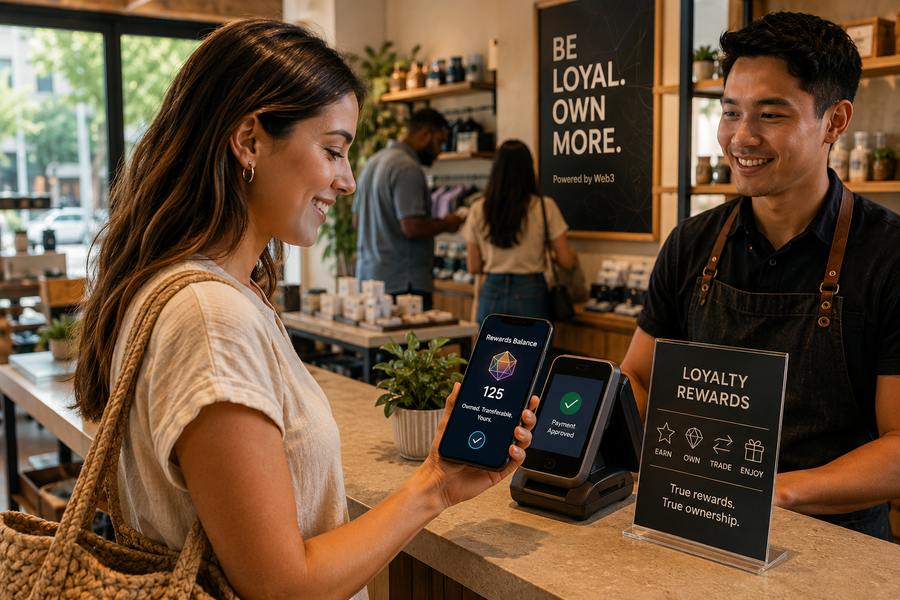
Almost everyone holds a scattered collection of loyalty rewards they will likely never fully use, points accumulated in airline programs, stars in coffee apps, store credits, and miles in credit card schemes that all sit locked inside the closed systems of the various companies that issued them. These rewards all share a common and deeply frustrating set of limitations, since they cannot be transferred to another person, cannot be sold for cash, often quietly expire if left unused, and can be devalued or eliminated at almost any moment by the company that controls them, leaving the customer holding something that feels very much like a possession but is in fact entirely and permanently at the mercy of the issuer. A person may have spent many thousands of dollars over years to accumulate points that the company can quietly make worth less overnight, or that simply vanish when a program changes its rules, and the customer has essentially no recourse at all, because they never truly owned the rewards in the first place; they merely held a revocable entry in someone else’s private database.
Web3 loyalty programs propose a fundamentally and refreshingly different model, one in which the rewards a customer earns are genuine digital assets that the customer truly owns, can freely transfer or sell, and can carry beyond the issuer’s walled garden. By issuing rewards as tokens or digital collectibles recorded permanently on a blockchain, these programs give customers actual, verifiable ownership of what they earn, so that a reward becomes a genuine possession the customer fully controls rather than a revocable entry in a company’s private ledger. This means a reward can be freely given away, traded on an open secondary market, used across different platforms, and held with the firm assurance that the issuing company cannot simply make it disappear, transforming loyalty rewards from locked, perishable points into owned, liquid, and genuinely portable assets. Major brands across coffee, sportswear, technology, and hospitality have experimented with this approach, drawn by its potential to create deeper engagement and to offer customers something genuinely valuable, and their varied experiences, encompassing both notable successes and instructive failures, provide a revealing picture of both the promise of the idea and the considerable difficulty of putting it into practice.
This article examines how brands are creating loyalty programs in which rewards are transferable, tradeable assets rather than locked points, written for a reader with no background in blockchain or loyalty marketing. It explains the limitations of traditional loyalty programs and the ownership problem they embody, the mechanisms by which Web3 loyalty creates true ownership and the benefits that flow from it, and the technology and design considerations involved. It weighs the genuine benefits and the real challenges for customers, brands, and the ecosystem, and it grounds the discussion in documented programs, including both notable successes and instructive failures. The aim is to convey both the appeal of giving customers true ownership of their loyalty rewards and the substantial obstacles that have made the approach far harder to execute well than its promise might suggest.
Understanding Traditional Loyalty and the Ownership Problem
To appreciate what Web3 loyalty programs offer, one must first understand how traditional loyalty programs work and the fundamental limitation at their core, which concerns who actually owns the rewards. A loyalty program rewards customers for their continued patronage, typically by granting points, stars, miles, or similar units in exchange for purchases, which customers accumulate and eventually redeem for discounts, free products, or other benefits. These programs are enormously widespread and valuable to the businesses that run them, because they encourage repeat business, generate valuable data about customer behavior, and create switching costs that make customers less likely to defect to competitors. From the business’s perspective, a loyalty program is a powerful tool for retention and for understanding customers, and the rewards it grants are a cost incurred in pursuit of these benefits.
The crucial feature of traditional loyalty rewards, and the source of their limitations, is that customers do not actually own them; they merely hold a balance in a system entirely controlled by the issuing company. The points or miles exist only as entries in the company’s database, and the company retains complete control over them, setting the rules for how they are earned and redeemed, determining their value, and reserving the right to change those rules, devalue the rewards, or eliminate them entirely at its discretion. This means that what feels to the customer like a growing store of value is in reality a revocable promise that the company can alter or break, and the history of loyalty programs is full of devaluations in which companies quietly reduced the worth of accumulated points, expirations that erased unused rewards, and program changes that left customers worse off, all without the customers having any say or recourse.
The limitations that flow from this lack of ownership are significant and frustrating for customers. Because the rewards are confined to the issuer’s system, they cannot be transferred to another person, so a customer cannot give their points to a friend or family member, and they cannot be sold, so a customer who will not use their rewards cannot recover any value from them. The rewards often expire if not used within a certain period, causing customers to lose value they had earned, and they are trapped within a single company’s ecosystem, useless anywhere else, so that points earned with one airline cannot be used with another or for anything outside that airline’s program. This combination of non-transferability, non-saleability, expiration, and confinement means that loyalty rewards, despite representing real value that customers worked to accumulate, are illiquid, perishable, and locked, a far cry from genuine ownership of an asset.
The phenomenon known as breakage captures the practical consequence of these limitations and reveals how the system is designed around customer disadvantage. Breakage refers to the portion of loyalty rewards that customers earn but never redeem, whether because they expire, because the customer forgets about them, because redemption is too difficult, or because the customer never accumulates enough to redeem anything useful, and breakage represents enormous value that customers lose and that the issuing companies effectively keep. The prevalence of breakage, with substantial fractions of loyalty rewards going unredeemed, demonstrates that the traditional model systematically leaves customers holding value they cannot realize, and it reflects a structure in which the rewards are designed to encourage spending while often failing to deliver their full promised value to the customer. This ownership problem, the reality that customers do not truly own their loyalty rewards and therefore cannot fully use, transfer, or realize their value, is precisely the deficiency that Web3 loyalty programs set out to address, and understanding it is the key to appreciating what the new model offers, which is genuine ownership of rewards that customers can actually control, use, and realize the value of.
It is worth appreciating the sheer scale of the value tied up in these closed systems, because it underscores why the ownership problem matters so much. The loyalty and rewards industry is enormous, with the total value of unredeemed points and miles held by consumers around the world estimated in the many hundreds of billions of dollars, representing a vast store of value that customers have earned but cannot freely use, transfer, or convert to cash. This is value that customers contributed to creating through their spending and patronage, yet under the traditional model much of it remains locked, illiquid, and at perpetual risk of devaluation or forfeiture, effectively a large interest-free loan that customers extend to the companies whose programs they participate in. The companies, for their part, carry these unredeemed rewards as liabilities but benefit from the float and from the breakage when rewards go unclaimed, an arrangement that quietly favors the issuer at the customer’s expense. When one considers that this dynamic plays out across billions of loyalty accounts and hundreds of billions of dollars of stranded value, the appeal of a model that would let customers genuinely own and freely use the rewards they earn becomes clear, since even a partial unlocking of this trapped value would represent an enormous shift of control and worth toward the customers who earned it, which is the fundamental promise that gives Web3 loyalty its significance.
How Web3 Loyalty Creates True Ownership
Web3 loyalty programs create true ownership by issuing rewards as digital assets on a blockchain that customers genuinely own and control, and by enabling the transferability, portability, and participation that genuine ownership makes possible. The foundational change is to make the reward a real asset held by the customer rather than an entry in the company’s database, which transforms the relationship between the customer and their rewards. From this foundation flow the further benefits that distinguish Web3 loyalty, the ability to transfer and sell rewards, to carry them across platforms and ecosystems, to realize their value on secondary markets, and even to participate in the creation of value, all of which become possible once the reward is a genuinely owned asset rather than a locked balance.
The two subsections that follow examine these capabilities in turn. The first concerns the foundational shift to tokenized rewards and the transferability it enables, how issuing rewards as tokens or digital collectibles on a blockchain gives customers actual ownership and the ability to transfer and sell what they earn. The second concerns the further benefits that ownership unlocks, including the portability of rewards across platforms, the existence of secondary markets where their value can be realized, and the possibility of customers participating in co-creation and sharing in the value they help generate. Understanding both the foundational change to ownership and the benefits it enables is necessary to grasp how Web3 loyalty differs from the traditional model.
Tokenized Rewards and Transferability
The foundational mechanism of Web3 loyalty is the issuance of rewards as digital assets on a blockchain, which gives customers genuine ownership in a way that traditional points never could. Rather than recording a customer’s rewards as a balance in the company’s private database, a Web3 loyalty program issues the rewards as tokens or digital collectibles, often non-fungible tokens representing unique items or fungible tokens representing points-like value, recorded on a blockchain and held in the customer’s own digital wallet. Because the reward exists on the blockchain in the customer’s control rather than in the company’s system, the customer genuinely owns it, holding an asset that the company cannot unilaterally take away or erase, which represents a fundamental shift from the revocable balance of traditional loyalty to actual ownership of a digital asset. This change in the underlying nature of the reward, from an entry in someone else’s ledger to a possession the customer controls, is the basis for everything else that Web3 loyalty offers.
The most immediate and significant consequence of this genuine ownership is transferability, the ability of customers to transfer or sell their rewards, which traditional points fundamentally lack. Because the customer truly owns the digital asset, they can transfer it to another person, giving or selling their reward as they would any possession, and they can sell it on a marketplace to realize its value in money. This transforms the reward from a locked, perishable balance trapped in the issuer’s system into a liquid asset that the customer can actually use, share, or convert to value, addressing the core limitations of traditional loyalty in which rewards could not be transferred or sold. A customer who will not use a particular reward is no longer forced to let it go to waste, since they can sell it to someone who values it, and a customer can give a reward to a friend or family member, possibilities that the non-transferable nature of traditional points categorically excluded.
This transferability fundamentally changes the value proposition of loyalty rewards and the relationship between customers and the brands that issue them. When rewards are genuinely owned and transferable, they carry real, realizable value rather than the often-illusory value of points that may expire or go unredeemed, which can make a loyalty program more genuinely rewarding and attractive to customers. It also shifts power toward the customer, who now holds an asset under their own control rather than a balance at the mercy of the issuer, changing the dynamic from one in which the company controls the rewards to one in which the customer truly owns them. For brands, this means offering customers something of genuine, ownable value, which can deepen engagement and loyalty by giving customers a real stake, though it also means relinquishing the control over rewards that traditional programs enjoyed, including the value that breakage captured. The shift to tokenized, genuinely owned, transferable rewards is the essential innovation of Web3 loyalty, and it is from this foundation of real ownership that the further benefits of portability, secondary markets, and participation all flow.
Portability, Secondary Markets, and Co-Creation
Building on the foundation of genuine ownership, Web3 loyalty rewards can be portable across platforms and ecosystems, freeing them from confinement within a single company’s system. Because the reward is an asset on a blockchain rather than an entry in one company’s database, it can in principle be recognized and used beyond the issuer’s own ecosystem, carried into other platforms, applications, or programs that choose to recognize it, rather than being trapped where it was earned. This portability holds the promise of loyalty rewards that travel with the customer and can be used in many places, rather than being locked into a single program, and it points toward a vision of interoperable loyalty in which the value a customer accumulates is not fragmented across countless isolated programs but can be combined and used flexibly. While the full realization of this portability depends on other platforms choosing to recognize and accept a given reward, which is not automatic, the underlying ownership of the asset on a shared blockchain makes such portability possible in a way that the closed systems of traditional loyalty never could.
The existence of secondary markets where rewards can be bought and sold is a further consequence of ownership, allowing customers to realize the value of their rewards and creating a transparent measure of what those rewards are worth. Because owned digital assets can be traded, marketplaces emerge where loyalty rewards can be bought and sold, giving customers a place to realize value from rewards they will not use and giving the rewards a visible, market-determined price that reflects their actual worth. This secondary market liquidity is a profound departure from traditional loyalty, where rewards had no market and no realizable value outside redemption within the issuer’s system, and it means that loyalty rewards become genuine assets with a price, that customers can treat as a store of value they can access. The secondary market also creates new dynamics, since the market value of a brand’s loyalty rewards becomes a visible signal of their desirability, and the prospect of rewards appreciating in value can drive interest, though it can also introduce speculation that may distort the program’s purpose.
Perhaps the most ambitious possibility that ownership enables is co-creation, in which customers participate in creating value and share in the rewards, moving beyond passive consumption toward active participation. Because Web3 enables ownership and the sharing of value, some loyalty programs allow customers to contribute to the creation of products or content and to share in the resulting value, for instance by designing items that the brand produces and earning royalties when those items are sold or used. This transforms the relationship from one in which customers merely earn rewards for purchases into one in which they can actively participate in and benefit from the brand’s creative output, becoming collaborators and stakeholders rather than just consumers. This co-creation model represents a deeper form of engagement and a more genuine sharing of value than traditional loyalty offers, harnessing the ownership and value-sharing capabilities of Web3 to involve customers in ways that build a stronger and more participatory relationship with the brand. Together, the portability of rewards, the secondary markets that realize their value, and the possibility of co-creation represent the further benefits that genuine ownership unlocks, extending the basic innovation of owned, transferable rewards into a richer set of possibilities that distinguish the Web3 approach from the locked, passive model of traditional loyalty.
The community dimension that ownership enables deserves emphasis, because much of the value of these programs comes not from the individual rewards alone but from the sense of belonging and shared identity they can create. When customers own a brand’s digital collectibles, those items can function as markers of membership and affiliation, signaling that the holder is part of a community of the brand’s most engaged supporters, and the programs often build around this by offering holders access to exclusive experiences, content, events, and spaces reserved for the community. This transforms a loyalty program from a transactional points scheme into something closer to a club or a fan community, in which the owned asset is both a reward and a credential of belonging. Because the assets are genuinely owned and visible, they can be displayed and recognized across platforms, reinforcing the holder’s identity as a member of the community, and the shared ownership of a brand’s collectibles can foster connection among holders who recognize one another as fellow members. This cultivation of genuine community and belonging, made possible by the visible, owned nature of the rewards, represents a form of engagement that traditional points programs, with their private and invisible balances, could never achieve, and it points toward loyalty programs that build emotional connection and shared identity rather than merely tracking and rewarding transactions.
The Technology and Design of Web3 Loyalty
Web3 loyalty programs rest on a foundation of blockchain technology and require careful design to be usable and effective, and understanding both clarifies how the programs work and the challenges of executing them well. At the technical base are the blockchains on which the rewards are issued and recorded, which must be suitable for the high volumes and low values typical of consumer loyalty, meaning they need to support large numbers of transactions cheaply and quickly. For this reason, Web3 loyalty programs are often built on blockchains designed for scale and low cost, rather than on networks where transactions are expensive, since loyalty rewards are typically numerous and individually of modest value, and a program that imposed high transaction costs on issuing or transferring rewards would be impractical. The choice of an appropriate blockchain that can handle consumer-scale activity affordably is a foundational technical decision for any Web3 loyalty program.
The reward assets themselves are implemented as tokens on the blockchain, with the choice of token type shaping the nature of the rewards. Non-fungible tokens, which are unique and indivisible, are well suited to representing distinct collectible rewards, special items, or membership credentials, giving each a unique identity and allowing for rarity and differentiation, while fungible tokens, which are interchangeable, are better suited to representing points-like value that can be accumulated and spent in divisible amounts. Many programs use non-fungible tokens for collectible or experiential rewards and fungible tokens for points-like currencies, and the design of these tokens, including their attributes, their rarity, and the benefits they confer, is central to creating rewards that customers find appealing and valuable. The flexibility of tokens to represent everything from unique collectibles to divisible currencies to membership passes gives Web3 loyalty a rich palette of reward types, but it also requires thoughtful design to create rewards that genuinely engage customers.
A critical and often decisive design challenge is managing the complexity of blockchain technology so that ordinary customers can use the program without friction, since the underlying technology is unfamiliar and intimidating to most people. Interacting with blockchain assets traditionally required customers to set up and manage digital wallets, understand concepts like private keys and gas fees, and navigate unfamiliar interfaces, all of which present a daunting barrier to the average loyalty program participant who simply wants to earn and use rewards easily. Recognizing this, well-designed Web3 loyalty programs employ techniques to abstract away the complexity, hiding the blockchain mechanics behind familiar, user-friendly interfaces so that customers can participate without needing to understand or directly handle the underlying technology, sometimes without even realizing that a blockchain is involved. The success of a Web3 loyalty program depends heavily on how well it manages this abstraction, since a program that exposes customers to the full complexity of blockchain will deter all but the most technically sophisticated, while one that makes the experience as simple as a traditional loyalty app can reach a broad audience, and the failure to adequately address this friction has been a significant factor in the struggles of some prominent programs.
The broader design of the program, beyond the technology, is what ultimately determines whether a Web3 loyalty program succeeds in engaging customers and serving the brand’s goals. This includes the design of the rewards themselves and the experiences and benefits they confer, the integration of the Web3 program with the brand’s existing loyalty and customer systems, the cultivation of a community around the program, and the alignment of the program with what customers actually value. A Web3 loyalty program that offers rewards customers do not find appealing, that is poorly integrated with the brand’s other offerings, or that fails to build genuine engagement will struggle regardless of the elegance of its technology, while one that creates genuinely desirable rewards, smooth experiences, and a real sense of community and participation can succeed. The design of Web3 loyalty is thus a matter not just of technology but of understanding customers, creating value, and executing well, and the combination of appropriate blockchain infrastructure, well-designed token rewards, effective abstraction of complexity, and sound overall program design constitutes the foundation on which a successful Web3 loyalty program must be built, with the difficulty of getting all of these elements right helping to explain why the approach has proven harder to execute than its conceptual appeal might suggest.
Benefits and Challenges Across Stakeholders
Web3 loyalty programs produce distinct effects for the various parties involved, and a balanced assessment requires weighing their genuine benefits against their real challenges across customers, brands, and the broader ecosystem. Customers gain true ownership and the ability to use, transfer, and realize the value of their rewards, brands gain deeper engagement and new ways to create value, and the ecosystem gains innovation in loyalty and customer relationships, yet these benefits come alongside the friction of unfamiliar technology, the risk of speculation, the difficulty of execution, and a string of high-profile struggles and failures. The approach is genuinely innovative and addresses real limitations of traditional loyalty, but it has proven difficult to execute well, so a clear-eyed view must hold the promise and the difficulties together.
The analysis below organizes these considerations by stakeholder and by category, first examining the benefits that accrue to customers, brands, and the ecosystem when Web3 loyalty works, then turning to the risks, friction, and limitations that have made it so challenging in practice. Keeping these perspectives distinct helps move past both the hype that presented Web3 loyalty as a revolution and the cynicism that dismisses it after high-profile failures, arriving at a grounded understanding of what the approach genuinely offers and why it has been so hard to realize.
Benefits for Customers, Brands, and the Ecosystem
For customers, the central benefit is true ownership of their loyalty rewards and the value, control, and flexibility that ownership provides, addressing the core deficiencies of traditional loyalty. With Web3 loyalty, customers genuinely own their rewards, which they can transfer, sell, carry across platforms, and hold with the assurance that the issuer cannot simply erase them, transforming rewards from locked, perishable points into liquid, controllable assets. This gives customers real, realizable value from their loyalty, the ability to recover value from rewards they will not use, the freedom to give rewards to others, and protection against the devaluations and expirations that plague traditional programs. The shift from holding a revocable balance to owning an actual asset represents a meaningful improvement in the customer’s position, giving them control and value that traditional loyalty withheld, and for customers who engage with these programs, the genuine ownership of appealing, valuable rewards can make loyalty more rewarding and more fair than the traditional model.
For brands, Web3 loyalty offers the potential for deeper engagement, new forms of value creation, and richer relationships with customers, though realizing this potential has proven difficult. By offering customers genuinely owned, valuable rewards and the possibility of participation through co-creation, brands can build deeper engagement and a stronger sense of connection and investment than traditional points programs typically achieve, turning customers into stakeholders and collaborators. The novelty and appeal of owned digital assets can generate excitement and attract attention, and the data and direct relationship that a blockchain-based program can provide may offer brands valuable insight into their most engaged customers. The co-creation model in particular allows brands to involve their community in creating products and content, harnessing customer creativity and deepening the relationship, and the broader approach can differentiate a brand and signal innovation. When executed well, Web3 loyalty can thus offer brands a more engaging and participatory relationship with their best customers, though the difficulty of execution means that these benefits have often been more potential than realized.
For the ecosystem and the broader evolution of loyalty and customer relationships, Web3 loyalty represents genuine innovation that challenges long-standing assumptions and points toward new possibilities. The introduction of true ownership, transferability, portability, and co-creation into loyalty programs questions the traditional model in which customers hold revocable balances locked in closed systems, and it points toward a future in which loyalty rewards might be genuinely owned, interoperable across brands, and more fair to customers. Even where specific programs have struggled, the experimentation has advanced the understanding of how ownership and blockchain might transform customer relationships, and it has demonstrated both the appeal of true ownership and the challenges of delivering it. This contribution to the evolution of loyalty, and the broader exploration of how customers might own and control more of the value they help create, has significance beyond any individual program, reflecting an ongoing reconsideration of the relationship between brands and customers that Web3 has helped to provoke, even as the practical path to realizing these possibilities remains difficult and uncertain.
Risks, Friction, and the Limits of Hype
The most immediate and persistent challenge is the friction and complexity of blockchain technology, which has deterred the mainstream customers that loyalty programs must reach. Despite efforts to abstract away the complexity, many Web3 loyalty programs have presented customers with unfamiliar and intimidating experiences, requiring them to navigate digital wallets, understand new concepts, or contend with a high-friction process that contrasts sharply with the simplicity of traditional loyalty apps. This friction has been a major obstacle, since loyalty programs depend on broad participation by ordinary customers who have little patience for technical complexity, and a program that is harder to use than a conventional rewards app will struggle to attract and retain participants regardless of the benefits of ownership. The challenge of making blockchain-based loyalty as easy as the alternatives has proven substantial, and the failure to overcome it has contributed to the disappointing results of several prominent programs, demonstrating that the conceptual benefits of ownership count for little if customers find the experience too difficult.
Speculation, volatility, and the distortion of loyalty’s purpose form a second significant risk, since making rewards into tradeable assets introduces dynamics that can undermine the program. When loyalty rewards become tradeable assets with market values, they can attract speculators interested in profiting from price movements rather than genuine customers engaged with the brand, and the value of rewards can become volatile, rising and falling with market sentiment and speculative interest rather than reflecting their loyalty value. This speculation can distort the program, drawing in participants who care only about flipping rewards for profit, creating boom-and-bust dynamics that can leave customers holding rewards that have lost value, and shifting the focus from building genuine customer relationships to financial speculation. The experience of some programs, in which rewards initially sold and traded at high prices driven by speculation only to decline as interest waned, illustrates how the financialization of loyalty rewards can create unsustainable excitement followed by disappointment, undermining the genuine engagement that loyalty programs are meant to build.
The remaining challenges concern execution, integration, and the broader limits of the approach, which the record of high-profile struggles and failures makes clear. Executing a Web3 loyalty program well requires getting many things right, the technology, the abstraction of complexity, the design of appealing rewards, the integration with existing systems, and the cultivation of genuine engagement, and the difficulty of doing all of this has led even major, well-resourced brands to struggle, with some prominent programs being scaled back or shut down after failing to achieve lasting success. Poor integration with a brand’s existing loyalty program, rewards that customers did not find compelling, eligibility restrictions and access problems, and the general difficulty of the experience have all contributed to disappointing outcomes, and the decline of broader enthusiasm for digital collectibles has further dampened the appeal of programs built around them. These failures demonstrate that the conceptual appeal of true ownership does not translate easily into successful programs, that the approach demands excellent execution that has often been lacking, and that Web3 loyalty remains an experimental and unproven model whose genuine benefits have frequently been outweighed in practice by the friction, speculation, and execution challenges that have undermined its promise. None of this negates the real value of true ownership, but it makes clear that delivering that value through a successful program is far harder than the appealing concept suggests.
Real-World Implementations and Measured Outcomes
Web3 loyalty programs have been attempted by major brands with widely varying results, and three examples illustrate the range of outcomes, from instructive failure to notable success. These cases span a prominent program that was ultimately shut down, a wildly successful effort at onboarding millions of users, and an ongoing program built around customer co-creation, together demonstrating both the appeal and the difficulty of the approach. Each is grounded in documented developments and figures, showing the real-world experience of brands attempting to give customers true ownership of their loyalty rewards.
Starbucks Odyssey exemplifies the high-profile struggle and ultimate failure that has befallen some Web3 loyalty efforts, offering instructive lessons. Launched as a beta extension of the company’s existing rewards program, Odyssey allowed customers to earn and purchase digital collectible stamps that offered access to experiences and benefits, representing an ambitious attempt by a major brand to add Web3 ownership to its loyalty program. The early signs were promising, with the first paid collection of two thousand collectibles selling out in under twenty minutes in early 2023 and trading on secondary markets at prices far above their original cost, demonstrating genuine demand and the appeal of owned, tradeable rewards. However, the program faltered, as a subsequent collection failed to sell out, participation declined, and the program faced criticism over its high-friction experience, its limited availability and access problems, and its poor integration with the existing Starbucks rewards that customers actually used. The company shut down the Odyssey beta in early 2024, and the program’s trajectory, from initial excitement to decline and closure, illustrates the central challenges of Web3 loyalty, the friction, the speculation-driven boom and bust, and the difficulty of integrating a novel ownership model with an established loyalty program in a way that genuinely serves customers.
Reddit Collectible Avatars exemplifies the surprising success that a well-executed approach can achieve, particularly in bringing blockchain-based ownership to a mass audience. Reddit offered users collectible avatars, digital assets recorded on a blockchain that users genuinely owned, available both for free and for purchase, and the program achieved remarkable scale, onboarding millions of users to blockchain-based digital ownership, with reports indicating around ten million users claiming avatars and the number of unique holders growing into the millions, making it one of the largest such ecosystems. Crucially, Reddit succeeded by abstracting away the blockchain complexity, presenting the avatars as simple, appealing digital items within its familiar interface so that users could acquire and use them without needing to understand or directly handle the underlying technology, with many users likely unaware that a blockchain was involved. The avatars were genuinely owned and could be traded on secondary markets, where some achieved significant value, and the program’s enormous reach demonstrated that blockchain-based ownership could be brought to a mainstream audience at scale when the complexity was successfully hidden. Reddit’s success stands in instructive contrast to the struggles of other programs, illustrating that the key to mainstream Web3 ownership is making it effortless and appealing rather than exposing customers to the technology. A further lesson of Reddit’s approach is that the rewards themselves were genuinely desirable as items, appealing avatars that users actually wanted to display on a platform where identity and self-expression already mattered, rather than abstract collectibles whose only value was speculative. By tying the owned assets to something users already cared about, namely their presence and identity within Reddit’s communities, the program ensured that the rewards had genuine utility and appeal independent of any resale value, which gave the ownership real meaning rather than making it a mere wrapper around speculation. This integration of the owned asset into a context where it was naturally useful and desirable, combined with the effortless experience, is much of what allowed Reddit to succeed at a scale that eluded programs whose collectibles lacked an obvious purpose beyond trading.
Nike .Swoosh exemplifies the co-creation approach and the ongoing effort to build a participatory Web3 community around a brand. Launched as a Web3 platform and community, .Swoosh allowed members to collect digital products and, notably, to participate in co-creating virtual products, with the brand selecting designs from community members to bring to market and allowing those creators to earn royalties on the virtual products they helped create. This co-creation model represented a deeper form of engagement than simply earning rewards for purchases, turning customers into collaborators who could contribute to and share in the brand’s creative output, and the platform cultivated a substantial community of engaged participants. By involving its community in the creation of value and allowing them to benefit from it, Nike’s approach harnessed the ownership and value-sharing capabilities of Web3 to build a participatory relationship with its most engaged customers, illustrating the more ambitious possibilities of the model beyond simple owned rewards. While the broader trajectory of brand experimentation with Web3 has been mixed and the long-term outcomes of such efforts remain uncertain, the co-creation approach demonstrates the genuine innovation in customer engagement that true ownership can enable. Taken together, these three implementations, the instructive failure, the surprising mass-scale success, and the ambitious co-creation effort, demonstrate both the real appeal of Web3 loyalty and the substantial difficulty of executing it well, showing that the approach can succeed when complexity is hidden and value is genuine, while failing when friction, speculation, and poor integration overwhelm the benefits of ownership.
Final Thoughts
Web3 loyalty programs address a genuine and long-standing deficiency in the way brands reward their customers, the reality that traditional loyalty rewards are not truly owned by the customers who earn them but are revocable balances locked in the issuer’s system, subject to devaluation, expiration, and confinement. By issuing rewards as genuine digital assets that customers own and control, Web3 loyalty offers a fundamentally fairer and more valuable proposition, transforming rewards from perishable, locked points into liquid, portable, ownable assets that customers can use, transfer, sell, and carry beyond the issuer’s walls. This shift from a revocable balance to genuine ownership represents a meaningful reimagining of the relationship between brands and customers, one that gives customers real control and value and that challenges the long-standing model in which the value of loyalty rewards too often leaked away through breakage and devaluation, benefiting the issuer at the customer’s expense.
The broader significance of this innovation lies in what it represents about the shifting balance of power and value between companies and the people who patronize them. The principle that customers should genuinely own the rewards they earn, rather than merely holding entries in a company’s database that the company can alter at will, reflects a wider aspiration of the Web3 movement to give people true ownership and control of their digital assets and value. Applied to loyalty, this principle could make the enormous economy of rewards fairer and more valuable to customers, allowing them to realize and control value that the traditional system often left them unable to use, and the possibility of co-creation extends this further, letting customers participate in and share the value they help create. Even where the practical execution has faltered, the introduction of these principles into the world of loyalty has provoked a reconsideration of what customers are owed and what they might own, a contribution that extends beyond any individual program.
The honest assessment must reckon with how difficult the approach has proven in practice and how often it has fallen short of its promise. The friction of unfamiliar blockchain technology has deterred the mainstream customers that loyalty programs require, the financialization of rewards has introduced speculation and volatility that distort the genuine engagement loyalty is meant to build, and the difficulty of executing well across technology, design, and integration has led even major brands to struggle and abandon their efforts. The high-profile failures, alongside the genuine successes, demonstrate that the conceptual appeal of true ownership does not translate easily into successful programs, and that the approach demands a level of execution, particularly in hiding complexity and delivering genuine value, that has frequently been lacking.
The most balanced understanding is that Web3 loyalty represents a genuine and valuable innovation whose realization depends on overcoming substantial practical challenges, particularly the friction of the technology and the distortions of speculation. The successes, especially those that brought blockchain-based ownership to a mass audience by hiding its complexity, demonstrate that the approach can work when executed well, while the failures show how easily it can falter. As the technology matures and brands learn to deliver genuine ownership without the friction and speculation that undermined earlier attempts, the prospect grows of loyalty programs that genuinely give customers ownership and value in a way the traditional model never did. The enduring promise of this innovation lies in making loyalty fairer and more rewarding by giving customers true ownership of what they earn, and the continued effort to realize that promise reflects a worthwhile reconsideration of the relationship between brands and the customers whose loyalty they seek.
FAQs
- What is a Web3 loyalty program?
A Web3 loyalty program rewards customers with genuine digital assets recorded on a blockchain, such as tokens or digital collectibles, that the customers truly own and control, rather than with points that exist only as a balance in the company’s database. Because the rewards are owned assets, customers can transfer them, sell them, carry them across platforms, and hold them with the assurance that the issuer cannot simply erase them. This contrasts with traditional loyalty programs, in which rewards are revocable balances locked in the issuer’s system and subject to devaluation or expiration. - Why don’t customers own traditional loyalty points?
Traditional loyalty points exist only as entries in the issuing company’s private database, and the company retains complete control over them, setting the rules, determining their value, and reserving the right to change those rules, devalue the points, or eliminate them at its discretion. What feels like a growing store of value is actually a revocable promise the company can alter or break. This is why points cannot be transferred or sold, often expire, and are confined to a single company’s system, leaving customers without genuine ownership or control of the rewards they earned. - What is breakage?
Breakage refers to the portion of loyalty rewards that customers earn but never redeem, whether because the rewards expire, the customer forgets about them, redemption is too difficult, or the customer never accumulates enough to redeem anything useful. Breakage represents enormous value that customers lose and that issuing companies effectively keep, and its prevalence demonstrates that the traditional model systematically leaves customers holding value they cannot realize. Web3 loyalty addresses breakage by giving customers genuinely owned, transferable rewards whose value they can realize even if they do not redeem them with the issuer. - How does Web3 loyalty give customers true ownership?
It issues rewards as digital assets on a blockchain, held in the customer’s own digital wallet rather than recorded as a balance in the company’s database. Because the reward exists on the blockchain in the customer’s control, the customer genuinely owns it, holding an asset the company cannot unilaterally take away or erase. This fundamental change, from an entry in someone else’s ledger to a possession the customer controls, is what enables the further benefits of transferability, the ability to sell rewards, portability across platforms, and realizing value on secondary markets, all of which traditional points lack. - Can I sell or give away Web3 loyalty rewards?
Yes, which is one of the main advantages over traditional points. Because the customer genuinely owns the digital asset, they can transfer it to another person, giving or selling their reward as they would any possession, and they can sell it on a marketplace to realize its value in money. This transforms the reward from a locked, perishable balance trapped in the issuer’s system into a liquid asset the customer can use, share, or convert to value. A customer who will not use a reward is no longer forced to waste it, and can give it to a friend or sell it to someone who values it. - What is co-creation in Web3 loyalty?
Co-creation is a model in which customers participate in creating products or content and share in the resulting value, rather than merely earning rewards for purchases. Because Web3 enables ownership and value-sharing, some programs let customers design items that the brand produces and earn royalties when those items are sold or used, turning customers into collaborators and stakeholders. Nike’s .Swoosh, for example, selected designs from community members and allowed those creators to earn royalties on virtual products. This represents a deeper, more participatory form of engagement than traditional loyalty offers. - Why do Web3 loyalty programs use blockchains designed for scale?
Because loyalty rewards are typically numerous and individually of modest value, the underlying blockchain must support large numbers of transactions cheaply and quickly. A program built on a network where transactions are expensive would be impractical, since issuing or transferring many low-value rewards would cost too much. For this reason, Web3 loyalty programs are often built on blockchains designed for scale and low cost, which can handle consumer-scale activity affordably, making it feasible to issue and transfer the large volumes of modestly valued rewards that loyalty programs involve. - Why have some Web3 loyalty programs failed?
The most common reasons are the friction of unfamiliar blockchain technology, which deters mainstream customers; the financialization of rewards, which introduces speculation and volatility that distort genuine engagement; and the difficulty of executing well across technology, reward design, and integration with existing systems. Starbucks shut down its Odyssey program after it faced a high-friction experience, declining participation, access problems, and poor integration with its existing rewards. These failures show that the conceptual appeal of true ownership does not translate easily into success and that excellent execution, especially in hiding complexity, is essential. - How did Reddit succeed with blockchain-based collectibles?
Reddit succeeded largely by hiding the blockchain complexity, presenting collectible avatars as simple, appealing digital items within its familiar interface so users could acquire and use them without needing to understand or handle the underlying technology, with many likely unaware a blockchain was involved. The avatars were genuinely owned and tradeable, and the program reached an enormous audience, onboarding millions of users into blockchain-based ownership. Its success demonstrated that the key to mainstream Web3 ownership is making it effortless and appealing rather than exposing customers to the technology, in contrast to programs that struggled with friction. - Are Web3 loyalty rewards a good investment?
They should not be viewed primarily as investments, and treating them that way carries real risk. While owned, tradeable rewards can have market value and some have appreciated, their value can be volatile, rising and falling with speculation and sentiment, and the experience of several programs has shown rewards that traded at high prices declining sharply as interest waned. The genuine purpose of loyalty rewards is engagement and value within a brand relationship, not speculation, and customers who buy rewards hoping to profit may be disappointed. The real benefit of true ownership is control and realizable value, not guaranteed financial gain.