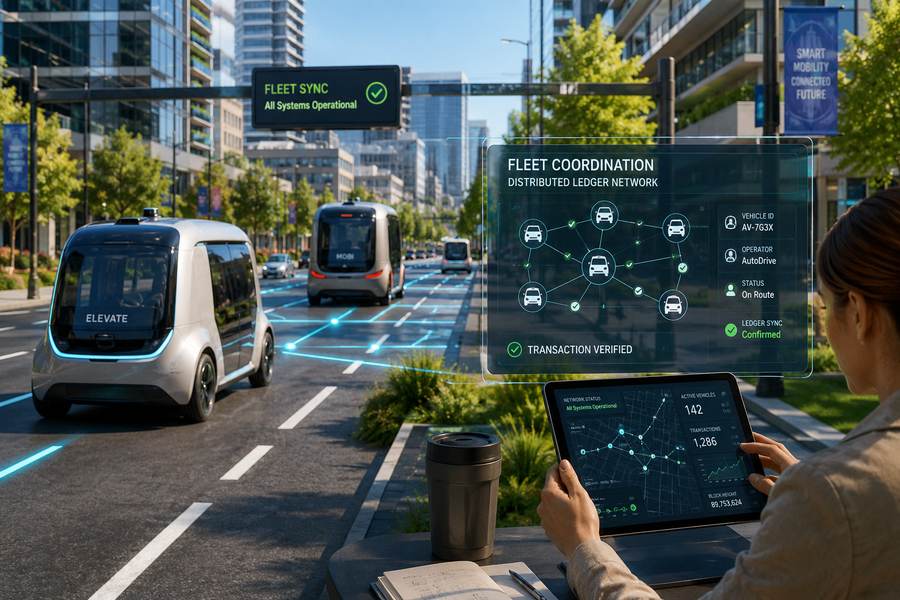
The popular vision of self-driving vehicles has long focused almost entirely on the remarkable engineering challenge of teaching a single car to perceive its surroundings and to navigate safely through the world without any human driver at the wheel. Yet as autonomous vehicles begin to move from research projects toward genuine real-world deployment, a different and equally important challenge steadily comes into focus, the problem of coordination among them. Roads are inherently shared spaces, and a future filled with autonomous vehicles will not consist of isolated cars each operating alone in a vacuum but of large fleets and individual vehicles built by many different manufacturers, operated by many different companies, and interacting constantly with one another and with the road infrastructure around them. These vehicles will need to share information, negotiate the use of road space, pay for services, and cooperate in countless ways, often with other vehicles and systems they have never encountered and whose operators they have no prior relationship with or reason to trust. The smooth functioning of such a system depends on these interactions happening reliably millions of times a day, between machines that were never designed together and that answer to rival commercial interests, a requirement that turns coordination from an afterthought into one of the defining technical and organizational challenges of the entire autonomous mobility project.
This necessary coordination across organizational and manufacturer boundaries is precisely where a particular and stubborn difficulty arises, because cooperation usually depends on trust, and trust is hard to establish between vehicles and systems controlled by competing companies. A vehicle from one manufacturer has no inherent reason to believe data broadcast by a vehicle from a rival, a fleet operator may be reluctant to share valuable information with a competitor, and the seamless payments and exchanges that efficient coordination requires need a way to transact securely between parties who do not know each other. Building a single central authority to mediate all of this would create its own serious problems of control, neutrality, and single points of failure, and it sits uneasily with a fiercely competitive global industry made up of many independent and often rivalrous players. Distributed ledger technology, the broad family of technologies that includes blockchain, has emerged in recent years as a promising way to enable this coordination without requiring such trust or any central point of control.
This article examines how distributed ledger systems are being used to enable trustless coordination between autonomous vehicles from different manufacturers and operators, written for a reader with no background in either autonomous vehicles or blockchain. It explains why coordination across organizational boundaries is so challenging, the mechanisms by which blockchain enables shared identity, data exchange, and automated transactions among parties who do not trust each other, and the standards and infrastructure being built to support this. It weighs the genuine benefits and the real limitations for fleet operators, manufacturers, and cities, and it grounds the discussion in documented consortia and companies working in this space. The aim is to convey both the promise of a cooperative, interoperable future for autonomous mobility and the substantial challenges that must be overcome to achieve it.
Understanding the Coordination Problem for Autonomous Fleets
To appreciate why blockchain has attracted interest in autonomous mobility, one must first understand the nature and difficulty of the coordination problem that autonomous fleets face. As vehicles become autonomous and connected, they generate and depend on a constant flow of interactions, sharing information about road conditions, hazards, traffic, and their own intentions, negotiating the use of shared resources like road space and charging stations, and engaging in transactions for services such as energy, tolls, parking, and data. Much of the promise of autonomous mobility, including improved safety, efficiency, and new services, depends on vehicles cooperating effectively, since a vehicle that can communicate and coordinate with others can anticipate hazards, smooth traffic flow, and operate more efficiently than one acting in isolation. This cooperation is not a peripheral feature but central to realizing the full benefits of a connected, autonomous transportation system.
The crucial complication is that this coordination must happen across the boundaries of different manufacturers and operators, who are often competitors with no inherent trust in one another. The autonomous vehicle landscape is not a monolith but a diverse ecosystem of many car manufacturers, technology companies, fleet operators, ride-hailing services, and infrastructure providers, each building and running their own vehicles and systems. For the benefits of coordination to be realized, a vehicle from one company must be able to interact, share data, and transact with vehicles and systems from many others, but these parties are commercial rivals who may be reluctant to cooperate, who cannot simply assume the honesty of one another’s data, and who lack the established relationships that trust normally requires. The coordination that autonomous mobility needs therefore must occur precisely among parties who have the least reason to trust each other, which is the heart of the difficulty.
The problem of establishing trust in this setting is genuinely hard, because the usual solutions each have serious drawbacks in a competitive, multi-party environment. One approach would be for every pair of parties to establish bilateral trust and agreements, but this becomes impossibly complex as the number of participants grows, since each would need separate arrangements with every other. Another would be to create a central authority that all parties trust to mediate their interactions, verify identities, and settle transactions, but this raises difficult questions of who would control such an authority, whether it would be neutral among competitors, and what would happen if it failed or abused its position, and it concentrates power in a way that the diverse industry is unlikely to accept. The absence of a natural trusted intermediary, combined with the impracticality of countless bilateral arrangements, leaves a gap where coordination is needed but no straightforward means of establishing the trust it requires exists.
This is precisely the kind of problem that distributed ledger technology is designed to address, because blockchains enable parties who do not trust each other to interact reliably without a central authority. A blockchain is a shared, distributed record maintained collectively across many participants rather than by any single controller, with rules enforced by the network and transactions recorded in a way that no single party can falsify, which allows mutually distrustful parties to agree on a shared truth and to transact securely without trusting each other or a central intermediary. Applied to autonomous mobility, this offers a way for vehicles and systems from different manufacturers and operators to share a common, trustworthy foundation for identity, data, and transactions, enabling coordination across organizational boundaries without requiring the participants to trust one another or to submit to a central controller. The term trustless captures this property, meaning not that there is no trust but that the trust is placed in the transparent, decentralized system rather than in the other parties, and it is this capacity to enable cooperation among competitors without a central authority that has made blockchain a focus of interest for the coordination of autonomous fleets, addressing a problem for which the traditional alternatives are poorly suited.
It is worth illustrating the coordination problem with a concrete scenario to make its difficulty tangible. Imagine a busy intersection where autonomous vehicles from several different manufacturers approach simultaneously, each running its own proprietary software and controlled by a different operator. For them to negotiate who proceeds first, to warn one another of a pedestrian one vehicle has detected but the others have not, or to smoothly merge into a single lane, they must exchange information and act on it, but each vehicle’s software was built independently and none has any reason to assume the others are transmitting honest, accurate data rather than errors or even malicious signals. A vehicle that blindly trusted a false hazard warning could brake unnecessarily and cause a collision, while one that ignored a genuine warning could fail to avoid one. The vehicles need a way to verify that a message genuinely comes from a legitimate, certified vehicle and that the data has not been tampered with, and they need this verification to work instantly across manufacturers, without any of the companies having to share their proprietary systems or trust a competitor’s word. This everyday scenario, multiplied across millions of interactions on roads worldwide, captures why a shared, neutral, verifiable foundation for identity and data is not a luxury but a prerequisite for the cooperative behavior that makes connected autonomous mobility safe and efficient, and why a solution that does not depend on trusting competitors or a central gatekeeper is so attractive.
How Blockchain Enables Trustless Coordination
Blockchain enables trustless coordination among autonomous vehicles through two complementary capabilities, the establishment of a shared, trustworthy foundation for identity and data that all parties can rely on, and the enabling of secure, automated transactions and agreements between parties who do not trust each other. The first creates a common trust layer, allowing vehicles and systems from different operators to verify each other’s identities and to share and rely on data without a central authority vouching for it. The second allows these parties to transact and coordinate through automated agreements, paying for services and executing cooperative arrangements securely and without intermediaries. Together these address the core requirements of cross-operator coordination, providing both the trusted foundation and the means to act upon it.
The two subsections that follow examine each capability in turn. The first concerns the trust layer, how blockchain provides shared digital identity, verifiable credentials, and trustworthy data exchange that let mutually distrustful parties establish who is who and rely on shared information. The second concerns the action layer, how blockchain enables machine-to-machine payments and smart-contract-based coordination that let vehicles autonomously pay for services and execute cooperative agreements without human intervention or trusted intermediaries. Understanding both how trust is established and how coordinated action is carried out is necessary to grasp how blockchain enables the trustless cooperation that autonomous fleets require.
Shared Identity, Data, and the Trust Layer
The foundation of trustless coordination is the establishment of reliable identity and trustworthy data that all parties can verify without depending on a central authority, and this is the first capability blockchain provides. For vehicles and systems from different operators to coordinate, they must first be able to establish who they are dealing with, since a vehicle receiving data or a request from another must know that the other is a legitimate participant and not an impostor. Blockchain-based systems address this through decentralized digital identity, in which each vehicle has a digital identity recorded in a way that can be verified by anyone without a central registry, often based on emerging standards for decentralized identifiers and verifiable credentials. This allows a vehicle to prove its identity and its attributes, such as its manufacturer, its operator, or its certifications, to any other party in a way that the other can independently verify, establishing a trustworthy foundation for interaction even among parties who have never met.
The concept of the digital twin, a digital representation of a physical vehicle that carries its identity and relevant information, is central to this trust layer. In blockchain-based mobility systems, each vehicle can have a digital twin that serves as a secure container for its identity and credentials, allowing it to participate in the digital ecosystem with a verifiable identity that links to its real-world counterpart. These digital twins can hold verifiable credentials attesting to facts about the vehicle, and they enable the vehicle to engage in transactions and data exchange with assurance about who and what it is. By giving every vehicle a self-sovereign digital identity that the vehicle or its owner controls rather than one held by a central authority, this approach allows vehicles from any manufacturer or operator to establish verifiable identities on a common foundation, enabling cross-operator interaction without requiring a central identity provider that all must trust.
Beyond identity, the trust layer enables the sharing of data among vehicles and systems in a way that recipients can rely on, addressing the reluctance and risk involved in exchanging information among competitors. Autonomous vehicles benefit enormously from sharing data about road conditions, hazards, and traffic, but operators may be reluctant to share valuable data, and recipients need to trust that shared data is accurate and untampered. Blockchain can underpin data-sharing arrangements by providing a verifiable record of what data was shared and by whom, enabling mechanisms that give parties control and sovereignty over their data while allowing trustworthy exchange, and supporting privacy-preserving techniques that let data be shared or verified without exposing sensitive details. This can encourage the sharing that improves safety and efficiency by giving operators control over their data and assurance about its handling, and by giving recipients confidence in the data’s provenance and integrity. The combination of verifiable identity and trustworthy data exchange constitutes the trust layer that allows mutually distrustful parties to establish who they are dealing with and to rely on shared information, the essential foundation on which coordinated action can be built.
Machine-to-Machine Payments and Smart Contract Coordination
Building on the trust layer, blockchain enables the second essential capability for coordination, the ability of vehicles to transact and to execute cooperative agreements automatically through machine-to-machine payments and smart contracts. As autonomous vehicles operate without human drivers, they need to pay for the services they consume, such as energy at charging stations, tolls, parking, and access to data or infrastructure, and to do so autonomously without a human reaching for a credit card. Blockchain enables machine-to-machine payments, in which a vehicle can pay another machine or a service provider directly and automatically, settling transactions between parties who do not have a prior relationship, which is essential for autonomous operation. A vehicle can hold a digital wallet and, upon consuming a service, automatically pay for it through a secure transaction, allowing the seamless, autonomous commerce that a driverless future requires.
Smart contracts extend this capability from simple payments to the automated execution of more complex coordinated agreements, allowing vehicles and systems to cooperate according to predefined rules without intermediaries. A smart contract is a program on the blockchain that executes automatically when its conditions are met, and in autonomous mobility it can encode agreements such as paying for a charging session when it completes, reserving and paying for a parking spot, or settling a transaction for shared data, all carried out automatically and verifiably without either party needing to trust the other to honor the deal. Because the smart contract enforces the terms itself, parties who do not trust each other can nonetheless transact with confidence, knowing the agreement will execute as written. This enables a wide range of automated coordination, from a vehicle paying for the exact energy it draws to vehicles bidding for and reserving scarce resources like parking spaces or priority access, all handled through transparent, self-executing agreements.
The deeper potential of this capability is to allow autonomous vehicles to function as independent economic actors that can coordinate complex interactions among themselves and with infrastructure, paying for what they use and being paid for what they provide. In this vision, vehicles do not merely consume services but participate in an economy of machines, transacting with charging stations, infrastructure, other vehicles, and service providers as autonomous agents that earn and spend according to their activity, all coordinated through the blockchain without human intervention or central control. A fleet vehicle might autonomously pay for energy and tolls, earn revenue from providing rides or data, and negotiate access to resources, settling all of these interactions through machine-to-machine transactions and smart contracts. This capacity for vehicles to act and transact autonomously, coordinating with a multitude of other parties through trustless mechanisms, is what allows blockchain to support not just isolated payments but the rich, automated coordination that an efficient autonomous transportation system requires, turning the trust layer’s foundation of verifiable identity and reliable data into a basis for genuine cooperative action among competing parties.
The economic dimension of this coordination deserves emphasis, because much real-world cooperation is ultimately mediated by incentives, and the ability to attach value to interactions makes coordination far more powerful. When a vehicle can pay for priority access to a congested road, or be compensated for yielding its place, or earn a small payment for sharing a valuable hazard warning, the bare exchange of information becomes an economic transaction that aligns the interests of the parties. This opens the door to market-based coordination mechanisms that can allocate scarce resources efficiently, such as auctions for road space or parking, dynamic pricing that reflects real-time demand, and compensation schemes that reward cooperative behavior. Such mechanisms are difficult to implement among competitors without a trusted way to settle the resulting payments instantly and securely, which is precisely what machine-to-machine transactions provide. By making it possible for vehicles to not only coordinate but to pay and be paid for coordinating, blockchain enables a far richer set of cooperative arrangements than information-sharing alone could support, potentially allowing a transportation system to use pricing and incentives to manage demand and allocate resources in ways that purely technical coordination could not achieve. This fusion of coordination and commerce, in which vehicles cooperate partly because it is economically worthwhile to do so, is among the more powerful and distinctive possibilities that the technology opens up.
The Technology and Standards Infrastructure
The coordination capabilities described so far depend on a substantial infrastructure of technology and, crucially, of shared standards, and understanding this infrastructure clarifies both how the systems work and why standardization is so important. At the technical foundation are the distributed ledgers themselves, which must be suited to the demands of mobility applications, including the potential for very high transaction volumes as many vehicles transact frequently, the need for speed so that coordination can happen in useful timeframes, and considerations of cost and energy efficiency. Various blockchain platforms have been developed or adapted for these purposes, some designed specifically for the machine economy of devices and vehicles transacting at scale, aiming to provide the throughput and low cost that a future of millions of vehicles transacting constantly would require. The suitability of the underlying ledger to the specific demands of high-volume, real-time machine coordination is an important factor, and platforms purpose-built for connecting machines and vehicles have emerged to address these needs.
Layered on the ledger are the systems for digital identity and credentials that constitute the trust layer, built increasingly on open, internationally recognized standards. The representation of vehicle identity and credentials relies on emerging standards for decentralized identifiers and verifiable credentials developed by international standards bodies, which provide common, interoperable ways to express and verify identity and attributes across different systems. By building on these widely accepted standards rather than proprietary schemes, blockchain-based mobility systems can achieve the interoperability that cross-operator coordination requires, since identities and credentials expressed in a common standard can be verified by any participant regardless of which manufacturer or operator they belong to. The use of established standards, combined with privacy-preserving cryptography to protect sensitive information, allows the trust layer to function across the diverse ecosystem, and the development of these standards is a significant part of the infrastructure that makes trustless coordination feasible across organizational boundaries.
The most distinctive and arguably most important infrastructure for cross-operator coordination is the body of shared industry standards that allow systems from different participants to work together, often developed through industry consortia. Because the entire point is to enable coordination among vehicles and systems from many different companies, common standards for identity, data, transactions, and interactions are essential, since without them each company’s systems would be incompatible and coordination would be impossible. Industry consortia have formed to develop such standards collaboratively, bringing together manufacturers, technology companies, and others to agree on common frameworks for blockchain-based mobility, and these consortia have produced standards covering vehicle identity, data sharing, and other functions, along with platforms and marketplaces built on them. The collaborative development of shared standards through such consortia is perhaps the single most critical element of the infrastructure, because it addresses the fundamental requirement that systems from competing companies be able to interoperate, and the breadth of industry participation in these efforts, encompassing a large share of global vehicle production, reflects recognition that coordination across the industry requires common foundations that no single company can impose.
The supporting ecosystem and the connection to the physical world round out the infrastructure, linking the digital coordination layer to actual vehicles and services. Realizing blockchain coordination requires not just ledgers and standards but the integration of these systems into vehicles and infrastructure, the development of applications and services that use the coordination capabilities, and connections to the existing systems of finance, identity, and infrastructure that the mobility ecosystem depends on. A growing ecosystem of platforms, applications, and services has developed to build on the foundational infrastructure, including marketplaces for mobility transactions, applications for specific use cases like charging and payments, and the integration of vehicle data and identity into broader systems. This connective tissue between the abstract coordination layer and the concrete reality of vehicles, services, and infrastructure is what allows the technology to function in practice, and its continued development, alongside the underlying ledgers, identity standards, and industry frameworks, constitutes the full infrastructure that turns the concept of blockchain coordination into working systems, with the emphasis on shared standards reflecting the central importance of interoperability in a domain defined by the need for competitors to cooperate.
Benefits and Challenges Across Stakeholders
Blockchain coordination for autonomous fleets produces distinct effects for the various parties involved, and a balanced assessment requires weighing its genuine benefits against its real challenges across operators, manufacturers, cities, and the public. Fleet operators and manufacturers stand to gain efficiency and interoperability, cities and infrastructure providers gain new tools for managing mobility, and the public stands to benefit from safer, more efficient transportation, yet these benefits face substantial obstacles of scalability, safety, adoption, and regulation, and the technology remains largely at an early and experimental stage. The promise is real and the industry interest substantial, but the challenges are equally real and the deployment far from mature, so a clear-eyed view must hold the potential and the obstacles together.
The analysis below organizes these considerations by stakeholder and by category, first examining the benefits that could accrue to operators, manufacturers, and cities when the technology works, then turning to the risks, limitations, and open questions that determine whether those benefits are realized. Keeping these perspectives distinct helps move past both the enthusiasm that presents blockchain as the key to autonomous mobility and the skepticism that dismisses it as hype, arriving at a grounded understanding of what the technology genuinely offers and what it must overcome.
Benefits for Operators, Manufacturers, and Cities
For fleet operators and manufacturers, the central benefit is the interoperability and efficiency that come from a common foundation for coordination across the industry, allowing vehicles and systems from different companies to work together. By enabling trustless coordination, blockchain can let operators share data that improves safety and efficiency without surrendering control of it, allow vehicles to transact seamlessly for services regardless of provider, and reduce the friction and cost of interactions across organizational boundaries. This interoperability can lower costs, since it reduces the need for countless bilateral arrangements and proprietary integrations, and it can enable new efficiencies in fleet operation, such as autonomous payment for services and coordinated use of shared resources. For an industry of many competing players who nonetheless need to interoperate, a shared, neutral coordination layer that no single competitor controls offers a way to achieve the cooperation that benefits all of them without ceding advantage to any one, which is a significant attraction.
For manufacturers and operators, the technology also enables new business models and services built on the ability of vehicles to act as economic agents and to handle data and transactions securely. The capacity for vehicles to autonomously pay for and earn from services opens possibilities such as usage-based services, automated commerce, and the monetization of vehicle data under the owner’s control, while verifiable digital identity and data provenance support trustworthy services and reduce fraud. New models built on real-time vehicle data and autonomous transactions, such as flexible rental, pay-per-use, and data services that activate and settle automatically, become possible when vehicles can securely transact and prove their identity and activity. These new capabilities can create value for manufacturers and operators beyond the traditional sale or operation of vehicles, supporting innovative services that the secure, trustless coordination layer makes feasible, and giving companies new ways to generate revenue and serve customers in an increasingly connected and autonomous mobility landscape.
For cities and infrastructure providers, blockchain coordination offers tools for managing mobility more efficiently and for integrating autonomous vehicles into smart urban systems. As vehicles become able to coordinate and transact autonomously, cities can implement more sophisticated and responsive management of resources like road space, parking, and charging, potentially using mechanisms such as automated pricing and reservation to allocate scarce resources efficiently and to manage traffic and emissions. The verifiable data that vehicles can provide, such as emissions or usage information, can support regulatory and environmental goals, and indeed pilots have explored using these capabilities for purposes like vehicle emissions reporting. The integration of autonomous vehicles with smart city infrastructure through trustless coordination could enable more efficient, responsive, and sustainable urban mobility, benefiting cities and the public by reducing congestion, improving the use of infrastructure, and supporting environmental objectives, and representing a meaningful potential contribution to the broader goal of more livable and efficient cities as autonomous mobility grows.
Risks, Limitations, and Open Questions
The most fundamental challenge is the technical demand of coordinating potentially enormous numbers of vehicles transacting in real time, which strains the scalability and performance of blockchain systems. A future with vast numbers of autonomous vehicles coordinating and transacting constantly would generate an immense volume of activity, and blockchain systems have historically faced limits on how many transactions they can process quickly and cheaply, raising the question of whether the technology can scale to the demands of mass autonomous mobility. While platforms designed for high throughput have emerged and the technology continues to improve, achieving the speed, scale, and low cost required for millions of vehicles to coordinate in real time remains a substantial technical challenge, and the gap between current capabilities and the demands of full-scale deployment is significant. The performance requirements of real-time coordination, where timing can matter greatly for safety and efficiency, are especially demanding, and meeting them at scale is an unresolved problem.
Safety, reliability, and the stakes of the application form a second critical concern, because autonomous vehicles are safety-critical systems where failures can be catastrophic. Any technology involved in coordinating autonomous vehicles must meet extremely high standards of reliability and security, since errors, delays, or attacks could contribute to accidents, and the introduction of blockchain-based coordination adds complexity and potential points of failure that must be rigorously managed. The reliance on the correct functioning of distributed systems, smart contracts, and connectivity in a safety-critical context raises serious questions, and the consequences of failure are far graver than in many other blockchain applications, demanding a level of assurance that is difficult to achieve. There are also security concerns specific to the high stakes, since malicious actors might seek to exploit coordination systems to cause harm, and the safety-critical nature of autonomous vehicles means that the security and reliability of any coordination technology must be exceptional, a bar that is challenging to meet and to demonstrate.
The remaining challenges concern adoption, regulation, and the early state of both autonomous vehicles and the coordination technology. Realizing the benefits of cross-operator coordination requires broad adoption of common standards and systems across a competitive industry, which is difficult to achieve, since companies may prefer proprietary approaches or be reluctant to cooperate, and the value of coordination depends on widespread participation that may be slow to materialize. The regulatory environment for both autonomous vehicles and blockchain is evolving and uncertain, adding further complexity, and the technology operates at the intersection of two fields, autonomous driving and distributed ledgers, that are each themselves still maturing, with autonomous vehicles not yet widely deployed at scale. This means that blockchain coordination for autonomous fleets remains largely forward-looking, with much of the activity consisting of standards development, pilots, and infrastructure-building in anticipation of a future that has not yet fully arrived, rather than large-scale operational deployment. None of these challenges negates the genuine potential of the approach, but together they make clear that it is an early-stage endeavor facing substantial technical, organizational, and regulatory hurdles, whose realization depends on progress in autonomous vehicles themselves, on solving difficult problems of scale and safety, and on achieving the broad cooperation and standardization that cross-industry coordination requires, all of which will take considerable time and effort to accomplish.
Real-World Implementations and Measured Outcomes
The vision of blockchain coordination for autonomous mobility is being pursued through real consortia, platforms, and companies, and three examples illustrate the range of efforts, from industry-wide standards development to machine-economy infrastructure to autonomous payments. These cases span a consortium building shared standards across the automotive industry, a blockchain platform purpose-built for the machine economy of vehicles and devices, and a company enabling autonomous machine-to-machine payments for vehicles, together demonstrating that the foundations for trustless coordination are being actively built even as full autonomous deployment remains in the future. Each is grounded in documented developments, showing serious industry engagement with the coordination challenge.
The Mobility Open Blockchain Initiative, known as MOBI, exemplifies the industry-wide standards effort that is central to enabling cross-operator coordination. Launched in 2018, MOBI is a consortium that brings together automakers, technology companies, and other organizations to develop common standards for blockchain in mobility, and its membership has included companies accounting for a large majority of global vehicle production, reflecting broad industry participation. MOBI has developed standards addressing functions such as vehicle identity, beginning with a standard that uses the vehicle identification number to define a vehicle’s digital identity, and it has produced numerous standards and initiatives across areas including data sharing and electric vehicle integration. Through its Citopia marketplace and related infrastructure, MOBI has built systems in which each entity has a self-sovereign digital twin, a secure container for decentralized identifiers and verifiable credentials based on international standards combined with privacy-preserving cryptography, enabling secure, verifiable transactions across the connected ecosystem. MOBI has also engaged in concrete pilots, including work with public authorities on applications such as vehicle emissions reporting. As the leading effort to develop the shared standards that cross-operator coordination fundamentally requires, MOBI represents the collaborative, industry-wide foundation on which trustless coordination among vehicles from different manufacturers depends.
The significance of MOBI’s consortium model deserves emphasis, because it directly addresses the central paradox of the whole endeavor, that fierce competitors must somehow cooperate to build the shared foundation they all need. No single automaker, however large, could impose a coordination standard on the industry, since rivals would be unwilling to adopt a competitor’s proprietary system, and a future of incompatible, manufacturer-specific approaches would defeat the entire purpose of cross-operator coordination. By providing a neutral venue in which competitors jointly develop open standards that none of them controls, a consortium overcomes this impasse, much as industry bodies have historically established the shared standards that allow otherwise competing companies to interoperate in fields from telecommunications to payment cards. The breadth of participation MOBI has attracted, spanning companies responsible for a large majority of the world’s vehicle production, is itself meaningful, because the value of a coordination standard grows with the number of participants who adopt it, and widespread industry buy-in is what could eventually give such standards the critical mass needed to function. This collaborative, standards-based approach, building shared and open foundations rather than competing proprietary ones, is arguably the most important precondition for trustless coordination to become real, and the existence of a consortium pursuing it with broad industry support is among the more encouraging signs that the coordination problem is being addressed in a way that could actually scale across the fragmented industry.
The peaq network exemplifies the machine-economy infrastructure approach, providing a blockchain platform purpose-built for vehicles, devices, and machines to act as autonomous economic agents. Designed as a foundational layer for what is often called the machine economy, peaq aims to enable robots, devices, and vehicles to participate in decentralized economic and coordination systems, optimized for the high transaction volumes that such applications demand and hosting a range of real-world applications across mobility and other sectors. The platform supports use cases such as electric vehicle charging stations that accept payments directly and vehicles that transact based on their activity, and it has hosted a growing number of decentralized physical infrastructure networks across many industries, reflecting an ecosystem of machines coordinating and transacting on-chain. A notable application built in this ecosystem involves vehicle data platforms that power session-based mobility services such as rentals and pay-per-use, giving developers the tools to build services around real-time vehicle data, consent, payments, and automation that activate at the start of a trip and settle when it ends. peaq illustrates the infrastructure being built to support vehicles and machines as autonomous economic actors, demonstrating the machine-economy foundation on which autonomous coordination and commerce can be built.
Car IQ exemplifies the autonomous payments approach, focusing specifically on enabling vehicles to pay for services machine-to-machine without human intervention or traditional payment cards. The company developed a payment network allowing connected vehicles and fleets to transact directly, with its product enabling machines to connect with banks and merchants to purchase services such as fuel, tolls, and parking without a credit card, addressing the practical need for autonomous vehicles to pay for what they consume on their own. The company has attracted investment, including a funding round of around fifteen million dollars, reflecting commercial interest in the autonomous payment capability that driverless operation requires. By enabling vehicles to make payments autonomously and securely, Car IQ addresses one of the concrete, near-term requirements of autonomous and connected fleet operation, the ability to transact for services without a human in the loop, and it demonstrates that the machine-to-machine payment capability central to autonomous coordination is being built and commercialized. Notably, this capability delivers value even before full autonomy arrives, since connected fleets of conventionally driven vehicles can already benefit from machines paying directly for fuel, tolls, and parking, eliminating fraud-prone fuel cards and manual expense processes. This near-term applicability is important, because it means the payment infrastructure for the autonomous future can be built and refined commercially today, funded by present-day fleet efficiency gains rather than waiting on the uncertain timeline of full self-driving deployment, which helps the underlying capability mature in advance of the autonomous vehicles that will eventually depend on it. Taken together, these three implementations, the industry standards consortium, the machine-economy platform, and the autonomous payments company, demonstrate that the foundations for blockchain coordination of autonomous fleets are being actively developed across the layers the technology requires, from shared standards to infrastructure to practical payment capabilities, even as the full realization of coordinated autonomous mobility awaits the broader maturation of autonomous vehicles themselves.
Final Thoughts
Blockchain coordination for autonomous vehicle fleets addresses a challenge that becomes visible only when one looks beyond the individual self-driving car to the system of many vehicles, built by competing companies, that must somehow cooperate on shared roads. The coordination this future requires, the sharing of data, the negotiation of resources, and the seamless transaction for services among vehicles and systems that have no inherent reason to trust each other, is a genuine and difficult problem for which the traditional solutions of bilateral agreements or central authorities are poorly suited. Distributed ledger technology offers a distinctive answer, enabling competitors to coordinate without trusting each other or submitting to a central controller, by providing a shared foundation of verifiable identity, trustworthy data, and automated transactions. In doing so, it addresses a real gap in the vision of autonomous mobility with a mechanism well matched to the competitive, multi-party nature of the industry.
The broader significance of this work lies in its potential to make autonomous mobility safer, more efficient, and more accessible by enabling the cooperation that isolated vehicles cannot achieve. A transportation system in which vehicles coordinate effectively can anticipate hazards, smooth traffic, use infrastructure efficiently, and offer new services, and the trustless coordination that blockchain enables could be a key to unlocking these benefits across an industry of many players rather than only within the fleets of individual companies. The integration of autonomous vehicles with smart city infrastructure through such coordination could support more livable, sustainable, and efficient urban mobility, and the new services and business models the technology enables could expand the value and accessibility of autonomous transportation. The intersection of technology and the public good is present here, in the prospect of a cooperative mobility system that serves safety and access rather than fragmenting into incompatible proprietary silos.
The honest assessment must temper this promise with recognition of how early and how challenging the endeavor remains. The technology faces substantial unresolved problems of scaling to the enormous demands of mass autonomous mobility, of meeting the extreme safety and reliability requirements of a safety-critical application, and of achieving the broad industry cooperation and standardization that cross-operator coordination fundamentally requires. Moreover, it depends on the broader maturation of autonomous vehicles themselves, which are not yet widely deployed at scale, so that much of the current activity consists of building foundations in anticipation of a future that has not fully arrived. These are not minor caveats but defining realities, and they mean that blockchain coordination for autonomous fleets is a forward-looking endeavor whose realization will take considerable time and depends on progress across multiple difficult fronts.
The most balanced understanding is that blockchain coordination represents a thoughtful and increasingly serious response to a real challenge of autonomous mobility, whose ultimate role depends on overcoming significant obstacles and on the broader development of self-driving technology. As autonomous vehicles mature, as the scalability and safety of coordination systems improve, and as industry standards and cooperation deepen, the prospect grows of a future in which vehicles from many manufacturers and operators coordinate seamlessly and trustlessly, realizing the full cooperative potential of autonomous mobility. The substantial industry engagement in building shared standards, encompassing a large share of the automotive industry, suggests the need for such coordination is widely recognized and being seriously addressed. The enduring promise of this work lies in enabling cooperation among competitors for the common benefit of safer and more efficient mobility, and the continued effort to build the trustless coordination that this requires represents a meaningful contribution to the foundations of a connected, autonomous, and cooperative transportation future.
FAQs
- Why do autonomous vehicles need to coordinate with each other?
Roads are shared spaces, and much of the promise of autonomous mobility, including improved safety and efficiency, depends on vehicles cooperating rather than operating in isolation. Vehicles that can share information about hazards, traffic, and their intentions, negotiate the use of shared resources like road space and charging stations, and transact for services can operate more safely and efficiently than vehicles acting alone. A future filled with autonomous vehicles from many manufacturers and operators will require constant coordination among them and with infrastructure to realize the full benefits of a connected transportation system. - Why is coordination across different manufacturers so difficult?
The autonomous vehicle landscape is a diverse ecosystem of many manufacturers, technology companies, and operators who are often competitors with no inherent trust in one another. For coordination to work, a vehicle from one company must interact, share data, and transact with vehicles and systems from many others, but these rivals may be reluctant to cooperate, cannot assume the honesty of each other’s data, and lack established relationships. The coordination that mobility needs must therefore occur among parties who have the least reason to trust each other, which is the central difficulty that blockchain aims to address. - What does trustless coordination mean?
Trustless does not mean there is no trust, but that trust is placed in a transparent, decentralized system rather than in the other parties or a central authority. A blockchain is a shared record maintained collectively across many participants, with rules enforced by the network and transactions recorded so that no single party can falsify them, allowing mutually distrustful parties to agree on a shared truth and transact securely without trusting each other. Applied to autonomous vehicles, this lets vehicles and systems from different operators coordinate without requiring them to trust one another or a central controller. - How does blockchain establish a vehicle’s identity?
Blockchain-based systems use decentralized digital identity, in which each vehicle has an identity recorded so it can be verified by anyone without a central registry, often based on standards for decentralized identifiers and verifiable credentials. Each vehicle can have a digital twin, a secure container for its identity and credentials that links to its physical counterpart, allowing it to prove its identity and attributes, such as manufacturer or certifications, to any other party in a verifiable way. This gives vehicles from any manufacturer verifiable identities on a common foundation, enabling cross-operator interaction without a central identity provider. - What are machine-to-machine payments?
Machine-to-machine payments are transactions in which a machine, such as an autonomous vehicle, pays another machine or service provider directly and automatically, without human intervention. Since autonomous vehicles operate without drivers, they need to pay for services like charging, tolls, and parking on their own, and blockchain enables a vehicle to hold a digital wallet and automatically pay for services through secure transactions, even with parties it has no prior relationship with. This autonomous commerce is essential for driverless operation, allowing vehicles to consume and pay for services seamlessly as independent economic actors. - How do smart contracts help vehicles coordinate?
A smart contract is a program on the blockchain that executes automatically when its conditions are met, enabling automated agreements without intermediaries. In autonomous mobility, a smart contract can encode arrangements such as paying for a charging session when it completes, reserving and paying for parking, or settling a data transaction, all carried out automatically and verifiably. Because the smart contract enforces the terms itself, parties who do not trust each other can transact with confidence that the agreement will execute as written, enabling coordinated actions like bidding for and reserving scarce resources through transparent, self-executing agreements. - What is MOBI?
MOBI, the Mobility Open Blockchain Initiative, is a consortium launched in 2018 that brings together automakers, technology companies, and others to develop common standards for blockchain in mobility, with membership including companies accounting for a large majority of global vehicle production. It has developed standards for functions such as vehicle identity, beginning with one using the vehicle identification number, and built infrastructure like its Citopia marketplace, where entities have self-sovereign digital twins based on international standards and privacy-preserving cryptography. MOBI represents the industry-wide standards effort essential to enabling coordination across different manufacturers. - Can blockchain handle the scale of millions of vehicles?
This is one of the biggest challenges. A future with vast numbers of autonomous vehicles coordinating and transacting constantly would generate immense activity, and blockchain systems have historically faced limits on how many transactions they can process quickly and cheaply. While platforms designed for high throughput have emerged and the technology continues to improve, achieving the speed, scale, and low cost required for millions of vehicles to coordinate in real time remains a substantial unresolved technical challenge, and the demanding performance requirements of real-time, safety-relevant coordination make meeting them at scale especially difficult. - Is this technology actually being used today?
The foundations are being actively built, though full deployment awaits the broader maturation of autonomous vehicles. Consortia like MOBI are developing shared industry standards, platforms purpose-built for the machine economy host real-world applications such as vehicle charging and data services, and companies enable autonomous machine-to-machine payments for fuel, tolls, and parking. However, much of the activity consists of standards development, pilots, and infrastructure-building in anticipation of a future that has not fully arrived, since autonomous vehicles themselves are not yet widely deployed at scale, so the technology remains largely forward-looking. - What are the main risks of blockchain coordination for autonomous fleets?
Key risks include the technical difficulty of scaling to the enormous transaction volumes of mass autonomous mobility while maintaining speed and low cost; the extreme safety and reliability requirements of a safety-critical application, where failures could contribute to accidents and added complexity creates potential points of failure; the difficulty of achieving the broad industry adoption and standardization that cross-operator coordination requires among competitors; and the evolving, uncertain regulatory environment for both autonomous vehicles and blockchain. The technology also depends on the broader maturation of autonomous driving, making it an early-stage endeavor facing substantial hurdles.