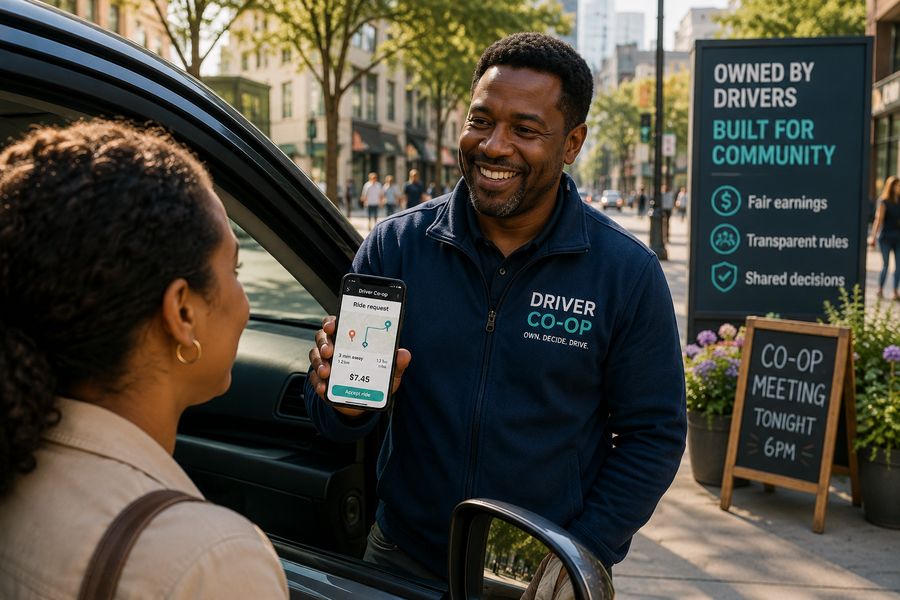
The rise of ride-hailing apps transformed urban transportation with remarkable speed, summoning a car to almost any street corner with a few taps and creating flexible earning opportunities for millions of drivers, yet beneath the convenience that riders enjoy lies a persistent grievance among the people who actually do the driving. The drivers who provide the service that these platforms sell own none of the platforms they depend on, exercise little control over the rules that govern their work, and surrender a substantial portion of every fare to companies whose algorithms set their pay, assign their rides, and can deactivate their accounts with little explanation or recourse. This arrangement, in which the workers generate the value but the platform captures the ownership and control, has fueled a growing frustration among drivers and a search for alternatives in which they would not be mere contractors at the mercy of an app but owners with a genuine stake in the enterprise and a voice in how it is run.
Two distinct movements have emerged to pursue this vision of driver ownership, sharing the goal of putting drivers in control but differing in method, one rooted in the long tradition of worker cooperatives and the other in the newer technologies of blockchain and Web3. The cooperative approach applies a centuries-old model of collective ownership to the ride-hailing business, organizing drivers into worker-owned enterprises that they govern democratically and whose profits they share, while the Web3 approach uses blockchain networks, digital tokens, and decentralized governance to coordinate drivers and riders without a traditional company at the center, distributing ownership and control through technology rather than legal incorporation. Both movements challenge the dominant model on the same fundamental ground, that the people who drive should own and control the platform, but they pursue this challenge along different roads, with different strengths, weaknesses, and records of success and failure that make for an instructive comparison.
This article examines driver-owned ride-sharing for readers who use ride-hailing apps but may never have considered who owns them or how the alternatives work, beginning with the grievances of the dominant model that drive the search for something better. It explains the two roads to driver ownership, the cooperative and the blockchain, and grounds the discussion in real platforms, from established cooperatives like The Drivers Cooperative in New York and its Colorado counterpart to Web3 experiments like DRIFE and the now-shuttered Teleport, drawing lessons from both successes and failures. It then confronts the central and difficult question of whether decentralized, driver-owned coordination can ever match the scale, convenience, and polish of the well-funded giants, weighs the genuine benefits against the formidable obstacles these alternatives face, and considers what their prospects reveal about the future of platform work, aiming throughout to assess honestly whether driver ownership is a realistic challenge to the apps or an admirable ideal that struggles against hard economic realities.
The Problem with the Ride-Hailing Giants
To understand why drivers would attempt the difficult work of building their own platforms, one must first appreciate the depth and nature of the grievances that the dominant ride-hailing model has produced, since these alternatives are a response to real and widely felt problems rather than an abstract preference for novelty. The fundamental structure of the major ride-hailing companies positions drivers as independent contractors who use the platform but have no ownership of it and little control over the terms of their work, an arrangement that concentrates the value drivers generate in the hands of the companies while leaving the drivers themselves exposed to decisions they cannot influence. This structure has generated a cluster of related grievances around pay, control, and security that together explain the appeal of any model promising drivers a greater share and a real voice.
The most immediate and tangible grievance concerns pay, specifically the large commissions that the platforms take from each fare, which can claim a substantial fraction of what the rider pays and leave the driver with considerably less than the headline fare would suggest. Drivers have watched as the share of fares they keep has come under pressure, with the platforms adjusting their economics in ways that drivers often experience as reducing their earnings, and the opacity of the pricing and commission structures has compounded the frustration by making it difficult for drivers to know how much they will earn or why their pay has changed. When a driver sees the fare a rider paid and compares it to what they received, the gap captured by the platform can feel like an extraction that the driver is powerless to contest, and this sense of being shortchanged by a distant company that owns everything and shares little is at the heart of the discontent.
It is worth noting that this grievance has sharpened over time rather than easing, because the relationship between the platforms and their drivers has evolved in ways that drivers have generally experienced as unfavorable. In the early years of ride-hailing, the platforms competed for drivers with generous incentives, bonuses, and favorable terms, and many drivers recall a period when the earnings were genuinely attractive and the platforms seemed to treat them well. As the companies matured, faced pressure to become profitable, and consolidated their hold on the market, the incentives diminished and the economics tightened, so that drivers who had come to rely on the income found their earnings squeezed by changes they had no power to resist. This trajectory, from courtship to extraction, has left many long-serving drivers feeling that they helped build the platforms’ success only to be progressively shortchanged once that success was secure, a sense of betrayal that adds emotional weight to the financial grievance and intensifies the desire for an alternative in which the drivers themselves would capture the value of their work.
Beyond pay lies the deeper grievance of control, the recognition that drivers have almost no say over the rules, algorithms, and decisions that govern their working lives, from how rides are assigned and priced to the standards they must meet and the conditions under which they can be deactivated. The algorithms that direct the work are opaque, the policies are set by the company without driver input, and the threat of deactivation hangs over drivers who have no ownership stake and little recourse if a decision goes against them, creating a relationship of dependence and vulnerability that contractors nominally classified as independent rarely feel to be independent at all. This combination of high commissions, opaque control, and insecurity is what drives the search for alternatives in which drivers would own the platform, share in its profits, and have a genuine voice in how it operates, and the examination of these grievances in detail clarifies exactly what the driver-ownership models aim to fix.
How Commissions and Control Squeeze Drivers
The economics of the commission model deserve closer examination, because the numbers reveal the scale of what drivers forgo and explain why even a modest improvement in their share can transform their livelihoods. Under the dominant platforms, drivers commonly retain only a portion of each fare after the company takes its commission, with the platform’s cut on some rides reaching substantial levels that leave the driver with well under the full fare, and the contrast with what driver-owned alternatives offer is stark, since cooperatives and blockchain platforms that take much smaller cuts can leave drivers with a far greater share of the same fare. When a driver who might keep only a fraction of a fare under a major app could instead keep the great majority of it under a driver-owned model, the difference in earnings on the same work is dramatic, and this gap is the single most powerful argument for the alternatives, since it promises drivers more money for the same driving without necessarily charging riders more.
The control dimension squeezes drivers in ways that are less easily quantified but no less real, beginning with the opacity of the algorithms that assign rides and set pay, which leave drivers unable to understand or predict the system that governs their earnings. A driver cannot see why they were assigned one ride and not another, cannot know how the pay for a trip was calculated, and cannot appeal decisions made by an algorithm whose workings are hidden, a condition of working under rules one cannot see or influence that strips the work of the autonomy that independent contracting is supposed to provide. This opacity extends to changes in the platform’s policies and economics, which can alter a driver’s earnings or working conditions without warning or explanation, leaving drivers to adapt to decisions made far above them and entirely outside their control.
The insecurity of deactivation completes the squeeze, since drivers who depend on a platform for their income can have their accounts suspended or terminated based on ratings, complaints, or algorithmic judgments, often with limited ability to contest the decision or understand its basis. For a driver whose livelihood rests on access to the platform, the possibility of sudden deactivation introduces a precariousness that undermines the security of the work and underscores the powerlessness of the contractor position, since the driver has no ownership stake to protect them and no voice in the process that could end their earning. These three pressures together, the commissions that reduce pay, the opacity that removes understanding, and the insecurity that threatens livelihood, constitute the squeeze that driver-ownership models seek to relieve, and they explain why drivers would undertake the formidable challenge of building platforms they themselves own and control, where the share is larger, the rules are transparent, and the security comes from ownership rather than dependence.
Two Roads to Driver Ownership
The aspiration to driver ownership has been pursued along two distinct roads, each drawing on a different tradition and technology, and understanding the difference between them is essential to evaluating the prospects of driver-owned ride-sharing, since the two approaches face different challenges and offer different advantages. The first road is the worker cooperative, an old and well-established model of collective enterprise in which the workers own and democratically govern the business, sharing its profits and electing its leadership, applied now to the ride-hailing business by organizing drivers into cooperatives that own the platforms they drive for. The second road is the Web3 or blockchain network, a newer approach that uses decentralized technologies, digital tokens, and smart contracts to coordinate drivers and riders without a conventional company at the center, distributing ownership and governance through technology and aiming to eliminate the corporate intermediary altogether.
The cooperative road builds on a model with deep historical roots and a substantial record across many industries, in which a business is owned by its workers, who share in its profits and participate in its governance, typically through democratic structures that give each member a voice in major decisions. Applied to ride-hailing, the cooperative model organizes drivers into a worker-owned company that operates a ride-hailing platform, with the drivers as members who own the enterprise, elect its leadership, share its surplus, and set its policies, so that the platform serves the drivers who own it rather than distant shareholders. This approach has the advantage of a proven legal and organizational form, since worker cooperatives are well-understood entities with established structures for ownership, governance, and profit-sharing, and it grounds driver ownership in a tangible institution that drivers genuinely control, though it must still overcome the formidable practical challenges of competing against vastly larger and better-funded rivals.
The Web3 road takes a different approach, using blockchain technology to create decentralized networks in which the functions of a ride-hailing platform, matching riders with drivers, processing payments, and governing the system, are handled through software running on a blockchain rather than by a traditional company. These platforms typically issue digital tokens that serve multiple purposes, facilitating payments, distributing rewards to active participants, and conferring governance rights that let token holders influence how the platform is run, with the aim of creating a system owned and controlled by its users rather than a corporation. The Web3 approach promises to eliminate the corporate intermediary through technology, allowing drivers to keep the full or nearly full value of fares with minimal commission, and to give participants governance power through tokens, but it introduces the complexities and uncertainties of blockchain technology, the volatility of tokens, and the practical difficulties of building a usable service on decentralized infrastructure, challenges that have proven significant in practice. The contrast between these two roads, the established cooperative and the experimental blockchain network, is examined more closely in the comparison that follows.
Worker Cooperatives Versus Blockchain Networks
The differences between the cooperative and blockchain approaches run deeper than the technologies they use, extending to their legal structures, their methods of governance, their sources of capital, and their fundamental theories of how driver ownership should work, and drawing out these differences clarifies the distinct strengths and weaknesses of each. A worker cooperative is a legally incorporated entity, a company owned by its worker-members under established law, with formal structures for membership, governance, and the distribution of profits, which means that the ownership drivers hold is a concrete legal interest in a real company and the governance they exercise operates through recognized mechanisms like member votes and elected boards. This legal solidity gives the cooperative model a clarity and accountability that can be reassuring, since drivers know exactly what they own and how they govern it, and the cooperative can operate within the existing legal and regulatory framework as a conventional, if differently owned, business.
A blockchain network, by contrast, distributes ownership and governance through digital tokens and software rather than through legal incorporation, so that a participant’s stake and voice derive from holding tokens and participating in decentralized governance rather than from membership in an incorporated company. This approach aims to achieve ownership and control through technology, using tokens to represent stakes and smart contracts to enforce rules automatically, and it appeals to those who see decentralization as a way to eliminate intermediaries and distribute power more widely, but it also introduces distinctive uncertainties, since the value of tokens can be volatile, the governance through token-holding can concentrate power among large holders, and the legal status of these arrangements is often unclear. The blockchain model offers the prospect of very low commissions and global, permissionless participation, but it rests on newer and less proven foundations than the cooperative, and its reliance on tokens introduces a speculative and volatile element that the cooperative model avoids.
The two approaches also differ markedly in how they raise the capital that any ride-hailing platform requires, a difference that bears heavily on their prospects, since building and operating a platform demands significant investment in technology, marketing, and operations. Cooperatives typically raise capital through member contributions, grants, loans, and the slow accumulation of surplus, sources that are often limited and that constrain how quickly a cooperative can grow and how effectively it can compete against rivals with vast resources, a constraint that has shaped the trajectory of real cooperatives. Blockchain networks, on the other hand, have often raised capital by selling tokens to investors, which can generate substantial funding quickly but ties the platform’s fortunes to the volatile dynamics of token markets and the expectations of investors seeking returns, a different but equally consequential financial dynamic. These contrasts, in legal structure, governance, and capital, mean that the cooperative and blockchain roads to driver ownership are genuinely distinct ventures with different risks and prospects, and the real-world experiences of platforms following each road, examined next, reveal how these differences play out in practice.
Cooperatives That Already Work
The cooperative road to driver ownership has moved well beyond theory into functioning enterprises that genuinely operate, employ drivers, and serve riders, and examining these real cooperatives, with their documented histories and results, demonstrates both that the model can work and what it takes to make it work. These cooperatives have shown that drivers can indeed own and operate ride-hailing platforms, that such platforms can pay drivers substantially more than the major apps, and that they can build real businesses serving real customers, while also revealing the challenges of scale and competition that constrain how far the model has spread. The most prominent examples in the United States offer concrete evidence of what driver-owned cooperatives can achieve and the obstacles they confront.
The Drivers Cooperative in New York City stands as the leading example of the model, a driver-owned ride-hailing cooperative that launched in 2020 and obtained its license to operate in New York City in early 2021, co-founded by a for-hire vehicle driver, a labor organizer, and a former executive of a major ride-hailing company. The cooperative grew substantially, attracting thousands of drivers as members, and by later accounts had some nine thousand drivers who were or would soon be members, representing an estimated fifteen percent of the ride-hailing driver workforce in New York City, a remarkable penetration for a driver-owned alternative. Its economics demonstrated the appeal of the model concretely, with the cooperative taking a much smaller cut than the major apps, setting driver pay above the minimum rates the large platforms were required to meet and rider fares below those of the competitors, and creating custom systems to guarantee drivers a minimum hourly wage, which it described as the first hourly living wage guarantee of its kind in the gig economy for the work it focused on.
The financial record of The Drivers Cooperative illustrates both the substance and the difficulty of the model, since in 2022, its first full year of operation, it earned revenue of several million dollars from well over a hundred thousand successful trips, with the great majority of that revenue going directly to driver wages, a striking demonstration that the cooperative directed its income to the drivers rather than to outside shareholders. Yet the same record showed the financial pressures the model faces, since the cooperative recorded a net loss that year even as it paid out most of its revenue to drivers, reflecting the difficulty of competing against far larger rivals while maintaining the generous driver economics that are the cooperative’s reason for being. Over time the cooperative adapted by focusing increasingly on particular niches such as paratransit and non-emergency medical transportation, areas where its model could be sustainable and where it could serve a genuine need, a strategic evolution that shows how cooperatives may find their footing in specific segments rather than by competing head-to-head across the whole market.
The trajectory of The Drivers Cooperative also reveals an important truth about how worker-owned platforms grow, namely that their expansion is organic and member-driven rather than fueled by the vast subsidies that powered the giants’ rise. The cooperative grew its revenue many times over from one year to the next, an impressive rate of growth that nonetheless started from a modest base and proceeded without the war chests that the major platforms deployed to buy market share, which meant that the cooperative had to build its driver base and its rider following through the appeal of its model and the loyalty of its community rather than through aggressive spending. This mode of growth is slower and more fragile than the subsidized expansion of the incumbents, but it also produces a more committed and genuinely invested membership, since the drivers who join a cooperative do so because they believe in owning their platform rather than because they were lured by temporary bonuses, and this commitment can translate into a resilience and a sense of shared purpose that the transactional relationships of the major apps lack.
The Drivers Cooperative Colorado represents another instance of the model taking root in a different setting, a driver-owned, community-oriented rideshare cooperative that launched in 2024 and grew to employ some fifteen hundred drivers, operating primarily along Colorado’s Front Range with drivers based in cities including Denver, Fort Collins, and Colorado Springs. This cooperative offered drivers a far larger share of each fare than the major apps, with drivers reportedly taking home around eighty percent of each fare compared to a much smaller share from the corporate platforms, while keeping rider fares lower than the national apps and avoiding practices like surge pricing and booking fees that frustrate riders. The cooperative invested in its technology, rebuilding both its driver and rider platforms and launching a new driver app in 2025, a sign of the ongoing effort and resources required to operate a competitive platform, and its growth demonstrated that the cooperative model could establish itself in a regional market and attract a substantial body of drivers drawn by the better economics and the community-oriented mission. Together, the New York and Colorado cooperatives show that driver-owned ride-hailing is a real and functioning alternative, capable of paying drivers far more and serving riders well, while also revealing the financial and competitive challenges that keep the model from easily matching the scale of the giants.
The Web3 Experiments
The blockchain road to driver ownership has produced a series of experiments that illustrate both the ambition and the difficulty of using decentralized technology to challenge the ride-hailing giants, with outcomes ranging from continued operation to outright failure, and examining these experiments reveals what the Web3 approach promises and where it has stumbled. These platforms have sought to apply blockchain technology, digital tokens, and decentralized governance to ride-hailing, aiming to eliminate the corporate intermediary, minimize commissions, and give drivers and riders ownership and control through tokens, and their varied fortunes offer instructive lessons about the viability of the approach. The most notable examples show the model’s appeal and its real-world challenges in sharp relief.
DRIFE represents one of the more durable Web3 ride-hailing efforts, a decentralized mobility platform built on blockchain technology that has pursued a zero-commission model, allowing drivers to retain the full value of their fares while the platform’s operations are supported by a digital token used for payments, governance participation, and the distribution of incentives. Built on a blockchain that extends the Ethereum ecosystem, DRIFE has used its token to facilitate peer-to-peer payments and to give participants a voice in governance, and it has sought to expand in markets including India, where it positioned itself as a challenger to the dominant apps, and has worked to integrate with additional blockchain networks to extend its reach. The zero-commission promise captures the central appeal of the Web3 approach, since a platform that takes no commission can in principle leave drivers with everything they earn, supported instead by the token economy, though whether such a model can sustain the costs of operating a competitive platform over the long term remains an open question that the continued operation of platforms like DRIFE is still testing.
Teleport offers a cautionary tale that illustrates the risks of the Web3 approach, a decentralized ride-sharing application built on the Solana blockchain and developed by a company that raised a substantial seed round of nine million dollars in late 2022, backed by venture investors and built on a protocol designed to enable decentralized governance in which the community of drivers and riders could influence how the platform was run. Teleport charged drivers a much smaller share than the major apps and was deliberately designed to look and function like a conventional ride-hailing app so that riders and drivers could use it without any knowledge of cryptocurrency, with riders able to pay by credit card or stablecoin and drivers paid in stablecoin or directly to a bank account, an effort to hide the blockchain complexity behind a familiar interface. Its initial launch in a first city attracted hundreds of registered drivers, and the project generated considerable interest as a promising decentralized challenger, yet despite the funding, the thoughtful design, and the early momentum, Teleport announced that it was shutting down as of early 2025, a failure that underscores the difficulty of building a viable ride-hailing business on the Web3 model even with significant resources and careful execution.
An instructive feature of the more thoughtful Web3 efforts was their recognition that blockchain technology, for all its theoretical appeal, must be hidden from ordinary users if a ride-hailing platform is to succeed, since riders and drivers want a service that works simply and reliably rather than an exercise in cryptocurrency. The most carefully designed platforms therefore went to considerable lengths to conceal their blockchain underpinnings behind interfaces indistinguishable from conventional apps, accepting ordinary payment methods, paying drivers in familiar ways, and asking nothing of users that a normal app would not ask, an approach that implicitly conceded that the blockchain was a means rather than a selling point. This concession raises a pointed question about the Web3 model, namely whether the blockchain adds enough genuine value to justify its complexity and risks when it must be hidden to be usable, or whether a conventional cooperative might achieve the same goals of driver ownership and low commission more reliably without the volatility and technical fragility that tokens introduce. The failure of well-funded blockchain platforms alongside the survival of cooperatives lends some weight to this question, suggesting that the decentralizing technology may complicate more than it enables when the practical goal is simply a fair platform that drivers own.
The contrasting fortunes of these experiments carry important lessons about the Web3 road to driver ownership, demonstrating that while the approach can attract funding, build functional platforms, and generate genuine interest, it faces severe challenges in achieving the scale, sustainability, and adoption needed to compete with the established giants. The failure of a well-funded and carefully designed effort like Teleport, alongside the continued but still-developing operation of platforms like DRIFE, suggests that the obstacles to Web3 ride-hailing are not merely matters of funding or design but reflect deeper difficulties in building network effects, sustaining operations, and overcoming the entrenched advantages of the incumbents, difficulties that the addition of blockchain technology does not by itself resolve. The Web3 experiments thus reveal both the enduring appeal of the vision of decentralized, driver-owned ride-hailing and the hard reality that turning that vision into a lasting and competitive service has so far proven elusive, a reality that any honest assessment of the approach must confront.
Can Decentralized Coordination Match Big-App Convenience
The central question hanging over every attempt at driver-owned ride-sharing, whether cooperative or blockchain, is whether a decentralized or worker-owned platform can ever match the convenience, reliability, and scale that the dominant apps provide, since riders have come to expect a level of service that is difficult and expensive to deliver. The major ride-hailing companies have invested enormous sums over many years to build platforms that summon a car within minutes almost anywhere in a city at any hour, that handle payments seamlessly, that provide reliable service through sophisticated matching algorithms and large networks of drivers, and that present a polished and dependable experience, and matching this standard is a formidable challenge for any alternative regardless of how it is owned. The convenience that riders enjoy rests on scale, technology, and capital that the giants possess in abundance and that driver-owned alternatives, with their limited resources, struggle to assemble.
The challenge of network effects lies at the heart of the difficulty, since the value of a ride-hailing platform to riders depends on having enough drivers to provide quick and reliable service, while its value to drivers depends on having enough riders to keep them busy, a mutual dependence that creates a powerful advantage for large incumbents and a correspondingly steep barrier for newcomers. A driver-owned platform with relatively few drivers may struggle to provide the quick pickups and broad coverage that riders expect, leading riders to stick with the larger apps, which in turn makes it harder to attract drivers, a chicken-and-egg problem that the giants solved with years of heavy spending to subsidize both sides of the market until the network reached critical mass. Driver-owned alternatives generally lack the capital to subsidize their way to scale in this manner, which means they must grow more slowly and organically, often by focusing on particular cities, communities, or niches where they can achieve sufficient density to provide good service rather than attempting to match the giants everywhere at once.
The experience of riders also bears on this question in ways that matter for the prospects of the alternatives, since riders, unlike drivers, generally have little ideological stake in who owns the platform and choose based largely on convenience, price, and reliability. A driver may feel a strong loyalty to a cooperative they own, but a rider deciding how to get home on a cold night will typically open whichever app summons a car most quickly and cheaply, which means that a driver-owned platform must compete for riders on the same practical terms as the giants regardless of the fairness of its model. This asymmetry, in which drivers are motivated by ownership but riders by convenience, poses a particular difficulty, since the platform must attract enough riders to keep its committed drivers busy, yet it cannot count on riders sharing the drivers’ commitment to the cause. The most successful alternatives have addressed this by ensuring that their fares are competitive and their service adequate within their chosen areas, recognizing that the appeal of fairness, while real to some riders, cannot by itself overcome a meaningful gap in convenience or price, and that the platform must therefore deliver a practically satisfactory experience to riders who are indifferent to its ownership.
The matter of capital and technology compounds the challenge, since building and maintaining a competitive ride-hailing platform requires ongoing investment in software, infrastructure, customer support, and the many operational functions that riders take for granted, investment that the well-funded giants can sustain but that resource-constrained alternatives find difficult. The cooperatives raise capital from limited sources and operate on thin margins while paying drivers generously, and the blockchain platforms depend on token economies whose sustainability is uncertain, so that both face constraints on the resources available to build and improve their platforms, constraints that show in the gap between the polish of the major apps and the more modest offerings of the alternatives. Yet the experience of the functioning cooperatives suggests that the answer to whether decentralized coordination can match big-app convenience is nuanced rather than simply negative, since while driver-owned platforms may struggle to match the giants across an entire market, they have shown they can provide genuinely good service within the scope they target, achieving sufficient scale in particular cities or niches to offer riders a real and satisfactory alternative. The honest conclusion is that driver-owned platforms can match big-app convenience within limited domains where they achieve adequate density, but that matching the giants’ seamless service across whole markets remains beyond the reach of their current resources, which is why the most successful alternatives have focused their efforts rather than attempting to compete everywhere.
Benefits, Obstacles, and the Road Ahead
The driver-owned models, whatever their challenges, offer genuine benefits that explain their appeal and their persistence despite the formidable obstacles they face, and setting out these benefits clearly alongside the obstacles gives a balanced picture of where the movement stands and where it might go. The foremost benefit is to drivers, who under these models keep a far larger share of each fare, gain a voice in how the platform operates, and acquire a measure of security and dignity that the contractor position denies them, a transformation of the working relationship from dependence to ownership that addresses the core grievances of the dominant model. The cooperatives have demonstrated this benefit concretely, paying drivers substantially more than the major apps and guaranteeing minimum earnings, while the blockchain platforms promise minimal commissions that would leave drivers with nearly the full value of their fares, and in both cases the driver stands to gain materially and to escape the powerlessness of working under an app they do not own.
Riders, too, can benefit from these models, since driver-owned platforms often charge fares comparable to or lower than the major apps while avoiding practices that frustrate riders, such as surge pricing and various fees, and since a platform that treats its drivers well may provide better service through drivers who are more satisfied and invested. The cooperatives have offered lower fares than the giants while paying drivers more, a combination made possible by taking a smaller cut and operating without the demand for shareholder profit, and this alignment of the interests of drivers and riders against the extraction of a distant owner is part of the appeal of the model to riders who may prefer to support a fairer arrangement. There is also a broader social benefit, since driver-owned platforms keep more of the value generated by local transportation within the communities that produce it rather than transferring it to distant corporations, a form of economic democracy that appeals to those concerned about the concentration of wealth and power in the platform economy. When a major app extracts its commission from a city’s rides, that money largely flows out of the local economy to the company’s shareholders and headquarters, whereas a cooperative’s surplus and its drivers’ larger earnings remain with people who live and spend in the same community, circulating locally rather than draining away. This retention of value has a multiplier effect that extends beyond the individual drivers, since better-paid drivers spend more in their neighborhoods, and a platform accountable to its community may make decisions that serve local needs rather than distant financial targets, a difference that gives driver ownership a civic dimension beyond the immediate question of driver pay. Advocates of the cooperative model often frame this as a question of where a community’s transportation infrastructure should ultimately reside, arguing that the work of moving people around a city is too important and too embedded in local life to be controlled entirely by distant corporations, and that there is value in at least some portion of it being owned by the residents who depend on it. Whether or not one shares this conviction, it captures a dimension of the driver-ownership movement that pure financial comparison overlooks.
The obstacles, however, are severe and have repeatedly constrained these models, beginning with the fundamental challenge of capital, since competing against the enormous resources of the established giants requires investment that cooperatives and blockchain platforms struggle to raise, leaving them perpetually under-resourced relative to their rivals. The network-effect advantage of the incumbents compounds the capital problem, making it difficult for alternatives to achieve the scale needed for good service, while the technological and operational demands of running a competitive platform strain the limited resources of driver-owned ventures, and the regulatory complexity of the ride-hailing business adds further burdens. The blockchain platforms face the additional obstacles of token volatility, the technical complexity of decentralized systems, and uncertain legal status, obstacles that contributed to failures like the shutdown of a well-funded Web3 platform, while the cooperatives face the persistent difficulty of competing on thin margins while paying drivers generously, a tension visible in the financial losses that even successful cooperatives have recorded.
The road ahead for driver-owned ride-sharing is therefore likely to be one of focused, incremental progress rather than wholesale displacement of the giants, with the most promising path lying in the cultivation of particular cities, communities, and niches where driver-owned platforms can achieve sustainable scale and serve genuine needs. The evolution of established cooperatives toward specialized segments like paratransit and medical transportation suggests one viable direction, in which driver-owned platforms find sustainable footholds in areas where their model fits well rather than attempting to compete across the entire market, while the continued experimentation of blockchain platforms, despite notable failures, keeps alive the possibility that decentralized technology might eventually overcome some of the obstacles that have limited it. The future of these models depends on whether they can secure the capital, achieve the scale, and refine the operations needed to compete, challenges that remain daunting, but their persistence and their genuine achievements demonstrate that the vision of driver ownership is not merely idealistic but capable of producing real, functioning alternatives that materially improve the lives of the drivers who own them, even if they have not yet, and may never, dethrone the dominant apps.
Final Thoughts
Driver-owned ride-sharing represents a serious and instructive challenge to one of the defining business models of the platform economy, raising fundamental questions about who should own and control the platforms on which so many people now work and depend. The movement, in both its cooperative and its blockchain forms, rests on a compelling moral intuition, that the people who generate the value of a platform through their labor deserve a share of its ownership and a voice in its governance rather than the powerless position of contractors at the mercy of a distant company, and this intuition has motivated real and impressive efforts to build alternatives that put drivers in control. The functioning cooperatives that pay drivers far more than the giants and guarantee them a living wage demonstrate that the vision can be realized in practice, and they stand as proof that the dominant model is a choice rather than a necessity, that ride-hailing could be organized to serve the drivers who do the work.
The honest assessment, though, must acknowledge the formidable obstacles that have constrained these alternatives and the mixed record they have compiled, with notable successes alongside significant failures, and the persistent difficulty of matching the scale and convenience that the well-funded giants provide. The capital constraints, the network effects, the technological demands, and the competitive pressures that driver-owned platforms face are not minor inconveniences but fundamental challenges that have limited the reach of even the most successful cooperatives and contributed to the collapse of well-funded blockchain ventures. The result is a movement that has proven it can create genuine value for drivers and serve riders well within particular domains, but that has not, and may not, displace the dominant apps across the broad market, a reality that tempers the more utopian hopes for driver ownership without negating its real and meaningful achievements.
The intersection of technology and economic justice visible in this movement is genuinely significant, since the question of how platform work is owned and governed bears directly on the livelihoods and dignity of millions of workers and on the distribution of wealth and power in an economy increasingly shaped by platforms. The driver-ownership models, whether through the established mechanism of the cooperative or the experimental technology of the blockchain, represent attempts to answer this question in favor of the workers, to build platforms that distribute rather than concentrate the value and control, and their efforts illuminate both the possibility and the difficulty of a more equitable organization of platform work. Whether such models ultimately remain niche alternatives or grow into more substantial challengers, they expand the sense of what is possible and demonstrate that the prevailing arrangement is not the only one available.
Looking ahead, the prospects of driver-owned ride-sharing will depend on whether these models can overcome their resource constraints, achieve sustainable scale in the domains they target, and perhaps benefit from supportive policy or shifting attitudes that favor worker ownership. For riders and drivers alike, the existence of these alternatives offers a meaningful choice and a reminder that the platforms they use are not forces of nature but human institutions that could be organized differently, owned by the workers who run them and governed in their interest. The challenge that driver-owned ride-sharing poses to the apps may not soon overturn the giants, but it keeps alive a vital question about fairness and ownership in the platform economy, and the real achievements of the drivers who have built and run their own platforms stand as evidence that a different way is not only imaginable but, within limits, already real.
FAQs
- What is driver-owned ride-sharing?
It is a model in which the drivers who provide rides own and control the platform they drive for, rather than working as contractors for a company owned by outside shareholders. Driver-owned platforms come in two main forms: worker cooperatives, in which drivers are member-owners who govern the business democratically and share its profits, and blockchain networks, which use digital tokens and decentralized governance to distribute ownership and control among drivers and riders through technology. - Why are drivers unhappy with the major ride-hailing apps?
The main grievances concern pay, control, and security. The major apps take a substantial commission from each fare, leaving drivers with considerably less than the rider paid, and they govern drivers through opaque algorithms that set pay and assign rides without explanation. Drivers also face the threat of deactivation with little recourse. Because drivers own no stake in the platforms and have no voice in their rules, they experience a powerlessness that has driven the search for alternatives they would own and control. - How much more can drivers earn on a cooperative platform?
The difference can be substantial. Cooperatives take a much smaller cut than the major apps, so drivers keep far more of each fare. Drivers Cooperative Colorado, for example, reported that its drivers take home around eighty percent of each fare, compared to a much smaller share from corporate apps. The Drivers Cooperative in New York set driver pay above the minimum rates the major platforms must meet and even guaranteed a minimum hourly wage, directing most of its revenue to driver wages. - What is the difference between a cooperative and a Web3 ride-sharing platform?
A cooperative is a legally incorporated company owned by its worker-members, who govern it through democratic structures like member votes and elected boards, a proven and well-understood model. A Web3 platform uses blockchain technology, digital tokens, and decentralized governance to distribute ownership and control through software rather than legal incorporation. The cooperative offers legal solidity and clarity, while the Web3 model promises very low commissions and global participation but introduces token volatility and technical and legal uncertainty. - Are there driver-owned platforms that actually work?
Yes. The Drivers Cooperative in New York City, launched in 2020 and licensed in 2021, grew to some nine thousand drivers, an estimated fifteen percent of the city’s ride-hailing workforce, and earned several million dollars in revenue in 2022 from over a hundred thousand trips. Drivers Cooperative Colorado launched in 2024 and grew to around fifteen hundred drivers along the Front Range. Both demonstrate that the cooperative model can operate as a real, functioning business. - What happened to Teleport, the blockchain ride-sharing app?
Teleport was a decentralized ride-sharing app built on the Solana blockchain, developed by a company that raised a nine-million-dollar seed round in late 2022 and designed to function like a conventional app so users needed no knowledge of cryptocurrency. It launched in a first city with hundreds of registered drivers and generated considerable interest, but despite the funding and careful design, it announced it was shutting down as of early 2025. Its failure illustrates the difficulty of building a viable Web3 ride-hailing business even with significant resources. - Can driver-owned platforms match the convenience of Uber and Lyft?
Within limits. The major apps provide quick, reliable service across whole cities thanks to enormous scale, technology, and capital that driver-owned alternatives struggle to match. Because of network effects, a platform needs enough drivers and riders to provide good service, which is hard to achieve without the capital to subsidize growth. However, functioning cooperatives have shown they can provide genuinely good service within particular cities or niches where they achieve sufficient density, even if they cannot match the giants everywhere. - How do driver-owned platforms raise money to compete?
This is one of their biggest challenges. Cooperatives typically raise capital through member contributions, grants, loans, and accumulated surplus, sources that are limited and constrain how fast they can grow. Blockchain platforms have often raised money by selling tokens to investors, which can generate funding quickly but ties the platform to volatile token markets and investor expectations. Neither approach gives driver-owned platforms anything close to the resources of the established giants, which shapes their slower, more focused growth. - Do riders benefit from driver-owned platforms?
They can. Driver-owned platforms often charge fares comparable to or lower than the major apps while avoiding practices riders dislike, such as surge pricing and extra booking fees, because they take a smaller cut and do not answer to outside shareholders. Drivers Cooperative Colorado, for instance, offered lower fares without surge pricing. Riders may also receive better service from drivers who are more satisfied and invested, and some prefer supporting a model that treats drivers fairly and keeps value in their community. - Will driver-owned ride-sharing replace the major apps?
It is unlikely to displace them broadly in the near future, given the capital, network-effect, and operational obstacles these alternatives face. The more realistic path is focused, incremental progress, with driver-owned platforms establishing sustainable footholds in particular cities, communities, or niches such as paratransit and medical transportation, where their model fits well. Rather than dethroning the giants, they offer a meaningful alternative that materially improves drivers’ livelihoods and keeps alive an important question about fairness and ownership in platform work.