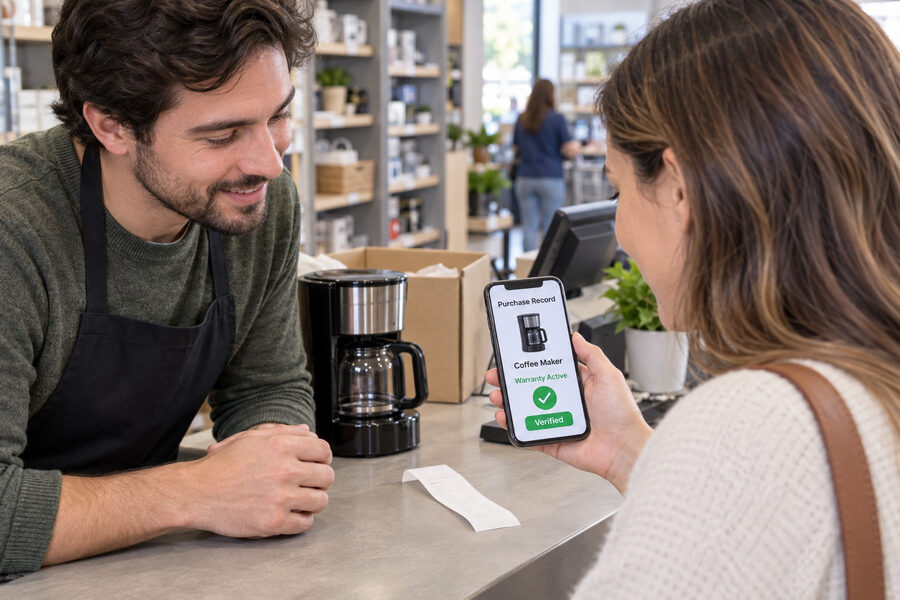
Almost everyone who has ever tried to return a printed item to a store has run into the same small, frustrating problem: the receipt that would prove the purchase happened has faded into a blank, unreadable strip of paper. This is not a storage accident or a sign of careless handling. Most retail receipts are printed on thermal paper, a material coated in a heat-sensitive chemical layer that darkens when the printer’s heating element touches it, and that same chemical layer continues to react to heat, light, and simple friction long after the receipt leaves the store, meaning a receipt tucked into a wallet or left on a car dashboard can lose its printed text within weeks rather than years. A warranty claim, a tax deduction, or a simple exchange can all hinge on a document that was, in effect, designed to erase itself.
The obvious alternative, the emailed digital receipt, solves the fading problem but introduces a different and in some ways more frustrating one. An email receipt depends on a chain of things staying intact for as long as the record might be needed: the same email address must remain active, the retailer’s systems must still exist and still be willing to resend a copy, and the message itself must survive years of inbox cleanups, spam filters, and platform migrations without ever being deleted. Retailers close, rebrand, or get acquired, and when that happens, the servers that once could re-send a copy of a five-year-old order confirmation frequently disappear along with the company that issued it. A consumer trying to file a warranty claim on a refrigerator purchased four years earlier may find that the retailer’s email system was decommissioned during a merger, that their own email provider purged old messages during an account migration, or simply that the original message was buried under thousands of newer ones and is functionally impossible to locate when it matters most.
Both approaches, the physical slip of chemically treated paper and the digital message sitting on someone else’s server, share a structural weakness that has nothing to do with how carefully a person manages their own belongings. Each depends on a single point of custody, either an object that degrades on its own schedule or a company-controlled database that can vanish, change hands, or simply stop prioritizing years-old transaction records. Neither format was built with the expectation that a purchase record might need to remain readable and verifiable a full decade after the transaction occurred, and yet warranties, tax audits, and insurance claims routinely require exactly that kind of durability.
Blockchain-anchored digital receipts approach the problem from a different angle entirely. Rather than storing the proof of purchase on a fading physical object or inside one company’s database, the core details of the transaction, or a cryptographic fingerprint representing those details, are recorded on a shared ledger maintained across many independent computers rather than a single server controlled by one retailer. A consumer does not need to understand cryptography or distributed computing to use one of these systems any more than they need to understand how a credit card’s magnetic stripe works to swipe it at a register; what matters practically is that the resulting record cannot quietly disappear because one company went out of business, and it cannot be secretly altered after the fact by anyone hoping to dispute what was actually purchased or when.
This shift is also arriving at a moment when the broader shopping experience has already moved decisively away from cash and paper in almost every other respect. Contactless cards, mobile wallets, and buy-now-pay-later checkout flows have made the physical act of paying largely invisible, yet the record generated at the end of that transaction still frequently defaults back to one of the two fragile formats already described, a printed slip from a register or a message routed through an email inbox. The gap between how modern a purchase feels at the moment of checkout and how outdated the resulting proof of that purchase actually is has become increasingly conspicuous, particularly to a generation of shoppers who already manage boarding passes, event tickets, and loyalty cards entirely through smartphone apps rather than printed paper, and who reasonably expect a receipt to behave the same durable, always-accessible way.
This article examines how that shift from paper and email toward shared, ledger-based purchase records is actually unfolding in practice, starting with a closer look at exactly why the current default options are failing consumers so consistently, and then walking through the technical mechanics that make a blockchain-anchored receipt meaningfully different from a downloadable PDF. It then turns to two real, documented deployments of this idea, a consortium of luxury goods companies built around shared product and purchase authentication, and an open digital-passport infrastructure provider whose technology now underpins purchase and ownership records for dozens of independent fashion, watch, and retail brands, before examining the concrete benefits these systems offer across returns, warranty claims, and tax season. It closes with an honest look at the fraud problem driving much of this interest in the first place, the broader regulatory momentum building around durable, verifiable purchase records, and the real hurdles, around privacy, standardization, and consumer habit, that still stand between where the technology is today and where it would need to be to fully replace the receipt in every person’s wallet.
Why Paper and Email Receipts Are Failing Consumers
The technical explanation for why thermal receipts fade is straightforward once explained, but the practical consequences are more serious than most people realize until they need an old receipt and discover it has become a blank strip. Thermal printing works by applying targeted heat to paper coated with a leuco dye and a color-developer chemical, typically a compound related to bisphenol A or one of its substitutes, which reacts with the dye under heat to produce the visible black or blue text. That same chemical reaction is not perfectly stable once it happens; continued exposure to heat, direct sunlight, and even the oils naturally present on human skin gradually breaks down the reacted compound, causing the printed characters to lighten and eventually vanish entirely. A receipt kept in a hot car, tucked next to a heat source, or simply carried in a pocket for months can become unreadable far sooner than a person filing it away for a future return or warranty claim would ever expect, and unlike a photograph or a handwritten note, there is no way to restore the text once the chemical reaction that produced it has run its course.
Email receipts were widely adopted specifically because they sidestep the physical fading problem, but they inherit a different kind of fragility rooted in custody rather than chemistry. An email receipt exists because a retailer’s system generated it and a person’s inbox provider stored it, and the record remains accessible only for as long as both of those systems continue operating in a compatible, cooperative way. Retailers merge, rebrand, or shut down with some regularity, and when a company’s ordering and customer-service infrastructure is decommissioned during an acquisition or bankruptcy, the ability to re-send a lost receipt or verify a years-old order frequently disappears along with it, leaving a customer holding what amounts to an unverifiable claim rather than a document anyone can independently confirm. On the consumer side, email accounts get closed, migrated between providers, or simply accumulate so much volume that a specific message from several years earlier becomes effectively unfindable even though it technically still exists somewhere in an archive.
The costs of this fragility land unevenly, but they land hardest exactly where a purchase record matters most: multi-year warranties, insurance claims following theft or damage, and tax situations where a deduction or reimbursement depends on documented proof of what was bought and when. A consumer appliance with a five-year manufacturer’s warranty is a common example, since the paper or email receipt proving the purchase date needs to survive exactly as long as the warranty itself, a timeframe that frequently exceeds how long either format reliably remains intact and accessible. Small business owners and freelancers face a sharper version of the same problem at tax time, when a lost or faded receipt for a legitimate business expense can mean forfeiting a deduction entirely, since tax authorities generally require a legible, verifiable record rather than simply a good-faith recollection of what was purchased. Insurance claims following a fire, flood, or theft compound the difficulty further, since the receipts needed to document a household’s possessions are often stored in the very location the disaster affected, meaning the exact moment a person most needs proof of past purchases is frequently the moment that proof has also been physically destroyed.
Large, infrequent purchases magnify these problems even further, precisely because the stakes attached to a single lost or faded receipt tend to scale with the price and expected lifespan of whatever was bought. A major appliance, a piece of home electronics, or a large furniture purchase often carries a manufacturer’s warranty running several years, sometimes a full decade, meaning the proof of purchase needs to remain legible and retrievable for far longer than the typical thermal receipt or actively monitored email inbox realistically allows. Homeowners filing an insurance claim after a burglary or house fire face a version of the same problem at the worst possible moment, since the receipts needed to document the value of lost or damaged belongings are frequently stored inside the very home the incident affected, and even when a household keeps digital backups, those backups are often just scanned images of paper receipts that had already begun fading before they were photographed, carrying the original document’s legibility problems forward into the digital copy.
Retailers, meanwhile, absorb a related but distinct cost when receipts cannot be reliably verified, particularly around returns and exchanges. A cashier or return-desk employee has no independent way to confirm that a printed or emailed receipt reflects an unaltered, genuine transaction, and this gap has become a meaningful vector for retail fraud, a problem examined in more detail later in this article alongside the specific industry data documenting its scale. Both consumers and retailers, in other words, are working around the same underlying weakness from opposite sides of the counter: the format used to prove a purchase happened offers no built-in way to confirm that the proof itself has not faded, been lost, or been altered, a gap that a shared, tamper-evident ledger record is specifically designed to close.
How Blockchain-Anchored Digital Receipts Actually Work
Understanding why a blockchain-anchored receipt behaves so differently from a PDF attachment or a printed slip requires looking at two separate questions that together determine how trustworthy and how durable the resulting record actually is. The first question is technical: once a transaction happens, what specific process turns the details of that purchase into something that can be checked later without relying on anyone’s word that it was recorded accurately? The second question is organizational: who actually operates the system that stores and maintains that record, and what happens to the receipt if that operator disappears, gets acquired, or simply decides to shut the service down?
These two questions are related but distinct, and conflating them is a common source of confusion about what blockchain-based receipts actually promise. The technical process, generally involving cryptographic hashing and some form of timestamped, tamper-evident storage, is what gives a ledger-anchored receipt its resistance to quiet alteration after the fact, since changing even one detail of a properly hashed and anchored record would be immediately detectable by anyone checking it against the shared ledger. The organizational structure, meanwhile, determines something different but equally important: whether the record depends on a single company’s continued goodwill and continued existence, similar to the email-receipt problem described earlier, or whether it is maintained by a broader network that no single participant can unilaterally shut down or alter. A well-designed blockchain receipt system needs to get both of these pieces right, since strong cryptographic tamper-evidence does little good if the only copy of the record sits on a server that a bankrupt company stops paying to keep running, and a maximally decentralized network offers little practical benefit if the underlying data it stores was never made verifiable in the first place.
Hashing, Timestamps, and the Anatomy of a Ledger Record
The starting point for any blockchain-anchored receipt is a cryptographic hash function, a mathematical process that takes any input, in this case the details of a purchase such as the item, price, date, and merchant, and converts it into a fixed-length string of characters that looks essentially random but is entirely determined by that specific input. The defining property that makes this useful for receipts is that changing even a single character of the original transaction data, altering the price by one cent or the date by one day, produces a completely different hash output, with no way to predict in advance how the output will change. This means the hash functions as a kind of digital fingerprint unique to that exact transaction record, and anyone holding both the original receipt data and its corresponding hash can independently verify, without needing to trust any third party’s assurance, that the data has not been altered since the hash was originally generated.
Once this hash exists, the next step is anchoring it to a blockchain, meaning the hash value, rather than necessarily the full transaction details themselves, is included in a batch of data that gets written into the shared ledger and timestamped as part of that process. This distinction matters for privacy as much as for technical design, since a receipt system can prove that a specific transaction happened at a specific time, and that its details have not been altered since, without necessarily broadcasting the full contents of that transaction to everyone who can view the underlying blockchain, a meaningful difference from simply posting a scanned copy of a receipt to a public database. The timestamp itself carries real evidentiary weight precisely because of how blockchains are structured: once a hash is included in a confirmed block, altering it would require rewriting that block and every subsequent block built on top of it across every independent computer maintaining a copy of the ledger, a task that becomes exponentially more difficult, and in well-established networks effectively impossible in practice, as more blocks are added afterward.
This same hashing process also solves a subtler problem that a simple photograph or scanned copy of a receipt cannot address on its own. Scanning a paper receipt preserves whatever the paper happened to show at the moment it was scanned, fading and all, and it does nothing to prevent someone from editing that image afterward using ordinary photo-editing software, since a scanned image carries no built-in mechanism for detecting whether it has been altered since it was created. A hash anchored to a blockchain, by contrast, is generated directly from the structured transaction data at the moment of purchase, before any possibility of later editing, and the timestamp attached to that hash establishes exactly when the underlying record was created, giving anyone checking it a fixed, provable reference point that a scanned image, however clear, cannot offer.
The practical result for an ordinary shopper is a receipt that behaves less like a document and more like a claim that can be independently checked. Instead of trusting that a retailer’s PDF or a faded paper slip accurately reflects what happened at checkout, a person, or a warranty department, or a tax auditor, can recompute the hash from the transaction details in question and compare it against the value permanently recorded on the ledger at the time of purchase, confirming a match without needing to take anyone’s word for it. This does not make fraud technically impossible, since someone could still misrepresent details at the moment of the original transaction before anything is hashed, but it closes off the much more common failure mode of a record being quietly altered, lost, or contradicted after the fact, which is precisely the gap that has made paper and email receipts so unreliable for anything beyond an immediate, same-day return.
Custodial Platforms vs. Decentralized Networks
Even a technically sound hashing and timestamping process still leaves open the organizational question of who runs the infrastructure that generates, stores, and displays these records to the people who need them, and the answer varies considerably across real implementations. A custodial approach, the more common pattern among retailer-branded digital receipt services, involves a company building its own application or platform that anchors transaction hashes to an existing public or permissioned blockchain while keeping the user-facing interface, the full transaction details, and the customer relationship entirely under its own control. This model is generally easier and faster to deploy, since a single company can design, launch, and iterate on the system without needing to coordinate with outside partners, but it reintroduces a version of the same custody risk that undermines email receipts: if the company operating the platform shuts down, the convenient interface for viewing and retrieving receipts may disappear even if the underlying hash remains technically present on the blockchain somewhere.
A more fully decentralized approach spreads both the technical infrastructure and the governance of the system across multiple independent parties, none of whom can unilaterally alter records or shut the entire system down. This is closer to how public blockchain networks themselves already operate, maintained by thousands of independently run computers rather than a single company’s servers, and extending that same structure to the receipt-issuing layer means no single retailer’s business decisions, financial troubles, or corporate restructuring can make historical purchase records permanently inaccessible. The tradeoff, much like other decentralized systems, is coordination cost: getting multiple retailers, platforms, and infrastructure providers to agree on shared formats and standards takes considerably longer than one company building its own proprietary solution, which helps explain why most real-world deployments to date, including the case studies examined in the next two sections, have leaned toward hybrid models that anchor records to a public or industry blockchain while still relying on a company-operated application as the primary way customers actually interact with their receipts.
Choosing between these two organizational models in practice generally comes down to how quickly a company needs to launch and how much control it is willing to share with outside partners in exchange for greater resilience. A single national retailer rolling out its own receipt platform can move at its own pace, set its own technical requirements, and change course quickly if the initial design needs adjusting, advantages that a multi-party decentralized effort, requiring agreement across several independent organizations before anything changes, generally cannot match. That speed advantage helps explain why most of the earliest, most visible deployments of this technology, including both case studies examined later in this article, have come from individual companies or focused industry consortiums rather than from fully open, ownerless networks built from the ground up specifically for receipts.
What both models share, and what distinguishes either of them from a traditional paper or email receipt, is that the underlying proof of the transaction does not depend entirely on one company’s servers remaining online indefinitely. A custodial platform that shuts down still leaves the hashed record anchored on the underlying blockchain, recoverable in principle by anyone who retained the original transaction details needed to recompute and match the hash, even if the convenient consumer-facing app built on top of it is gone. A fully decentralized system goes further, ensuring not just the underlying proof but also the infrastructure for accessing and displaying it survives the departure of any single participant. Both represent a meaningful structural improvement over a model in which the entire chain of proof runs through one retailer’s email server or one printer’s chemical coating, which is precisely why the real deployments discussed next have chosen to build on shared ledger infrastructure rather than simply digitizing the receipt in a company-controlled database.
Case Study: The Aura Blockchain Consortium and Luxury Goods Provenance
The clearest large-scale example of companies pooling resources to build shared, blockchain-anchored purchase and authenticity records is the Aura Blockchain Consortium, unveiled on April 20, 2021, by luxury conglomerate LVMH together with OTB Group, Prada Group, and Cartier, the latter operating under the Richemont group. The consortium’s founding members, ordinarily fierce competitors in the luxury retail market, made the notable decision to build shared blockchain infrastructure together rather than each developing separate, incompatible systems, reasoning that a common standard for proving authenticity and purchase history would benefit the entire luxury sector more than any single company’s proprietary alternative. The technology underpinning the consortium matches a unique product identifier to a client identifier through a chain of secure digital blocks, letting a consumer access a product’s documented history and verified proof of authenticity at essentially any point after purchase, from the original point of sale onward. Mercedes-Benz joined the following year as the consortium’s fifth founding member, marking the project’s first expansion beyond fashion, leather goods, and jewelry into a large automotive manufacturer, a signal that the underlying approach was viewed as applicable well beyond the specific product categories it started with.
The practical mechanics of an Aura-registered purchase illustrate how blockchain-anchored records solve the exact durability problem described earlier in this article. When a consumer buys a qualifying item from a participating brand, the transaction and the product’s unique digital identifier are recorded on the consortium’s blockchain infrastructure, creating a permanent, verifiable link between that specific physical item and its documented ownership and purchase history, independent of whether the original store receipt survives, whether the purchasing customer’s email account remains active, or whether the specific boutique that made the sale still exists years later. This matters enormously in the secondhand and resale luxury market, where establishing authenticity and a legitimate chain of ownership has traditionally depended on physical documentation, a box, a card, a receipt, that is exactly the kind of fragile paper record this article has already described as unreliable over any meaningful stretch of time. A verified digital record tied to the blockchain rather than to a single retained document gives both the original purchaser and any future buyer a way to confirm the item’s history that does not depend on anyone successfully holding onto a piece of paper for years or even decades.
The consortium’s growth since its 2021 founding has been substantial by the standards of enterprise blockchain adoption, a category of technology that has frequently struggled to move from pilot projects to genuine operational scale. As most recently reported by the consortium itself, Aura has expanded from its four original founding members to a global community of more than 50 luxury member brands, with more than 60 million individual luxury products now registered on its blockchain infrastructure, figures that represent one of the largest documented deployments of blockchain-based product and purchase authentication currently operating anywhere in the retail sector. This scale is particularly notable given that luxury goods, precisely because of their resale value and the correspondingly strong incentive for counterfeiting, represent one of the product categories where a durable, tamper-evident purchase and authenticity record delivers the clearest and most immediately measurable value, both to the consumer trying to verify what they bought and to the brand trying to protect its reputation from counterfeit goods circulating with fraudulent claims of authenticity.
The consortium’s structure also illustrates why an industry-wide approach can succeed where a single company’s proprietary system might struggle to gain traction. Because Aura’s founding brands compete directly with one another in the same luxury market, their decision to build shared infrastructure rather than separate, incompatible systems meant that a customer purchasing from any participating brand could rely on the same underlying verification standard, rather than needing to learn and trust a different proprietary app for every label in their closet or jewelry box. This shared-standard approach also strengthens the system’s value specifically in the resale market, since a prospective secondhand buyer evaluating an item from one Aura member brand can rely on the same verification process they would use for an item from any other member brand, an interoperability advantage that a single retailer acting alone, however well-resourced, could not replicate on its own.
What the Aura case demonstrates most clearly is that a shared, industry-wide blockchain record for purchases and provenance is not merely a theoretical proposal but an operating system handling tens of millions of real transactions across dozens of major brands, several years into continuous operation. It also illustrates a broader pattern worth carrying into the rest of this article: the companies most motivated to solve the durable-receipt problem first are frequently the ones selling goods where a lost or fraudulent proof of purchase carries the highest financial stakes, a pattern that recurs in the next case study from a very different corner of the retail world.
Case Study: Arianee’s Digital Product Passports for Moncler and Other Brands
A second, structurally different real-world deployment comes from Arianee, a Paris-based company that operates an open blockchain protocol for issuing digital product passports rather than building a single retailer’s proprietary app. Arianee’s approach came into sharp focus in October 2022, when the Italian fashion house Moncler, marking its 70th anniversary, announced it was joining the Arianee Association, a governance body then already including more than 50 industry leaders, as a first step toward equipping its products with blockchain-anchored digital passports. Rather than each brand building its own isolated blockchain system from scratch, Arianee supplies the shared underlying protocol that any participating brand, whether a fashion house, a watchmaker, or a department store, can build its own passport program on top of.
The resulting digital passport functions as a purchase, ownership, and authenticity record in one, since it captures a specific physical item’s serial number and transaction details, allows an owner to prove authenticity and legitimate possession, and, in the case of the watchmaker Breitling’s parallel Arianee-based program, connects directly to a warranty system that lets an owner track repairs against the item’s documented purchase date. When a product changes hands through resale, the passport’s certificate of ownership can be transferred to the new owner without any paper documentation, addressing the same secondhand-authentication problem examined in the Aura case study, but through an infrastructure model in which Arianee provides the shared technical backbone rather than a small group of founding brands governing their own closed consortium.
Moncler’s participation was followed by comparable dated deployments from other brands built on the same protocol, most visibly the French fashion house Mugler’s launch of blockchain-based digital passports in November 2023, covered at the time by Forbes as an example of how such passports could deepen post-purchase engagement between a brand and a verified owner. Arianee’s own current public reporting describes its network as having grown to more than 3.4 million digital product passports deployed across brand partners spanning fashion, luxury watches, wine and spirits, and department-store retail, including named partners such as Lacoste, YSL Beauty, Printemps, and Galeries Lafayette alongside Moncler, Mugler, and Breitling. That growth has coincided with Arianee’s move, beginning in early 2023, to build a dedicated layer-two blockchain using Polygon’s Chain Development Kit specifically to handle passport issuance at this larger scale.
Arianee’s infrastructure model also connects directly to the regulatory momentum examined later in this article, since the company has positioned its passport protocol as compliance-ready technology for the European Union’s forthcoming Digital Product Passport mandate, giving brands already using Arianee’s system for purchase and ownership records a documented head start on a requirement that will apply far more broadly starting in 2027. Taken together with the Aura Consortium, Arianee’s shared-protocol model demonstrates a second viable path to the same destination: rather than a fixed group of founding competitors building and governing their own network, an open infrastructure provider can let any number of independent brands add durable, verifiable purchase records to their products without each one having to design a blockchain system from first principles, a pattern that recurs in the next section’s look at the practical benefits both models deliver.
Real-World Benefits: Returns, Warranties, and Tax Season
The two case studies just examined point toward a broader set of practical benefits that verifiable, ledger-anchored purchase records offer across the specific situations where paper and email receipts have historically failed. These benefits are not evenly distributed, however, and understanding them requires looking separately at how consumers and retailers each experience the shift from a fragile, single-point-of-failure receipt to a durable, independently verifiable one. Consumers primarily benefit from no longer needing to personally safeguard a physical or digital document against loss, damage, or the passage of time, while retailers primarily benefit from a reduction in the fraud and reconciliation costs that stem from receipts that can be forged, altered, or disputed without any independent way to check them.
These two categories of benefit are also connected in a way that matters for understanding why retailers, and not just consumers, have real financial incentive to invest in this technology. A return-fraud attempt built around a counterfeit or altered receipt harms the retailer directly through the value of the fraudulently returned merchandise, but it also harms the honest consumer indirectly, since the operational costs and losses retailers absorb from receipt fraud frequently get passed along to all shoppers through higher prices, stricter return policies, or more burdensome verification requirements imposed on every customer regardless of whether that specific customer has ever committed fraud. A verifiable purchase record, in other words, is not simply a convenience upgrade for the individual consumer holding it; it is also a mechanism that, if broadly adopted, could reduce the systemic costs currently distributed across the entire customer base of a retailer dealing with receipt-based fraud, a dynamic explored in more detail in the following section on the scale of documented return fraud.
For Consumers: Faster Returns and Warranties That Don’t Get Lost
The most immediate consumer benefit of a blockchain-anchored purchase record is that it removes the personal responsibility of safeguarding a specific physical or digital artifact against loss, damage, or simple forgetfulness for as long as a return window, warranty period, or tax-relevant timeframe remains open. Rather than needing to file away a thermal receipt in a folder, hoping it has not faded by the time it is needed, or search through years of email history hoping the original order confirmation was never deleted, a consumer using a blockchain-anchored system can retrieve verified proof of a purchase through an app or portal that draws directly on the underlying ledger record, a record that does not degrade with time or depend on any single company’s server remaining operational.
This durability becomes especially valuable for exactly the categories of purchase where paper and email receipts have historically caused the most frustration: multi-year appliance and electronics warranties, luxury goods that may be resold years or even decades after the original purchase, and any situation where an insurance claim requires documenting the original cost and purchase date of items lost to theft, fire, or flood. A consumer filing a warranty claim on a five-year-old appliance no longer needs to have successfully preserved a specific piece of paper or located a specific email; they need only access to the account or wallet associated with the original purchase, a considerably lower bar that does not depend on the physical survival of a chemically unstable receipt or the operational survival of a specific email server.
Returns and exchanges benefit in a more immediate, everyday way as well, since a cashier or return-desk associate working with a verified digital record does not need to visually inspect a printed receipt for signs of alteration or attempt to manually confirm details against a store’s internal database, a process that can be slow even when the receipt in question is completely genuine. A verifiable record also gives the customer a stronger position when a dispute arises over price, purchase date, or which specific item was actually bought, since the underlying record cannot be quietly altered after the fact by either party, a protection that benefits an honest customer just as much as it protects the retailer against a dishonest one.
For Retailers: Cutting Fraud and Simplifying Operations
Retailers gain a related but distinct set of benefits centered less on convenience and more on reducing the financial losses and operational overhead created by unverifiable paper and email receipts. Return fraud built around counterfeit, altered, or reused receipts is a documented and costly problem across the retail industry, examined in specific, dated detail in the following section, and a verifiable ledger-anchored record directly closes the specific gap that this kind of fraud exploits, since a receipt that can be cryptographically checked against a shared ledger cannot be convincingly forged or altered the way a printed or emailed document can be.
Beyond fraud reduction specifically, blockchain-anchored purchase records also simplify a retailer’s broader reconciliation and customer-service operations, since a verified record eliminates much of the manual back-and-forth currently required when a customer disputes a charge, claims a purchase was never properly refunded, or needs a retailer to manually confirm details of a years-old transaction that has since been purged from an active customer-service database. Both the Aura Consortium and Arianee’s digital-passport network illustrate a further, less immediately obvious retailer benefit: a durable, verifiable proof-of-purchase and authenticity system also strengthens a brand’s reputation for handling counterfeiting and product authenticity seriously, a meaningful differentiator in luxury and premium product categories where counterfeit goods circulating with fraudulent claims of legitimacy can meaningfully damage a brand’s standing with consumers regardless of whether the retailer itself did anything wrong.
Taken together, these consumer- and retailer-side benefits point toward the same underlying conclusion from two different directions: a purchase record that can be independently verified rather than simply trusted on its face reduces friction and cost for whichever party would otherwise bear the burden of proving or disproving a transaction’s legitimacy, whether that is a consumer struggling to produce a faded receipt for a legitimate warranty claim or a retailer trying to distinguish a genuine return from a fraudulent one.
The Return-Fraud Problem and the Road to Wider Adoption
The financial scale of receipt-related fraud provides some of the clearest evidence for why retailers have real incentive to move toward verifiable digital purchase records, and the National Retail Federation’s annual research, conducted with Appriss Retail, offers some of the most consistently cited figures documenting the problem. According to that research, retailers lost an estimated $101 billion to fraudulent returns in 2023, representing 13.7 percent of the $743 billion in total merchandise returned that year, itself equal to roughly 14.5 percent of total retail sales, and that fraud rate had already climbed more than three percentage points from the 10.4 percent reported in 2022. The following year’s data showed the trend continuing rather than reversing: retailers reported $103 billion in losses from fraudulent returns and claims in 2024, with fraudulent returns rising to 15.14 percent of the year’s total returns even as the overall dollar volume of returns declined to $685 billion, meaning fraud made up a larger share of a somewhat smaller overall returns pool.
The same research breaks down the specific tactics behind this fraud in a way directly relevant to the receipt-durability problem this article has focused on throughout. Wardrobing, the practice of using merchandise briefly before returning it as though it were unused, topped the list of documented return-fraud methods, followed closely by fraudulent or stolen tender, most commonly involving gift cards, and then, notably, returns involving counterfeit receipts or counterfeit electronic receipts, which the research found present in 48 percent of documented fraudulent-return cases. That figure matters enormously for the case being made throughout this article, since it demonstrates that receipt forgery and alteration is not a marginal or theoretical fraud vector but one implicated in roughly half of all documented fraudulent return attempts industry-wide, precisely the vulnerability that a cryptographically verifiable, ledger-anchored receipt is specifically designed to close by making a receipt’s authenticity independently checkable rather than dependent on a store employee’s visual inspection.
Regulatory momentum is also beginning to build in ways that could accelerate broader adoption of durable, verifiable product and purchase records, most visibly through the European Union’s Ecodesign for Sustainable Products Regulation, formally EU Regulation 2024/1781, which will require a Digital Product Passport for many categories of goods sold in the European market starting in 2027. The regulation itself does not mandate blockchain specifically as the underlying technology, and manufacturers remain free to build compliant digital product passports using other data-storage approaches, but the European Commission has separately signaled support for blockchain-based implementations through the eIDAS 2.0 framework’s concept of Electronic Registers, established in 2024, which formally recognizes traceability evidence recorded on a blockchain as admissible documentation. Multiple EU-backed pilot programs, including the CIRPASS initiative covering electronics and apparel, are actively testing blockchain-anchored approaches to these upcoming passport requirements, suggesting that even though blockchain will remain one option among several rather than a mandatory standard, regulatory pressure to build genuinely durable, tamper-evident product and purchase records is set to expand well beyond the voluntary, brand-led efforts represented by Aura and Arianee.
The specific mechanics behind counterfeit-receipt fraud help explain why a cryptographically verifiable record closes the gap so directly. A common version of the scheme involves altering the price, item description, or date on a genuine receipt template using ordinary editing software, then presenting the modified document at a return counter in the hope that a busy or undertrained associate will not notice the inconsistency, while a related version involves reusing a single legitimate receipt to support multiple fraudulent returns of similar merchandise obtained elsewhere, since nothing about a printed or emailed receipt inherently prevents it from being presented more than once. Both versions of the scheme depend entirely on the receipt being difficult for store staff to verify against an independent source in real time, a dependency that a hash-based, ledger-anchored record eliminates by allowing the receipt to be checked against the original transaction data directly, rather than relying on a visual inspection of a document that could, in principle, have been produced by anyone with basic image-editing skills.
Real obstacles remain before blockchain-anchored receipts could plausibly replace paper and email as the default across mainstream retail, and they are worth stating plainly rather than glossing over. Privacy is a genuine concern distinct from the technical privacy protections discussed earlier in this article, since even a system that avoids broadcasting full transaction details publicly still requires some party, whether a retailer, a consortium, or a blockchain-based platform, to generate and initially hold the underlying data, raising familiar questions about who can access purchase histories and under what circumstances. Standardization represents an equally significant hurdle, since the value of a verifiable receipt increases considerably if it can be checked and understood across multiple retailers and platforms rather than remaining locked within one company’s proprietary app, a problem the Aura Consortium’s multi-brand structure addresses only within its own membership rather than across the retail industry as a whole. Consumer habit and awareness present a final, less technical but equally real barrier, since decades of experience with paper and email receipts have shaped what people expect a receipt to look like and how they expect to retrieve one, meaning any transition toward blockchain-anchored alternatives will likely require a period in which digital ledger receipts and traditional formats coexist rather than one immediately displacing the other.
Final Thoughts
The technology examined throughout this article addresses a problem that is easy to underestimate precisely because it rarely announces itself as a crisis; it shows up quietly, as a blank strip of thermal paper pulled from a glove compartment three years too late, or as a warranty claim denied because an email account changed providers sometime during the intervening years. What blockchain-anchored purchase records offer is not a dramatic reinvention of how people shop but a durable fix to something that has always been treated as a minor, unavoidable inconvenience: the fact that proof of a purchase has traditionally depended on a fragile physical object or a single company’s continued goodwill, neither of which was ever designed to last as long as the warranties, tax obligations, and insurance claims that depend on them.
The documented reality of return fraud, with counterfeit or altered receipts implicated in roughly half of fraudulent return attempts industry-wide according to the National Retail Federation’s own research, demonstrates that this is not a purely theoretical improvement aimed at a rare edge case. It is a response to a financial problem measured in tens of billions of dollars annually, one that ultimately gets absorbed by the same honest consumers a verifiable receipt is meant to protect, through higher prices and stricter, more burdensome return policies applied uniformly regardless of any individual shopper’s actual honesty. A purchase record that can be independently checked rather than simply trusted on its face changes the underlying incentives for everyone involved, making forgery and alteration measurably harder rather than merely against store policy.
The two real deployments examined in this article, the Aura Blockchain Consortium’s tens of millions of registered luxury products across more than 50 competing brands, and Arianee’s open digital-passport protocol now underpinning more than 3.4 million purchase and ownership records across independent brands including Moncler, Mugler, and Breitling, demonstrate that this shift is already underway rather than purely speculative, even if it remains concentrated for now in higher-value product categories where the stakes of a lost or fraudulent receipt are highest. That concentration is itself instructive: it suggests the technology tends to arrive first wherever the financial and reputational cost of an unverifiable purchase record is most acute, a pattern likely to continue as broader regulatory frameworks, including the European Union’s forthcoming Digital Product Passport requirements, extend similar expectations of durable, checkable product and purchase documentation across a much wider range of everyday goods.
None of this suggests paper and email receipts will disappear on any fixed timeline, and the real barriers around privacy governance, cross-retailer standardization, and simple consumer habit remain genuine rather than merely theoretical. What has changed is that a durable, independently verifiable alternative now exists in working, documented form rather than only as a proposed fix, and its steady expansion from luxury consortiums and individual retailer pilots toward broader regulatory frameworks suggests the underlying problem, receipts that fade, get lost, or depend entirely on one company’s continued existence, has finally attracted a solution built to outlast the very failures it was designed to correct. The choice facing retailers and platforms going forward is less about whether verifiable digital purchase records eventually become commonplace than about how quickly the coordination, privacy safeguards, and shared standards needed to extend them beyond luxury goods and pilot programs can actually be built.
FAQs
- What exactly is a blockchain-anchored digital receipt?
It is a purchase record whose key details, or a cryptographic fingerprint of those details, are recorded on a shared ledger maintained across many independent computers rather than stored solely on one retailer’s server or printed on paper, making the record checkable and resistant to being quietly altered after the fact. - Why do paper receipts fade so quickly?
Most are printed on thermal paper coated with a heat-sensitive chemical layer that continues reacting to heat, light, and skin oils long after printing, gradually breaking down the compound that produced the visible text until it fades to an unreadable blank strip, sometimes within months. - Are email receipts a reliable long-term alternative to paper?
Not entirely. Email receipts depend on both the retailer’s systems and the customer’s email provider remaining active and cooperative for years, and retailers that close, merge, or rebrand frequently decommission the servers needed to resend or verify old order confirmations. - Does a blockchain receipt expose all my purchase details publicly?
Not necessarily. Many systems anchor only a cryptographic hash of the transaction, rather than the full transaction details, to the blockchain, allowing the record’s authenticity to be verified without broadcasting the complete purchase information to everyone who can view the underlying network. - What is the Aura Blockchain Consortium?
It is a shared blockchain infrastructure launched in April 2021 by LVMH, OTB Group, Prada Group, and Cartier (part of Richemont) to authenticate luxury goods and their purchase history, later joined by Mercedes-Benz, and now covering more than 50 member brands and over 60 million registered products. - How does Arianee’s digital product passport system work?
Arianee provides an open blockchain protocol that brands such as Moncler, Mugler, and Breitling build their own digital passports on, capturing each item’s purchase, ownership, and authenticity record and, in Breitling’s case, connecting directly to a smartphone-based warranty and repair-tracking program. - How big of a problem is return fraud involving fake receipts?
According to National Retail Federation and Appriss Retail research, retailers lost $101 billion to fraudulent returns in 2023 and $103 billion in 2024, with counterfeit or altered receipts, including fake e-receipts, present in 48 percent of documented fraudulent-return cases. - Will governments eventually require blockchain-based purchase records?
Not directly. The European Union’s Ecodesign for Sustainable Products Regulation will require Digital Product Passports for many goods starting in 2027, and while blockchain is not mandated, EU pilot programs and the eIDAS 2.0 framework’s Electronic Registers concept actively support blockchain-based approaches to meeting that requirement. - What happens to my blockchain receipt if the retailer’s app shuts down?
In a well-designed system, the underlying hashed record remains anchored on the blockchain independent of any single company’s app, meaning the proof itself can still be recovered and verified even if the convenient consumer-facing interface built on top of it is discontinued. - Are blockchain receipts going to replace paper and email receipts soon?
Not on any fixed timeline. Real barriers around privacy governance, cross-retailer standardization, and consumer habit remain, and current deployments remain concentrated in higher-value categories like luxury goods, though regulatory momentum suggests broader adoption is likely to expand gradually over time.