When a family decides to bring a dog or cat into their home, whether by purchasing a purebred puppy from a professional breeder or adopting a rescue animal from a local shelter, they place an extraordinary and often unexamined amount of trust in pieces of paper and the unverified claims of strangers, accepting a pedigree certificate as definitive proof of a dog’s lineage, a vaccination record as solid evidence of its health, and a breeder’s mere word that the animal was raised in humane and caring conditions. Yet these documents, on which so much depends emotionally and financially, are remarkably easy to forge, lose, or fabricate, and the systems that maintain them are often deeply fragmented, structurally fragile, and highly vulnerable to manipulation, with the unfortunate result that a buyer can pay a substantial premium for a dog whose papers are entirely worthless, a rescuer can adopt an animal whose history is a complete mystery, and the unscrupulous can profit handsomely from deception while the animals themselves quietly bear the consequences. The gap between the trust people place in pet records and the reliability those records actually offer is wide, and it is a gap that has enabled fraud, concealed cruelty, and caused heartbreak. For most people acquiring a pet, this gap remains invisible until something goes wrong, since the documents look official and the process feels legitimate right up until the moment a purebred turns out to be nothing of the sort, a vaccination record proves fictitious, or a beloved animal cannot be traced back to its owner because the registry that held its records has vanished. By then the damage is done, and the discovery that the paperwork meant little comes too late to help either the disappointed family or the animal whose true history was never honestly recorded.
Into this problem has come a proposed technological solution drawing on the same blockchain technology that underlies cryptocurrencies, namely the idea of recording a pet’s pedigree, identity, health history, and ownership transfers on a permanent, tamper-resistant digital ledger that cannot be forged, lost, or quietly altered. The appeal is straightforward, since a blockchain offers a way to create records that are immutable, meaning they cannot be changed once written, and verifiable, meaning their authenticity can be checked by anyone, which seems to address directly the weaknesses of the paper certificates and fragile databases that pet records currently rely upon. By giving each individual animal a permanent and genuinely trustworthy history, the technology promises to make pedigrees truly reliable at last, to give adopted pets a clearly verifiable past, and, most ambitiously of all, to combat the puppy mills and adoption scams that exploit the chronic unreliability of current records in order to profit from animals and to deceive the people who love them.
This article examines blockchain pet pedigrees and adoption records for readers who may know little about either pet breeding or blockchain technology, beginning with the real problems that afflict today’s pet records and make them so vulnerable to fraud and failure. It explains how blockchain-based records would actually work, from recording lineage and microchip identity to tracking adoption and ownership transfers, and it grounds the discussion in documented real-world implementations such as a pioneering effort by a Japanese dog preservation society. It then weighs the genuine benefits against the real challenges and limitations of the approach, and considers carefully where verifiable histories could meaningfully combat the fraud and cruelty that plague the world of pets, aiming throughout to distinguish the genuine promise of the technology from the considerable hype that so often surrounds anything connected to blockchain, and to give readers a clear and honest basis for judging what these verifiable records can and cannot achieve.
The Problem with Today’s Pet Records
To appreciate why anyone would propose putting pet records on a blockchain, one must first understand how unreliable and vulnerable the current systems of pet documentation actually are, since the technology is a response to real and serious problems rather than a solution in search of one. The records that matter most in the world of pets, namely pedigree certificates documenting an animal’s lineage, health and vaccination records, and the documentation of ownership and adoption, are typically maintained as paper documents or in centralized databases controlled by individual organizations, and in both forms they are susceptible to a range of failures that undermine the trust placed in them. These failures are not merely theoretical, but enable a substantial economy of fraud and deception that costs people money, endangers animals, and facilitates the cruelty of operations that profit from breeding animals in inhumane conditions.
The financial and emotional toll of unreliable pet records is considerable and well documented, particularly in the realm of online pet purchases, where scams have flourished precisely because buyers cannot easily verify the claims made about an animal. Americans lost over a million dollars to online puppy scams in 2023 alone, with thousands of scam reports accumulating over recent years, and a striking proportion of these reports, around sixty percent, involved consumers who paid for a pet and never received any animal at all, while others received pets with health or genetic problems and no proper documentation. Because authorities estimate that only a small fraction of victims, perhaps around ten percent, ever report such crimes, the true scale of the problem is far larger than the reported figures suggest, and the common thread running through these scams is the impossibility of verifying, at the moment of purchase, whether an animal and its claimed history are genuine.
Beyond outright scams lies the deeper and more troubling problem of puppy mills, the high-volume breeding operations that prioritize profit over the welfare of the animals, keeping breeding dogs in cramped and unsanitary conditions and producing puppies with frequent health and behavioral problems, often obscured by falsified or meaningless documentation. Animal welfare organizations have documented these operations extensively, with annual reports exposing scores of problematic breeding facilities across the country, and many such mills operate with licenses that allow them to sell to pet stores and online buyers nationwide, their products entering the market with paperwork that gives no honest indication of the conditions in which the animals were raised. The unreliability of pedigree and breeding records is precisely what allows these operations to launder their animals into the market, since a buyer has no trustworthy way to trace a puppy back to its origins and verify that it came from a humane source rather than a mill, and this opacity is central to how cruelty persists and profits.
The persistence of these operations despite decades of awareness underscores how deeply the problem is rooted in the failure of documentation, since the animals produced by mills do not arrive in the market wearing any mark of their origins but instead come accompanied by papers that look much like those of humanely bred animals, allowing them to be sold through pet stores and online channels to buyers who have no means of knowing the difference. Annual investigations by welfare organizations have, over more than a decade, identified hundreds of problematic facilities and contributed to the closure of many, yet the trade endures because closing individual mills does not address the underlying condition that makes them profitable, namely the impossibility for ordinary buyers of distinguishing a mill-bred animal from one raised responsibly. As long as the documentation that should reveal an animal’s origins can be fabricated or rendered meaningless, the market remains hospitable to those who profit from cruelty, and this is the structural weakness that verifiable records aspire to correct.
The emotional dimension of these failures deserves emphasis, because behind the financial statistics lie people who have suffered genuine grief, families who paid for a healthy companion and received a sick animal that incurred enormous veterinary bills or died young, and others who fell in love with the idea of a pet that never existed at all. The animals themselves suffer most acutely, bred in misery, transported in poor conditions, and sometimes burdened with genetic and health problems that diminish their lives, all obscured by paperwork that conceals rather than reveals. This human and animal cost gives the seemingly technical question of record-keeping a moral urgency that purely commercial framings can miss, and it is this cost, more than any abstract interest in efficiency, that motivates the search for records that cannot lie.
Why Centralized Records Fail
The fundamental weakness of current pet records lies in their reliance on either physical documents or centralized databases, both of which are vulnerable to forgery, loss, and the failure of the institutions that maintain them, and understanding these vulnerabilities clarifies what a blockchain alternative would aim to fix. Paper pedigree certificates can be forged with relative ease, copied, altered, or fabricated entirely, and because they often travel internationally and pass through many hands, they can be lost in transit or substituted, so that the document a buyer receives may bear little relation to the animal’s true history. The very fact that these certificates are static pieces of paper, disconnected from any tamper-proof verification, means that their authenticity rests on trust in whoever produced them, which is exactly the trust that fraudsters exploit.
Centralized digital databases, while seemingly more modern, carry their own serious vulnerabilities, most strikingly the dependence of the entire record system on the continued existence and integrity of the single organization that controls it, a dependence whose dangers were vividly illustrated by events in the pet microchip industry. In January 2024, one of the largest pet microchip companies in the United States went out of business, and when it shut down, the registry of pet owner information it maintained became inaccessible, leaving some microchipped pets effectively unregistered and severing the link between those animals and their owners that the microchips were meant to guarantee. This episode demonstrates the central flaw of centralized records, namely that they create a single point of failure, so that the collapse, mismanagement, or compromise of one organization can render countless records useless, destroying in an instant the very permanence and reliability that the records were supposed to provide. The owners of those microchipped pets had done exactly what responsible guidance recommends, having their animals chipped and registered in the belief that this created a durable safeguard, only to discover that the safeguard depended on the continued solvency of a private company over which they had no control and whose failure they could not have foreseen. This is precisely the kind of vulnerability that a decentralized ledger, maintained across many participants rather than by a single firm, is designed to eliminate, since no individual company’s failure can erase a record that exists independently of any one of them.
The proliferation of multiple competing and unregulated registries compounds these problems, since the pet record landscape is fragmented across numerous organizations with no common standard or unified system, making it difficult to verify records, to scan and identify animals reliably, or to trust that a given registry is legitimate and will endure. This fragmentation and the resulting inconsistency help explain why even well-intentioned systems like microchipping achieve disappointing results, with reunification of lost pets undermined by inconsistent scanning, unregistered chips, and registries that may be fraudulent or unstable. The combination of forgeable paper, fragile centralized databases prone to single points of failure, and a fragmented landscape of untrustworthy registries creates exactly the conditions of unreliability that fraud and cruelty exploit, and it is against this backdrop of systemic weakness that the immutable, decentralized, and verifiable qualities of blockchain records present themselves as a potential remedy, promising records that cannot be forged, that do not depend on any single fallible institution, and that anyone can verify.
How Blockchain Pet Records Work
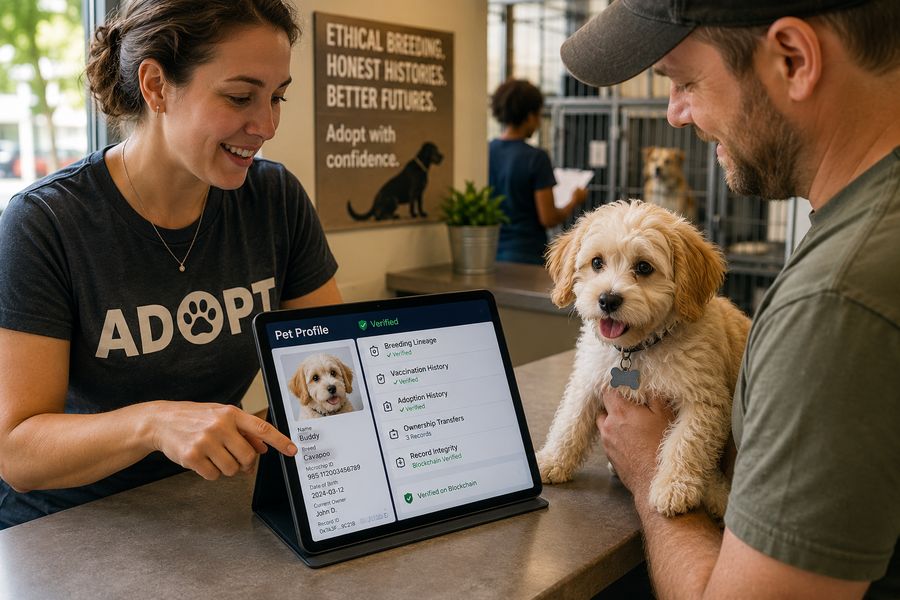
A blockchain is, in essence, a shared digital ledger maintained across many computers rather than by a single authority, on which records can be written but, once written, cannot be altered or deleted, creating a permanent and tamper-resistant history that anyone with access can verify. Applied to pets, this technology would record an animal’s key information, such as its lineage, identity, health history, and ownership, on this immutable ledger, so that instead of relying on a forgeable paper certificate or a database controlled by a single vulnerable organization, the animal’s history would exist as a permanent digital record that cannot be quietly changed and does not depend on any one institution’s survival. The core proposition is that the immutability and decentralization of the blockchain directly address the weaknesses of current pet records, making forgery extremely difficult, eliminating the single point of failure that doomed centralized registries, and allowing the authenticity of records to be checked openly.
In practice, applying blockchain to pet records involves writing specific pieces of information to the ledger at key moments in an animal’s life and linking that information to the animal’s verifiable identity, typically through its microchip, so that the digital record and the physical animal are reliably connected. Different implementations approach this in various ways, some creating a unique digital token to represent each animal’s registration and history, others focusing on recording particular documents like pedigree certificates, but all share the basic aim of capturing an animal’s important records on a medium that is permanent and verifiable. Understanding how this works in the two most important domains, namely the recording of lineage, identity, and health on the one hand, and the tracking of adoption and ownership transfers on the other, clarifies both the promise of the technology and the practical questions it raises.
Recording Lineage, Microchips, and Health
The recording of an animal’s lineage is one of the primary applications of blockchain pet records, since pedigree, the documented ancestry of a purebred animal, is exactly the kind of information that is valuable, frequently falsified, and well suited to permanent recording, and a blockchain-based pedigree would capture an animal’s parentage and ancestry in a form that cannot be forged or altered. When a puppy is born to parents whose own pedigrees are already recorded on the blockchain, its lineage can be established and written to the ledger with confidence, creating an unbroken and verifiable chain of ancestry that traces back through the generations, and because each record is immutable, the resulting pedigree carries a reliability that no paper certificate can match. This addresses directly the problem of forged pedigrees that allows animals of unknown or misrepresented origin to be passed off as something they are not.
Linking these records to the animal’s physical identity is essential, and this is typically accomplished through the microchip, the small implanted device carrying a unique identification number that already serves as the standard means of identifying individual pets, which can be recorded on the blockchain and associated with the animal’s history. By tying the immutable digital record to the microchip number, the system creates a reliable connection between the physical animal and its recorded history, so that scanning the chip can retrieve the verified records and confirm that a given animal is indeed the one described in the pedigree and other documentation. This connection between the permanent record and the permanent identifier embedded in the animal is what allows the blockchain history to be genuinely useful in the real world, enabling verification at the moments when it matters, such as a sale, an adoption, or the recovery of a lost pet.
Health and vaccination records represent a third category of information well suited to blockchain recording, since an animal’s medical history, including its vaccinations, veterinary treatments, and health screenings, is important for its welfare and for the decisions of those who acquire or care for it, yet is often poorly documented or unreliably conveyed. Recording these records on the blockchain would create a permanent and verifiable medical history that travels with the animal, accessible to veterinarians, owners, and prospective adopters, and resistant to the loss, fabrication, or omission that affects paper records, so that a buyer could confirm that a puppy has genuinely received its vaccinations or that an adopted animal has a documented health background. Together, the recording of lineage, the linking of records to the microchip, and the capture of health history aim to give each animal a comprehensive, permanent, and trustworthy record of who it is, where it came from, and how it has been cared for, forming the foundation on which the further tracking of ownership and adoption can build.
Tracking Adoption and Ownership Transfers
Beyond establishing an animal’s identity and history, blockchain pet records can track the transfers of ownership that occur throughout an animal’s life, recording each change of hands, whether a sale from a breeder, an adoption from a shelter, or a transfer between owners, as a permanent entry on the ledger. This creates a verifiable chain of custody for the animal, documenting not only where it came from but every step of its journey through different owners and institutions, so that at any point the full history of who has owned and cared for the animal can be traced and confirmed. Such a record of transfers addresses a significant gap in current systems, where ownership changes are often poorly documented and where the history of an animal, particularly one that has passed through multiple hands or been surrendered and rehomed, is frequently lost or obscured.
The recording of adoption transfers in particular carries special significance for animal welfare, since shelters and rescues handle large numbers of animals whose backgrounds are often unknown and whose subsequent fates are difficult to track, and a permanent record of adoptions could improve accountability and follow-through in the rehoming process. When an animal is adopted, recording the transfer on the blockchain would create a lasting record linking the animal to its new owner and documenting the adoption, which could help ensure that animals are properly tracked after they leave a shelter, support efforts to prevent animals from being repeatedly surrendered or falling into the hands of those who would mistreat them, and provide a verifiable history for an animal whose past might otherwise be a blank. This capacity to give even an animal of unknown origin a documented forward history from the point of adoption onward represents a meaningful potential benefit for the welfare of rescued animals.
The verifiable chain of ownership also has implications for combating fraud and theft, since a permanent record of who legitimately owns an animal makes it harder for stolen pets to be sold and easier to establish rightful ownership in disputes, while the documentation of transfers from breeders can help distinguish animals from legitimate, humane sources from those laundered through deceptive channels. If a buyer can trace an animal’s ownership back through a verifiable chain to a reputable breeder or shelter, the opportunity for fraudsters to misrepresent an animal’s origins shrinks, and the difficulty of inserting a mill-bred or stolen animal into the market with false credentials grows. The tracking of adoption and ownership transfers thus extends the value of blockchain pet records from the establishment of an animal’s past to the ongoing documentation of its life, creating a complete and verifiable history that, in principle, follows the animal permanently and resists the manipulation that current systems allow, though whether this promise is realized depends greatly on how the technology is actually implemented and adopted, as real-world examples begin to reveal.
Real-World Implementations
The concept of blockchain pet records has moved beyond theory into actual implementation, and examining documented real-world examples reveals both the genuine potential of the technology and the early, limited state of its adoption, providing concrete grounding for an assessment that might otherwise rest on speculation. While the field remains young and many proposed systems are small or experimental, at least one prominent and well-documented implementation demonstrates how the technology can be applied to a real problem by an established organization, and the broader ecosystem of projects illustrates the range of approaches being explored. Looking at these actual cases, with their specific details and motivations, helps separate the genuine application of blockchain to pet records from the more speculative claims and clarifies what the technology has so far achieved.
The most prominent and clearly documented implementation comes from Japan, where the Akita Inu Preservation Society, the organization dedicated to preserving the Akita breed of dog, began issuing blockchain-based digital pedigree certificates in January 2024, in what was described as a global first for this kind of application. The society turned to blockchain in direct response to a real and pressing problem, namely the forgery of pedigree documents, with the decision prompted by a complaint surrounding a forged pedigreed document from China brought against the society in early 2024, against a backdrop of rapidly growing international interest in the breed. The society’s overseas membership had increased markedly, rising from around three hundred people in 2022 to roughly five hundred in 2023, and this expansion of international demand, coupled with reports of forged pedigree documents circulating in China, created exactly the conditions in which the immutability and verifiability of blockchain records offered a compelling solution to a genuine threat to the integrity of the breed’s documentation.
The details of the Akita implementation illustrate how such a system can be built and what advantages it offers over traditional paper certificates, demonstrating the practical application of the principles described earlier. The society developed the system in collaboration with a local information technology firm called Meta Akita and a United States based company called Heirloom, and it chose blockchain specifically for its immutability and transparency while maintaining privacy for its users, offering the digital pedigree service to all members free of charge in its initial rollout. The blockchain-based certificates address multiple weaknesses of the traditional paper documents at once, providing security against forgery, which was the immediate catalyst, while also preventing the loss of documents in transit during international shipping, a real problem given the breed’s global following, so that the system simultaneously combats fraud and improves the reliability of legitimate record-keeping. This case stands as a clear example of an established, reputable organization adopting blockchain to solve a concrete documentation problem rather than as a speculative venture.
Beyond this leading example, a broader ecosystem of blockchain pet record projects has emerged, reflecting growing interest in the concept even as most efforts remain smaller, earlier-stage, or more experimental than the Akita society’s initiative. Various projects have proposed or built systems to record dog pedigrees, microchip data, vaccination records, and breeding information on blockchains, some creating unique digital tokens to represent each animal’s registration and others focusing on particular aspects of the record-keeping problem, and these efforts collectively explore the different ways the technology might be applied to pets. What distinguishes the Akita society’s effort from many of the more speculative ventures is that it arose from a concrete, painful problem experienced by an established and reputable organization rather than from a desire to apply a fashionable technology in search of a use, and this grounding in genuine need is instructive about where blockchain pet records are most likely to succeed. The society did not adopt blockchain because the technology was novel or because it promised speculative financial returns, but because a specific instance of forgery threatened the integrity of its pedigrees and the trust of its growing international membership, and the immutable, verifiable nature of the blockchain answered that threat directly. This pattern, in which the technology is adopted to solve a well-defined problem by an organization with a real stake in the outcome, contrasts sharply with the many projects that have led with the technology and struggled to find traction, and it suggests that the most promising applications will be those driven by acute, specific needs rather than by general enthusiasm.
The relative scarcity of large, well-documented implementations also reflects the genuine difficulty of the undertaking, since building a trustworthy blockchain record system requires not only technical capability but the cooperation of breeders, registries, and owners, the careful handling of data and privacy, and the credibility to be trusted by the community it serves, all of which are easier to achieve for a focused organization like a breed society than for an effort attempting to span the whole fragmented world of pets. The early state of the field is therefore not merely a matter of the technology being new, but a reflection of the substantial practical and social challenges involved in creating record systems that people will actually adopt and trust, challenges that the analysis of benefits and limitations must take seriously.
The contrast between the well-documented, problem-driven success of the Akita society and the more varied and uncertain state of the wider ecosystem captures the current reality of blockchain pet records, namely a technology with demonstrated potential in specific, motivated applications but still early in its development and far from widespread adoption, whose ultimate impact will depend on whether more organizations follow the path that examples like the Akita society have begun to chart.
Benefits and Challenges of Verifiable Pet Histories
Having examined how blockchain pet records work and seen them applied in practice, it becomes possible to weigh honestly what they genuinely offer against the real challenges and limitations they face, since the technology brings both meaningful potential benefits and significant obstacles that temper the enthusiasm of its proponents. The benefits flow largely from the immutability and verifiability that address the weaknesses of current records, promising to reduce fraud, establish trust in pedigrees, improve animal welfare accountability, and aid in the recovery of lost pets, while the challenges arise from fundamental limitations of the technology, practical barriers to adoption, and concerns about cost and privacy that must be confronted clearly. A balanced assessment recognizes that verifiable pet histories could deliver real value in specific applications while acknowledging that the technology is no panacea and faces serious hurdles before it could transform the broader landscape of pet records.
It is useful to consider the benefits and challenges in terms of the different parties affected, since what benefits a purebred buyer may differ from what serves animal welfare broadly, and a limitation that matters little in one context may be decisive in another. The buyers and adopters who rely on records, the breeders and shelters who create them, and the animals whose welfare is ultimately at stake each relate to the advantages and obstacles differently, and organizing the discussion around these perspectives clarifies where the technology offers genuine value and where its limitations bite hardest. What follows examines first the benefits across buyers, breeders, and animal welfare, and then the challenges of adoption, data accuracy, and privacy that any honest evaluation must weigh, so that the genuine promise of verifiable pet histories can be understood alongside the real difficulties that stand between that promise and its widespread realization.
Benefits for Buyers, Breeders, and Animal Welfare
For buyers and adopters, the central benefit of blockchain pet records is the ability to verify an animal’s history with confidence, transforming the act of acquiring a pet from one based on trust in unverifiable claims into one grounded in checkable, tamper-resistant records, which directly addresses the vulnerability that fraud exploits. A buyer considering a purebred puppy could confirm its lineage against an immutable record, check that its vaccinations are genuinely documented, and trace its origins to a legitimate source, while an adopter could access whatever verified history exists for a rescued animal, and in both cases the reduction in uncertainty protects the person from the scams and misrepresentations that currently cost people money and heartbreak. This capacity to verify rather than merely trust is the most immediate and tangible advantage the technology offers to those acquiring animals.
For reputable breeders, blockchain records offer a way to distinguish themselves from fraudulent operators and to protect the value and integrity of their breeding programs, since the immutable documentation of genuine pedigrees allows honest breeders to prove the authenticity of their animals in a way that forgers cannot replicate. A breeder who maintains verifiable records on the blockchain can demonstrate the true lineage and quality of their animals, defend against the forgery that undermines confidence in pedigrees generally, and differentiate their legitimate operation from the puppy mills and scammers that trade on deception, which benefits both the breeder and the buyers who can now identify trustworthy sources. The Akita society’s experience illustrates this benefit directly, as the move to blockchain was driven precisely by the need to protect the integrity of legitimate pedigrees against forgery, serving the interests of honest breeders and the breed itself.
For animal welfare more broadly, the potential benefits are perhaps the most significant, since verifiable records could strike at the economic foundations of puppy mills and improve outcomes for animals throughout their lives, advancing the cause of those who cannot advocate for themselves. By making it harder to launder mill-bred animals into the market with false credentials, the technology could reduce the profitability of inhumane breeding operations, while the permanent recording of adoptions and ownership transfers could improve accountability in rehoming, support efforts to track and protect animals after they leave shelters, and aid in reuniting lost pets with their owners by providing reliable, enduring identification that does not vanish when a single company fails. The prospect of records that genuinely connect animals to their histories and owners, resistant to the forgery and institutional failure that plague current systems, holds real promise for reducing the cruelty and the losses that unreliable records currently enable, representing the deepest potential value of the technology for the welfare of animals themselves.
Challenges: Adoption, Data Accuracy, and Privacy
The most fundamental challenge facing blockchain pet records is one that the technology cannot solve on its own, namely the problem that the immutability of a blockchain guarantees only that a record cannot be changed after it is written, not that the record was accurate in the first place, so that false information entered at the start becomes permanently and verifiably false. If a breeder lies about a puppy’s parentage when first recording it, or if incorrect health information is entered, the blockchain will faithfully preserve that falsehood forever, lending it the appearance of authority without making it true, which means the system depends entirely on the honesty and accuracy of those who create the initial records. This limitation, often summarized as the problem that a tamper-proof record of garbage is still garbage, means that blockchain cannot by itself guarantee truthful pet histories and must rely on trusted parties to enter accurate data, which reintroduces at the point of entry the very question of trust that the technology was meant to eliminate.
A second major challenge is adoption in the practical sense of getting the technology widely used, since the value of a verifiable record system depends heavily on broad participation, and the current landscape of pet records is fragmented, inconsistent, and resistant to the coordination that a useful system would require. For blockchain pet records to deliver their promised benefits at scale, breeders, shelters, veterinarians, registries, and owners would need to adopt compatible systems and consistently record information, yet the existing difficulty of achieving even basic consistency in microchipping and registration, where many animals remain unchipped or unregistered and registries fail to coordinate, suggests how formidable the barriers to widespread adoption are. A blockchain system used by only a few organizations, like the various small projects that populate the field, offers limited benefit, and overcoming the inertia and fragmentation of the current system to achieve the broad adoption that would make verifiable records genuinely transformative is a substantial and uncertain undertaking.
Further challenges involve cost, complexity, and privacy, each of which raises real concerns about the practicality and desirability of blockchain pet records. Implementing and maintaining such systems involves costs and technical complexity that may be burdensome for shelters operating on tight budgets or for small breeders, potentially limiting adoption to wealthier or more sophisticated participants and raising the question of whether the benefits justify the expense, particularly when simpler solutions might address some of the same problems. Privacy presents another genuine concern, since recording detailed information about animals and, by extension, their owners on a ledger raises questions about who can access that data and how the privacy of owners is protected, a tension that implementations like the Akita society’s have had to navigate by seeking to maintain privacy while preserving verifiability. These challenges of data accuracy, widespread adoption, cost, and privacy do not negate the genuine benefits the technology can offer in specific applications, but they make clear that blockchain pet records are not a simple or complete solution to the problems of fraud and cruelty, and that their real-world impact will be shaped as much by these practical and human factors as by the capabilities of the technology itself.
How Verifiable Records Could Combat Fraud and Cruelty
Drawing together the analysis, it becomes possible to assess realistically where verifiable pet records could genuinely combat the fraud and cruelty that motivate interest in the technology, distinguishing the applications where the benefits are real and achievable from the more sweeping claims that overlook the technology’s limitations. The clearest and most realistic value lies in the verification of pedigrees and the authentication of legitimate documentation, where the immutability of the blockchain directly counters forgery, as the Akita society’s experience demonstrates concretely, since in this application the technology addresses a specific, well-defined problem in which the key requirement is that genuine records cannot be falsified or altered. Where the central issue is the forgery of documents produced by a trusted authority, blockchain offers a genuine and proven remedy, making this perhaps the most immediately valuable application for combating a particular and significant form of fraud.
The fight against puppy mills and adoption scams presents a more complex picture, where blockchain records could contribute meaningfully but only as part of a broader effort and only if certain conditions are met, rather than serving as a complete solution on their own. Verifiable records could help by making it harder to insert mill-bred or nonexistent animals into the market with false credentials, by enabling buyers to trace animals to legitimate sources, and by raising the difficulty and lowering the profitability of deception, which could genuinely reduce some forms of fraud and cruelty over time. Yet because the technology cannot guarantee the accuracy of initial entries and depends on widespread adoption to be effective, its power against mills and scams is conditional, requiring that trustworthy parties consistently create accurate records and that enough of the market participates for verification to become the norm, conditions that the fragmented and uneven current landscape makes difficult to achieve and that limit how decisively the technology can strike at these deeply entrenched problems.
The improvement of animal welfare through better tracking of ownership, adoption, and identity represents a third domain where verifiable records could help, particularly in reducing the losses and failures that afflict current systems, though here too the benefits depend on overcoming the practical barriers discussed. A record system that does not vanish when a single company fails, that reliably links animals to their histories and owners, and that documents adoptions and transfers could improve the reunification of lost pets, support accountability in rehoming, and help protect animals from neglect and abuse, addressing real weaknesses in the present arrangements. The realistic conclusion is that blockchain pet records are neither the cure-all that enthusiasts sometimes suggest nor a mere gimmick, but a genuinely useful tool for specific problems, most clearly the authentication of pedigrees and documentation, with real but conditional potential to contribute to the broader fight against fraud and cruelty, provided that the substantial challenges of accuracy, adoption, cost, and privacy are honestly confronted and that the technology is deployed as part of a wider effort rather than relied upon as a solution in itself.
Final Thoughts
The application of blockchain technology to pet pedigrees and adoption records represents a thoughtful response to genuine and longstanding problems in the way societies document and verify the histories of the animals they bring into their homes, problems that have enabled fraud, concealed cruelty, and caused real suffering for both animals and the people who love them. At its best, the technology offers something valuable and concrete, namely records that cannot be forged, that do not depend on the survival of any single fallible institution, and that anyone can verify, addressing directly the weaknesses of forgeable paper certificates and fragile centralized databases whose failures have repeatedly betrayed the trust placed in them. The pioneering example of an established dog preservation society turning to blockchain to protect the integrity of its pedigrees against forgery demonstrates that this is not mere speculation but a practical solution already being applied to real problems by reputable organizations motivated by genuine need.
The deeper significance of this development lies in what it represents for the welfare of animals and for the broader question of how transparency and verifiable trust can be brought to systems that have too long depended on unreliable documentation and the honesty of strangers. Animals cannot advocate for themselves, and they bear the consequences of the fraud and cruelty that unreliable records enable, so technologies that could make it harder to profit from deception, easier to trace animals to humane sources, and more reliable to reunite lost pets with their families carry a moral weight beyond their technical interest, touching on a genuine responsibility that people bear toward the creatures in their care. Yet realizing this potential requires honesty about the technology’s limitations, particularly the crucial truth that an immutable record guarantees only permanence, not accuracy, and that the value of verifiable histories depends entirely on the honesty of those who create them and on achieving the broad adoption that the fragmented current landscape makes so difficult, so that the technology must be understood as a tool serving human and institutional efforts rather than as a substitute for them.
Looking ahead, the trajectory of blockchain pet records will depend less on the capabilities of the technology than on whether the conditions for its effective use can be created, including the consistent participation of trustworthy breeders, shelters, and registries, the development of accessible and affordable systems, and the careful balancing of verifiability against the privacy of owners. The most encouraging vision is one in which verifiable records, deployed thoughtfully and as part of a broader commitment to animal welfare and honest dealing, help to authenticate legitimate pedigrees, to undermine the economics of puppy mills and scams, and to give every animal a permanent and trustworthy history that protects both the creature and those who care for it. Whether that vision is realized will be determined not by blockchain alone, which is merely a tool capable of preserving truth or falsehood with equal fidelity, but by the integrity and the commitment of the people who choose to use it, and the enduring lesson of this whole endeavor is that the goal was never the technology itself but the trustworthy and humane treatment of animals that better records might help to secure.
FAQs
- What are blockchain pet pedigrees and adoption records?
They are records of a pet’s lineage, identity, health history, and ownership transfers stored on a blockchain, which is a shared digital ledger that cannot be altered once information is written to it. Instead of relying on forgeable paper certificates or databases controlled by a single organization, the animal’s history exists as a permanent, tamper-resistant record that anyone can verify. The aim is to make pedigrees genuinely reliable, give adopted pets a verifiable past, and combat the fraud and cruelty that the unreliability of current pet records enables. - Why are current pet records considered unreliable?
Current records rely on paper documents or centralized databases, both of which are vulnerable. Paper pedigree certificates can be forged, copied, altered, or lost in transit, and their authenticity rests entirely on trusting whoever produced them. Centralized databases create a single point of failure, as shown when a major United States pet microchip company went out of business in January 2024 and its registry became inaccessible, leaving some pets effectively unregistered. The landscape is also fragmented across many competing and sometimes fraudulent registries with no common standard. - How does blockchain help prevent pet fraud?
Blockchain helps by making records immutable and verifiable, so a pedigree or document recorded on it cannot be forged or quietly altered, and its authenticity can be checked openly. This directly counters the forgery of pedigree certificates that allows animals of unknown or misrepresented origin to be passed off as something they are not. By linking records to an animal’s microchip and tracing ownership back to legitimate sources, the technology makes it harder for fraudsters to misrepresent an animal’s origins or insert mill-bred and stolen animals into the market with false credentials. - What is a real example of blockchain pet records in use?
The clearest documented example is the Akita Inu Preservation Society in Japan, which began issuing blockchain-based digital pedigree certificates in January 2024, described as a global first. The society acted in response to a forged pedigree document complaint from China in early 2024, amid growing international interest, with overseas membership rising from about three hundred in 2022 to roughly five hundred in 2023. It built the system with a local IT firm, Meta Akita, and a United States company, Heirloom, offering it free to members. - How does a blockchain record connect to the actual animal?
The connection is typically made through the microchip, the small implanted device carrying a unique identification number that already serves as the standard way to identify individual pets. The microchip number is recorded on the blockchain and associated with the animal’s history, so scanning the chip can retrieve the verified records and confirm that a given animal is the one described in the pedigree and other documentation. This link between the permanent digital record and the permanent identifier in the animal is what makes the system useful at moments like a sale, adoption, or recovery of a lost pet. - Can blockchain stop puppy mills?
It can contribute but not by itself. Verifiable records could make it harder to launder mill-bred animals into the market with false credentials and could let buyers trace animals to legitimate, humane sources, reducing the profitability of inhumane breeding operations over time. However, the technology cannot guarantee the accuracy of the information entered at the start and depends on widespread adoption to be effective. Combating puppy mills therefore requires blockchain to be part of a broader effort, with trustworthy parties consistently creating accurate records and enough of the market participating for verification to matter. - What is the biggest limitation of blockchain pet records?
The biggest limitation is that immutability guarantees only that a record cannot be changed after it is written, not that the record was accurate to begin with. If a breeder lies about a puppy’s parentage or enters incorrect health information at the start, the blockchain will preserve that falsehood permanently while lending it an appearance of authority. This means the system depends entirely on the honesty and accuracy of those who create the initial records, so a tamper-proof record of false information is still false, and trust at the point of entry remains essential. - Does blockchain help with adoption and lost pets?
It can. Recording adoptions and ownership transfers on the blockchain creates a verifiable chain of custody, documenting an animal’s journey through owners and institutions and giving even an animal of unknown origin a documented history from adoption onward. This could improve accountability in rehoming, help track animals after they leave shelters, and aid in reuniting lost pets by providing reliable identification that does not vanish when a single company fails. Because microchipped pets are far more likely to be reunited with their families, durable records linked to chips could meaningfully improve outcomes. - Are there privacy concerns with these records?
Yes. Recording detailed information about animals and, by extension, their owners on a ledger raises legitimate questions about who can access that data and how owners’ privacy is protected. A well-designed system must balance the verifiability that gives the records their value against the need to keep sensitive owner information private. Real implementations have had to navigate this tension, with the Akita society, for example, choosing blockchain for its immutability and transparency while seeking to maintain privacy for its users. How well a given system protects privacy is an important factor to consider. - Will blockchain pet records become widespread?
It is uncertain and depends less on the technology than on whether the conditions for its use can be created. Widespread benefit requires breeders, shelters, veterinarians, registries, and owners to adopt compatible systems and consistently record accurate information, yet the current landscape is fragmented and even basic microchipping and registration remain inconsistent. Cost and complexity may also limit adoption among shelters and small breeders. The technology has demonstrated clear value in specific, motivated applications like authenticating pedigrees, but achieving the broad adoption needed to transform pet records more generally remains a substantial and uncertain undertaking.