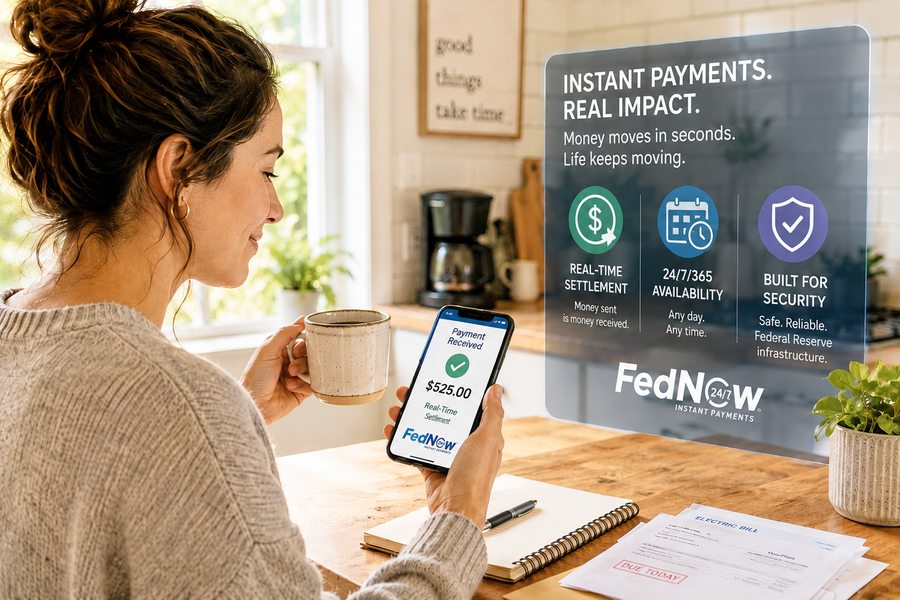
Anyone who has ever deposited a check and watched the days tick by before the money became available, or sent a payment to a friend or a landlord and waited anxiously for it to arrive, has bumped against one of the strangest features of modern financial life, which is that in an age when information travels across the globe in an instant, money itself has continued to move with surprising slowness. A message can reach the other side of the world in a fraction of a second, a video can stream to millions of devices at once, and yet a simple transfer of funds between two bank accounts in the same city has often taken days to settle, leaving people waiting for their own money to clear, scrambling to cover bills before a deposit posts, and paying fees to access funds faster. This peculiar lag, in which money lumbers along while everything else has accelerated, has been an accepted fact of life for so long that most people have stopped questioning it, even as it imposes real costs and real anxieties on those who live close to the financial edge.
A fundamental change is now underway in the way money moves, as a new generation of payment systems makes it possible for funds to travel between bank accounts instantly, at any hour of any day, with the money arriving and becoming usable within seconds rather than days. In the United States, the most significant development in this transformation is a system called FedNow, launched by the Federal Reserve, the nation’s central bank, which provides the infrastructure for instant payments that settle in real time around the clock, and it joins a privately operated instant payment network and a growing collection of similar systems around the world to bring the long-awaited acceleration of money to ordinary financial life. These systems represent a modernization of the basic plumbing of the financial system, the rails along which money flows, replacing the batch-processed, business-hours, multi-day transfers of the past with settlement that happens immediately and continuously.
The implications of money that moves in real time reach into the everyday financial lives of ordinary people in ways that are easy to underestimate, because the slowness of traditional payments has shaped countless routines and imposed countless hidden costs that instant settlement can eliminate. When a paycheck can arrive and be spent immediately rather than after a delay, when a bill can be paid at the last moment without fear that it will post too late, when money sent to help a family member in an emergency arrives in seconds rather than days, and when a person no longer has to pay fees to access their own funds quickly, the acceleration of money translates into tangible benefits for daily life. For those who live paycheck to paycheck, for whom the timing of when money arrives and when bills are due can mean the difference between making ends meet and falling into overdraft fees or late penalties, the shift to real-time payments is not a mere convenience but a meaningful improvement in financial security and peace of mind.
This article explains FedNow and the broader arrival of instant payments and what real-time money means for ordinary people, written for readers who may have experienced the frustration of slow transfers without understanding why money moves so slowly or how the new systems change things. It begins by explaining why money has always moved so slowly, then describes what FedNow actually is and how an instant payment travels in seconds, before situating FedNow alongside the other instant payment systems in the United States and around the world, exploring what real-time money changes for everyday life, and examining the real progress of the rollout with documented figures. It then considers the risks and frictions honestly, including the dangers that come with the irreversibility and speed of instant payments. The aim throughout is to make an unfamiliar but consequential change in the financial system comprehensible, so that readers come away understanding not only how instant payments work but why the modernization of money’s plumbing matters for their own financial lives.
Why Money Has Always Moved So Slowly
To understand the significance of instant payments, one must first understand why money has traditionally moved so slowly, a slowness that is not the result of any technical impossibility but of the way the financial system’s underlying infrastructure was designed decades ago and has operated ever since. The principal system for moving money between bank accounts in the United States for routine payments, the one that handles direct deposits of paychecks, automatic bill payments, and most electronic transfers, is known as the Automated Clearing House, commonly abbreviated as ACH, and its design reflects the era in which it was created, a time when computing was expensive and transactions were processed in large batches rather than individually. Rather than handling each payment the moment it is initiated, the Automated Clearing House gathers payments together and processes them in batches at set times, which means that a payment does not move instantly but waits to be bundled with others and processed at the next scheduled run, introducing delay from the very start.
The batch-processing design is compounded by the limited hours during which the traditional system operates, since these systems have historically run only on business days during business hours, not on nights, weekends, or holidays, which means that a payment initiated on a Friday evening might not even begin processing until the following Monday. This business-hours limitation reflects the assumption, built into the system long ago, that banking happens during the working day and that the machinery of payments can rest at night and on weekends, an assumption that sits oddly with the around-the-clock nature of modern life and commerce. The combination of batch processing and limited operating hours means that the time for a payment to complete can stretch across several days, particularly when weekends and holidays intervene, and this delay is not an occasional glitch but the normal, designed behavior of the system that handles most of the routine payments people make and receive.
The concept of float is essential to understanding the slowness of traditional payments and the interests that have sustained it, because the days during which money is in transit, having left one account but not yet arrived in another, represent a period during which the funds exist in a kind of limbo that has financial value to the institutions involved. During this float period, the money may continue to earn interest or be otherwise used by the banks, and the delay that frustrates customers can benefit the financial institutions that hold the funds in transit, which means there has historically been limited incentive for the system to speed up. The existence of float helps explain why the slowness persisted for so long even as technology made faster settlement entirely possible, since the institutions best positioned to modernize the system also benefited from its delays, and the costs of slowness fell largely on customers rather than on the banks. This alignment of institutional interest with delay is part of the reason that money continued to move slowly long after there was any technical reason for it to do so.
It is worth distinguishing the routine payment system from the older method that has long allowed money to move quickly, the wire transfer, because the contrast illuminates why everyday payments stayed slow. Wire transfers, conducted through systems operated by the Federal Reserve and others, have for many years allowed funds to move on the same day with finality, but they were designed for large, important transactions, carried significant fees, and operated only during business hours, which made them impractical for the small, frequent payments of ordinary life. The existence of fast wires alongside slow routine payments shows that the slowness of everyday money was never a matter of technical impossibility but of which system handled which kind of payment, with the cheap, accessible system for ordinary transfers being the slow one and the fast system being reserved for costly, large-value transactions. This division left ordinary people with the choice between slow, cheap payments and fast, expensive ones, with no widely available option that was both quick and affordable for everyday amounts, a gap that instant payment systems were designed precisely to fill.
Beyond batch processing, limited hours, and float, the traditional system carries other sources of delay rooted in the way settlement and risk are managed, including the time taken to verify funds, guard against fraud, and reconcile accounts between institutions. When a payment moves through the traditional system, there are processes for confirming that the funds exist, for allowing time to catch errors and fraudulent transactions, and for the banks to settle their obligations to one another, and these processes have traditionally been conducted in ways that add time to the journey of a payment. The multi-day hold that a bank may place on a deposited check, for instance, reflects in part the time the system takes to confirm that the check will clear and the bank’s caution against making funds available before it is certain of receiving them. All of these factors together, the batch processing, the business-hours operation, the value of float, and the time-consuming management of settlement and risk, combined to produce a financial system in which money moved at a pace that, by the standards of modern information technology, was remarkably slow, and it is this entire legacy of slowness that instant payment systems like FedNow were created to overcome.
What FedNow Actually Is
FedNow is an instant payment service operated by the Federal Reserve, the central bank of the United States, designed to allow financial institutions to send and receive payments that settle in real time, instantly, at any hour of any day, every day of the year, fundamentally changing the speed at which money can move between bank accounts. Launched in July 2023, FedNow provides the infrastructure, the underlying rails, that banks and credit unions can use to offer their customers the ability to make payments that arrive and become usable within seconds rather than the days that traditional systems require, and it operates continuously, without the business-hours and business-days limitations that constrained the older systems. As a service of the Federal Reserve, FedNow occupies a distinctive position, since the central bank sits at the heart of the nation’s financial system and operates the infrastructure on which banks rely, which gives FedNow broad potential reach across the many thousands of financial institutions that maintain relationships with the Federal Reserve.
It is important to understand what FedNow is and what it is not, because its nature is easily misunderstood. FedNow is not a consumer-facing app or a service that individuals sign up for directly, but rather an infrastructure operated by the Federal Reserve for use by financial institutions, which means that ordinary people experience FedNow not as a brand they interact with but through the instant payment features their own banks and credit unions choose to offer using the FedNow rails. A person might send an instant payment through their bank’s app or website without ever knowing that FedNow is the system carrying the payment behind the scenes, just as people use the internet without thinking about the underlying protocols that move their data. FedNow is, in essence, a piece of plumbing, a foundational system that enables instant payments but that depends on the banks and credit unions building services on top of it to bring its benefits to their customers, and its impact on any given person depends on whether their financial institution participates and what features it offers.
The way FedNow differs from the older systems goes to the heart of why it represents such a significant change, since it was designed specifically to overcome the limitations that made traditional payments slow. Where the Automated Clearing House processes payments in batches at set times, FedNow processes each payment individually and immediately, settling it the moment it is made rather than waiting to bundle it with others, and where the traditional systems operated only during business hours on business days, FedNow operates around the clock, every day of the year, so that a payment can be made and completed at any time, including nights, weekends, and holidays. The settlement is also final and immediate, meaning that when an instant payment is completed, the funds are genuinely transferred and available to the recipient right away, not subject to the holds and delays that characterize traditional transfers. These differences together transform the experience of moving money, replacing the multi-day wait with near-instant completion and the business-hours constraint with continuous availability.
How an Instant Payment Travels in Seconds
To appreciate how an instant payment accomplishes in seconds what traditional payments take days to do, it helps to walk through what actually happens when such a payment is made, in plain terms that reveal the elegance of the real-time approach. When a person initiates an instant payment through their bank, perhaps to pay a bill or send money to another person, their bank sends a message through the FedNow system to the recipient’s bank, and this message contains the details of the payment, including who is sending it, who is to receive it, and how much. This message travels in moments, and the recipient’s bank, upon receiving it, confirms that it can accept the payment and credit the recipient’s account, sending back a confirmation, so that within seconds the two banks have communicated and agreed that the payment will be made, all happening automatically and near-instantaneously rather than waiting for a scheduled batch.
The crucial step that makes the payment truly instant is the settlement, the actual transfer of value between the banks, which in the FedNow system happens immediately as part of the transaction rather than being deferred to a later time. The Federal Reserve, which holds accounts for the participating banks, adjusts the balances of the sending and receiving banks in real time, debiting the sender’s bank and crediting the recipient’s bank, so that the obligation between the institutions is settled at the very moment the payment is made, with finality. This immediate settlement is what distinguishes the instant system from traditional ones, in which the actual movement of value between banks might happen well after the payment was initiated, and it means that when the recipient’s bank credits the recipient’s account, it does so knowing that the funds have genuinely and finally arrived, allowing the money to be made available for use right away without the risk that the payment might later fail to clear.
The result of this sequence, the messaging between banks, the confirmation, and the immediate settlement through the central bank, is that a payment can be completed from start to finish in a matter of seconds, with the recipient able to use the money almost immediately after the sender initiates it. The entire process unfolds automatically and continuously, without waiting for business hours or batch processing, so that whether the payment is made at noon on a Tuesday or midnight on a Sunday, it travels and settles in the same brief span of time. This is a profound change from the traditional experience of waiting days for money to move, and it is achieved not through any single miraculous technology but through the design of a system that processes and settles each payment individually and immediately, around the clock, using the central bank as the trusted point of settlement between institutions. The seeming magic of money arriving in seconds is, in reality, the product of thoughtful infrastructure designed to do what the older systems were never built to do.
FedNow, RTP, and the Global Picture
FedNow is not the only instant payment system operating in the United States, nor was it the first, and understanding its place requires recognizing that it joined an existing private-sector instant payment network and fits within a global movement toward real-time payments that has been underway for years. The privately operated instant payment system in the United States, known as the RTP network and run by The Clearing House, a company owned by large banks, launched in 2017, several years before FedNow, and it pioneered real-time payments in the country, offering instant settlement around the clock much as FedNow does. The existence of two instant payment systems, the Federal Reserve’s FedNow and the private RTP network, means that the United States has more than one set of rails for instant payments, and financial institutions may connect to one or both, with the two systems coexisting and together expanding the reach of real-time payments across the financial system.
The relationship between FedNow and the RTP network is one of both complementarity and a degree of competition, and the entry of the Federal Reserve into instant payments with FedNow was significant for reasons beyond simply adding capacity. As a service of the central bank, FedNow has the potential to reach financial institutions of all sizes across the country, including the many small community banks and credit unions that maintain relationships with the Federal Reserve, and its arrival was seen in part as a way to ensure that instant payment capability would be broadly available rather than concentrated among the large banks that own the private network. The presence of a central-bank-operated option alongside the private one offers financial institutions a choice and helps promote the wide adoption of instant payments throughout the system, and the two networks together advance the broader goal of making real-time payments a standard feature of American financial life rather than a niche offering.
Viewed globally, the arrival of instant payments in the United States is part of a worldwide transformation that in some respects the United States joined relatively late, since a number of other countries built real-time payment systems years earlier and have achieved remarkable levels of adoption. In the United Kingdom, a faster payments system has enabled near-instant transfers for many years, while in the European Union instant payment capabilities have been developed across the euro area, and most strikingly, systems in some large developing economies have achieved enormous scale and become central to everyday commerce. India’s unified payments interface, launched in 2016, has grown to process staggering volumes of instant transactions and has transformed how hundreds of millions of people pay for goods and transfer money, while Brazil’s instant payment system known as Pix, launched by that country’s central bank in 2020, achieved rapid and widespread adoption, becoming a dominant means of payment within a few years of its introduction. These international examples demonstrate both the transformative potential of instant payments and the extent to which the United States, with FedNow and the RTP network, has been working to catch up with a global shift already well advanced elsewhere.
The experience of the countries that adopted instant payments earlier also offers instructive lessons about how the transformation can unfold, including the speed with which adoption can accelerate once the systems reach a critical mass of users and businesses. In Brazil, the instant payment system moved within a few years from launch to becoming a dominant method of payment used by a large majority of the adult population, a pace of adoption that surprised many observers and that demonstrated how quickly people will embrace instant payments when they are convenient, widely accepted, and low in cost. These international precedents suggest that the gradual adoption now visible in the United States could, as the systems mature and as more institutions and consumers participate, give way to a more rapid acceleration, and they provide a glimpse of the scale that instant payments may ultimately reach in American financial life once the necessary participation and familiarity are in place.
The global picture reveals that instant payments are not a speculative idea but a proven transformation that has already reshaped financial life in many countries, and that the United States is in the midst of adopting a model that has succeeded dramatically abroad. The varied paths that different countries have taken, some with central-bank-operated systems, some with private or hybrid arrangements, reflect different circumstances and choices, but the common direction is unmistakable, toward money that moves instantly and continuously as a normal feature of the financial system. The United States, with its combination of the Federal Reserve’s FedNow and the private RTP network, is building the infrastructure to bring this global standard to American financial life, and the lessons of the countries that moved earlier suggest both the substantial benefits that instant payments can deliver and the scale of adoption that may eventually be possible as the systems mature and spread.
What Real-Time Money Changes for Everyday Life
The shift to real-time payments changes everyday financial life in ways that are most meaningful for the routines and pressures that the slowness of traditional payments has long shaped, and understanding these concrete effects reveals why instant money matters beyond mere convenience. Consider the matter of receiving a paycheck, where the timing of when wages become available can be critical for someone living close to the financial edge, since traditional direct deposit can involve delays and the funds may not be available exactly when needed. With instant payments, wages can in principle be received and made available immediately, and the broader capability for instant disbursement means that workers paid on flexible or frequent schedules, such as gig workers or those receiving earned wages early, can get their money the moment it is sent rather than waiting for it to clear, which can ease the cash-flow pressures that force people into costly alternatives like payday loans or overdrafts.
The payment of bills is another domain where real-time money offers tangible relief, because the slowness of traditional payments has long forced people to navigate the gap between when they send a payment and when it actually posts, a gap that can lead to late fees, service interruptions, or anxiety about whether a payment will arrive in time. With instant payments, a person can pay a bill at the last moment and know that it has been received immediately, eliminating the uncertainty and the need to send payments days in advance to ensure they post on time, which is particularly valuable for those whose finances are tight and who must carefully time their payments around when money comes in. The ability to pay precisely when one chooses, with the certainty that the payment arrives at once, gives people greater control over their cash flow and removes a source of stress and cost that the traditional timing of payments imposed, allowing money to be held until it is needed rather than committed early to cover the delay.
Perhaps the most emotionally resonant benefit of instant payments arises in emergencies and urgent situations, when the speed at which money can move makes a genuine difference in people’s lives. When a family member faces a sudden need, a medical emergency, an unexpected expense, a crisis far from home, the ability to send money that arrives in seconds rather than days can be profoundly important, transforming a transfer from a slow process that leaves the recipient waiting into an immediate lifeline. The same speed matters for any urgent payment, whether to secure a purchase, avoid a penalty, or seize a time-sensitive opportunity, and the assurance that money can be moved instantly at any hour provides a kind of financial responsiveness that the traditional system, with its delays and business hours, simply could not offer. For people who have experienced the helplessness of needing to move money quickly and being unable to do so, the arrival of instant payments addresses a real and sometimes acute source of difficulty.
Instant payments also reshape the relationship between individuals and the businesses they deal with, as well as the experience of small businesses and workers who depend on prompt payment. A small business that accepts instant payments receives its money immediately rather than waiting days for card payments or transfers to settle, which improves its cash flow and reduces the financial strain that delayed receipts can impose on enterprises operating with thin margins. For the growing number of people who work in the gig economy or are paid on flexible schedules, the ability to be paid instantly at the end of a shift or a task, rather than waiting for a conventional pay cycle, can transform their financial stability, giving them access to their earnings when they need them rather than forcing them to bridge the gap with credit. The benefits of speed thus extend beyond individual consumers to the businesses and workers whose livelihoods depend on the timely movement of money, and the spread of instant payments can ease cash-flow pressures across a wide range of economic activity.
The certainty that instant payments provide is as valuable as the speed itself, because the traditional system’s delays were accompanied by uncertainty about exactly when money would move and whether a payment would clear, an uncertainty that complicated financial planning and decision-making. With instant payments, a person knows immediately whether a payment has succeeded and that the money has genuinely arrived, eliminating the ambiguous interval during which a payment is in progress but not yet complete, and this certainty allows for more confident management of money. The combination of speed and certainty means that people can make financial decisions in real time, knowing the true state of their funds at any moment, rather than having to account for money that has left one account but not yet arrived in another, and this clarity is itself a meaningful improvement over the murky timing of the traditional system.
Beyond these specific situations, real-time money changes the everyday experience of financial life in a more general way by removing the pervasive waiting that has characterized the movement of money, the holds on deposited funds, the delays before transfers complete, the uncertainty about when money will actually arrive. When payments settle instantly and finally, people can know with certainty where they stand financially at any moment, without the ambiguity of funds that have left one account but not yet arrived in another, and this clarity and immediacy can make managing money less stressful and more predictable. The cumulative effect of these changes is to give ordinary people greater control, certainty, and security in their financial lives, particularly those for whom the timing of money has been a source of difficulty, and while the benefits may seem modest when considered individually, together they represent a meaningful improvement in the daily financial experience, especially for those whom the slowness of the old system burdened most heavily.
The Rollout: Adoption, Banks, and Real Numbers
The transformation that instant payments promise depends on the actual adoption of the new systems by financial institutions and their customers, and examining the documented progress of the rollout gives a grounded sense of how far the change has advanced and how much remains ahead. FedNow launched in July 2023 with a modest initial group of thirty-five participating financial institutions, a deliberately measured beginning for a system meant to eventually serve the broad financial system, and from that starting point its participation grew steadily as more banks and credit unions connected to the new rails. By the end of 2023, only months after launch, the number of participating institutions had grown to over three hundred, headquartered across forty-five states and ranging enormously in size, from small community institutions to some of the largest in the country, demonstrating early momentum and broad geographic reach. This growth continued through the following years, with participation climbing past one thousand institutions by the end of 2024 and continuing upward thereafter, reaching well over a thousand and approaching and then exceeding fourteen hundred participants as the system passed its two-year mark in 2025, and climbing toward fifteen hundred participating institutions later that year.
A notable feature of FedNow’s adoption is the prominence of small and midsize financial institutions among its participants, which speaks to the central bank’s role in broadening access to instant payments. Community banks and credit unions, the smaller institutions that serve many local communities and that might otherwise lack the resources to build instant payment capabilities on their own, have made up the large majority of FedNow participants, with such smaller institutions accounting for well over ninety percent of those on the network. This composition reflects one of the purposes behind the Federal Reserve’s entry into instant payments, namely to ensure that the capability would be available to institutions of all sizes and not concentrated among the largest banks, and it suggests that FedNow is helping to spread real-time payments throughout the financial system rather than confining them to the customers of major banks. The participation of so many smaller institutions is significant for financial inclusion, since it extends the benefits of instant payments to the customers of community banks and credit unions across the country.
The private RTP network, which launched in 2017 and had a head start over FedNow, provides documented evidence of the rapid growth in instant payment volume that demonstrates the rising demand for real-time money. The value of payments on the RTP network grew dramatically, jumping by roughly ninety-four percent in 2024 to reach two hundred forty-six billion dollars for the year, while the volume of transactions rose substantially to hundreds of millions of payments, and the network surpassed a billion cumulative transactions in early 2025. The growth accelerated further in 2025, driven in part by an increase in the network’s transaction limit to ten million dollars introduced that February, which spurred a surge in higher-value payments, and the network’s total payment value for 2025 climbed into the trillions of dollars, representing an enormous increase over the prior year. These figures, documented by The Clearing House, illustrate that instant payments are not merely available but increasingly used, with both the number and the value of real-time transactions rising sharply as more institutions connect and more use cases emerge.
The picture that emerges from these numbers is one of substantial and accelerating progress alongside the recognition that the full transformation is still unfolding, since even with well over a thousand institutions on each network and rapidly growing volumes, the adoption of instant payments across the entire financial system and among all consumers remains a work in progress. The thousands of financial institutions in the United States mean that participation in the low thousands, while impressive growth from a standing start, still represents a portion of the whole, and many consumers may not yet have access to instant payments through their own institutions or may be unaware of the capability where it exists. The trajectory, however, is clearly toward broader adoption, with participation and volume both climbing steadily, and the documented growth of both FedNow and the RTP network indicates that instant payments are moving from a new offering toward becoming a standard feature of American financial life, even as the process of getting there continues and the benefits reach more people gradually rather than all at once.
Risks, Frictions, and What to Watch
For all the benefits that instant payments bring, the speed and finality that make them valuable also introduce genuine risks and challenges that deserve honest attention, beginning with the heightened danger of fraud that comes with irreversible, instant transactions. When a payment settles immediately and finally, there is no window during which a mistaken or fraudulent transfer can be caught and reversed, which means that a person tricked into sending money to a scammer, or who sends a payment to the wrong recipient, may have no recourse to recover the funds, unlike with some traditional payment methods that allow for reversal or dispute. This irreversibility makes instant payments an attractive target for fraudsters, who can use social engineering and scams to induce victims to send money that, once sent, is gone for good, and the speed of the system means that fraudulent funds can be moved and dispersed before anyone realizes what has happened. The very finality that gives instant payments their certainty thus creates a serious vulnerability, and protecting users from fraud is one of the central challenges that the operators of these systems and the institutions using them must address through education, security measures, and safeguards.
The irreversibility of instant payments also raises questions of consumer protection more broadly, since the protections that surround some traditional payment methods, such as the ability to dispute a charge or reverse a payment in cases of error or fraud, may not apply in the same way to instant transfers. A person accustomed to the recourse available with credit cards or certain other payment methods may not realize that an instant payment, once made, generally cannot be undone, and this difference in protection is something consumers must understand to use instant payments safely. The challenge for the financial system is to develop appropriate protections and clear guidance for instant payments that help users avoid mistakes and fraud, while preserving the speed and finality that make the system valuable, a balance that is still being worked out as the systems mature and as experience reveals where users are most vulnerable. The need to build consumer protection appropriate to a world of instant, final payments is an ongoing task that will shape how safely and confidently people can use the new capability.
The very speed that benefits legitimate users also benefits criminals seeking to launder money or move illicit funds, since the ability to transfer money instantly and across many accounts can make it harder for authorities and institutions to track and intercept suspicious activity before the funds disappear. The systems that operate instant payments must therefore incorporate sophisticated monitoring and controls to detect and prevent financial crime without slowing down the legitimate payments that make up the overwhelming majority of activity, a balance that is technically demanding and that grows more important as the volume of instant payments rises. The challenge of policing a system designed for speed and finality is one that operators and regulators continue to grapple with, and the effectiveness of these safeguards will bear significantly on whether instant payments can grow safely or become a conduit for abuse.
Other frictions and concerns surround the rollout of instant payments, including the uneven pace of adoption that means the benefits are not yet available to everyone equally. Because instant payments depend on both the sending and receiving institutions participating in a network, a person whose bank has adopted instant payments may still be unable to send money instantly to someone whose bank has not, and the gaps in adoption mean that the capability works fully only when both parties’ institutions are connected, limiting its usefulness until participation becomes more universal. This uneven availability can create a divide in which the customers of forward-looking institutions enjoy instant payments while others wait, and ensuring that the benefits reach everyone, including the customers of smaller or slower-moving institutions, is an important consideration for the equitable spread of the technology. The loss of float that instant payments entail also represents a change for financial institutions accustomed to benefiting from the delays in the traditional system, and while this is a benefit to customers, it requires institutions to adjust their business models, which may affect the pace and manner of adoption.
The broader transition to instant payments must also contend with the practical challenges of integrating new systems into the existing financial infrastructure, educating consumers about the new capability and its risks, and ensuring that the systems are secure and reliable as their use grows. The financial system is vast and complex, and bringing instant payments to its full breadth involves not only the technical work of connecting institutions but the human work of helping people understand and trust the new way of moving money, guarding against the fraud that targets it, and resolving the problems that arise as more people use it. These challenges are not reasons to doubt the value of instant payments, which is real and substantial, but they are realities that temper the optimistic case and that the financial system must navigate carefully to ensure that the transformation benefits people without exposing them to undue harm. The honest assessment is that instant payments bring genuine and important benefits along with real risks and frictions, and that realizing the promise while managing the dangers is the work that lies ahead as real-time money becomes an ever more central part of financial life.
Final Thoughts
The arrival of instant payments represents a long-overdue modernization of the basic infrastructure on which the financial lives of ordinary people depend, bringing the movement of money into alignment with the speed of the modern world and correcting a peculiar lag that imposed real costs on those least able to bear them. For decades, the slowness of money stood as a strange exception to the acceleration of nearly everything else, an accepted inconvenience that quietly burdened people with waiting, uncertainty, and fees, and the transformation now underway through systems like FedNow finally addresses that exception, making real-time settlement a normal feature of financial life. This modernization may lack the visibility of more glamorous technological developments, but its impact on the everyday experience of managing money, particularly for those who live close to the financial edge, is profound and direct.
The significance of instant payments for financial inclusion deserves particular emphasis, because the people who stand to benefit most from money that moves quickly are often those whom the financial system has served least well, the workers paid in tight cash-flow cycles, the families managing bills against the timing of paychecks, and the customers of small community institutions that the central bank’s system is helping to bring into real-time payments. When money arrives instantly, the costly workarounds that the slowness of the old system forced upon people, the payday loans, the overdraft fees, the early commitment of funds to cover delays, become less necessary, and the financial security of those operating on thin margins improves in tangible ways. The prominence of community banks and credit unions among the participants points toward a future in which the benefits of instant payments reach broadly across the economy, including the individuals for whom the difference between waiting days and waiting seconds matters most, and this democratizing potential is among the most hopeful aspects of the transformation.
The intersection of technological capability and social benefit that instant payments represent is a reminder that the modernization of financial infrastructure, however technical and unglamorous, can serve genuine human needs and advance fairness in everyday economic life. The speed of money is not merely a matter of convenience but of security, since those who must wait for their money and pay to access it quickly bear a burden that those with financial cushions do not, and the elimination of that waiting removes a quiet inequity that the old system perpetuated. The responsibility that accompanies this advance is to ensure that the new systems are safe, that consumers are protected from the fraud that the speed and finality of instant payments invite, and that the benefits reach everyone rather than only the customers of the most advanced institutions.
The transformation of how money moves is still unfolding, with adoption growing steadily but not yet complete and with the full benefits reaching people gradually as the systems mature and spread. Yet the direction is clear and the foundation is laid, toward a financial system in which money moves as quickly as information, in which the waiting and uncertainty that characterized the old way of paying give way to immediacy and certainty. The humble matter of how quickly money moves between accounts may seem an unlikely place to find meaningful progress, but it is precisely in such fundamental and widely shared aspects of financial life that improvements can touch the greatest number of people, and the arrival of instant payments offers a reminder that innovation, when directed at the basic systems on which everyone depends, can extend security, control, and fairness to people across the whole of society.
FAQs
- What is FedNow?
FedNow is an instant payment service operated by the Federal Reserve, the central bank of the United States, that launched in July 2023. It provides the infrastructure that allows financial institutions to send and receive payments that settle instantly, in real time, at any hour of any day, every day of the year, replacing the multi-day delays of traditional bank transfers with settlement that completes in seconds. - Can I sign up for FedNow directly?
No, FedNow is not a consumer app or a service individuals sign up for directly, but rather infrastructure operated by the Federal Reserve for use by banks and credit unions. You experience FedNow through the instant payment features your own financial institution chooses to offer using the FedNow rails, often through your bank’s app or website, frequently without ever knowing that FedNow is the system carrying the payment behind the scenes. - Why have traditional bank transfers always been so slow?
Traditional transfers move slowly because the main system for routine payments, the Automated Clearing House, processes payments in batches at set times rather than instantly, and historically operated only during business hours on business days. The delay was also sustained by float, the financial value institutions gain from money in transit, which reduced the incentive to speed things up, along with the time taken to verify funds, guard against fraud, and settle accounts between banks. - How does an instant payment settle in seconds?
When you initiate an instant payment, your bank sends a message through the system to the recipient’s bank with the payment details, the recipient’s bank confirms it can accept the payment, and the Federal Reserve immediately adjusts the balances of the two banks, settling the transfer with finality. This all happens automatically and continuously within seconds, so the recipient can use the money almost immediately, regardless of the hour or day. - What is the difference between FedNow and the RTP network?
Both are instant payment systems in the United States, but the RTP network, run by The Clearing House and owned by large banks, launched in 2017, while FedNow is operated by the Federal Reserve and launched in 2023. They coexist and together expand the reach of instant payments, with FedNow’s central-bank operation helping to extend instant payment capability to institutions of all sizes, including the many small community banks and credit unions. - How is real-time money useful in everyday life?
Real-time money lets paychecks be received and spent immediately, bills be paid at the last moment with certainty they arrive on time, and money be sent to family in an emergency within seconds rather than days. It removes the waiting and uncertainty of traditional payments, which is especially valuable for people living paycheck to paycheck, for whom the timing of money can mean the difference between making ends meet and facing overdraft or late fees. - Is FedNow being widely adopted?
Yes, adoption has grown steadily since launch. FedNow began with thirty-five institutions in July 2023, grew to over three hundred by the end of that year, and climbed past a thousand participants by the end of 2024, approaching and then exceeding roughly fourteen hundred by its two-year mark in 2025. Small and midsize institutions, such as community banks and credit unions, make up well over ninety percent of participants, though full adoption across all institutions and consumers is still in progress. - Are instant payments safe?
Instant payments are built to be secure, but their speed and finality introduce risks, since a payment that settles immediately and irreversibly cannot easily be reversed if you are tricked into sending money to a scammer or send it to the wrong person. This makes instant payments a target for fraud, so users should be careful to confirm recipients and be wary of scams, and the financial system continues to develop protections and guidance appropriate to a world of instant, final payments. - Can an instant payment be reversed if I make a mistake?
Generally no, because instant payments settle with finality, meaning that once a payment is completed the funds are transferred and typically cannot be undone, unlike some traditional methods such as credit cards that allow disputes or reversals. This is why it is important to verify the recipient and amount carefully before sending, since the recourse available with other payment methods may not apply to instant transfers. - How does the United States compare with other countries on instant payments?
The United States adopted instant payments relatively late compared with some countries that built real-time systems years earlier and achieved enormous scale. India’s unified payments interface, launched in 2016, processes massive volumes of instant transactions, and Brazil’s Pix system, launched by its central bank in 2020, became a dominant means of payment within a few years. The United States, through FedNow and the RTP network, is building the infrastructure to bring this global standard to American financial life.