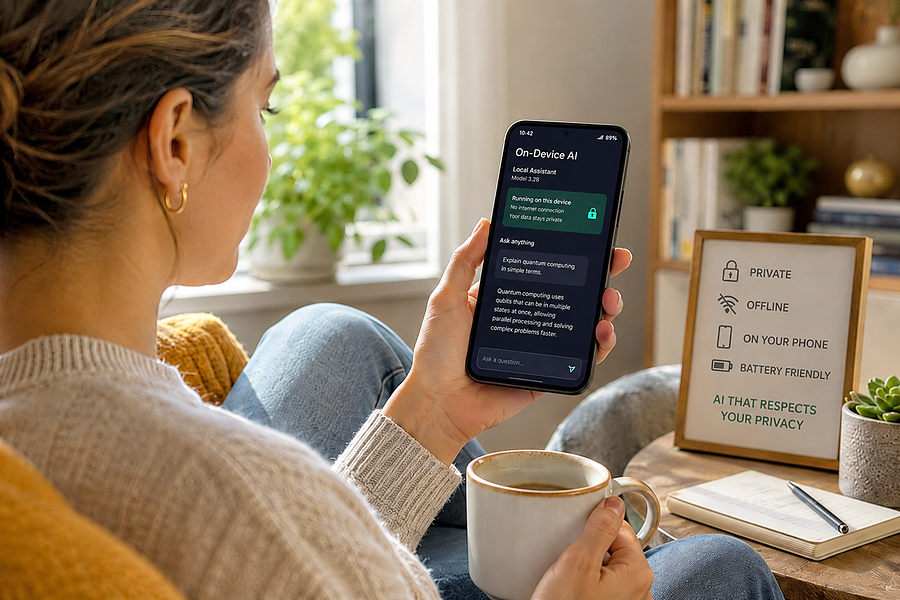
For most of the short time that artificial intelligence has been a part of everyday life, the intelligence itself has lived somewhere else, on banks of powerful computers in distant data centers, and the phone in a person’s hand has served only as a window onto that remote machinery, sending each question away to be answered and waiting for the reply to travel back across the network. When a person asks a virtual assistant to condense a message, draft a reply, or describe a photograph, the words and images have typically left the device, crossed the internet, been processed by enormous models running on company servers, and returned as a finished result, so that the device acted as little more than a messenger carrying requests to an intelligence that resided entirely in the cloud. This arrangement made sense when the models capable of useful language understanding were so large that no phone could hope to hold them, and it has shaped the assumption, now deeply ingrained, that serious artificial intelligence necessarily means sending one’s data to someone else’s computer.
A quiet but consequential shift is now changing that assumption, as a new generation of compact artificial intelligence models has become small and efficient enough to run entirely on the phone itself, processing requests on the device without sending anything to the cloud at all. These models, known as small language models, are the streamlined descendants of the giant systems that power the best-known chatbots, deliberately compressed and refined so that they can fit within the limited memory and modest power budget of a handheld device while still performing many of the tasks people most often want, such as summarizing text, drafting messages, answering questions, and describing images. When such a model runs on the phone, the conversation never leaves the device, the photograph is never uploaded, and the intelligence that was once available only by reaching out to a data center now sits in the user’s pocket, available even when the phone is in airplane mode or far from any signal.
The implications of this shift reach well beyond technical novelty, because moving the intelligence onto the device changes the fundamental relationship between a person, their data, and the companies whose software they use. When processing happens locally, the most personal material a person handles, their private messages, their photographs, their notes and searches, can be understood and acted upon by capable artificial intelligence without ever being transmitted, stored on a remote server, or exposed to interception along the way, which transforms the privacy equation that has troubled many people about cloud-based artificial intelligence. The same locality brings practical benefits as well, since a model on the device can respond almost instantly without waiting for a round trip across the network, can work without any internet connection at all, and can be engineered to sip power rather than drain the battery, making artificial intelligence a more dependable and unobtrusive part of daily use.
This article explains small language models and what it means for them to run on a phone, written for readers who may use artificial intelligence features on their devices every day without understanding where the processing actually happens or why the location matters. It begins by clarifying what a small language model is and how it differs from the large models that run in the cloud, then explains the engineering that allows a model to fit inside a phone at all, before turning to the privacy advantages that on-device processing offers and the practical effects on speed and battery life that shape the everyday experience. It surveys the major companies now building this technology into the devices people carry, drawing on documented products rather than speculation, and it confronts honestly the real limitations of small models and the trade-offs that come with keeping intelligence local. The aim throughout is to make an unfamiliar but rapidly arriving development understandable, so that readers come away knowing not only what on-device artificial intelligence is but why it is being built and what it changes for them.
What a Small Language Model Actually Is
A small language model is, at its core, the same kind of artificial intelligence system as the large models that power the most famous chatbots, a neural network trained on vast quantities of text to predict and generate language, but it is built deliberately at a far smaller scale so that it can run efficiently on modest hardware rather than requiring the enormous computing resources of a data center. The defining characteristic that separates small from large is the number of parameters the model contains, parameters being the adjustable internal values, learned during training, that encode everything the model knows about language and the world, and that collectively determine how it responds to any given input. The largest cloud models are commonly described as having hundreds of billions or even more than a trillion parameters, an astronomical figure that demands racks of specialized chips and great quantities of electricity to operate, whereas the small language models designed to run on phones typically contain a few billion parameters or fewer, a difference of one or two orders of magnitude that is precisely what makes on-device operation possible.
To grasp why parameter count matters so much, it helps to understand that each parameter must be stored in memory and that running the model means performing a calculation involving those parameters for every piece of text the model processes, so that a model with a trillion parameters requires roughly a trillion stored values and a corresponding mountain of arithmetic, far beyond what a phone could hold or compute, while a model with three billion parameters requires only a few billion stored values and a manageable amount of computation that a modern phone’s hardware can handle. The relationship is not perfectly linear, and clever engineering can stretch what a given number of parameters achieves, but the basic intuition holds that fewer parameters mean a smaller memory footprint and less computation, which together are what allow a model to live on a device rather than in the cloud. A small language model is therefore not a different species of artificial intelligence but a smaller member of the same family, sized to fit within constraints that the giant models ignore.
The natural question this raises is whether a model so much smaller than the cloud giants can possibly be useful, and the answer that has emerged over the past few years is that smallness need not mean incapability, because a great deal depends on how the model is trained and what it is asked to do. The early assumption in the field was that bigger was simply better, that capability scaled with size and that smaller models would always be poor imitations of larger ones, but research has shown that a small model trained with care, on carefully selected high-quality data rather than indiscriminately scraped text, can perform many tasks at a level that approaches or even matches much larger models, particularly on focused tasks rather than open-ended ones. The crucial insight is that many of the things people actually want from artificial intelligence on a phone, such as summarizing a long message, rewriting a sentence in a different tone, extracting a date from an email, or answering a straightforward question, do not require the full breadth of knowledge and reasoning that a trillion-parameter model commands, and a well-built small model can handle them ably.
Microsoft’s Phi family of models offers a clear illustration of this principle, having been built explicitly to demonstrate that small models trained on high-quality data can punch far above their weight. The Phi-3-mini model, released in April 2024, contains 3.8 billion parameters, small enough to run on a phone, yet Microsoft reported that its performance on standard benchmarks rivaled that of models several times its size, a result the company attributed to its emphasis on carefully curated and synthetically generated training data rather than sheer scale. The subsequent Phi-4 generation pushed the approach further, with the 14-billion-parameter Phi-4 model scoring 84.8 percent on the broad knowledge benchmark known as MMLU, up from the 77.9 percent of its Phi-3 predecessor, and with the smaller Phi-4-mini retaining 3.8 billion parameters while offering a large context window for handling longer inputs. These results, documented by Microsoft and independently discussed in the research community, established that the path to capable small models runs through the quality of training rather than the quantity of parameters, which is precisely what makes a useful model that fits on a phone achievable.
Understanding what a small language model is, then, means recognizing both its kinship with the cloud giants and its deliberate difference from them, a model of the same fundamental kind, shrunk and refined to live within the tight constraints of a personal device while still delivering genuine usefulness. With that foundation in place, the next question is how engineers actually accomplish the shrinking, how a model that began as a large system is compressed and adapted to fit inside the phone in a person’s hand.
How a Model Fits Inside Your Phone
Getting a capable language model to run on a phone is a feat of engineering that draws on several distinct techniques working together, because even a model of a few billion parameters would, in its original form, be too large and too demanding to operate smoothly on a handheld device. A phone has only so much memory, a fraction of what a server commands, and it must run the model without overheating, without draining the battery in minutes, and without making the user wait, all while leaving room for the dozens of other things the phone is doing at any moment. Meeting these constraints requires shrinking the model’s size, reducing the computation each response demands, and harnessing specialized hardware built for exactly this kind of work, and the combination of these efforts is what has turned on-device artificial intelligence from an aspiration into a shipping reality on tens of millions of devices.
The starting point is that a model’s parameters are ordinarily stored as relatively precise numbers, each occupying a sizable amount of memory, so that a model of a few billion parameters can require several gigabytes of storage in its original form, which is more than a phone can comfortably devote to a single feature. The techniques that address this challenge work along two complementary lines, one that makes each parameter smaller and one that reduces the number of parameters needed in the first place, and alongside them sits a third element, the specialized processors now built into phone chips specifically to run artificial intelligence efficiently. These three threads, compression of the individual values, reduction of the model’s effective size through transfer of knowledge from a larger teacher, and acceleration by purpose-built hardware, together explain how the impossible became routine, and the most important of them deserves a closer look.
Quantization, Distillation, and the Hardware Underneath
The single most important technique for shrinking a model to fit on a phone is quantization, the process of storing each of the model’s parameters using fewer bits of information, which reduces the model’s memory footprint dramatically while sacrificing only a small amount of accuracy. A parameter that might originally be stored with sixteen bits of precision can often be reduced to eight, four, or even two bits, and because the model has billions of parameters, this reduction compounds into an enormous saving, cutting a model that might have needed many gigabytes down to a size that fits comfortably within a phone’s memory. The remarkable finding that makes quantization practical is that models tolerate this loss of numerical precision far better than one might expect, retaining most of their capability even when their parameters are stored quite coarsely, so that the trade-off between size and quality strongly favors compression. Apple’s on-device foundation model illustrates how far this can be taken, having been built using what the company calls two-bit quantization-aware training, an approach that compresses the model’s weights to roughly two bits each while training the model in a way that anticipates and compensates for the compression, preserving quality despite the aggressive reduction. Google’s Gemini Nano models similarly employ four-bit quantization to fit within mobile hardware, demonstrating that this technique is central to essentially every on-device model now in use.
A second technique, distillation, attacks the problem from a different angle by transferring the knowledge of a large, capable teacher model into a smaller student model that learns to imitate it. Rather than training the small model only on raw text, engineers have it learn from the outputs and internal behavior of a much larger model, so that the student absorbs a distilled version of the teacher’s competence in a form compact enough to run on a device, a process that allows the small model to perform better than it could if trained in isolation. Apple has described training its on-device model using a distillation loss, drawing on a larger model to guide the smaller one, and the broader Phi family’s reliance on high-quality data generated with the help of capable models reflects the same underlying logic of concentrating capability into a smaller package. Distillation, combined with quantization, means that the model running on a phone is both numerically compressed and intellectually concentrated, a doubly refined descendant of far larger systems.
The third essential element is the hardware itself, because even a compressed and distilled model still requires a great deal of computation to run, and phones have come to include specialized processors designed expressly to perform that computation efficiently. These processors, commonly called neural processing units, are distinct from the general-purpose central processor and the graphics processor, and they are optimized for the particular mathematical operations that neural networks demand, performing them far faster and with far less energy than a general-purpose chip could. Apple’s devices run their foundation models on the company’s custom silicon, with its dedicated neural engine, while Google’s Gemini Nano runs on the Tensor processors in Pixel phones, and Qualcomm’s Snapdragon chips, which power many Android flagships including Samsung’s Galaxy devices, include increasingly powerful neural processing units that the company has positioned as central to on-device generative artificial intelligence. Qualcomm’s Snapdragon 8 Gen 3, used in the Galaxy S24 series in 2024, expanded the on-device artificial intelligence features Samsung could offer, and each subsequent generation, such as the Snapdragon 8 Elite for the Galaxy S25 in 2025, has brought substantial increases in neural processing performance, with the company reporting a forty percent faster neural unit in that generation compared to its predecessor. This dedicated hardware is what makes running a model on a phone not merely possible but fast and energy-efficient enough for everyday use.
Taken together, quantization, distillation, and purpose-built hardware form the engineering foundation on which on-device artificial intelligence rests, each addressing a different facet of the challenge and combining to make a phone capable of running models that only a few years ago would have required a server. The result is that the model fitting inside a phone is not a watered-down toy but a carefully optimized system, shrunk through numerical compression, sharpened through learning from larger models, and accelerated by chips designed for the task, and it is this convergence of techniques that has carried on-device intelligence from the laboratory into the hands of ordinary users.
The Privacy Case for Keeping AI Offline
The most compelling argument for running artificial intelligence on the device rather than in the cloud is privacy, because when processing happens locally the data being processed never has to leave the phone, which fundamentally changes the exposure of a person’s most sensitive information. In the cloud model that has dominated until now, using an artificial intelligence feature means transmitting the relevant data, whether a private message, a personal photograph, a voice recording, or a search query, across the internet to a company’s servers, where it is processed and where, depending on the company’s practices, it may be stored, logged, used to train future models, or exposed to anyone who gains unauthorized access to those systems. Each of these steps represents a point at which deeply personal material passes out of the user’s control, and the accumulation of such material on corporate servers has been a persistent source of unease for people who recognize that the convenience of cloud artificial intelligence comes at the cost of surrendering their data to someone else’s keeping.
On-device processing collapses this chain of exposure by keeping the data on the phone throughout, so that the artificial intelligence reads and acts upon the information without it ever being transmitted or stored remotely. When a small language model running locally summarizes a person’s text messages, the messages are read by software on the phone and the summary is produced on the phone, with nothing sent across the network, which means there is no transmission to intercept, no server-side copy to be breached, and no remote log accumulating a record of what the person asked. This is the concrete meaning of the phrase that the data never leaves the device, a phrase that companies have begun to emphasize precisely because it addresses the central anxiety about artificial intelligence, namely that using it requires giving away the very information one might most wish to keep private. The privacy benefit is not a matter of trusting a company’s promise not to misuse transmitted data but of structural design that removes the transmission altogether, a more robust form of protection because it does not depend on policies that could change or be violated.
The categories of data that benefit most from this protection are exactly those that people consider most sensitive and that artificial intelligence is increasingly used to handle. Personal communications, including text messages, emails, and chat conversations, contain the substance of a person’s relationships and private affairs, and the ability to have them summarized, drafted, or organized by artificial intelligence without sending them anywhere is a meaningful safeguard. Photographs, which may capture not only a person’s appearance and location but those of family, friends, and children, can be searched, described, and edited by on-device models without being uploaded, keeping intimate visual records under the owner’s control. Health-related notes, financial details, and the contents of personal documents likewise gain protection when the intelligence that processes them runs locally, and even the simple record of what a person asks their assistant, which can itself reveal a great deal about their concerns and circumstances, stays on the device rather than accumulating in a remote profile. For all of these, the locality of processing is the difference between intelligence that respects the boundary of the device and intelligence that requires crossing it.
The privacy advantages of on-device processing also intersect with the growing body of regulation and the rising expectations around data protection, because keeping data local can simplify compliance and reduce the risks that come with handling sensitive information on remote servers. Organizations and individuals subject to strict requirements about where data may be sent and stored find that on-device processing sidesteps many of the complications of cloud handling, since data that never leaves the device does not raise the same questions about cross-border transfer, third-party access, or retention. This is not to say that on-device artificial intelligence is free of all privacy considerations, since a model running locally still operates on personal data and could in principle be designed to report information back, and users must still trust that the software does what it claims, but the structural reduction in data movement represents a genuine and substantial improvement over the cloud-only approach. Companies building these systems have reinforced the point with design choices, such as Apple’s broader architecture that handles many requests entirely on the device and routes only those requiring more capability to a privacy-focused server environment, with on-device processing as the default rather than the exception.
It is worth being clear-eyed that privacy is not absolute even with on-device models, and that the picture involves trade-offs rather than a simple guarantee, because some tasks still exceed what a small local model can do and require help from the cloud, at which point data may leave the device after all. The honest framing is that on-device processing dramatically reduces the routine, everyday transmission of personal data, handling the bulk of common tasks locally and reserving network communication for the cases that genuinely need it, which is a substantial advance over an arrangement in which everything was sent away by default. For the many things a small model can do on its own, the privacy benefit is real and structural, and it represents one of the strongest reasons that the industry has invested so heavily in moving intelligence onto the device, recognizing that people increasingly want the benefits of artificial intelligence without the cost of surrendering their data, and that local processing offers a way to provide the former while protecting the latter.
Battery, Speed, and the Everyday Experience
Beyond privacy, running artificial intelligence on the device reshapes the everyday experience of using it in ways that people feel directly, beginning with speed, because a model on the phone can respond without the delay of sending a request across the internet and waiting for the answer to return. Every cloud-based interaction carries the overhead of a network round trip, the time it takes for data to travel to a distant server, be processed, and travel back, which depends on the quality of the connection and can introduce noticeable lag, especially on a weak or congested network. An on-device model eliminates this overhead entirely, processing the request locally and producing a response with the immediacy of any other operation the phone performs, so that features like text suggestions, summaries, and quick answers can feel instantaneous rather than sluggish. The flagship phones that run these models have demonstrated very low response times for on-device tasks, with the dedicated neural hardware producing results in a fraction of a second, and this responsiveness makes artificial intelligence feel like a natural part of the device rather than a service one waits on.
The independence from the network brings a second practical benefit that is easy to overlook until it matters, which is that on-device artificial intelligence works without any internet connection at all, functioning on an airplane, in a remote area, in a building with poor reception, or anywhere a signal is unavailable or unreliable. Because the model lives on the phone, it does not need to reach a server to do its work, so a person can summarize a document, draft a message, get a photograph described, or ask a question while completely offline, and the feature behaves exactly as it would with a strong connection. Google has highlighted this capability with its Gemini Nano model, noting that features such as its screenshot organization and other tools continue to work offline on supported Pixel devices, and the broader principle applies across on-device systems, that the intelligence is always available because it is always present, not dependent on the vagaries of connectivity. For anyone who has experienced the frustration of a cloud-based feature failing in a dead zone, the reliability of an always-available local model is a tangible improvement.
The matter of battery life is more nuanced, because running a model does consume energy, and a naive implementation could drain a battery quickly, but the specialized neural processing hardware that phones now include is designed precisely to perform artificial intelligence computation with far greater energy efficiency than a general-purpose processor could achieve. These neural units accomplish the mathematical operations that models require using much less power per operation, which means that an on-device model can run without the battery cost that the same computation would incur on general hardware, and the efficiency improves with each chip generation as manufacturers refine the designs. There is also an energy argument in favor of local processing over cloud processing from a holistic standpoint, since a cloud interaction consumes power not only on the phone, to transmit and receive data over the radio, but also in the data center and across the network, whereas a local computation confined to an efficient neural unit can in some cases be the more economical path overall. The radio that connects a phone to the network is itself a significant consumer of power, and avoiding a network round trip for every artificial intelligence request spares that cost, contributing to the battery-friendly character that companies emphasize when describing on-device features.
The everyday experience that emerges from these properties is one in which artificial intelligence becomes a quiet, dependable, and unobtrusive part of using a phone rather than a feature that demands patience, a connection, and a willingness to send one’s data away. Responses arrive immediately, features work everywhere regardless of signal, and the battery is not noticeably taxed by intelligence that runs on hardware built to run it efficiently, so that the friction which once accompanied artificial intelligence fades into the background. This combination of speed, offline availability, and energy efficiency, taken together with the privacy benefits, explains why on-device processing is not merely a technical curiosity but a meaningfully better way of delivering artificial intelligence for the many tasks that a small model can handle, and why the companies that make phones have raced to build it into the devices people carry every day.
Who Is Building On-Device AI: The State of Play
The movement of artificial intelligence onto personal devices is not a future prospect but a present reality being shipped by the largest technology companies in the world, each of which has built small language models into the phones and software that millions of people already use. The clearest way to understand how far this has progressed is to examine the documented products that these companies have released, because the state of play is defined not by announcements of intent but by features running today on devices in people’s hands, drawing on models that operate locally to deliver privacy, speed, and offline capability. The leading efforts come from Apple, Google, Microsoft, and the chipmakers such as Qualcomm whose silicon powers much of the Android world, and together they show that on-device artificial intelligence has moved decisively from research into the mainstream of consumer technology.
Apple’s entry, introduced under the name Apple Intelligence beginning in 2024 and advanced through subsequent generations, centers on an on-device foundation model of roughly three billion parameters that runs on the company’s custom silicon and handles a wide range of everyday language tasks directly on the device. According to Apple’s published technical reports, including its 2025 foundation models documentation, the on-device model was built with aggressive optimization for Apple hardware, using two-bit quantization-aware training to compress its weights and a technique called key-value cache sharing that reduces its memory use by more than a third, allowing it to run efficiently within the constraints of a phone. The model is designed to understand both text and images, to support around fifteen languages, and to power features such as summarization, text refinement, and short interactions, and Apple has opened it to outside developers through a framework that lets third-party apps build features on the same local model. Crucially, Apple’s overall design treats on-device processing as the default, handling many requests entirely on the phone and routing only those that require greater capability to a privacy-focused server environment, which positions local intelligence as the foundation of the experience rather than an afterthought.
Google’s on-device effort revolves around Gemini Nano, the most compact member of its Gemini family of models, which the company has built into its Pixel phones and made available to the broader Android ecosystem. Gemini Nano runs locally on the Tensor processors in recent Pixel devices, with reported parameter counts in the range of roughly one and a half to a bit over three billion and four-bit quantization to fit within mobile memory, and it powers a growing list of features that work without the cloud, including Call Notes that summarize phone conversations, a scam detection capability introduced in 2025 that watches for fraudulent calls, screenshot organization, and improved image descriptions for blind and low-vision users through the device’s accessibility tools. Google extended access to Gemini Nano to outside Android developers beginning in 2024 through its on-device system services and later through dedicated programming interfaces, allowing apps across the Android world to build features on the local model, and each new generation of Pixel hardware, powered by successive Tensor chips, has brought a more capable version of the model. The breadth of Gemini Nano’s deployment, spanning Google’s own devices and a wider range of Android phones from manufacturers including Samsung, Xiaomi, and Motorola, makes it one of the most widely distributed on-device models in use.
Microsoft’s contribution comes through its Phi family of small language models, which the company has developed explicitly to demonstrate and advance the capabilities of compact models suitable for local operation. The Phi-3-mini model, released in April 2024 with 3.8 billion parameters, was presented as small enough to run on a phone while delivering performance that rivaled much larger models, a result achieved through Microsoft’s emphasis on training with carefully curated and synthetically generated high-quality data rather than sheer scale. The subsequent Phi-4 generation continued this trajectory, with strong benchmark results in areas such as mathematical reasoning and broad knowledge, and the Phi-4-mini variant retaining a phone-friendly size while offering an expanded capacity for handling longer inputs. While Microsoft’s Phi models are not tied to a single consumer device in the way Apple’s and Google’s are, they represent an influential demonstration that small models can be genuinely capable, and they are available for developers and manufacturers to build upon, contributing to the broader ecosystem of compact models that on-device artificial intelligence depends upon.
Underpinning much of the Android side of this landscape are the chipmakers, above all Qualcomm, whose Snapdragon processors include the neural processing units that run on-device models in many of the most popular phones, including Samsung’s Galaxy flagships. Qualcomm has positioned on-device generative artificial intelligence as a central capability of its silicon, building increasingly powerful neural processing units into successive Snapdragon generations, and Samsung’s Galaxy AI features, introduced with the Galaxy S24 series in early 2024 and expanded in subsequent models, rely on this hardware to run capabilities such as image editing, translation, and summarization with local processing where possible. Each new chip generation, from the Snapdragon 8 Gen 3 in the Galaxy S24 to the Snapdragon 8 Elite in the Galaxy S25 with its substantially faster neural unit, has widened the range of artificial intelligence tasks that can run on the device, and the close collaboration between chipmakers and phone manufacturers has been instrumental in bringing on-device intelligence to the broad Android market. The collective effect of these efforts, across Apple, Google, Microsoft, and the chipmakers, is that on-device artificial intelligence is no longer an experiment but an established and rapidly maturing feature of the devices people use every day.
The Limits and Trade-offs of Small Models
For all the genuine advantages of running artificial intelligence on the device, an honest account must acknowledge that small models have real limitations, and that the very compactness which makes them suitable for a phone also constrains what they can do compared to the large models running in the cloud. The most fundamental limitation is one of raw capability, because a model of a few billion parameters simply contains less knowledge and less reasoning power than a model of hundreds of billions, and there are tasks, particularly those demanding broad world knowledge, complex multi-step reasoning, or the synthesis of information across many domains, where the larger model performs noticeably better. A small model may handle the summarization of a message or the drafting of a short reply with ease, yet struggle with a question requiring deep expertise, an intricate analytical problem, or the kind of sophisticated open-ended generation that the largest systems manage, and pretending otherwise would misrepresent the trade-off that on-device processing involves. The compactness that brings privacy, speed, and efficiency comes at the cost of some ceiling on capability, and this is an inherent tension rather than a temporary shortcoming, even as small models steadily improve.
A related limitation concerns the breadth and freshness of the knowledge a small model carries, since its limited size constrains how much information it can hold, and since the model on a device is fixed until it is updated, it cannot know about events or information that emerged after its training, nor reach out to the live internet for current facts the way a connected system can. A person asking an on-device model about a recent event, a current price, or a fact that changes over time may receive an outdated or incomplete answer, because the model’s knowledge is frozen at the point of its training and bounded by what its modest size can store. This is why many practical systems combine on-device processing with selective use of the cloud, handling what they can locally while reaching out to larger models or live information sources for tasks that exceed the small model’s reach, an arrangement that preserves the privacy and speed benefits for the common case while still allowing access to greater capability when it is genuinely needed. The existence of this hybrid approach is itself an acknowledgment that small models cannot do everything, and that the realistic future is not purely local but a thoughtful division of labor between device and cloud.
The hybrid model, while sensible, introduces its own complexity and qualifies some of the privacy benefits that pure on-device processing offers, because whenever a task is routed to the cloud, data does leave the device after all, and the user may not always know which path a given request has taken. The honest framing is that on-device processing handles the routine majority of tasks locally and privately while escalating only the demanding minority to the cloud, which is a substantial improvement over sending everything away, but it does mean that the simple promise of data never leaving the device applies to the local cases rather than to every interaction. Companies have addressed this by designing their cloud fallback to preserve privacy as much as possible, as with Apple’s privacy-focused server environment intended to handle escalated requests without retaining personal data, but users who want the strongest privacy guarantee must understand the distinction between what runs locally and what is sent away, and recognize that the boundary is not always visible to them in the moment.
There are also practical constraints rooted in the hardware, since running capable models on the device depends on having a phone with sufficient memory and a powerful enough neural processing unit, which means that the most advanced on-device features are often available only on newer, higher-end devices and not on older or less expensive phones. The substantial memory that a model and its working data occupy must be shared with everything else the phone does, and manufacturers must balance the resources devoted to artificial intelligence against the needs of the rest of the system, so that on-device capability is partly a function of how recent and how premium a person’s device is. This creates a divide in which the benefits of local artificial intelligence accrue first to those with the latest hardware, and it means that the spread of on-device intelligence across the full range of devices people own will take time as the necessary hardware becomes more common and more affordable. The trajectory points toward broader availability as chips improve and as the techniques for compressing models advance, but at any given moment the most capable on-device experiences are tied to capable hardware.
Recognizing these limits does not diminish the significance of on-device artificial intelligence so much as place it in proper perspective, as a powerful approach that excels for a large and growing set of everyday tasks while still working alongside the cloud for the demands that exceed a small model’s reach. The realistic picture is neither that local models will replace cloud intelligence entirely nor that they are mere toys, but that a sensible balance is emerging in which the device handles what it can privately, quickly, and efficiently, and the cloud remains available for the harder cases, with the boundary between them shifting steadily toward the device as small models grow more capable and the hardware that runs them grows more powerful. Understanding both the strengths and the limits of small models is what allows a person to use them well, relying on them for the many things they do admirably while knowing when a task calls for the greater capability that only a larger system can provide.
Final Thoughts
The arrival of capable artificial intelligence that runs entirely on a personal device marks a meaningful rebalancing of power between the individual and the cloud, returning to the person a measure of control over their own data that the cloud-only model had quietly taken away. For years the implicit bargain of artificial intelligence was that its benefits could be had only by surrendering one’s information to distant servers, accepting that private messages, personal photographs, and the record of one’s questions would travel across the internet and reside on someone else’s computers, and that bargain seemed unavoidable because the intelligence was simply too large to live anywhere but the cloud. The emergence of small language models that fit on a phone breaks that bargain by relocating the intelligence to the device itself, so that the benefits of artificial intelligence can increasingly be enjoyed without the cost of giving away the data that fuels it.
This shift carries implications that extend beyond individual convenience into questions of autonomy and the distribution of technological power, because intelligence that lives on a person’s own device is intelligence they own and control in a way a remote service can never quite be. When the model is local, it works whether or not a company’s servers are running, whether or not a network is available, and whether or not the user is willing to transmit their data, which gives the individual a kind of independence that cloud services, however convenient, cannot offer. On-device artificial intelligence democratizes a powerful technology by placing it directly in the hands of users rather than mediating every interaction through corporate infrastructure, and this redistribution matters to anyone who believes people should retain agency over the tools that shape their lives.
The social dimension of this technology is equally significant, because privacy is not merely an individual preference but a foundation for the kind of free and dignified life that depends on being able to think, communicate, and seek information without surveillance. When the intelligence that helps a person manage their communications, understand their photographs, and answer their questions runs on their own device, the most intimate aspects of their digital life remain genuinely private, which protects not only individuals but the broader social fabric that erodes when personal data accumulates in corporate repositories vulnerable to breach or misuse. On-device artificial intelligence points toward a future in which the spread of capable intelligence does not require a corresponding spread of surveillance, in which smart features and personal privacy are aligned rather than opposed, among the most hopeful aspects of the technology’s development.
The road ahead will involve continued tension between what small models can do locally and what still requires the cloud, and the honest expectation is not that the device will do everything but that it will do steadily more, with the boundary shifting toward the device as models grow more capable and the hardware that runs them grows more powerful and widespread. The challenges that remain, the capability gaps, the hardware divides, and the complexities of hybrid systems, are real, yet the direction of travel is clear, toward intelligence that is more personal, more private, and more firmly under the control of the people who use it. In an era when the question of who holds power over personal data has become a defining issue of technological life, the quiet movement of artificial intelligence into the device in a person’s pocket represents a genuine reorientation toward the individual, a reminder that innovation and accessibility can advance together with privacy and autonomy rather than at their expense.
FAQs
- What is a small language model in simple terms?
A small language model is a compact version of the artificial intelligence systems that power chatbots, built with far fewer internal values, called parameters, so that it can run on a phone or other personal device instead of requiring powerful servers in a data center. It performs many of the same everyday tasks, such as summarizing text, drafting messages, and answering questions, while being small enough to fit within the limited memory and power of a handheld device. - How is a small language model different from ChatGPT or other large models?
The main difference is size, since large cloud models can have hundreds of billions or more than a trillion parameters and run on banks of specialized server hardware, while small models designed for phones typically have a few billion parameters or fewer. This makes small models less capable on the hardest tasks requiring deep knowledge or complex reasoning, but capable enough for many common tasks, and crucially able to run locally on a device rather than in the cloud. - Does my data really stay private with on-device AI?
When a model runs entirely on your device, the data it processes stays on the phone and is not transmitted to remote servers, which removes the routine transmission and storage of personal information that cloud-based artificial intelligence involves. This is a structural privacy benefit, though it is important to know that some demanding tasks may still be sent to the cloud in hybrid systems, so the strongest privacy applies to the tasks the local model handles on its own. - Can on-device AI work without an internet connection?
Yes, because the model lives on the phone, it can perform its work without any internet connection at all, functioning on an airplane, in a remote area, or anywhere a signal is unavailable. Features such as summarization, text drafting, and image description continue to work offline on supported devices, since the intelligence is present on the device rather than reached over the network. - Will running AI on my phone drain the battery?
Modern phones include specialized processors called neural processing units that are designed to run artificial intelligence efficiently, performing the necessary computation with far less energy than a general-purpose processor would use. Because of this dedicated hardware, on-device models can run without the heavy battery cost one might expect, and avoiding network round trips can even save the power that transmitting data over the radio would consume. - Which phones can run small language models on the device?
On-device artificial intelligence is available on recent flagship devices from major manufacturers, including Apple devices running Apple Intelligence, Google Pixel phones running Gemini Nano, and Samsung Galaxy and other Android phones powered by Qualcomm Snapdragon chips with capable neural processing units. The most advanced features generally require newer, higher-end hardware with sufficient memory and a powerful enough neural processor, so older or less expensive phones may not support them. - How can a model small enough for a phone still be useful?
A well-built small model can be genuinely useful because capability depends heavily on the quality of its training, not just its size, and because many everyday tasks do not require the full power of a giant model. Techniques such as training on carefully curated high-quality data and learning from larger teacher models, as Microsoft demonstrated with its Phi family, allow compact models to perform many common tasks at a level that approaches much larger systems. - What is quantization and why does it matter for on-device AI?
Quantization is the technique of storing a model’s parameters using fewer bits of information, which dramatically reduces the memory the model occupies while sacrificing only a small amount of accuracy. It matters because it is what allows a model that would otherwise need several gigabytes to shrink down to a size that fits comfortably on a phone, and essentially every on-device model relies on it, with examples ranging from four-bit to as low as two-bit compression. - What are the limitations of small language models?
Small models have less raw capability than large cloud models, so they can struggle with tasks requiring broad knowledge, complex multi-step reasoning, or current information about recent events, since their knowledge is fixed at training time and limited by their compact size. Many systems address this by combining local processing with selective use of the cloud for harder tasks, which preserves privacy and speed for common cases while still allowing access to greater capability when needed. - Will on-device AI replace cloud-based AI entirely?
On-device artificial intelligence is unlikely to replace cloud intelligence completely, since the largest and most capable models still require the resources of a data center and there are tasks that exceed what a small local model can do. The realistic outcome is a balance in which the device handles the many tasks it can do privately, quickly, and efficiently, while the cloud remains available for the most demanding work, with the boundary shifting toward the device as small models and the hardware that runs them continue to improve.