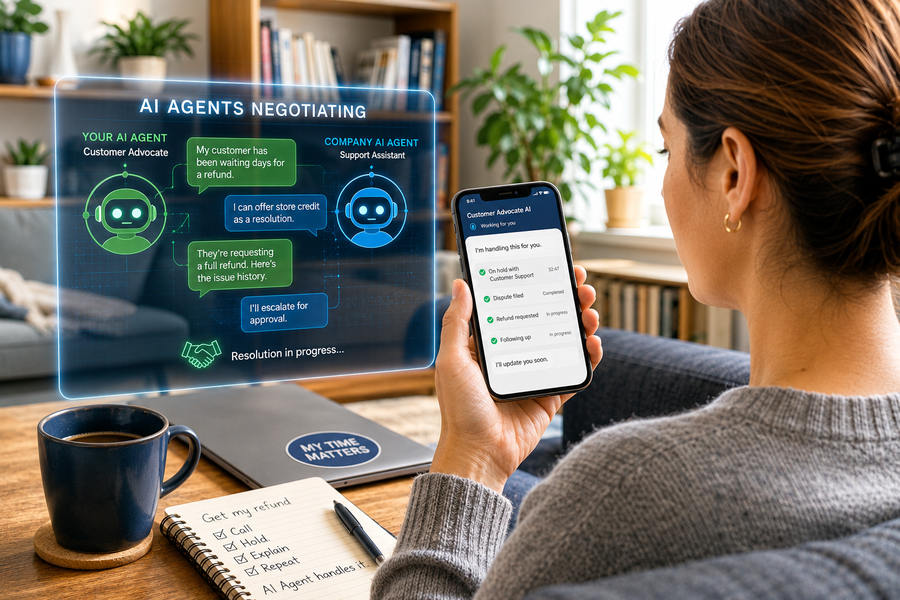
Few experiences of modern life are as universally dreaded as the customer service ordeal, the long wait on hold listening to a loop of tinny music interrupted by reminders that the call is important, the navigation through a maze of automated menus that never quite offer the option needed, the explanation of a problem to one representative followed by its re-explanation to another after a transfer, and the wearing persistence required to obtain a refund, cancel a subscription, or correct an erroneous charge that should never have been made. This experience is so common that it has become a shared cultural complaint, a source of jokes and resigned sighs, and yet beneath the humor lies a real cost in time, money, and frustration, because the difficulty of getting satisfaction from a company is not merely an annoyance but a barrier that causes many people to give up, to accept charges they should have contested, and to keep paying for services they meant to cancel, surrendering money and rights simply because the effort of reclaiming them is too great.
Into this landscape of friction has arrived a new kind of tool, an artificial intelligence agent that acts on the consumer’s behalf, undertaking the very tasks that people dread, sitting on hold so they do not have to, navigating the automated menus and the retention scripts, filing disputes and chasing refunds, negotiating bills, and canceling subscriptions, all while the person who delegated the task goes about their day. These consumer-side AI agents represent a notable inversion of the usual relationship between people and the automated systems of large companies, because for years automation has been deployed by companies to manage and often to deflect their customers, and now automation is being placed in the hands of consumers to push back, to absorb the tedium and persistence that customer service demands, and to fight the battles that individuals have neither the time nor the patience to fight themselves.
This article examines the emergence of AI agents that handle customer service tasks for consumers, written for readers who have endured the frustrations of dealing with companies but who may not realize that tools now exist to take on those frustrations for them. It begins by explaining why customer service is so often stacked against the individual, then describes in plain language what a consumer AI agent actually does and how it works, before examining the real services that have begun to offer this capability and the metrics they report. It then turns to the other side of the interaction, the AI agents that companies themselves are deploying to handle customer service, and considers the striking prospect of consumer bots and company bots negotiating with each other. It weighs a cautionary tale of a consumer AI service that overpromised and drew regulatory action, surveys the risks and the questions of trust that these tools raise, and considers what their arrival means for the balance of power between individuals and the institutions they must deal with.
The Customer Service Asymmetry: Why Consumers Are Outgunned
To understand why an AI agent that fights customer service battles is appealing, it helps first to recognize that the difficulty of dealing with companies is not accidental but in many respects a designed feature of how those companies manage the costs and the revenues associated with their customers. Customer service is expensive, since every minute a representative spends helping a customer costs the company money, and so companies have powerful incentives to minimize the amount of service they provide, channeling customers toward automated systems, limiting the availability of human representatives, and making certain actions, particularly those that cost the company money such as cancellations and refunds, more difficult than the actions that benefit the company such as signing up and upgrading. The result is an asymmetry in which the company, armed with systems designed to manage customers efficiently and to protect its revenues, faces an individual who has limited time, limited patience, and limited knowledge of how to navigate the company’s processes.
This asymmetry manifests in several familiar forms, each of which works to the disadvantage of the individual consumer. The long hold time is perhaps the most direct, since making customers wait reduces the number who will persist, so that some give up before reaching a representative, sparing the company the cost of serving them, while the maze of automated menus serves a similar function by adding friction that filters out all but the most determined. Retention scripts, the carefully designed sequences that representatives follow when a customer tries to cancel, are crafted to deflect the cancellation through a series of offers, objections, and appeals that wear down the customer’s resolve, and the practice of requiring cancellations to be made by phone rather than online, even when sign-ups can be completed with a click, deliberately raises the effort required to stop paying. These techniques, sometimes described as dark patterns when they are built into digital interfaces, share the common purpose of using friction to the company’s advantage.
The consequences of this asymmetry fall heavily on consumers, and they are measured not only in wasted time but in real financial loss, because the friction that companies introduce causes many people to abandon legitimate claims and to keep paying for things they no longer want. A person who is owed a refund but who faces an hour on hold to obtain it may decide the refund is not worth the time, a calculation the company is counting on; a person who means to cancel a subscription but who must call during business hours and endure a retention script may postpone the task indefinitely, continuing to pay month after month for a service they do not use; and a person who has been charged in error but who lacks the persistence to escalate the dispute may simply absorb the loss. These outcomes are not failures of the system from the company’s perspective but rather its intended function, since the friction converts consumer fatigue into retained revenue, and the cumulative effect across millions of customers represents an enormous transfer of value from individuals to companies, accomplished not through any single large charge but through the steady accretion of small surrenders.
It is precisely this asymmetry that consumer AI agents are designed to counter, because the disadvantages that individuals face in dealing with companies stem largely from the scarcity of their time and patience, the very resources that an AI agent has in effectively unlimited supply. An AI agent does not grow frustrated waiting on hold, does not lose its resolve when confronted with a retention script, does not forget to follow up, and does not weigh the value of a refund against the tedium of obtaining it, because it has no competing demands on its attention and no emotional response to the friction that wears down human callers. By supplying the persistence and the patience that individuals lack, the AI agent aims to neutralize the company’s friction-based advantages, restoring to the consumer the leverage that the asymmetry of time and attention has long denied them, and it is this rebalancing that gives the technology its appeal and its potential significance.
What an AI Customer Service Agent Actually Does for You
A consumer AI customer service agent is a software tool that acts autonomously on a person’s behalf to complete the kinds of tasks that ordinarily require a frustrating interaction with a company, going beyond merely advising the person on what to do and instead actually doing it, by making phone calls, sending emails, navigating websites, and carrying out the multi-step processes that resolving a customer service issue requires. This distinction between advising and acting is important, because earlier generations of digital assistants could answer questions and offer guidance but left the actual work to the person, whereas the new consumer agents are built to take action in the world, to place the call to the cable company, to wait through the hold, to speak with the representative, to make the case, and to see the task through to completion, all without requiring the person to be involved beyond the initial instruction and any necessary approvals.
The range of tasks these agents undertake covers the full spectrum of dreaded customer service interactions, and understanding that range conveys what the technology aims to do. The agents can negotiate bills, calling a provider to seek a lower rate on a cable, internet, or phone service and arguing the case as a knowledgeable customer might; they can cancel subscriptions, undertaking the often deliberately difficult process of stopping a recurring charge and persisting through retention scripts; they can pursue refunds and file disputes, contacting a company to contest an erroneous or unwanted charge and following the matter through the company’s process; and they can handle complaints and the follow-up work that resolution often requires, the second and third contacts needed when the first does not suffice. In each case the agent takes on the task that the person would otherwise have to perform, absorbing the time and the tedium that make these tasks so unwelcome.
The capability that distinguishes these agents from simpler tools is their ability to conduct real interactions through the channels that companies actually use, particularly the telephone, which remains the channel through which many of the most difficult customer service tasks must be accomplished. An agent that can place a phone call, navigate the automated menu, wait on hold, and then conduct a spoken conversation with a human representative is performing a far more demanding task than one that merely fills in a web form, because the phone call requires understanding speech, responding appropriately in real time, and adapting to the unpredictable course of a live conversation. The leading consumer agents combine this telephone capability with the ability to send emails and to navigate websites, so that they can pursue a task through whatever channel is required and can complete the multi-step workflows in which a single issue may involve a call, a follow-up email, and a form submission, carrying the matter through from start to finish across all the channels the resolution demands.
The promise of these agents, then, is to transfer the burden of customer service from the person to the software, allowing the individual to delegate a dreaded task with a simple instruction and then to step away while the agent does the work, returning only to approve a result or to provide any information the agent needs. A person who wishes to lower their internet bill need not set aside an afternoon, brace themselves for the call, and steel their resolve against the retention offers, but can instead instruct the agent to seek a lower rate and then go about their day while the agent makes the call, waits on hold, and negotiates, reporting back when the task is done. This delegation of customer service labor to an autonomous agent represents a genuine shift in what individuals can accomplish in their dealings with companies, and its practical realization depends on a set of mechanics that determine how an agent can act on a person’s behalf without that person’s continuous involvement.
The Mechanics: Verification, Guardrails, and Sitting on Hold
For an AI agent to act on a person’s behalf in customer service interactions, it must be able to do several things that raise practical and security questions, beginning with the challenge of identity verification, because companies typically require a caller to confirm their identity before discussing or changing an account. To pass these security checks, the consumer provides the agent with the necessary verification details or grants one-time permissions that allow the agent to authenticate as the account holder, supplying the information that the company will ask for so that the agent can satisfy the verification process and proceed to the actual task. This requirement means that using such an agent involves entrusting it with sensitive account information, a significant consideration that bears on the trust a person must place in the service and that constitutes one of the central risks of the technology, since the agent must be given enough access to act convincingly as the account holder.
Beyond verification, the person directs the agent through a set of guardrails that define what the agent should try to accomplish and what limits it must respect, so that the agent acts within the person’s wishes rather than pursuing the task in ways the person would not want. Before the agent begins, the consumer sets preferences and guardrails, including the target outcome they are seeking and the minimum acceptable terms they will accept, so that an agent negotiating a bill knows what reduction to aim for and what result would be good enough to accept, while an agent canceling a subscription knows that cancellation is the goal and that retention offers should be declined unless they meet criteria the person has specified. These guardrails allow the person to delegate the task while retaining control over its objectives, defining the boundaries within which the agent exercises its autonomy, so that the agent’s persistence is directed toward the outcomes the person actually wants.
Once verification and guardrails are established, the agent undertakes the part of the task that consumers find most onerous, which is the actual conduct of the interaction, including the waiting, the navigating, and the negotiating that the resolution requires. The agent places the call, works through the automated menu, waits on hold for however long the wait may be, and then conducts the conversation with the representative, making the case, responding to objections, and escalating when necessary, while the person who delegated the task can track the progress through a dashboard and receive updates rather than having to participate. This division of labor, in which the person sets the objective and the boundaries while the agent supplies the patience and persistence to pursue it, captures the essence of how consumer AI agents work, transferring to the software the time and tedium that make customer service so unwelcome while leaving with the person the decisions about what to seek and what to accept.
The Consumer Agents in the Wild: Pine AI and the Refund Fighters
The clearest example of a consumer AI agent built to fight customer service battles is Pine AI, an autonomous agent founded in late 2024 and launched in January 2025 that is designed specifically to complete real-world customer service tasks through phone calls, emails, and web actions, positioning itself not as a tool that answers questions but as one that does the work. Pine AI describes its purpose as undertaking customer service labor on the user’s behalf, making calls, sending emails, and using a computer to finish tasks, and its capabilities span the range of dreaded interactions, including bill negotiation, subscription cancellation, complaint filing, refunds, disputes, and the follow-up work that resolution often requires. The service represents one of the more developed attempts to deliver on the promise of a consumer agent that acts rather than advises, conducting phone calls, sending emails, navigating websites, and completing multi-step workflows without requiring the person’s continuous involvement.
The metrics that Pine AI reports convey both the ambition of the service and the results it claims to achieve, offering concrete evidence of what a consumer agent can accomplish in real interactions. The company reports a success rate of ninety-three percent for complex negotiations, a figure that, if borne out in practice, would indicate that the agent succeeds in the great majority of the difficult tasks it undertakes, and it reports that users can expect to save an average of around twenty percent on their telecom and cable bills, a meaningful reduction that reflects the kind of savings a persistent and knowledgeable negotiator can obtain from providers who often offer lower rates to customers who ask. These figures describe the practical value proposition of the service, which is to obtain for the user the savings and the resolutions that they could in principle achieve themselves but that the friction of customer service deters most people from pursuing.
The way Pine AI structures its pricing reflects an attempt to align the service’s incentives with the user’s interests and to address the natural skepticism that surrounds a tool entrusted with such tasks. The service operates on a model in which the user pays only if the task is successfully completed, so that the person is not charged for an agent that fails to obtain the desired result, an arrangement that places the risk of failure on the service rather than the user and that signals the company’s confidence in its agent’s effectiveness. This success-based pricing distinguishes the model from services that charge regardless of outcome, and it reflects a broader pattern in consumer financial tools, where services that act to save the user money often take a share of the savings or charge only upon success, aligning the provider’s reward with the value actually delivered to the user.
The category that Pine AI exemplifies also includes established services that have offered related capabilities, particularly in the negotiation of bills, and examining these alongside the newer agents illuminates both the appeal and the complications of delegating financial tasks to a third party. Bill negotiation services such as the one offered by Rocket Money have for some time allowed users to request that the service contact their providers to negotiate lower bills, charging a portion of the savings achieved as the fee for the service, an arrangement similar in spirit to the success-based pricing of the newer agents. Yet these services have also generated substantial consumer complaints, with data from the Better Business Bureau showing hundreds of complaints over several years involving issues such as unexpected savings fees and confusing billing, and with the particular complication that canceling a subscription to such a service may not cancel pending negotiation requests, so that the service may still claim its success fee. These complications are instructive because they show that delegating financial tasks to an agent, whether human or artificial, introduces its own questions about fees, consent, and control, questions that the newer AI agents must also answer if they are to earn and keep the trust of the people who use them.
The Other Side of the Line: Companies Are Deploying AI Too
While consumers are beginning to deploy AI agents to fight their customer service battles, the companies on the other end of those battles have been deploying AI agents of their own, and far more extensively, so that the customer service interaction is increasingly becoming an encounter between a consumer’s tools and a company’s automation. Companies have powerful incentives to automate customer service, because the human representatives who staff call centers and chat queues are expensive, and an AI agent that can handle a substantial share of customer inquiries promises large cost savings, which has driven rapid adoption of company-side AI customer service across many industries. The result is that a consumer reaching out to a company today is increasingly likely to encounter an AI agent rather than a human, a development that both motivates the consumer-side agents, since people want help dealing with the company bots, and sets the stage for the prospect of automation on both sides of the interaction.
The most widely discussed example of company-side AI customer service is Klarna, the financial technology company that, in February 2024, announced that an AI assistant built with OpenAI’s technology had handled two-thirds of its customer service chats in its first month of operation, with results the company presented as a striking demonstration of the technology’s potential. According to Klarna’s reporting, the assistant handled 2.3 million conversations across thirty-five languages in that first month, equivalent to the work of seven hundred full-time agents, reduced the average resolution time from eleven minutes to two, cut repeat inquiries by twenty-five percent, and was projected to deliver around forty million dollars in profit improvement for 2024. These figures, widely cited as evidence of AI’s capacity to transform customer service economics, suggested that a single AI assistant could perform the work of hundreds of human agents while resolving issues faster, and they helped drive enthusiasm for the rapid replacement of human customer service with automation.
The subsequent evolution of Klarna’s experience, however, complicates the initial triumphant narrative and offers an important lesson about the limits of company-side automation, because the company later concluded that it had relied too heavily on AI and moved to restore a larger human role. By May 2025, Klarna’s chief executive acknowledged publicly that the company had gone too far in its automation, and Klarna walked back some of its AI-only approach, reintroducing human agents for complex cases and moving toward a model in which a human is always available alongside the AI. The company’s later updates continued to report substantial benefits from the AI, with figures putting the assistant’s work at the equivalent of more than eight hundred agents and annual savings around sixty million dollars while reporting faster response times and strong customer satisfaction scores, but the correction made clear that the most effective approach combined AI with human support rather than replacing humans entirely. This arc, from triumphant automation to acknowledged overreach to a balanced hybrid, is instructive for understanding where company-side AI customer service is heading, namely toward a combination of automation for routine matters and human involvement for the complex and sensitive cases that automation handles poorly.
The scale of investment in company-side customer service AI is conveyed by the rise of companies that build these agents for enterprises, most prominently Sierra, the company founded by the technology executive Bret Taylor that develops AI customer service agents for large companies. Sierra’s growth has been extraordinary, with the company first securing major funding in October 2024 at a valuation of around four and a half billion dollars and subsequently raising far larger sums at valuations that climbed to over fifteen billion dollars, while reporting annual recurring revenue surpassing one hundred fifty million dollars and counting among its customers more than forty percent of the largest American companies along with prominent financial technology firms. The speed of this growth, with the company reaching such scale within roughly two years, reflects the intensity of corporate demand for AI customer service agents and the enormous resources flowing into building them, a torrent of investment that ensures the company-side automation that consumers encounter will only become more capable and more pervasive, intensifying the dynamic in which consumers increasingly need their own agents to deal effectively with the companies’ agents. The broader market for AI customer service software has been growing rapidly, expanding at an estimated annual rate of around twenty-six percent, a pace that signals how decisively the era of simple chatbots is giving way to more capable autonomous agents, and that all but guarantees the consumer of the near future will deal with company automation as a matter of routine rather than exception.
When Bots Negotiate With Bots
The simultaneous rise of consumer-side and company-side AI agents leads to a striking and increasingly plausible scenario, in which a consumer’s AI agent contacts a company and is met not by a human representative but by the company’s AI agent, so that the customer service interaction becomes a negotiation between two artificial intelligences, each acting on behalf of its respective principal. This prospect, of bots negotiating with bots, has moved from speculation toward genuine possibility as both sides of the interaction become automated, and it represents a notable development in the relationship between individuals and institutions, because the encounter that has traditionally pitted a tired and outmatched human against a company’s systems would become a contest between comparably capable automated agents, potentially altering the balance that has long favored the company.
The logic that points toward this scenario is straightforward, because if a consumer can deploy an agent to handle customer service tasks and a company deploys an agent to handle customer service inquiries, then when the consumer’s agent contacts the company, it will naturally encounter the company’s agent, and the two will interact. Observers of the field have anticipated exactly this development, suggesting that consumers will come to have personal AI agents that deal with company chatbots, allowing the artificial intelligences to resolve low-level issues between themselves, and envisioning a near future in which AI agents act on behalf of users to navigate company systems, cancel memberships, and negotiate terms directly with the companies’ own automated systems. The interaction between a consumer’s agent and a company’s agent would, in this view, handle the routine matters that make up the bulk of customer service, resolving them through an automated exchange that neither a human consumer nor a human representative would need to join.
There is a certain appeal to this prospect from the consumer’s perspective, because it promises to remove the human burden from both sides of the routine interaction, sparing the consumer the tedium of the customer service task and resolving the matter through an exchange between agents that can proceed quickly and without the friction that wears down human callers. If a consumer’s agent can state the issue, the company’s agent can verify the account and apply the appropriate resolution, and the two can complete a refund or a cancellation in moments, then the routine customer service interaction that once consumed an afternoon could be reduced to a brief automated exchange, a genuine improvement for the consumer who wants the matter resolved with minimal effort. The automation of both sides could, in this optimistic reading, make routine customer service faster and less painful for everyone, eliminating the waiting and the repetition that make the human experience so unpleasant.
The trajectory toward heavily automated customer service is reflected in the forecasts of industry analysts, who anticipate that autonomous AI will handle a steadily larger share of customer service over the coming years. The research firm Gartner has predicted that agentic AI, meaning AI systems capable of acting autonomously to complete tasks, will autonomously resolve eighty percent of common customer service issues without human intervention by 2029, a forecast that, whatever its precision, conveys the direction in which the field is widely expected to move. If anything close to that level of automation is reached on the company side, the encounter between a consumer’s agent and a company’s autonomous system will become not an occasional novelty but the ordinary form of routine customer service, so that the bot-versus-bot interaction would describe the everyday experience of resolving common problems rather than an exotic edge case. This expectation that automation will come to dominate routine service is part of what makes the consumer-side agent more than a curiosity, because as companies automate the front line of their customer service, the consumer who lacks an agent of their own may increasingly find themselves negotiating with a tireless company system while armed only with their own limited patience, precisely the asymmetry that a consumer agent is meant to correct.
Yet the prospect of bots negotiating with bots also raises questions that complicate the optimistic reading and that deserve careful consideration. There is the question of whether the company’s agent would be designed to resolve the consumer’s issue fairly or to deflect it as efficiently as the company’s friction-based systems have always sought to do, since a company that deploys an AI agent retains its incentive to protect its revenues, and a sufficiently sophisticated company agent might resist the consumer agent’s requests as cleverly as a well-trained human following a retention script. There is the question of transparency, of whether the consumer and the company would even know that both sides were automated, and of what it would mean for important decisions about a person’s account to be made through an exchange between two systems that the person does not directly observe. And there is the deeper question of whether the automation of both sides would genuinely rebalance power toward the consumer or merely escalate the contest to a new level on which the company, with its greater resources and its control of the systems, might once again hold the advantage, so that the bot-versus-bot future, while plausible and in some respects appealing, is far from certain to deliver the consumer empowerment that its proponents imagine.
The Cautionary Tale: DoNotPay and the Limits of the Robot Lawyer
The promise of AI agents that fight consumers’ battles carries with it a danger that the technology will be oversold, that services will claim capabilities they do not possess, and that consumers will be misled into relying on tools that cannot deliver what they promise, a danger illustrated vividly by the case of DoNotPay, a service that marketed itself as a robot lawyer and that drew the attention of regulators for its claims. DoNotPay offered an AI-powered service that it presented as capable of performing legal tasks, and it described its product in terms that suggested it could substitute for the expertise of a human lawyer, generating legal documents and offering legal advice, a marketing posture that positioned the service as a powerful tool for consumers seeking to handle legal matters without the cost of an attorney. The case of DoNotPay is instructive precisely because it shows what happens when the marketing of a consumer AI service outruns the reality of what the technology can actually do.
The Federal Trade Commission, the agency responsible for protecting consumers from deceptive business practices, took action against DoNotPay as part of a broader initiative aimed at deceptive claims involving artificial intelligence, an initiative the agency called Operation AI Comply. In a complaint announced in September 2024, the Commission charged that DoNotPay had made false and unsubstantiated claims about its service’s ability to function as a human lawyer, alleging that the company had not tested whether its so-called AI lawyer actually operated at the level of a human lawyer when generating legal documents and giving advice, and that the company had not hired or retained attorneys to verify the quality and accuracy of its law-related features. The complaint thus centered not on the use of AI as such but on the gap between what the company claimed and what it had actually established its service could do, a gap that the Commission treated as a deceptive practice harmful to the consumers who relied on the claims.
The resolution of the case set terms that carry a clear lesson for the consumer AI industry, because the final order, completed in early 2025, required DoNotPay to pay one hundred ninety-three thousand dollars in monetary relief, to notify consumers who had subscribed to the service during a defined period about the settlement, and, most significantly for the broader industry, prohibited the company from making claims that its service could substitute for any professional service without evidence to back up those claims. This prohibition establishes a principle with implications well beyond DoNotPay, namely that a consumer AI service may not claim to replace a professional, whether a lawyer, an accountant, or another expert, unless it can substantiate that claim with evidence, a standard that holds the marketing of consumer AI to the requirement of truthfulness and that signals regulators’ willingness to act when AI services overpromise. The case stands as a marker of the legal and reputational risks that attend the overselling of consumer AI agents.
The lesson of the DoNotPay case for the consumer AI agents that fight customer service battles is not that such agents are inherently deceptive or ineffective, since the customer service tasks these agents perform, making calls, negotiating bills, canceling subscriptions, are concrete and verifiable in a way that the open-ended claim to substitute for a lawyer is not, but rather that the value of these services depends on their claims being accurate and their capabilities being real. A consumer agent that genuinely succeeds in negotiating a lower bill or canceling a subscription delivers a verifiable result, and services that report concrete success rates and that charge only upon success are, in this respect, on firmer ground than a service claiming to replace professional expertise. The cautionary tale is therefore a reminder that the consumer AI field must be held to the standard of doing what it claims, that consumers should regard grand claims with appropriate skepticism, and that the credibility of the entire category depends on services delivering real and demonstrable value rather than the inflated promises that drew regulatory action against the robot lawyer.
Risks, Trust, and What Could Go Wrong
For all the appeal of an AI agent that absorbs the tedium of customer service, the technology carries real risks that a careful assessment must weigh, beginning with the fundamental matter of the access and information that such an agent requires in order to act on a person’s behalf. To pass the identity verification that companies demand and to conduct account business, a consumer agent must be entrusted with sensitive personal and account information, the very details that authenticate a person to their bank, their service providers, and their other accounts, and handing this information to a third-party service introduces a meaningful risk, because the security of that information depends on the practices of the service, and a breach or misuse could expose the person to fraud or unauthorized access. The convenience of delegating customer service tasks must therefore be weighed against the exposure created by giving an agent the keys needed to act as oneself, a tradeoff that bears directly on the trust a person places in the service.
A second category of risk concerns the possibility of error, because an autonomous agent acting in the world may make mistakes, agreeing to terms the person did not want, canceling the wrong service, or taking an action that proves difficult to reverse, and the consequences of such errors fall on the person on whose behalf the agent acted. The guardrails that allow a person to specify objectives and limits are intended to constrain the agent’s actions, but no set of instructions can anticipate every situation, and an agent that misunderstands a person’s intent or that encounters a circumstance its instructions did not address might act in ways the person would not have chosen. The question of who bears responsibility when an agent errs is a serious one, since the person delegated the task but did not perform the action, the service provided the agent but acted on the person’s instructions, and the company on the other end dealt with what it took to be the account holder, an allocation of responsibility that existing arrangements may not cleanly resolve.
The early experience of consumers with AI customer service, on both the consumer and the company side, has been mixed in ways that temper the enthusiasm surrounding the technology and that point to genuine frustrations. Reporting on the consumer experience of AI in customer service has described a rocky start, with consumers expressing dissatisfaction with chatbots and with the handling of refunds and disputes through automated systems, a reminder that the technology does not always perform as its promoters suggest and that the experience of dealing with AI can be as frustrating as the human customer service it aims to improve. On the company side, Klarna’s acknowledgment that it had relied too heavily on automation and its move to restore human involvement for complex cases reflects the same lesson from the other direction, namely that AI handles routine matters reasonably well but struggles with the complex, sensitive, or unusual cases that require judgment, empathy, or flexibility, so that an over-reliance on automation degrades the experience precisely where careful handling matters most.
There is, finally, the broader question of whether the proliferation of AI agents on both sides of the customer service interaction will genuinely serve consumers or will simply escalate an arms race in which the advantages continue to favor the better-resourced party. The optimistic vision holds that consumer agents will rebalance power toward individuals by supplying the persistence and patience that the asymmetry of customer service has long denied them, and there is real merit to this hope, since the agents do address the specific disadvantages of limited time and attention that have disadvantaged consumers. Yet companies have far greater resources to invest in their own agents, and the same forces that have made customer service difficult for consumers, the incentive to protect revenues and to deflect costly requests, will shape the design of the company-side agents that consumer agents must contend with, so that the contest may simply move to a new and more automated level without fundamentally altering the underlying imbalance. The realistic assessment is that consumer AI agents offer genuine and valuable help with specific, verifiable tasks, that they can save people real time and money, and that they represent a meaningful new tool for individuals, while also recognizing that they are not a complete solution to the asymmetry of customer service and that their ultimate effect on the balance of power remains to be seen.
Final Thoughts
The arrival of AI agents that fight customer service battles reflects a deeper pattern in how technology can shift the balance of power between individuals and the large institutions they must deal with, because the difficulties that consumers face in obtaining refunds, canceling subscriptions, and correcting errors stem not from any lack of right or reason on their side but from the scarcity of the time, patience, and persistence that institutions have learned to exploit. By supplying those scarce resources in effectively unlimited measure, an AI agent addresses the specific mechanism through which the asymmetry operates, and in doing so it offers individuals a tool to reclaim money and rights that the friction of customer service has long caused them to surrender, a genuine and meaningful form of empowerment even if it is not a complete remedy for the imbalance.
What makes this development significant is the prospect that it could, at least partially, level a playing field that has long tilted toward institutions, returning to ordinary people some of the leverage that scale and resources have denied them. The consumer agents now operating, exemplified by services that report high success rates in negotiation and meaningful savings on bills, demonstrate that the technology can deliver concrete results, while the rapid spread of company-side automation, from Klarna’s assistant to the enterprise agents that command billion-dollar valuations, shows that the institutions are automating just as quickly, setting the stage for an encounter between consumer agents and company agents that could define the next phase of customer service. The cautionary example of the robot lawyer that drew regulatory action is a reminder that this promise must be held to the standard of truth, that services must deliver what they claim, and that consumers are right to regard grand promises with measured skepticism.
The question of fairness and inclusion runs through this development, because tools that help individuals deal with institutions could be especially valuable to those who have the least time and the fewest resources to fight customer service battles themselves, the people for whom an hour on hold is the costliest, yet the benefits will reach them only if the tools are accessible, affordable, and trustworthy rather than available chiefly to those already well served. The same technology that could empower consumers also requires them to entrust sensitive information to third parties and to accept the risks of autonomous action, tradeoffs that demand careful attention to security, accountability, and consumer protection if the tools are to deserve the trust they ask for.
The most likely near-term reality is neither the complete rebalancing that enthusiasts envision nor the empty hype that skeptics suspect, but a steady growth in the usefulness of these agents for specific, verifiable tasks, alongside an ongoing contest between consumer automation and company automation whose ultimate balance remains uncertain. The value of these agents lies in their capacity to absorb the tedium that institutions have long used to wear individuals down, and in the possibility that, by doing so, they restore to people a measure of the leverage that the friction of modern customer service has steadily eroded. Whether that possibility is broadly realized will depend on how well these tools earn trust, how honestly they are marketed, and how the contest between consumer agents and company agents unfolds, but the individuals who once faced the institutions alone now have, for the first time, agents of their own to send into the fight.
FAQs
- What is an AI customer service agent that works for consumers?
It is a software tool that acts on a person’s behalf to complete customer service tasks, going beyond giving advice to actually making phone calls, sending emails, navigating websites, and completing multi-step processes. These agents can negotiate bills, cancel subscriptions, pursue refunds, and file disputes, absorbing the time and tedium that make these tasks so unwelcome while the person who delegated the task goes about their day. - How does the agent get past identity verification on my accounts?
The agent passes security checks using verification details you provide or one-time permissions you grant, supplying the information a company asks for to confirm you are the account holder. This means you must entrust the agent with sensitive account information, which is one of the main risks of the technology, since the agent needs enough access to act convincingly as you when dealing with the company. - What is Pine AI and what does it claim to do?
Pine AI is an autonomous consumer agent founded in late 2024 and launched in January 2025 that completes customer service tasks through calls, emails, and web actions, including bill negotiation, subscription cancellation, complaints, refunds, and disputes. The company reports a ninety-three percent success rate for complex negotiations and average savings of around twenty percent on telecom and cable bills, and it charges only when a task is successfully completed. - Do I pay for these services even if they fail?
It depends on the service. Pine AI operates on a model where you pay only if the task is successfully completed, placing the risk of failure on the service rather than on you. Other bill-negotiation services charge a portion of the savings achieved, though some have generated complaints about unexpected fees and confusing billing, so it is important to understand a service’s pricing and cancellation terms before using it. - Are the companies I contact also using AI agents?
Increasingly, yes. Companies have strong incentives to automate expensive customer service, and many now deploy AI agents to handle inquiries. Klarna reported in 2024 that an AI assistant handled two-thirds of its customer chats in its first month, and enterprise providers building these agents have grown rapidly, so a consumer reaching out to a company today is increasingly likely to encounter automation rather than a human representative. - What happens when a consumer bot and a company bot interact?
This is an emerging scenario in which your AI agent contacts a company and is met by the company’s AI agent, turning the interaction into an exchange between two automated systems. It could resolve routine matters quickly and spare both sides the tedium, but it also raises questions about whether the company’s agent is designed to resolve issues fairly or to deflect them, and whether automating both sides truly shifts power toward consumers. - What was the DoNotPay case and why does it matter?
DoNotPay marketed an AI service as a robot lawyer capable of substituting for a human attorney. In September 2024 the Federal Trade Commission charged that these claims were false and unsubstantiated, and the final order required the company to pay one hundred ninety-three thousand dollars and barred it from claiming to replace a professional service without evidence. The case is a warning that consumer AI must deliver what it claims rather than overpromising. - Can these agents actually save me money?
For specific tasks like negotiating bills, they can deliver verifiable savings, with some services reporting average reductions around twenty percent on telecom and cable bills. The value comes from supplying the persistence that most people lack the time or patience for, since providers often offer lower rates to customers who ask and follow up. Results vary, however, and savings are not guaranteed in every case. - What are the biggest risks of using a consumer AI agent?
The main risks are entrusting sensitive account information to a third party, the possibility that an autonomous agent makes an error such as canceling the wrong service or agreeing to unwanted terms, and unsettled questions about who is responsible when something goes wrong. The early consumer experience with AI in customer service has also been mixed, so the tools do not always perform as smoothly as their marketing suggests. - Will AI agents fix customer service for good?
Not entirely, at least not soon. These agents genuinely help with specific, verifiable tasks and can save real time and money, but companies have far greater resources to invest in their own agents, and their incentive to protect revenue will shape the automation that consumer agents must contend with. The realistic outcome is a useful new tool for individuals and an ongoing contest between consumer and company automation whose ultimate balance remains to be seen.