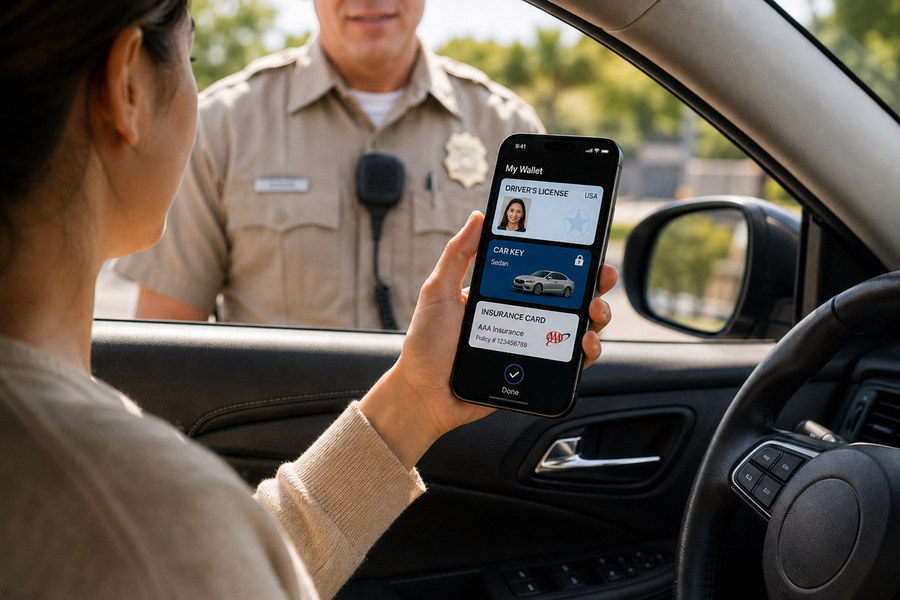
For most of modern life, the wallet has been a small leather object carried in a pocket or a bag, holding the physical tokens that prove who a person is and what they are entitled to do, the driver’s license that establishes identity and the right to drive, the payment cards that allow purchases, the insurance card kept folded in a glovebox, and the keys jingling alongside them. This collection of objects has been so constant a companion that most people barely think about it, patting a pocket before leaving the house to confirm that the familiar bundle is there. Yet over the past several years, a quiet transformation has been underway, in which the contents of that leather wallet have begun migrating, one by one, into the smartphone that nearly everyone already carries, so that the phone is becoming not merely a device for communication and entertainment but the single object that holds a person’s identity, their means of payment, the keys to their car, and the proof that they are insured.
This migration began with payment, as the digital wallets built into smartphones, the most prominent being Apple Wallet on the iPhone and Google Wallet on Android devices, first allowed people to store their credit and debit cards and to pay by tapping their phone at a checkout terminal. But payment was only the beginning, and in recent years these same digital wallets have expanded far beyond their original purpose to hold a growing collection of credentials that once existed only as physical objects, including driver’s licenses and state identification cards, the digital keys that unlock and start a car, proof of automobile insurance, transit passes, hotel room keys, event tickets, and employee or student identification badges. The phone, in other words, is absorbing the wallet, and with it the very tokens by which people prove their identity and access the spaces and services of daily life.
This article examines the digital wallet’s expansion beyond payment into the realm of identity, keys, and insurance, written for readers who may have used their phone to pay for coffee but who have not thought carefully about what it means for the same device to hold their driver’s license or to start their car. It traces how the digital wallet grew from a payment tool into a container for credentials of every kind, then explores in turn the arrival of the mobile driver’s license, the digital car key, and the electronic insurance card, examining what each one is and how it works. It considers the genuine convenience that this consolidation offers, the harder questions of privacy, security, and dependence that it raises, and the practical limits that remain, including the simple but important question of what happens when the phone’s battery dies. The aim is to help readers understand a change that is reshaping the most ordinary objects of daily life, so that they can weigh for themselves the tradeoffs of carrying their identity, their keys, and their coverage on a single glass screen.
From Payment Card to Everything: What the Digital Wallet Has Become
The digital wallet began as a solution to a narrow problem, which was the desire to make payments more convenient and secure by allowing a person to pay with their phone rather than reaching for a physical card. When Apple Wallet and the predecessors of Google Wallet first arrived, their function was simple, to store a digital version of a credit or debit card and to transmit the payment information to a checkout terminal through a short-range wireless technology called near-field communication, the same technology that allows a contactless card to be tapped rather than swiped or inserted. This payment function proved popular because it was fast, because it could be secured with the phone’s fingerprint or face recognition, and because it replaced the actual card number with a substitute code during the transaction, so that a merchant never received the real card details, an arrangement that made the digital payment in some respects more secure than handing over a physical card.
Having established the phone as a place to hold a payment credential, the companies behind these wallets recognized that the same basic capability, the secure storage of a sensitive credential and its transmission to a reader, could be applied to many other kinds of credentials beyond payment cards. The phone already had the necessary ingredients, a secure area of the device’s hardware designed to protect sensitive information, the wireless technologies to communicate with readers, and the biometric authentication to confirm that the person holding the phone was its rightful owner. These same foundations that made mobile payment possible could support the storage of any credential that needed to be held securely and presented to a reader, which opened the door to transforming the digital wallet from a payment tool into a general-purpose container for the tokens of identity and access.
The expansion that followed has been steady and wide-ranging, as the digital wallet has come to hold an ever-growing variety of credentials that reflect the many roles a person plays and the many places they need to enter. Transit systems in numerous cities allowed riders to store transit passes in their phone wallets and to tap their way onto buses and trains, airlines placed boarding passes in the wallet, hotels enabled guests to store a room key on their phone and unlock the door with a tap, and employers and universities began issuing digital versions of the identification badges that open office doors and dormitories. Event tickets, loyalty cards, vaccination records during the pandemic, and membership cards of various kinds all found their way into the digital wallet, so that the single app on the phone came to hold a collection of credentials far broader than anything a leather wallet could comfortably carry.
It is worth pausing on the technical inheritance that made this broad expansion possible, because the digital wallet did not have to be reinvented for each new credential but instead reused a small set of capabilities that the phone had acquired for payment. The secure element, a tamper-resistant chip isolated from the rest of the phone’s software, had been included to protect payment card data, and it proved equally suited to protecting a license number or a car key. The near-field communication radio that transmitted payments could transmit any credential to a compatible reader, and the biometric check that authorized a payment could authorize the presentation of an identity document just as readily. This reuse of a common foundation is why the expansion has been able to proceed so quickly across so many kinds of credentials, since each new use case did not require new hardware but only new software and the cooperation of the institutions that issue the credentials, a pattern that helps explain both the speed of the migration and its dependence on the willingness of states, automakers, and insurers to participate.
The most consequential additions, however, have been the credentials that carry legal weight and that touch the core functions of identity and access in daily life, namely the driver’s license and state identification card, the keys to one’s car, and the proof of insurance. These are different in kind from a coffee shop loyalty card or a concert ticket, because they are the credentials by which a person proves their legal identity to authorities, gains control of a vehicle, and demonstrates compliance with the law’s requirement to carry insurance. The movement of these weighty credentials into the digital wallet marks the moment at which the phone stops being merely a convenient holder of minor passes and becomes a genuine repository of legal identity and access, a development that brings real benefits but also raises questions that a loyalty card never did. The remainder of this article examines these three pivotal credentials in turn, beginning with the one that sits at the foundation of identity, the driver’s license.
Your ID on Your Phone: Mobile Driver’s Licenses
The driver’s license is, for most people, the single most important identity document they carry, serving not only as proof of the right to drive but as the everyday credential by which a person establishes who they are, their age, and their address, used to board flights, to enter age-restricted venues, to verify identity for countless transactions, and to satisfy the requests of authorities. The migration of this document into the smartphone, in the form of what is called a mobile driver’s license or mobile identification, is therefore among the most significant developments in the digital wallet’s expansion, because it places the foundational token of legal identity onto the same device that holds a person’s payments, communications, and much of their daily life. A mobile driver’s license is a digital, cryptographically secured version of the physical license, stored in the phone’s wallet and presented to a reader or verifier electronically rather than handed over as a plastic card.
The deployment of mobile driver’s licenses in the United States has proceeded state by state, because driver’s licenses are issued by individual states rather than the federal government, which means that each state must decide to offer the digital version and build the systems to support it. As of the spring of 2026, Apple reported that thirteen states offered driver’s licenses or state identification cards in Apple Wallet, a group that had grown gradually since the feature first launched, with Arizona becoming the first state to offer it in March 2022, followed by Maryland in May 2022, Colorado in November 2022, and Georgia in May 2023, after which the pace picked up with Ohio, Hawaii, California, Iowa, and New Mexico all joining through 2024, and Montana, North Dakota, West Virginia, and Illinois following through 2025, alongside availability in Puerto Rico. Apple also reported that additional states, including Connecticut, Kentucky, Mississippi, Oklahoma, Utah, Arkansas, and Virginia, had signed on to adopt the feature, though without announced timeframes, indicating that the rollout, while steady, has remained gradual rather than sweeping.
The technical foundation that makes mobile driver’s licenses possible and interoperable is an international standard known by its designation ISO/IEC 18013-5, developed jointly by the International Organization for Standardization and the International Electrotechnical Commission, which defines how a mobile driver’s license is structured, secured, and verified, and how the device holding the license communicates with the device reading it. This standard matters because it establishes a common technical language that allows a mobile license issued by one state to be read and trusted by a verifier that follows the same standard, rather than each state and each reader speaking a different and incompatible dialect. The standard applies to what is called attended verification, in which both the person presenting the license and the official reading it are physically present, and it has been adopted in the mobile license programs of states including California, Maryland, Arizona, and Colorado, providing the shared foundation on which the broader system of mobile identity is being built.
One of the most prominent places where mobile driver’s licenses have found practical use is at airport security, where the Transportation Security Administration has deployed the technology to read them at checkpoints, allowing travelers in participating states to verify their identity by presenting their phone rather than a physical card. The agency’s credential authentication technology readers, in a version designed to read mobile licenses conforming to the international standard, have been deployed at more than two hundred fifty checkpoints, and more than thirty-five airport security operations now accept mobile driver’s licenses for domestic travel. This airport use case has been the leading practical application of the mobile license, the place where most people who have used the feature have done so, and it demonstrates both the promise of the technology and its current limits, since the mobile license works smoothly in this specific, well-equipped setting while remaining unusable in many other contexts where a physical card is still required.
How a Mobile ID Proves Who You Are Without Oversharing
A distinctive and underappreciated feature of the mobile driver’s license, and one of the strongest arguments in its favor, is its capacity to reveal only the specific piece of information a situation requires rather than the entire contents of the license, a capability known as selective disclosure that the physical card cannot match. When a person hands over a plastic driver’s license to prove that they are old enough to buy alcohol, the recipient sees not only the birthdate but the full name, the home address, the license number, and everything else printed on the card, exposing far more personal information than the situation actually requires. The mobile driver’s license, by contrast, can be designed to share only the relevant fact, confirming that the holder is above the required age without revealing the birthdate itself, much less the address or the license number, so that the verification reveals the minimum necessary rather than the maximum available.
This selective disclosure works through the cryptographic design of the mobile license, in which the information is structured so that individual elements can be shared and verified independently, and the verifier can request only the specific attribute needed for the transaction at hand. The system can answer a yes-or-no question, such as whether the person is over a certain age, or provide a single field, such as a photograph for visual confirmation, without surrendering the rest of the data held in the license, and the holder can see and approve what is being shared before it is transmitted. This represents a genuine privacy advantage over the physical card, because it inverts the usual relationship in which proving one thing requires exposing everything, allowing instead a verification that is precise and minimal, revealing only what the specific interaction genuinely requires.
The privacy benefit of selective disclosure is real and important, yet it comes with an essential caveat that prevents it from being a simple and unqualified gain, which is that realizing the benefit depends on the verifiers, the businesses and officials who read the license, actually using readers and systems designed to request only the minimum information rather than demanding everything. A bar that uses a properly configured reader can confirm a customer’s age without learning their address, but the privacy advantage materializes only when the verifying systems are built and operated to take advantage of selective disclosure rather than simply pulling the full set of data because they can. The technology makes minimal disclosure possible, but whether it is actually practiced depends on the choices of those who deploy the readers, and the same infrastructure that enables privacy-protective verification could, if configured differently, collect more rather than less. The promise of proving identity without oversharing is therefore genuine but conditional, a capability that the mobile license provides but that the surrounding ecosystem must choose to honor, and this dependence on the behavior of verifiers is a theme that recurs throughout the story of digital credentials.
Car Keys in Your Pocket: The Phone as a Key
Alongside the migration of identity documents into the phone has come the migration of the car key, a development that allows a smartphone to unlock and start a vehicle in place of the physical key fob, turning the device that already holds a person’s payments and identification into the means of controlling their car. The digital car key, stored in the phone’s wallet, communicates with the vehicle through wireless technologies to lock and unlock the doors and to authorize starting the engine, so that a driver can approach their car, open it, and drive away with nothing in hand but the phone they were already carrying. This capability, once a futuristic novelty, has become a feature offered across a growing range of vehicles and supported by both the major smartphone platforms, marking another step in the consolidation of daily life onto a single device.
The digital car key depends on cooperation between the automakers who build the vehicles and the technology companies who make the phones, and this cooperation has been organized through an industry body called the Car Connectivity Consortium, which develops the shared standard, known as the CCC Digital Key, that allows phones and vehicles from different manufacturers to work together. This standard has evolved through successive versions, with a major advance coming in the version that added two wireless technologies, Bluetooth Low Energy and a more precise technology called ultra-wideband, which together enable hands-free operation in which the car detects the phone’s presence and unlocks as the driver approaches, without requiring the phone to be taken out or tapped against the door. The consortium brings together automakers and technology companies, including Apple, Google, BMW, Mercedes-Benz, Hyundai, Kia, and many others, to test interoperability and certify products, and one of its members, the BMW iX, was the first vehicle to incorporate the version of the standard that supports the advanced hands-free technology.
The wireless technology called ultra-wideband is central to the most seamless version of the digital car key, because it allows the vehicle to determine the precise location of the phone, distinguishing whether the device is outside the door, inside the cabin, or some distance away, which is what makes truly hands-free entry and starting possible while guarding against certain kinds of attacks that exploit less precise technologies. Among the automakers, BMW has been a prominent adopter, with nearly every new BMW since 2021 supporting the digital key, and newer models equipped with the latest in-car software, such as recent versions of the X5 and X7, offering an enhanced digital key that uses ultra-wideband so that the driver can leave the phone in a pocket or bag. Other manufacturers, including Mercedes-Benz, Hyundai, Kia, Genesis, and others, have likewise incorporated the technology, so that the digital car key, while not yet universal, has become an established feature across a meaningful portion of new vehicles.
The security of the digital car key is a subject that the precise wireless technology directly addresses, because earlier electronic keys, including traditional fobs that simply broadcast a signal, proved vulnerable to a class of attacks in which thieves used equipment to capture and relay the signal between a key inside a house and a car parked outside, fooling the vehicle into unlocking. The ultra-wideband technology that underpins the most advanced digital keys was designed in part to defeat these relay attacks, because it measures the precise distance and timing between the phone and the car with an accuracy that makes it extremely difficult to forge or relay, so that the vehicle can be confident the authorized device is genuinely present rather than being impersonated from a distance. This security benefit, alongside the convenience of hands-free operation, is a significant part of the appeal of the newer digital keys, and it illustrates how the same technologies that make these credentials convenient are also being engineered to make them harder to defeat than the physical and electronic keys they replace.
Despite this progress, the digital car key remains far from ubiquitous, and the pace of its spread is governed by the slow turnover of the automobile fleet and the gradual incorporation of the necessary hardware into new vehicles. Industry analysis indicated that in 2024 only around six percent of cars were shipped with the ultra-wideband technology that enables the most advanced hands-free keys, a figure projected to grow to roughly forty percent by 2030 as the hardware becomes more widely available and less expensive, which means that for the near future the digital car key will be a feature enjoyed by a minority of drivers, those with newer and often more expensive vehicles, while the majority continue to carry physical fobs. The digital car key thus illustrates a general pattern in the digital wallet’s expansion, in which a genuinely useful capability arrives first for a fortunate subset of users and spreads only gradually to the broader population, constrained by the physical realities of manufacturing and fleet replacement rather than by the speed of software.
Insurance Cards and the Paperless Glovebox
The third of the weighty credentials migrating into the phone is the proof of automobile insurance, the card that drivers are required by law to carry and to produce when stopped by police or involved in an accident, which has traditionally lived as a small paper or plastic card tucked into the glovebox or wallet. The electronic insurance card, displayed on a smartphone through an insurer’s app or stored in the phone’s wallet, presents the same information as the physical card, the policyholder’s name, the policy number, the vehicle covered, and the dates of coverage, but does so on the device that the driver already carries, eliminating the need to keep track of a paper card that can be lost, left at home, or rendered out of date when a new card arrives with each policy renewal. This shift, while less technologically dramatic than the mobile driver’s license or the digital car key, addresses a genuine everyday annoyance and has become widely accepted.
The acceptance of electronic proof of insurance is notably more advanced than that of the mobile driver’s license, because it does not require the same elaborate technical infrastructure of cryptographic verification and special readers, depending instead on a simpler arrangement in which a driver can show the digital card on their phone screen and an officer can read it visually. As of late 2024, forty-nine states plus the District of Columbia generally accepted some form of electronic proof of automobile insurance, with New Mexico standing as the principal exception and Massachusetts handling proof of insurance through vehicle registration documents rather than a separate card. In the many states that permit electronic proof, police officers are legally required to accept a digital insurance card displayed on a smartphone, which means that for the great majority of American drivers, the paper insurance card has become optional, replaceable by an image or app-based card on the phone.
The form that electronic proof of insurance takes is flexible, reflecting its relatively simple verification requirements, and a driver may present it as a card within the insurer’s own application, as a document saved to the phone’s wallet, as a portable document file, or even as a clear screenshot or image stored on the device, depending on the requirements of the particular state and insurance company. This flexibility makes the electronic insurance card the easiest of the three credentials to adopt, since it does not depend on the driver having a particular model of phone or on the verifier having specialized equipment, and it can be obtained simply by opening an insurer’s app or saving a card to the phone. The convenience is meaningful in practical terms, because the digital card updates automatically when a policy renews, cannot be left in the wrong vehicle, and is always available on the phone that the driver carries, removing a small but real source of friction from the experience of driving.
The electronic insurance card also points toward a quieter shift in how proof of coverage might work in the future, because once the information lives in a digital form rather than on a static card, it becomes possible for verification to move beyond the mere display of a document toward systems in which an officer or an authority could confirm coverage directly against an insurer’s records. Some states have explored or implemented databases that allow law enforcement to check insurance status electronically, which in principle could one day reduce the reliance on the driver producing any card at all, digital or physical, by letting the verifier confirm coverage at the source. This possibility remains uneven and incomplete, and for now the digital card displayed on the phone is the practical reality for most drivers, but it suggests that the electronic insurance card, like the mobile license, may be an intermediate step toward a world in which credentials are verified against authoritative records rather than presented as documents at all, a development that would carry its own implications for privacy and for the records such checks might generate.
Even with this widespread acceptance, the prudent practice remains to keep a paper copy of the insurance card in the vehicle as a backup, a recommendation that experts continue to make despite the digital card’s convenience, for reasons that echo the limitations affecting the other digital credentials. A phone can run out of battery, can be damaged or lost, or can fail to display the card when needed, and an officer at the roadside or another driver after an accident may need the information at a moment when the phone is unavailable, which is why the digital insurance card, for all its convenience, is best treated as a primary but not exclusive means of carrying proof, with a paper card kept in reserve. This advice to retain a physical backup is a recurring refrain across all the digital credentials, reflecting the reality that the migration of these documents into the phone, however far advanced, has not yet reached the point where the physical version can be discarded entirely.
The Convenience Dividend
The consolidation of identity documents, keys, and insurance proof into the smartphone delivers a tangible convenience that, while easy to take for granted, addresses a series of small frictions that have long been part of the texture of daily life, and understanding this convenience helps explain why the migration into the phone has proceeded as steadily as it has. The most immediate benefit is the simple reduction in the number of objects a person must carry and keep track of, since a phone that holds the driver’s license, the payment cards, the car key, and the insurance card replaces a wallet, a key fob, and the various cards within them, allowing a person to leave the house with their phone alone and still possess the means to identify themselves, pay for purchases, drive their car, and prove their coverage. This reduction in physical clutter is modest but real, and it accumulates across the countless daily moments in which a person reaches for one of these objects.
Beyond the reduction in objects, the digital credentials offer a convenience of reliability and currency, because a digital document held in the phone is always the current version, updated automatically when a policy renews or a license is reissued, and it cannot be left at home, dropped on the street, or forgotten in another bag in the way that physical cards and keys routinely are. The traveler who has stored a mobile driver’s license can move through a participating airport checkpoint by presenting the phone they are already holding, the driver with a digital car key need not fish for a fob or worry about having locked the keys inside the vehicle, and the policyholder with an electronic insurance card always has the current proof of coverage rather than an expired card lingering in the glovebox. These conveniences address the specific irritations that physical credentials impose, the lost card, the forgotten key, the outdated document, replacing them with the reassurance that the credential is present and current on the device that rarely leaves a person’s side.
The convenience extends as well to the speed and smoothness of the interactions in which credentials are used, since presenting a phone can be faster and more fluid than retrieving and handing over a physical card, particularly when the technology allows for hands-free or tap-based operation. The hands-free digital car key that unlocks the vehicle as the driver approaches eliminates the moment of standing at the door searching for a key, the mobile license presented at a checkpoint can be verified electronically without the manual inspection of a physical card, and the various passes and credentials in the wallet can be summoned with a tap rather than sorted through in a crowded billfold. This smoothing of small interactions, repeated many times across a day and a life, represents a genuine if undramatic improvement in the friction of daily existence, and it is the cumulative weight of these small conveniences, rather than any single transformative feature, that gives the digital wallet its appeal and drives its steady adoption. Yet the convenience, real as it is, must be weighed against a set of harder questions that the consolidation of identity onto a single device inevitably raises, questions of privacy, security, and dependence that the next section examines.
Privacy, Security, and Who Controls Your Identity
The migration of identity documents, keys, and insurance into the smartphone, for all its convenience, concentrates a person’s most sensitive credentials onto a single device controlled by a small number of powerful companies, and this concentration raises profound questions about privacy, security, and control that deserve careful attention rather than being waved away by the appeal of convenience. When the driver’s license, the car key, the payment cards, and the insurance proof all reside in the phone, the device becomes a master credential whose compromise, loss, or surveillance carries far greater consequences than the loss of any single physical card, and the companies that control the wallet platforms, principally Apple and Google, occupy a position of extraordinary influence over the infrastructure of identity. These concerns do not negate the benefits of digital credentials, but they form an essential counterweight that anyone adopting these technologies should understand.
The security model of the digital wallet is, in important respects, genuinely strong, and it would be a mistake to assume that storing credentials on a phone is inherently less safe than carrying them as physical cards, since the digital approach incorporates protections that the plastic card lacks. The credentials in the wallet are stored in a specially protected area of the phone’s hardware designed to resist tampering, their use is gated by the phone’s biometric authentication so that a thief who steals the phone cannot present the owner’s license or use their car key without the owner’s fingerprint or face, and the transmission of credentials to readers is encrypted and, in the case of payments and selective disclosure, designed to reveal only what is necessary. A lost physical wallet exposes everything in it to whoever finds it, whereas a lost phone, properly secured, keeps its credentials locked behind authentication, which means that in the specific dimension of protecting credentials against use by a thief, the digital wallet can offer better security than the leather one.
Against these security strengths must be set the deeper concerns about surveillance and the creation of records, because the electronic presentation of identity, unlike the visual inspection of a plastic card, can in principle generate data about when and where a person proved their identity, and this potential for tracking is among the most serious privacy questions raised by digital credentials. Each time a mobile license is read electronically, there is the possibility, depending on how the systems are designed, that a record is created of the verification, and the aggregation of such records across the many points where identity is checked could produce a detailed picture of a person’s movements and activities that the casual showing of a physical card never did. The selective disclosure that allows a mobile license to reveal less than a plastic card is a genuine privacy protection, but it addresses what is shared in a given interaction rather than whether the fact of the interaction is recorded, and the broader question of who can learn when and where a person used their digital identity depends on choices made by states, verifiers, and platform companies that are not always visible to the user.
The concentration of identity infrastructure in the hands of a few private companies raises a further set of concerns about dependence and control, because when the driver’s license and other credentials live within Apple Wallet or Google Wallet, the companies that operate those platforms become gatekeepers to the use of one’s own identity, with the power to set the terms, the supported devices, and the conditions under which the credentials function. A person whose identity depends on their phone’s wallet is dependent on the company that makes the phone and the software, on that company’s decisions about which devices and which states to support, and on the continued functioning of the company’s systems, a dependence that did not exist when the driver’s license was a piece of plastic issued by the state and usable by anyone regardless of what phone they carried. This shift of identity infrastructure from public documents toward private platforms concentrates significant power in a small number of technology companies, and it raises questions about equity for those who do not own a recent smartphone, about the terms on which access to one’s own identity is mediated by a corporation, and about the resilience of a system in which the proof of who one is depends on a commercial device and the company behind it. These questions do not have easy answers, and they form part of the considered judgment that the convenience of the digital wallet should not be allowed to obscure.
When the Battery Dies and Other Real-World Limits
The most immediate and intuitive concern that occurs to nearly everyone considering the move of essential credentials onto a phone is the simple question of what happens when the battery dies, a scenario that captures in concrete form the broader anxiety about depending on a single electronic device for identity, access, and proof of coverage. A physical driver’s license, car key, and insurance card never run out of power, never need charging, and never fail because of a software problem, whereas a phone can be drained, damaged, lost, or stuck on a malfunctioning screen at precisely the moment when its credentials are needed, and this dependence on a charged and functioning device is the most tangible limitation of the digital wallet. The concern is real and reasonable, and it deserves a clear-eyed answer rather than dismissal.
The phone makers have anticipated this concern and built in a partial safeguard, a feature called power reserve that allows certain credentials to remain usable for a limited time after the phone’s battery has otherwise died, addressing the dead-battery scenario at least in part. On iPhone models from 2018 onward, credentials with what Apple calls express mode, which can include transit cards, car keys, and home or hotel keys, may remain available for up to five hours after the battery has been depleted, so that a person whose phone has died can still tap to ride transit or unlock and start their car for a window of time. This power reserve operates only when the battery drains naturally rather than when the phone is deliberately turned off, and repeatedly invoking it draws down the small remaining reserve, so it is a genuine but limited safeguard, providing a buffer of hours rather than an indefinite guarantee, and it does not cover every credential in every situation.
Beyond the battery question, the digital credentials face a more pervasive limitation in the uneven and incomplete state of their acceptance, since a credential that exists on the phone is useful only where the systems and authorities are equipped and willing to accept it, and that acceptance remains partial across all three of the credentials examined. The mobile driver’s license, available in only thirteen states and accepted mainly at airport checkpoints and a limited set of other locations, cannot yet replace the physical license for the many interactions, including encounters with law enforcement in most contexts, where a plastic card is still required, which is why even residents of participating states must continue to carry the physical license. The digital car key works only with compatible vehicles, a minority of the fleet, and the electronic insurance card, though widely accepted, is not recognized in every state. This patchwork of acceptance means that the digital credentials, for all their promise, supplement rather than replace their physical counterparts, and the person who relies solely on the phone risks finding, at an inconvenient moment, that the particular verifier before them does not accept the digital form.
These limitations together explain why the consistent advice from experts and from the providers of these credentials is to treat the digital versions as a convenient primary option while retaining the physical credentials as a backup, a recommendation that reflects the transitional moment at which the technology currently stands. The plastic driver’s license, the physical key fob, and the paper insurance card have not become obsolete, and carrying them alongside their digital counterparts remains the prudent course, because the digital wallet, however far it has advanced, has not yet achieved the universal acceptance and the freedom from technical failure that would allow the physical versions to be discarded. The migration of identity, keys, and insurance into the phone is a real and accelerating trend, but it is a migration still in progress, and the wise user enjoys the convenience of the digital credentials while keeping the physical ones in reserve against the dead battery, the unaccepting verifier, and the other contingencies that a single electronic device cannot yet fully overcome.
Final Thoughts
The absorption of the driver’s license, the car key, and the insurance card into the smartphone represents a quiet but profound reordering of the most ordinary objects of daily life, transforming the phone from a device for communication and payment into the central repository of a person’s identity, access, and legal standing. This transformation reflects a broader pattern in which the smartphone, already the hub of so much of modern existence, steadily absorbs the functions of the separate objects that people once carried, consolidating into a single glass screen the tokens by which they prove who they are, enter the spaces of their lives, and demonstrate their compliance with the law. The convenience of this consolidation is genuine and considerable, and it is the cumulative weight of small daily frictions removed, rather than any single dramatic capability, that has driven the steady migration of credentials into the phone.
Yet the significance of this change extends well beyond convenience, because the credentials now moving into the phone are not minor passes but the foundational tokens of identity and access, and their migration raises questions about privacy, security, equity, and control that a loyalty card never did. The same consolidation that makes life more convenient also concentrates a person’s most sensitive credentials onto a single device controlled by a small number of powerful companies, creating new dependencies and new possibilities for surveillance even as it offers real protections against the loss and misuse that plague physical cards. The capacity of the mobile license to reveal only what a situation requires points toward a future in which proving one’s identity need not mean exposing everything about oneself, a genuine advance for privacy, while the concentration of identity infrastructure in private platforms points toward harder questions about who controls the means by which people prove who they are.
The matter of equity deserves particular emphasis, because a system in which identity, keys, and insurance increasingly live on a recent smartphone risks leaving behind those who do not own such a device, and the public character of the driver’s license as a document issued by the state and usable by anyone must not be quietly surrendered to a system that works only for those with the latest phones. The promise of digital credentials will be fully realized only if their benefits are extended broadly and if the physical alternatives remain available to those who need them, so that the convenience of the phone does not become a barrier for those on the wrong side of the digital divide. The transition now underway is real and accelerating, but it remains incomplete, with acceptance uneven, technical limits unresolved, and the physical card still necessary as a backup against the dead battery and the unaccepting verifier.
The migration of the wallet’s contents into the phone is, in the end, a story still being written, one in which the convenience of consolidation must be continually balanced against the privacy, security, and fairness concerns that consolidation creates. The thoughtful path forward treats the digital credential as a powerful and welcome tool while insisting that it be built and governed in ways that protect rather than erode the privacy and autonomy of the people who use it, and that preserve access for all rather than only for the technologically fortunate. The phone may well become the universal holder of identity that its trajectory suggests, but whether that future serves people well will depend on the choices made now about how these systems are designed, who controls them, and whose interests they ultimately serve.
FAQs
- What is a mobile driver’s license and how is it different from a photo of my license?
A mobile driver’s license is a cryptographically secured digital version of your license stored in your phone’s wallet and verified electronically, not merely a picture. Unlike a photo, it is tamper-resistant, can be authenticated by a reader to confirm it is genuine, and can share only the specific information a situation requires, such as confirming you are over a certain age without revealing your address or birthdate. - Which states offer driver’s licenses in Apple Wallet?
As of spring 2026, thirteen states offered licenses or state IDs in Apple Wallet, including Arizona, Maryland, Colorado, Georgia, Ohio, Hawaii, California, Iowa, New Mexico, Montana, North Dakota, West Virginia, and Illinois, along with Puerto Rico. Additional states such as Connecticut, Kentucky, Utah, and Virginia have signed on to adopt the feature, though without announced dates, so the rollout remains gradual. - Can I leave my physical driver’s license at home if I have it on my phone?
No, not yet. Mobile licenses are accepted mainly at airport security checkpoints and a limited set of other locations, and they are not accepted by law enforcement in most contexts. Even in participating states you must still carry your physical license, because the digital version supplements rather than replaces the plastic card given the patchwork of current acceptance. - How does a digital car key work?
A digital car key stored in your phone’s wallet communicates wirelessly with a compatible vehicle to lock, unlock, and start it. Using technologies such as Bluetooth Low Energy and ultra-wideband, newer systems can detect the phone as you approach and let you enter and drive hands-free without taking the phone out, following a shared standard developed by the Car Connectivity Consortium so phones and cars from different makers work together. - Which cars support digital keys on a phone?
Support is growing but still limited to a minority of vehicles, generally newer and often more expensive models. Nearly every new BMW since 2021 supports the digital key, and Mercedes-Benz, Hyundai, Kia, Genesis, and others have adopted it as well. In 2024 only about six percent of cars shipped with the ultra-wideband technology that enables the most advanced hands-free keys, a figure projected to reach roughly forty percent by 2030. - Is it legal to show proof of car insurance on my phone?
In most of the United States, yes. As of late 2024, forty-nine states plus the District of Columbia generally accepted electronic proof of insurance, with New Mexico the main exception and Massachusetts handling proof through registration documents. In states that permit it, police officers are legally required to accept a digital insurance card displayed on your smartphone, though keeping a paper copy as backup is still wise. - What happens to my credentials if my phone’s battery dies?
Phone makers have built in a partial safeguard called power reserve. On iPhone models from 2018 onward, certain credentials with express mode, such as transit cards and car keys, can remain usable for up to five hours after the battery dies, but only if the battery drained naturally rather than being switched off. This is a limited buffer, not an indefinite guarantee, which is why carrying physical backups remains prudent. - Are digital credentials safer or riskier than physical cards?
Both. Digital credentials are stored in a protected area of the phone’s hardware, gated by fingerprint or face authentication, and transmitted in encrypted form, so a thief who steals your phone cannot easily use them, which can be safer than a lost wallet that exposes everything. The risks lie in concentrating sensitive credentials on one device controlled by a few companies and in the potential for electronic verification to create records of where and when you proved your identity. - What is selective disclosure and why does it matter?
Selective disclosure is the ability of a mobile license to share only the specific fact a situation requires rather than the whole document. A bar can confirm you are old enough to drink without seeing your address or license number, which inverts the usual situation where proving one thing exposes everything. The privacy benefit is real, but it materializes only when the businesses and officials reading the license use systems designed to request the minimum information. - Do I need a particular phone to use these digital credentials?
Generally yes, you need a reasonably recent smartphone that supports the relevant wallet features, which raises equity concerns for those without one. Mobile licenses, digital car keys, and wallet-based credentials depend on the secure hardware, wireless technologies, and software found in newer iPhone and Android devices, and specific features such as power reserve or ultra-wideband car keys require particular models, so older or basic phones may not support the full range of capabilities.