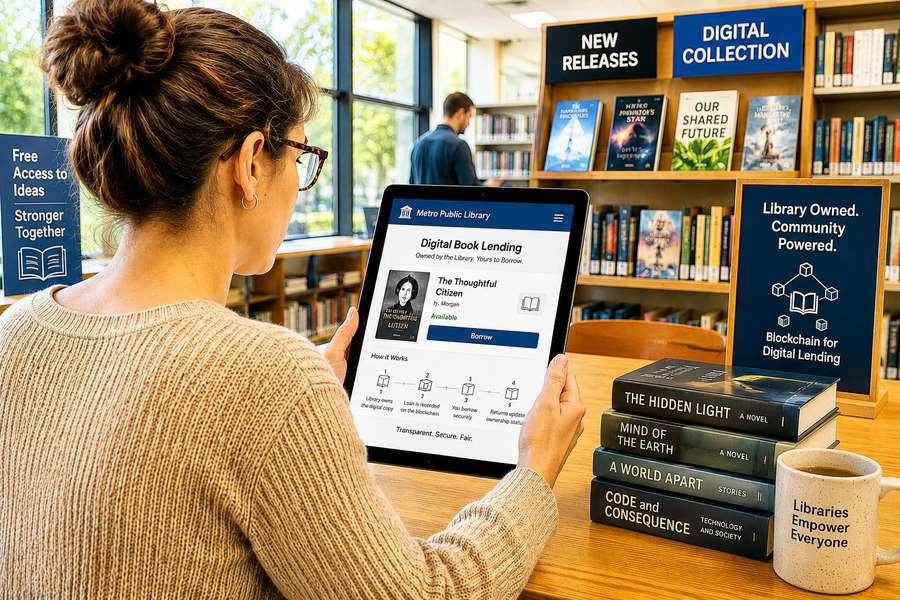
For generations, the public library has rested on a simple and powerful arrangement, in which the library buys a book, owns it outright, and lends it freely to one reader after another for as long as the physical object survives, a practice so familiar that few people pause to consider the legal foundation that makes it possible. That foundation is a principle of copyright law sometimes called the first sale doctrine, which holds that once a library has lawfully purchased a copy of a book, it may lend that copy, give it away, or sell it without seeking further permission from the publisher, because the publisher’s control ends at the sale. This principle is what allows a library to build a permanent collection from the books it buys, lending each volume hundreds of times over the years at no additional cost, and it is the quiet legal engine behind the library’s enduring role as a place where anyone can borrow a book for free.
When books became digital, however, this arrangement quietly broke down, because a library that offers ebooks does not buy and own them in the way it owns a physical book but instead licenses them under restrictive terms set by publishers, terms that bear little resemblance to ownership and that have transformed the economics and the freedoms of library lending. A library that licenses an ebook typically does not own it at all but rents the right to lend it under conditions that may cause the license to expire after a set period or a set number of checkouts, after which the library must pay again to continue offering the same title, so that the permanent collection built from owned books gives way to a perpetual stream of payments for temporary access. The familiar act of borrowing an ebook from the library, which feels to the reader like the digital equivalent of borrowing a physical book, rests on a foundation utterly different from the one beneath the physical shelves, a foundation of licenses rather than ownership that has shifted power and money toward publishers and the intermediaries who broker the licenses.
This article examines a technology that some believe could restore to libraries a form of genuine ownership over their digital collections, namely blockchain, the distributed ledger technology best known for underpinning cryptocurrencies, which offers a way to represent a digital book as a controllable, ownable object rather than a mere license. It is written for readers who borrow ebooks from their libraries but who may not realize how different the digital arrangement is from the physical one, and it begins by explaining the licensing model that governs library ebooks today and why it costs libraries so much. It then explains in plain language how blockchain and smart contracts could change digital ownership, examines the real platforms that have begun to put blockchain book ownership into practice, considers the pivotal legal battle over digital lending that has shaped what libraries may and may not do, and weighs what a shift toward blockchain-based ownership could mean for libraries, readers, and publishers, along with the substantial obstacles that stand in the way.
The Hidden Truth About Library Ebooks: You’re Renting, Not Owning
The central fact that most library patrons do not know is that when they borrow an ebook through a service like Libby, the application many libraries use to lend digital books, the library has not bought that ebook in any meaningful sense but has licensed it under terms that make the arrangement closer to a rental than a purchase. Libraries do not own the ebooks they offer through these services but instead acquire licenses that expire after a defined period, often one or two years, or after a certain number of checkouts has been reached, after which the library can no longer lend the title and must purchase a new license if it wishes to continue offering the book. This expiration is the crucial difference from the physical world, because a physical book bought by a library remains in the collection indefinitely, lent again and again for decades, whereas a licensed ebook vanishes from the library’s offerings when its license runs out, requiring repeated repurchase to maintain access to the same title.
The terms of these licenses are set by publishers, who have used their control over digital rights to impose conditions that would be impossible in the physical world, where the first sale doctrine limits their power once a copy is sold. Because an ebook is licensed rather than sold, the first sale doctrine does not apply in the same way, and publishers have therefore been able to dictate that libraries may lend a licensed ebook to only one patron at a time, just like a physical copy, while also subjecting that single-user license to expiration after a period or a number of loans, combining the scarcity of the physical book with the impermanence of a rental. This means that a library serving a community of thousands, faced with a popular new title, must license many copies to meet demand, knowing that each of those licenses will eventually expire and require repurchase, a structure that turns the library’s collection into a perishable inventory rather than a permanent asset.
The history of these restrictions includes episodes that drew widespread attention to the power publishers hold over library digital lending, the most prominent being a policy adopted by the publisher Macmillan, which in 2019 imposed an embargo allowing a library system to purchase only a single perpetual license for a new ebook title upon publication and then to wait eight weeks before purchasing additional metered licenses. Under that policy, a large library system serving an entire metropolitan area could offer only one copy of a hot new Macmillan title for the first two months after its release, so that with a typical two-week loan period only a handful of patrons could read the book while everyone else waited, a restriction that provoked boycotts and advocacy from libraries and that Macmillan eventually rescinded. Although that particular embargo ended, the episode illustrated the breadth of the control publishers wield over digital lending and the willingness of some to use that control in ways that sharply limit what libraries can offer, a power that flows directly from the shift from ownership to licensing.
The consequences of this licensing model for libraries are significant and ongoing, because the need to repeatedly repurchase expiring licenses imposes a continuous drain on library budgets that the ownership of physical books never did, turning what was once a one-time acquisition into a recurring expense. A library that built its physical collection through purchases that lasted for decades now finds that a substantial and growing share of its acquisitions budget must go toward licenses that expire and must be renewed, so that the same dollars buy temporary access rather than permanent ownership, and the library can never truly build a lasting digital collection in the way it built its physical one. This recurring cost, combined with the high prices that publishers charge for library ebook licenses, has created a financial pressure on libraries that is one of the central reasons some have looked toward alternatives, including the possibility that blockchain technology could restore a form of genuine ownership, a possibility that requires first understanding why library ebooks cost so much.
Why a Digital Book Costs a Library More Than a Hardcover
One of the most counterintuitive aspects of library ebook licensing is that a digital book, which costs almost nothing to copy and distribute, typically costs a library far more than the physical hardcover of the same title, an inversion of ordinary expectations that reflects the pricing power publishers hold over digital rights. A vivid illustration comes from popular titles for which a single library ebook license commonly costs around sixty dollars, allowing the book to be lent to only one reader at a time and expiring after a period such as two years, while the hardcover edition of the same book might cost a consumer roughly fifteen dollars and, if bought by the library, would remain in the collection permanently. The library, in other words, pays several times the consumer price for a digital copy that it does not own and that will expire, while the cheaper physical copy it can own outright and lend indefinitely, a pricing structure that defies the intuition that digital should be cheaper.
The magnitude of this markup is substantial and well documented, with libraries commonly paying three to five times the consumer price for ebook licenses, and with the average price of a library ebook license reported at sixty-five dollars or more and library audiobook licenses often exceeding one hundred dollars, prices that apply to copies that will expire and require repurchase. These figures mean that the cost of maintaining a digital collection that meets patron demand can be far higher than the cost of the equivalent physical collection, because the library must pay premium prices repeatedly for licenses that do not last, rather than once for books that do. The result is that the convenience of digital lending, which patrons increasingly expect and prefer, comes at a cost to libraries that is often greater, not smaller, than the cost of the physical books it supplements or replaces.
A significant part of this cost structure flows from the role of intermediaries who sit between publishers and libraries, brokering the licenses and operating the platforms through which digital lending occurs, adding their own margins to the arrangement. The dominant such intermediary is a company that acquires digital distribution rights from publishers and then sells lending rights to libraries, operating as a for-profit business that profits from the public funds that libraries spend, so that tax dollars allocated to public libraries flow through a private corporation that takes its share. This concentration of digital library lending in the hands of a single dominant platform, combined with the licensing terms set by publishers, creates a system in which libraries have limited leverage and must accept the prices and conditions offered to them, a dependence that mirrors the broader pattern of digital intermediaries capturing value, and that has prompted interest in alternative models, including blockchain-based approaches that might reduce the role of such intermediaries and restore ownership to libraries.
How Distributed Ledgers Could Change Digital Ownership
To understand how blockchain might change library digital lending, it is necessary first to understand the fundamental problem that blockchain claims to solve in the realm of digital goods, which is the difficulty of making a digital file behave like a physical object that can be genuinely owned, transferred, and controlled. A digital file, by its nature, can be copied perfectly and infinitely at no cost, which is wonderful for spreading information but problematic for ownership, because if anyone can make a perfect copy then no one truly owns a particular copy in the way a person owns a physical book that exists as a single unique object. The licensing model that governs library ebooks is in part a response to this problem, a way for publishers to impose artificial scarcity and control on files that would otherwise be infinitely copyable, and blockchain offers a different response, a technical means of making a digital item behave more like a unique, ownable object.
A blockchain is a kind of digital ledger, a record of who owns what, that is maintained not by a single company but by a network of many computers that each hold a copy and agree, through a defined process, on what the record says, which makes the record difficult to falsify and removes the need for a single trusted authority to maintain it. On such a ledger it is possible to create a token, a unique digital entry that represents ownership of a particular item and that can be transferred from one owner to another in a way the ledger records and enforces, so that even though the underlying file might be copyable, the token representing legitimate ownership of a specific copy is unique and controllable. This is the technology behind what are often called non-fungible tokens, unique digital tokens that represent ownership of a particular digital item, and it offers a way to make a digital book behave like a unique object that can be owned, lent, and transferred rather than merely licensed.
Built on top of this ownership ledger are smart contracts, which are small programs that live on the blockchain and execute automatically according to their coded rules, and which can govern how a tokenized digital book may be used, lent, and transferred without requiring a central authority to administer the process. A smart contract attached to a tokenized book could, for example, enforce that the book may be lent to only one borrower at a time, automatically returning it to the lender after a set period, or could permit the owner to resell or transfer the book while ensuring that only one valid copy circulates, encoding the rules of lending and ownership into the token itself rather than relying on a platform like the current intermediaries to enforce them. In principle, this would allow a library to own a tokenized digital book outright, lend it under rules enforced by the smart contract, and keep it permanently in its collection, restoring the ownership that the licensing model took away.
Beyond the question of ownership, advocates of blockchain for libraries point to the technology’s capacity to streamline the administrative machinery of lending, particularly the cumbersome process of interlibrary loan by which one library borrows materials from another on a patron’s behalf. Because a blockchain maintains a shared and tamper-resistant record that many institutions can trust without a central authority, smart contracts could automate lending transactions and interlibrary loans, enforce lending policies consistently, and provide an auditable trail of every borrowing and return, reducing the friction and the record-keeping burden that currently accompany the movement of materials between libraries. This administrative dimension is less dramatic than the restoration of ownership but is genuinely useful, because libraries spend considerable effort coordinating loans and tracking materials, and a shared ledger that all participating libraries could rely on might make these processes more efficient and transparent, an application of blockchain to library operations that does not depend on resolving the thornier questions of digital book ownership.
The appeal of the ownership approach for libraries lies in the possibility of recreating, in the digital realm, the ownership arrangement that the first sale doctrine provides in the physical realm, so that a library could buy a digital book once and own it permanently, lending it again and again under controlled conditions without paying repeatedly for expiring licenses. If a library could acquire a tokenized book that it genuinely owned, with a smart contract enforcing one-borrower-at-a-time lending in the same way a physical book naturally allows only one borrower at a time, then the library could build a permanent digital collection much as it builds a physical one, escaping the perpetual repurchase that the licensing model imposes. This vision, of blockchain restoring genuine ownership to library digital collections, is compelling in theory, and to assess whether it is realistic it is necessary to examine the platforms that have actually begun to put blockchain book ownership into practice, beginning with the most prominent attempt to give digital book buyers true ownership.
True Ownership in Practice: Book.io and Blockchain Books
The clearest real-world example of an attempt to give digital books genuine ownership through blockchain is Book.io, a company founded in 2022 that places ebooks and audiobooks on the blockchain using a technology it calls decentralized encrypted assets, with the explicit aim of allowing readers to truly own their digital books rather than merely license them. Book.io’s premise is precisely the one that motivates interest in blockchain for libraries, namely that the current model of digital books denies buyers real ownership, and that by representing a book as a token on a blockchain, the buyer can own it in a way that allows them to sell, gift, lend, or otherwise control it, much as they could a physical book. The company has positioned itself as a demonstration that digital books need not be perpetual rentals, that the technology exists to make a digital book an ownable object, and that a market for genuinely owned digital books can function.
The technology that Book.io employs, which it describes as decentralized encrypted assets, is designed to address the central challenge of making a digital book both ownable and protected, by having the digital asset live entirely on the blockchain rather than on a centralized server, with the content encrypted so that only the owner of the token can access it. This approach attempts to combine the ownership benefits of a blockchain token, which can be transferred and resold, with the protection that publishers require, since the content is encrypted and accessible only to the legitimate owner, so that the book can be owned and transferred without being freely copyable by anyone. By placing the asset on the blockchain and freeing it from dependence on a central server, the model aims to give the owner durable control over their book, independent of any single company that might change its terms or cease to operate, addressing one of the concerns about licensed digital content that can disappear when a platform changes its policies.
The practical activity of Book.io provides concrete evidence that the model can operate, with the company having released real books as blockchain assets in collaboration with notable partners, demonstrating that the approach functions beyond mere theory. In 2023 the company worked with the Algorand Foundation to release ten thousand copies of Aldous Huxley’s classic novel Brave New World as blockchain-based ebooks, presented as the first time a reader could truly own a digital copy of that 1932 work, and in the same year it released the entrepreneur Mark Cuban’s book on business as a limited edition of ten thousand numbered ebooks on the Polygon blockchain. The company has released decentralized encrypted assets across several blockchain networks, including Cardano, Ethereum, Algorand, and Polygon, and it attracted investment from the venture arm of a major media company, signals that the venture has drawn serious interest and resources rather than remaining a purely experimental curiosity. In its early days the venture, then operating under a different name, reported selling around one hundred thousand dollars worth of blockchain ebooks on its first day of sales, an indication that there was genuine consumer appetite for owned digital books and not merely theoretical interest, and the subsequent collaborations with recognized authors and blockchain foundations built on that early traction to establish the model as a functioning commercial reality rather than a speculative proposition.
A particularly significant feature of the Book.io model, and one with direct relevance to the question of library lending, is its provision for a secondary market in which owners can resell their digital books, with publishers and authors earning royalties on every resale in perpetuity, an arrangement that addresses one of the publishers’ deepest objections to genuine digital ownership. In the physical world, a person who buys a book can resell it, but the author and publisher earn nothing from that resale, whereas the Book.io model allows the resale to occur while directing a royalty to the author and publisher each time, so that genuine ownership and transferability coexist with ongoing compensation for the creators. This feature is important because it suggests a way to reconcile the interests that the current licensing model sets in opposition, giving buyers real ownership and the right to transfer their books while ensuring that publishers and authors continue to be compensated, a reconciliation that, if it could be extended to library lending, might address some of the publisher concerns that have shaped the restrictive licensing of library ebooks. Whether the consumer ownership model that Book.io demonstrates can be adapted to the specific needs of library lending remains an open question, but the company shows that genuine blockchain-based book ownership is technically achievable and commercially operational.
Lending, Reselling, and the Smart Contract: Bookchain
A second platform that illustrates how blockchain can be applied to digital books, with particular attention to the configuration of lending and resale rights, is Bookchain, a platform developed by the Canadian company Scenarex that uses blockchain and smart contracts to let publishers and authors control how their ebooks may be used, including whether they may be lent or resold. Bookchain demonstrates the flexibility that smart contracts bring to digital book rights, because rather than imposing a single fixed set of restrictions, the platform allows the configuration of security, traceability, attribution, and distribution settings for each book, including the optional ability to enable lending and reselling, so that the rights attached to a digital book can be tailored rather than dictated by a one-size-fits-all license. This configurability is significant because it shows that blockchain-based book systems need not lock books into rigid terms but can instead encode varied and flexible rules into each book’s smart contract.
The use of smart contracts to govern lending is directly relevant to the library question, because it shows how the rules that libraries need, particularly the limitation of lending to one borrower at a time with automatic return, could be encoded into a digital book in a way that enforces them without a central intermediary. A smart contract can be written to allow a book to be lent, to track who currently holds it, and to ensure that only one valid loan exists at a time, returning the book to its owner when the loan period ends, which replicates in code the natural scarcity of a physical book and the controlled lending that libraries practice. By making lending a configurable feature enforced by the smart contract rather than by a platform’s policies, the model points toward a way that libraries could lend genuinely owned digital books under controlled conditions, maintaining the one-at-a-time discipline that publishers expect while owning the books permanently.
A distinctive characteristic of the Bookchain platform is its deliberate avoidance of cryptocurrency, which sets it apart from many blockchain ventures and addresses a major barrier to adoption among ordinary users and institutions. The platform was built to be free of cryptocurrency, allowing payments to be made through ordinary methods such as a credit card rather than requiring users to acquire and use digital currencies, a design choice that recognizes that the complexity and unfamiliarity of cryptocurrency is a significant obstacle for most people and most institutions, including libraries. By separating the benefits of blockchain-based ownership and smart-contract enforcement from the requirement to use cryptocurrency, the platform makes the technology more accessible to the libraries, publishers, and readers who might benefit from it but who have no interest in or familiarity with digital currencies, an approach that has received support from public cultural funding in Canada and that suggests one path toward making blockchain book systems practical for mainstream institutional use. The example of Bookchain, taken together with Book.io, shows that the technical building blocks for genuinely owned, lendable, and resellable digital books exist and have been implemented, even if their application specifically to public library lending remains largely prospective rather than realized at scale.
The Legal Battle Over Digital Lending: Hachette v. Internet Archive
Any discussion of reinventing library digital lending must reckon with the legal constraints that govern what libraries may do with digital books, constraints brought into sharp focus by a major lawsuit that tested whether libraries could lend digital copies of books they owned, a case that ended in a decisive defeat for the expansive view of library digital rights. The case centered on a practice known as controlled digital lending, a model under which a library digitizes a physical book it owns and lends out the digital copy while keeping the physical copy out of circulation, maintaining a strict one-to-one ratio between owned physical copies and digital copies in circulation, so that the library never lends more digital copies than the physical books it actually owns. Controlled digital lending was conceived as a way to bring the first sale doctrine into the digital realm, allowing libraries to lend digital versions of their owned books on the theory that lending one digital copy in place of one withheld physical copy was equivalent to lending the physical book, and it represented the library world’s most ambitious attempt to assert digital lending rights based on ownership.
The practice was challenged when a group of major publishers, led by Hachette Book Group, sued the Internet Archive, a nonprofit organization that operated a large controlled digital lending program, arguing that its digitization and lending of books without licenses infringed their copyrights. The case proceeded through the federal courts, and in March 2023 the District Court for the Southern District of New York ruled in favor of the publishers, finding that the Internet Archive’s controlled digital lending was not protected by the fair use doctrine, the provision of copyright law that permits certain unlicensed uses of copyrighted works. The Internet Archive appealed the decision, but in September 2024 the Second Circuit Court of Appeals affirmed the lower court’s ruling, holding that the controlled digital lending program violated copyright law and rejecting the argument that the practice qualified as fair use, a decision that represented a major victory for the publishing industry and a significant setback for the library digital lending movement. The Internet Archive subsequently decided, in December 2024, not to pursue a further appeal to the Supreme Court, leaving the appellate ruling as the governing law.
The significance of this legal defeat for the prospect of blockchain-based library lending is considerable, because it establishes that libraries do not have a general right to digitize and lend the books they own without the permission of publishers, regardless of how carefully they control the number of copies in circulation. The ruling means that the mere fact that a library owns a physical book, or could own a tokenized digital book, does not by itself confer the right to lend a digital copy in defiance of the publishers’ licensing arrangements, so that a technical capacity to enforce controlled lending through a blockchain smart contract does not resolve the legal question of whether such lending is permitted. The technology that blockchain provides, however elegant its enforcement of one-at-a-time lending, operates within a legal framework that the Hachette decision has clarified to the disadvantage of libraries, and any blockchain-based approach to library digital lending would have to be built either on books that libraries are licensed or authorized to lend digitally or on a future change in the law or in publisher practices.
This legal reality tempers the optimism that blockchain’s technical capabilities might inspire, because it shows that the central obstacle to reinventing library digital lending is not primarily technical but legal and commercial, rooted in the rights that publishers hold and the courts have upheld. A blockchain system can make a digital book ownable and can enforce controlled lending, but it cannot by itself grant libraries the legal right to lend digital books that they have not been authorized to lend, which means that the realization of blockchain’s promise for libraries depends not only on the technology but on the willingness of publishers to participate in new models or on changes in the legal landscape. The platforms like Book.io and Bookchain that have implemented blockchain book ownership have done so in cooperation with publishers and authors, working within the rights framework rather than against it, which points toward the conclusion that any blockchain-based future for library lending will require the cooperation of publishers rather than an attempt to circumvent their rights, a cooperation that the current incentives do not obviously favor.
What Blockchain Lending Could Mean for Libraries and Readers
Setting aside for a moment the formidable legal and commercial obstacles, it is worth considering what a blockchain-based model of library digital lending could mean for libraries and the readers they serve, because the potential benefits are substantial and help explain why the idea attracts interest despite the difficulties. The most fundamental benefit would be the restoration of genuine ownership, allowing libraries to buy digital books once and own them permanently, building lasting digital collections in the way they build physical ones rather than paying repeatedly for expiring licenses, which would relieve the continuous budgetary drain that the current licensing model imposes. A library that owned its digital books outright could lend them indefinitely, preserve them as part of a permanent collection, and direct the funds currently consumed by license renewals toward acquiring more titles and serving more readers, a transformation of library economics that would strengthen the institution’s capacity to fulfill its mission.
For readers, a shift toward owned digital collections could mean broader and more reliable access to library ebooks, because libraries freed from the cost of perpetual repurchase could maintain larger and more stable digital collections, and titles would not vanish from the library’s offerings when licenses expired. The current model creates a situation in which a book available one year may be gone the next if the library cannot afford to renew the license, and in which budget pressures force libraries to ration their digital offerings, so that a model of genuine ownership could provide readers with more dependable access to a wider range of titles over time. The preservation function of libraries, their role in keeping books available across generations, is also undermined by the licensing model, since a library cannot preserve a book it does not own and that disappears when its license ends, whereas owned digital books could be preserved much as physical books are, maintaining the library’s role as a guardian of the cultural record.
It is worth noting that the library community has not waited idly for blockchain to mature but has pursued its own efforts to build shared infrastructure for digital and controlled lending, efforts that illustrate both the appetite for alternatives and the practical difficulty of creating them. Library consortia have collaborated with software developers to build tools for controlled digital lending and interlibrary loan, with one such effort producing software released in 2023 to facilitate and process controlled digital lending requests among participating institutions, developed through partnerships among academic libraries seeking to share their owned materials more effectively. These library-led initiatives, while not blockchain-based, reflect the same underlying desire to reclaim control over digital lending from restrictive licensing and dominant intermediaries, and they suggest that any blockchain approach would enter an environment in which libraries are already experimenting with new models, an environment that might prove receptive to a technology that could genuinely restore ownership if the legal and commercial barriers could be overcome.
The reduction or reconfiguration of the role of intermediaries represents another potential benefit, because a blockchain-based system in which libraries hold and lend their own tokenized books, with smart contracts enforcing the lending rules, could reduce the dependence on the dominant for-profit platform that currently brokers digital library lending and takes its margin from public funds. If libraries could acquire and manage their owned digital books through a more open infrastructure, the public money currently flowing to a private intermediary might be redirected toward the libraries’ core purposes, and the libraries might gain greater control over their digital collections and the terms on which they lend them. This potential to return control and value to the libraries themselves, reducing the extraction by intermediaries, aligns with the broader appeal of blockchain as a technology for disintermediation, and it represents one of the more concrete ways that the technology could benefit the public institutions that serve readers.
These potential benefits, however, must be understood as contingent on overcoming the legal and commercial obstacles examined earlier, because the value of owned digital collections, broader reader access, and reduced intermediation can be realized only if libraries are permitted to acquire and lend genuinely owned digital books, which the current legal and commercial environment does not readily allow. The benefits describe what a blockchain-based model could offer if the rights framework permitted it, and they explain the appeal of the idea, but they remain prospective rather than actual, dependent on a cooperation from publishers or a change in circumstances that has not yet materialized. Understanding both the genuine promise of the model and its dependence on factors beyond the technology is essential to a realistic assessment, and that assessment requires examining the perspective of publishers and the obstacles that stand between the vision and its realization.
The Implications for Publishers and the Obstacles Ahead
Any honest evaluation of blockchain-based library lending must take seriously the perspective of publishers, whose cooperation would be essential to any such model and whose concerns explain much of the restrictive licensing that has prompted interest in alternatives in the first place. Publishers have legitimate interests in being compensated for their books and in maintaining a sustainable business that allows them to continue publishing, and they view the library lending of digital books with particular wariness because the ease and convenience of digital borrowing, with no need to visit a library and no physical wear on the book, could in their view substitute for sales in a way that physical library lending does not. The licensing model, with its expiring licenses and premium prices, is the publishers’ response to this concern, a way to ensure that library digital lending generates recurring revenue and does not undermine the sales on which their business depends, and any alternative model, including a blockchain-based one, would have to address this concern if publishers were to participate.
The resale royalty feature demonstrated by Book.io suggests one way that blockchain models might partially address publisher concerns, by ensuring that publishers and authors continue to earn revenue even from owned and transferable books, but extending this to the specific context of library lending raises questions that the consumer ownership model does not fully answer. A library that owned digital books permanently and lent them indefinitely without repurchase would, from the publisher’s perspective, generate far less recurring revenue than the current licensing model, even if some mechanism directed payments to publishers, so that publishers would have a strong financial incentive to resist any model that replaced perpetual licensing with permanent ownership. The fundamental tension is that the benefit to libraries of owning rather than renting their digital books is precisely the loss to publishers of the recurring revenue that renting generates, a tension that no clever technical arrangement can wholly dissolve, and that means the adoption of blockchain-based ownership models for libraries would require publishers to accept a business arrangement less favorable to them than the current one, which they have little incentive to do voluntarily.
The legal obstacles, clarified by the Hachette decision, compound the commercial ones, because even setting aside the question of whether publishers would participate voluntarily, the law as it currently stands does not grant libraries the right to lend digital books without the publishers’ authorization, so that a blockchain-based model could not simply be adopted by libraries acting on their own. Any such model would have to operate within the licensing framework that publishers control or await a change in the law, neither of which the technology itself can bring about, which places the realization of blockchain’s promise for libraries beyond the reach of technical innovation alone and squarely within the domain of law, policy, and commercial negotiation. The combination of legal constraints and commercial disincentives represents the central barrier to blockchain-based library lending, a barrier far more formidable than any technical limitation, and one that the elegance of the underlying technology does nothing on its own to lower, since the questions it raises are ultimately about rights and revenue rather than about code.
Beyond the legal and commercial obstacles lie practical and technical challenges that would also have to be overcome for blockchain-based library lending to become workable at scale. The complexity of blockchain technology, the unfamiliarity of libraries and patrons with digital tokens and smart contracts, the need for systems that are easy to use and that integrate with the existing infrastructure of library lending, and the concerns about the energy consumption and environmental impact associated with some blockchain networks all present difficulties that would require careful attention. The example of Bookchain, with its deliberate avoidance of cryptocurrency and its use of ordinary payment methods, suggests that some of these practical barriers can be addressed through thoughtful design, but the broader challenge of making blockchain systems accessible, reliable, and acceptable to public institutions and their users remains substantial. Taken together, the legal, commercial, and practical obstacles explain why blockchain-based library lending, despite its compelling promise of restored ownership, remains largely a prospect rather than a reality, an idea whose technical feasibility has been demonstrated but whose adoption awaits changes in the legal and commercial environment that the technology alone cannot produce.
Final Thoughts
The question of whether libraries truly own the digital books they offer cuts to the heart of what a library is and what role it can play in a society where reading increasingly happens on screens rather than from physical pages. For its entire history the public library has rested on ownership, on the simple and powerful arrangement by which it buys a book and lends it freely forever, and the shift to a licensing model for digital books has quietly eroded that foundation, replacing permanent ownership with perpetual rental and turning the library’s collection from a lasting asset into a perishable stream of payments to publishers and intermediaries. The interest in blockchain as a remedy reflects a recognition that this erosion matters, that a library which only rents its digital books is a diminished institution, and that restoring genuine ownership to library digital collections would strengthen the library’s capacity to serve readers and to preserve the cultural record across generations.
The technology examined here demonstrates that genuine digital ownership is achievable, with platforms like Book.io showing that a digital book can be made an ownable, transferable object and that resale can coexist with ongoing compensation for creators, and with Bookchain showing that smart contracts can encode flexible lending rules without requiring cryptocurrency. These are real accomplishments that dispel the notion that digital books must necessarily be rentals, and they prove that the technical building blocks for a different model exist and function. Yet the same examination makes clear that the central obstacles to reinventing library digital lending are not technical but legal and commercial, rooted in the rights that publishers hold and that the courts, in the Hachette decision, have firmly upheld, and in the commercial reality that the benefit to libraries of owning rather than renting is precisely the loss to publishers of the recurring revenue on which their participation would depend.
The matter touches directly on questions of public good and equitable access, because the library exists to provide free access to knowledge for everyone regardless of means, and a licensing model that drains library budgets and causes titles to vanish when licenses expire undermines that mission, falling hardest on the communities that depend most heavily on the library for access to books. A model that restored ownership could strengthen the library’s ability to serve those communities, to maintain stable and growing digital collections, and to preserve books for the future, advancing the public purpose that distinguishes the library from a commercial bookstore or streaming service. The stakes of the ownership question are therefore not merely budgetary but go to the library’s capacity to fulfill its democratic role as a guarantor of access to knowledge.
The realistic path forward is likely to run not through libraries unilaterally adopting blockchain to assert ownership rights the law does not grant them, a route the Hachette decision has foreclosed, but through negotiation, experimentation, and possibly changes in law or publisher practice that might allow new models to emerge with the cooperation of the rights holders. The technology has shown what is possible, and the pressures of the current licensing model continue to push libraries to seek alternatives, but the reinvention of library digital lending will depend on aligning the interests of libraries, publishers, and authors in ways that the present arrangement does not, a task of policy and negotiation as much as of technology. What blockchain has contributed is proof that digital ownership need not be surrendered, a demonstration that may inform the search for a better arrangement even as the obstacles remain in place.
FAQs
- Do libraries actually own the ebooks they lend?
In most cases, no. When a library offers ebooks through a service like Libby, it does not own them but licenses them under terms set by publishers, and those licenses typically expire after a period such as one or two years or after a set number of checkouts. After a license expires, the library can no longer lend the title and must purchase a new license, so the arrangement is closer to renting than to owning. - Why does a library ebook cost more than a hardcover?
Publishers set the prices for library ebook licenses and have used their control over digital rights to charge libraries three to five times the consumer price. A single ebook license for a popular title commonly costs around sixty dollars and lets the book be lent to one person at a time before expiring, while the hardcover might cost a consumer about fifteen dollars and, once bought, can be lent indefinitely. - How could blockchain change library digital lending?
Blockchain can represent a digital book as a unique, ownable token on a shared ledger, and smart contracts can enforce rules such as lending to only one borrower at a time. In principle this could let a library own a digital book permanently and lend it under controlled conditions without paying repeatedly for expiring licenses, recreating in the digital realm the ownership that libraries have always had with physical books. - What is Book.io?
Book.io is a company founded in 2022 that places ebooks and audiobooks on the blockchain using a technology it calls decentralized encrypted assets, giving buyers genuine ownership of their digital books rather than a license. Owners can sell, gift, or lend their books, and publishers and authors earn royalties on every resale. The company has released titles including Aldous Huxley’s Brave New World on the Algorand blockchain. - What is controlled digital lending?
Controlled digital lending is a model under which a library digitizes a physical book it owns and lends the digital copy while keeping the physical copy out of circulation, maintaining a one-to-one ratio between owned physical copies and digital loans. It was conceived as a way to extend the first sale doctrine to digital books, but a major court ruling found that one prominent program was not protected by fair use. - What happened in the Hachette v. Internet Archive case?
A group of publishers led by Hachette sued the Internet Archive over its controlled digital lending program. In March 2023 a federal district court ruled against the Internet Archive, and in September 2024 the Second Circuit Court of Appeals affirmed that ruling, holding that the lending was not fair use. The Internet Archive decided in December 2024 not to appeal to the Supreme Court, leaving the decision as governing law. - Does the technology being available mean libraries can use it now?
Not on their own. The main obstacles are legal and commercial rather than technical. The Hachette decision established that libraries do not have a general right to lend digital copies without publisher authorization, so a blockchain system that can technically enforce controlled lending still cannot grant libraries the legal right to lend books they are not licensed to lend. Adoption would require publisher cooperation or changes in the law. - Why would publishers resist a library ownership model?
Publishers earn recurring revenue from the current licensing model, since libraries must repurchase expiring licenses, and they worry that easy digital borrowing could substitute for sales. A model in which libraries owned digital books permanently and lent them indefinitely would generate far less recurring revenue for publishers, so they have a strong financial incentive to resist replacing perpetual licensing with permanent ownership. - Does blockchain book ownership require cryptocurrency?
Not necessarily. While many blockchain ventures rely on cryptocurrency, some platforms have deliberately avoided it. Bookchain, developed by the Canadian company Scenarex, was built to be free of cryptocurrency, allowing payments through ordinary methods such as a credit card, a design choice that makes the technology more accessible to libraries, publishers, and readers who have no familiarity with digital currencies. - Will blockchain replace the current library ebook system soon?
That is unlikely in the near term. Although the technology has shown that genuine digital ownership and controlled lending are achievable, the legal and commercial obstacles remain formidable, and publishers have little incentive to abandon a licensing model that serves their interests. The more realistic path runs through negotiation, experimentation, and possible changes in law or publisher practice rather than through libraries adopting blockchain on their own.