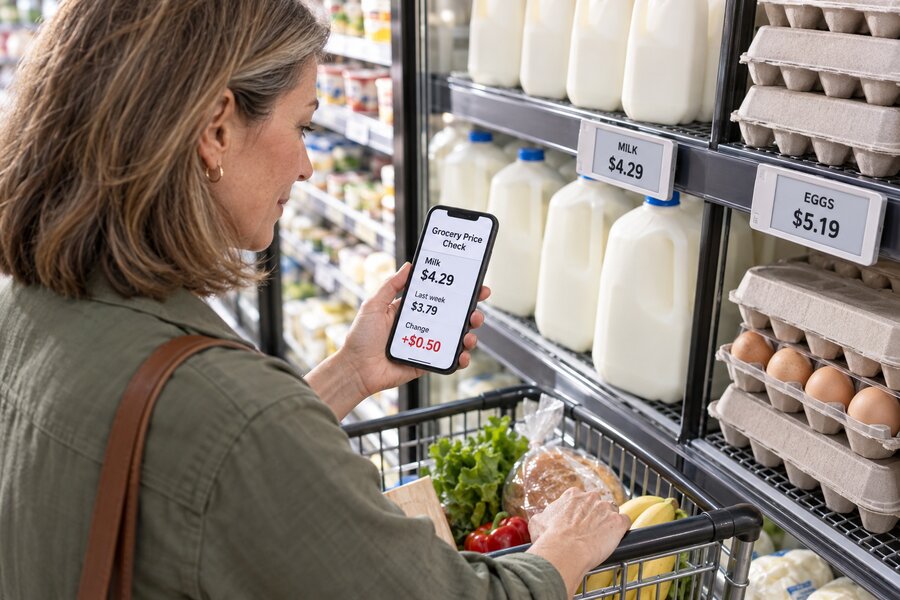
For most of the history of the modern supermarket, a price tag was one of the least interesting objects in the store. A worker with a pricing gun or a sheet of adhesive labels walked the aisles, checked a printed list against the shelf, and peeled a new sticker into place whenever a price changed. That process was slow enough that prices rarely moved more than once a week, and a shopper who wrote down a price on Monday could walk back into the same store on Friday and find it unchanged. That predictability was never a deliberate feature of grocery retailing; it was simply a side effect of how expensive and labor-intensive it was to change a price by hand across an entire store, let alone a chain with hundreds of locations.
That predictability is now eroding, and the reason has little to do with inflation, corporate greed, or any of the other explanations that dominate public conversation about rising food costs. It has to do with a piece of hardware called an electronic shelf label, a small digital display that has replaced the paper sticker on the shelf edge in a growing share of American and European supermarkets, and with the software system sitting behind it that can update thousands of prices across a store, or a thousand stores, in the time it takes a shopper to walk from the produce section to the checkout line. Once a chain has that capability, the question of whether and how to use it becomes a business decision rather than a physical constraint, and it is that decision, not the technology itself, that has drawn attention from journalists, regulators, and increasingly nervous shoppers who worry their grocery bill might start behaving like an airline ticket or a rideshare fare.
The concern is understandable even before looking at any specific evidence, because shoppers have already watched dynamic, algorithm-driven pricing reshape other everyday purchases, from the fare a rideshare app quotes during a sudden downpour to the fluctuating price of a hotel room booked a week versus a day in advance. Groceries have historically felt different from those categories precisely because the price on the shelf was fixed for the length of a shopping trip and usually for days afterward, and the prospect that a household’s most routine, recurring expense could start behaving like a surge-priced service touches something more personally unsettling than a change in how a discretionary purchase like a hotel room is priced. That gap between how other industries already price dynamically and how groceries have traditionally been priced is exactly why any move toward digital, centrally controlled grocery pricing invites this level of public attention, regardless of what the technology is actually being used for in practice.
This article looks closely at what electronic shelf labels and the artificial intelligence systems that often sit behind them actually do, separating the documented reality from the more alarming scenarios that have circulated in the press and in political debate. It examines why grocers are adopting this technology so quickly, what has actually happened at chains that have rolled it out at scale, and what independent researchers who have studied real pricing data have found when they looked for evidence of the kind of demand-based price spikes that critics describe as “surge pricing.” It draws on three verified, documented cases: Kroger’s electronic shelf label rollout and the formal scrutiny it drew from United States senators in 2024, Walmart’s parallel and even larger rollout with the technology vendor VusionGroup, and a 2025 academic study that examined more than 180 million real product-price observations to test whether the feared surge pricing was actually occurring. It also looks honestly at what remains genuinely uncertain, including questions about data privacy, personalized pricing, and whether the benefits of this technology are shared evenly across different kinds of shoppers. None of this is a claim that grocery pricing is becoming either a consumer nightmare or a consumer-friendly innovation in any simple sense. It is a look at a real, fast-moving change in how food is priced, grounded in what has actually been documented so far.
How Electronic Shelf Labels and AI Pricing Engines Work
To understand the debate over dynamic grocery pricing, it helps to separate two things that are often talked about as though they were one: the electronic shelf label itself, which is simply a display device, and the pricing engine behind it, which is the decision-making system that determines what number appears on that display. A store can install electronic shelf labels purely to save labor, using them only to mirror whatever prices a manager sets manually on the same schedule as before, in which case nothing about how prices are determined actually changes. It is only when a retailer pairs that hardware with software capable of analyzing sales data and automatically recommending or executing price changes that the system starts to resemble what people mean when they talk about “AI dynamic pricing” in groceries.
This distinction matters because much of the public concern about grocery pricing technology has focused on the display hardware, when the more consequential question is what governs the numbers that hardware shows. A retailer with electronic shelf labels but a conservative, human-supervised pricing process looks very different in practice from one that has connected those labels to an automated engine making frequent, algorithm-driven adjustments. Both are technically “electronic shelf labels,” and the confusion between the two has fueled a fair amount of the alarm surrounding this technology, since a photograph of a digital price tag says nothing on its own about how aggressively or how often that number is actually changing behind the scenes.
The two sections below unpack these pieces separately: first the physical display technology that has been installed in thousands of stores, and then the software layer that decides what appears on it, including the kinds of data an AI pricing engine typically draws on and the vendors that build these systems for the grocery industry.
The Hardware Behind the Price Tag
An electronic shelf label is typically built around an e-paper or e-ink display, the same basic screen technology used in dedicated e-readers, chosen specifically because it consumes very little power and remains visible without a backlight under ordinary store lighting. A label of this kind can run for several years on a single small battery, which is what makes it practical to install tens of thousands of them across a single supermarket without a costly wiring project or a constant battery-replacement burden for store staff. Each label is paired with a barcode or a printed identifier that ties it to a specific product on the shelf, so that when a price update is sent to that label, the store’s inventory and point-of-sale systems remain in sync with what the shopper actually sees.
Getting a price change from a central computer to thousands of individual displays requires a communication network built specifically for that purpose, and most electronic shelf label systems rely on a wireless mesh network or an infrared-based relay system installed throughout the store’s ceiling and shelving. In a mesh design, labels near a network access point relay signals to labels further away, so that a single update broadcast from the store’s server can reach every shelf edge within seconds rather than requiring someone to walk the aisles with a handheld scanner. This is also what allows a chain to push a single price change simultaneously across every store in a region, or even nationwide, from one central office, which is the specific capability that makes chain-wide promotions and centrally managed pricing changes possible at a speed that was simply not achievable with paper labels.
Integration with a store’s existing point-of-sale and inventory management systems is what turns the shelf label from a passive display into a genuinely useful retail tool rather than a novelty. When a price is updated on the shelf label, the same update typically flows to the register system, ensuring that the price a customer sees on the shelf matches what they are charged at checkout, which addresses a long-standing source of customer complaints and, in many jurisdictions, a genuine legal compliance risk around shelf-to-register price discrepancies. The same integration lets a store’s inventory system flag when a product is approaching its sell-by date, feeding that information back into the pricing decision described in the next section, which is where the “smart” part of a modern electronic shelf label system genuinely lives.
What the AI Pricing Engine Actually Decides
The software layer sitting behind an electronic shelf label deployment is where the more consequential decisions actually happen, and it typically draws on several categories of data that have nothing to do with how badly an individual shopper wants a product at a given moment. Sales velocity, meaning how quickly a specific item has been moving off the shelf in recent days, is one of the most heavily weighted inputs, because a grocer generally wants to avoid running out of a fast-selling item and also wants to avoid having a slow-selling item sit on the shelf consuming valuable retail space. Wholesale cost changes from suppliers, seasonal shifts in produce availability, and a chain’s own promotional calendar, including manufacturer-funded discounts like “buy one, get one” deals, all feed into the same system and are, according to the research examined later in this article, the dominant drivers of most day-to-day grocery price movement.
A second major input, and the one most directly tied to reducing food waste, is a product’s expiration or sell-by date. Fresh categories like produce, dairy, bakery items, and prepared foods have a limited shelf life, and a pricing engine that can automatically apply a markdown to a product as it nears that date, without a store employee having to manually identify and reprice each item, gives a grocer a meaningfully better chance of selling that inventory before it has to be thrown away. This waste-reduction function is one of the more genuinely beneficial uses of the technology, since it can mean lower prices for shoppers on items that are still perfectly good to eat, while reducing the amount of unsold food that ends up in a landfill, where it becomes a notable source of methane emissions.
Competitor pricing is a third input that many pricing engines track, sometimes through automated web scraping of rival retailers’ published prices or through third-party pricing-intelligence data feeds, allowing a grocer to keep specific, closely watched items priced in line with a competitor down the street without a manager manually checking prices in person. Several established retail technology and pricing-intelligence firms build these systems commercially, selling algorithmic pricing software to grocers as a standalone product that can be layered on top of electronic shelf label hardware from a separate vendor, and a 2024 federal inquiry specifically identified companies in this space as intermediaries that help retailers, including grocery chains, build and operate these kinds of pricing models. What virtually none of these systems are built to do, based on the actual, documented behavior described later in this article, is scan real-time in-store foot traffic or weather conditions and spike a single item’s price within the same shopping trip the way a rideshare app might during a sudden storm; the technical capability for that kind of hyper-local, moment-to-moment repricing exists in theory, but the evidence available so far indicates it is not how these systems are actually being used in grocery retail.
Taken together, the hardware and the software layer described in this section form the full picture of what “electronic shelf labels” and “AI dynamic pricing” mean in a grocery context: a digital display that can be updated instantly and centrally, paired with an algorithmic system that primarily adjusts prices based on cost, waste, and competitive positioning rather than real-time demand at the individual shopper level. Understanding this distinction is essential background for evaluating both the genuine business motivations discussed next and the specific, documented rollouts and research examined in the sections that follow.
Why Grocers Are Racing to Adopt Dynamic Pricing
Grocery retailing is a famously low-margin business, with many chains operating on net profit margins in the low single digits, which means that even small improvements in labor efficiency or waste reduction can have an outsized effect on a store’s bottom line. Against that backdrop, the appeal of electronic shelf labels to a grocery chain’s finance and operations teams is less about extracting more money from any individual shopper and more about eliminating a specific, well-understood cost center: the labor required to manually reprice a store. A large supermarket can carry tens of thousands of distinct products, and updating paper price tags for even a modest weekly promotional cycle can require many hours of staff time across a single location, time that store operators would generally rather redirect toward stocking shelves, staffing checkout lanes, or assisting customers directly on the floor.
This labor calculation has become more pressing as grocery chains have struggled to fill and retain hourly positions in many markets over the past several years, making any technology that reduces the number of staff-hours needed for routine, repetitive tasks especially attractive to store operators managing thin schedules. A chain running a national promotional campaign that touches thousands of items across thousands of stores would, under a paper-based system, need to coordinate an enormous, error-prone manual effort across every location on the same day, with a very real risk that some stores would still be displaying yesterday’s price by the time the promotion officially began. Electronic shelf labels eliminate that coordination problem entirely, since a single update from a central office reaches every participating store at effectively the same moment, which is a mundane but genuinely significant operational improvement that has little to do with the more headline-grabbing dynamic pricing debate.
Food waste reduction is a second major motivation, and one that grocers themselves tend to emphasize heavily in public statements about this technology, for good reason: unsold perishable inventory is a direct, measurable loss that eats into already thin margins, and any system that improves the odds of selling a product before it spoils delivers value that is easy for a grocery chain’s leadership to quantify. Automated markdowns tied to sell-by dates, applied instantly and consistently across every relevant product rather than depending on a staff member noticing and manually repricing an item, represent one of the clearest and least controversial financial cases for this technology, and it is also the use case most often highlighted by researchers studying the consumer welfare effects of electronic shelf labels.
Competitive price matching is a third driver, particularly in markets where multiple grocery chains compete directly for the same customers within a few miles of each other. A chain that can adjust its price on a specific, closely watched item, such as a gallon of milk or a carton of eggs, within hours of a competitor’s own price change is in a stronger position to avoid losing price-sensitive shoppers on the items they compare most closely, without needing to reprice its entire store to stay competitive on the handful of products that actually drive comparison shopping. This kind of narrowly targeted competitive response is a different phenomenon from broad, demand-based “surge pricing,” even though both fall under the general label of dynamic pricing, and conflating the two is one of the more common sources of confusion in public discussion of this technology.
Finally, the broader economic environment of the past several years, marked by a period of unusually high food price inflation followed by continued pressure on household grocery budgets, has made grocery chains more attentive than usual to any technology that promises measurable cost control, whether through labor savings, waste reduction, or sharper competitive positioning. This same environment, however, is precisely what has made shoppers and lawmakers more suspicious of any pricing technology introduced during a period when grocery bills were already rising, which is the tension that runs through the real-world rollouts and the political scrutiny examined in the next section.
Real-World Rollouts: Kroger, Walmart, and What the Data Shows
Claims about dynamic grocery pricing have circulated widely enough, and with enough political charge attached, that it is worth being unusually careful about which specific facts can actually be verified against public documentation rather than repeated secondhand from opinion pieces or social media commentary. The amount of concern expressed about “surge pricing” in supermarkets, likening electronic shelf labels to the demand-based pricing familiar from rideshare apps or airline tickets, has at times outpaced the amount of documented evidence that this specific behavior is actually occurring at scale in American grocery stores.
Three cases stand out for having enough public documentation, specific dates, and named institutions to examine responsibly: Kroger’s electronic shelf label rollout, which became the subject of a formal congressional inquiry in 2024; Walmart’s parallel and larger rollout with the technology vendor VusionGroup, announced the same year; and an independent academic study published in 2025 that set out specifically to test, using real pricing data rather than theoretical modeling, whether electronic shelf labels have actually produced the surge-pricing behavior that critics feared. Looking at these three cases together offers a considerably more grounded picture than any single announcement, press release, or political statement could provide on its own, precisely because they include both an industry rollout under public scrutiny and an independent empirical check on whether that scrutiny’s central worry has actually materialized.
Kroger’s EDGE Rollout and the Senate Scrutiny It Triggered
Kroger, one of the largest supermarket chains in the United States, has deployed a branded electronic shelf label system it calls EDGE, an acronym for Enhanced Display for Grocery Environment. By 2024, Kroger had confirmed that roughly one in four of its stores nationwide were using this technology, allowing the company to update prices across those locations from a centralized system rather than through manual in-store repricing. Kroger has also disclosed a partnership with Microsoft involving cameras mounted on the EDGE shelf displays, with the stated purpose of using image recognition to gather general demographic information, such as approximate age and gender, that could be used to inform personalized offers and advertising displayed on the same screens.
This combination of price-changing capability and camera-based data collection drew direct attention from federal lawmakers. On August 5, 2024, Senators Elizabeth Warren of Massachusetts and Bob Casey of Pennsylvania sent a formal letter to Kroger’s chairman and chief executive, Rodney McMullen, raising concerns that the EDGE technology could allow the company to “calibrate price increases to extract maximum profits” at moments when specific products were in especially high demand, and warning that widespread adoption of this kind of technology industry-wide could result in grocery prices behaving more like airline tickets, changing frequently and unpredictably based on real-time demand. The senators’ letter, which became public and was covered extensively by trade publications including Grocery Dive, also raised separate concerns about the Microsoft camera partnership, asking whether Kroger was adequately protecting shoppers’ data and whether customers would have any ability to opt out of the underlying data collection. Warren and Casey requested that Kroger respond in writing to more than ten specific questions by August 20, 2024, including how frequently individual item prices had actually changed under the EDGE system and whether any items had been repriced more than once within the same day.
Kroger’s public response, issued through a company statement to reporters, directly disputed the characterization of its pricing practices, stating that any testing of electronic shelf technology was intended to lower prices for customers rather than raise them, and adding that suggestions to the contrary were “not true.” A Kroger executive further stated that the company’s underlying business model depends on lowering prices over time to build customer volume and loyalty, arguing that this incentive structure runs directly counter to any strategy built around surprise price increases. Notably, Kroger’s public statements addressed the pricing concern directly but did not specifically respond to the senators’ separate questions about the camera-based data collection and facial analysis component of the system, leaving that particular question less fully resolved in the public record than the pricing question itself.
What makes the Kroger case valuable for understanding this technology is not that it resolves the surge-pricing question definitively, since a company’s public statement denying an allegation is not the same as independently verified pricing data, but that it documents, with specific named individuals, dates, and a real regulatory response, exactly what concerns this technology has generated among lawmakers and exactly how a major grocery chain responded to direct questioning about its own practices. It is precisely this kind of specific, dated, verifiable record that separates a genuine case study from the more diffuse, secondhand anxiety that circulates about grocery pricing technology more broadly, and it sets up the question the next two cases help answer: what does the underlying pricing data actually show once someone goes looking for it directly.
Walmart’s Nationwide VusionGroup Expansion
Walmart, the largest grocery retailer in the United States by revenue, announced in June 2024 that it would expand its use of electronic shelf labels supplied by VusionGroup, a French-headquartered retail technology company, to 2,300 stores by 2026, building on an earlier, smaller phase of the rollout that had already reached several hundred locations. Walmart described the technology’s primary benefits in terms of store operations rather than pricing strategy, emphasizing that the labels would let store associates reprice merchandise far more quickly than manual methods allowed, freeing up staff time for tasks like restocking shelves and fulfilling online grocery orders picked directly from store shelves, a workflow that has grown substantially as more shoppers order groceries for delivery or pickup.
The pace of the rollout accelerated further in December 2024, when VusionGroup announced a contract extension with Walmart to expand deployment across the retailer’s entire United States store fleet, which numbers roughly 4,600 locations, moving well beyond the 2,300-store figure originally announced six months earlier. Walmart’s own public statements about the expansion specifically credited the technology’s role in what the company called its “EdgeSense” and “VusionCloud” initiatives, framing the labels as part of a broader effort to modernize in-store operations and improve the accuracy and speed of price updates, rather than as a mechanism for introducing more aggressive or more frequent price increases.
Walmart’s rollout is significant for this discussion less because of any specific pricing controversy attached to it, since Walmart did not face the same kind of direct congressional letter that Kroger received in 2024, and more because of its sheer scale: a nationwide deployment across thousands of stores by the country’s largest grocery retailer demonstrates that electronic shelf labels are moving rapidly from a limited pilot technology into standard grocery retail infrastructure, a trajectory that makes the underlying question of how these systems actually affect prices considerably more urgent for the tens of millions of households that shop at Walmart and similar large chains every week. The scale of Walmart’s commitment, expanding from an initial few hundred stores to its full national footprint within roughly eighteen months of the first major public announcement, also illustrates how quickly this technology can move from pilot to near-universal deployment once a major retailer commits to it, which is part of why independent research into its actual pricing effects, discussed next, has taken on particular importance.
What the Research Actually Shows: The UC San Diego Study
Given the gap between the political concern generated by cases like Kroger’s and the more operationally focused framing that retailers like Walmart use in their own announcements, a genuinely independent empirical study of what electronic shelf labels actually do to grocery prices is especially valuable. That study arrived in July 2025, as a working paper published by researchers Robert Sanders of the University of California San Diego’s Rady School of Management, Ioannis Stamatopoulos of the University of Texas at Austin’s McCombs School of Business, and Robert Bray of Northwestern University’s Kellogg School of Management, examining real, itemized grocery pricing data rather than relying on theoretical modeling or anecdotal reports.
The researchers analyzed more than 180 million product-level price observations drawn from 114 grocery stores across four U.S. states, tracking each store’s pricing behavior both before and after it adopted electronic shelf labels, with the underlying stores in the study having gradually installed the technology between October 2022 and mid-2024. Rather than asking a general question about whether prices changed after installation, which they inevitably do for many legitimate reasons, the researchers specifically looked for the statistical signature of surge pricing: short-lived, localized, seemingly unexplained price spikes on individual items that would suggest a store was capitalizing on a temporary spike in local demand rather than adjusting to cost, competition, or a planned promotion.
The results were striking in how little change the researchers found. Before electronic shelf labels were installed, roughly one in every 20,000 products in the dataset, or about 0.0050 percent, showed a pricing pattern consistent with this kind of short-lived, unexplained spike. After installation, that figure was approximately 0.0006 percent, meaning the underlying rate of surge-pricing-like behavior was already extremely rare and showed no meaningful increase, and if anything trended in the opposite direction, once digital labels were in place. As Sanders put it in comments accompanying the study’s release, if electronic labels were genuinely enabling surge pricing, researchers would expect to see a visible spike in the frequency and localization of price changes following installation, and instead the data showed no meaningful difference in either measure before and after stores adopted the technology.
The study also examined what does actually explain the price changes that do occur in grocery stores, finding that base prices generally track wholesale costs and competitor pricing over time, while most short-term price movement is driven by manufacturer-funded promotions, such as temporary discounts or “buy one, get one” offers, that are typically planned well in advance of any given shopping trip and unrelated to real-time local demand or weather conditions. The researchers further found that when prices did change, they tended to move consistently across an entire chain’s stores rather than varying locally based on store-specific demand, which runs directly counter to the localized, opportunistic pricing behavior that concerns about surge pricing generally describe. Stamatopoulos offered a structural explanation for this pattern grounded in ordinary grocery retail economics, noting that unlike a rideshare service or a hotel, a grocery store does not make its money from any single transaction but from a shopper’s entire basket and their loyalty over repeated visits, which makes alienating customers with an unexpected price spike on a single item a poor business strategy even where the technical capability to do so exists.
The researchers were careful to frame their findings as evidence against the specific surge-pricing scenario that had drawn political attention, including direct criticism from lawmakers who had cited electronic shelf labels in letters to both Kroger and Walmart, while also noting a separate, more constructive finding: that dynamic markdown capability appears well-suited to reducing food waste by allowing stores to discount perishable items automatically as they approach their sell-by dates, a use case that could particularly benefit lower-income shoppers seeking discounted but still-usable food, and one the researchers noted was already more common in European grocery markets, where electronic shelf label adoption is further along than in the United States. Taken together with the Kroger and Walmart rollouts described above, this study provides the closest thing currently available to an independent, data-driven answer to the central question this article opened with: not what electronic shelf labels are theoretically capable of, but what grocery chains that have actually deployed them at scale have been shown to do with that capability so far.
What Dynamic Pricing Means for Household Budgets and Fairness
For an individual household trying to understand what any of this means for their own weekly grocery bill, the most direct takeaway from the documented evidence is that the worst-case scenario many shoppers imagined, prices quietly climbing higher whenever a store detects unusually high demand for a particular item, does not appear to be how this technology has actually been used at the scale it has been studied so far. The UC San Diego research specifically found that base prices continue to track the same underlying drivers they always have, namely wholesale costs and competitive positioning, and that most of the price volatility shoppers do encounter comes from planned promotional cycles rather than real-time demand sensing. This does not mean grocery prices are becoming less variable in an absolute sense, since electronic shelf labels do make it easier for stores to run more frequent, more targeted promotions and markdowns, but it does mean that the specific fear of a grocery store working like an airline fare, charging more simply because a shopper is standing in the aisle wanting a product urgently, is not supported by the evidence currently available.
Where the fairness questions become genuinely more complicated is in the areas the pricing-focused research did not directly address: data collection and personalization. Kroger’s camera-equipped EDGE displays, developed in partnership with Microsoft, are explicitly designed to gather demographic signals about shoppers in order to tailor the offers and advertisements shown on the same screens that display prices, and the senators who raised concerns about Kroger’s system in 2024 specifically asked whether this kind of personalization could eventually translate into different prices or different offers for different categories of customers, a practice sometimes described more broadly as personalized or “surveillance” pricing. A separate federal inquiry conducted around the same period examined this broader practice across retail generally, finding that a range of intermediary companies help retailers, including grocery chains, build pricing and targeting systems informed by detailed consumer data, and raising the concern that such systems could eventually be used to offer different prices to different shoppers for identical products based on factors like browsing behavior, location, or purchase history, rather than the store-wide, transparent pricing that has traditionally governed grocery retail.
This distinction, between dynamic pricing that varies by time and store-wide conditions and personalized pricing that could vary by individual shopper, is central to any honest assessment of fairness in this technology. Dynamic pricing of the kind documented in the Kroger, Walmart, and UC San Diego cases changes the price of an item for everyone shopping in a given store at a given time, which is a meaningfully different and more transparent practice than a system that could, in principle, show two different shoppers two different prices for the identical product based on data collected about each of them individually. The technical infrastructure that makes dynamic, store-wide pricing possible, namely networked digital displays connected to a central pricing system, is largely the same infrastructure that would be required to eventually enable individualized pricing, which is precisely why lawmakers and consumer advocates have pushed for transparency requirements and data protections now, before personalized pricing becomes as commonplace as dynamic, store-wide pricing already is.
There is also a fairness dimension tied to how loyalty programs interact with electronic shelf label systems, since many grocery chains already offer different prices to app users or loyalty card holders than to shoppers who do not participate in these programs, a practice that predates electronic shelf labels but that becomes easier to implement and expand once a store has the underlying digital pricing infrastructure in place. Shoppers who are less comfortable with smartphone apps, who have limited data access, or who are simply unaware that a loyalty program exists can end up paying a meaningfully higher price for the same product than a neighbor scanning a loyalty barcode at the same register, a gap that existed before this wave of pricing technology but that the same technology could plausibly widen if adoption of app-based personalized discounts continues to grow alongside electronic shelf labels. Older shoppers, lower-income households without reliable smartphone access, and shoppers who simply value privacy enough to decline a loyalty program are the groups most likely to be affected by this kind of gap, which is a genuinely different concern from the surge-pricing scenario that has dominated headlines, even though the two are frequently discussed together.
Weighing these strands together, the fairest overall characterization of dynamic grocery pricing today is that of a technology whose most feared application has not materialized at meaningful scale, while a quieter and more gradual set of fairness questions around data and personalization continues to develop largely out of public view. A household’s weekly grocery bill is unlikely to swing sharply because a store’s algorithm senses a busy Saturday afternoon, based on everything documented in the cases examined here, but the same household may already be paying a somewhat different price than a neighbor simply because of which loyalty program each has joined or which data-sharing choices each has made, a gap that predates this technology but that the infrastructure now being installed nationwide has the clear capacity to widen further as it matures.
Taken as a whole, the evidence available so far suggests that the direct, dollar-for-dollar budget impact of electronic shelf labels and dynamic pricing engines has been more modest and more benign than the most alarming public commentary suggested, particularly on the specific question of real-time demand-based price spikes. The genuinely open questions are less about whether a shopper will pay more for milk on a hot Saturday afternoon, which the research so far does not support, and more about the slower-moving, less visible questions of data collection, personalization, and whether the conveniences of loyalty-based discounts come at the cost of a two-tiered pricing system that disadvantages shoppers who are least equipped to navigate it.
How Shoppers Can Adapt to a Dynamic-Pricing Grocery Store
Given that electronic shelf labels are already installed in a substantial and growing share of American grocery stores, and that the underlying evidence suggests the technology is being used mainly for waste reduction, competitive matching, and operational efficiency rather than aggressive real-time markups, the most useful response for an individual shopper is less about avoiding the technology entirely and more about understanding how to work with it. Paying attention to markdown patterns on perishable goods is one of the more directly useful adjustments a shopper can make, since stores using automated, sell-by-date-triggered discounts on items like bakery goods, dairy, and pre-cut produce tend to apply those markdowns at fairly predictable points in a product’s shelf life, meaning a shopper willing to buy an item a day or two closer to its sell-by date can often capture a meaningful discount on food that remains entirely safe to eat.
Shoppers who regularly buy the same staple items, such as milk, eggs, bread, or a particular brand of coffee, can also benefit from paying closer attention to the timing of a store’s promotional cycle rather than assuming any given week’s price is simply the going rate. Because the research discussed earlier in this article found that most short-term price movement traces back to planned manufacturer promotions rather than unplanned demand spikes, these cycles tend to repeat on a fairly regular schedule, whether weekly, biweekly, or tied to a specific season, which means a shopper who notices that a favorite item reliably goes on sale around the same interval can plan larger purchases of shelf-stable goods to coincide with those discounts rather than buying at whatever price happens to be displayed on a given visit.
Tracking prices over time, whether through a grocery chain’s own loyalty app, a personal habit of noting prices on frequently purchased staples, or a third-party price-tracking tool, gives a shopper a genuinely useful baseline for recognizing whether a price change reflects a real cost shift or simply a short-term promotional cycle. Because the research examined earlier in this article found that most short-term grocery price movement comes from planned manufacturer promotions rather than unexplained spikes, a shopper who has a general sense of an item’s typical price range is well positioned to recognize a genuine bargain when a promotional markdown appears, rather than reacting to every price fluctuation as a cause for concern.
Understanding how a specific store’s loyalty program interacts with its pricing is also worth a shopper’s attention, particularly given the fairness questions raised in the previous section. A shopper who signs up for a chain’s free loyalty app, even without providing extensive personal information beyond what is required to create the account, can often access the same lower prices that would otherwise be reserved for app users, closing at least part of the gap between loyalty-based and standard shelf pricing described earlier. For shoppers who are uncomfortable with the data collection that these programs sometimes involve, reading a chain’s privacy disclosures before signing up, and asking store staff directly what data a loyalty program or camera-equipped shelf display collects, remains a reasonable and available way to make an informed decision rather than opting in or out based on assumption alone.
Finally, shoppers who want to stay informed about how this technology continues to develop have a genuine advantage in following the same kind of documented, verifiable reporting drawn on throughout this article, including trade publications that cover grocery technology rollouts in detail and the public statements retailers make about new pricing systems, rather than relying on secondhand summaries or unverified social media claims. Because electronic shelf labels are still expanding rapidly across the industry, with Walmart’s rollout alone projected to reach thousands of additional stores in the years following its initial 2024 announcement, the specific practices retailers adopt around pricing transparency and data use are likely to keep evolving, and a shopper who understands the underlying technology, as described throughout this article, is better equipped to evaluate those changes as they arrive rather than reacting only to the more alarming framing that tends to dominate initial coverage of any new retail technology.
Final Thoughts
Electronic shelf labels and the AI pricing engines that increasingly sit behind them represent a genuine shift in the mechanics of grocery retail, but the evidence gathered so far tells a more measured story than either the technology’s most enthusiastic promoters or its most alarmed critics initially suggested. The transformative potential of this technology lies less in any single dramatic capability and more in the cumulative effect of removing a decades-old physical constraint, the sheer labor cost of manually repricing a store, and replacing it with a system that can update prices instantly, apply waste-reducing markdowns automatically, and keep a chain competitively positioned against its rivals without requiring an army of employees walking the aisles with pricing guns. That shift touches millions of households simply because grocery shopping is one of the most universal and frequent financial transactions in ordinary life, which is exactly why any change to how prices are set draws scrutiny well beyond the retail industry itself.
The documented cases examined in this article illustrate both sides of that scrutiny working as intended. Kroger’s EDGE rollout, and the congressional inquiry it triggered in August 2024, show that lawmakers are willing to demand specific answers from a major retailer about how a pricing technology is actually being used, rather than accepting vague reassurances at face value. Walmart’s parallel expansion, moving from a few hundred stores to its entire national footprint within about eighteen months, shows how quickly this infrastructure can become standard practice once a dominant retailer commits to it. And the independent research published by Sanders, Stamatopoulos, and Bray in 2025 shows that empirical scrutiny, applied to real pricing data rather than speculation, offers a far more grounded answer to the surge-pricing question than either a company’s denial or a lawmaker’s warning could provide alone.
The broader societal implications extend beyond whether any single item’s price spikes unexpectedly. Grocery spending sits close to the center of household financial stability for a very large share of the population, and food affordability carries a weight that a rideshare fare or a hotel room rate simply does not, which is why applying demand-based pricing models borrowed from other industries to something as basic as food raises a different order of ethical concern even where the underlying technology is similar. The waste-reduction potential of automated perishable markdowns is a genuine point in this technology’s favor from a social responsibility standpoint, since food that would otherwise be thrown away can instead reach households that need an affordable option, and reducing food waste carries real environmental benefits given the outsized role spoiled food plays in landfill emissions.
At the same time, the unresolved questions around data collection, camera-based demographic profiling, and the gap between loyalty-app pricing and standard shelf pricing deserve continued attention precisely because they are less visible than a dramatic price spike, and therefore easier to overlook until they have already become widespread. The infrastructure that makes transparent, store-wide dynamic pricing possible today is largely the same infrastructure that could, without continued regulatory attention, be extended toward more individualized pricing in the future, and the distance between those two outcomes will likely depend less on the technology itself than on the transparency requirements lawmakers and consumers continue to demand. What the evidence supports right now is a technology still finding its footing, delivering real operational benefits to retailers, genuine benefits to shoppers through waste-reduction markdowns, and a set of fairness questions around data and personalization worth watching closely as adoption spreads across the American grocery landscape.
FAQs
- What is an electronic shelf label?
An electronic shelf label is a small digital display, usually built with low-power e-paper or e-ink technology, that replaces the traditional printed paper price sticker on a store shelf. It connects to a store’s central computer system over a wireless network, allowing prices to be updated instantly across an entire store or chain rather than requiring an employee to manually replace paper tags one at a time. - Does AI actually set grocery prices, or is that an exaggeration?
Many chains do use algorithmic pricing software, sometimes described as AI, to recommend or automatically apply price changes based on factors like sales velocity, wholesale costs, competitor prices, and how close a perishable item is to its sell-by date. The documented evidence indicates these systems are mainly used for cost tracking, competitive matching, and waste-reducing markdowns rather than for real-time demand-based price spikes. - Is “surge pricing” actually happening at grocery stores like Kroger and Walmart?
Based on the most rigorous evidence available, a 2025 study analyzing more than 180 million product-level price observations across 114 stores found no meaningful increase in short-lived, unexplained price spikes after electronic shelf labels were installed. Both Kroger and Walmart have also stated publicly that their systems are not used to raise prices based on real-time demand. - Why did U.S. senators send Kroger a letter about its shelf labels?
In August 2024, Senators Elizabeth Warren and Bob Casey sent Kroger’s CEO a formal letter raising concerns that its EDGE electronic shelf label system, combined with a Microsoft-linked camera and data collection component, could enable “surge pricing” and exploit sensitive customer data. Kroger responded publicly that the technology is intended to lower prices for customers, though it did not directly address the senators’ data-privacy questions in its public statement. - How widespread are electronic shelf labels in the United States right now?
Adoption has expanded quickly. Kroger confirmed that roughly one in four of its stores used electronic shelf labels by 2024, while Walmart announced plans in June 2024 to reach 2,300 stores by 2026 before extending that contract in December 2024 to cover its entire U.S. fleet of roughly 4,600 stores. - Do electronic shelf labels help reduce food waste?
Yes, this is one of the more clearly documented benefits. Because the system can be linked to a product’s sell-by date, it can apply automatic markdowns on perishable items like produce, dairy, and bakery goods as they approach expiration, increasing the odds those items are purchased and eaten rather than thrown away. - Could grocery stores eventually charge different shoppers different prices for the same item?
This is a genuine and largely unresolved concern, separate from time-based dynamic pricing. Some retail pricing systems already use loyalty-app data to offer different prices to app users versus non-users, and a broader federal inquiry has examined how retailers across industries use consumer data to build more individualized pricing models, which is a distinct issue from the store-wide dynamic pricing examined in the research discussed throughout this article. - Are cameras on shelf displays actually watching shoppers?
In at least one documented case, yes. Kroger has disclosed a partnership with Microsoft involving cameras mounted on its EDGE displays intended to gather general demographic signals, such as approximate age and gender, in order to personalize the offers and advertisements shown on the same screens, a practice that drew direct questions from U.S. senators about data protection and customer consent. - What can shoppers do to get the best prices in a store using dynamic pricing?
Paying attention to markdown timing on perishable goods, tracking typical prices for frequently purchased items, and signing up for a store’s free loyalty app to access app-based discounts are all practical ways shoppers can benefit from this technology rather than being caught off guard by it. - Is this technology likely to keep expanding in the years ahead?
The trajectory documented in this article suggests continued growth, given that major chains like Walmart moved from a few hundred pilot stores to a commitment covering their entire U.S. footprint within about eighteen months. As adoption spreads, continued attention from researchers, journalists, and lawmakers to how these systems are actually used will likely remain an important check on the technology’s development.