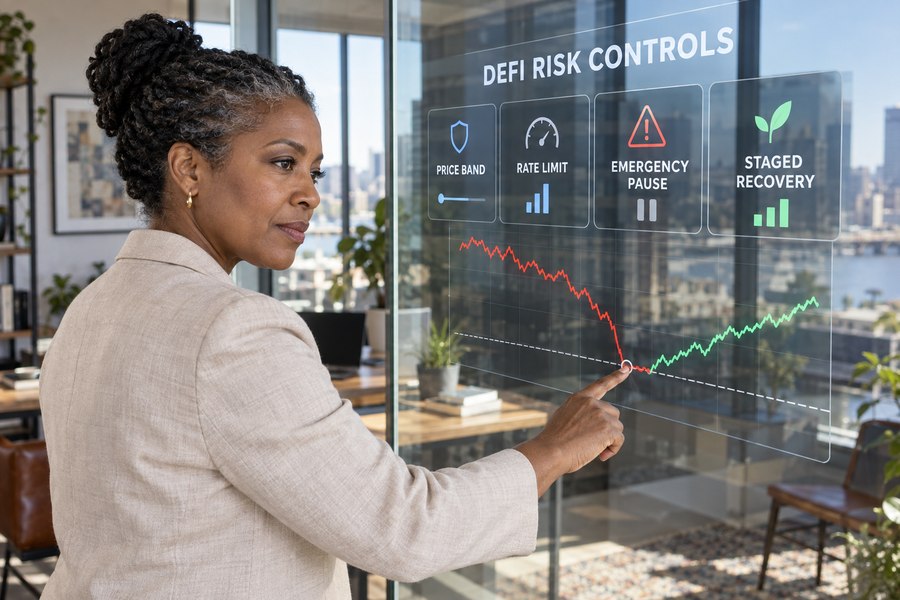
On a normal trading day, a stock exchange behaves like a well-run auction: buyers and sellers meet, prices adjust smoothly, and the whole apparatus fades into the background. On an abnormal day, that same exchange has a set of blunt, deliberately unglamorous tools it can reach for — a switch that stops trading altogether for a few minutes, or for the rest of the day, so that the humans involved can catch their breath before the machinery starts again. Decentralized finance, the ecosystem of lending markets, exchanges, and stablecoins built on public blockchains, has no such switch by default. A smart contract does exactly what its code says, instantly and irreversibly, whether the market behind it is calm or in freefall, and for the first several years of DeFi’s existence that was treated almost as a point of pride: no operator, no gatekeeper, no one who could simply decide to stop the music.
That pride has run into a harder reality. Crypto markets move faster and more violently than the equity markets that traditional circuit breakers were built to tame, and the same qualities that make DeFi appealing — composability between protocols, permissionless access to enormous amounts of borrowed capital, prices that update every block rather than every few seconds — also make a bad moment spread faster and cut deeper than it would on a regulated exchange. A lending protocol that misprices one collateral asset for even a few blocks can be drained of tens of millions of dollars before a human has time to notice, let alone act. A stablecoin that loses its peg can trigger a cascade of liquidations across a dozen protocols that all happened to accept it as collateral, each one unaware of what the others are doing until the damage is already done. The result is that many of the protocols managing the most value in DeFi have quietly built their own versions of a circuit breaker: pause functions that a small group of trusted signers can trigger, oracle checks that refuse to accept a price that has moved too far too fast, interest rate curves that punish a sudden rush for the exits, and governance processes with built-in delays meant to stop a bad decision, or a malicious one, from executing immediately.
The stakes of getting this wrong are not abstract. Billions of dollars now sit in smart contracts that were, in many cases, written and deployed by small teams working under real time pressure, and a single overlooked edge case in how a price is read or how a withdrawal is processed can be the difference between a protocol surviving a bad week and a protocol ceasing to exist within a single afternoon. Regulators and traditional financial institutions watching from outside the space have taken notice of exactly this fragility, and the question of whether decentralized markets can develop their own credible safeguards, without simply importing a regulator of their own, has become one of the more consequential open questions in the industry’s ongoing maturation.
This article is about that quiet convergence — the way DeFi, despite its founding instinct to avoid anything resembling a centralized override, has ended up reinventing versions of the same safety mechanisms that stock exchanges adopted decades ago, while also discovering that some of those mechanisms translate badly, or not at all, into code. It starts with the traditional circuit breaker as Wall Street built it: what problem it was designed to solve, and what assumptions about markets and operators it depends on. It then looks at why decentralized markets break several of those assumptions outright, which is why protocols could not simply copy the exchange playbook and had to build something adapted to a world without a single operator or a single point of control. From there it walks through the actual toolkit protocols use today — admin pause functions, oracle deviation guards, time-weighted pricing, and dynamic fee curves — and examines three real, documented events that show these mechanisms succeeding, partially succeeding, and being entirely absent, each with measurable consequences. It closes by taking seriously the tradeoffs nobody has fully solved: the tension between speed and decentralization, the risk that a pause mechanism becomes a new point of failure in its own right, and the early efforts to standardize these safeguards across the industry rather than leaving every protocol to invent its own from scratch. None of this is a claim that DeFi has solved the problem traditional finance spent a century working on. It is a look at a genuinely difficult engineering and governance question, and at what has actually been built, tested, and learned so far.
Traditional Circuit Breakers: What Wall Street Built and Why
The modern circuit breaker exists because of a single catastrophic day. On October 19, 1987, a date now universally known as Black Monday, the Dow Jones Industrial Average fell by more than twenty percent in a single session, and much of the damage was blamed on automated trading strategies that fed on each other’s selling in a self-reinforcing spiral with no mechanism to interrupt it. In the aftermath, a presidential task force led by Nicholas Brady recommended that exchanges adopt coordinated trading halts for exactly this scenario, and by 1988 the New York Stock Exchange and other major U.S. exchanges had implemented the first marketwide circuit breakers: rules that would halt trading across the entire market once a broad index fell by a specified percentage in a single day. The underlying theory was not that a halt could change the fundamental value of anything. It was that panic and automated selling feed on continuous motion, and that forcing a pause, even a short one, gives human judgment a chance to reassert itself over a process that would otherwise run purely on momentum.
The rules have been revised more than once since 1988, most significantly after another single-day event: the Flash Crash of May 6, 2010, when the Dow fell nearly a thousand points in minutes before recovering almost as quickly, a move later attributed in part to a large automated sell order interacting badly with high-frequency trading algorithms. That event led U.S. regulators to introduce a second layer of protection alongside the marketwide halt: limit-up/limit-down bands for individual securities, which pause trading in a specific stock, rather than the whole market, if its price moves outside a defined percentage band relative to its recent trading price. Today, under SEC Rule 80B, the marketwide mechanism uses three thresholds measured against the S&P 500’s prior closing level: a seven percent decline triggers a fifteen-minute, market-wide halt during most of the trading day, a thirteen percent decline triggers a second fifteen-minute halt, and a twenty percent decline closes the market for the remainder of the day entirely. Single-stock limit-up/limit-down bands operate continuously and independently of the broader index, catching problems, such as a single company’s stock briefly trading at an erroneous price due to a fat-fingered order, that a marketwide rule would never notice. Individual exchanges layer additional protections on top of these federal requirements, including their own short-duration trading pauses for a specific listed security when its price swings by a set percentage within a five-minute window, giving the exchange another tool that sits between a single-stock band and a full marketwide halt.
What makes this system work, when it works, is a set of conditions specific to regulated exchanges that are easy to take for granted until they are missing. There is a single operator, the exchange itself, with the legal authority and technical ability to stop every participant from trading simultaneously. There is a settlement process with enough of a delay, typically a day or more historically and same-day today, that a halt genuinely buys time before anything is final. And there is a regulator standing behind the exchange with the power to investigate what happened during the pause and, if necessary, unwind trades that were the product of a clear error. None of these three conditions holds by default in decentralized finance, and that mismatch is the starting point for understanding why DeFi could not simply borrow the traditional playbook wholesale. It is worth adding that even within traditional finance, the circuit breaker is understood as a blunt instrument rather than a precise fix, useful mainly for buying time during a broad, index-level panic rather than for solving a narrow, asset-specific problem, which is exactly the kind of narrow, asset-specific problem that has caused most of the largest losses in DeFi to date.
Why DeFi Breaks the Traditional Playbook
The most basic difference is the absence of an operator. A stock exchange is a company with an org chart, a legal department, and a switch someone is authorized to flip. A decentralized protocol is a set of smart contracts, and by the founding philosophy of the space, no single party is supposed to have unilateral power over them. Some protocols address this by designating a small, often multisig-controlled group with limited emergency powers, which is itself a meaningful compromise on decentralization, discussed later in this article, but many protocols in their earliest and most idealistic form had no pause mechanism at all, on the theory that removing any human veto was the entire point. That theory held up reasonably well until it collided with protocols holding hundreds of millions of dollars in user funds and a single exploited bug.
A second difference is speed and finality. A trade on a regulated exchange clears through a chain of intermediaries with at least some latency and, historically, a settlement window measured in days, which is exactly the buffer a circuit breaker is designed to use. A transaction on a public blockchain, once included in a block, is final within seconds to minutes and cannot be reversed by any authority, however clearly it resulted from manipulation or error. This means a DeFi circuit breaker cannot function the way a stock exchange’s does, by pausing trading and later deciding whether to unwind what happened; it has to prevent the damaging transaction from executing in the first place, which is a fundamentally harder and less forgiving design problem.
A third and less obvious difference is composability, sometimes called “money legos” in DeFi circles: protocols are built to plug into each other, so that a stablecoin can be used as collateral on a lending market, which in turn issues a token that gets deposited into a yield strategy, which in turn is used as collateral somewhere else. This interconnection is a genuine feature when things are stable, since it lets developers build sophisticated products by combining simple pieces rather than writing everything from scratch. In a crisis, the same interconnection becomes a transmission mechanism: a single asset losing its peg does not stay contained to the protocol that issued it, but propagates instantly into every other protocol that accepted it as collateral, each of which may have no visibility into what is happening elsewhere and no coordinated way to respond together. A fourth structural feature, flash loans, compounds the problem specifically for manipulation-based attacks: a borrower can access an enormous, temporarily uncollateralized sum of capital within a single transaction, use it to distort a price or drain a pool, and repay it before the transaction ends, all without ever putting up real capital of their own or leaving time for anyone to react in between. Traditional markets have nothing structurally equivalent to a flash loan, because settlement delay and intermediary oversight make that kind of same-block, self-reversing maneuver essentially impossible. A fifth difference, less dramatic than a flash loan but just as persistent, is that DeFi markets never close. A stock exchange’s overnight and weekend closures function as an unintentional circuit breaker of their own, giving markets a forced pause after almost every trading day during which new information can be absorbed before the next session opens. Crypto markets run continuously, every hour of every day, which means a protocol can face its worst moment at any time, with no natural lull in which a human team is more likely to be awake, alert, and ready to respond. Taken together, these differences explain why DeFi protocols could not simply install a copy of the NYSE’s circuit breaker and call it solved; they needed mechanisms that act automatically, at the speed of a single block, without a central operator, and ideally before a damaging transaction is confirmed rather than after.
The Toolkit: How On-Chain Circuit Breakers Actually Work
In place of a single halt switch, DeFi protocols have converged on a handful of complementary tools, each addressing a different part of the problem and each carrying its own tradeoffs. Broadly, these fall into two families: mechanisms that depend on a human or a small group of humans making a discretionary judgment call, and mechanisms that are fully automated and execute according to a fixed rule with no human in the loop at the moment of crisis. Neither family is sufficient on its own, which is why most well-designed protocols today combine both.
The human-in-the-loop family exists because code cannot anticipate every failure mode, and sometimes the fastest, most reliable response to a novel problem is a person who understands the situation deciding to freeze part of the system immediately. The fully automated family exists because human response, even a fast one, is measured in minutes at best, while an on-chain exploit can be measured in seconds, and because a rule enforced by code removes the risk that the humans in question are unavailable, asleep, or themselves compromised at the exact moment they are needed. Choosing between them, or more often combining them in specific proportions, is one of the central design decisions a protocol’s engineering and governance teams make, and that choice is rarely revisited casually once a protocol is already managing significant user funds, since changing an emergency mechanism after the fact carries its own risk of introducing a new bug into code that was previously battle-tested. The following two subsections look at each family in turn, starting with the discretionary tools built around trusted roles and multisignature wallets, and then turning to the automated guards built directly into pricing and interest-rate logic.
Pause Functions, Guardians, and Emergency Multisigs
The most direct analogue to a stock exchange’s halt switch is a pause function: a piece of code, present in the smart contract from the start, that when triggered stops specific actions, such as new borrowing, new deposits, or a particular asset’s market entirely, while typically still allowing existing users to withdraw or repay. This pattern is common enough in smart contract development generally that libraries such as OpenZeppelin’s widely used Pausable module provide it as a standard building block, and major DeFi protocols have built their own versions on top of that basic idea. Aave, one of the largest lending protocols in the industry, designates a role called the Emergency Admin, held in practice by a body known as the Aave Guardian, which is authorized to pause specific reserves or disable specific features without going through the protocol’s full governance process. Compound, a similarly large lending protocol, has historically used an analogous Pause Guardian role with narrower, specifically enumerated powers, reflecting a deliberate design choice to limit exactly what emergency actors can and cannot do even in an emergency.
The obvious question raised by any of these roles is who holds them and what stops that power from being misused, and the answer in most mature protocols is a multisignature wallet requiring several independent parties to agree before an emergency action executes. Aave’s Guardian, for instance, has operated as a multisig requiring a majority of a set group of signers drawn from community-elected security professionals and organizations rather than a single founder or company, which is meant to ensure that pausing the protocol requires broad agreement among people with no single shared interest in abusing the power, while still being fast enough to act within minutes rather than the days a full governance vote would require. This is a genuine compromise on decentralization, and critics of the approach point out, correctly, that any group with the unilateral ability to freeze a protocol’s markets is a form of centralized control and a potential target, whether through compromised keys, legal pressure on individual signers, or a Guardian group simply making a bad judgment call under pressure. Protocols that adopt this pattern are, in effect, betting that the risk of an available, fast-acting emergency brake outweighs the risk of that brake’s misuse, a bet that looks very different depending on whether the protocol has already lived through an exploit that a faster pause might have prevented. Many protocols also layer a time delay onto their non-emergency governance actions specifically, using a separate mechanism called a timelock that forces a proposal passed by token-holder vote to sit unexecuted for a fixed period, often twenty-four to forty-eight hours, before it takes effect. That delay is a deliberate security feature, giving the community a window to notice and react to a malicious or mistaken proposal before it can change the protocol, and it is a completely different tool from an emergency pause, built to solve the opposite problem of governance moving too fast rather than too slow.
Oracle Deviation Guards, TWAP Pricing, and Dynamic Fee Curves
Where pause functions depend on a human deciding something has gone wrong, a second category of safeguard is built to catch problems automatically, without anyone needing to notice in real time. The most consequential of these concerns price oracles, the services that feed external market prices into a smart contract so it knows, for instance, what one unit of collateral is currently worth. Because so many DeFi exploits work by manipulating the price a protocol believes an asset holds, rather than attacking the protocol’s code directly, oracle design has become one of the most closely scrutinized parts of the entire circuit-breaker toolkit. Chainlink, the most widely used oracle network in DeFi, builds deviation thresholds directly into many of its price feeds, meaning a new price is only pushed on-chain once it has moved by more than a set percentage from the last reported value, or once a maximum time interval, called a heartbeat, has elapsed, whichever comes first. This is meant to prevent a feed from updating on every trivial tick while still guaranteeing it stays reasonably current, but as later sections of this article show, the specific numeric bounds chosen for a feed can themselves become a source of risk if a market moves far enough to break the assumptions those bounds were built on.
A related and older technique is time-weighted average pricing, commonly abbreviated TWAP, which calculates an asset’s price as an average over some recent window of time, such as the last thirty minutes, rather than reading whatever the most recent single trade happened to be. Uniswap, the largest decentralized exchange by volume, popularized on-chain TWAP oracles specifically because a single trade, especially one funded by a flash loan, can push a spot price to an extreme level for only the duration of one block, and any protocol relying on that instantaneous spot price is vulnerable to exactly that kind of momentary manipulation. Averaging over a longer window means an attacker would need to sustain an artificial price across many blocks, at real cost and real risk of being front-run or arbitraged back to normal by other market participants, which is a meaningfully higher bar than manipulating a single transaction. The tradeoff is responsiveness: a TWAP oracle is, by design, slower to reflect a genuine, fast-moving market crash than a spot price feed would be, which means a protocol has to balance resistance to manipulation against the risk of using a stale price during a real, rapid decline.
A third automated mechanism works not on price but on behavior, using dynamic interest rate and fee curves to discourage the kind of sudden, mass exit that can turn an isolated problem into a bank run. Lending protocols such as Aave and Compound set borrowing rates according to a utilization curve that stays low and stable across most of its range but rises sharply, sometimes described as a kink, once a market’s available liquidity is mostly borrowed out, which makes it progressively more expensive to keep borrowing and progressively more attractive to repay, precisely when a market is under the most stress. Curve Finance’s crvUSD stablecoin system uses a related idea called soft liquidation, implemented through a mechanism known as LLAMMA, which converts a borrower’s collateral into the stablecoin gradually, across a band of prices, as the market moves against them, rather than liquidating the entire position in one abrupt event once a single threshold is crossed, and reverses that conversion automatically if the price recovers. The discount a borrower receives on that gradual conversion widens as market volatility rises, which is a deliberate design choice meant to compensate liquidity providers for taking on more risk during turbulent periods while still avoiding the single, all-at-once liquidation event that has historically amplified losses during a fast-moving crash. Each of these automated tools shares a common design philosophy: rather than stopping activity outright the way a pause function does, they change the economics of a given action moment by moment so that panic-driven behavior becomes progressively more expensive or is smoothed out over time, without ever requiring a human to intervene or make a judgment call under pressure.
Taken together, the discretionary and automated halves of this toolkit are meant to cover each other’s blind spots: a Guardian multisig can react to a novel exploit that no automated rule anticipated, while an oracle deviation guard or a dynamic rate curve keeps working at three in the morning when no human is watching at all. Neither half is a complete circuit breaker in the traditional sense, and neither is free of its own failure modes, which is exactly what the documented events in the next section illustrate.
Case Studies: Circuit Breakers Under Real Market Stress
Design philosophy is one thing; how these mechanisms perform when real money is on the line during a real, fast-moving crisis is another, and the difference matters because DeFi’s short history already contains clear, well-documented examples of each outcome. The three events examined here were chosen specifically because each is independently verifiable through protocol governance forums, contemporaneous industry reporting, and, in one case, a federal court record, rather than relying on any single party’s own account of what happened.
The first shows an emergency pause mechanism working close to as intended: a protocol identifies a critical vulnerability through a bug bounty program and freezes the affected markets before large-scale losses occur. The second is a genuine natural experiment, since two similar lending protocols faced the identical external shock on the same day and had measurably different outcomes based on how quickly each could act. The third shows what happens in the complete absence of an effective safeguard, and what happened afterward when the case moved from a technical postmortem into a real courtroom. Read together, they make the abstract tradeoffs of the previous section concrete: speed genuinely matters, discretionary human response has real limits, and the absence of any deviation check or position limit at all carries a cost that can run into the hundreds of millions of dollars. Each event also happened in public, generating a trail of governance-forum posts, contemporaneous news coverage, and in one instance sworn testimony and a written judicial opinion, which is precisely the kind of independent documentation that distinguishes a verifiable case study from an anonymous anecdote repeated secondhand across crypto social media.
Aave’s Emergency Pause During the November 2023 Security Incident
On November 4, 2023, Aave’s bug bounty program received a report describing a vulnerability affecting Aave V2, which the team quickly validated and escalated to critical severity. Rather than waiting for a full governance vote, a process that on most DeFi protocols takes days, the Aave Guardian, the community-elected multisig empowered to take emergency action, moved within hours to pause the Aave V2 market on Ethereum entirely and to pause or freeze specific affected assets across other deployments, including Avalanche and the V3 markets on Polygon, Arbitrum, and Optimism. As an additional mitigation, the team disabled the protocol’s stable interest rate borrowing mode, which was identified as connected to the exploitable pathway, while confirming that users could still manage and withdraw their existing positions throughout the pause even though new borrowing and depositing were halted.
The Aave team was notably tight-lipped about the exact technical details of the vulnerability while the pause was in effect, explaining publicly that because Aave’s code had been forked by numerous other protocols, disclosing specifics risked handing a working exploit to attackers targeting those forks before they had a chance to patch their own deployments. This is itself a small but telling illustration of one of DeFi’s structural challenges discussed earlier in this article: composability and open-source code sharing accelerate innovation, but they also mean a single vulnerability can potentially affect an entire family of protocols at once, and a defender has to weigh transparency against the risk of arming other attackers. By November 13, 2023, industry reporting confirmed that Aave’s affected markets had resumed full, normal operations, meaning the practical disruption to ordinary users lasted a little over a week, and no funds were confirmed lost as a result of the vulnerability itself during that window. The episode is frequently cited within the industry as a demonstration that a well-structured emergency multisig, staffed by security professionals with a pre-existing incident response plan, can convert a potentially catastrophic bug into a contained, resolved incident, precisely the outcome a circuit breaker is supposed to produce. It also illustrated the practical value of a bug bounty program working exactly as intended, rewarding an outside researcher for surfacing a critical flaw before a malicious actor found it independently, which meant Aave’s Guardian had the rare luxury of acting on advance warning rather than reacting to an exploit already in progress.
Venus Protocol and Blizz Finance: Two Responses to the Terra Collapse
The collapse of the Terra blockchain’s UST stablecoin and its sister token LUNA in May 2022 remains one of the largest single events in crypto history, erasing tens of billions of dollars in value within days as LUNA’s price fell from tens of dollars to a small fraction of a cent. Amid that broader collapse, two DeFi lending protocols that both accepted LUNA as collateral, Venus Protocol on the BNB Chain and Blizz Finance on Avalanche, were exposed to a specific and narrower exploit tied directly to how their price oracles handled the crash, and the different outcomes each protocol experienced offer a genuine natural experiment in what a faster emergency response is actually worth.
Both protocols relied on Chainlink price feeds that, as a general safeguard against a corrupted or manipulated data source, included a hardcoded minimum reportable price, sometimes called a minAnswer floor, for the assets they tracked. As LUNA’s real market price crashed toward zero, it fell below that hardcoded floor of ten cents, meaning the oracle continued reporting a price far above LUNA’s actual, negligible market value even as the token became essentially worthless. Attackers recognized this gap and bought real LUNA at its true, crashed market price, then deposited it as collateral on both protocols, where it was still valued at the stale ten-cent floor, and borrowed other, genuinely valuable assets against that artificially inflated collateral. Venus Protocol, which had roughly a billion dollars in total value locked at the time, was able to identify the problem and suspend the affected market before the exploit could fully play out, ultimately absorbing losses reported at roughly $13.5 million, a meaningful sum but one the protocol was able to address afterward using its dedicated risk reserve fund set aside for exactly this kind of shortfall. Blizz Finance, a smaller protocol built as a fork of Aave’s codebase on Avalanche, held governance and emergency powers behind a timelock, a deliberate security feature meant to prevent a malicious or rushed governance change from executing instantly, and in this instance that same timelock meant the protocol could not disable LUNA support fast enough to stop the exploit. Blizz absorbed losses of roughly $8.3 million, a smaller dollar figure than Venus’s loss but proportionally devastating for a much smaller protocol, and the project ceased operating shortly afterward. Combined, the two protocols lost roughly $21.8 million to what was structurally the same exploit, with the gap between an outcome the affected protocol could absorb and one that ended the protocol entirely coming down almost entirely to how quickly each could act once the danger became apparent. The episode also drew attention back to the oracle design choice at its root, since the hardcoded minAnswer floor existed as its own safeguard, meant to stop a feed from reporting a corrupted or wildly erroneous price, and instead became the exact mechanism attackers exploited once a real, legitimate market crash pushed an asset’s true price below where anyone had thought to set that floor, a reminder that a safeguard built for one failure mode can become the entry point for a different one entirely.
Mango Markets and the Price of No Safeguard at All
If the Terra-related exploits show what a faster response is worth, the Mango Markets exploit of October 2022 shows what happens when a protocol has essentially no automated safeguard standing between a manipulated price and a large withdrawal of real funds. Mango Markets, a decentralized exchange and lending platform built on the Solana blockchain, allowed users to trade perpetual futures on its own governance token, MNGO, using that token’s oracle-reported price to determine the value of a trader’s collateral and, by extension, how much they could borrow against it. A trader named Avraham Eisenberg, who later identified himself publicly, split roughly ten million dollars in USDC across two accounts, then used one account to open a massive long position in MNGO perpetual futures while simultaneously buying real MNGO tokens on the open market across several exchanges. Because Mango’s oracle sourced its MNGO price from those same thin outside markets, the coordinated buying pushed the reported price up by well over a thousand percent within minutes, and that inflated price was then applied directly to the value of Eisenberg’s leveraged position on Mango itself.
With his position’s paper value suddenly ballooning to several hundred million dollars against an initial outlay of roughly ten million, Eisenberg borrowed out the platform’s available liquidity against that inflated collateral, ultimately draining assets reported at roughly $110 million from Mango’s treasury, funds that had been deposited by the platform’s other users. Critically, nothing in Mango’s design flagged the underlying MNGO price movement as implausible or paused trading once it moved far outside any historical range; there was no deviation cap comparable to Chainlink’s thresholds discussed earlier, no TWAP smoothing to blunt a rapid single-session price spike, and no position size or concentration limit that might have capped how much a single trader could borrow against a thinly traded asset used as its own collateral. Eisenberg later negotiated to return a large portion of the funds in exchange for Mango’s governance community agreeing not to pursue further recovery efforts, while publicly arguing that his actions amounted to legal use of the protocol exactly as its code allowed, rather than theft. Federal prosecutors disagreed, and in April 2024 a jury convicted him of wire fraud, commodities fraud, and commodities manipulation; that outcome did not stand, however, as a federal judge vacated the convictions in May 2025, ruling that prosecutors had not established sufficient grounds to bring the case in that particular court and separately noting that Mango’s own permissionless, fully automated design made it difficult to argue in a legal sense that the protocol itself had been deceived. Whatever the final legal resolution, the technical lesson is not in dispute: absent any automated check on price plausibility or borrowing concentration, a protocol’s own code will faithfully execute a transaction that drains it, exactly as it was written to do. The overturned conviction adds an additional, uncomfortable layer to the story for anyone hoping the legal system would simply supply the safeguard the protocol itself lacked, since a court later concluded that a fully automated, permissionless system is a genuinely difficult fit for fraud statutes written with human deception in mind, which only reinforces the case for building the safeguard into the protocol rather than counting on a courtroom to supply one after the fact.
Across all three episodes, the pattern is consistent even though the outcomes differ sharply. Aave’s pre-built emergency multisig, staffed by people with a rehearsed incident response plan, converted a critical vulnerability into a contained, week-long disruption with no confirmed loss of funds. Venus Protocol’s ability to act, even without the fastest possible response, kept a shared exploit from becoming an existential loss, while Blizz Finance’s identical exposure, slowed by a timelock built for a different kind of risk, proved fatal to the protocol. Mango Markets, with no comparable safeguard of any kind standing between a manipulated price feed and a real withdrawal of user funds, lost an amount larger than either of the other two incidents combined. None of these mechanisms is free, and none is a guarantee; what they demonstrably are is the difference, measured in tens of millions of dollars and in some cases in whether a protocol survives at all, between having a circuit breaker and not.
Designing Better Circuit Breakers: Governance, Tradeoffs, and Open Problems
The case studies above make a strong argument for building some form of circuit breaker into any protocol handling significant value, but they should not be read as an argument that more emergency power is automatically better, because every one of these mechanisms carries a real cost that has to be weighed against the risk it is meant to reduce. The most fundamental tension is between speed and decentralization, and it runs through nearly every design decision covered in this article. A small, fast-acting multisig can freeze a market within minutes of a threat being identified, which is exactly what worked in Aave’s favor during the November 2023 incident, but that same speed depends on concentrating real power in a small number of hands, which is precisely the kind of trusted-third-party risk that decentralized finance was originally conceived to eliminate. A protocol that instead routes every emergency decision through full, decentralized governance gains legitimacy and removes any single point of failure, but inherits the delay that a governance timelock is designed to enforce, the same delay that left Blizz Finance unable to react before its LUNA exposure was drained. There is no version of this tradeoff that eliminates the tension entirely; there is only a choice about which failure mode a given protocol is more willing to risk. Some protocols have tried to soften the tradeoff rather than choose one side outright, for instance by granting an emergency multisig the narrow power to pause activity immediately but requiring any permanent change, such as adjusting a risk parameter or removing an asset entirely, to still pass through full governance afterward, which preserves a fast initial brake while still routing any lasting decision through a slower, more broadly legitimate process.
A second, less discussed problem is that any pause mechanism can itself become a source of harm rather than only a source of protection. A market frozen during a genuine emergency also freezes ordinary users who have no connection to the underlying problem and simply need to withdraw funds for reasons entirely unrelated to the crisis, and a pause triggered incorrectly, whether through a false alarm, a bug in the pause logic itself, or a compromised Guardian key, can cause real damage with no corresponding benefit. A pause that lingers longer than the emergency that caused it is its own quiet cost as well, since users unable to access funds for even a short window may face liquidation elsewhere, miss an unrelated market opportunity, or simply lose confidence in a protocol that otherwise did nothing wrong, all of which argues for pause mechanisms that are as narrowly scoped and as quickly reversible as the underlying threat allows. Traditional finance has faced a version of this exact debate for decades, with a long-running argument among market economists over whether stock market circuit breakers actually calm markets or instead add a new layer of anxiety, as traders rush to complete transactions before an approaching threshold triggers a halt, a pattern sometimes called a magnet effect that can accelerate exactly the kind of panic-driven selling the mechanism was designed to prevent. DeFi protocols face the same risk in a more acute form, since a pause is public, immediate, and visible to every market participant simultaneously, and the mere announcement that a protocol has frozen a market can itself trigger panic in adjacent protocols holding related collateral, even when the underlying problem turns out to be contained.
Insurance and backstop funds represent a different, complementary approach: rather than trying to prevent every possible loss through a faster or smarter pause, a protocol sets aside a pool of capital specifically to absorb losses that occur despite its other safeguards. Aave’s Safety Module allows users to stake the protocol’s native token in exchange for yield, with the explicit condition that up to thirty percent of staked tokens can be slashed to cover a shortfall if the protocol suffers losses it cannot otherwise absorb, which is precisely the kind of reserve Venus Protocol drew on to make its Terra-related losses manageable rather than existential. This approach shifts risk toward people who have voluntarily accepted it in exchange for a yield, rather than toward the ordinary depositors who had no say in the protocol’s risk parameters, but it depends on the reserve being large enough relative to the protocol’s total exposure, a sizing problem that is difficult to get right in advance of an actual crisis and that several protocols have discovered, after the fact, they had gotten wrong.
The industry has begun to recognize that every protocol solving this problem independently, from scratch, is itself a source of risk, since a novel, unaudited emergency mechanism can introduce new bugs of its own. This has led to early standardization efforts, most notably a proposed Ethereum standard known as ERC-7265, put forward by DeFi security researchers in 2023 in direct response to a string of large exploits across the industry. The proposal defines a shared, reusable interface that any protocol can adopt to automatically rate-limit token outflows once they exceed a configurable threshold within a given time window, functioning as a generic, audited circuit breaker that developers can plug into new code rather than reinventing a bespoke pause mechanism for every project. Whether this kind of shared standard achieves wide adoption remains an open question, but its existence reflects a maturing recognition across the industry that circuit breakers are not a solved problem to be handled once per protocol, but an ongoing area of shared infrastructure that benefits from collective scrutiny rather than isolated, one-off engineering.
Final Thoughts
The deepest lesson of DeFi’s circuit breaker experiments so far is that removing every human safeguard from a financial system does not make that system safer; it simply relocates the danger to wherever the code did not anticipate. That is a harder and more interesting conclusion than either side of the usual debate wants to admit. It is not a vindication of centralized control, since Aave’s emergency multisig and Blizz Finance’s protective timelock are both forms of human judgment embedded in a system, and one of them worked far better than the other under real pressure. It is also not a case for abandoning automation, since the same events show flash-crash-speed exploits that no committee, however fast, could plausibly have caught before the damage was done. What the evidence actually supports is something less tidy: durable financial infrastructure, whether built from paper rules on a trading floor or from smart contracts on a blockchain, needs both a human backstop and an automated one, deployed in the places each is suited to and audited honestly for where each one fails.
That has implications well beyond the technical question of how to write a pause function correctly. DeFi’s advocates have long argued that permissionless, code-based finance can extend access to financial services, lending, saving, trading, and insurance-like protection, to people who have historically been shut out of traditional banking by geography, credit history, or the simple cost of serving a small account. That promise depends entirely on these systems being trustworthy enough for an ordinary person, not just a sophisticated trader who can absorb an occasional loss, to actually use them, and trustworthiness is inseparable from the question this article has examined: what happens to a user’s funds during the worst five minutes the system ever experiences. A protocol that has thought seriously about its failure modes, and built in a mechanism to contain them, is offering something closer to the reliability that financial inclusion actually requires. A protocol that has not is, whatever its other merits, asking its most vulnerable users to bear a risk that better-resourced participants can often see coming and exit before it lands.
There is also a broader social responsibility dimension that the industry has been slow to reckon with honestly. A circuit breaker that only a protocol’s own team or a small multisig can trigger is, functionally, a concentration of power over other people’s money, and pretending otherwise because the code is open-source does not change that reality. Taking that responsibility seriously means being transparent about who holds emergency powers, under what conditions those powers can be used, and what recourse ordinary users have when a pause mechanism itself causes harm, whether through error, compromise, or a judgment call that turns out to be wrong. The protocols that have handled real crises best, on the evidence examined here, are not the ones that avoided every form of centralized power, nor the ones that centralized it without limits, but the ones that were explicit in advance about exactly how much power existed, who held it, and when it could be used. That kind of honesty, more than any specific piece of code, is what will determine whether the next decade of DeFi safeguards earns the trust the technology’s broader promise depends on.
FAQs
- What is a circuit breaker in the context of DeFi?
It is any mechanism, whether a human-triggered pause function or an automated rule built into a smart contract, that stops or slows protocol activity during extreme market stress, similar in purpose to the trading halts stock exchanges use, but implemented in code rather than through a central operator. - How do traditional stock market circuit breakers actually work?
Under current U.S. rules, a decline of seven percent in the S&P 500 from the prior day’s close triggers a fifteen-minute marketwide halt, a thirteen percent decline triggers a second halt, and a twenty percent decline closes the market for the rest of the day. Individual stocks are separately protected by limit-up/limit-down price bands that pause trading in just that stock if its price moves too far too fast. - Why can’t DeFi protocols just copy the stock exchange model directly?
Stock exchanges have a single legal operator with authority to halt every participant at once, plus a settlement delay of at least a day that gives a pause real meaning. DeFi transactions finalize within seconds and cannot be reversed by any authority, and no single party is typically meant to control every protocol, so a circuit breaker has to prevent a damaging transaction before it executes rather than pause and later decide whether to unwind it. - What is an emergency admin or Guardian multisig, and who controls it?
It is a role, usually held by several independent parties through a multisignature wallet requiring most of them to agree, authorized to pause specific markets or disable specific features without waiting for a full governance vote. Aave’s Guardian, for example, is drawn from community-elected security professionals rather than a single company, though critics correctly note that any such group represents a real concentration of power. - How does a TWAP oracle protect against flash-crash-style manipulation?
A time-weighted average price calculates an asset’s value as an average over a recent window, such as thirty minutes, rather than reading the single most recent trade. This means an attacker attempting to manipulate a price for one transaction, often using a flash loan, would need to sustain the artificial price across many blocks at real cost, rather than distorting it for an instant. - What happened during Aave’s November 2023 security incident?
Aave’s bug bounty program flagged a critical vulnerability on November 4, 2023, and the Aave Guardian paused the Aave V2 market on Ethereum along with specific assets on other deployments within hours, while disabling stable rate borrowing as an added precaution. Full operations resumed by November 13, 2023, with no funds confirmed lost during the pause. - What was different between Venus Protocol and Blizz Finance during the Terra collapse?
Both protocols were exposed to the same oracle flaw when LUNA’s price crashed below a hardcoded floor in May 2022, but Venus Protocol suspended the affected market before the exploit fully played out, limiting its loss to roughly $13.5 million and covering the shortfall with its risk reserve. Blizz Finance’s response was delayed by a governance timelock, and it lost roughly $8.3 million before ceasing operations shortly afterward. - What went wrong at Mango Markets in October 2022?
A trader used coordinated buying across outside exchanges to push the reported price of Mango’s own MNGO token up by well over a thousand percent within minutes, then borrowed roughly $110 million from the platform against a leveraged position whose value was based on that inflated price. Mango had no deviation cap, TWAP smoothing, or position limit that could have flagged or stopped the move. - Do circuit breakers ever make a crisis worse instead of better?
They can. Economists studying traditional stock market circuit breakers have long debated a “magnet effect,” where traders rush to act just before an approaching threshold triggers a halt, potentially accelerating the same panic the mechanism is meant to prevent. In DeFi, a publicly visible pause on one protocol can also spook users of other protocols holding related collateral, even if the original problem turns out to be contained. - Is there an industry standard for DeFi circuit breakers?
Not yet widely adopted, but a proposed Ethereum standard called ERC-7265 was put forward by security researchers in 2023 to give protocols a shared, reusable interface for automatically rate-limiting token outflows once they exceed a set threshold, rather than every project designing its own emergency mechanism from scratch.