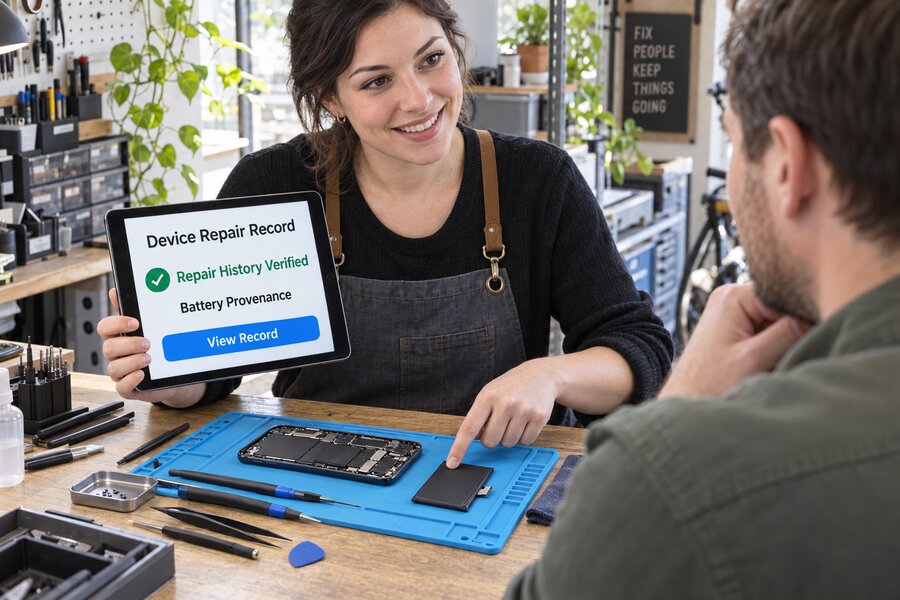
A cracked phone screen used to be a genuinely simple, ordinary problem: find a local repair shop, get a replacement part installed, and move on with a functioning device. Increasingly, that same repair can trigger a cascade of software warnings, disabled features, or an outright refusal by the device to recognize a perfectly genuine replacement part, because the part’s internal serial number was never formally paired to that specific unit by the manufacturer’s own authorized process. This practice, often called parts pairing or serialization, has quietly become one of the most consequential battlegrounds in a much larger fight over who actually controls the products people buy and nominally own. At the same time, a second and related problem sits underneath the used electronics and appliance market more broadly: when someone buys a secondhand phone, laptop, or major appliance, they typically have no reliable way to know what has already been replaced inside it, whether a prior repair used a genuine or counterfeit component, or whether the device was ever subjected to water damage or another undisclosed failure that a private seller has every incentive not to mention.
Both of these problems, the software lockout that prevents independent repair and the missing paper trail that obscures a device’s actual history, share a common root: the records that would resolve them exist, if they exist at all, inside a single manufacturer’s closed database, accessible only to that company and, at its own discretion, to the authorized repair network it has chosen to work with. A blockchain-based maintenance and parts-provenance record proposes a different arrangement, one where a device’s repair history and the authenticity of its components are written to a shared, tamper-evident ledger that independent repair shops, secondhand buyers, and the original owner can all verify without needing the manufacturer’s permission or cooperation to access basic facts about a product they own or are considering buying. This is a meaningfully different ambition than simply digitizing a warranty card, because a shared ledger is specifically designed so that no single party, including the manufacturer itself, can quietly alter a past entry to obscure an inconvenient repair history or a discontinued parts-supply relationship.
It is worth being precise from the outset about what this technology can and cannot do, because the right-to-repair debate is ultimately a fight over control that a database alone cannot resolve. A shared, tamper-evident record of a device’s parts and repair history does not, by itself, force a manufacturer to stop pairing replacement parts to a specific unit through software, and it does not compel a company to publish the diagnostic manuals and error codes that independent technicians need to actually perform a repair in the first place. What it can do is make the underlying facts about a device’s components and service history impossible for any single party to quietly rewrite after the fact, which matters enormously for resale trust, warranty disputes, and counterfeit-parts detection, even in a world where the deeper legislative and technical fight over parts pairing continues on a separate track.
This article looks at why independent repair has become harder rather than easier over the past several years, what a genuinely open, blockchain-based maintenance record actually involves at a technical level, and who benefits when device histories move from a manufacturer’s closed database onto a shared ledger. It examines two documented, verifiable projects working in this exact space, one still actively expanding its role in a major new regulatory framework for battery provenance, and one that pursued a closely related ambition before collapsing financially despite real technical accomplishments. It also takes seriously the limitations: the gap between a verifiable parts record and a manufacturer’s separate, and much harder to dislodge, software lockout, the cost burden facing small independent repair shops, and the sobering fact that at least one prominent provenance company in this space has already gone out of business. None of this is a promise that blockchain will settle the right-to-repair fight on its own. It is a look at a specific class of technology, what it has actually demonstrated so far, and why it matters to the much larger movement it is now becoming part of.
Readers do not need any background in blockchain architecture to follow the argument that unfolds here, and that is a deliberate choice, because the people most affected by parts pairing and opaque device histories are ordinary owners and independent repair technicians rather than software engineers. The technical detail included in the sections that follow exists to answer a specific, practical question: when a company claims its device or its supply chain now uses “blockchain” to support repair or provenance, what does that claim actually mean in practice, and what should a skeptical owner, technician, or policymaker expect it to change and, just as importantly, not change.
Why Independent Repair Is Harder Than It Should Be
The most direct obstacle facing independent repair today is parts pairing, a practice in which a manufacturer’s software cryptographically links a specific serialized component, commonly a screen, battery, or camera module, to the unique identity of a single device at the point of manufacture or authorized service. When a replacement part is installed that has not been formally paired to that device through the manufacturer’s own authorized process, the device’s software can respond in several ways depending on the manufacturer and the specific component involved, ranging from a persistent warning notification to the outright disabling of features like battery health reporting, automatic brightness adjustment, or biometric authentication. Advocacy organizations that track this practice closely have documented its expansion across an increasing range of product categories in recent years, and have argued that the practical effect, regardless of a manufacturer’s stated rationale around security or counterfeit prevention, is to make a repair performed with a functionally identical, even genuine, component behave as if something is wrong with the device, discouraging consumers from using independent repair shops that cannot access the manufacturer’s own pairing process.
A second obstacle, longstanding and in some ways more fundamental than parts pairing itself, is the restriction of diagnostic documentation, error codes, and specialized tools to a manufacturer’s authorized service network. An independent technician without access to a manufacturer’s internal diagnostic flowcharts is often reduced to educated guesswork when a device presents a complex or unusual failure, a problem that authorized technicians do not face because their employer has direct access to the manufacturer’s own troubleshooting guidance. This asymmetry compounds the parts-pairing problem rather than existing separately from it, since a technician who cannot diagnose a failure precisely is also less able to argue persuasively that a specific, non-paired replacement part is the correct and sufficient fix.
A third obstacle, distinct from the first two but closely related to the theme of this article, is the almost complete absence of a reliable, independently verifiable service history for most used electronics and appliances. When someone buys a secondhand laptop or a used major appliance, whatever history exists about its prior repairs, replaced components, or past damage typically lives only in the memory or informal paperwork of the previous owner and whichever repair shops happened to service it, none of which a buyer can independently verify at the point of sale. This gap matters most acutely in exactly the markets that most benefit from a healthy independent repair ecosystem, since a buyer weighing whether to purchase a refurbished device from an independent seller has considerably less confidence in that transaction than one purchasing a manufacturer-certified refurbished unit precisely because the manufacturer-certified process comes with an implicit, if often unverifiable, promise of quality control that an independent seller’s device simply does not carry.
These three obstacles, together, have driven a rapid legislative response across the United States that is worth understanding as context for where blockchain-based solutions might fit. New York became the first state to pass a broad consumer electronics right-to-repair law when its Digital Fair Repair Act was signed in December 2022, requiring manufacturers to make diagnostic and repair information, parts, and tools available to independent providers and consumers on fair and reasonable terms, with the law taking effect in December 2023. California followed with a similar law signed in October 2023 that took effect in July 2024, covering electronics and appliances sold after July 2021, and Minnesota’s own Digital Fair Repair Act took effect on the same date in July 2024. Oregon’s right-to-repair law, which took effect in January 2025, went a step further than its predecessors by specifically restricting the practice of parts pairing itself, rather than only requiring access to parts, tools, and documentation, making it the first state law to directly target the software lockout mechanism described earlier in this section. This wave of state legislation establishes the legal backdrop against which any technical solution, blockchain-based or otherwise, now has to operate, and it is this specific legislative momentum that the phrase “growing right-to-repair movement” refers to throughout the rest of this article.
Manufacturers have generally defended parts pairing and restricted documentation on grounds of safety, security, and counterfeit prevention, arguing that an unverified replacement battery installed without proper calibration could pose a genuine fire risk, or that open diagnostic access could be exploited to bypass security features designed to protect a device if it is lost or stolen. These are not frivolous concerns, and any credible assessment of the right-to-repair debate has to take them seriously rather than dismissing them as pure pretext. What right-to-repair advocates and the state legislation described above have argued, with increasing legislative success, is that these legitimate concerns can be addressed through verification standards and authentication mechanisms that do not require excluding independent repair entirely, and it is precisely in that narrower space, verifying a part’s authenticity without necessarily restricting who is allowed to install it, that a shared provenance ledger has the clearest potential contribution to make.
What a Blockchain Maintenance Record Actually Adds
A blockchain-based maintenance record is, at its core, a shared, append-only ledger where entries describing a device’s components, repairs, and ownership history are written by authorized participants and become extremely difficult to alter after the fact once confirmed by the network. Applied to a phone, laptop, or major appliance, this means that when a component is installed at the factory, or a repair technician replaces a part later in the device’s life, that event can be recorded as a permanent entry that no single party, not the manufacturer, not the repair shop, and not the device’s current owner, can quietly edit afterward to misrepresent what actually happened. This distinguishes a genuine shared-ledger system from an ordinary manufacturer database, where the company controlling the servers could, in principle, alter or delete a historical record without any external party ever being able to detect the change.
It is essential to distinguish this concept clearly from parts pairing, because the two are sometimes conflated despite pointing in opposite directions. Parts pairing is a closed, unilateral mechanism controlled entirely by the manufacturer, designed specifically to restrict which parties can perform a repair that the device will accept without protest. A blockchain-based provenance record, by contrast, is explicitly designed to be readable, and in well-designed implementations writable, by multiple independent parties, including repair shops that have no formal relationship with the original manufacturer. A shared provenance ledger could, in principle, even record the fact that a given part was installed by an independent technician using a component sourced outside the manufacturer’s authorized supply chain, without that fact triggering any software lockout at all, since verifying a component’s authenticity and origin is a separate function from restricting which technician is legally or technically permitted to install it. This distinction matters enormously for understanding the limitations discussed later in this article, since a provenance ledger addresses the documentation and trust problem directly but does not, on its own, address the separate and more deliberately adversarial problem of software-enforced parts pairing, which remains a distinct and ongoing fight.
The genuine value such a system offers comes from combining tamper-evident record-keeping with a serialization scheme that already exists in most modern manufacturing processes, since components in phones, laptops, and major appliances are already assigned unique identifiers for internal quality-control and warranty purposes. What a shared ledger changes is not whether a component has a traceable identity, since it typically already does, but who can see that identity’s associated history and who can add new, verified events to it over the device’s lifetime. A well-designed system does not simply let any party type an unverified claim about a repair into the ledger; it structures the process so that specific, authenticated actors, an authorized manufacturer facility at the point of original assembly, a certified independent repair technician performing a verified replacement, or an accredited recycler processing a device at end of life, are the ones permitted to write particular kinds of entries, typically through a scan of the component’s existing serial identifier rather than manual, unverifiable data entry.
It is also worth clarifying what this technology is not attempting to be, since some early marketing around blockchain and consumer electronics has blurred the distinction between provenance and control. A shared maintenance ledger is not a remote-control mechanism that lets any party disable a device, nor is it a surveillance tool tracking a device’s real-time location or usage; its scope is limited specifically to recording discrete, verified events about a component’s identity and service history at the moments those events occur. This narrower scope is actually a strength rather than a limitation, since a system trying to do too much, combining provenance with remote device management or usage tracking, would raise far more serious privacy and security concerns than the comparatively modest, historical record-keeping function this article focuses on.
How a Repair or Part Gets Logged and Verified
The process typically begins at the point of manufacture, when each serialized component already receives a unique identifier as part of standard quality-control practice, and that identifier becomes the first, foundational entry on the shared ledger, establishing a documented point of origin for the part before it is ever installed. From this point forward, any subsequent event involving that component, its original installation into a specific device, any authorized repair that removes or replaces it, and its eventual disposal or recycling, can be logged as a discrete, time-stamped entry linked back to that same serialized identity, rather than existing only in a scattered set of separate repair-shop invoices and manufacturer warranty records that no single party can query together.
What a blockchain or shared-ledger layer adds on top of this existing serialization is the assurance that once one of these events is recorded, it becomes part of a permanent, cross-organizational history rather than sitting inside one company’s isolated database, invisible to every other party in the device’s actual service history. In a well-integrated system, an independent repair shop’s log of a battery replacement in one city becomes visible to a secondhand buyer verifying a listing in another city, and to a recycler evaluating the device for parts recovery at the end of its useful life, without any of those parties needing to separately contact the original manufacturer or the specific repair shop that performed the earlier work. This visibility matters most exactly at the moments when trust is hardest to establish through any other means, such as a private secondhand sale where the buyer has no other credible way to confirm what the seller is telling them about the device’s history.
Verification at each of these points depends less on cryptography and more on the physical scanning infrastructure and technician discipline behind it, an important caveat that mirrors the honest limitation found in nearly every shared-ledger system built on top of a physical process. A component’s serial identifier is only as reliable as the tag or chip carrying it and the scanning equipment a technician uses to read it at each service event, and a shared ledger cannot make a scan more accurate than the underlying hardware and process allow; it can only ensure that whatever accurate or inaccurate data is captured at that moment is then preserved without alteration and made visible to every party who subsequently needs to see it. This means the credibility of the entire system still depends heavily on manufacturers designing genuinely tamper-resistant serialization into their components in the first place, and on independent repair shops being brought into the verification process as trusted, authenticated participants rather than being excluded from it, which is precisely the point of contention this technology sits closest to in the broader right-to-repair debate.
Who Can Read and Write to the Record
In a well-designed system, read access to a device’s provenance record is deliberately broad, extending to the current owner, any independent repair shop the owner chooses to engage, and a prospective buyer evaluating a secondhand purchase, since restricting visibility only to the manufacturer’s own authorized network would simply recreate the closed-database problem the ledger is meant to solve in a new technical form. Write access, by contrast, is necessarily more restricted, since allowing any party to add unverified claims to a device’s permanent history would undermine the entire premise of a trustworthy record, but the key design principle distinguishing a genuinely open system from a manufacturer-controlled one is that write access is extended to accredited independent repair technicians and recyclers, not reserved exclusively for the original manufacturer’s authorized service network.
This is where the practical and political stakes of system design become most visible, because a manufacturer that controls which parties are accredited to write to the shared record retains significant power over independent repair even within an otherwise open provenance system, simply by setting accreditation requirements that are costly or impractical for smaller, independent shops to meet. A genuinely open standard, of the kind right-to-repair advocates have pushed state legislatures to require more broadly, would set accreditation criteria through an independent standards body or a regulatory framework rather than leaving that gatekeeping function entirely in the hands of the same manufacturers whose parts-pairing practices motivated the reform in the first place. This tension between technical openness and who controls the accreditation process is not a solved problem in any of the systems examined in this article, and it is one of the clearest places where the right-to-repair movement’s legislative and technical fronts remain connected rather than separate concerns.
Ownership transfer adds a further layer of complexity to who can read and write a device’s record over its lifetime, since a device that changes hands through a private sale, a trade-in program, or a recycling drop-off needs a clear, verifiable mechanism for transferring read access, and in some designs write permission for future service events, to the new party without requiring the original manufacturer’s active involvement in every transaction. Systems built around open, standards-based identifiers rather than a manufacturer-specific proprietary format handle this more gracefully, since a new owner or repair shop can verify a device’s history against a shared, cross-manufacturer standard rather than needing a separate account or relationship with every individual manufacturer whose products they might ever service or purchase secondhand.
Privacy considerations also shape who should reasonably be granted read access, since a device’s full service history can reveal sensitive information about an owner’s habits, travel patterns, or financial situation that has nothing to do with verifying a part’s authenticity. A thoughtfully designed system addresses this by separating the specific facts a given party actually needs to verify, such as whether a battery is genuine and correctly rated, from unrelated details about when and where an owner has used the device, often through the same kind of selective-disclosure cryptographic techniques used in other privacy-conscious blockchain applications, allowing a prospective buyer to confirm a component’s authenticity without gaining access to an owner’s complete, granular usage history in the process.
Benefits by Stakeholder
For device owners, the most immediate benefit of an open maintenance record is the ability to prove a device’s genuine service history at the exact moments that history matters most, whether negotiating a warranty claim, selling a device secondhand, or disputing an unexpected refusal of a component the owner is confident is genuine. An owner who can point to a verifiable, tamper-evident record showing precisely when and by whom a part was installed has a fundamentally stronger position in any of these disputes than one whose only evidence is a paper receipt from an independent shop that the manufacturer has no obligation to trust or even acknowledge. This shift, from an owner’s word against a manufacturer’s discretion to an independently verifiable record both parties can examine, addresses a power imbalance that has defined most warranty and repair disputes for as long as consumer electronics have existed, and it removes much of the guesswork that currently surrounds even simple questions like when a component was last serviced.
Independent repair shops benefit in a more directly commercial way, since the ability to log a verified, genuine part installation onto a shared record that a customer, a future buyer, or even the original manufacturer can later confirm gives these shops a credibility tool that a purely local reputation cannot provide at the same scale. A shop that can demonstrate, through a portable, cross-organizational record rather than its own internal paperwork, that it consistently installs genuine, correctly sourced components is in a stronger competitive position relative to both disreputable independent competitors and the marketing narrative, common among manufacturers resistant to right-to-repair reform, that independent repair inherently carries greater risk of counterfeit or substandard parts. Being able to point a skeptical customer to a portable, independently verifiable record, rather than asking that customer to simply trust the shop’s own word, is precisely the kind of credibility advantage that has historically been available only to manufacturer-authorized service centers.
Manufacturers, somewhat counterintuitively given their frequent resistance to right-to-repair legislation, also stand to gain from a well-designed shared provenance system, primarily through improved counterfeit detection and supply-chain integrity. A component with a verifiable, tamper-evident chain of custody from factory to installation is considerably harder to counterfeit convincingly than one relying only on a printed serial number or a hologram sticker, both of which are increasingly easy for sophisticated counterfeiters to replicate, and manufacturers genuinely concerned about counterfeit parts entering their supply chain, a real and costly problem in electronics manufacturing broadly, have a legitimate business interest in a verification system that works regardless of who ultimately installs the part. This is one of the more persuasive arguments right-to-repair advocates have made to skeptical manufacturers: an open provenance system serves the stated goal of preventing counterfeit and substandard parts more effectively than a closed pairing system does, since it extends verification to every channel a part might travel through rather than only the manufacturer’s own authorized network.
Secondhand buyers and recyclers gain perhaps the most straightforward benefit of any stakeholder group, since a verifiable service and parts history transforms a secondhand purchase from a transaction based largely on trust in an anonymous seller’s word into one grounded in an independently checkable record. A recycler evaluating a device at the end of its useful life similarly benefits from knowing precisely which components remain original, genuine, and potentially suitable for reuse or resale, versus which have already been replaced with parts of unknown provenance, information that directly affects how much value a recycler can extract from a device being processed for parts recovery rather than complete material destruction.
Insurers and extended-warranty providers represent a less obvious but still meaningful beneficiary of this same underlying shift. A claims adjuster evaluating a damaged device or a warranty provider assessing whether a failure falls under a covered defect currently has to rely largely on the account given by the policyholder or the repair shop that examined the device, an arrangement that leaves considerable room for both honest disagreement and outright fraud. A verifiable, tamper-evident service history gives these parties an independent basis for evaluating a claim, potentially reducing the friction and delay that currently characterizes many warranty and insurance disputes over electronics and appliances, while also giving policyholders a stronger, documented basis for disputing a denial they believe is unjustified. This benefit cuts in both directions rather than favoring only the insurer, since a documented, independently verifiable history is just as useful to a policyholder proving a legitimate claim as it is to an insurer screening out a fraudulent one.
Environmental and circular-economy goals, while not a stakeholder group in the traditional sense, benefit indirectly from all of the dynamics described above, since every one of these improvements, easier warranty resolution, greater trust in secondhand purchases, better information for recyclers, and stronger competitive standing for independent repair shops, points in the same direction: making it more economically rational to repair and reuse a device rather than discard it. This connection between provenance infrastructure and environmental outcomes is part of why some of the regulatory momentum behind these systems, particularly around batteries, has come from sustainability and circular-economy policy rather than consumer protection law specifically, a dynamic explored in more detail in the case studies that follow.
Documented Case Studies in Blockchain Parts Provenance
The distance between a promising pilot announcement and a system that has actually operated at meaningful scale, tied to a real regulatory requirement rather than existing as a standalone experiment, is significant in this space, and it is worth examining two specific, well-documented projects that illustrate both a genuine, still-expanding implementation and an honest example of technical ambition colliding with financial reality. Both projects focus specifically on battery provenance, a segment of the electronics and appliance ecosystem where regulatory pressure, environmental urgency, and the sheer value of the underlying materials have combined to produce more concrete, dated implementation activity than almost any other category of device covered by the broader right-to-repair conversation.
These two cases were chosen because both have identifiable companies and institutions behind them, published dates and figures rather than vague transformation claims, and outcomes that can be independently verified rather than taken solely from either company’s own promotional materials. Read together, they offer a genuinely balanced picture of where blockchain-based parts provenance stands today: real, sustained institutional momentum behind one approach, and a sobering reminder, from a company pursuing closely related goals, of how difficult it has been for even well-established provenance specialists to sustain the business model financially.
Circularise and the EU Battery Passport: Provenance Meets Regulation
Circularise, a Netherlands-based blockchain provenance company, announced its membership in the Global Battery Alliance in June 2023, joining a coalition of more than one hundred forty organizations working to establish sustainability and traceability standards across the battery supply chain, and specifically positioning its blockchain-based data-sharing technology to help power the battery passport concept the alliance had begun piloting earlier that year. The battery passport itself, first launched as a proof-of-concept pilot at the World Economic Forum’s annual meeting in January 2023 following three years of prior multi-stakeholder development, is designed to give every relevant party in a battery’s life cycle, from original manufacturer to eventual recycler, verifiable access to data about the battery’s material composition, carbon footprint, and, critically for the right-to-repair conversation, its service and replacement history.
In November 2023, Circularise deepened its role in this ecosystem by partnering with P3, a German consulting and engineering firm, specifically to help automotive manufacturers and battery suppliers comply with the European Union’s battery regulation, a legal framework that, notably, includes requirements around battery replaceability and removability designed explicitly to support independent repair rather than only environmental reporting. Circularise’s specific technical contribution centers on allowing supply-chain participants to share verified data selectively, using cryptographic techniques that let a party prove a specific fact about a battery’s provenance, such as compliance with a sourcing standard, without necessarily disclosing every underlying detail of its supply chain to every other participant, an approach the company has continued to build on through subsequent industry partnerships, including becoming a supporting partner in the BatteryPass-Ready initiative in 2026.
What makes this case genuinely significant for the right-to-repair movement specifically, rather than only for battery sustainability reporting generally, is the direct legal connection between the EU Battery Regulation’s replaceability requirements and the same underlying provenance infrastructure Circularise and its partners are building. A regulation that requires batteries in certain product categories to be removable and replaceable by the end user or an independent repairer creates direct demand for exactly the kind of verifiable parts and service history this article has described, since a battery that must legally be replaceable also needs a trustworthy way to verify that a replacement is genuine, correctly rated, and appropriately documented for warranty and safety purposes. This regulatory tailwind is a meaningful part of why battery provenance has moved further and faster toward real, dated implementation than blockchain-based provenance efforts in most other device categories.
It is worth noting honestly that Circularise’s role within this ecosystem is one of several competing and complementary technology providers rather than a single, exclusive solution, and the Global Battery Alliance’s own published pilot documentation describes multiple interoperable technical approaches being tested in parallel rather than a single winning architecture already selected. This reflects a broader and generally healthy pattern in early-stage shared-infrastructure standards, where competing technical approaches are deliberately tested against each other before an industry converges on common protocols, and it means that Circularise’s specific blockchain-based approach should be understood as one credible, actively funded contender within a still-evolving standards landscape rather than as the definitive, universally adopted battery passport technology.
Everledger: A Provenance Pioneer’s Collapse
Everledger, a blockchain provenance company originally built around tracking diamonds and other high-value physical assets, had by early 2023 expanded its platform specifically toward battery and electronics provenance, positioning itself in February 2023 to help manufacturers create battery passports for electric vehicle batteries partly in response to new compliance requirements introduced by the United States Inflation Reduction Act. This expansion reflected a genuine and, at the time, well-regarded technical capability, since Everledger had spent nearly a decade building tools for chain-of-custody reporting, fraud detection, and detailed provenance records across multiple industries, expertise that transferred reasonably well to the battery and electronics traceability problem this article has focused on.
That expansion did not translate into lasting financial stability. In June 2023, only months after publicly positioning itself around battery passport compliance, Everledger entered administration, the Australian equivalent of bankruptcy protection, reportedly carrying debts of approximately ten million Australian dollars. The company’s collapse was attributed to funding challenges rather than any specific failure of its underlying technology, and it stands as a sobering, concrete example of a broader pattern in provenance and shared-ledger technology generally: a company can build genuinely useful, technically sound infrastructure and still fail to survive as a business if it cannot secure sustained funding through the multi-year period typically required for large manufacturers and regulators to fully adopt a new provenance standard.
Reading Everledger’s story alongside Circularise’s continued expansion is instructive precisely because both companies pursued closely related technical goals during the same general period, and the difference in outcome appears to hinge less on the underlying technology, which was broadly comparable in ambition and sophistication, than on financial runway, institutional partnerships, and the timing of when each company’s technology intersected with binding regulatory requirements rather than voluntary corporate sustainability commitments. This is a useful, honest reminder that evaluating any blockchain-based provenance claim requires looking past the technical demonstration itself and asking whether the company behind it has the institutional backing and regulatory tailwind necessary to survive long enough for the underlying infrastructure to actually matter at scale.
Everledger’s earlier work outside electronics is itself worth understanding briefly, since it shapes how seriously the company’s later battery-passport ambitions should be taken on technical merit alone. The company built its original reputation over roughly a decade tracking diamonds through their supply chain, a use case that shares clear structural similarities with electronics parts provenance, since both involve verifying a physical object’s authenticity and chain of custody across multiple independent parties who do not necessarily trust one another by default. That track record is precisely why Everledger’s 2023 pivot toward battery passports was taken seriously by industry observers at the time, and it is precisely why the company’s subsequent collapse only months later serves as such a pointed illustration of the gap between technical credibility and financial durability in this specific corner of the blockchain industry.
Limitations, Costs, and Open Questions
The most consequential limitation facing blockchain-based parts provenance, in the specific context of the right-to-repair movement this article has focused on, is that a verifiable record of a part’s authenticity and history does nothing, on its own, to override a manufacturer’s separate decision to lock a device’s software against unpaired components. A shared ledger can prove conclusively that a replacement battery is genuine, correctly sourced, and properly documented, and a manufacturer’s device can still refuse to grant that battery full functionality if the manufacturer’s own software checks for a specific pairing credential that only its own authorized service process issues. This means the technology examined throughout this article addresses the documentation and trust half of the right-to-repair problem effectively, while the software-lockout half remains a separate fight that depends on legislation like Oregon’s parts-pairing restriction, ongoing regulatory pressure, or a voluntary shift in manufacturer policy, none of which any provenance ledger can force by itself.
A second significant obstacle is cost and integration burden, which, as in most shared-infrastructure technologies examined across this kind of analysis, falls hardest on the smaller, independent repair shops that would benefit most from being included as trusted participants in a provenance network. Building or subscribing to a shared parts-provenance platform, acquiring the scanning hardware needed to read and verify serialized components, and training staff to use the system correctly all require investment that a large manufacturer’s authorized service network can absorb far more easily than a small, independent repair shop operating on thin margins. This creates a genuine risk that even a well-designed, technically open provenance system ends up serving mainly larger, well-capitalized repair chains, while the smallest independent shops, often the most committed advocates for right-to-repair reform in the first place, remain effectively excluded by the practical cost of participation.
A third limitation, illustrated directly by Everledger’s collapse, is the broader financial fragility that has characterized blockchain-based provenance ventures across several industries, not only electronics. Building and maintaining a shared ledger platform, securing the institutional partnerships needed to make it genuinely useful, and sustaining operations through the multi-year period typically required before large manufacturers commit to a new provenance standard all require patient capital that has proven difficult for even technically accomplished companies to secure consistently. This history is a useful corrective against assuming that any blockchain-based provenance announcement will still exist in its current form a few years later, and it argues for evaluating these systems based on their institutional backing and regulatory alignment as much as their technical design.
There is also an unresolved governance question about who sets the accreditation standards determining which independent repair shops and technicians can write trusted entries to a shared record, a question this article raised earlier and returns to here because it sits at the center of whether these systems ultimately serve the right-to-repair movement’s actual goals or simply recreate manufacturer gatekeeping in a more sophisticated technical form. Absent an independent standards body or regulatory requirement establishing accreditation criteria, individual manufacturers retain significant discretion to set requirements that favor their own authorized networks, even within an ostensibly open, shared ledger system, which means the technology’s ultimate impact on independent repair access will depend heavily on decisions made outside the technology itself, in statehouses and standards bodies rather than in blockchain architecture.
Finally, achieving genuine cross-manufacturer standardization across a fragmented electronics and appliance industry, made up of hundreds of separate manufacturers with little historical incentive to cooperate on shared data standards, remains a substantial practical challenge. The clearest path forward, based on the cases examined here, runs through large, regulation-driven consortiums, of the kind the Global Battery Alliance represents, where a binding legal requirement gives competing manufacturers a shared incentive to adopt common standards rather than each building an incompatible proprietary system. Whether that pattern extends beyond batteries into the broader universe of phones, laptops, and major appliances will likely depend on whether legislators follow Oregon’s lead in directly targeting parts pairing, and whether the cost of participation can be brought down enough for independent repair shops of every size to genuinely take part.
A further open question concerns international coordination, since the regulatory momentum described throughout this section has so far emerged unevenly across different jurisdictions, with the European Union moving comparatively quickly on battery-specific rules while the United States has developed its right-to-repair framework mainly through a patchwork of individual state laws rather than a single federal standard. A device manufacturer operating globally faces the practical challenge of reconciling these different regulatory regimes, and a genuinely interoperable provenance standard would need to satisfy the European Union’s specific battery passport requirements, the individual documentation and parts-access rules of states like New York and California, and Oregon’s parts-pairing restriction simultaneously, a harmonization problem that remains substantially unresolved and that will likely shape how quickly any single provenance standard can achieve the kind of broad, cross-manufacturer adoption this article’s earlier sections describe as necessary for the technology to reach its full potential.
Final Thoughts
Every replacement battery, screen and camera module already leaves a factory carrying a unique identifier, and every scan at a service counter captures one. The parts are serialized, the scanners are in technicians’ hands, and events are logged as they occur. What has never existed is a place to put them that no single company can quietly revise afterward. Framed that way, the ambition behind a shared maintenance ledger is narrower than the marketing around it and considerably more useful, because it does not ask a manufacturer to surrender control of its designs or supply chain, only to stop being the sole author of the story a device tells about itself. A repair economy in which that story can be checked by whoever holds the device is a different one from today’s.
The two projects examined above suggest what decides whether such a record gets built. Circularise’s work inside the Global Battery Alliance and its partnership with P3 advanced because the European Union’s battery rules made replaceability and traceability a legal obligation rather than a voluntary sustainability gesture, handing competing manufacturers a reason to agree on something. Everledger brought comparable technology and a decade of chain-of-custody experience to the same problem, and entered administration in June 2023, months after positioning itself for battery-passport work. The distinguishing variable was not engineering. It was whether a binding requirement arrived before the funding ran out, an uncomfortable finding for anyone expecting the better system to win on merit.
Who benefits when the timing works out is not evenly distributed. A verified service history lowers the cost of keeping a working device in service, and the households that feel it most acutely are those for whom a failed battery forces a replacement purchase rather than a forty-dollar repair. The same holds in the secondhand market, where a buyer with no way to check what has already been swapped inside a phone pays for that uncertainty in either price or risk. Independent shops in neighborhoods where no authorized service center has ever opened are the practical route to repair for those buyers, and they are the shops least able to absorb the cost of joining a provenance platform.
That tension is where the design choices stop being technical. Whoever sets the accreditation criteria for writing to a shared record decides whose repairs count as documented, and a manufacturer holding that authority can reproduce its existing gatekeeping inside an ostensibly open system without ever refusing anyone outright. A ledger cannot allocate that responsibility; it can only preserve what the people holding it decided. The obligation therefore sits with the standards bodies, regulators and consortium members writing the participation rules, and it is the heavier half of the work, since the engineering has largely been demonstrated while those rules have not.
Parts pairing survives all of this untouched. A device can still refuse full functionality to a battery whose provenance is documented in perfect detail, and only legislation of the kind Oregon enacted in January 2025, or a change of position by manufacturers themselves, alters that. What a shared record changes is the terms of the argument: a shop turned away can point to an unbroken chain of custody instead of asserting its own good faith, and a regulator weighing a complaint has something to examine that no party to the dispute controls. Whether that evidence reaches a two-person shop as readily as a national chain is the question worth watching, since a verification system only the well-capitalized can join would leave the repair economy roughly where it started, better documented and no more open.
FAQs
- What is “parts pairing” and why does it matter for the right to repair?
Parts pairing is a software mechanism that cryptographically links a specific replacement component, such as a battery or screen, to one individual device, so that a part not formally paired through the manufacturer’s own authorized process can trigger warnings or disabled features even if it is a genuine, functioning component. It matters because it is currently the single most direct technical obstacle to independent repair, and a blockchain-based provenance record does not by itself override it. - Does a blockchain maintenance record stop manufacturers from locking out independent repairs?
No, not directly. A shared ledger can verify that a part is genuine and document its full service history, but it cannot force a manufacturer’s separate software system to accept an unpaired part. Overriding parts pairing specifically requires legislation, like Oregon’s right-to-repair law that took effect in January 2025, rather than a provenance record alone. - How is a blockchain parts record different from a manufacturer’s existing serial number system?
Most components already carry serial numbers for internal quality control, but that data typically stays inside the manufacturer’s own closed database. A blockchain-based system makes the resulting service and ownership history visible and verifiable to independent repair shops, secondhand buyers, and owners, rather than restricting it to the original manufacturer and its authorized network alone. - What right-to-repair laws have actually passed in the United States?
New York’s Digital Fair Repair Act, signed in December 2022 and effective December 2023, was the first broad state law of its kind. California and Minnesota both passed similar laws that took effect in July 2024, and Oregon’s law, effective January 2025, went further by specifically restricting parts pairing rather than only requiring access to parts and documentation. - Is there a real, working example of blockchain-based parts provenance in use today?
Yes. Circularise, a blockchain provenance company, joined the Global Battery Alliance in June 2023 and partnered with the consulting firm P3 in November 2023 to help automotive manufacturers comply with the European Union’s battery regulation, which includes battery replaceability requirements directly relevant to independent repair. - What happened to Everledger, and does its failure mean this technology does not work?
Everledger, a blockchain provenance company that expanded into battery-passport work in February 2023, entered administration in June 2023 with roughly ten million Australian dollars in debt due to funding challenges, not a documented failure of its underlying technology. This shows that financial sustainability, not just technical capability, determines whether a provenance venture survives long enough to matter. - Who is allowed to add entries to a shared device maintenance record?
In a well-designed system, write access is extended to accredited participants, which can include independent repair technicians and recyclers alongside the original manufacturer, rather than being restricted to the manufacturer’s authorized network alone. Who sets the accreditation standards for independent participants remains an unresolved governance question in most current systems. - Can a secondhand buyer actually use one of these records to check a device’s history?
In a mature implementation, yes, since read access is designed to be broad, extending to prospective buyers evaluating a secondhand purchase rather than only to the manufacturer and current owner. This is one of the clearest, most immediately useful benefits of moving device histories onto a shared ledger rather than leaving them undocumented. - Why has battery provenance moved further than other device categories?
Battery provenance has benefited from a direct regulatory driver, the European Union’s battery regulation, which requires traceability and replaceability in ways that create genuine legal demand for verifiable parts records. Phones, laptops, and appliances generally lack an equivalent binding regulatory requirement pushing manufacturers toward open, shared provenance systems as quickly. - Are independent repair shops likely to be able to afford joining these provenance systems?
Cost and integration burden remain real obstacles, since building or subscribing to a shared platform and acquiring scanning hardware requires investment that falls more easily within reach of large, well-capitalized repair chains than small independent shops. Whether smaller shops can participate affordably will likely depend on lower-cost, standardized tools emerging as adoption grows.