The notification arrives with the confident finality of a system that believes it has done its job: “Your package has been delivered.” A photo shows a box sitting on a porch, or occasionally nothing recognizable at all, just a stretch of pavement or a closed door. The shopper walks outside a few minutes later and finds nothing there. What follows is a strange kind of limbo that anyone who has shopped online for more than a few years has experienced at least once: a customer certain the package never arrived, a retailer whose system insists that it did, and a delivery record sitting somewhere in a courier’s database that neither the customer nor the retailer can directly inspect or fully trust. The customer calls support, the agent looks at the same “delivered” status the customer already saw, and the conversation that follows is less an investigation than a negotiation over whose word carries more weight in a dispute that, by its nature, has no independent witness.
This is not a rare edge case in modern retail; it is a routine, structural feature of how last-mile delivery evidence gets created and stored today. A driver’s handheld scanner logs a GPS coordinate and a timestamp, takes a photograph, and sometimes captures a signature, and all of that flows into the courier’s own internal system, retained on the courier’s own schedule and shared with the retailer only as a summarized status update rather than the underlying evidence itself. The retailer has its own fulfillment system, populated by whatever data the courier chooses to pass along, and the shopper has neither, only an app notification and a photograph that could, in principle, have been taken at the wrong address or mislabeled. None of the three parties, the shopper who paid for the item, the retailer on the hook for replacing it, and the courier paid to deliver it, has access to a single, shared, independently verifiable account of what happened at the door. Each has its own partial, self-interested version of events, and reconciling those versions after something goes wrong is exactly the kind of slow, adversarial process that erodes trust in online shopping generally.
The scale of this problem is large enough that it has become a recognized cost center across retail and logistics rather than a minor annoyance. Package theft, colloquially known as porch piracy, and the broader category of disputes over items reported missing, damaged, or never received cost retailers, shoppers, and carriers a measurable and growing sum every year, and the reason so many disputes drag on is not usually bad faith on any party’s part, but the absence of a shared, trustworthy record all three can examine at once. This is the gap that a new generation of cryptographic and blockchain-based proof-of-delivery systems is attempting to close, not by adding another tracking notification, but by changing how the underlying delivery evidence itself is created, verified, and shared, so a courier’s claim of delivery, a retailer’s fulfillment record, and a shopper’s own experience all draw from the same tamper-evident source rather than three separate accounts.
This article examines what blockchain proof of delivery actually involves, from how a cryptographic delivery record gets created and verified at the moment of handoff to what couriers, retailers, and shoppers each see when a dispute arises. It looks at the genuine benefits for every stakeholder in the last-mile delivery chain, and it walks through documented, verifiable examples of this technology in production and in decline, including a tamper-proof delivery validation platform now running inside one of the world’s largest logistics groups, a shared-ledger system that all but eliminated invoice disputes across a major retailer’s carrier network, and a cautionary example of a similarly ambitious blockchain shipping platform that shut down after concluding the industry was not ready to adopt it at scale. It also takes seriously what this technology cannot do: no cryptographic signature can inspect the inside of a box, confirm a package was placed somewhere safe, or stop a determined thief from walking off with something that was, by every available record, delivered exactly as promised. What has genuinely changed, and what this article sets out to explain, is that the argument over whose version of events is true no longer has to be an argument at all.
The Problem: Why Package Disputes Happen and Why They’re Hard to Resolve
To understand why cryptographic proof of delivery has become an attractive idea to retailers and logistics companies, it helps to look at how a delivery dispute actually unfolds today, because the friction is built into the architecture of the systems involved rather than being the result of any single party’s carelessness. When a driver completes a stop, the handheld device or phone application they use typically records several pieces of information in quick succession: a GPS reading meant to confirm the vehicle or device was near the delivery address, a timestamp marking when the stop was logged, and increasingly a photograph of the package at the point of drop-off, sometimes accompanied by a customer signature captured on a touchscreen. Every one of these data points is genuinely useful, and taken together they represent a real improvement over the paper delivery manifests and undocumented doorstep drops of a decade ago. The trouble is not that this data is fake or careless; the trouble is that it is created, stored, and controlled entirely within the courier’s own systems, using the courier’s own formats and retention rules, and made visible to the retailer and the shopper only as a simplified, after-the-fact summary rather than as verifiable evidence either of them can independently examine.
This asymmetry matters most exactly at the moment a dispute arises. A shopper who never received a package they were told was delivered has no way to inspect the GPS coordinate that was logged, no way to confirm the timestamp was accurate, and often only a low-resolution photograph to compare against their own front door, sometimes taken at an angle that makes it genuinely difficult to tell whether the photo even shows the correct address. The retailer, for its part, is typically relying on the same summarized status the shopper can see, since most retailers do not operate their own delivery fleets and instead depend on third-party carriers to supply proof-of-delivery data after the fact. This leaves the retailer deciding, often based on a customer’s account history and its own tolerance for chargeback risk, whether to trust the shopper’s claim that the package never arrived or the courier’s claim that it was delivered exactly where the photo shows. Neither decision rests on verified fact, because no fact has been verified; both sides are working from incomplete, self-reported records that were never designed to be cross-checked by an outside party.
A second driver of dispute volume, separate from the recordkeeping gap, is the sheer scale and speed of modern last-mile delivery operations, which leaves little room for the kind of careful, attentive handling that might catch an error before it becomes a dispute. Drivers working under tight per-stop time targets have every incentive to log a stop as completed and move on rather than double-check an address or photograph a package in a way that clearly documents its placement. This is not a claim that most drivers are careless; the overwhelming majority complete their routes accurately every day. It is simply an acknowledgment that a system optimized for speed and volume will inevitably generate a nontrivial error rate, and when that rate is combined with a recordkeeping architecture that gives no other party any way to verify what happened, the result is a steady stream of disputes that could often be resolved quickly with better evidence, but instead take days or weeks to work through customer service escalations.
A third and increasingly significant contributor is outright package theft, a genuinely different problem from a mislogged delivery but one that gets tangled up with the same evidentiary gap in practice. When a package is placed at a doorstep exactly as intended and is later stolen by someone walking past, the delivery record itself may be entirely accurate: the courier really did deliver the package to the correct address at the stated time. The dispute that follows is not about whether the courier’s record is true, but about who bears responsibility for what happened after an accurate delivery, a question no delivery record, however well verified, can answer on its own, since it depends on the retailer’s own replacement and reimbursement policies rather than on any additional fact about the delivery itself. What a trustworthy, shared record can do here is remove any doubt about the first half of the story, so the remaining conversation about what happens next proceeds from agreed facts rather than a shopper having to argue that an accurate delivery does not mean the story is over.
Taken together, these three sources of dispute, unverifiable recordkeeping, high-volume operational error, and theft after accurate delivery, share a common thread: the shopper, the retailer, and the courier are working from different, non-comparable pieces of evidence, assembled by different systems, under different incentives, with no shared mechanism for establishing what is actually true. Resolving a dispute today typically means a support agent pulling up whatever the courier’s system reports, taking it largely at face value because there is no practical way to independently verify it, and then applying a store policy to decide whether a refund, replacement, or denial is appropriate. This process is slow, inconsistent from one case to the next, and leaves shoppers with the sense that resolution depends more on how firmly they argue than on any objective determination of what happened. It is precisely this gap, the absence of a single, cryptographically verifiable record every party can trust without trusting each other, that blockchain-based proof-of-delivery systems are designed to close.
What “Blockchain Proof of Delivery” Actually Means
At its foundation, a blockchain is a shared, append-only record maintained across a network of participating systems rather than stored on any single company’s private server. Once a piece of data, such as a delivery confirmation, is written to the ledger and confirmed by the network, altering it afterward would require rewriting that entry across enough of the participating systems simultaneously that doing so becomes impractical as more independent parties join the network. Applied to package delivery, this means that when a courier’s scanner captures a GPS location, a timestamp, and a photograph at the moment of drop-off, that information can be cryptographically hashed and written to a record that the courier cannot quietly edit later if a dispute arises, and that a retailer or, in some designs, the shopper themselves can independently verify without having to simply take the courier’s word for it.
It is worth being precise about what this cryptographic guarantee actually covers, because vague marketing language has attached itself to “blockchain” claims across many industries, and a healthy skepticism is the right starting point. A cryptographic ledger can guarantee that a specific piece of delivery data, once recorded, has not been silently altered after the fact. It cannot guarantee the underlying data was accurate to begin with: a GPS reading can be imprecise near tall buildings, a photograph can be taken at the wrong address by an honest mistake, and a timestamp reflects only when a device logged an event, not necessarily the exact moment a package changed hands. This is the same “garbage in, garbage out” limitation that applies to every blockchain-based tracking system, and it means the technology’s real value lies in eliminating disputes over whether a record has been tampered with, not in eliminating every source of human or mechanical error at the point of capture. A courier disputing a customer’s claim benefits from this the same way a customer does: once an event is on the shared ledger, neither party can be accused of having altered it to win an argument.
Given that boundary, the practical value of a cryptographic proof-of-delivery system comes from combining tamper-evident recordkeeping with a well-designed data capture process, and then making the resulting record visible, in an appropriate and often privacy-protected form, to every party who has a legitimate interest in it. A well-built system does not let any employee at the retailer or the courier simply type in a claim about what happened at a delivery stop; it structures the process so that specific, authenticated actions, a driver’s handheld device confirming a GPS-verified stop, a photograph captured and hashed at the moment it is taken, are the only way new entries get written, which is what gives the resulting record its evidentiary weight. Because full transaction-level detail is not always something a retailer wants competitors or the public to see, and because a shopper’s home address and delivery photograph are personal information that should not be broadly exposed, many of the more sophisticated systems now being built layer privacy-preserving technology on top of the underlying ledger, so that the tamper-evidence and shared verifiability of a blockchain can be achieved without every detail of every delivery being visible to everyone on the network.
In practice, essentially every proof-of-delivery system operating in commercial logistics today uses what is known as a permissioned network, in which only vetted participants, the retailer, the courier, and any third-party logistics platform coordinating between them, are authorized to write entries or operate the underlying validating infrastructure, rather than an open network of the kind that underpins major public cryptocurrencies. This distinction addresses a common misunderstanding about what blockchain-based delivery verification actually requires of the people using it: a delivery driver’s interaction with the system is scanning a barcode and taking a photo with equipment that looks and functions like the handheld scanners already in wide use, and a shopper’s interaction is simply seeing a delivery confirmation in an app, with the cryptographic mechanics handled invisibly behind the scenes by the companies operating the network. The tradeoff, as with any permissioned system, is that its trustworthiness depends on how carefully the operating company vets participants and on whether the underlying technical architecture genuinely prevents an after-the-fact edit, rather than on the fully open, trustless design that public blockchains are built around.
How a Delivery Record Gets Created and Verified
The process typically begins well before a package reaches a customer’s door, at the moment a courier’s system accepts custody of a shipment from a retailer’s warehouse. This initial handoff is logged with its own timestamp and identifier, establishing the baseline record every later event will be compared against. From there, the record grows through a sequence of discrete, authenticated events rather than manual re-entry: a scan when the package leaves the sorting facility, a GPS-confirmed stop when the delivery vehicle arrives within a defined radius of the destination, and a final capture event, typically a photograph and, where required, an electronic signature, marking the moment of drop-off. Each event is hashed, run through a cryptographic function producing a fixed, unique digital fingerprint of that data, and it is that fingerprint, rather than necessarily the full underlying data, that gets written to the shared ledger, creating a permanent, verifiable marker that the original data existed in that exact form at that exact time.
What a blockchain layer adds on top of this sequence is the assurance that once an entry is recorded, it becomes part of a permanent, cross-organizational history rather than sitting inside the courier’s own isolated system, accessible only through whatever summary the courier chooses to share. In a well-integrated system, the moment a delivery photograph is hashed and written to the ledger, a retailer’s dispute-resolution team can independently verify that the photograph the courier presents as evidence matches the fingerprint recorded at the time of delivery, without simply trusting the courier has not swapped in a different image afterward. This matters most in exactly the disputes described earlier, since it removes the possibility that a photograph or timestamp could be altered retroactively to favor one party, giving a support representative a genuinely independent basis for accepting or challenging a courier’s account.
Verification at each step depends less on the cryptography itself and more on the quality of the underlying hardware and the discipline of the process capturing the data, a point worth returning to since it is easy to overstate what cryptographic verification accomplishes. A GPS reading is only as accurate as the device and environment it operates in, and a photograph is only useful evidence if it clearly shows the delivery location and package together. Some logistics providers now require geofenced photo capture, meaning the app will not log a photograph as valid unless the device’s GPS coordinates fall within a tight radius of the destination at the moment the photo is taken, closing off a common source of ambiguous evidence. The blockchain layer sitting on top of this capture process cannot make a GPS reading more precise or a driver more careful; what it can do is guarantee that whatever data was captured is preserved exactly as it was, without alteration, for as long as it might be needed to resolve a dispute.
A practical consequence of this design is that the usefulness of a cryptographic proof-of-delivery system depends heavily on how many of the parties in a given transaction have actually joined the shared network. A package moving through a retailer’s own delivery fleet, using devices and software the retailer directly controls, is comparatively straightforward to document end to end on a shared ledger, since every step of the journey already sits inside one coordinated technical relationship. A package that changes hands between a retailer’s warehouse, a regional freight carrier, and a final-mile delivery contractor that has not integrated its systems with the same ledger will have gaps in its verified record at exactly the organizational boundaries where disputes are most likely to arise, which is why industry-wide adoption across the full last-mile ecosystem, rather than any single company’s internal technology, ultimately determines how much of the porch piracy and dispute problem this approach can realistically address.
What Couriers, Retailers, and Shoppers Each See
For a delivery driver working a route, the shared ledger itself is invisible; what they interact with is the same kind of handheld scanning device or delivery app already familiar from years of last-mile logistics work, with the cryptographic hashing and ledger-writing happening automatically in the background the moment a stop is logged and a photo is captured. The driver experiences essentially no additional friction compared to existing proof-of-delivery workflows, which matters enormously for adoption, since any system that meaningfully slows down a driver working under a tight route schedule is unlikely to be embraced regardless of how much it might help resolve disputes later. Some systems have gone further and built in real-time confirmation prompts that alert a driver immediately if a photo fails the geofence check, giving them the chance to correct an issue on the spot rather than leaving a gap in the record that only surfaces once a customer complains days later.
For a retailer’s customer service and fraud-prevention teams, the value of a shared, cryptographically verified record looks quite different: instead of taking a courier’s summarized delivery status at face value, an agent working a dispute can pull up the underlying, hash-verified evidence directly, confirming that the specific photograph and timestamp being presented as proof have not been altered since the moment of capture. This changes the nature of the conversation a retailer has with a shopper who disputes a delivery, because the retailer is no longer simply relaying whatever the courier claims; it is presenting independently verifiable evidence that the shopper can, in principle, examine as well. Retailers that have adopted this kind of shared verification report being able to resolve a meaningfully larger share of delivery disputes on the first contact, without escalation, specifically because the evidence available to the customer service agent is no longer a one-sided account from a party with an obvious interest in the outcome.
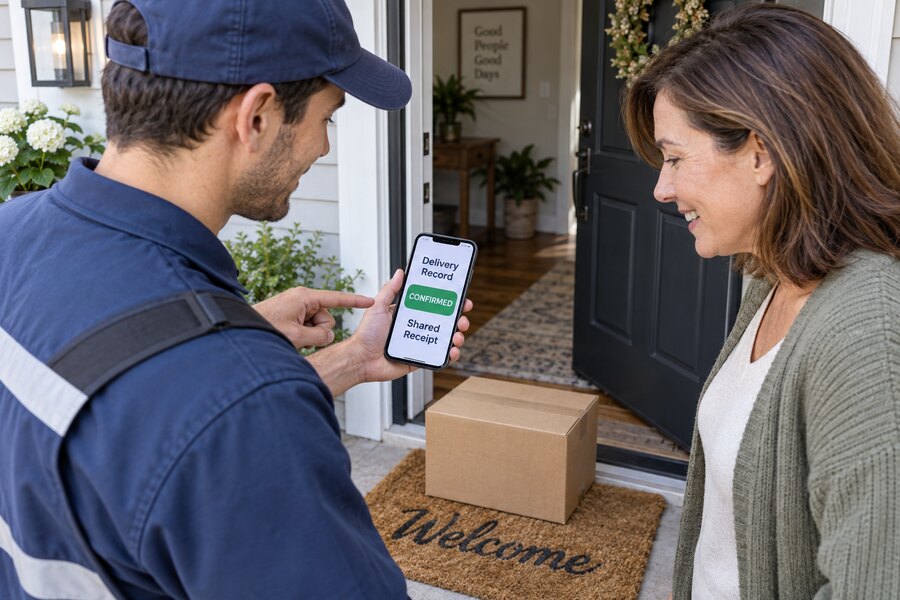
For the shopper, the experience is designed to remain simple even though the underlying verification is considerably more rigorous than a typical delivery notification: a confirmation showing the delivery photograph, the time it was captured, and, in more advanced implementations, a verification indicator showing that the record has been cryptographically confirmed as unaltered since the moment of capture. Some platforms have begun offering shoppers a way to flag a delivery as disputed directly within the same interface, automatically routing the flagged case, along with its verified evidence trail, to the retailer’s resolution team rather than requiring the shopper to separately contact support and re-explain the situation from scratch. This does not eliminate the possibility that a shopper’s home was genuinely the victim of porch piracy after an accurate delivery, but it does mean the conversation that follows starts from a shared, agreed set of facts about what the courier actually did, rather than from competing and unverifiable claims about what may or may not have happened.
Taken together, these three interfaces, an unchanged and low-friction workflow for the driver, an evidence-backed resolution tool for the retailer, and a simple, verifiable confirmation for the shopper, are what a cryptographic proof-of-delivery system actually looks like in daily use, regardless of how much of the underlying architecture is a strict blockchain versus another form of tamper-evident, shared recordkeeping. What unites all three views is that they draw from the same underlying, hash-verified record rather than three separate accounts that each party has to take on faith, which is the specific operational shift that makes disputes faster and fairer to resolve.
Benefits Across the Delivery Chain
For shoppers, the most immediate benefit of cryptographic proof of delivery is a faster, less adversarial path to resolution, since a dispute no longer has to be argued from a position of having no independent evidence at all. Someone whose package was reported delivered but never arrived can point to the same verified record the retailer is looking at, rather than essentially asking a company to take their word over its own courier’s. This shift, from a dispute resolved on trust in one party’s internal system to one resolved on jointly verifiable evidence, changes the emotional character of the interaction considerably, even where the ultimate outcome would have been the same either way.
Retailers benefit in a more directly financial sense, since delivery disputes and the chargebacks, replacement shipments, and customer service costs that follow from them represent a real and recurring expense, particularly for retailers operating at high order volumes where even a small dispute rate translates into a large absolute cost. A shared, verifiable record lets a retailer’s fraud and operations teams distinguish more confidently between a genuine delivery failure, a case of theft after an accurate delivery, and, in the rare but real cases that every high-volume retailer eventually encounters, a fraudulent claim from a shopper who received an item but reported it missing anyway. Because the underlying evidence is tamper-evident, a retailer can rely on it with considerably more confidence than an easily disputed photograph sitting in a courier’s proprietary system, which reduces both the direct cost of wrongly granted refunds and the reputational cost of wrongly denying a legitimate claim.
Couriers and last-mile contractors, who often absorb a disproportionate share of blame precisely because they are physically responsible for the final handoff, gain a form of protection from the same shift: a verified record of exactly when and where a package was delivered protects a driver and employer from being held responsible for theft after an accurate, on-time delivery, while still holding the courier accountable where the record shows a genuine delivery failure. This clearer, evidence-based demarcation of responsibility benefits the courier side of the relationship as much as the retailer side, since disputes that once required lengthy internal investigations and, in serious cases, driver discipline based on incomplete information can instead be resolved by referring to a record neither side can credibly dispute the authenticity of.
Payment processors, insurers, and third-party warranty or protection-plan providers gain a related but distinct advantage from the same underlying architecture: a verifiable, shared delivery record makes it possible to settle a chargeback or an insurance claim based on an agreed, cryptographically confirmed sequence of events rather than competing, unverifiable accounts submitted by the merchant and the cardholder or claimant. This shortens the time a shopper waits for a chargeback determination or an insurance payout, and it reduces the administrative cost that processors and insurers currently absorb investigating claims where the only available evidence is a screenshot that, however genuine it may actually be, cannot be independently verified as unaltered. Across every stakeholder examined here, shopper, retailer, courier, and the financial intermediaries sitting behind the transaction, the underlying benefit is structurally consistent: a single, cryptographically trustworthy source of truth substitutes for the slow, manual, and often adversarial process of comparing separate, self-interested records that has defined delivery dispute resolution for as long as e-commerce has existed, and while that substitution benefits each party somewhat differently, it adds up to a faster and less contentious system for everyone involved.
Documented Case Studies in Blockchain and Shared-Ledger Delivery Verification
The distance between the theoretical promise of blockchain-based delivery verification and what has actually been built and deployed at meaningful scale is worth examining honestly, because the amount of promotional language attached to “blockchain logistics” over the past several years considerably exceeds the number of systems that were genuinely built, tested, and put into ongoing use. Two projects in particular illustrate what this technology looks like once it moves past a conference-stage pitch: a tamper-proof delivery validation platform now running inside one of the world’s largest logistics groups for time-sensitive shipments, and a commercial shared-ledger system that fundamentally changed how a major retailer and its carrier network resolve disputes over deliveries and invoices.
Finding examples that meet a high bar for independent verification takes real effort, since many blockchain logistics announcements from the years following the technology’s initial hype cycle generated substantial press coverage at launch but little to no follow-up reporting on actual outcomes, and at least one of the industry’s most prominent blockchain shipping platforms shut down entirely after concluding that the broader industry was not ready to adopt the technology at the scale its founders had originally envisioned, a case examined later in this article for the honest lessons it offers about institutional readiness. The two cases explored in this section were chosen specifically because they clear that higher bar: both involve identifiable companies, both have documented dates and outcomes published independently of any single sponsoring company’s own marketing materials, and both are still either operating or were operating long enough to generate genuine, measurable results rather than remaining a pilot that never progressed.
Neither case is a finished, universally adopted solution to the porch piracy and delivery dispute problem this article opened with, and that gap between what has actually been demonstrated and the fuller vision that blockchain proof-of-delivery advocates describe is itself an important and honest part of the story that follows.
DHL Health Logistics’ Atlas Path: Tamper-Proof Delivery Validation in Production
In December 2025, CRYOPDP, the temperature-controlled logistics specialist operating as part of DHL Health Logistics and the DHL Pharma Specialised Network across roughly fifteen countries in the United States, Europe, the Middle East, Africa, and Asia-Pacific, won the SAP Digital Transformation Award for Software at the 2025 Supply Chain Excellence Awards, a category that drew seven global finalists including Cryoport Systems, EORI, Finmile, Reckitt, The ClearVue, and VT Garment and Coats Digital. The award recognized Atlas Path, a platform CRYOPDP built with Applied Blockchain, a London-founded blockchain and privacy development studio with over a decade of enterprise experience and clients including Shell and Barclays, using Applied Blockchain’s Silent Data infrastructure, a privacy-focused Ethereum Layer 2 network built for regulated industries that need blockchain-level verifiability without exposing commercially sensitive data to every network participant.
Atlas Path was built specifically for CRYOPDP’s network of drivers, field agents, and global operations teams handling temperature-sensitive shipments, and its core function is directly relevant to the proof-of-delivery problem this article examines: it delivers instant status updates, tamper-proof delivery validation, and end-to-end shipment visibility, ensuring clear, compliant, and secure coordination between offices, field staff, and customers. What makes the underlying architecture notable is that Silent Data runs within a Trusted Execution Environment, a hardware-protected computing space in which sensitive shipment and delivery data is processed without ever being visible even to the network’s operator, while access to specific data is governed by standard Solidity smart contracts that only permit authorized parties to view particular details under particular conditions. This directly addresses a limitation that has held back blockchain adoption in regulated industries generally: a fully open, transparent ledger where every participant can see every transaction is often unacceptable for healthcare logistics, where shipment details can involve patient-linked clinical trial materials, and Atlas Path’s privacy-preserving design let CRYOPDP gain tamper-evident recordkeeping without exposing that kind of sensitive operational detail across its network.
According to the companies’ own published account of the deployment, the network sustains throughput of up to 400 transactions per second on the underlying Silent Data infrastructure and provides round-the-clock coverage across the roughly sixteen countries where Atlas Path is in active use, supporting CRYOPDP’s continuous, time-critical transport operations. Adi Ben-Ari, founder and chief executive of Applied Blockchain, described the achievement in terms directly relevant to the broader argument this article makes about blockchain’s real, rather than theoretical, value: “This award demonstrates how blockchain is now creating measurable value in complex, regulated environments,” he said, adding that the collaboration with CRYOPDP showed how the underlying infrastructure “enables digital transformation at scale, delivering the transparency of blockchain while maintaining the privacy and compliance enterprises demand.” Lourenço Teotónio Pereira, CRYOPDP’s IT R&D manager, echoed this from the operator’s side, noting that the platform gives the company “the ability to leverage blockchain for trust, automation and resilience, without compromising the confidentiality that’s critical to our operations.”
It is worth being precise about what this case does and does not establish, in keeping with the same standard of honesty this article applies to every case study it discusses. Applied Blockchain itself describes Atlas Path as “one of the first real-world implementations of a privacy-enabled blockchain platform in healthcare logistics,” language that signals genuine achievement but also candidly acknowledges that this remains an early example within its specific category rather than a mature, widely replicated industry standard. The deployment is also concentrated within a specialized segment of logistics, temperature-controlled healthcare and life sciences shipments, rather than the broader universe of ordinary e-commerce parcel delivery that generates most porch piracy disputes, which means its lessons about tamper-proof delivery validation transfer conceptually to retail logistics without yet having been proven at that different kind of scale and consumer-facing complexity. What the case does establish, credibly and with independent award recognition rather than only the companies’ own promotional claims, is that a privacy-preserving blockchain platform providing genuinely tamper-proof proof of delivery can be built, deployed, and operated continuously across a major international logistics network, which is a meaningfully higher bar than the conference-stage pilots that dominated blockchain logistics coverage in earlier years.
Walmart Canada and DLT Labs: A Shared Ledger Ends Invoice Disputes
Where the Atlas Path case demonstrates a currently operating, privacy-preserving blockchain platform focused specifically on delivery validation, an earlier and by now extensively documented deployment shows what happens when a shared ledger settles the broader category of disputes that arise around delivery and fulfillment data over a period of years rather than months. Walmart Canada, working with the Toronto-based enterprise blockchain company DLT Labs, built DL Freight, a platform running on Hyperledger Fabric, the open-source, enterprise-grade blockchain framework hosted by the Linux Foundation, specifically to address chronic invoice disputes between Walmart Canada and the third-party carriers that deliver goods to its stores. The platform’s DL Asset Track module tracks deliveries, verifies transactions, and automates invoice creation in real time, so that instead of Walmart and each carrier separately calculating a shipment’s cost and reconciling two different numbers afterward, both parties work from the same shared record of what was picked up, transported, and delivered, with invoices generated jointly rather than disputed after the fact.
The scale of the problem DL Freight was built to solve, as reported by Harvard Business Review in January 2022 and by the retail trade publication Chain Store Age the same month, was severe: invoice disputes between Walmart Canada and its carrier network had at times affected more than 70 percent of loads delivered, driven by the complexity of reconciling fixed shipping charges against variable accessorial fees across a network that grew to more than seventy carriers, each under its own contractual terms, moving roughly 500,000 loads a year. Reconciling that volume of data across dozens of incompatible carrier systems using a traditional “match and compare” approach had, according to DLT Labs’ account corroborated by Walmart Canada executives, made disputes a structural feature of the relationship, driving up administrative costs and delaying carrier payments industry-wide.
After DLT Labs configured the platform for Walmart Canada’s requirements and ran it through an extended live pilot, the shared ledger was rolled out as Walmart Canada’s national standard for freight invoicing. The reported results, described consistently across Harvard Business Review’s January 2022 account, Chain Store Age’s reporting the same month, and DLT Labs’ own published case study, were substantial: invoice disputes fell from a range exceeding 70 percent to below 2 percent, a reduction of roughly 97 percent, while the per-invoice error threshold that had previously required review, historically as much as 10 dollars of discrepancy per invoice, was effectively eliminated. Chain Store Age additionally reported that Walmart Canada compressed an 11-step invoicing workflow down to five steps from tender to payment, and the time required to approve and settle a carrier invoice, previously six to eight weeks or longer, dropped to less than one week. Francis Lalonde, Walmart Canada’s vice president of transportation, summarized the shift: “Something unusual has to occur to have a dispute now,” he said. “There are small items to resolve, but as we all have the same information, there is simply no need for disputes anymore.”
It is important to describe this case accurately rather than overstating its relevance to porch piracy specifically, since DL Freight resolves disputes over freight invoicing and carrier payment rather than consumer-facing package theft at a shopper’s front door. What makes it directly relevant to this article’s broader argument is that it demonstrates, over years of continuous, verified operation rather than a bounded pilot, the exact mechanism blockchain-based proof of delivery relies on for resolving any delivery dispute: when every party works from a single, jointly created and verified record instead of separately maintained accounts reconciled after the fact, disputes stop occurring at anywhere near their previous rate. The structural fix that took Walmart Canada’s carrier disputes from more than 70 percent of loads to below 2 percent is, at its core, the same fix a shared, cryptographically verified proof-of-delivery record offers to the shopper standing at an empty porch arguing with a retailer’s support line, even though the disputed data, freight charges in one case and a missing package in the other, is different.
Limitations, Costs, and Open Questions
The most fundamental limitation facing any cryptographic proof-of-delivery system is the one already introduced earlier in this article: the persistent gap between a verified digital record and the physical reality it describes. No hash, however cryptographically sound, can inspect the contents of a box, confirm a package was placed somewhere reasonably secure rather than in plain view of a busy street, or prevent a thief from taking an item that was, by every available record, delivered exactly as intended. This gap can be narrowed through complementary measures, geofenced photo capture, delivery-to-locker programs that remove the exposed doorstep entirely, and retailer policies treating a verified delivery as the starting point for a theft claim rather than the end of the conversation, but none of these measures is native to the cryptography itself, and a system marketing blockchain-verified delivery confirmation without also addressing the physical vulnerability of an unattended doorstep offers less real protection than the marketing suggests.
A second significant obstacle is cost and integration burden, which tends to fall hardest on the smaller retailers and independent local couriers that might benefit proportionally the most from reduced disputes but have the least capacity to absorb the upfront investment. Building or subscribing to a shared, verified delivery platform, integrating it with existing order and dispatch systems, and equipping staff with compatible scanning hardware all require investment that large retailers and national carriers can spread across enormous volumes far more easily than a small merchant or a regional contractor on thin margins. This creates a genuine risk that verified delivery confirmation becomes a competitive advantage available mainly to well-capitalized players, leaving smaller operators reliant on the same unverifiable data that generates the bulk of today’s disputes.
A related and more sobering limitation comes from the industry’s actual track record with ambitious blockchain logistics ventures, which has been rockier than early coverage suggested it would be. TradeLens, a blockchain-based global trade platform launched in 2018 by Maersk and IBM, was, at its peak, used by carriers representing a substantial share of the world’s containerized trade and was frequently cited as blockchain’s flagship logistics example. On November 29, 2022, Maersk and IBM jointly announced they would discontinue TradeLens, and it went offline by the end of the first quarter of 2023. Rotem Hershko, Maersk’s head of business platforms, explained the decision in terms directly instructive for any proof-of-delivery initiative: “While we successfully developed a viable platform, the need for full global industry collaboration has not been achieved,” he said, adding that “TradeLens has not reached the level of commercial viability necessary to continue work.” The lesson is not that blockchain logistics platforms cannot work technically; by Maersk’s own account, the platform functioned as designed. The lesson is that a shared ledger’s value depends on getting enough independent, sometimes competing organizations to actually join it, and that building sound technology is not the same achievement as persuading a fragmented industry to adopt a shared standard at commercially sustainable scale.
There is also an unresolved question of data governance among organizations that are simultaneously partners and competitors, a dynamic that applies as directly to retail delivery verification as it did to TradeLens. A large retailer and the competing couriers it contracts with share an interest in resolving disputes efficiently, but each courier also competes for the retailer’s business, raising real questions about who controls the shared platform’s infrastructure, what happens to a courier’s data if it later switches providers, and whether one dominant vendor gains outsized influence over how the industry’s delivery data gets structured and priced. Cryptographic tamper-evidence does not resolve these governance questions; they depend on the commercial terms set by whichever company operates the platform, and those terms vary considerably between vendors.
Finally, there is the ordinary challenge of achieving genuine coverage across a last-mile ecosystem of national carriers, regional contractors, and countless independent local services, many operating on thin margins with limited appetite for adopting a new platform without an immediate, demonstrated return. The clearest path forward, based on the cases examined here, runs through large, well-resourced institutions absorbing the early cost and complexity before smaller participants are asked to adopt an unproven technology on their own. Whether cryptographic proof of delivery becomes a standard expectation across ordinary e-commerce will likely depend on how many more such institutions absorb that cost, and on the industry avoiding the failure mode that ended TradeLens: building useful technology without first securing the broad collaboration needed to make it durable.
Final Thoughts
Blockchain proof of delivery is, at its core, a solution to a trust problem rather than a purely technical one, and recognizing that distinction determines whether the technology delivers on its transformative potential or simply becomes another layer of infrastructure that shoppers never notice. Retailers, couriers, and shoppers have always been capable of recording what happened at a doorstep; a photograph, a timestamp, and a GPS coordinate are not new inventions. What has been missing is a way for all three parties to look at that same record and agree, without simply trusting one another, that it has not been altered or quietly adjusted to favor whichever side controls the system it lives in. A cryptographically verified, shared ledger does not replace the physical act of a driver placing a package somewhere secure, or a shopper choosing a delivery location less exposed to a busy street. What it offers is a common, tamper-evident foundation that lets every party in a dispute argue from the same set of facts, a smaller-sounding achievement than it actually is, given how much of today’s friction comes precisely from the absence of shared facts rather than any disagreement about what those facts would mean.
The broader social significance of this shift extends beyond the convenience of any single shopper resolving a missing-package claim more quickly. Trust in e-commerce, like trust in any large, mostly invisible system, accumulates through thousands of small interactions that mostly go unnoticed, and a package dispute is one of the few moments where that trust becomes visibly, personally tested, precisely because the shopper has no independent way to verify anything the retailer or courier tells them. A system that lets a retailer say, with a verifiable record rather than a mere assurance, exactly what its courier’s data shows and when, changes an interaction that currently feels like an opaque judgment call into one that feels like an accountable, evidence-based conversation, and that shift matters most for shoppers who can least afford to lose a package’s cost while a dispute drags on. This has a genuine equity dimension: faster resolution benefits every shopper, but it matters disproportionately to those living paycheck to paycheck, in neighborhoods already targeted more frequently by porch piracy, or without the flexibility to absorb the cost of a stolen item while an investigation proceeds at its own pace.
None of this should be mistaken for a claim that the underlying problem of porch piracy or delivery disputes has been solved. The cases examined in this article are real and independently verifiable, but they remain, in important ways, early: a privacy-preserving platform operating within a specialized segment of healthcare logistics rather than across the far larger world of ordinary e-commerce parcel delivery, and a freight invoicing system that eliminated disputes over shipping costs rather than the consumer-facing theft that gives porch piracy its name. The physical vulnerability of an unattended doorstep remains untouched by any ledger technology, and the industry’s own history includes a technically sound blockchain platform that shut down because building the technology proved easier than persuading a competitive, fragmented industry to adopt it together. What has genuinely changed is that the infrastructure needed to give shoppers, retailers, and couriers one shared, trustworthy account of what happened at a doorstep now exists, has been tested in real operational settings, and has already shown, in the disputes it was built to resolve, that shared facts end arguments faster than three separate, unverifiable ones ever could.
FAQs
- What does “blockchain proof of delivery” actually mean?
It means that the evidence created at the moment a package is delivered, such as a GPS location, a timestamp, and a photograph, is cryptographically recorded on a shared, tamper-evident ledger that the courier, the retailer, and often the shopper can all verify, rather than being stored only inside the courier’s own private system and shared as a simplified summary after the fact. - Does this technology stop packages from being stolen off a porch?
No. A cryptographic record can verify that a package was delivered to a specific location at a specific time exactly as the evidence shows, but it cannot physically prevent someone from later taking that package. What it does is remove any doubt about whether the delivery itself happened as claimed, so that a theft dispute starts from agreed facts rather than an argument over unverifiable evidence. - How is this different from the delivery photo and tracking notifications couriers already provide?
Existing delivery photos and tracking updates are generated and stored entirely within a courier’s own system, and a retailer or shopper has no independent way to confirm that a photo or timestamp has not been altered after the fact. A blockchain-based system cryptographically hashes that same evidence at the moment it is captured and writes it to a shared ledger, so any party can verify the evidence presented later matches exactly what was recorded at delivery. - Are there real companies actually using this today, or is it still mostly a concept?
Both, depending on the application. CRYOPDP, part of DHL Health Logistics, built a platform called Atlas Path with Applied Blockchain that delivers tamper-proof delivery validation for temperature-sensitive healthcare shipments and won a Digital Transformation Award at the 2025 Supply Chain Excellence Awards. Separately, Walmart Canada’s DL Freight platform, built with DLT Labs, has used a shared ledger since 2019 to cut invoice disputes with its carrier network from more than 70 percent of loads to below 2 percent, as reported in 2022. - Have any similar blockchain logistics platforms failed?
Yes. TradeLens, a blockchain shipping platform built by Maersk and IBM and used by carriers representing a large share of global containerized trade, shut down in late 2022 after its operators concluded it had not achieved the level of industry-wide collaboration and commercial viability needed to continue. Maersk’s own leadership stated the technology worked as designed but that not enough of the industry adopted it together. - Can a small online retailer or independent courier use this kind of system?
It is harder for smaller businesses than for large retailers and national carriers, mainly due to the cost of integrating new verification platforms and compatible scanning hardware rather than any deliberate exclusion. The clearest path so far has involved large, well-resourced companies building and proving these systems first, which creates a foundation smaller retailers and couriers may eventually be able to join through lower-cost managed platforms. - What happens if a driver’s photo or GPS reading is simply wrong, not tampered with?
A blockchain record only guarantees that data has not been altered after it was captured; it cannot correct an inaccurate GPS reading or a photo taken at the wrong address. Some systems address this by requiring geofenced photo capture, which rejects a delivery photo unless the device’s location matches the destination address closely enough at the moment the photo is taken. - Does this mean the retailer, courier, and shopper all see the exact same data?
Not necessarily in full detail. Many systems use privacy-preserving designs so that sensitive information, such as a shopper’s exact address or a courier’s confidential shipping volumes, is not broadly exposed, while still allowing each authorized party to verify that the specific evidence relevant to their dispute has not been altered since it was recorded. - Will this replace the customer service process for a missing package?
It is more likely to speed up and simplify that process than eliminate it. A verified, shared delivery record gives customer service teams a faster, more confident basis for deciding whether a package was genuinely delivered, but a resolution process, including refund and replacement decisions, still depends on the retailer’s own policies for what happens after an accurate delivery. - What should a shopper actually expect to change because of this technology?
Where retailers and couriers have adopted verified delivery systems, shoppers can generally expect faster resolution of missing-package disputes and delivery confirmations that carry more independently verifiable weight than a simple photo and status update. The underlying cryptography remains invisible in daily use; what shoppers experience is a more trustworthy and less argumentative version of the delivery confirmation process that already exists today.