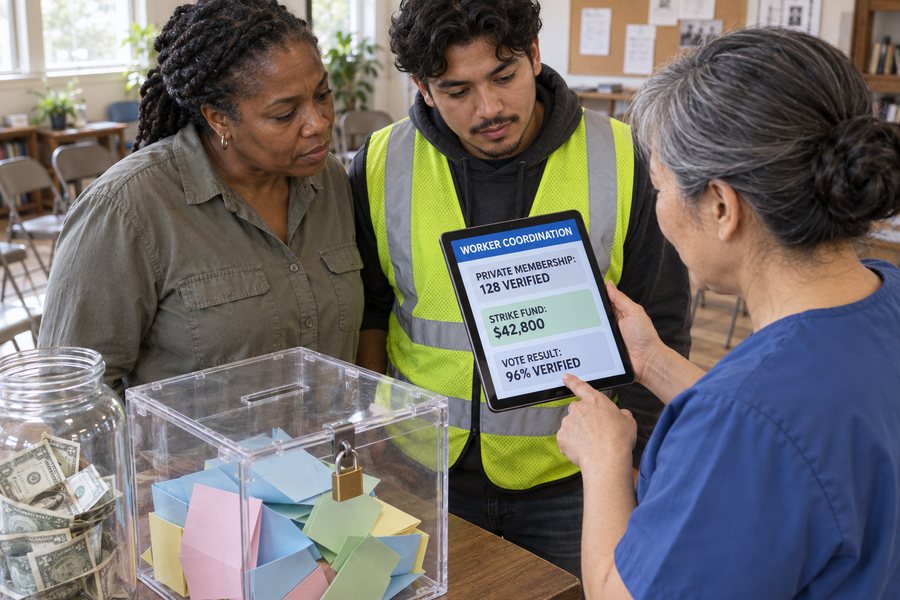
Organized labor has always run on a small set of fragile mechanisms: a list of who has signed a union card, a fund that pays striking workers while they have no paycheck, and an internal election that decides who gets to speak for the membership at the bargaining table. Each of these mechanisms has failed in well-documented ways throughout labor history, not because organizers were careless but because each one depends on trust that is difficult to verify from the outside and easy for a hostile employer, a dishonest official, or simple institutional opacity to exploit. A list of union supporters can be leaked or subpoenaed and used for targeted retaliation. A strike fund can be drained by an officer with poor bookkeeping or outright fraud long before members ever learn there was a problem. An internal union election can be contested, delayed, or manipulated in ways that take years of litigation to unwind, as several major American unions have discovered the hard way over the past two decades.
Blockchain technology, and the broader category of tools built around it, cryptographic signatures, decentralized autonomous organizations, tamper-evident public ledgers, and token-based voting, has been pitched by parts of the crypto industry as a fix for exactly these vulnerabilities. The pitch usually runs the same way regardless of who is making it: put membership verification, strike fund accounting, or election tallies on a public, cryptographically verifiable ledger, and the specific kind of institutional trust that has repeatedly broken down in labor’s history becomes, in principle, something anyone can independently check rather than something members simply have to believe. This is not a new argument. In late 2021, the venture investor Li Jin argued publicly that decentralized autonomous organizations represented the next evolution of the labor movement, citing their transparency and open admission rules, and the backlash from labor organizers and researchers was immediate and pointed, with critics arguing that no amount of cryptographic tooling substitutes for the collective action and legal protection that actual organizing requires.
This article takes neither side of that argument at face value. It is built around a narrower and more testable question: where, specifically, has cryptographic infrastructure actually been adopted by real unions, worker cooperatives, or labor-adjacent organizations since 2022, what did that adoption actually accomplish, and where has it instead remained speculative marketing aimed at union treasuries rather than a genuine organizing tool. That distinction matters enormously, because the labor movement has a long and largely unrelated history of technology vendors, financial firms, and political operatives approaching unions with products framed as empowerment that primarily benefit the vendor, and cryptographic tools are not automatically exempt from that pattern simply because their marketing language borrows the vocabulary of transparency and worker power.
What follows examines the specific, recurring failure points in labor organizing that any credible technology would need to address, walks through what web3 tooling for labor actually consists of in practical terms, and then turns to three real, dated cases from 2022 onward: a worker-owned cooperative that has built genuine on-chain treasury governance, a private-sector union whose adoption of self-custodied Bitcoin became a case study in exactly the kind of internal trust breakdown this technology claims to solve, and a driver-owned cooperative whose functioning worker democracy runs, deliberately and successfully, on none of this infrastructure at all. The goal is not to declare cryptography either a solution or a distraction for organized labor, but to give an honest accounting of what has actually been tried, what it actually achieved, and what remains an open and often contested question.
No prior familiarity with blockchain technology is assumed in what follows, since the audience most likely to benefit from a clear-eyed accounting of these tools, rank-and-file members deciding whether to trust a proposal brought to their local, is generally not the audience already fluent in cryptocurrency terminology. Wherever a technical term appears for the first time, this article defines it in plain language before relying on it, and wherever a claim about a specific organization is made, that claim is anchored to a named, dated, independently checkable source rather than to a general industry narrative, since the whole point of examining verifiability as a concept is undermined by an article about verifiability that cannot itself be verified.
Labor’s Old Problems: Trust, Transparency, and Verification
Before evaluating any proposed technological fix, it is worth being precise about the specific problems that fix is supposed to solve, because much of the enthusiasm and much of the skepticism surrounding web3 tools for labor talks past each other by describing different problems. Three recurring, historically documented failure points are worth naming individually, since each one implies a different kind of technical solution and a different kind of risk if that solution is poorly designed.
The first is employer identification and retaliation against workers involved in organizing. A signed union authorization card, a list of committee members, or even metadata showing who attended an organizing meeting has historically been a target for employers seeking to identify and pressure or terminate the workers most central to a campaign, a dynamic labor law is specifically designed to prohibit but has never fully prevented in practice. Any organizing tool that creates a durable, identifiable record of who supports unionization, whether that record sits in a spreadsheet, a Slack channel, or, notably, a public blockchain, has to reckon with the fact that durability and transparency, valuable properties in a treasury or a vote count, are actively dangerous properties in a list of workers exposed to employer retaliation before an election has occurred.
The second recurring failure point is opacity or outright fraud in strike and benefit fund administration. Strike funds exist precisely because workers need income while withholding labor, and the scale involved is genuinely large: the United Auto Workers entered its 2023 stand-up strike against the Detroit automakers with a strike fund exceeding $825 million and paid striking members $500 per week from that fund, according to widely reported union financial disclosures at the time. A fund of that size, like any large pool of member dues, depends on internal financial controls and periodic disclosure to members and to the Department of Labor, and the labor movement’s own history includes instances of officers misusing such funds in ways that surfaced only after significant damage had been done, which is precisely the kind of failure that continuous, auditable, third-party-verifiable accounting is meant to address regardless of which specific technology performs the accounting.
The third failure point is disputed or fraud-vulnerable internal elections, a problem serious enough that it has already produced its own institutional remedy independent of any blockchain technology. Following a wide-ranging federal corruption investigation that resulted in convictions of multiple United Auto Workers officials for embezzling member dues, the union agreed to a consent decree in December 2020 that installed a court-appointed independent monitor and mandated the union’s first-ever direct, one-member-one-vote election of its top international officers, held in 2022 specifically because the existing indirect delegate system had proven vulnerable to exactly the kind of internal capture that direct, independently verifiable voting is designed to prevent. That remedy came from federal oversight and a change in electoral rules, not from cryptography, and it is a useful baseline against which to measure how much a blockchain-based voting system would actually add.
It is worth adding that American labor law already imposes a real, if imperfect, transparency requirement of its own: most unions with annual receipts above $250,000 must file a detailed LM-2 financial disclosure form with the Department of Labor every year, itemizing income, expenses, and officer compensation for any member or member of the public to inspect. This existing requirement is precisely the kind of after-the-fact, periodic disclosure that continuous, real-time cryptographic verification is proposed to improve upon, and any fair assessment of blockchain-based treasury tools has to compare them against this actual legal baseline rather than against a hypothetical union with no transparency requirements at all.
Taken together, these three failure points point toward a genuine tension at the center of any cryptographic tool for labor organizing: the properties that make blockchain infrastructure valuable for financial transparency, permanence and public verifiability, are close to the opposite of the properties needed to protect an organizing committee from employer retaliation before a union has legal recognition. A credible evaluation of web3 tools for labor has to hold both halves of that tension in view rather than treating “more transparency” as an unqualified good, which is precisely the framework the rest of this article applies to the specific tools and cases that follow.
What “Web3 for Labor” Actually Means
Stripped of marketing language, the phrase “web3 for labor” typically refers to a small, specific set of technical components rather than a single unified product: decentralized autonomous organizations, or DAOs, which are internet-native groups that make collective decisions through token-based voting recorded on a blockchain; token-gated membership, in which holding a specific digital token or credential grants access to a group’s internal spaces and voting rights; on-chain treasuries, which hold and disburse pooled funds through publicly visible blockchain transactions rather than a private bank account; and cryptographic or blockchain-based voting systems, which aim to make an election’s tally independently verifiable by anyone rather than dependent on trusting whoever counted the ballots.
For a reader entirely new to the underlying technology, the core idea beneath all four of these components is simpler than the jargon suggests: a blockchain is a shared record of transactions that thousands of independent computers each keep an identical, continuously updated copy of, secured by cryptographic signatures, a mathematical technique that lets anyone confirm a specific record was authorized by a specific key holder without needing to trust a single central authority’s own bookkeeping. Applied to a treasury, this means a fund’s balance and history are not stored in one institution’s private database that could be altered or hidden, but distributed across a network where altering the record after the fact would require rewriting the copies held by a large majority of independent participants simultaneously, which is what advocates mean when they describe such a record as tamper-evident.
Each of these components was developed for, and is far more commonly used by, cryptocurrency projects and decentralized finance protocols than by labor organizations, which matters for two related reasons. First, the tooling is generally mature and well-tested for its original purpose, meaning a labor organization adopting it is not typically building experimental software from scratch but rather repurposing infrastructure that already secures large amounts of financial value elsewhere. Second, and less favorably, the tooling was designed around the assumptions of voluntary, often pseudonymous online communities coordinating around a shared token, assumptions that map imperfectly onto a legally regulated union with a fixed, dues-paying membership, formal bargaining obligations, and election rules set by federal labor law rather than by a smart contract’s own governance logic.
The distinction this article draws throughout is between organizations that have genuinely adopted this infrastructure for real governance functions, accepting its actual technical and legal constraints, and outreach efforts that use the language of worker empowerment primarily to interest union treasurers and pension funds in acquiring cryptocurrency as an asset, a distinction that becomes concrete in the case studies examined later in this article. Understanding the specific tools in the next two sections, and their genuine track record outside of labor entirely, is a necessary step before that distinction can be evaluated fairly rather than rhetorically.
DAO Tooling: Snapshot, Colony, and On-Chain Treasuries
Snapshot is a widely used off-chain voting platform that lets a token-holding community cast votes whose results are cryptographically signed and publicly recorded, without the cost and delay of submitting every individual vote as its own blockchain transaction, making it one of the most commonly adopted governance tools across the broader decentralized autonomous organization ecosystem since its release in 2021. Colony is a related but distinct piece of infrastructure focused specifically on workforce coordination within a decentralized organization, tracking members’ contributions and assigning a reputation score intended to weight influence by demonstrated work and peer assessment rather than purely by token holdings, an explicit attempt to avoid the plutocratic outcome in which whoever holds the most tokens simply controls every decision.
These two tools have, in a documented and verifiable way, been integrated with each other rather than existing purely as separate competitors: Snapshot has built an integration allowing communities to weight votes using Colony’s reputation system specifically to counterbalance token-weighted voting with a measure of actual contribution and peer standing, a partnership covered in decentralized finance trade press as an attempt to make DAO governance more equitable than a simple one-token-one-vote model. This combination is directly relevant to labor-style organizing because it represents an attempt to solve the same problem a union constitution solves through eligibility rules and one-member-one-vote provisions, ensuring that voting power reflects membership and contribution rather than simply who has accumulated the most financial stake in the organization.
Snapshot’s scale is itself part of why it is a reasonable starting point for any organization, labor or otherwise, considering on-chain-adjacent voting: it has been used by a large number of decentralized finance and DAO projects to run governance votes since launching, giving it a substantially longer and more battle-tested operating history than a bespoke voting tool built from scratch would have, an important practical consideration for any union treasurer weighing reliability against novelty. Colony’s more specialized reputation system has seen comparatively narrower adoption, reflecting the general pattern in this space that contribution-weighted governance is more conceptually appealing than it is easy to actually implement well.
On-chain treasuries built on this same underlying infrastructure function differently from a union’s bank account primarily in their default visibility: transactions moving funds into or out of a treasury smart contract are recorded on a public blockchain and can be independently verified by any member, or any outside observer, using a block explorer, without waiting for a periodic financial disclosure filing or trusting a treasurer’s own reporting. This property is precisely what makes on-chain treasuries attractive for the strike-fund transparency problem described earlier in this article, and precisely why the case study examined later in this piece, involving a real worker-owned collective’s use of exactly this kind of on-chain treasury governance, is worth examining in detail rather than taking the underlying promise on faith.
Blockchain E-Voting and Its Limits for Union Elections
The technical case for blockchain-based voting rests on a genuinely appealing property: a properly designed system can let every voter, and every outside auditor, independently verify that their own vote was recorded correctly and that the published tally matches the full set of recorded votes, without requiring anyone to simply trust an election committee’s count the way a traditional paper or electronic ballot system requires. This property has attracted real, documented experimentation well beyond the labor context specifically. Research surveys tracking the field counted roughly eighty academic papers on blockchain-based electronic voting published in 2022, rising to more than one hundred twenty by 2023, and government-adjacent pilots have moved beyond pure research, including a 2023 United Nations-backed blockchain voting pilot intended to allow refugee populations to participate in elections securely, and a 2023 blockchain voting trial conducted by the Australian state of Victoria that its own reporting credited with a meaningful reduction in per-vote administrative cost compared to prior digital voting methods. National governments have also funded direct exploration of the technology rather than relying solely on academic study, with South Korea reportedly committing the equivalent of roughly $1.1 million in 2022 toward a dedicated blockchain voting research effort and Greenland separately funding a comparable research group with roughly half that amount the same year, spending that reflects genuine government-level interest even where it has not yet produced binding elections.
What is notably absent from this same body of documented pilots, as of the most recent publicly available research, is a binding, legally recognized internal union election conducted on blockchain infrastructure in the United States. This gap has a specific, structural explanation rather than reflecting simple technological conservatism: internal union elections for the officer positions covered by federal labor law are governed by strict procedural requirements under the Labor-Management Reporting and Disclosure Act, enforced by the Department of Labor, and any voting system, blockchain-based or otherwise, must satisfy secret-ballot and verifiability requirements that predate this technology entirely and were not written with cryptographic verification in mind. The direct, one-member-one-vote United Auto Workers election held in 2022 under federal monitor oversight, discussed earlier in this article, used a conventional mail-ballot system administered by an independent monitor rather than any blockchain infrastructure, illustrating that the union movement’s most significant recent election-integrity reform to date was achieved through legal and procedural change rather than new voting technology.
None of this means blockchain-based voting has no plausible future role in union governance, particularly for narrower internal votes, such as strike authorization polls or contract ratification votes, that a local union might choose to run through its own systems rather than under the specific federal procedures governing officer elections. But the gap between the technology’s demonstrated use in government and NGO pilots and its complete absence from binding American union elections is itself informative, and it is a gap this article’s later discussion of open legal questions returns to directly.
Taken together, DAO governance tooling and blockchain e-voting represent two genuinely distinct technical maturities: one, built around treasury transparency and contribution-weighted voting, has already been adopted by real worker-owned organizations in ways this article examines next, while the other, built around verifiable ballot tallying, remains largely confined to contexts outside the specific legal framework that governs American union elections, a distinction any honest evaluation of this technology for labor needs to preserve rather than collapse into a single undifferentiated claim about “blockchain voting for unions.”
Case Studies: Where This Has Actually Been Tried
Evaluating any of the claims made in the preceding sections requires looking past both the crypto industry’s promotional framing and organized labor’s own understandable skepticism toward documented, dated examples of what has actually happened when this technology met a real organization with real members and real money at stake. Three cases, chosen specifically because each is independently verifiable through primary sources rather than a single company’s own marketing, illustrate just how uneven this adoption has actually been.
The first case involves a genuine worker-owned collective that built its core funding mechanism directly on DAO infrastructure and has a documented, on-chain record of that mechanism actually operating. The second involves a private-sector union whose adoption of self-custodied cryptocurrency, framed publicly as a step toward financial empowerment, instead became a well-documented case study in exactly the kind of internal trust breakdown that transparent, verifiable systems are supposed to prevent. The third is a deliberate point of contrast: a real, functioning worker-owned cooperative whose democratic governance has never used blockchain technology at all, examined here specifically because its documented successes and struggles show what worker democracy looks like when it runs on conventional tools instead. Each case below is drawn from the organization’s own public statements and technical documentation together with independent press coverage, and each is presented with its actual limitations intact rather than smoothed over for the sake of a cleaner narrative.
Breadchain Cooperative: On-Chain Governance for a Real Worker-Owned Collective
Breadchain Cooperative describes itself, in its own public documentation, as a worker-owned collective building open-source financial tools for cooperatives, nonprofits, and other solidarity-focused communities, with every governance decision made collectively by its own contributors. The project’s origins are themselves instructive: it grew out of an online community of self-described “crypto leftists” active on Discord and Reddit who were specifically dissatisfied with how little of the broader blockchain industry’s stated interest in decentralization and worker empowerment translated into tools actually built for cooperatives rather than speculative trading, and it organized itself as a formal worker-owned cooperative rather than a purely informal online collective. Its central product, called the Bread Solidarity Fund, works by letting participants deposit a stablecoin into a pooled, interest-generating smart contract in exchange for a governance token called BREAD, with the interest earned on the pooled deposits flowing into a shared treasury that funds a network of member cooperative projects rather than accruing to any individual depositor.
The specific, verifiable mechanism that makes this a genuine rather than merely promised example of on-chain worker governance is how that treasury is actually allocated: BREAD token holders vote, using the same voting infrastructure discussed earlier in this article, on how the pooled yield should be distributed among Breadchain’s member projects on a recurring cycle. According to Breadchain’s own technical documentation and third-party coverage of the underlying smart contract deployment, the cooperative’s developers deployed the first working version of this voting and distribution system on June 28, 2024, ran the initial vote through July 1, 2024, and completed a distribution of 7,764 BREAD tokens across five member cooperative projects based on the outcome, a concrete, dated, on-chain event rather than a roadmap promise.
What makes this case genuinely instructive is not its scale, which remains modest, but the fact that it demonstrates the specific mechanism described earlier in this article’s discussion of on-chain treasuries actually functioning as intended: a real collective of worker-owned and solidarity-economy organizations pooling resources, voting transparently on their allocation, and leaving a publicly verifiable record of both the vote and the resulting fund transfers, satisfying exactly the transparency property that a strike fund or benefit fund administered through conventional accounting cannot offer by default. It is worth being precise about what this case is not, since overstating it would repeat the same promotional excess this article has cautioned against throughout: Breadchain is not a labor union recognized under federal labor law, does not engage in collective bargaining, and its member projects are themselves generally small cooperative and mutual-aid organizations rather than dues-paying rank-and-file workforces of the kind a traditional union represents. It is, more precisely, a real and verifiable instance of the worker-ownership and DAO governance pattern this article examines, operating adjacent to organized labor rather than inside it.
IATSE Local 728: Bitcoin, Self-Custody, and a Union Divided
IATSE Local 728, a roughly 3,000-member local of the International Alliance of Theatrical Stage Employees representing lighting technicians and related crafts in the entertainment industry, announced on March 13, 2025, in a press release published by Bitcoin Magazine, that it had purchased Bitcoin for its balance sheet and would hold it in self-custody, describing itself as the first private-sector labor union in the United States to do so. The initiative was carried out with the assistance of Proof of Workforce, a nonprofit founded in 2023 by Dom Bei, a professional firefighter and Bitcoin advocate, whose stated mission is helping public- and private-sector unions adopt Bitcoin through education-focused outreach. The union’s own statement framed the move explicitly in terms of the transparency and verification themes this article has traced throughout, describing Bitcoin as protection for “the value of our members’ labor” and control that self-custody, rather than a bank or fund manager, would provide. IATSE Local 728 itself is not a new or peripheral organization within the entertainment industry’s labor movement; it traces its own institutional history back to 1939 and describes itself, in its own public statements, as having led the industry in safety and technical training for its lighting and camera crews for more than eight decades, context that makes its 2025 Bitcoin announcement notable precisely because it came from an established, mainstream union local rather than a marginal or newly formed one.
The self-custody claim in this case is technically real and independently checkable in the same way this article’s earlier discussion of on-chain treasuries described: because a self-custodied Bitcoin holding sits on a public blockchain under keys the union itself controls, its existence and movement can, in principle, be verified independently of the union’s own reporting, exactly the property that makes cryptographic assets attractive for treasury transparency. What makes this case genuinely instructive, however, is what happened next, as reported in a detailed investigative piece published in The Nation on March 28, 2025. According to that reporting, the announcement caught many IATSE 728 members by surprise, generating visible dissent in the local’s own Facebook group, with members asking pointedly when any vote on the purchase had actually occurred and noting that many members, especially those behind on dues during an industry-wide production slowdown, had not been informed before the decision was publicly announced as having been “approved by an overwhelming majority.” The union disclosed that the purchase amounted to roughly one percent of its total assets but did not disclose the dollar amount, the exchange used, or further details, and IATSE officials did not respond to requests for comment from The Nation. Michael Parks, a chief lighting technician and eight-year IATSE 728 member quoted in that reporting, called the purchase “clearly a huge mistake” given that many members were simultaneously struggling with a prolonged industry-wide production slowdown, and argued that the union should instead prioritize divesting from Bitcoin and addressing more immediate workplace safety and dues-affordability concerns, a reaction that stands as a direct, on-the-record rebuttal to the announcement’s own framing of the purchase as a broadly supported, empowering decision.
The same reporting also surfaced a conflict-of-interest question directly relevant to this article’s broader theme of verification and trust: Dom Bei, whose nonprofit facilitated the purchase, is himself a Bitcoin holder whose public advocacy work benefits from rising Bitcoin adoption among institutions, and he was simultaneously campaigning for a seat on the board of trustees of CalPERS, the roughly $500 billion California public pension fund, at the time of the IATSE announcement. Bei stated that neither he nor Proof of Workforce received fees or commissions from the IATSE transaction, but declined to disclose the nonprofit’s donors. This case, taken as a whole, is a genuinely useful test of the theory examined throughout this article: the underlying cryptographic asset was self-custodied and verifiable in exactly the technical sense web3 advocates emphasize, yet the actual decision-making process that led to its purchase reproduced precisely the opacity and lack of membership consent that transparent financial technology is supposed to prevent, a gap between technical verifiability and organizational trust that no blockchain, by itself, closed.
The Drivers Cooperative: Worker Ownership Without the Blockchain
The Drivers Cooperative, a driver-owned ride-hailing cooperative co-founded by driver and Grenadian immigrant Ken Lewis, labor organizer Erik Forman, and former Uber executive Alissa Orlando, launched in New York City in May 2021, offers a useful and deliberately contrasting data point precisely because its governance runs entirely on conventional, non-blockchain infrastructure: each driver-member owns one share of the cooperative and casts one vote in its leadership and policy decisions, a traditional one-member-one-vote structure administered the way cooperatives have handled internal democracy for more than a century. The cooperative’s underlying business model is itself a direct answer to a concrete driver grievance rather than an abstract governance experiment: it takes roughly fifteen percent of each ride’s fare for overhead, compared with the twenty-five to forty percent that competitors such as Uber and Lyft have been reported to charge, with the difference flowing back to driver-owners as higher per-mile pay and, eventually, dividends. By 2022, its first full year of sustained operation, the cooperative reported $5.9 million in revenue from more than 162,000 completed trips, with $5.2 million of that revenue paid directly to driver-members as wages, and its driver-ownership base had grown to roughly 9,000 members, representing an estimated fifteen percent of New York City’s total ride-hailing driver workforce at the time, according to contemporaneous reporting.
The cooperative’s subsequent history also illustrates, honestly, that conventional governance carries its own real vulnerabilities of the kind this article’s earlier sections examined in the context of cryptographic fixes. Independent reporting on the cooperative’s internal struggles documented that, from October 2023 through June 2024, an internal dispute over control of the cooperative’s technology contract left the organization in what one detailed case study described as the paradoxical position of “a cooperative without an app, and an app without a cooperative,” after the cooperative’s leadership stopped paying for the Google API service underlying its ride-hailing application amid an unresolved governance conflict. This episode is worth naming directly rather than glossing over, because it demonstrates the same underlying vulnerability, opaque or contested control over shared operational resources, that this article’s case studies of Breadchain and IATSE Local 728 approached through cryptographic tooling, showing that the underlying problem is not unique to organizations without blockchain infrastructure, even though the specific remedy in this case was ultimately organizational and legal rather than technical.
Read against the other two cases in this section, the Drivers Cooperative demonstrates that functioning, democratically governed worker ownership, including its documented periods of financial success and its documented periods of internal dysfunction, does not require blockchain infrastructure to exist or to matter, and that the specific failure modes cryptographic tools are marketed as solving can and do occur in cooperatives that have never touched this technology at all. None of the three cases examined in this section offers a clean verdict in either direction. Breadchain shows on-chain governance genuinely functioning at a small, real scale among a real network of cooperatives; IATSE Local 728 shows a technically real cryptographic asset failing to prevent the exact governance opacity it was marketed as solving; and the Drivers Cooperative shows that conventional worker democracy carries its own comparable vulnerabilities without any blockchain involved at all, a pattern that should inform rather than resolve the stakeholder-by-stakeholder assessment that follows.
Benefits and Risks by Stakeholder
For rank-and-file union members, the potential benefit of cryptographic organizing tools tracks closely with the specific failure points identified earlier in this article: a genuinely well-implemented on-chain treasury could let an ordinary dues-paying member independently verify a strike fund’s balance and disbursements without waiting for an annual Department of Labor filing, and a properly designed verifiable voting system could let a member confirm their own ballot was counted as cast. The IATSE Local 728 case study demonstrates precisely how this benefit fails in practice when it is not paired with genuine communication and consent: the underlying Bitcoin holding was verifiable in a technical sense, yet ordinary members experienced the decision as something that happened to them rather than something they meaningfully participated in, meaning the promised benefit of member-level verification was never actually exercised by the members it was supposed to empower.
For union officers and treasurers, the calculus is different and in some ways more favorable, since these are the individuals actually responsible for the kind of financial recordkeeping and disclosure that transparent, auditable systems could genuinely simplify and defend them against false accusations of mismanagement, an underappreciated benefit given how often disputes over fund administration become matters of he-said-she-said even when officers have acted honestly. Against this benefit sits a real governance risk specific to token-based systems: because on-chain voting power in most DAO infrastructure is distributed according to token holdings rather than verified membership status, an officer or a small group of large token holders can, without any hacking or fraud in the technical sense, accumulate enough voting weight to functionally control decisions that are supposed to reflect the full membership, reproducing rather than solving the concentration-of-power problem organizing structures are meant to prevent, a risk Colony’s reputation-weighting system discussed earlier in this article was specifically designed to counter but has not been widely adopted precisely because it requires more setup than simple token voting.
For employers and regulators, the same transparency that benefits members cuts in an uncomfortable and rarely discussed second direction: a public, permanent blockchain record showing which employees hold a specific organizing-related token, participated in a specific on-chain vote, or contributed to a specific strike fund wallet is, by the nature of public blockchains, potentially visible to exactly the employer that labor law is designed to keep from retaliating against identified organizers, a risk this article’s discussion of labor’s old problems identified as a fundamental tension rather than an implementation detail. Regulators, meanwhile, face a genuinely unresolved question about whether existing labor law protections, written around paper ballots, dues checkoffs, and Department of Labor financial disclosure forms, apply cleanly to assets and votes recorded on a public blockchain, a legal ambiguity that the next section of this article examines directly rather than assuming away.
The stakes involved in disputed election legitimacy specifically, separate from the union officer elections discussed earlier in this article, are illustrated by the Amazon Labor Union’s April 2022 election victory at Amazon’s JFK8 warehouse on Staten Island, a representation election, not an internal union officer election, but one that shows how contested the underlying question of a fair count can become even under conventional National Labor Relations Board procedures: Amazon formally challenged the results, and it took the National Labor Relations Board’s own review process, upholding the union’s win, before the outcome was considered settled. A verifiable, cryptographically auditable tally would not have changed the substance of Amazon’s objections, which centered on employer conduct during the campaign rather than ballot counting, but the episode underscores how much is riding on any mechanism, cryptographic or procedural, that can credibly settle a contested labor election once the votes are cast.
Across all three stakeholder groups, the pattern that emerges from the case studies and considerations in this section is consistent: cryptographic tools shift where transparency and risk sit rather than eliminating either one, benefiting whichever party is best positioned to actually use the new transparency and exposing whichever party is least equipped to protect itself from it, a dynamic that makes the specific design and specific deployment context of any given tool far more important than the underlying technology’s abstract properties.
Open Questions: Can Cryptography Actually Fix Labor’s Oldest Problems?
The most significant unresolved question this article has touched on repeatedly is legal rather than technical: American labor law, specifically the Labor-Management Reporting and Disclosure Act’s requirements for union officer elections and financial disclosure, was written decades before blockchain technology existed and does not currently specify how, or whether, a cryptographically verifiable vote or an on-chain treasury satisfies its secret-ballot, recordkeeping, and disclosure requirements. Until the Department of Labor or federal courts directly address that question, any union adopting blockchain-based voting or treasury management for functions covered by federal labor law would be doing so without clear legal footing, which is a substantial part of why, as this article’s earlier discussion of e-voting noted, no binding officer election covered by this law has actually been conducted on blockchain infrastructure to date. A related and more immediate gap concerns the LM-2 disclosure form discussed earlier in this article: the form’s current categories were built around conventional bank and investment accounts, and a union holding self-custodied cryptocurrency, as IATSE Local 728 now does, must still report that holding as an asset, but without settled federal guidance on exactly how a self-custodied digital asset should be categorized, valued, and described for a filing that predates this asset class entirely.
A second significant limitation is Sybil resistance, the technical term for a system’s ability to prevent one person from creating many fake identities to gain disproportionate influence, applied to a context DAO tooling was not originally designed for. Most DAO infrastructure assumes that Sybil resistance comes from requiring a financial stake, holding tokens costs money, which discourages fake accounts in a speculative trading context but maps poorly onto a union, where membership should depend on employment status and dues payment rather than on how much cryptocurrency someone can afford to acquire, meaning a naive token-based membership system risks weighting influence by wealth rather than by workplace standing, precisely the outcome a union’s constitution and bylaws are typically designed to prevent.
A third limitation, illustrated concretely by the IATSE Local 728 case examined earlier in this article, is that token-weighted or reputation-weighted voting systems tend, in practice, to concentrate influence among whichever small group of technically engaged early adopters sets up and controls the system in the first place, a dynamic documented extensively in the broader DAO ecosystem well beyond labor and one that Breadchain’s own contribution-weighted approach was specifically built to counter, with only partial and still-developing success by its own account. A related and equally important limitation is the digital divide within union membership itself: any tool requiring members to manage a cryptocurrency wallet, safeguard a private key, or navigate a DAO’s voting interface excludes members, often disproportionately older or less digitally engaged workers, less completely than a conventional paper ballot or a union hall meeting does, raising real questions about whether such tools broaden or narrow effective participation in practice.
Finally, the conflict-of-interest pattern surfaced by the IATSE Local 728 case is not incidental to that single example but a structural feature of how this technology has actually reached organized labor so far: the entities most active in bringing cryptographic tools to unions, including nonprofits explicitly built around promoting cryptocurrency adoption, are frequently funded, staffed, or led by people with a direct financial stake in the underlying asset’s price, a dynamic that does not automatically invalidate any specific tool but that any union evaluating such a proposal should treat as seriously as it would treat a financial advisor’s undisclosed commission. None of these open questions has a settled answer as of this writing, and any honest treatment of this technology’s future in labor organizing has to hold that uncertainty directly rather than resolving it prematurely in either direction.
Final Thoughts
The most honest way to state this article’s thesis is also the least dramatic one: cryptographic tools can plausibly harden a handful of specific, narrow points in labor’s old architecture of vulnerability, but they do not, and by their nature cannot, manufacture the collective trust and shared risk-taking that organizing has always actually depended on. A transparent, on-chain strike fund can make embezzlement harder to hide, exactly as Breadchain Cooperative’s on-chain distribution record demonstrates is technically achievable today, but it cannot make workers trust each other enough to walk out together in the first place, and no smart contract has ever put a picket line in motion. This distinction, between infrastructure that verifies a decision after members have already built the trust to make it collectively and infrastructure that claims to manufacture that trust on its own, is the single most important idea running through every section of this article.
The IATSE Local 728 case study makes this distinction unavoidable rather than academic. A technically self-custodied, independently verifiable Bitcoin holding did nothing to prevent, and arguably contributed to, a documented breakdown in member trust once ordinary members learned how little they had actually been consulted, which is precisely the outcome a genuinely transparent process is supposed to prevent. The lesson is not that cryptographic verification is worthless, since the underlying asset really was self-custodied in exactly the sense the union claimed, but that verifiability at the level of a blockchain transaction is a poor substitute for verifiability at the level of an actual, well-communicated internal vote, a substitution that no amount of technical sophistication can paper over.
Set against that caution, the Breadchain Cooperative case shows something genuinely worth taking seriously: a small, real network of worker-owned organizations using on-chain governance not as a marketing gesture but as its actual operating mechanism, with a dated, verifiable record of a real vote directing real resources to real member projects. That this example remains modest in scale, and adjacent to rather than inside the legally recognized labor movement, does not make it meaningless; it suggests that the more durable path for this technology in labor-adjacent organizing runs through worker-owned cooperatives building their own tools deliberately, on their own terms, rather than through crypto-industry outreach programs courting existing union treasuries for reasons that are not always disinterested.
The Drivers Cooperative’s own history, including its documented 2022 financial success and its later, thoroughly conventional governance crisis over a lapsed technology contract, offers perhaps the most grounding perspective of all three cases: worker democracy has always been difficult to sustain, whether or not a blockchain is involved, because the difficulty was never primarily about the recordkeeping technology in the first place. Financial inclusion and organizational transparency are genuine, worthwhile goals for any labor institution to pursue, and the specific cryptographic tools examined throughout this article deserve continued, clear-eyed experimentation rather than either uncritical adoption or reflexive dismissal. But the deeper social responsibility resting on any union or cooperative considering this technology is the same one it has always carried: building enough real trust among real members that a ledger, cryptographic or otherwise, is simply confirming what the members already collectively decided, rather than substituting for the harder work of deciding it together in the first place.
FAQs
- What does “web3 for labor” actually mean in practice?
It refers to a specific set of tools, decentralized autonomous organizations, token-gated membership, on-chain treasuries, and cryptographic voting, being applied to union or worker-cooperative governance. It does not refer to a single unified product, and as this article’s case studies show, actual adoption ranges from genuine on-chain treasury governance to little more than crypto-industry outreach aimed at union funds. - Has any U.S. union actually held a legally binding election on a blockchain?
No documented example currently exists. Internal officer elections covered by the Labor-Management Reporting and Disclosure Act must meet secret-ballot and disclosure rules written before blockchain technology existed, and the United Auto Workers’ landmark 2022 direct-election reform, prompted by a corruption scandal, used a conventional mail-ballot system administered by a federal monitor rather than blockchain infrastructure. Government-adjacent blockchain voting pilots have instead concentrated in contexts like United Nations refugee elections and state-level trials in Australia, none of which carry the same binding federal procedural requirements a U.S. union officer election does. - What happened when IATSE Local 728 bought Bitcoin for its treasury?
The 3,000-member local announced on March 13, 2025 that it held self-custodied Bitcoin, about one percent of its assets, with help from the nonprofit Proof of Workforce. Reporting by The Nation later that month found many members had not known about or voted on the decision, generating visible internal dissent despite the union’s framing of the move as transparent and member-approved. - Is Breadchain Cooperative a labor union?
No. Breadchain is a worker-owned collective that governs a pooled treasury through on-chain votes by BREAD token holders, directing funds to member cooperative projects. It is not recognized under federal labor law and does not engage in collective bargaining, but it is a genuine, dated example of on-chain worker governance actually functioning, including a completed distribution cycle in June and July 2024 that sent 7,764 BREAD tokens to five member cooperatives based on a transparent, on-chain vote. - Does putting a strike fund on a blockchain automatically make it more trustworthy?
It makes the fund’s balance and transaction history independently verifiable by anyone with a block explorer, which is a real improvement over purely internal bookkeeping. It does not, by itself, guarantee members were consulted on how the fund is used, as the IATSE Local 728 case demonstrates. - What is Sybil resistance, and why does it matter for union membership tools?
Sybil resistance refers to preventing one person from creating multiple fake identities to gain outsized influence. Most DAO tools achieve this by requiring a financial stake in tokens, which risks weighting influence by wealth rather than by verified employment or dues-paying status, the opposite of how union membership and voting rights are traditionally defined. A workable labor-specific version would likely need to tie voting credentials to verified dues-paying status rather than to token purchases at all. - Can token-based voting end up less democratic than traditional union voting?
Yes, if voting power is weighted by token holdings rather than verified membership, a small group of early or wealthy participants can accumulate outsized control, a pattern documented broadly across the DAO ecosystem. Tools like Colony’s reputation-weighting system were built specifically to counter this, with only partial success so far. - Why does The Drivers Cooperative matter to a discussion about blockchain and labor?
It shows that functioning, democratic worker ownership does not require blockchain technology, and that its documented struggles, including a 2023-2024 governance dispute that left the cooperative without a working app, resemble the same transparency and control failures that cryptographic tools are marketed as solving, just addressed through conventional organizational means. - Are the people promoting crypto tools to unions financially neutral?
Not always. Proof of Workforce founder Dom Bei is a Bitcoin holder and advocate who was simultaneously seeking a seat on the board of CalPERS, a major public pension fund, while his nonprofit facilitated IATSE Local 728’s Bitcoin purchase, a conflict of interest reported directly by The Nation that any union should weigh carefully. - What is the most realistic near-term use of this technology in organized labor?
Narrower applications, such as a local union’s own non-binding strike authorization poll or a worker cooperative’s internal treasury governance, are more realistic near-term uses than binding officer elections, which remain constrained by existing federal labor law that was not written with blockchain verification in mind. Worker-owned cooperatives building these tools deliberately for their own members, in the pattern Breadchain illustrates, currently have a clearer path to genuine adoption than crypto-industry outreach programs courting existing union treasuries from the outside.