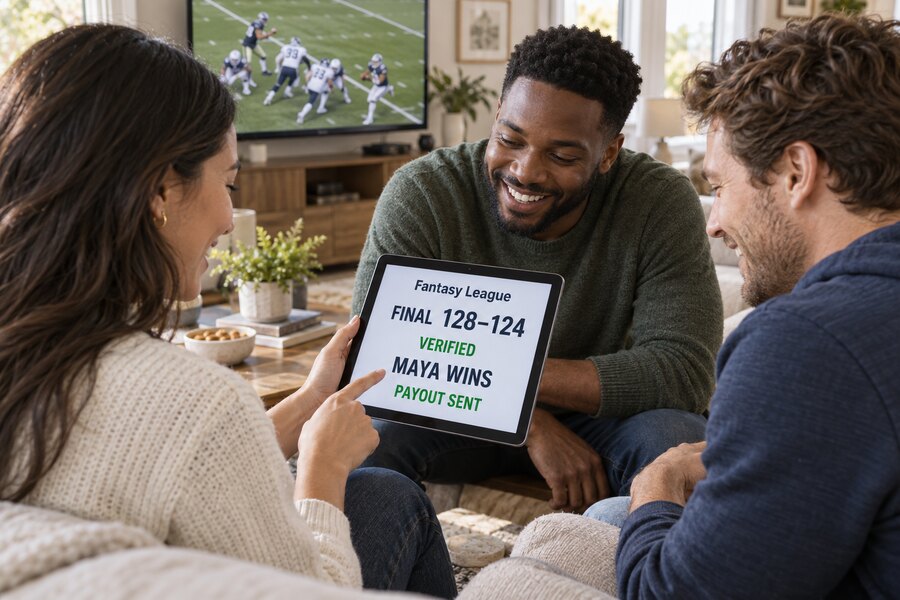
Every fantasy sports league that has run for more than a season or two eventually produces the same story: a disputed scoring correction that changed a week’s outcome, a commissioner who happened to win the league they were also responsible for scoring, a payout that arrived weeks late or not quite in full, or a rule interpretation that conveniently favored whoever was making the call. None of this usually involves genuinely serious money by the ordinary standards of professional sports betting, and none of it usually involves anything resembling outright theft, but it produces a very specific and very familiar kind of low-grade resentment, the sense that the person running the league has both the authority to make consequential decisions and a personal stake in how those decisions turn out, with no independent record anyone can check to settle the argument definitively. Anyone who has played in a fantasy league with real money on the line, even a modest twenty-dollar buy-in among friends, has likely experienced some version of this friction, and anyone who has served as commissioner has likely felt the corresponding, uncomfortable position of being both referee and player in the same game.
Blockchain-verified fantasy sports leagues are a direct, deliberate, and specifically targeted technical response to this exact and widely familiar problem. Instead of a commissioner manually tracking rosters in a spreadsheet, applying scoring corrections at their own discretion, and personally holding and distributing the pooled buy-in money, a blockchain-based system records player ownership, calculates scoring from an agreed data source, and distributes winnings through a smart contract, a small program that executes automatically once its programmed conditions are met. The promise is narrow but genuinely meaningful: remove the single human being who currently holds unchecked authority over scoring corrections, roster disputes, and prize money, and replace that authority with a process anyone in the league can independently verify against public, tamper-evident records.
It is worth being precise from the outset about what this technology can and cannot actually deliver, since the framing matters enormously for evaluating it honestly. A blockchain-recorded league does not eliminate the need for an underlying, trusted source of real-world sports statistics, since a smart contract can only calculate a score from whatever data it is fed, and it does not automatically resolve every kind of dispute a fantasy league can generate, particularly disagreements about trade fairness or suspected collusion between opposing managers, questions this article’s later sections address directly rather than glossing over. What a genuinely well-built system does deliver is a specific and checkable improvement: once a roster is submitted and a scoring source is agreed upon, the resulting calculation and payout happen according to fixed, visible rules that no single participant, including whoever originally set up the league, can quietly alter after the fact.
This article walks through why commissioner-run leagues generate the specific disputes they do, how a blockchain-based system actually handles roster ownership, scoring, and payouts differently, and who benefits and in what ways when a league moves from a spreadsheet and a personal bank account to a public ledger and a smart contract. It then examines two documented, verifiable examples of blockchain-based fantasy sports already operating at real commercial scale: an officially licensed global platform that has built genuine partnerships with major professional leagues, and a large American sportsbook’s NFT-based fantasy product whose rapid growth was ultimately cut short by a securities lawsuit and a corporate decision to shut it down entirely. Both examples show the underlying mechanics working with real money and real users; neither shows a small, casual friend-group league actually adopting this technology, and this article says so plainly rather than overstating how far adoption has actually reached.
Readers new to this topic sometimes assume the interesting part is the novelty of trading digital collectible cards, but the more useful framing is that this is fundamentally a dispute-prevention technology aimed at a very specific, well-understood failure mode: concentrated, unchecked authority over money and rules within a small group of people who mostly trust each other but have no independent way to verify that trust when something goes wrong. Every fantasy football group chat that has ever argued about a scoring correction or a late payout is arguing, at bottom, about exactly the kind of verifiability problem this technology is built to solve, and keeping that framing in mind makes it easier to evaluate the case studies and limitations that follow on their actual merits rather than as a novelty feature.
This article is written for a reader who has played fantasy sports through a conventional platform, has perhaps experienced or heard about exactly the kind of commissioner dispute described above, and wants a clear, non-technical account of what actually changes when a league moves onto a blockchain rather than a marketing pitch for any specific product. It assumes no prior familiarity with cryptocurrency, NFTs, or smart contracts, and it tries throughout to distinguish clearly between what this technology has actually been shown to do in the documented, real-world deployments examined later in this article, and what remains an open question or an unrealized promise, since a category this new deserves a precise, honest account rather than either uncritical enthusiasm or reflexive dismissal.
Why Commissioner-Run Fantasy Leagues Generate Trust Disputes
The standard structure of a fantasy sports league concentrates several distinct and consequential responsibilities in a single person, typically whichever league member happened to set up the group originally or volunteered to handle the administrative work. This person, the commissioner, is usually responsible for configuring and interpreting the league’s scoring rules, manually applying corrections when a scoring platform’s automated calculation appears to have made an error, collecting buy-in money from every participant at the start of a season, and distributing the resulting prize pool to winners at the end. Each of these responsibilities is individually reasonable for one person to handle in a small, informal group, but together they create a structural conflict of interest whenever the commissioner is also, as is extremely common, a competing participant in the same league.
Scoring corrections are the most frequent source of visible disputes, since fantasy platforms occasionally misattribute a statistic, miss a late correction from an official league’s own box score, or apply a scoring rule inconsistently across different weeks. When this happens, the commissioner typically has sole discretion over whether and how to correct the error, a decision that can materially change a week’s outcome, and league members have historically had no independent, agreed-upon record to check the correction against beyond whatever the commissioner reports, meaning a correction that happens to benefit the commissioner’s own team, even if entirely justified on the merits, invites a level of suspicion that an identical correction benefiting someone else would not.
Buy-in collection and prize distribution introduce a separate, financial dimension to this same structural problem. A commissioner who personally collects cash, a shared payment app balance, or checks from every league member at the start of a season is, in practice, holding other people’s money in a personal account for the duration of the season, with no formal, independent accounting of exactly how much was collected, how it is held, or when and how completely it will be distributed at the end. Most leagues never experience a real problem here, since most commissioners are honest and most leagues involve people who know and trust each other reasonably well, but the arrangement still depends entirely on that personal trust holding up, with no structural safeguard if a commissioner is simply slow to pay out, makes an accounting error, or in rarer cases behaves dishonestly, and disputes over delayed or shorted payouts are a persistent, well-documented irritant across casual fantasy leagues even when they rarely escalate into anything more serious.
Rule ambiguity compounds both of these problems, since most fantasy league rule sets, however detailed, inevitably fail to anticipate every possible edge case a season can produce, an injured player replaced mid-game, a tie in the standings, a trade proposed just before a roster lock deadline. When an unanticipated situation arises, the commissioner is typically the final arbiter of how the ambiguous rule should be interpreted, and because that interpretation can materially affect the commissioner’s own competitive standing or financial outcome, even a genuinely good-faith ruling can generate lasting resentment from whichever league member the decision disadvantaged, particularly in the absence of any independent, agreed-upon process for resolving the disagreement other than the commissioner’s own word.
A further, quieter source of friction involves the near-total absence of any independent record a departing or dissatisfied league member can point to when a dispute does escalate beyond a friendly disagreement. Because the season’s history typically lives entirely inside one platform’s account, tied to whichever email address the commissioner originally used to set the league up, a member who leaves a league on bad terms, or a group that simply wants to audit several seasons of scoring history after a pattern of disputed corrections, generally has no independent way to reconstruct that history without the cooperating goodwill of whoever currently controls the league’s account. This is a structural feature of how conventional fantasy platforms are built, not a flaw specific to any one company, but it compounds the trust dependency already created by concentrated commissioner authority, since even a fully accurate historical record remains inaccessible to anyone the current account holder chooses not to share it with.
Taken together, these dynamics, discretionary scoring corrections, personally held prize money with no independent accounting, unilateral rule interpretation, and a historical record that only the commissioner can access at will, describe a structure that works acceptably well precisely because most fantasy leagues involve small groups of people with enough existing trust and social connection to tolerate this level of concentrated, unchecked authority. It is this specific bundle of structural conflicts of interest, not a vague sense that fantasy sports commissioners are untrustworthy as a group, that blockchain-verified fantasy platforms are attempting to address by replacing personal discretion with fixed, publicly checkable rules.
How Blockchain-Verified Fantasy Sports Actually Work
At the center of a blockchain-verified fantasy platform is a shift in where three specific functions actually live: roster ownership, which moves from a spreadsheet or a platform’s internal database to a public blockchain record; scoring calculation, which moves from a mix of automated platform tools and manual commissioner correction to a fixed, pre-agreed formula applied consistently to an agreed data source; and prize distribution, which moves from a commissioner’s personal account to a smart contract that releases funds automatically once a competition’s results are finalized. None of these three shifts requires the underlying sport itself to change in any way; a football game is still decided on the field, and a blockchain-verified platform is still entirely dependent on real-world athletic performance for everything it ultimately scores and pays out on.
This distinction matters because it clarifies exactly what problem this technology is actually solving. A blockchain does not make anyone a better fantasy manager, does not change the underlying rules of football or basketball, and does not eliminate the need for accurate real-world statistics; what it changes is who has the practical ability to alter a roster, a score, or a payout after the fact without leaving an obvious, checkable trace. A commissioner using a conventional spreadsheet can, in principle, quietly edit a past week’s recorded score, and league members would have no independent way to detect that this had happened unless they had separately saved their own records. A properly designed blockchain-based system makes this kind of quiet, after-the-fact alteration extremely difficult, since altering a past record on a public ledger in a way that is not immediately and obviously detectable by anyone else checking that same public record is, by the underlying design of the technology, computationally impractical.
It is also worth being direct that not every platform describing itself as blockchain-based fantasy sports delivers this full guarantee. A platform that uses blockchain technology only to record final ownership of a digital collectible card, while still calculating scores and distributing prizes through an entirely conventional, private company database, delivers a meaningfully smaller trust improvement than a platform that also makes its scoring calculations and payout logic independently verifiable. Evaluating any specific platform’s actual claims, rather than assuming every blockchain-branded fantasy product delivers the same level of verifiability, is an important practical step for anyone considering this category of product, a distinction this article’s limitations section returns to directly.
The specific blockchain network a platform chooses to build on also shapes what is practically achievable at real scale, since a fantasy sports platform serving millions of users generates a correspondingly large volume of roster updates, trades, and scoring transactions each week, particularly during a busy game day when many leagues finalize scoring within a short window. Networks designed for high transaction throughput and low per-transaction fees are generally better suited to this kind of workload than networks whose fee structures make frequent, small transactions prohibitively expensive, which is a significant part of why the platforms examined later in this article have generally built on networks specifically chosen for lower costs and higher capacity rather than on a blockchain optimized primarily for maximum decentralization at the expense of transaction throughput.
On-Chain Ownership: NFT Player Cards and Provable Rosters
In the platforms examined later in this article, a fantasy roster is built from digital player cards issued as non-fungible tokens, commonly called NFTs, each representing a specific real-world athlete and recorded as belonging to a specific participant’s wallet address on a public blockchain. This differs meaningfully from a conventional fantasy platform, where a roster exists only as a row in a company’s internal, private database, because ownership of an NFT-based player card is independently verifiable by anyone with access to the relevant blockchain explorer, rather than depending entirely on a company’s own internal records being accurate and unaltered.
This ownership model also changes the economics and mechanics of trading and acquiring players compared with a conventional fantasy draft or waiver-wire system. Because player cards function as genuinely owned digital assets rather than a temporary seasonal assignment inside a single company’s platform, they can typically be bought, sold, and traded on open marketplaces independent of the specific league or season a participant is currently playing in, meaning a valuable card retains value and usefulness across multiple competitions rather than resetting to zero at the end of each fantasy season the way a conventional platform’s roster typically does. This introduces a genuinely different, ongoing collectible market dynamic layered on top of the underlying fantasy competition, one that platforms in this space have leaned into deliberately as both a revenue model and an engagement mechanism, though it also means a participant’s cost of entry can scale considerably beyond a conventional fantasy league’s typical draft-and-play model, a tradeoff examined further in this article’s limitations section.
Licensing is a practical and often underappreciated prerequisite for this model to function credibly at real scale, since a platform issuing digital cards depicting real, identifiable professional athletes generally needs a formal licensing agreement with the relevant sports league or players’ association to do so legitimately, rather than simply generating unlicensed digital representations of real players. The case studies examined later in this article both involve platforms that pursued exactly this kind of formal, publicly announced licensing relationship with major professional sports organizations, a meaningful signal of commercial legitimacy distinct from smaller or less established projects that may operate without any comparable formal licensing arrangement in place.
Ownership verification also changes what happens when a participant wants to prove, to a skeptical league mate or to a third party, exactly which players they held during a specific scoring period, a question that can matter enormously when a dispute arises about whether a given roster was actually eligible or correctly submitted before a lock deadline. On a conventional platform, this proof depends entirely on that same platform’s own internal logs remaining accurate and being made available on request, whereas an NFT-based roster leaves a timestamped, independently checkable record of exactly which wallet held which card at any given block in the chain’s history, meaning a dispute over roster eligibility can, in principle, be settled by any party capable of reading public blockchain data rather than depending on the platform operator’s own internal audit being trusted at face value.
Automated Scoring and Smart Contract Payouts
Once a roster of player cards is set for a given competition period, scoring is calculated by applying a fixed, pre-published scoring formula to real-world statistics drawn from an agreed data source, typically an official league statistics feed or a licensed third-party sports data provider, with the calculation itself executed by code rather than left to a human commissioner’s manual review. Because the formula and its inputs are published and fixed in advance, any participant capable of accessing the same underlying statistics feed can, in principle, independently reproduce the scoring calculation and confirm it matches what the platform reports, a meaningfully different position than a conventional fantasy platform’s opaque internal scoring engine, whose exact calculation logic is typically not published in a form ordinary users could independently verify against raw data.
Prize distribution is where the smart contract mechanism does its most direct work in removing a human intermediary from the process entirely. Rather than a commissioner manually calculating who won what share of a prize pool and then personally transferring funds, a smart contract holding pooled entry funds can be programmed to release specific amounts to specific wallet addresses automatically once final scoring results are confirmed, without requiring any single person to manually authorize or execute that transfer. This does not mean no human judgment is involved anywhere in the process, since someone still has to define the payout structure and confirm that the underlying scoring data is accurate before results are finalized, but it does mean the actual movement of money, the step most vulnerable to a commissioner’s personal discretion, delay, or error, happens automatically according to fixed, pre-agreed rules rather than depending on one person’s ongoing, manual follow-through.
This automated payout structure also changes what happens in the specific scenario that has historically produced some of the most bitter conventional fantasy league disputes: a commissioner who simply disappears, becomes unresponsive, or drops out of contact before distributing a season’s prize money, leaving the rest of the league with pooled funds sitting in an account they cannot access and no reliable way to compel payment beyond informal social pressure. A smart contract holding pooled funds is not dependent on any single participant remaining engaged, reachable, or cooperative once the season concludes, since the release logic executes automatically according to its programmed conditions regardless of whether the person who originally set up the league is still actively involved, removing a specific failure mode that conventional, informally run leagues have no structural protection against.
It is worth noting that most real-world implementations of this payout mechanism still require some agreed, trusted method for confirming that a competition’s results are actually final and correctly reported before the smart contract releases funds, whether that confirmation comes from an oracle service reading an official statistics feed directly, or from a designated, published process for finalizing results after a defined dispute window has passed. This final confirmation step is not eliminated by the technology, only made more structured, transparent, and resistant to unilateral after-the-fact alteration than a conventional commissioner’s informal, undocumented sign-off on a season’s final standings.
Benefits by Stakeholder
For casual, friend-group fantasy leagues, the primary benefit is removing exactly the specific social awkwardness described in this article’s introduction: a commissioner no longer has to be trusted, personally, to apply scoring corrections fairly or distribute prize money promptly and completely, since a properly built system handles both according to fixed rules everyone in the league agreed to and can independently check. This is a meaningful quality-of-life improvement for groups that have experienced a real, if usually minor, dispute in the past, though it is worth noting candidly that most casual leagues have not yet actually adopted blockchain-based platforms for this purpose, a gap this article’s limitations section addresses directly.
For competitive, higher-stakes players, the benefit is more directly financial and reputational, since a platform capable of demonstrating independently verifiable scoring and automated payout logic offers a meaningfully stronger guarantee against the kind of dispute that can become genuinely costly when real money at stake moves beyond a casual, twenty-dollar league buy-in. Players competing for larger prize pools have a correspondingly stronger interest in a platform whose payout logic does not depend on trusting a single operator’s internal accounting, and the case studies examined later in this article both involve real money moving through exactly this kind of higher-stakes, more formally operated environment rather than casual, informal play.
This same population also benefits from the secondary-market liquidity that comes with genuinely owned, tradable player cards, since a competitive player who wants to exit a specific card position, rebalance a roster strategy mid-season, or liquidate an entire collection can generally do so through an open marketplace rather than being limited to whatever trade a conventional platform’s internal, closed-league trading tool happens to support. This liquidity is itself a meaningful benefit distinct from the dispute-prevention framing this article has emphasized elsewhere, since it gives a serious, financially engaged player genuine flexibility and exit options a conventional, non-tokenized fantasy roster simply does not offer.
For the platforms and leagues operating this technology, the benefit is a genuine, demonstrable fairness feature that can be marketed directly to users who have experienced or worry about exactly the kind of commissioner-related disputes this article has described, alongside a new business model built around the ongoing collectible value of tradable player card NFTs rather than a conventional flat entry fee alone. It is worth noting plainly, however, that this benefit is not unqualified: the DraftKings Reignmakers case study examined later in this article shows directly that building a fantasy product around tokenized digital collectibles can expose an operator to a specific and serious category of legal risk, securities regulation, that a conventional, non-tokenized fantasy product does not carry in the same way, a tradeoff any platform considering this model has to weigh seriously rather than treating the collectible business model as a purely additive benefit.
Professional sports leagues and players’ associations themselves represent a further stakeholder group with a distinct commercial interest in this technology, since a formal licensing partnership with a blockchain-based fantasy platform generates a new, ongoing royalty and partnership revenue stream tied directly to the ongoing collectible trading activity these platforms generate, separate from a league’s more conventional broadcast and sponsorship revenue. This helps explain why major leagues have been willing to sign the kind of multi-year licensing agreements described in this article’s case studies, since the arrangement gives the league a direct commercial stake in a platform’s ongoing collectible marketplace activity, an incentive structure that did not exist under conventional, non-tokenized fantasy sports products where a league typically licenses player likenesses for a flatter, less directly volume-linked fee.
Documented Case Studies in Blockchain-Verified Fantasy Sports
Blockchain-based fantasy sports has now existed long enough, and at large enough commercial scale, to produce two clearly documented and dated case studies illustrating meaningfully different outcomes. One traces a France-based platform’s growth into formal, multi-year licensing partnerships with some of the world’s largest professional sports leagues, demonstrating durable commercial legitimacy over several years of continuous operation. The other traces a major American sportsbook’s rapid revenue growth in an NFT-based fantasy product, followed by a swift, legally forced shutdown, illustrating that this category of product carries real regulatory risk that has already materialized in a specific, well-documented case rather than remaining a purely theoretical concern.
Sorare: Officially Licensed On-Chain Fantasy Football at Global Scale
Sorare, a Paris-based company founded in 2018, operates a blockchain-based fantasy football platform built around officially licensed digital player cards issued as NFTs, with participants building lineups from owned cards and competing based on those players’ real-world match performance. The company’s commercial trajectory is independently documented through a long series of major, publicly announced funding rounds and formal league partnerships rather than resting only on the company’s own unverified internal claims about its business. In September 2021, Sorare announced a 680 million dollar Series B funding round led by the Japanese investment firm SoftBank, at the time described publicly as the single largest Series B funding round in all of European technology history, valuing the young company at approximately 4.3 billion dollars, with additional meaningful participation from established investment firms including Atomico, Bessemer Venture Partners, and Benchmark.
Building on this financial foundation, Sorare secured a series of major, formally announced licensing agreements with professional football leagues in the years that followed, including existing partnerships with Spain’s LaLiga, Germany’s Bundesliga, and Italy’s Serie A, culminating in a four-year licensing agreement with England’s Premier League announced on January 30, 2023, granting Sorare rights to produce officially licensed digital player cards for Premier League athletes. By early 2023, independent reporting placed Sorare’s global user base at approximately three million people worldwide, alongside an expansion of the platform’s core fantasy model beyond football into NBA basketball and MLB baseball, demonstrating both sustained, real user growth and a broadening commercial footprint across multiple major professional sports rather than remaining a narrow, single-sport niche product confined to one country or one fan base.
What makes Sorare a genuinely useful case study for this article’s subject is that its core mechanics combine exactly the elements described in this article’s earlier sections: player cards function as independently verifiable, tradable NFTs rather than platform-locked internal database entries, and lineup scoring is calculated from real-world match statistics according to a published formula rather than a commissioner’s manual discretion. Sorare’s continuous operation and expanding formal league partnerships through 2023, several years after its initial launch and well past its 2021 funding milestone, demonstrate that this specific model can sustain genuine commercial legitimacy and continued growth over a meaningful span of time, rather than functioning only as a short-lived novelty.
The specific structure of Sorare’s competitive format is also instructive for understanding how a blockchain-verified platform actually replaces the individual functions this article’s earlier sections described. Managers assemble a lineup from owned player cards for a given match week, and the platform calculates each player’s score from official match statistics, aggregating individual card scores into a total lineup score used to rank participants within a given competition and determine prize distribution, all according to a scoring formula published in advance rather than subject to after-the-fact adjustment by any single party. Prizes in Sorare’s competitions have historically included both cryptocurrency payouts and additional player card packs, meaning the platform’s reward structure blends a directly financial incentive with the same collectible-acquisition loop that drives its secondary marketplace activity, a hybrid model distinct from a conventional fantasy platform’s typically simpler cash-only prize structure.
Sorare’s multi-sport expansion into NBA basketball and MLB baseball following its initial football-only launch also demonstrates a specific commercial pattern worth noting: rather than building an entirely new platform and licensing infrastructure from scratch for each additional sport, the company extended the same underlying blockchain-based ownership, scoring, and marketplace mechanics across new sports, suggesting the core technical approach generalizes reasonably well across different sports’ specific statistical scoring systems rather than being narrowly tailored to football’s particular rules and season structure alone.
DraftKings Reignmakers: Rapid Growth, Regulatory Reckoning, and Shutdown
DraftKings, one of the largest American sports betting and fantasy sports operators, launched Reignmakers, an NFT-based fantasy sports product built on the Polygon blockchain, on May 17, 2022, allowing participants to acquire digital player cards across football, golf, and mixed martial arts through pack drops, auctions, and a secondary marketplace, with each card scoring fantasy points based on the represented athlete’s real-world statistical performance in a given event. The product’s commercial performance in its first year was substantial and independently reported: Reignmakers generated approximately 52 million dollars in sales during its first year of operation, representing roughly two percent of DraftKings’ total company revenue during that period, a meaningful contribution for a single new product line at a company DraftKings’ size.
Reignmakers’ growth continued to accelerate into 2023, with the product estimated to drive more than 70 million dollars in revenue over the following four quarters, representing more than three percent of DraftKings’ total revenue and, according to industry analysis, as much as five percent of the company’s overall profit during that period, reflecting NFT-based fantasy sports products’ comparatively high margins relative to DraftKings’ conventional sports betting business. Independent market tracking placed Reignmakers as the third-largest digital collectibles project across all blockchains by transaction volume during a period spanning July through September 2023, a specific, dated, and independently verifiable measure of the product’s genuinely real commercial scale and popularity at its peak, well before the legal troubles described below.
This trajectory ended abruptly. DraftKings announced the shutdown of Reignmakers and its associated NFT marketplace on July 30, 2024, following an adverse ruling in an ongoing federal class-action lawsuit alleging that the platform’s NFT player cards constituted unregistered securities under United States federal law, a claim that survived DraftKings’ motion to dismiss in Massachusetts federal court. Rather than continue defending the product while the litigation proceeded, DraftKings elected to discontinue Reignmakers immediately, and the company subsequently agreed to a ten million dollar cash settlement to resolve the class-action lawsuit, with a Massachusetts federal judge granting preliminary approval of that settlement and estimates suggesting approximately 175,000 individuals could qualify for compensation as class members.
This case study matters precisely because it demonstrates, with specific dollar figures and court-documented legal reasoning rather than speculative concern, that building a fantasy sports product around tokenized digital collectibles carries genuine securities-law exposure in the United States, a risk that materialized concretely for one of the industry’s largest and best-resourced operators despite substantial, independently documented commercial success. DraftKings did not shut down Reignmakers because the underlying fantasy sports mechanics failed or because users stopped engaging with the product; the shutdown followed directly from a specific legal theory, that the tokenized player cards functioned as unregistered securities, succeeding far enough in federal court that continuing to operate the product became a legal liability DraftKings was unwilling to keep carrying, a genuinely important and sobering counterpoint to Sorare’s more durable trajectory examined above.
The specific legal theory underlying the lawsuit is worth understanding in a bit more detail, since it illustrates exactly what kind of tokenized fantasy sports product faces the greatest regulatory exposure. The plaintiffs argued that Reignmakers cards functioned less like simple digital trading cards and more like investment contracts, because the platform actively marketed the cards’ potential to appreciate in value on its secondary marketplace and structured packs and auctions in a way that encouraged players to view card acquisition partly as a financial investment rather than purely as a means of fielding a fantasy lineup. This distinction matters for any platform evaluating similar models, since a product that emphasizes collectible resale value and speculative appreciation alongside its fantasy sports utility appears to face meaningfully greater securities-law exposure than one that treats digital ownership primarily as a mechanism for verifiable roster construction rather than as an investment product in its own right.
DraftKings’ decision to settle rather than continue litigating the underlying legal question also leaves the broader industry without a definitive court ruling on whether tokenized fantasy sports cards are, in fact, securities under federal law, meaning the specific legal theory that forced Reignmakers’ shutdown remains untested at a higher court level even after this particular case concluded. Other operators considering a similar tokenized-collectible model are left to weigh this unresolved uncertainty for themselves, with DraftKings’ own costly experience serving as the most concrete, real-world data point currently available about how seriously this specific category of legal risk should be taken, rather than a definitive legal precedent that either clearly confirms or clearly forecloses the underlying theory across the wider industry.
Limitations and Open Questions
The most immediate and highest-stakes limitation this category of product currently faces is the unresolved securities-law question the Reignmakers case study demonstrates is not merely theoretical. Whether a given tokenized player card, or the broader packaged offering of packs, auctions, and secondary marketplace trading built around it, constitutes a security under United States federal law remains a genuinely contested legal question, and the fact that this exact theory survived a motion to dismiss against one of the industry’s largest, best-funded operators means any platform considering a similar tokenized-collectible business model faces real, documented legal exposure rather than a hypothetical regulatory concern that has never actually been tested in court.
A second, more technical limitation is that every blockchain-verified fantasy platform examined in this article still depends entirely on an off-chain, real-world data source for the actual statistics that determine scoring, meaning the platform’s fairness guarantee only extends as far as the underlying data feed’s own accuracy. A blockchain can guarantee that a published scoring formula was applied consistently and that the resulting calculation cannot be quietly altered after the fact, but it cannot independently verify that an official league’s own box score was itself correct, meaning a genuine error at the data-source level, a misattributed statistic in an official league feed, for instance, would still propagate faithfully through an otherwise perfectly verifiable blockchain-based scoring system. This is a meaningful and honest limitation worth acknowledging clearly: the technology solves the specific problem of preventing after-the-fact manipulation of an agreed calculation, not the separate and quite different problem of guaranteeing the underlying real-world data itself was entirely flawless to begin with.
This data-dependency limitation also raises a practical governance question that platforms have to resolve explicitly rather than leave ambiguous: what happens when an official statistics provider itself issues a correction days or weeks after a competition period has already closed and payouts have already been distributed according to the original, since-corrected figures. A conventional fantasy platform can, in principle, simply have its commissioner manually reopen and adjust a closed week, however imperfectly, while a smart-contract-based system that has already executed an automatic, final payout faces a considerably harder problem in unwinding a completed, on-chain financial transaction after the fact. Platforms operating at real commercial scale generally address this by building in a formal, published dispute or correction window before final results and payouts are locked in, rather than allowing corrections indefinitely after funds have already moved, a design choice that trades some flexibility for the finality and predictability the underlying technology is built to provide.
Practical adoption friction represents a third real barrier, particularly for the casual, friend-group leagues this article’s benefits section identified as a natural beneficiary of reduced commissioner-related disputes. Participating in a blockchain-based fantasy platform generally requires setting up and managing a cryptocurrency wallet, understanding how to acquire and hold NFT-based player cards, and in some cases paying network transaction fees for on-chain actions, a meaningfully higher barrier to entry than joining a conventional fantasy league through an existing, familiar platform with a simple account signup. Neither of the two case studies examined in this article demonstrates that this friction has been fully solved for a genuinely casual audience; both operate at meaningful commercial scale, but among users willing to engage with cryptocurrency wallets and digital collectibles specifically, rather than the broader, much larger population of casual fantasy sports players who have never previously interacted with blockchain technology at all.
Cost of entry compounds this friction in a way distinct from simple technical unfamiliarity. Because a competitive lineup on a card-ownership-based platform generally requires acquiring a roster of individual player cards rather than simply drafting from a shared, free player pool the way a conventional fantasy platform allows, meaningfully competing can require a real upfront financial outlay well beyond a conventional league’s typical entry fee, particularly for cards representing star athletes carrying correspondingly higher acquisition costs on the secondary marketplace. This dynamic favors participants with more disposable income to invest in a competitive card collection, a genuinely different economic structure than a conventional fantasy draft, where every participant starts from the same shared player pool regardless of how much money they are willing to spend, and one that a casual, low-stakes friend group considering this technology should weigh honestly against the dispute-reduction benefits this article has described.
Finally, and perhaps most importantly for evaluating this technology’s actual claim to solving fantasy league disputes, a blockchain-verified scoring and payout system does not resolve every category of dispute a fantasy league can generate. Disagreements over whether a proposed trade between two managers is fair, suspicion that two participants are colluding to manipulate a league’s competitive standings, or disputes over draft order and initial roster construction are all genuinely common sources of fantasy league friction that have nothing to do with scoring accuracy or payout distribution, the two specific problems this technology is actually built to address. A platform’s verifiable scoring and automated payout logic offers no direct technical solution to a dispute about whether a lopsided trade was made in good faith, meaning blockchain verification meaningfully narrows, but does not eliminate, the full range of disputes a fantasy league commissioner has historically had to adjudicate.
A further, related limitation involves what happens when the smart contract’s programmed release conditions turn out to have been defined incompletely or ambiguously in the first place, an entirely different failure mode than a commissioner changing their mind after the fact, but one that can produce a comparably frustrating outcome for participants. A payout structure that did not clearly anticipate a tie in the final standings, a mid-season roster rule change, or an unusual scoring edge case can still produce a technically correct execution of genuinely ambiguous or incomplete original programming, and resolving that kind of dispute may still require some off-chain, human governance process for amending or clarifying the contract’s rules going forward, meaning the technology shifts responsibility for getting the rules right upfront onto whoever originally designs the smart contract, rather than eliminating the need for careful, thoughtful rule-setting entirely.
Final Thoughts
The genuine value of blockchain-verified fantasy sports leagues lies in a specific, narrow, and well-targeted improvement: removing the structural conflict of interest that arises when a single person controls scoring corrections, holds pooled prize money, and adjudicates rule ambiguities in a competition they are also personally playing in. The two case studies examined in this article demonstrate that the underlying mechanics genuinely work at real commercial scale, with real money, real professional league licensing partnerships, and, in Sorare’s case, several years of sustained, independently documented growth. That is a meaningfully different and more credible foundation than a purely conceptual proposal, and it is worth taking seriously as a genuine improvement over the informal, trust-dependent structure every long-running fantasy league eventually tests.
At the same time, the DraftKings Reignmakers case study shows just as clearly that this specific business model, built around tokenized digital collectibles rather than a simpler subscription or entry-fee structure, carries real, documented legal risk that has already materialized against one of the industry’s largest operators, resulting in a complete shutdown and a significant financial settlement rather than a minor regulatory inconvenience. An honest treatment of this subject has to hold both of these documented outcomes in view simultaneously: the underlying dispute-resolution mechanics this article has described genuinely work, while the specific commercial packaging built around tradable NFT collectibles carries a real and, for at least one major operator, ultimately fatal legal exposure in the United States market.
There is also a meaningful accessibility question this article’s limitations section raised that deserves emphasis here. The specific population most likely to benefit from removing commissioner-related disputes, casual, informal friend-group leagues playing for modest stakes, is also the population least likely to tolerate the wallet setup, transaction fees, and general unfamiliarity that come with current blockchain-based platforms, meaning the technology’s single most natural beneficiary and its most realistic current adopter are, at present, two fairly different groups of people entirely. Closing that gap matters more for this technology’s eventual mainstream relevance than any further refinement of the underlying scoring or payout mechanics, both of which the case studies in this article already show working reliably.
The financial inclusion dimension worth considering here is somewhat different from the framing that applies to many other blockchain applications, since fantasy sports commissioner disputes rarely involve life-changing sums of money for most casual participants. What this technology offers instead is a more modest but genuinely valuable form of inclusion: extending a credible, independently verifiable fairness guarantee to informal, low-stakes social groups who have never had access to anything more sophisticated than mutual trust and a shared spreadsheet, without requiring those groups to engage a lawyer or any formal intermediary just to feel confident a twenty-dollar league buy-in will be handled fairly. Whether that modest benefit outweighs the current wallet and transaction friction is a judgment each league has to make for itself.
What ultimately determines whether blockchain-verified fantasy sports becomes a mainstream replacement for the conventional commissioner-run model, rather than a niche product adopted mainly by users already comfortable with cryptocurrency and digital collectibles, is not a further technical breakthrough in scoring or payout automation, since both already function credibly in the deployments this article has examined. It is whether the industry finds a way to deliver the same verifiability benefit without requiring every casual participant to become a cryptocurrency user first, and whether the unresolved securities-law questions the Reignmakers case study raised get settled clearly enough that other operators are willing to build and sustain similar products without facing the same legal risk that ended DraftKings’ own attempt at exactly this model.
FAQs
- What actually changes when a fantasy league moves onto a blockchain?
Roster ownership, scoring calculation, and prize distribution shift from a commissioner’s personal spreadsheet and bank account to a public, tamper-evident ledger and an automated smart contract, meaning the resulting records and payouts can be independently checked rather than depending entirely on one person’s honesty and follow-through. - Does blockchain verification stop every kind of fantasy league dispute?
No. It specifically addresses disputes over scoring accuracy and payout distribution, but it does not resolve disagreements over trade fairness, suspected collusion between managers, or draft order disputes, which remain common sources of friction unrelated to the specific problems this technology targets. - Is there a real, large-scale platform actually using this model today?
Yes. Sorare, founded in 2018, operates an officially licensed blockchain-based fantasy football platform that reported approximately three million users by early 2023 and signed a four-year Premier League licensing deal announced January 30, 2023, alongside existing partnerships with LaLiga, the Bundesliga, and Serie A. - Has a major American company tried this model, and did it work?
DraftKings launched an NFT-based fantasy product called Reignmakers on May 17, 2022, which generated approximately 52 million dollars in first-year sales and grew to more than 70 million dollars in the following four quarters, but the company shut the product down entirely on July 30, 2024, after a securities class-action lawsuit survived a motion to dismiss. - Why did DraftKings shut down Reignmakers if it was making money?
The shutdown was driven by legal risk rather than poor performance. A federal class-action lawsuit alleged the NFT player cards were unregistered securities, and after a Massachusetts judge declined to dismiss the case, DraftKings discontinued the product immediately and later agreed to a ten million dollar settlement. - Does a blockchain guarantee that the underlying sports statistics are correct?
No. A blockchain-based system can guarantee that a published scoring formula was applied consistently and cannot be altered after the fact, but it still depends entirely on an off-chain data source, such as an official league statistics feed, and cannot independently verify that the underlying real-world data itself was accurate. - Do I need to own cryptocurrency to play in a blockchain-verified fantasy league?
Generally yes, in current implementations. Most platforms require a digital wallet to hold NFT-based player cards and, in some cases, involve network transaction fees, which remains a real barrier for casual players unfamiliar with cryptocurrency. - Are NFT-based fantasy player cards considered securities under U.S. law?
This remains a genuinely unresolved legal question. A federal lawsuit against DraftKings alleging exactly this survived a motion to dismiss in 2024, and while DraftKings settled rather than continue litigating, the underlying legal question has not been definitively resolved industry-wide. - Can I still trade or sell my fantasy player cards on a blockchain-based platform?
On platforms like Sorare, yes. Because player cards are NFTs owned by the participant rather than temporary in-platform assignments, they can generally be bought, sold, and traded on secondary marketplaces independent of any single season or league. - Is this technology realistic for a small, casual friend-group fantasy league right now?
Not yet, in most cases. The documented case studies in this article operate at meaningful commercial scale among users already comfortable with cryptocurrency wallets and digital collectibles, and neither demonstrates that the wallet setup and transaction friction involved has been reduced enough for a typical casual, twenty-dollar-buy-in league to adopt easily today.