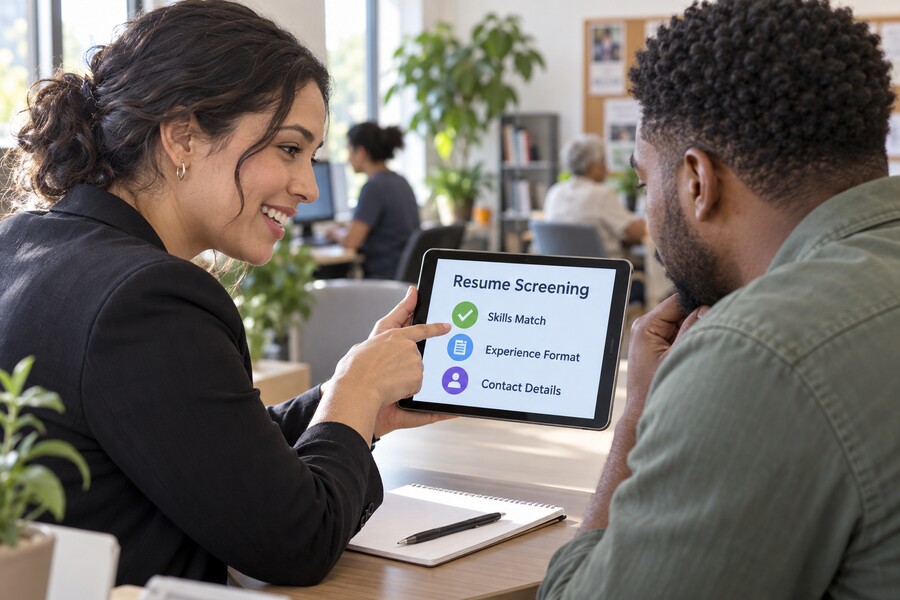
For most of the twentieth century, applying for a job meant that a human being, usually someone in a personnel office with a stack of paper on their desk, would eventually read every word a candidate had written and form a judgment based on that direct reading. That model, however imperfect, meant a resume’s substance mattered more than its structure, since a recruiter skimming a page could mentally reorganize awkward formatting, infer context from an unusual job title, and notice a relevant skill buried in the wrong section without much trouble. That world has largely disappeared for anyone applying to a mid-sized or large employer today, and most candidates do not fully realize how completely it has disappeared until a resume they consider strong disappears into silence after a single online submission.
The overwhelming majority of large and mid-sized employers now route every incoming application through software before a human recruiter ever opens the file, a category of tool generally called an applicant tracking system, or ATS, often layered with newer artificial intelligence components that go well beyond simple keyword search. These systems parse the text of a submitted resume into structured data, compare that data against the requirements of a specific job posting, and produce some combination of a searchable database entry, a match score, or an outright rank ordering of every applicant for a given role, all before a recruiter’s own judgment enters the process at all. A resume that would have impressed a human reader in 1995 can now be functionally invisible if the software reading it first cannot correctly extract the applicant’s job titles, dates, or skills from the page, regardless of how genuinely qualified that applicant actually is for the role in question. Surveys of corporate recruiting departments have consistently found that this kind of automated first pass is now the default rather than the exception at organizations of any meaningful size, which means the experience of applying for work has changed for nearly every job seeker whether or not they have noticed the shift directly.
This shift matters enormously for anyone currently searching for work, because the rules that make a resume effective have changed in ways that are not obvious from the outside, and because the software making these first-pass decisions is not neutral in any simple sense. It carries the assumptions, the limitations, and occasionally the documented biases of whoever built and trained it, and a growing body of legal cases and regulatory action, discussed later in this article, shows that automated screening can produce genuinely discriminatory outcomes even when no single person involved intended any such result. Understanding how this software actually works, where it has failed in demonstrable and documented ways, and how a job seeker can honestly and ethically present real qualifications in a format these systems can accurately read is no longer a niche technical concern for career changers alone; it has become a basic, practical literacy that shapes whether a genuinely qualified candidate’s application is ever seen by a human being at all.
This article walks through the mechanics of applicant tracking systems and the newer artificial intelligence layered on top of them, examines documented cases where that technology produced discriminatory results and the legal and regulatory response those cases triggered, and then turns to concrete, ethical guidance for presenting real experience in a way both the software and the human reader behind it can actually understand. None of what follows involves deceiving a screening system or padding a resume with irrelevant content; the goal throughout is accurate, honest self-presentation translated into a format modern hiring technology can correctly process, since even the strongest qualifications provide no benefit to a candidate if the system reading them first cannot see them clearly.
How Applicant Tracking Systems Actually Work
An applicant tracking system, at its core, is a piece of software that manages the entire lifecycle of a job application on behalf of an employer, from the moment a candidate submits a resume through a job board or company website to the moment a hiring manager makes a final decision. Employers adopted these systems initially for reasons that had little to do with artificial intelligence at all: a mid-sized company might receive several hundred applications for a single posted role, and no human recruiting team, however large, could realistically read every one of those resumes in full within a reasonable hiring timeline. An ATS solved this practical bottleneck by giving recruiters a searchable, sortable database of candidates rather than an unmanageable stack of individual documents, and that basic value proposition, taming an overwhelming volume of applications, remains the primary reason employers use this software today. As online job boards made it trivially easy for a single candidate to submit the same application to dozens of openings within a single afternoon, the total volume of submissions any given posting received grew substantially, and that growth in volume is itself part of why the software described throughout this article became close to universal among larger employers rather than remaining a niche convenience used only by the very largest organizations.
The typical pipeline a resume moves through after submission begins with intake, where the system accepts a file, commonly a Word document or PDF, through an online application portal. From there, the software performs parsing, the process of extracting the actual text and structured information, job titles, employers, dates, degrees, and skills, from that file and converting it into standardized fields in a database rather than leaving it as an unstructured document. Once parsed, that structured data becomes searchable and comparable, allowing a recruiter to query the system for candidates with a specific certification, a specific number of years of experience, or specific software proficiency, and increasingly allowing the system itself to automatically compare that structured data against a specific job posting’s stated requirements without a recruiter needing to run a manual search at all.
The final stage of this pipeline, and the one most consequential for whether a candidate is ever seen by a human being, is scoring or ranking. Many modern systems assign each parsed resume some form of match score relative to a specific job posting, based on how closely its extracted content aligns with the qualifications, skills, and keywords the employer specified when creating that posting, and then present candidates to the recruiting team in ranked order, sometimes with a cutoff below which resumes are rarely if ever manually reviewed at all. This means that a resume containing every genuine qualification the role requires can still rank poorly, and therefore go largely unseen, if the underlying parsing step failed to correctly extract that qualification from the document in the first place, which is precisely why the parsing stage described in the next section deserves close attention from any job seeker trying to understand why an application might have gone nowhere.
Parsing Resumes: What the Software Sees vs. What You Wrote
Parsing engines work by scanning the raw text layer of a document and applying pattern recognition to identify which portions of that text likely correspond to a name, a job title, an employer, a date range, or a skill, generally by looking for common formatting conventions like section headers, chronological date patterns, and typical resume structure. This approach works reasonably well on a simple, linear document where text flows in a single column from top to bottom in a predictable order, but it breaks down considerably when a resume departs from that simple structure in ways that a human reader would navigate effortlessly but that confuse an automated text extraction process.
Multi-column layouts are one of the most common sources of this breakdown. A resume designed with two side-by-side columns, one for work history and a narrower one for skills or contact information, often gets extracted by parsing software in a scrambled, interleaved order that mixes text from both columns into a single confused stream, since many parsers read a page left to right and top to bottom without recognizing that two visually separate columns represent two logically distinct sections. A skill listed clearly in a sidebar to a human eye can end up concatenated mid-sentence with an unrelated line from the main column once the underlying software extracts the page’s raw text without understanding the visual layout that made the original two columns sensible to a person looking at the page directly.
Tables present a closely related problem, since a resume that organizes work history or skills into a table structure often loses that structure entirely once extracted, again scrambling the intended reading order or, in some parsing engines, dropping table content altogether if the software is not specifically built to handle embedded tables. Headers and footers carry their own specific risk, since some parsing engines skip header and footer regions of a document entirely on the assumption that they generally contain page numbers or repeated boilerplate rather than substantive content, which becomes a serious problem for any candidate who has placed their name, phone number, or email address inside a header for visual polish, since that essential contact information can simply vanish from the extracted data the recruiter’s system actually stores.
Text embedded inside images, graphics, icons, or text boxes represents perhaps the most severe version of this problem, since most parsing engines extract only the actual text layer of a document and cannot read words that exist purely as pixels within an image, however clear that image appears to a human eye. A resume that uses a small icon of a telephone next to a phone number, or that renders a skills section as a stylized graphic rather than as selectable text, risks having that entire section disappear from the system’s understanding of the candidate’s qualifications, not because the underlying information was unclear, but because it was never text in the first place as far as the extraction software is concerned. Unusual or decorative fonts can compound this issue further, since some parsing engines struggle to correctly recognize characters rendered in a font that deviates significantly from standard, commonly used typefaces, occasionally producing extracted text riddled with recognition errors that then propagate into every downstream keyword comparison the system performs.
Keyword Matching and Ranking Algorithms
Once a resume’s text has been successfully extracted, the next major function most applicant tracking systems perform is comparing that extracted text against the specific language of a job posting to generate some form of relevance or match score. At its simplest, this comparison looks for exact or near-exact matches between terms appearing in the job description, such as specific software names, certifications, job titles, or required skills, and terms appearing anywhere in the candidate’s parsed resume text, with a higher count or density of matching terms generally producing a higher computed score.
This matching process is considerably more literal than most candidates assume, which explains why phrasing choices that seem stylistically interchangeable to a human reader can produce meaningfully different scores in an automated system. A job posting requiring experience with “project management” may not register a strong match against a resume that instead describes the same underlying work as “leading cross-functional initiatives,” even though a human recruiter reading both phrases would immediately recognize them as describing comparable experience, simply because the literal text strings do not overlap in the way the matching algorithm is checking for. Similarly, a posting requiring a specific certification abbreviation may fail to match a resume that only spells out the certification’s full name, or vice versa, unless the candidate has included both forms somewhere in the document.
Section placement and formatting consistency also influence how these systems weigh a given piece of text, since many ranking algorithms give somewhat greater weight to skills or qualifications appearing in a clearly labeled, standard section, such as a section explicitly titled “Skills” or “Work Experience,” compared with the same term appearing incidentally within a dense paragraph elsewhere in the document. This is part of why resume formatting advice consistently emphasizes clear, conventionally labeled sections rather than creative or unusual section titles, since a section a human reader would recognize as a skills list under an unconventional heading like “What I Bring to the Table” may not be reliably recognized as a skills section by an automated parser looking for more standard, predictable labels. The cumulative effect of these literal matching mechanics is that two candidates with genuinely equivalent underlying qualifications can receive substantially different computed scores purely based on word choice and document structure, a gap this article’s later section on practical formatting addresses directly.
The Rise of AI-Powered Screening Beyond Keyword Matching
While traditional keyword matching and parsing describe the foundational layer of most applicant tracking systems, a newer generation of tools has increasingly layered more sophisticated artificial intelligence capabilities on top of that foundation, moving beyond simple literal text matching toward systems that attempt to assess semantic meaning, predict job performance, or evaluate a candidate’s spoken responses directly. These newer capabilities are generally marketed to employers as solving exactly the literal-matching limitation described in the previous section, promising to recognize that “led cross-functional initiatives” and “managed projects” describe similar underlying experience even without identical wording, by using natural language processing techniques trained on large volumes of text to identify conceptually related terms rather than requiring an exact string match.
This semantic matching capability, when it works as intended, can genuinely reduce some of the rigid keyword-matching frustration described earlier in this article, since it allows a system to recognize related skills and experience described in varied language rather than penalizing every candidate who did not happen to guess the exact phrasing a job posting used. In practice, however, the sophistication and reliability of this semantic matching varies considerably across different vendors and products, and a candidate has no reliable way to know from the outside how well a given employer’s specific system actually performs this more nuanced matching versus reverting to simpler literal comparison, which is precisely why the practical formatting guidance later in this article still recommends including exact, literal keyword matches from a job posting rather than relying entirely on a system’s semantic capabilities to make the connection independently.
Beyond resume text analysis specifically, AI-powered screening has also expanded into automated chatbot pre-screening, where a candidate answers a preliminary set of questions through a text-based or voice-based conversational interface before ever reaching a human recruiter, and into AI-scored video interviews, where software analyzes a recorded response to a set of standard interview questions and generates some form of assessment score based on word choice, speech patterns, and historically, in some products, visual and facial characteristics as well. This visual and facial analysis component drew particular scrutiny in the years following its introduction, and one of the more notable, well-documented developments in this specific area came from HireVue, a major provider of AI-scored video interview technology, which announced in January 2021 that it would discontinue the facial-analysis component of its assessments entirely. Following an independent audit, HireVue’s own leadership stated publicly that visual facial-expression data contributed only a marginal amount to the tool’s actual predictive value for job performance, while the practice had drawn substantial public concern regarding fairness and the potential for the technology to disadvantage candidates based on physical or neurological differences unrelated to genuine job qualifications; the company shifted to scoring based on language and audio content only going forward.
This decision, made by one of the more prominent vendors in this specific space, illustrates a broader pattern that recurs throughout this article’s discussion of algorithmic hiring: a tool built with a plausible-sounding predictive rationale can carry real, documented fairness risks that only become visible after independent scrutiny, and vendors and employers do not always subject their own tools to that scrutiny voluntarily or in advance of public pressure to do so. Chatbot pre-screening carries a related, if less publicized, version of this same concern, since a candidate answering a fixed set of automated questions has little insight into how their specific wording is being scored, or whether a perfectly reasonable answer phrased unconventionally will be interpreted by the system as a poor fit for reasons that have nothing to do with the candidate’s actual suitability for the role. The two legal cases examined in the next section show what can happen when that scrutiny arrives instead through regulatory enforcement or federal litigation rather than a company’s own internal audit process.
Where Algorithmic Hiring Has Gone Wrong: Documented Cases
The theoretical concern that automated hiring tools might produce discriminatory outcomes even without any human recruiter’s discriminatory intent is no longer merely theoretical; it has produced actual regulatory enforcement action and ongoing federal litigation with real, documented facts and outcomes. Two cases in particular illustrate this concern with unusual clarity, precisely because both are backed by public legal filings, regulatory findings, and court rulings rather than by anecdote or speculation about how these systems might behave.
These two cases were selected specifically because each represents a different point in the legal process, one a completed regulatory settlement with a defined financial outcome, the other an active federal case whose most significant rulings have only recently established that this type of claim can proceed through the court system at all, and together they show both how algorithmic discrimination has already been formally established in at least one instance and how the broader legal question of accountability for automated hiring tools is actively being resolved in real time.
iTutorGroup’s 2023 EEOC Settlement Over Age-Based Rejections
The United States Equal Employment Opportunity Commission, the federal agency responsible for enforcing workplace anti-discrimination law, filed a lawsuit against iTutorGroup, a company providing online English-language tutoring services, alleging that the company’s application review software had been specifically programmed to automatically reject female applicants aged 55 or older and male applicants aged 60 or older, in direct violation of the federal Age Discrimination in Employment Act. According to the EEOC’s complaint, filed in May 2022, this automatic age-based rejection affected more than 200 qualified United States-based applicants for tutoring positions, who were screened out by the software before any human evaluator considered their actual qualifications for the role.
In August 2023, iTutorGroup and the EEOC filed a joint notice of settlement in the United States District Court for the Eastern District of New York, resolving the case through a consent decree under which the company agreed to pay $365,000 to the class of affected applicants. Beyond the direct financial payment, the settlement required iTutorGroup to adopt a new, formal anti-discrimination policy, to provide ongoing training for personnel involved in hiring decisions, and to comply with strong injunctions specifically prohibiting future discriminatory use of automated hiring criteria based on age or sex, including a specific prohibition on requesting applicants’ birth dates during the application process going forward. The EEOC publicly described this settlement as its first resolution of a case alleging discriminatory use of artificial intelligence in an employment context, a designation that gave the case outsized significance as an early, concrete precedent for how existing anti-discrimination law applies to automated hiring software specifically.
What makes the iTutorGroup case particularly instructive for understanding the mechanics of algorithmic discrimination is how directly the alleged bias was encoded into the software’s actual decision logic rather than emerging indirectly from some more subtle statistical pattern buried in a complex model. The system, as alleged, did not need to infer age indirectly from graduation dates or years of experience; it was configured to check age directly against a fixed threshold and reject accordingly, a form of discrimination that would be immediately and obviously illegal if a human recruiter had been instructed to do the same thing manually, but that had apparently gone unnoticed or unaddressed for some period while embedded in automated software processing hundreds of real applications. The case demonstrates that the specific mechanism of discrimination, whether executed by a person or by software following a person’s programmed instructions, does not change the underlying legal analysis under existing anti-discrimination statutes, even though detecting and proving that discrimination occurred required scrutinizing an automated system’s decision logic rather than a single human decision-maker’s stated reasoning.
Mobley v. Workday: Testing Whether an AI Vendor Can Be Held Liable
A separate and still-ongoing federal case, Mobley v. Workday, raises a related but legally distinct question: whether a company that builds and sells applicant screening software to employers, rather than the employer itself, can be held directly liable under federal anti-discrimination law for discriminatory outcomes its software produces. Derek Mobley, the named plaintiff, filed his lawsuit in February 2023 in federal court in California, alleging that Workday’s algorithmic applicant-screening tools discriminated against him and other similarly situated applicants on the basis of race, disability, and age across the numerous employers that used Workday’s screening software to evaluate his applications, and describing a pattern of rapid, seemingly automated rejections, including at least one rejection Mobley reportedly received less than an hour after submitting an application, in the middle of the night.
Workday sought to have the case dismissed on the theory that it was not the actual employer making any hiring decision and therefore could not be held liable under statutes generally written to govern the conduct of employers rather than third-party software vendors, an argument that, if accepted, would have significantly limited the ability of applicants to pursue claims against the companies that actually design and control the algorithms used to screen them, as opposed to the individual employers who license that software. In July 2024, a federal judge rejected this argument and allowed Mobley’s core claims against Workday to proceed, a ruling widely described by employment law observers as a significant, first-of-its-kind development establishing that a software vendor itself may bear direct legal exposure for the discriminatory effects of the screening tools it builds and sells to employers, rather than that exposure resting solely with the employers deploying the tool.
The case advanced further in May 2025, when Judge Rita Lin of the United States District Court for the Northern District of California granted preliminary certification of a nationwide collective action under the Age Discrimination in Employment Act, allowing other applicants who believe they were similarly screened out by Workday’s system because of their age to join the case as part of a coordinated collective proceeding rather than each having to file an entirely separate individual lawsuit. In that same ruling, the court dismissed Mobley’s claim of intentional discrimination specifically, while allowing his disparate impact claim, the legal theory that a facially neutral screening practice can still be unlawful if it produces a statistically disproportionate negative effect on a protected group, to move forward, framing the central legal question going forward as whether Workday’s AI recommendation system has a disparate impact on applicants over the age of forty. As of this writing, the case remains in active litigation rather than resolved, and its ultimate outcome will likely shape how courts approach vendor liability for algorithmic hiring tools well beyond this single dispute, but its procedural history to date already establishes that claims of this specific kind can survive a motion to dismiss and proceed on a collective basis, a meaningful development in its own right regardless of how the underlying factual dispute is eventually resolved.
Taken together, these two cases show that algorithmic hiring discrimination is neither a purely hypothetical concern nor a settled, fully resolved area of law, but rather an active and evolving front where regulatory enforcement, in the completed iTutorGroup settlement, and private federal litigation, in the ongoing Workday case, are both actively shaping what accountability actually looks like when software rather than a single identifiable person makes or heavily influences a hiring decision.
Regulating the Algorithm: Laws Aimed at Automated Hiring Tools
Alongside the case-by-case enforcement and litigation described in the previous section, a distinct and growing body of law has emerged specifically targeting automated employment decision tools before a discrimination claim ever needs to be filed, generally by requiring employers to proactively test these tools for biased outcomes and disclose the results, rather than waiting for harm to occur and then litigating it after the fact. The most detailed and closely watched example of this regulatory approach is New York City’s Local Law 144, though it is far from the only jurisdiction actively working through how existing employment law should apply to this specific category of technology.
Local Law 144, originally passed by the New York City Council in 2021, took effect for enforcement purposes on July 5, 2023, after the city’s Department of Consumer and Worker Protection finalized implementing regulations and extended an initial compliance grace period to give employers time to prepare. The law applies to what it defines as automated employment decision tools, a category covering any software, algorithm, or artificial intelligence system used to substantially assist or fully automate a decision about hiring or promotion, whether that tool exists as a standalone resume screener or as a feature embedded within a larger human resources information system an employer already uses. Under the law, an employer in New York City may not use such a tool to screen a candidate for hiring or promotion unless the tool has undergone an independent bias audit within the preceding year, the employer has published a public summary of that audit’s results, and the employer has provided advance notice to candidates and employees that such a tool will be used to evaluate them, along with information about what specific job qualifications and characteristics the tool assesses. The required bias audits specifically evaluate whether a tool’s outcomes differ meaningfully across protected characteristics such as race, ethnicity, and sex, and the city’s Department of Consumer and Worker Protection can impose civil penalties ranging from $500 to $1,500 per violation per day for employers that fail to comply with these requirements.
Local Law 144 matters well beyond New York City’s own borders because it represents one of the first concrete, binding legal frameworks anywhere in the United States translating the general, longstanding principle that employment decisions cannot discriminate based on protected characteristics into a specific, mandatory testing and disclosure regime built for the particular way modern automated hiring software actually operates. Other jurisdictions and federal agencies have moved in parallel, if generally less prescriptive, directions: the Equal Employment Opportunity Commission has issued formal guidance clarifying that existing federal anti-discrimination statutes, including those governing disparate impact analysis, apply fully to employment decisions made or substantially influenced by algorithmic tools, regardless of whether a human decision-maker or a piece of software directly produced the discriminatory outcome, a position directly reflected in the agency’s own enforcement action against iTutorGroup described earlier in this article. Illinois similarly enacted specific legislation governing the use of artificial intelligence in analyzing video job interviews, requiring employer notice and candidate consent before such analysis can be applied, reflecting a broader legislative trend of treating AI-driven video and resume analysis as meaningfully distinct from ordinary human interview practices deserving of its own specific legal guardrails rather than being left to general anti-discrimination principles alone. Several other state legislatures have introduced comparable proposals addressing automated employment decision-making more broadly since Local Law 144 took effect, suggesting that New York City’s specific audit-and-disclosure model, rather than remaining a single local experiment, may increasingly serve as a template other jurisdictions adapt to their own labor markets in the years ahead.
For a job seeker, the practical significance of this evolving regulatory landscape is twofold. First, it means an employer using a covered automated tool in a jurisdiction like New York City is now legally required to disclose that fact, giving a candidate at least some visibility into when software rather than a human alone is doing the initial evaluation, visibility that was rarely available even a few years earlier. Second, and just as importantly, it means the fairness and accuracy of these tools is no longer a purely internal, unexamined matter left entirely to the vendor’s own marketing claims about how well their product performs, since a growing number of employers are now legally obligated to subject these systems to independent, published scrutiny, a regulatory trend this article expects will continue to expand into more jurisdictions as algorithmic hiring tools become still more widespread across the labor market.
Writing a Resume That Both Machines and Humans Can Read
Given everything described so far about how parsing engines, keyword matching, and ranking algorithms actually process a submitted resume, a job seeker has considerable, entirely legitimate room to format their genuine qualifications in a way that these systems can accurately read, without misrepresenting any actual experience or fabricating a single qualification that was not genuinely earned. The starting point for this kind of ethical optimization is reading the specific job posting closely and identifying the exact terms it uses for required skills, tools, certifications, and qualifications, then ensuring a resume that genuinely possesses those qualifications uses that same specific language somewhere in its text rather than relying on a stylistically different but conceptually equivalent phrase that a literal matching algorithm may fail to recognize as related. This is not deception; it is simply describing real, existing experience using the vocabulary a specific employer has already indicated it is searching for, and it directly addresses the literal-matching limitation described earlier in this article’s discussion of keyword algorithms.
File format and document structure matter just as much as word choice, and the guidance here follows directly from the parsing challenges described earlier. A resume built with a simple, single-column layout, using standard, clearly labeled section headings like “Work Experience,” “Education,” and “Skills” rather than creative alternatives, gives a parsing engine the best possible chance of correctly extracting every piece of content in the order and structure the candidate actually intended, since these systems are generally built and tested against exactly this kind of conventional structure far more reliably than against unconventional or highly designed layouts. Contact information belongs in the main body of the document rather than inside a header or footer region, since, as described earlier, some parsing engines skip those regions entirely and a name or phone number placed there risks disappearing from the extracted record even though it remains perfectly visible to a human eye glancing at the printed or displayed page. Tables, multi-column designs, text boxes, and any content embedded as an image rather than as selectable text should generally be avoided entirely in favor of straightforward paragraph and list formatting using the document’s native text layer, since, as this article’s earlier discussion of parsing explained in detail, these design choices are precisely the ones most likely to produce scrambled, incomplete, or entirely missing extracted content regardless of how polished that same content appears when opened directly in a word processor.
Acronyms and abbreviations deserve particular attention given the literal nature of most keyword matching described earlier, and the safest, most universally effective practice is spelling out a given term in full at least once alongside its common abbreviation, for example writing “Search Engine Optimization (SEO)” rather than using only one form throughout the entire document. This single practice hedges against the genuine uncertainty a candidate faces about whether a specific employer’s job posting, and the underlying system scoring against it, is searching for the spelled-out term, the abbreviation, or both, and costs the candidate nothing in terms of honesty or accuracy since both forms describe the identical real qualification. File format choice matters as well; a resume saved as a standard Word document or a text-based PDF, meaning a PDF generated directly from a word processor rather than a scanned image of a printed page, generally parses far more reliably than a scanned image file, since a scanned document contains no underlying selectable text layer at all for a parsing engine to extract unless it has been run through a separate optical character recognition process first, something not every applicant tracking system reliably performs before evaluating a submission.
Beyond these more mechanical formatting choices, candidates benefit from tailoring the specific content emphasized on a resume to each individual job posting rather than submitting one identical, generic document to every opening regardless of how that particular role’s requirements are described. This does not mean fabricating experience that does not exist; it means genuinely reconsidering, for each application, which real accomplishments and skills from a candidate’s actual career history are most directly relevant to a specific posting’s stated requirements, and ensuring those specific, genuinely relevant qualifications appear clearly, in standard sections, using language that mirrors the posting’s own terminology wherever that language accurately describes the candidate’s real experience. A candidate who has genuinely managed budgets, led teams, and used specific software tools loses nothing by describing that real experience in the precise terms a given employer’s posting uses, and stands to gain considerably in how accurately an automated system represents that real experience internally, compared with describing the identical underlying work in idiosyncratic language that happens not to match what the receiving system was built to recognize. Consistent formatting of dates, job titles, and company names throughout a resume also helps a parsing engine correctly reconstruct a candidate’s chronological work history, since a system attempting to calculate total years of experience or identify employment gaps depends on recognizing a predictable date format repeated throughout the document, and switching between different date conventions or omitting an end date’s format partway through a resume can introduce exactly the kind of extraction inconsistency that undermines an otherwise well-organized document. Ultimately, presenting a resume in a machine-readable format is not a matter of gaming an algorithm dishonestly but of ensuring that real, substantive qualifications are not lost in translation between a human-designed document and the software increasingly responsible for the first, decisive read of that document.
Benefits, Limits, and Open Questions for Employers and Job Seekers
Employers who have adopted applicant tracking systems and AI-powered screening tools generally point to a straightforward set of benefits that explain this technology’s widespread and continuing adoption across the labor market. The most immediate benefit is simple scale: a large employer receiving thousands of applications for a single popular opening has no realistic way to have a human recruiter individually read every submission within a reasonable hiring timeline, and automated parsing and initial ranking allows that recruiting team to focus its limited human attention on a manageable subset of candidates the system has identified as most closely aligned with the posting’s stated requirements. Employers also generally cite consistency as a meaningful benefit, arguing that an automated system applies the same evaluation criteria to every single applicant without the day-to-day variation in attention, mood, or unconscious bias that can affect even a well-intentioned individual human recruiter reviewing hundreds of resumes across a long day. A related, often understated benefit is speed: an automated first pass can return a preliminary assessment within minutes of a candidate’s submission rather than the days or weeks a purely manual review process might require, which employers argue helps them compete for strong candidates who might otherwise accept a competing offer while a slower process is still working through its backlog.
These genuine benefits, however, come with equally genuine and well-documented limits that this article’s earlier sections have already illustrated in concrete terms. The most fundamental limit is the risk that rigid, literal keyword matching filters out candidates whose real qualifications are accurately described using different but equivalent language, a limitation this article’s discussion of keyword algorithms addressed directly and one that disproportionately affects candidates who are changing industries or describing their experience using terminology specific to a different professional field than the one they are now applying into. A second, more serious limit is the documented risk of outright discriminatory outcomes, illustrated concretely by the iTutorGroup and Mobley v. Workday cases examined earlier in this article, where automated systems either were programmed to discriminate directly or stand accused of producing a statistically disproportionate negative impact on applicants in a legally protected category, regardless of whether any individual human involved intended that specific outcome.
Candidates with disabilities face particular, well-documented challenges within this automated screening landscape that deserve specific attention organized around their own distinct circumstances rather than being folded generically into the broader discussion of algorithmic bias. A candidate whose disability has produced employment gaps, a non-traditional career trajectory, or the use of assistive technology that interacts unpredictably with an online application portal may be disadvantaged by a system built and tested primarily around a more conventional, uninterrupted career pattern, a concern that has drawn specific regulatory attention, including within the disability-related claims raised in the Mobley v. Workday litigation described earlier. Candidates whose first language is not English, or whose educational or professional credentials come from institutions and systems outside the primary context in which a given screening tool was trained and validated, face a related version of this same underlying problem, since a system’s underlying training data and validation testing may simply not reflect the full diversity of legitimate, equivalent qualifications that exist across different educational systems, professional cultures, and linguistic conventions worldwide.
A further, more subtle challenge facing candidates generally, regardless of any specific protected characteristic, is the profound transparency gap built into most current automated screening processes. A candidate who is filtered out by an automated system typically receives, at most, a brief, generic rejection notice, if any response arrives at all, with no meaningful explanation of why the system did not advance their application, no visibility into what specific keywords or qualifications the posting’s matching algorithm weighted most heavily, and no practical avenue for appeal or correction if the underlying parsing genuinely failed to extract a real, relevant qualification from an otherwise well-written resume. This opacity stands in real tension with the growing regulatory expectation, reflected directly in New York City’s Local Law 144 disclosure requirements described earlier in this article, that candidates deserve at least some baseline visibility into when and how automated tools are being used to evaluate them, even where current law generally does not yet require an employer to explain any single individual rejection decision in detail.
Reconciling these genuine efficiency benefits with these equally genuine risks and limitations remains an active, unresolved challenge for the entire hiring technology industry rather than a problem any single vendor or piece of legislation has fully solved to date. The direction this reconciliation takes, whether toward more rigorous, mandatory bias auditing along the lines Local Law 144 has pioneered, toward expanded vendor liability following whatever precedent the Workday litigation ultimately establishes, or toward some combination of both alongside continued technical improvement in how these systems handle varied, legitimate forms of describing equivalent qualifications, will substantially shape whether automated hiring technology ultimately narrows or widens genuine access to employment opportunity across the labor market.
Final Thoughts
The transformation this article has traced, from a hiring process built around a single human reader’s direct judgment to one mediated first by parsing engines, keyword algorithms, and increasingly sophisticated artificial intelligence, is not a passing trend but a durable restructuring of how access to employment actually works in practice, and its ultimate value to society depends entirely on whether it is built and governed to expand who can find meaningful work or allowed to quietly narrow that access instead. The efficiency case for this technology is genuine and should not be dismissed: no human recruiting team can manually read every application in a labor market where a single popular opening routinely attracts hundreds or thousands of submissions, and some form of automated triage is likely unavoidable at that scale regardless of how the underlying technology continues to evolve in the years ahead.
That efficiency case, however, only holds up as a net positive for society if the systems performing this triage are held to the same basic anti-discrimination standards that have long governed human hiring decisions, and the documented record examined throughout this article shows that this accountability cannot simply be assumed as an automatic byproduct of the technology itself. The iTutorGroup settlement demonstrated that a hiring algorithm can be configured to discriminate as directly and unambiguously as any human decision-maker ever could, while the ongoing Mobley v. Workday litigation is actively working through the harder, still-unresolved question of who bears legal responsibility when a screening tool built by one company produces discriminatory effects across the many different employers that license and deploy it. Neither case shows algorithmic hiring as inherently discriminatory; both show that accountability requires deliberate, ongoing effort rather than arriving as a default feature of the technology itself.
This is precisely where the parallel to broader questions of equitable access to employment becomes most important. A hiring system that can process an enormous volume of applications while still recognizing genuinely equivalent qualifications, a career changer’s transferable skills, a disabled candidate’s non-traditional path, an immigrant’s credentials from a different educational system, has the potential to widen the pool of people who get a fair first look, rather than narrowing it to those who happen to guess the exact keywords a system’s designers anticipated. Realizing that potential requires the kind of proactive bias auditing New York City’s Local Law 144 has pioneered, the kind of vendor accountability the Workday litigation is actively testing, and continued, genuine technical investment in systems that recognize the many legitimate ways real qualifications can be described rather than rewarding only a narrow, predictable vocabulary.
None of this places the burden of fairness solely on job seekers learning to format a resume correctly, even though that practical skill, examined in detail earlier in this article, remains genuinely useful for any individual candidate navigating today’s hiring landscape as it actually exists right now. The deeper responsibility rests with the employers deploying these systems and the vendors building them, to test rigorously for discriminatory outcomes before those outcomes affect real people’s livelihoods, to disclose openly when and how automated tools are shaping a hiring decision, and to treat the efficiency these tools genuinely provide as a means toward a fairer, more accessible labor market rather than as an end that justifies overlooking who gets quietly filtered out along the way. Whether algorithmic hiring becomes a durable force for broader, more equitable access to employment, or instead entrenches the same old exclusions in a less visible, technical guise, will be determined by choices made in exactly these areas in the years immediately ahead.
FAQs
- What is an applicant tracking system, and does every employer use one?
An applicant tracking system, or ATS, is software that manages job applications by parsing resumes into structured data, storing them in a searchable database, and often ranking candidates against a job posting’s requirements. Most large and mid-sized employers use some form of this software, though smaller employers may still review applications manually. - Can an ATS reject my resume before a human ever sees it?
Many systems rank or score resumes automatically, and recruiters often focus their limited time on higher-ranked candidates, meaning a resume that scores poorly due to parsing errors or missed keywords may receive little or no human review even if the underlying candidate is genuinely qualified for the role. - Why does my resume format matter if the content is strong?
Parsing engines extract text based on document structure, and formats like multi-column layouts, tables, headers, footers, and text embedded in images can cause content to be scrambled, misread, or dropped entirely, even when that same content looks perfectly clear to a human reading the document directly. - Is it dishonest to tailor my resume’s keywords to match a job posting?
No, as long as the underlying qualification is real. Describing genuine experience using the same terminology a job posting uses is an honest translation choice, not fabrication, and it directly addresses the literal, exact-match limitations built into many keyword-based screening algorithms. - What happened in the EEOC’s case against iTutorGroup?
The EEOC alleged that iTutorGroup’s application software was programmed to automatically reject female applicants 55 and older and male applicants 60 and older. The company settled in August 2023, agreeing to pay $365,000 to more than 200 affected applicants and adopt new anti-discrimination policies and training. - What is Mobley v. Workday, and is it resolved?
Mobley v. Workday is an ongoing federal case filed in 2023 alleging that Workday’s algorithmic screening tools discriminated based on race, disability, and age. A July 2024 ruling allowed the case to proceed against Workday as a software vendor, and in May 2025 a court granted preliminary certification of a nationwide collective action under the Age Discrimination in Employment Act. The case remains active and unresolved. - What is New York City’s Local Law 144?
Local Law 144, enforceable since July 5, 2023, requires New York City employers using automated employment decision tools to conduct independent annual bias audits, publish summaries of those audits, and notify candidates when such tools are used to evaluate them, with civil penalties for noncompliance. - Should I avoid using acronyms on my resume?
Not entirely. The safer approach is spelling out a term in full alongside its abbreviation at least once, since you cannot know whether a specific employer’s screening system is searching for the full term, the abbreviation, or both, and including both costs nothing in accuracy. - Do AI video interviews still analyze facial expressions?
Some providers historically did. HireVue, a major vendor in this space, announced in January 2021 that it was discontinuing facial-expression analysis after an independent audit found it contributed minimal predictive value, shifting instead to scoring based on language and audio content only. - Are candidates with disabilities or non-traditional career paths at a disadvantage with automated screening?
Potentially, yes. Systems built and tested around conventional, uninterrupted career patterns may not reliably recognize equivalent qualifications presented through employment gaps, assistive technology use, or credentials from different educational systems, a concern reflected in ongoing litigation and growing regulatory attention to bias auditing.