Walk into almost any Bitcoin mining facility, whether it is a converted warehouse in Texas or a repurposed paper mill in rural Norway, and the first thing that hits you is not the quiet hum of computation most people imagine when they think of digital currency, but a wall of genuinely uncomfortable heat, produced twenty-four hours a day by thousands of specialized machines racing to solve the same mathematical puzzle over and over again. For most of Bitcoin mining’s history, that heat has been treated as pure waste, something to be pushed outside as quickly as possible through industrial fans, evaporative cooling towers, or simple open-air ventilation, with no further thought given to where all that thermal energy actually goes once it leaves the building. The electricity bill for running the machines has always been the headline cost, and the environmental conversation around Bitcoin has almost entirely focused on that electricity consumption in isolation, as though the heat produced along the way were an unfortunate but ultimately irrelevant side effect rather than a genuinely usable byproduct in its own right.
A small but growing number of mining operators have begun to challenge that assumption directly, building facilities specifically designed to capture the heat their machines already produce and route it somewhere it can do useful work instead of simply dissipating into the atmosphere. This approach, sometimes called dual-purpose mining, has taken a strikingly wide range of practical forms over the past several years: a publicly traded mining company piping recovered heat into the district heating systems of two Finnish towns, a Brooklyn spa quietly using immersion-cooled mining rigs as its primary pool and hot tub heaters, and a hardware manufacturer partnering with a Canadian agricultural firm to warm a commercial tomato greenhouse through the coldest months of the year. None of these projects requires a reader to understand blockchain technology in any depth to follow, and that is deliberate, since the underlying idea driving all of them is closer to basic thermodynamics than to cryptography: electricity used to run a computer is, with very little exception, ultimately converted into heat, and that heat exists somewhere whether or not anyone bothers to use it.
These three headline examples are not the only ones on record, and are best understood as recent, particularly well-documented entries in a longer-running experiment rather than the first instances of the idea. As early as 2019, the Norwegian miner Kryptovault began piping heat recovered from its Hønefoss facility, a converted paper mill roughly forty miles from Oslo, to a local timber company that used it to dry freshly cut lumber outdoors in a fraction of the time conventional air-drying would otherwise take, a practice still documented as ongoing in reporting from early 2022. That example, industrial rather than residential or agricultural, illustrates just how varied the practical applications of recovered mining heat have already become, well before this article reaches the three central case studies it examines in detail.
The central question this article sets out to examine is whether this growing pattern of heat recovery actually changes anything meaningful about the broader, often heated argument over Bitcoin mining’s environmental footprint, or whether it functions mainly as a favorable talking point layered on top of an energy debate that remains largely unresolved regardless of how cleverly any individual facility’s exhaust is repurposed. Recovering waste heat is not the same thing as making Bitcoin mining’s overall electricity consumption smaller, and a reader should come away from this article with a clear, honest sense of where that distinction matters and where genuine, if modest, environmental and economic benefit exists alongside it.
None of what follows requires taking either side of that argument on faith. Every specific claim made in this article about a named project, whether a temperature, a date, a number of residents served, or a company’s own stated motivation, is drawn from dated, independently published reporting or from a company’s own on-the-record technical disclosures, and this article is equally careful to flag the handful of places where a figure comes only from a company’s own account and has not yet been independently verified by outside reporting.
This article proceeds in a deliberate order, beginning with the basic physical and technical explanation of why Bitcoin mining produces so much heat in the first place, before moving into how that heat is actually captured and delivered to a building, a pool, or a greenhouse in practice. It then examines three separate, independently documented projects, each mapped to one of the practical uses named in this article’s title, showing how the same underlying idea has been applied at meaningfully different scales and in meaningfully different contexts across different countries. Finally, it turns directly to the skeptical case against reading too much into any of this, drawing on independent researchers who study Bitcoin’s energy footprint for a living, before closing with a grounded assessment of what dual-purpose mining has actually accomplished so far and what would need to change for it to become considerably more than a niche practice.
Why Bitcoin Mining Generates So Much Waste Heat
Bitcoin mining, at its most basic technical level, is a competition among specialized computers, generally called ASICs, short for application-specific integrated circuits, to be the first to find a particular numeric solution to a cryptographic puzzle that changes with every new block added to the Bitcoin network. Unlike a general-purpose computer chip designed to run many different kinds of software reasonably well, an ASIC miner is built to do exactly one narrow calculation, called SHA-256 hashing, as many times per second as physically possible, and modern mining hardware can attempt many trillions of these calculations every single second while running continuously, without pause, for as long as the machine remains powered on and profitable to operate.
This intense, continuous computational effort requires substantial electrical power, and the specific reason mining facilities generate so much heat comes down to a fairly simple principle of physics rather than anything unique to cryptocurrency: nearly all of the electrical energy consumed by a computer chip is ultimately converted into heat, since very little of that energy actually leaves the chip in any other usable form. A processor performing calculations is, from a thermodynamic standpoint, not meaningfully different from a resistive space heater in terms of where its input electricity eventually ends up, and mining hardware manufacturers and heat-recovery companies alike commonly describe the conversion rate from electricity into heat as somewhere in the high nineties percentage-wise, meaning that a mining operation drawing a given amount of power from the grid is, almost by definition, also producing nearly that same amount of thermal energy as an unavoidable byproduct.
A single modern ASIC miner can draw on the order of three kilowatts of electricity while running at full tilt, a load comparable to running several household hair dryers simultaneously, and produces heat in direct proportion to that draw. A commercial mining facility housing several thousand such machines, as many large operations now do, is therefore also, whether its operators think of it this way or not, running the equivalent of an unplanned multi-megawatt heating plant around the clock, with a thermal output that scales in lockstep with however much electricity the facility happens to be consuming at any given moment.
The scale of this effect becomes clearer once the overall size of Bitcoin mining as an industry is taken into account. Independent research groups that track the network’s electricity use, most prominently the Cambridge Centre for Alternative Finance through its Bitcoin Electricity Consumption Index, have estimated the network’s annualized electricity draw at well over one hundred terawatt-hours in recent years, a figure that different methodologies push higher or lower but that consistently lands in a range roughly comparable to the total annual electricity consumption of a mid-sized industrialized country. Whatever the precise figure in any given year, and researchers openly acknowledge that pinning down an exact number is genuinely difficult given how mining operations are distributed globally and how little many of them disclose about their own energy use, the practical implication for this article’s subject is straightforward: an industry consuming electricity at that scale is also, simultaneously, generating an enormous and largely unclaimed quantity of low-grade heat.
Historically, the overwhelming majority of that heat has simply been discarded, for reasons that have relatively little to do with technical impossibility and considerably more to do with geography and economics. Bitcoin mining operations have tended to cluster in locations chosen primarily for cheap, abundant electricity, frequently in sparsely populated regions near hydroelectric dams, stranded natural gas, or underutilized grid capacity, and these locations do not reliably overlap with places that also happen to have a nearby building, pool, or greenhouse in need of heating. A mining facility built in an industrial park far from any residential district has no obvious, low-cost place to send its recovered heat even if its operators wanted to capture it, and this basic mismatch between where cheap power exists and where heat demand exists is one of the more persistent obstacles standing between Bitcoin mining’s current, still relatively rare practice of heat recovery and a future in which reusing that heat becomes the industry norm rather than the exception.
A smaller but steadily growing share of mining operators has nonetheless begun to reconsider that default, generally for reasons that are as much financial as environmental. An operation that can sell its recovered heat to a nearby utility, business, or agricultural operation gains a second, comparatively stable revenue stream that does not depend on the price of Bitcoin itself, which can otherwise swing sharply enough to make a mining facility’s core economics genuinely precarious from one year to the next. It is this financial logic, at least as much as any environmental motivation, that runs through each of the specific projects examined later in this article, and understanding it helps explain why heat recovery has tended to appear first in places where electricity is either unusually cheap or heat itself is unusually valuable, rather than spreading evenly across the industry as a whole.
This pattern also tracks fairly closely with where Bitcoin mining has clustered geographically for reasons unrelated to heat recovery in the first place. Cold-climate countries with abundant hydroelectric or wind power, including Norway, Finland, and Canada, have attracted mining investment specifically because low ambient temperatures make it cheaper to cool hardware and because renewable electricity in those regions has often been priced attractively for large, flexible industrial loads. Those same cold climates also happen to be places where residential and commercial heating demand runs high for much of the year, which is part of why several of the more mature dual-purpose mining projects documented so far have emerged from exactly these northern, hydro- and wind-rich regions rather than from the warmer, cheap-power regions of the southern United States that have also attracted substantial mining investment in recent years.
How Heat Recovery Actually Works
Turning a mining facility’s waste heat into something a nearby home, pool, or greenhouse can actually use requires solving two related but distinct engineering problems, and understanding both is necessary before any of the specific projects examined later in this article make full sense. The first problem is capturing the heat efficiently in the first place, which depends heavily on how the mining hardware itself is cooled, since different cooling methods produce heat at meaningfully different temperatures and in meaningfully different forms. The second problem is moving that captured heat to wherever it is actually needed, which is fundamentally a matter of physical infrastructure, insulated pipes, heat exchangers, and, in more ambitious projects, direct connections into an existing municipal district heating network rather than building an entirely new delivery system from scratch.
Neither of these problems is unique to Bitcoin mining specifically; district heating utilities have captured waste heat from factories, power plants, and other industrial processes for many decades, and the engineering principles involved are well established outside the cryptocurrency context entirely. What is distinctive about mining as a heat source is the specific combination of characteristics it offers: a facility that runs at a constant, predictable, near-continuous load throughout the year, unlike a seasonal industrial process, and one whose relatively modular hardware, individual servers rather than a single enormous furnace, makes it comparatively straightforward to scale a heat-recovery system up or down as a mining operation itself grows or shrinks. Both of these traits matter directly to the specific projects discussed later, since a heating customer, whether a municipal utility or a private greenhouse operator, generally wants a heat source that behaves predictably across an entire heating season rather than one that starts and stops unpredictably.
The remainder of this section examines the two halves of this engineering picture in turn, starting with how mining hardware is actually cooled and what quality of heat that cooling produces, before turning to the physical systems used to deliver that heat to an end user once it has been captured.
From ASIC Exhaust to Usable Heat: Cooling Methods and Temperature Grades
The simplest and historically most common way to cool a mining rig is straightforward air cooling, in which fans pull ambient air across a chip’s heatsink and exhaust the resulting warm air directly out of the building. This approach is inexpensive and mechanically simple, which is a large part of why it has dominated the industry for so long, but it produces a relatively low grade of heat, typically only modestly warmer than the surrounding room air, that is difficult to use for much beyond preheating incoming ventilation air in a nearby structure. Because air carries heat far less efficiently than liquid does, and because the resulting temperature rise is limited, air-cooled exhaust generally needs to be captured and used essentially where it is produced rather than transported any meaningful distance.
Immersion cooling, by contrast, submerges mining hardware directly in a specially engineered, non-conductive fluid that absorbs heat far more effectively than air does, allowing the resulting warmed fluid, or the water that fluid is subsequently used to heat through a heat exchanger, to reach considerably higher and more consistent temperatures. Companies building dedicated heat-recovery hardware have pushed this further still with what are sometimes marketed as mining boilers, purpose-built systems that cool computer chips using circulating water rather than air or a separate immersion fluid, producing hot water directly, in some documented commercial installations, at temperatures approaching or exceeding 170 degrees Fahrenheit, or roughly 77 degrees Celsius, a temperature grade high enough to be genuinely useful for direct building heating, domestic hot water, or industrial processes without requiring extensive further processing.
This distinction between cooling methods matters enormously for anything discussed later in this article, because the temperature, or grade, of recovered heat determines what it can practically be used for. Low-grade air exhaust might be just warm enough to take the edge off incoming fresh air in an adjoining room, while higher-grade water from immersion or dedicated mining-boiler systems can realistically replace or supplement a conventional gas or electric boiler serving an entire building, a swimming pool, or a greenhouse’s heating loop. Facilities that have invested specifically in immersion or liquid cooling, rather than simple air cooling, have generally done so with an eye toward exactly this kind of downstream reuse, since the additional upfront cost of a liquid-cooling system is far easier to justify economically when the resulting heat itself becomes a second, sellable product rather than a pure cost to be vented away.
The Canadian cleantech company MintGreen offers a useful, publicly documented illustration of how far this cooling-method choice can be pushed. The company has described its proprietary Digital Boiler technology as recovering more than 96 percent of the electricity consumed by its mining hardware in the form of usable heat, a figure achieved specifically because the system was engineered from the outset around water-based cooling rather than air, with heat recovery treated as a core design requirement rather than an afterthought bolted onto an existing air-cooled facility. That distinction, between hardware designed for heat recovery from the beginning and hardware retrofitted for it after the fact, recurs across nearly every successful project this article examines and is one of the clearer practical lessons the industry has drawn from several years of experimentation.
The idea of designing mining hardware around heat delivery rather than treating heat as an afterthought is not entirely new, either. The French company Qarnot Computing began selling a residential heater called the QH1 in the mid-2010s, later followed by a dedicated cryptocurrency-mining version called the QC-1, that embedded mining chips directly inside a household radiator so that the heat produced by mining would warm a room exactly the way a conventional electric heater does. Qarnot’s business has since grown considerably, and by 2023 the company had raised tens of millions of euros in funding and reported that its computing heaters and boilers, now generally running general-purpose cloud computing workloads rather than cryptocurrency mining specifically, were warming thousands of households across France for free in exchange for hosting the equipment. That evolution, from a dedicated crypto-mining heater toward a broader computing-heat business, is itself a useful, honest data point about how difficult it has proven to build a large, standalone company purely around residential Bitcoin-mining heaters, even when the underlying physical concept works exactly as intended.
Piping It Somewhere Useful: Boilers, Heat Exchangers, and District Systems
Once heat has been captured at a usable temperature, delivering it to an actual end user requires physical infrastructure that looks considerably more like conventional plumbing and district energy engineering than it does anything specific to cryptocurrency. A heat exchanger, a device that transfers thermal energy from one fluid loop to another without mixing the two fluids together, typically sits between the mining hardware’s own cooling loop and whatever separate water system ultimately delivers heat to a building’s radiators, a pool’s circulation system, or a greenhouse’s boiler intake, allowing the mining facility’s internal cooling process to remain isolated from the heating system it is feeding.
From that heat exchanger, recovered heat generally needs to travel through insulated underground or overhead pipes to reach its destination, and the practical distance this heat can travel before losing too much of its usable temperature to make the trip worthwhile is one of the more binding real-world constraints on this entire practice. This is precisely why the most ambitious dual-purpose mining projects, including the Finnish district heating case examined in the next section, have generally involved locating mining hardware directly within or immediately adjacent to an existing municipal district energy network rather than attempting to build new, long-distance pipe infrastructure specifically to connect a distant mining facility to a faraway town. A Canadian cleantech miner, MintGreen, illustrated this same principle on a smaller commercial scale when it announced in 2021 a long-term agreement to feed recovered mining heat directly into Lonsdale Energy Corporation’s existing hydronic district heating network in North Vancouver, tying its own heat exchangers into pipes and delivery infrastructure the utility had already built for other purposes rather than constructing a parallel system from scratch.
Building this kind of connection is rarely as simple as running a single pipe between two points, however, since insulated district-scale piping is expensive to install, particularly underground, and utilities generally need contractual assurance that a new heat supplier will keep delivering a predictable volume of heat for years into the future before committing to the capital cost of tying that supplier into an existing network. This is one of the main reasons the most successful district-scale projects examined in this article have involved long-term agreements running to a decade or more, rather than short-term arrangements, since the utility side of the partnership needs that kind of durability to justify its own share of the infrastructure investment.
Smaller-scale projects, including several examined later in this article, sidestep the distance problem entirely simply by locating the mining hardware in the same building, or even the same room, as the heat demand itself, whether that means a spa’s mechanical closet sitting a short pipe run away from its own pools, or shipping containers of mining servers parked directly beside the greenhouse boiler room they are designed to supplement. This section closes with the observation that runs through every project discussed in the rest of this article: heat recovery works best, and has been adopted most successfully, precisely where the physical distance between the mining hardware and the heat demand is kept as short as possible, which is as much a geographic and logistical constraint on this practice as it is a purely technical one.
Documented Case Studies: Homes, Pools, and Greenhouses
The three projects examined in this section were chosen specifically because each is independently documented through multiple sources beyond any single company’s own marketing materials, and because together they cover the full range of practical applications named in this article’s title, from municipal-scale district heating serving tens of thousands of residents down to a single commercial spa heating its own pools. Each case also represents a meaningfully different point on the scale of ambition and technical sophistication described in the preceding section, from a publicly traded mining company’s purpose-built district energy partnership to a comparatively modest, almost improvised setup that began with a spa owner’s personal curiosity about where his electricity bill was actually going.
Reading these three cases side by side is instructive precisely because of how differently sized and differently motivated they are, since the wood-drying, district-heating, spa-heating, and greenhouse-warming applications documented across the broader industry are not the product of a single coordinated movement but rather of scattered, independent operators in different countries arriving at a similar underlying insight through very different paths. What unites them is that each has been verified through dated, publicly available reporting rather than resting solely on a company’s own claims about its environmental benefits, and each involves a named organization, a specific launch date, and a measurable outcome that can, at least in principle, be checked against outside sources rather than taken purely on faith.
MARA Holdings: District Heating for Two Finnish Towns
MARA Holdings, one of the larger publicly traded Bitcoin mining companies in North America, listed on the Nasdaq exchange and rebranded in 2024 from its former name, Marathon Digital Holdings, launched a heat-recovery pilot project in Finland’s Satakunta region in June 2024, integrating a two-megawatt mining facility directly into two existing municipal district heating systems in under thirty days. The Finnish heat-recovery project represented one of the company’s most visible attempts to diversify its business beyond simply mining and holding Bitcoin on its own balance sheet. In this setup, air warmed by the mining hardware passes through a heat exchanger that transfers the thermal energy into water, which is then routed into the district heating network’s existing pipes and, where necessary, brought up to the network’s target delivery temperature using supplemental heat pumps before reaching the towns’ homes and buildings.
At launch, MARA described the Satakunta project as capable of supplying heat to a community of roughly eleven thousand residents, a figure that has since grown considerably as the company expanded the program; by the time later reporting on the project appeared, MARA was describing its combined Finnish heat-recovery operations, now including a second site in Seinäjoki delivering heat at a lower temperature grade suitable for direct network integration without additional heat pumps, as serving approximately eighty thousand residents across both communities. The company has stated that its two Finnish heat-recovery sites avoided nearly five thousand tons of greenhouse gas emissions over roughly a year and a half of combined operation, primarily by displacing the biomass and peat that the local district heating utilities would otherwise have needed to burn to meet the same heating demand.
What makes the MARA case particularly instructive for evaluating the broader claims made about dual-purpose mining is the speed and relative simplicity with which an existing municipal heating utility was able to absorb a new heat source without extensive new construction, since the company’s own account of the project emphasizes integration into pipe networks the towns already operated rather than a wholesale rebuild of local heating infrastructure. This does not mean every district heating utility could replicate the same result equally easily, since Satakunta and Seinäjoki both already had modern hydronic district heating systems in place, a form of infrastructure far less common in many parts of the world, including much of the United States, than it is across the Nordic countries where this project took place, a limitation this article returns to directly in its later discussion of skepticism and limits.
Finland’s broader energy landscape also helped make the Satakunta and Seinäjoki projects more straightforward to execute than a similar effort might be elsewhere. District heating already supplies a substantial share of homes and buildings across Finnish towns and cities, meaning MARA’s mining hardware needed only to connect into networks and institutional relationships that already existed rather than requiring an entirely new heating system to be designed and built around the mining facility itself. That head start, more institutional and infrastructural than technical, is part of why this particular case has become one of the most frequently cited examples of dual-purpose mining in industry and press coverage alike.
Bathhouse NYC: Bitcoin-Heated Pools in Brooklyn and Manhattan
Bathhouse, a spa co-founded by Jason Goodman and Travis Talmadge that opened its first Williamsburg, Brooklyn location in 2019, began mining Bitcoin directly on its premises in 2021, after Goodman, who had originally installed conventional electric pool heaters, became curious about cryptocurrency mining and realized that the same computational process he was reading about happened to generate exactly the kind of heat his business already needed to pay for anyway. Rather than positioning mining as a separate side venture, Bathhouse integrated ASIC miners directly into its own heating system, submerging the machines in tanks of non-conductive oil that absorb the heat they produce and pumping that warmed fluid through tubes running beneath the spa’s hot tubs, pools, and marble hammam rooms.
According to reporting published by MIT Technology Review in April 2025, it takes roughly six of Bathhouse’s immersion-cooled miners, each machine described as being about the size of an Xbox One console, to maintain one of the spa’s hot tubs at a temperature of 104 degrees Fahrenheit, with the miners themselves tucked quietly into a storage closet alongside ordinary spa supplies rather than housed in anything resembling a conventional data center. The same reporting noted that Bathhouse had since added dedicated mining-boiler equipment that cools its hardware using circulating water returning at temperatures near 170 degrees Fahrenheit, along with a thermal battery capable of storing surplus recovered heat for later use, and that the business had expanded its bitcoin-heated pool concept to a second location in Manhattan, with a combined operation of roughly a dozen ASIC units in Brooklyn and twenty in Manhattan managed through the Braiins mining pool. Forbes covered the Manhattan location’s opening in January 2024, describing it as the first bathhouse of its kind in the city built from the outset around bitcoin-heated pools rather than having mining added on after the fact, and outlets including Yahoo Finance have since described the arrangement as effectively giving the business a partial rebate on a monthly energy bill that reportedly runs to roughly twenty thousand dollars, since the mining revenue offsets a portion of the electricity cost the pools would have required regardless.
Goodman has been candid in press interviews, including with Fortune in December 2023 and MIT Technology Review in 2025, that the primary appeal of the arrangement for his business is economic rather than purely environmental, since Bathhouse faces a substantial monthly energy bill regardless of whether it heats its pools with ordinary electric heaters or with mining hardware, and mining simply allows the same electricity to generate a small additional stream of cryptocurrency revenue on top of the heat the business needed to produce anyway. This framing, heat as an unavoidable byproduct of electricity the business would be paying for regardless, echoes directly back to the basic thermodynamic point made earlier in this article and represents one of the clearer, smaller-scale illustrations of dual-purpose mining functioning as a genuine, verifiable, ongoing business practice rather than a one-time publicity exercise.
Canaan and Bitforest Investment: Warming a Manitoba Tomato Greenhouse
Canaan, a mining hardware manufacturer, announced a pilot project on January 6, 2026, in partnership with Bitforest Investment, a Canadian firm focused on sustainable infrastructure, to deploy liquid-cooled mining servers directly at a commercial tomato greenhouse operated by Bitforest in Manitoba. Canaan is one of the longer-established manufacturers of Bitcoin mining hardware, having built ASIC chips since 2013 and listing its shares on the Nasdaq exchange, and the Manitoba pilot represented a deliberate move by the company to demonstrate a practical use for its equipment’s heat output rather than treating that heat purely as a specification sheet footnote, while Bitforest Investment brought the agricultural operation and the existing greenhouse infrastructure the project needed to actually test the concept. Under the initial agreement, Canaan is installing 360 of its Avalon A1566HA-460T liquid-cooled mining servers, housed across four containerized cooling modules, in a three-megawatt deployment intended to run for an initial twenty-four-month term while the two companies evaluate whether recovered mining heat can practically function as a supplemental heat source for greenhouse agriculture rather than being vented away as an unused byproduct.
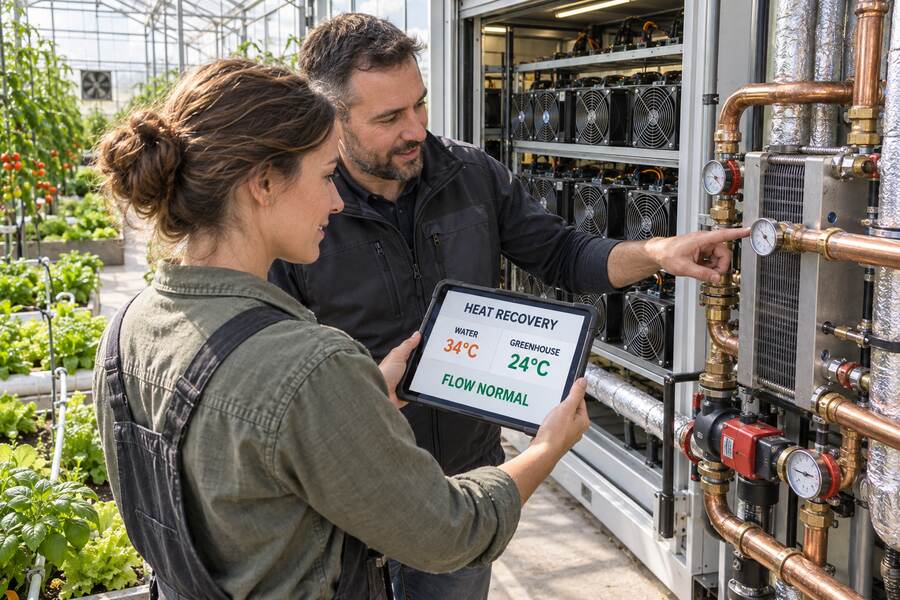
According to the companies’ own technical description of the project, the liquid-cooling system captures roughly ninety percent of the electricity consumed by the mining servers as usable heat, producing water at temperatures exceeding seventy-five degrees Celsius that is then used to preheat the intake water feeding the greenhouse’s existing electric boilers through a closed-loop heat exchange system, rather than replacing those boilers outright. Canaan has stated that the completed system is designed to deliver up to one million tonnes of heated water annually in support of year-round tomato cultivation, while targeting equipment uptime of roughly ninety-five percent, and the company separately disclosed an all-in power cost, including electricity, operations, and maintenance, of approximately three and a half cents per kilowatt-hour for the deployment. The four containerized cooling modules housing the servers were designed specifically to be added to the greenhouse site without requiring changes to the existing boiler equipment itself, with the preheated water simply reducing how hard those boilers need to work to reach the temperature the tomato crop requires, an approach that let Bitforest Investment test the concept without first committing to a full replacement of its existing heating system.
Because this project was only announced in January 2026 and remains in its initial twenty-four-month evaluation period at the time of this writing, it should be understood as a genuinely early-stage pilot rather than a long-running, fully proven commercial operation in the way the Finnish district heating project or Bathhouse’s several years of continuous operation can be described. It is nonetheless a useful and well-documented illustration of how the same underlying preheating principle used in municipal district heating can be adapted to a very different kind of heat customer, one where the relevant measure of success is not household comfort but the water temperature and heat volume needed to keep a commercial greenhouse’s own boilers running more efficiently through a cold Canadian winter.
Does Recycled Mining Heat Change the Energy Debate? Limits and Skepticism
Having examined how heat recovery works and three genuine examples of it operating at different scales, it is worth pausing to take seriously the case against reading too much significance into any of it, because the honest answer to whether dual-purpose mining meaningfully changes the broader argument over Bitcoin’s energy use is considerably more limited than either mining companies’ own promotional materials or the more enthusiastic corners of cryptocurrency media coverage tend to suggest. Alex de Vries, the economist behind the widely cited Digiconomist Bitcoin Energy Consumption Index, told MIT Technology Review in April 2025 that heat recovery from mining remains, in his assessment, an extremely niche practice, noting specifically that recovered heat can only be transported over short distances before it dissipates and loses its usefulness, a physical constraint this article’s earlier discussion of pipe infrastructure and distance limits already illustrated directly. De Vries has been blunt in characterizing the broader claim that heat reuse meaningfully offsets mining’s energy footprint as simply not competitive at any significant scale, a view grounded in the basic mismatch, described earlier in this article, between where mining facilities are typically sited for cheap electricity and where genuine heat demand actually exists.
A second, related point of skepticism concerns scale rather than distance specifically: even in the most successful documented projects examined in this article, recovered heat still represents only a fraction of the total energy that goes into Bitcoin mining globally, and the overwhelming majority of mining facilities worldwide continue to vent their heat with no attempt at recovery whatsoever, generally because they are sited in locations, industrial parks, remote hydroelectric sites, or oil and gas flaring locations, with no nearby building, pool, or greenhouse that could plausibly use that heat even if an operator wanted to capture it. The projects highlighted in this article’s case studies are worth documenting precisely because they remain unusual rather than representative, and readers should be cautious about extrapolating from a handful of well-publicized examples to any claim that heat recovery is becoming standard industry practice.
There is also a straightforward economic reason most mining operators have not followed the path taken by MARA, Bathhouse, or Bitforest Investment: retrofitting an existing air-cooled facility for heat recovery generally requires a meaningful upfront capital investment in liquid cooling, heat exchangers, and pipe infrastructure, an investment that only makes clear financial sense when a paying heat customer already sits close enough to make the connection practical. For an operator whose facility sits far from any such customer, that capital is generally better spent expanding mining capacity itself, and the heat produced along the way continues to be vented for the simple reason that no one nearby is in a position to buy it. Heat recovery, in other words, tends to work only where mining is already profitable enough to stand on its own, with the recovered heat functioning as a genuine bonus rather than as the underlying reason the facility exists in the first place.
Scale is a further, related consideration worth naming directly. Even the largest of the three projects examined in this article, MARA’s combined Finnish operation, involves a small number of megawatts of connected mining capacity, a figure that is dwarfed by the gigawatt-scale mining campuses now operating in places like Texas, where a single site can draw as much electricity as a small city. Measured against that broader industry backdrop, the aggregate heat currently being recovered and reused across every documented project combined remains a rounding error relative to the total heat Bitcoin mining generates worldwide, a gap this article’s case studies do not close simply by being well documented and genuinely successful on their own, comparatively modest terms.
Kaveh Madani, director of the United Nations University Institute for Water, Environment, and Health, offered a further, more fundamental objection in the same MIT Technology Review reporting, arguing that even Bitcoin mining powered entirely by renewable electricity does not automatically become sustainable simply because its power source is clean, since the mining process still consumes electricity, whether renewable or not, that could otherwise have been used to meet existing, unmet energy needs elsewhere. Applied specifically to heat recovery, this argument suggests that capturing and reusing mining’s waste heat, while a genuine improvement over simply discarding it, does not resolve the more basic question of whether mining that electricity for cryptocurrency in the first place represents the best use of that power to begin with, a question entirely separate from what happens to the resulting heat afterward.
A further, more practical limit involves the regulatory and institutional friction that a mining company faces when it tries to become, in effect, a heat utility rather than remaining purely a computing operation. District heating networks in most jurisdictions are built and regulated around a small number of established fuel sources, and a mining company hoping to sell heat to a municipal utility, as MARA has done in Finland, generally has to work through unfamiliar contractual, safety, and reliability requirements that a conventional gas or biomass heat supplier would already have relationships and track records to satisfy. This friction is rarely insurmountable, as the projects examined in this article demonstrate, but it does add real time and cost to any new heat-recovery project, and it helps explain why the earliest, most successful examples have tended to involve either a supportive local utility willing to work through those requirements or, as with Bathhouse, a business simply heating its own property rather than attempting to sell heat to an outside customer at all.
Taken together, these criticisms do not suggest that the case studies examined in this article are fabricated, exaggerated, or without genuine value; the Finnish towns receiving lower-carbon district heat, the greenhouse gas emissions MARA has documented avoiding, and the real, ongoing cost savings Bathhouse’s owners describe are all real, verifiable outcomes rather than marketing fictions. What the skeptical case does establish is that heat recovery should be understood as a modest, genuinely positive mitigation applied at the margins of a small number of individual mining operations, rather than as a development that meaningfully resolves, or even substantially softens, the much larger and still fundamentally unsettled debate over whether Bitcoin mining’s total electricity consumption, estimated in recent years at a level roughly comparable to that of a mid-sized country, represents a justifiable use of that energy in the first place.
Final Thoughts
The most honest way to think about Bitcoin mining heat recovery is as a genuine, verifiable improvement at the margins of an industry whose central, unresolved argument it does not actually settle, and holding both of those things as true at once, rather than picking whichever one is more convenient, is what a clear-eyed reader should take away from everything examined in this article. A Finnish family whose district heating now comes partly from MARA’s mining servers, a Bathhouse customer soaking in a pool warmed by immersion-cooled ASICs in a Brooklyn storage closet, and a Manitoba greenhouse worker checking on tomatoes kept warm by Canaan’s liquid-cooled servers are all benefiting from something real, measurable, and independently documented, and none of that should be dismissed simply because it fails to resolve every criticism leveled at Bitcoin mining more broadly.
At the same time, treating these examples as evidence that Bitcoin mining’s environmental debate has effectively been answered would badly misread what the case studies in this article actually demonstrate. Each project succeeded specifically because of a favorable, somewhat unusual set of local circumstances, existing Nordic district heating infrastructure already built to accept new heat sources, a spa business with pools that needed heating anyway sitting a short pipe run from its own mining closet, a greenhouse operator willing to restructure its boiler intake around an unproven twenty-four-month pilot, rather than because heat recovery has become simple or economical enough to apply universally across an industry still overwhelmingly sited in places with no heat customer nearby at all. The distance and infrastructure constraints described earlier in this article are not minor footnotes; they are the primary reason heat recovery remains the exception across global mining capacity rather than the rule, regardless of how compelling any individual example looks in isolation.
What would actually need to change for dual-purpose mining to grow from a collection of notable pilot projects into something closer to standard practice is reasonably clear from the cases this article has examined, even if achieving it is not: mining operators would need stronger financial incentive to site new facilities near genuine heat demand rather than purely toward the cheapest available electricity, district heating infrastructure comparable to what already exists across Scandinavia would need to become far more common in regions like North America where it remains relatively rare, and heat customers themselves, whether municipal utilities, spa owners, or greenhouse operators, would need enough confidence in mining as a heat source to restructure their own systems around it the way Bathhouse and Bitforest Investment have each done. None of these changes is impossible, and the fact that MARA, Bathhouse, and Canaan have each already demonstrated a working version of this arrangement at meaningfully different scales suggests the underlying idea is sound engineering rather than a novelty.
What this article’s examination ultimately supports is a narrower, more durable claim than either uncritical enthusiasm or blanket dismissal would offer: recycled mining heat is a real, if still marginal, contribution to a small number of specific communities and businesses, worth expanding wherever the underlying geography and infrastructure genuinely support it, and worth discussing honestly as exactly that rather than as a resolution to arguments about Bitcoin’s broader electricity footprint that these three projects, however well documented, were never actually positioned to settle.
FAQs
- Why does Bitcoin mining produce so much heat in the first place?
Bitcoin mining hardware, called ASICs, performs trillions of calculations per second, and nearly all of the electricity that powers those calculations is ultimately released as heat, similar to how a resistive space heater converts electricity into warmth rather than storing that energy in any other usable form. Because mining facilities draw substantial, continuous electrical power around the clock, they generate a correspondingly large and constant amount of recoverable heat as an unavoidable byproduct of simply running. - What is “dual-purpose mining”?
Dual-purpose mining refers to operations that deliberately capture the heat their mining hardware produces and route it toward a practical use, such as district heating, pool heating, or greenhouse warming, rather than simply venting it outdoors as waste. It does not change how Bitcoin mining itself works; it changes what happens to the heat the process was already generating. - Is MARA Holdings’ Finnish district heating project actually operating today?
Yes. MARA Holdings launched its initial two-megawatt heat-recovery site in Finland’s Satakunta region in June 2024 and later expanded to a second site in Seinäjoki, with the company reporting that the combined project has grown to serve roughly eighty thousand residents and has avoided nearly five thousand tons of greenhouse gas emissions over about a year and a half of operation. - How does a spa like Bathhouse actually heat its pools with Bitcoin mining?
Bathhouse submerges ASIC mining machines directly in tanks of non-conductive oil, which absorbs the heat the machines produce, and pumps that warmed fluid through tubing beneath its hot tubs, pools, and hammam rooms. According to reporting from MIT Technology Review, roughly six of these immersion-cooled miners are enough to keep one hot tub at 104 degrees Fahrenheit. - Does recovering mining heat actually reduce Bitcoin’s total electricity consumption?
No. Heat recovery captures and reuses energy that would otherwise be wasted, but it does not reduce how much electricity the mining hardware itself consumes in the first place. Independent researchers, including economist Alex de Vries, have emphasized that heat reuse addresses what happens to a byproduct rather than the underlying scale of the electricity use that produces it. - Why don’t more Bitcoin mining operations recover and reuse their waste heat?
Most mining facilities are sited primarily for access to cheap electricity, often in remote or industrial locations with no nearby building, pool, or greenhouse that could realistically use the resulting heat. Because low-grade heat cannot travel far before it becomes unusable, the physical mismatch between where mining happens and where heat demand exists remains the primary obstacle to wider adoption, and retrofitting an existing air-cooled site for heat recovery also carries a real capital cost that many operators have little financial incentive to take on. - What makes the Canaan and Bitforest Investment greenhouse project different from the other examples?
Unlike the Finnish district heating project or Bathhouse’s several years of continuous operation, the Canaan and Bitforest Investment tomato greenhouse pilot in Manitoba only began in January 2026 under an initial twenty-four-month agreement, making it a genuinely early-stage test of whether recovered mining heat can reliably supplement a commercial greenhouse’s boiler system rather than a long-proven commercial practice. - What is the difference between air cooling and immersion cooling for heat recovery purposes?
Air cooling uses fans to push warm air away from mining hardware, producing only a modest, low-grade temperature rise that is difficult to reuse beyond the immediate vicinity. Immersion cooling submerges hardware in a heat-absorbing fluid, producing higher and more consistent temperatures that are considerably easier to route into a building’s heating system, a pool, or a greenhouse boiler loop. - Do the businesses using dual-purpose mining do it mainly for environmental reasons?
Not primarily. Bathhouse’s co-founder Jason Goodman has said in press interviews that the main appeal is economic, since his business would be paying for pool-heating electricity regardless, and mining simply lets that same electricity generate a small additional stream of cryptocurrency revenue. The environmental benefit, such as avoided emissions in the MARA case, is a genuine but generally secondary outcome of decisions driven largely by cost. - Does heat recovery resolve the broader debate over Bitcoin mining’s environmental impact?
No, and researchers who study Bitcoin’s energy use, including Kaveh Madani of the United Nations University, have argued that even renewable-powered mining does not automatically become sustainable just because its heat is reused, since the underlying electricity could otherwise meet existing needs elsewhere. Heat recovery is best understood as a genuine but marginal improvement rather than a resolution to that larger, still unsettled argument.