For someone new to cryptocurrency, the prospect of buying a digital asset like Bitcoin can feel intimidating, not because the act of buying is difficult but because the prices move so violently that the decision of when to buy seems to carry enormous weight, with the constant fear that one might purchase just before a steep fall or miss out just before a sharp rise. The headlines tell stories of fortunes made and lost as prices swing by large percentages in days or even hours, and a newcomer watching this volatility naturally wonders how anyone could possibly know the right moment to enter, faced with the seemingly impossible task of timing a market that humbles even seasoned professionals. This anxiety about timing keeps many interested people on the sidelines, convinced that successful participation requires a skill at prediction that they do not possess and that may not really exist.
Dollar-cost averaging offers a way through this problem by removing the need to time the market entirely, replacing the fraught single decision of when to buy with a simple, mechanical discipline of buying a fixed amount of an asset at regular intervals regardless of the price. Instead of trying to identify the perfect moment, an investor using this approach commits to buying, say, a set sum every week or every month, so that they purchase steadily through the ups and downs, acquiring more units when prices are low and fewer when prices are high, and over time arriving at an average cost that smooths out the wild swings. This strategy, long used in traditional investing, has found a natural application in the highly volatile world of cryptocurrency, where the difficulty of timing is extreme and the appeal of a disciplined, emotion-free approach is correspondingly strong.
This article serves as a beginner’s playbook for dollar-cost averaging into cryptocurrency, written for someone with little or no investing experience who wants to understand this approach. It explains why crypto is so volatile and why timing the market is so difficult, what dollar-cost averaging is and how it smooths out volatility, how to set up a plan in practice, and how the strategy compares with investing a lump sum all at once. It weighs the benefits and the real limitations for beginners and grounds the discussion in the documented history of crypto’s dramatic price swings. It is important to note at the outset that this article is educational and not financial advice, that cryptocurrency is a highly risky and speculative asset that can lose value, and that no strategy, including dollar-cost averaging, removes that underlying risk, so readers should consider their own circumstances and consult a qualified professional before making investment decisions.
Understanding Crypto Volatility and the Timing Problem
Cryptocurrency is among the most volatile asset classes that ordinary people can invest in, with prices that routinely move by amounts that would be considered extraordinary in traditional markets, and understanding this volatility is essential to understanding why a strategy like dollar-cost averaging is so appealing. Where a movement of a few percent in a day would be a significant event for a major stock index, cryptocurrencies regularly swing by ten or twenty percent or more in a single day, and over longer periods they have experienced rises and falls of enormous magnitude, with the leading cryptocurrency, Bitcoin, having lost the great majority of its value in some periods and multiplied many times over in others. This extreme volatility is a defining feature of the asset class, driven by factors including its relative youth, the speculative nature of much of the activity around it, the absence of the stabilizing mechanisms present in more mature markets, and its sensitivity to news, sentiment, and events.
To put this volatility in perspective, it helps to compare crypto with the assets most people are more familiar with, such as savings accounts, bonds, or even stocks. A savings account holds its value steadily, a broad stock index might rise or fall by a modest amount in a typical year and only rarely moves dramatically in a single day, but a cryptocurrency can do in an afternoon what a stock index might do in a year, and can lose half its value or double over a span of months. This means that the experience of holding crypto is qualitatively different from the experience of holding more traditional assets, demanding a far greater tolerance for dramatic fluctuation, and it is this difference in degree, so large as to become a difference in kind, that makes the question of how and when to buy so much more pressing for crypto than for tamer investments.
This volatility creates what can be called the timing problem, the difficulty and danger of trying to decide when to buy an asset whose price is so unpredictable and so prone to dramatic swings. For an investor, the dream is to buy low and sell high, but the violent and unpredictable movement of crypto prices makes identifying the low points exceptionally difficult, and the consequences of getting the timing wrong are magnified by the size of the swings, so that buying at the wrong moment can mean watching a substantial portion of one’s investment evaporate in a short time. The newcomer, lacking experience and confronting an asset that moves more wildly than anything in traditional finance, faces this timing problem in its most acute form, and the fear of buying at the wrong time is a major source of the anxiety that surrounds entering the crypto market.
The timing problem is made worse by the emotional pressures that volatility creates, because the dramatic swings tend to provoke exactly the wrong responses from investors, who are inclined to buy when prices are high and excitement is greatest and to sell when prices are low and fear is greatest, the opposite of what successful investing requires. When prices are soaring and everyone is talking about gains, the pull to buy in is powerful, often leading people to purchase near peaks, while when prices are crashing and the mood is grim, the urge to sell and cut losses is equally strong, leading people to sell near bottoms, so that the emotional reactions provoked by volatility actively work against the investor. This combination of unpredictable swings and the emotional pressures they create is what makes timing the crypto market so treacherous for beginners, and it is precisely this combination that dollar-cost averaging is designed to neutralize by removing timing from the equation altogether.
Why Trying to Time the Market Fails
The attempt to time the market, to buy at the lows and sell at the highs by predicting price movements, fails for most people because reliably predicting the short-term direction of an asset as volatile and unpredictable as cryptocurrency is essentially impossible, even for experts. The price of a cryptocurrency at any moment reflects an enormous number of factors and the collective behavior of countless participants, and it responds to news and events that cannot be foreseen, so that the notion that one could consistently identify in advance when the price will rise or fall rests on a predictive ability that the evidence suggests no one reliably possesses. Professional investors with vast resources struggle to time markets consistently, and the forecasts of prominent analysts about crypto prices have frequently proven dramatically wrong, which should give pause to any newcomer who imagines they can succeed where the experts fail.
Beyond the sheer difficulty of prediction, market timing fails because it requires being right not once but repeatedly, since a successful timing strategy demands correctly identifying both when to buy and when to sell, and the probability of consistently getting both decisions right over many cycles is vanishingly small. An investor might occasionally make a well-timed purchase by luck, but sustaining that success across the many decisions that active timing requires is a different matter entirely, and a single badly timed decision can erase the gains from several good ones, so that the cumulative effect of trying to time the market tends to be poor for the great majority of those who attempt it. The asymmetry between the difficulty of the task and the confidence with which people approach it is a recipe for losses, particularly in a market as unforgiving as crypto.
The deepest reason market timing fails, however, is psychological, because even if reliable signals existed, the emotional pressures that markets generate would lead most people to act against their own interests at the crucial moments, buying out of greed at the top and selling out of fear at the bottom. Human beings are not wired to be calm and rational in the face of rapidly changing prices and the prospect of gain or loss, and the very moments when timing decisions matter most are the moments when emotions run highest and judgment is most compromised, so that the practical execution of a timing strategy is undermined by the investor’s own psychology. This is why the conventional wisdom in investing holds that time in the market tends to beat timing the market, and it is why a strategy that removes the need to make these fraught, emotionally charged timing decisions, replacing them with a simple mechanical rule, holds such appeal for those who recognize that the timing game is one they are likely to lose.
What Dollar-Cost Averaging Is and How It Works
Dollar-cost averaging is an investment strategy in which a person invests a fixed amount of money in an asset at regular intervals, regardless of the asset’s price at the time, so that they buy steadily and automatically rather than trying to choose the right moments to buy. The essential idea is to break a larger investment into many smaller, equal purchases spread out over time, committing in advance to a schedule, such as investing a set sum every week or every month, and then following that schedule mechanically without regard to whether the price is currently high or low. By doing this, the investor sidesteps the timing problem entirely, since they are not trying to predict prices but simply buying consistently through whatever the market does, and the regularity of the approach turns investing from a series of anxious decisions into a simple, repeatable habit.
The power of this approach in a volatile market comes from a simple mathematical consequence of buying a fixed dollar amount each time, which is that the fixed sum naturally buys more units of the asset when the price is low and fewer units when the price is high. Because the amount of money is constant while the price varies, a given purchase automatically acquires a larger quantity when the asset is cheap and a smaller quantity when it is expensive, which means the investor accumulates more of the asset at lower prices and less at higher prices without having to make any decisions about it, and over many purchases this has the effect of producing an average purchase price that tends to be favorable relative to the average price over the period. The two core elements of how this works are the mechanics of the regular, fixed buying itself and the way this buying smooths out the impact of volatility, and understanding each clarifies why the strategy is so well suited to crypto.
The Mechanics of Buying on a Schedule
The mechanics of dollar-cost averaging are deliberately simple, requiring the investor to decide on three things, namely how much to invest each time, how often to invest, and which asset to buy, and then to execute that plan consistently over time. Once these choices are made, the strategy runs on a fixed rule, such as investing a particular sum every week into a chosen cryptocurrency, and the investor simply carries out this rule on schedule, buying the same dollar amount each time no matter what the price happens to be, which is the entire discipline of the approach. The simplicity is intentional and is part of the strategy’s strength, because a simple rule that can be followed mechanically is far easier to sustain through the emotional turbulence of a volatile market than an approach that requires ongoing judgment.
A crucial feature of the mechanics is that the amount invested each time is fixed in money terms rather than in units of the asset, which is what gives the strategy its averaging property and distinguishes it from simply buying the same quantity each time. By committing to spend a constant amount of money rather than to acquire a constant number of units, the investor ensures that the quantity purchased automatically adjusts to the price, rising when the asset is cheap and falling when it is expensive, and this automatic adjustment is the mechanism through which averaging works its effect. The investor does not need to calculate or decide how much to buy in unit terms, since the fixed money amount and the prevailing price together determine the quantity, making the process entirely automatic in its response to price changes.
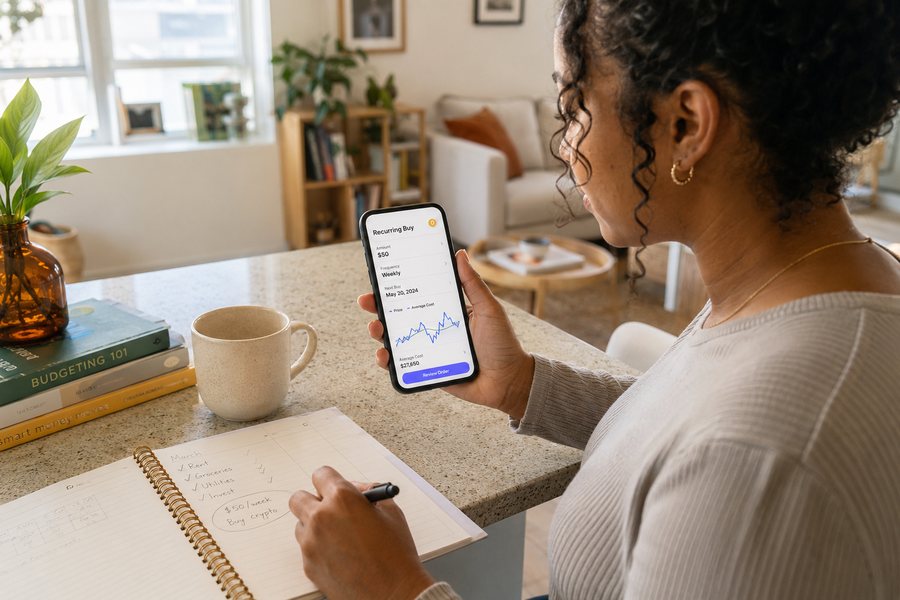
In practice, the mechanics of dollar-cost averaging into cryptocurrency are made especially easy by the recurring purchase features that many crypto platforms now offer, which allow an investor to automate the entire process so that it requires no ongoing effort or attention. Rather than manually making each purchase, an investor can set up an automatic recurring buy on a platform, specifying the amount and the frequency, after which the platform executes the purchases on schedule on the investor’s behalf, withdrawing the set amount and buying the asset at whatever the current price is. This automation is valuable not only for convenience but because it reinforces the discipline of the strategy, since by removing the need to actively initiate each purchase it removes the opportunity for emotion or hesitation to interfere, ensuring that the buying continues steadily through both rising and falling markets exactly as the strategy intends, which is often where human discipline alone would falter.
How Averaging Smooths Out Volatility
The central benefit of dollar-cost averaging, and the reason it is so well suited to a volatile asset like cryptocurrency, is that it smooths out the impact of price swings by spreading purchases across many different price points rather than concentrating them at a single moment. When an investor buys at just one time, the price they pay is entirely determined by the conditions at that single moment, exposing them fully to the risk that the moment turns out to be a poor one, but when they spread their buying across many times, the prices they pay are averaged together, so that no single purchase determines their overall cost and the effect of any one unfavorable price is diluted. This spreading of purchases across the market’s ups and downs is what gives the strategy its name and its smoothing effect, reducing the influence of volatility on the investor’s average cost.
The smoothing works to the investor’s mathematical advantage because of the way the fixed-amount buying interacts with price changes, since buying more units when prices are low and fewer when prices are high causes the average cost per unit to come out lower than the simple average of the prices at which purchases were made. A concrete illustration makes this clear, where an investor putting the same fixed sum into an asset over several periods during which the price falls and then recovers ends up, because their fixed sum bought a great many units while the price was low, with an average cost below the midpoint of the price range and a larger total holding than if they had bought everything at the start. This is not a guarantee of profit, since the outcome still depends on where prices ultimately go, but it does mean that the strategy tends to produce a favorable average cost in exactly the volatile, fluctuating conditions that characterize crypto, turning volatility from a pure threat into something the strategy can partly harness.
Beyond the mathematics, the smoothing has a profound psychological benefit, because by ensuring that no single purchase is decisive, it relieves the investor of the fear and stress that timing a single large purchase would involve and makes it easier to stay invested through downturns. An investor who has spread their buying knows that a price drop is not a catastrophe for their whole position but rather an opportunity for their next scheduled purchases to buy more units cheaply, which transforms the emotional experience of a falling market from one of pure dread into one that the strategy can actually exploit, helping the investor maintain the discipline to keep buying when fear would otherwise drive them away. This combination of a mathematically favorable average cost and a psychologically sustainable experience is the essence of how dollar-cost averaging smooths out volatility, and it is what makes the strategy particularly valuable for beginners who are most vulnerable to both the financial and the emotional dangers of crypto’s wild swings.
Setting Up a Dollar-Cost Averaging Plan
Putting dollar-cost averaging into practice requires making a few key decisions and then setting up the mechanics to execute the plan consistently, and while the strategy is simple in concept, thinking through these choices carefully helps ensure that the plan fits the investor’s circumstances and can be sustained over time. The main decisions involve how much to invest, how often, which asset or assets to buy, and which platform to use, and beyond these choices lies the practical step of automating the plan and the discipline of sticking to it through the market’s ups and downs. Approaching these decisions thoughtfully at the outset makes the strategy more likely to succeed, since a plan that is well matched to the investor’s situation is one they can maintain, and maintaining the plan is the whole point.
The most important decision is how much to invest, which should be an amount the investor can comfortably afford to commit on the chosen schedule without strain and, critically, an amount they could afford to lose given the speculative and risky nature of cryptocurrency. Because crypto can lose substantial value or even become worthless, the sum devoted to a dollar-cost averaging plan should be money the investor does not need for essential expenses or near-term goals and whose loss would not jeopardize their financial security, a principle that is especially important for beginners who may underestimate the risk. The amount should also be sustainable over the long horizon that the strategy implies, since dollar-cost averaging works through consistency over time, and setting the contribution too high to maintain would undermine the discipline the strategy depends on, making a modest, comfortable amount preferable to an ambitious one that cannot be sustained.
It is also worth keeping the plan as simple as possible, because simplicity is what makes a strategy sustainable over the long horizons on which dollar-cost averaging depends. A beginner can be tempted to overcomplicate matters by adjusting the contribution amount based on how they feel about the market, pausing during downturns, or trying to add a little extra when prices seem low, but each of these adjustments reintroduces exactly the timing judgments and emotional decisions that the strategy is meant to eliminate, and they tend to undermine its discipline. The most effective version of the strategy is often the most boring one, in which the investor sets a fixed amount and frequency, automates it, and then largely ignores the day-to-day movements of the market, checking in only occasionally rather than agonizing over every swing, since it is precisely this detachment that allows the strategy to do its work.
The remaining decisions concern the frequency, the asset, and the platform, each of which should be approached with the strategy’s logic in mind. The frequency, whether weekly, biweekly, or monthly, matters less than consistency, though more frequent purchases spread the buying across more price points and align well with the strategy’s averaging logic, while the choice of asset should reflect the investor’s research and risk tolerance, with many beginners focusing on the largest and most established cryptocurrencies as relatively less risky than smaller, more speculative ones, though all crypto remains highly risky. The platform should be a reputable and secure exchange that offers recurring purchase features to automate the plan, and the investor should be mindful of the fees the platform charges, since fees on each purchase can erode returns over many transactions, making it worthwhile to understand the cost structure before committing. Once these decisions are made, the investor can set up an automatic recurring buy that executes the plan on schedule, and the final and most important element is the discipline to leave the plan running through the market’s swings, resisting the temptation to stop buying during downturns or to deviate during rallies, since the strategy delivers its benefits precisely through steady adherence over time, and this consistency, more than any of the individual choices, is what determines whether the plan succeeds.
Dollar-Cost Averaging Versus Lump-Sum Investing
A natural question for anyone considering dollar-cost averaging is how it compares with the alternative of investing a lump sum all at once, putting the entire intended amount into the asset in a single purchase rather than spreading it out over time, and understanding this comparison clarifies when each approach makes sense. The two strategies represent different ways of deploying the same total amount of money, with lump-sum investing committing it all immediately and dollar-cost averaging committing it gradually, and each has distinct implications for risk, potential return, and the investor’s experience. The choice between them depends on the investor’s circumstances, their tolerance for risk, the nature of the asset, and their own psychology, and there is no single answer that is right for everyone.
The case for lump-sum investing rests on the observation that, in markets that tend to rise over time, investing everything at once puts the full amount to work immediately and so captures more of the market’s overall upward movement than spreading purchases out, which on average tends to leave money on the sidelines during a rising market. Research in traditional markets has generally found that, because markets rise more often than they fall over long periods, lump-sum investing produces higher returns than dollar-cost averaging more often than not, simply because it has more money exposed to the market’s growth for longer. From the standpoint of maximizing expected return, then, deploying a lump sum immediately has a statistical edge in markets with a long-term upward tendency, and this is the principal argument in its favor.
The case for dollar-cost averaging, by contrast, rests not primarily on maximizing return but on managing risk and emotion, which can matter more than expected return for many investors, especially beginners and especially in an asset as volatile as crypto. By spreading purchases over time, dollar-cost averaging reduces the risk of the worst outcome, that of committing everything just before a sharp decline, and it greatly eases the psychological burden of investing, since an investor who has spread their buying is far less exposed to regret and fear than one who put everything in at a single moment that might prove to be a peak. For a volatile and unpredictable asset like cryptocurrency, where the swings are extreme and the risk of a badly timed lump-sum entry is correspondingly large, and for a beginner whose tolerance for the emotional strain of a sudden large loss may be limited, the risk reduction and psychological comfort of dollar-cost averaging can outweigh the statistical return advantage of lump-sum investing. The sensible conclusion is that lump-sum investing may suit those focused on expected return who can tolerate the risk and have a long horizon, while dollar-cost averaging suits those who prioritize managing risk and emotion, who are wary of timing, or who are simply investing modest amounts from their income over time, which describes many of the beginners for whom the strategy is most often recommended.
Benefits and Challenges for Beginners
Dollar-cost averaging offers real benefits to beginners entering the crypto market, but it also has limitations and does not eliminate the substantial risks of cryptocurrency, and a balanced assessment requires weighing both, recognizing that the strategy is a useful tool rather than a guarantee of success. The benefits center on discipline, risk reduction, and accessibility, making the strategy particularly well suited to those who are new and who lack the experience, the emotional resilience, or the desire to actively manage their investments, while the challenges and limitations remind us that no approach to a speculative asset can make it safe. Understanding both sides allows a beginner to use the strategy wisely and with realistic expectations.
The benefits and challenges also interact with the particular situation of a beginner, who is typically more vulnerable to the emotional and financial dangers of crypto and less equipped to navigate them, which shapes how the strategy’s advantages and limitations apply. The discipline and emotional smoothing that dollar-cost averaging provides are most valuable precisely for those most susceptible to the panic and euphoria that volatility provokes, while the limitation that the strategy cannot remove crypto’s underlying risk is most important to impress upon those who might mistake a sensible buying method for a guarantee of safety. Examining the benefits and the challenges in turn gives a clearer picture of what dollar-cost averaging can and cannot do for someone beginning their journey into cryptocurrency.
Benefits for Discipline, Risk, and Peace of Mind
The foremost benefit of dollar-cost averaging for beginners is the discipline it instills, replacing the fraught and emotionally driven decisions of active investing with a simple, automatic routine that is easy to follow and that protects the investor from their own worst impulses. By committing in advance to a fixed schedule and automating its execution, the investor removes the constant temptation to react to price movements, to chase rallies or flee downturns, and instead buys steadily through all conditions, which is exactly the behavior that tends to serve investors well and exactly the behavior that emotion usually prevents. This enforced discipline is especially valuable for beginners, who are most likely to be swayed by the powerful emotions that volatile markets generate, and it transforms investing from a stressful test of willpower into a calm, mechanical habit.
A second major benefit is the reduction of timing risk, the danger of committing money just before a fall, which dollar-cost averaging substantially mitigates by spreading purchases across many price points so that no single moment determines the investor’s fate. For a beginner who has no ability to time the market and who would be exposed to potentially severe losses from a poorly timed lump-sum entry, this risk reduction is genuinely valuable, ensuring that even if some purchases are made at unfavorable prices, others are made at favorable ones, and the overall outcome reflects an average rather than a single bet. This does not eliminate the risk that the asset as a whole may decline, but it does protect against the specific and significant risk of catastrophic mistiming, which is one of the most damaging errors a newcomer can make.
A third benefit is peace of mind and accessibility, since dollar-cost averaging makes investing in crypto less stressful and more approachable for ordinary people who lack large sums, expertise, or the temperament for active trading. The strategy allows someone to begin with modest amounts invested regularly from their income, lowering the barrier to entry and making participation feasible without a large upfront commitment, and the spreading of purchases and the automatic nature of the approach reduce the anxiety that timing a single large purchase would involve, allowing the investor to participate without constant worry. This combination of discipline, reduced timing risk, and emotional ease makes dollar-cost averaging a sensible and accessible way for beginners to gain exposure to crypto in a measured manner, which is the core of its appeal, though these benefits must be understood alongside the strategy’s real limitations.
Risks, Costs, and Limitations
The most important limitation of dollar-cost averaging, and the one beginners most need to understand, is that it does not remove the fundamental risk of cryptocurrency, which remains a highly speculative and volatile asset that can lose much or all of its value regardless of how it is purchased. Dollar-cost averaging is a method of buying that manages timing risk and emotional strain, but it provides no protection against the possibility that the chosen cryptocurrency simply declines over the long term or fails entirely, and an investor who diligently averages into an asset that keeps falling will steadily lose money, since the strategy ensures only that they buy at an average price, not that the average price proves to be a good one. It is essential that beginners not mistake the disciplined, sensible character of the strategy for a guarantee of safety, because the underlying asset remains as risky as ever, and no buying method can change that.
This point deserves emphasis because the very features that make dollar-cost averaging feel reassuring can lull a beginner into a false sense of security, treating a sensible buying method as though it were a form of protection against loss. The discipline and the smoothing are real, but they operate only on the question of how and when one buys, not on the question of whether the asset itself holds or grows its value, and that latter question is the one that ultimately determines whether the investment succeeds or fails.
A second limitation involves costs, because dollar-cost averaging entails making many separate purchases, and if each purchase incurs a fee, as is common on crypto platforms, these fees accumulate over time and can meaningfully erode returns, particularly for smaller, more frequent purchases where the fee represents a larger proportion of the amount invested. An investor should understand the fee structure of their chosen platform and consider how the frequency of purchases interacts with the cost, since very frequent small buys on a platform with high per-transaction fees could see a significant share of the investment consumed by costs, working against the strategy’s benefits. Being mindful of fees and choosing the frequency and platform with costs in mind is therefore an important part of using the strategy effectively, lest the accumulation of small charges quietly undermine the returns.
The further limitations are more subtle but still worth understanding, including the opportunity cost relative to lump-sum investing and the simple fact that the strategy does not relieve the investor of the need to make sound underlying choices. Because dollar-cost averaging keeps some money uninvested while it is being deployed gradually, it tends to sacrifice some return in markets that rise over the period, representing an opportunity cost relative to having invested everything at once, which is the price paid for the strategy’s risk reduction. Moreover, the strategy says nothing about which asset to choose or whether investing in crypto at all is wise for a given person, so a beginner still bears the responsibility of researching their choices, understanding the risks, and deciding whether and how much to invest in light of their own circumstances, since dollar-cost averaging is only a method of buying and cannot substitute for the judgment that responsible investing requires. Understanding these limitations alongside the strategy’s genuine benefits allows a beginner to use dollar-cost averaging as the sensible tool it is, neither dismissing its real value nor mistaking it for something it is not.
Real-World Volatility and Documented Outcomes
The case for an approach that removes market timing is made vividly by the documented history of cryptocurrency’s price movements, which illustrate both the extreme volatility that makes timing so dangerous and the dramatic recoveries that reward those who remain invested, and examining this real history clarifies why dollar-cost averaging resonates so strongly in the crypto context. The most instructive recent episode is the boom and bust that Bitcoin experienced across 2021 and 2022, a swing of breathtaking magnitude that would have devastated a poorly timed investor and that demonstrates the peril of trying to pick the right moment. Bitcoin reached an all-time high of nearly sixty-nine thousand dollars in November 2021, a peak amid widespread euphoria, and anyone who invested a lump sum at that moment, drawn in by the excitement, would soon have seen their investment collapse.
What followed was a prolonged and severe decline that bottomed during a wave of crisis in the crypto industry, illustrating how quickly and how far these assets can fall. Over the course of 2022, Bitcoin lost roughly three-quarters of its value, and the collapse was punctuated by the dramatic failure of the major cryptocurrency exchange FTX, which imploded over about ten days in early November 2022 and triggered a loss of more than two hundred and sixty billion dollars in crypto market value, driving Bitcoin down to around fifteen thousand seven hundred dollars in late November 2022, with intraday lows below fifteen thousand six hundred dollars. An investor who had bought at the peak a year earlier would have been sitting on catastrophic losses, a stark demonstration of the timing risk that a single large, badly timed purchase entails and the kind of outcome that dollar-cost averaging is designed to guard against by ensuring that no single purchase, however unfortunate its timing, determines the investor’s whole position.
This episode is worth dwelling on because it captures the emotional reality that makes timing so destructive and discipline so valuable. At the peak in late 2021, the mood was euphoric, with stories of rapid riches drawing newcomers in at exactly the worst moment, and at the bottom a year later, after the FTX collapse and the cascade of failures around it, the mood was one of despair, with many declaring that crypto was finished and selling whatever they held. An investor swept along by these emotions would have bought near the top and sold near the bottom, suffering the full force of the swing, which is the precise pattern that ruins so many participants. A dollar-cost averaging plan, by contrast, would have done the opposite by design, buying smaller quantities during the expensive euphoria and larger quantities during the cheap despair, mechanically leaning against the very emotions that lead others astray, and this is the deepest reason the strategy suits a market as emotionally charged as crypto.
The subsequent recovery is equally instructive, because it shows how dramatically crypto can rebound and how those who continued to accumulate through the downturn, as a dollar-cost averaging plan would, were positioned to benefit. From its late-2022 low, Bitcoin recovered over the following two years, reaching a new all-time high above seventy-one thousand dollars in March 2024 and then climbing far higher to surpass one hundred and eight thousand dollars in December 2024, an extraordinary rise from the depths of the crash. An investor who had panicked and stopped buying or sold near the bottom would have missed this recovery, while one who had maintained a disciplined dollar-cost averaging plan would have continued buying through the low prices of the downturn, accumulating units cheaply that subsequently rose enormously in value, which illustrates precisely the way the strategy turns a downturn into an opportunity and rewards the discipline of buying steadily through fear.
The broader maturation of the crypto market during this period further illustrates the context in which dollar-cost averaging operates and the tools that now make it easy to practice. A landmark development came in January 2024, when United States regulators approved the first spot Bitcoin exchange-traded funds, with eleven such funds approved on January 10 and trading beginning the following day, providing a regulated and accessible way for ordinary investors to gain exposure to Bitcoin and seeing roughly four point six billion dollars in trading on the first day, with tens of billions of dollars in net inflows accumulating over the following period. At the same time, the major crypto platforms have made dollar-cost averaging straightforward by offering automatic recurring purchase features, with leading exchanges allowing investors to set up automatic buys of a fixed amount at daily, weekly, biweekly, or monthly intervals, executing the strategy on the investor’s behalf, though such purchases typically carry fees that vary with the amount and that an investor should weigh. Together, the documented history of crypto’s violent swings and dramatic recovery, the growing accessibility of regulated investment vehicles, and the widespread availability of automated recurring-buy tools illustrate both why a timing-free, disciplined approach appeals so strongly in this market and how readily a beginner can now put such an approach into practice.
Final Thoughts
Dollar-cost averaging into cryptocurrency offers beginners a sensible and accessible way to participate in a notoriously volatile market without taking on the near-impossible challenge of timing it, replacing anxiety-ridden speculation about the right moment to buy with a simple, disciplined habit of investing steadily over time. By spreading purchases across many price points, the strategy smooths out the impact of crypto’s wild swings, tends to produce a favorable average cost in fluctuating markets, and, perhaps most importantly, relieves the investor of the emotional burden that drives so many people to buy high and sell low, allowing them to remain calm and consistent through the turbulence that defeats less disciplined approaches. The documented history of crypto’s dramatic crashes and recoveries makes the appeal of this approach clear, showing both the peril of mistimed lump-sum bets and the reward that consistent accumulation through downturns can bring.
The deeper value of dollar-cost averaging lies in what it represents about a healthy approach to investing and to risk, because at its heart the strategy is an acknowledgment of the limits of prediction and a commitment to discipline over impulse, qualities that serve investors well far beyond the crypto market. In making participation feasible for ordinary people with modest means and no special expertise, the strategy also reflects a kind of democratization of investing, lowering the barriers that might otherwise confine crypto participation to the wealthy or the sophisticated and allowing anyone to gain measured exposure through small, regular contributions from their income. This accessibility, combined with the emotional steadiness the strategy fosters, points toward a more responsible and sustainable way for newcomers to engage with a market that has too often been associated with reckless speculation and devastating losses. The contrast between the disciplined, patient investor quietly making small regular purchases and the frenzied trader chasing every swing captures something important about which approach tends to endure, and it is the former, not the latter, that dollar-cost averaging encourages, offering a model of participation grounded in consistency and humility rather than in the overconfidence that the market so reliably punishes.
Yet it remains essential to keep the strategy’s limits firmly in view, because dollar-cost averaging is a method of buying, not a shield against loss, and the cryptocurrency it is used to acquire remains a highly speculative and risky asset that can decline severely or fail entirely no matter how prudently it is purchased. The discipline of averaging protects against the risk of bad timing and the damage of emotional decisions, but it offers no protection against the possibility that the underlying asset proves a poor investment, and a beginner must approach crypto with a clear understanding that they could lose what they put in, investing only what they can genuinely afford to lose and recognizing that no strategy can make a fundamentally risky asset safe. Used with this understanding, as a tool for disciplined, measured participation rather than as a guarantee of gain, dollar-cost averaging can help a newcomer engage with cryptocurrency in a way that manages timing risk, eases the emotional strain of volatility, and fosters the patient consistency that sound investing rewards, allowing them to participate thoughtfully in this market while keeping their eyes open to its very real dangers and their own financial wellbeing firmly in mind.
FAQs
- What is dollar-cost averaging into crypto?
Dollar-cost averaging is a strategy of investing a fixed amount of money in a cryptocurrency at regular intervals, such as weekly or monthly, regardless of the price at the time. Instead of trying to pick the perfect moment to buy, you buy steadily through the market’s ups and downs, acquiring more units when prices are low and fewer when they are high. Over time this produces an average purchase price and removes the need to time the market, turning investing into a simple, repeatable habit. - Why is timing the crypto market so difficult?
Cryptocurrency prices are extremely volatile and unpredictable, often swinging ten or twenty percent or more in a single day in response to news, sentiment, and events that cannot be foreseen. Reliably predicting these short-term movements is essentially impossible even for experts, and successful timing requires being right repeatedly about both when to buy and when to sell. On top of this, the emotions that volatility provokes tend to lead people to buy high out of greed and sell low out of fear, the opposite of what works. - How does buying on a schedule smooth out volatility?
Because you invest a fixed amount of money each time, your purchase automatically buys more units when the price is low and fewer when it is high, without you making any decision about it. Spreading your buying across many price points means no single purchase determines your overall cost, so the effect of any one unfavorable price is diluted. Mathematically, this tends to produce an average cost below the simple average of the prices, and psychologically it makes downturns feel like buying opportunities rather than disasters. - How do I set up a dollar-cost averaging plan?
Decide how much to invest each time, how often, which cryptocurrency to buy, and which platform to use, then automate the plan and stick to it. Choose an amount you can comfortably afford and could afford to lose, since crypto is highly risky. Many reputable exchanges offer recurring buy features that let you set an amount and frequency and then execute the purchases automatically. The most important element is the discipline to keep the plan running through the market’s swings rather than stopping during downturns. - Is dollar-cost averaging better than investing a lump sum?
Neither is universally better; it depends on your goals and circumstances. Research in traditional markets generally finds that lump-sum investing produces higher returns more often, because markets tend to rise over time and a lump sum puts all the money to work immediately. Dollar-cost averaging, however, reduces the risk of investing everything just before a fall and greatly eases the emotional strain, which can matter more for beginners and for a volatile asset like crypto. It trades some expected return for lower risk and peace of mind. - How much should I invest with this strategy?
You should invest only an amount you can comfortably commit on your chosen schedule without strain and that you could afford to lose entirely, since cryptocurrency is speculative and can lose much or all of its value. The sum should not be money you need for essential expenses or near-term goals, and it should be sustainable over the long term, because the strategy works through consistency. For many beginners, a modest amount invested regularly from income is more appropriate than a large amount that cannot be maintained. - Does dollar-cost averaging guarantee I will make money?
No. Dollar-cost averaging manages the risk of bad timing and reduces emotional mistakes, but it does not remove the fundamental risk of cryptocurrency, which can decline severely or fail entirely. If the asset you are buying keeps falling over the long term, you will steadily lose money, since the strategy only ensures you buy at an average price, not that the average price proves good. It is a sensible buying method, not a guarantee of safety or profit, and the underlying asset remains as risky as ever. - What are the costs of dollar-cost averaging into crypto?
The main cost is transaction fees, because the strategy involves many separate purchases, and most crypto platforms charge a fee on each buy. These fees accumulate over time and can erode your returns, especially with smaller, more frequent purchases where the fee is a larger share of the amount invested. It is worth understanding your platform’s fee structure and choosing your frequency with costs in mind. There is also an opportunity cost relative to lump-sum investing, since some money stays uninvested while being deployed gradually. - Can I automate dollar-cost averaging?
Yes. Many reputable crypto exchanges offer recurring buy features that automate the entire process, letting you set a fixed amount and a frequency such as daily, weekly, biweekly, or monthly, after which the platform executes the purchases on your behalf at whatever the current price is. Automation is valuable not only for convenience but because it reinforces discipline, removing the chance for emotion or hesitation to interrupt your buying during downturns or rallies, which is exactly when human willpower tends to falter. - Why does crypto’s price history support this approach?
Crypto’s documented history shows extreme swings that make timing dangerous and recoveries that reward staying invested. Bitcoin hit nearly sixty-nine thousand dollars in November 2021, then fell roughly seventy-five percent to around fifteen thousand seven hundred dollars by late 2022 amid the FTX collapse, before recovering to surpass one hundred and eight thousand dollars in December 2024. A lump-sum buyer at the peak suffered catastrophic losses, while someone averaging steadily would have kept buying cheaply through the downturn and benefited from the recovery, illustrating the strategy’s value.