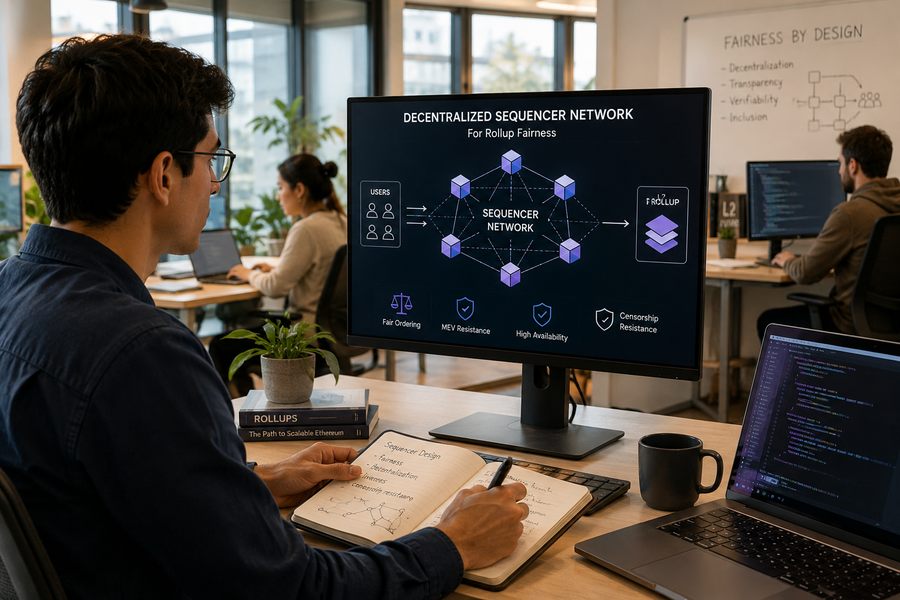
Ethereum’s scaling story has been written largely by rollups. Arbitrum, Optimism, Base, zkSync, and a growing constellation of Layer-2 networks now process the bulk of Ethereum-related transaction activity, settling compressed transaction data back to the base layer at a fraction of mainnet costs. The arithmetic is compelling, the user experience often superior to Layer-1, and the technical architecture genuinely elegant. Yet beneath this success sits an uncomfortable contradiction. The same networks that exist to extend Ethereum’s decentralized properties rely, almost without exception, on a single centralized component to order their transactions.
That component is the sequencer. It receives transactions from users, decides their order, batches them for posting to Ethereum, and effectively holds the keys to which transactions execute, when, and at what state. Most rollups operate exactly one sequencer, run by the foundation or company that built the network. The result is a peculiar inversion of the decentralization promise. Users transact on chains that inherit Ethereum’s security for settlement and data availability, but trust a single operator for the most economically significant decisions affecting their transactions. Recent analysis of rollup economics has highlighted just how concentrated this arrangement has become, with Base alone capturing roughly 70.9% of all rollup profits as of August 2025 and the three largest sequencer-operated rollups together accounting for nearly 90% of total Layer-2 revenue, according to Dune Analytics data.
The risks of this design are no longer theoretical. Centralized sequencers have suffered outages that halted entire networks for hours. They have censored specific addresses following security incidents. They sit on private mempools that allow operators to extract value through transaction reordering in ways that mirror, and sometimes exceed, the maximal extractable value problems that plagued Ethereum’s mining era. They create regulatory pressure points where law enforcement requests can land on a single corporate entity. And they introduce a structural mismatch between the open, permissionless application layer above and the closed, permissioned ordering layer below.
This article examines the architectural responses to that mismatch. Decentralized sequencer networks, in their various forms, represent the next major evolution in rollup design. They aim to distribute the power to order transactions across multiple independent operators, introduce cryptographic guarantees of fairness, and align economic incentives so that no single entity benefits disproportionately from controlling user transaction flow. The approaches differ substantially in their philosophies, tradeoffs, and current production readiness, but they share a common thesis. Rollups cannot fulfill their original promise as trust-minimized scaling solutions while their most powerful component remains a trusted intermediary.
Understanding Sequencers in Layer-2 Rollups
To grasp why sequencer decentralization matters, it helps to first understand what sequencers actually do and why they became centralized in the first place. The role is more consequential than the name suggests. A sequencer is not merely a transaction relay or a load balancer. It is the entity that determines the canonical ordering of every transaction on a rollup, which in turn determines which user gets filled first on a decentralized exchange, which liquidation executes ahead of which deposit, and which arbitrage opportunity is captured before another. In a competitive financial environment, ordering is value, and the sequencer is where ordering happens.
The architectural separation between sequencing and settlement is what makes rollups efficient. By moving transaction execution off the base layer and posting only compressed results back to Ethereum, rollups achieve throughput and cost characteristics that would be impossible on Layer-1 alone. But that same separation creates the opening for a centralized ordering layer to emerge between users and the security guarantees they ultimately rely on. The sequencer becomes a privileged position in a stack that was otherwise designed to be open.
The Role of Sequencers in Transaction Processing
When a user submits a transaction to a rollup, that transaction enters a queue managed by the sequencer rather than broadcasting to a public mempool the way Ethereum mainnet transactions do. The sequencer receives the transaction, performs initial validation, and assigns it a position within an ordered sequence of pending transactions. The sequencer then groups these ordered transactions into batches, executes them against the current rollup state, and produces both a new state commitment and the compressed data needed for Ethereum settlement.
This process produces two distinct confirmations that users experience as a single transaction lifecycle. The first is a soft confirmation, issued by the sequencer almost immediately upon ordering, which tells the user their transaction will appear in a specific position within the next batch. The second is hard finality, which arrives only when the batch has been posted to Ethereum and the relevant fraud-proof challenge windows (for optimistic rollups) or validity proofs (for zero-knowledge rollups) have completed. Users typically rely on soft confirmations for normal application interactions, treating them as effectively final because reversing them would require either the sequencer to retract its commitment or Ethereum itself to reorganize.
The ordering decisions a sequencer makes within a batch carry significant economic weight. Most production sequencers use a first-come, first-served policy based on the timestamp of transaction receipt, but the sequencer has technical capability to deviate from this policy if it chooses. It can prioritize transactions that pay higher tips, insert its own transactions, delay specific transactions to the next batch, or rearrange the order to capture value from predictable on-chain interactions. None of these behaviors are visible to users or auditable after the fact, since the sequencer’s internal mempool is private and the rollup’s public record shows only the final committed ordering. This information asymmetry is a structural feature of the centralized sequencer model, not a bug, and it creates the conditions for value extraction that decentralization efforts aim to eliminate. The asymmetry also extends to bridge operations and force-inclusion mechanisms. Most production rollups provide a backup path through which users can submit transactions directly to Layer-1 if the sequencer fails to include them within a reasonable time, but these backup mechanisms typically involve significant delays and cost overhead that make them impractical for routine use. Users effectively rely on the sequencer to behave reasonably the vast majority of the time, with the backup path serving as a theoretical safeguard rather than a regular fallback.
Why Most Rollups Started Centralized
The centralization of early rollup sequencers was not an ideological choice but a pragmatic one. Building a working rollup in 2021 and 2022 required solving an enormous range of technical problems simultaneously, including fraud-proof systems for optimistic rollups, zero-knowledge proof generation for zk-rollups, bridge security, gas optimization, and developer tooling. Adding distributed consensus among multiple sequencer operators on top of these challenges would have substantially delayed launch timelines and introduced new failure modes during a period when teams were racing to capture market share. A single sequencer operated by the rollup’s founding team was the path of least resistance.
The performance benefits reinforced this decision once rollups were in production. A centralized sequencer can provide near-instant soft confirmations because it does not need to wait for consensus among multiple nodes before committing to an order. It can compress batches more efficiently because it has full visibility into the transaction set. It can optimize execution pipelines without coordinating with peer sequencers. The user experience this enables, often surpassing Ethereum mainnet in both speed and cost, has been a major driver of rollup adoption and has made it difficult for any individual rollup to deprioritize performance in favor of decentralization without losing competitive position.
Economic incentives have further entrenched the centralized model. Sequencer operation generates revenue from transaction fees, and that revenue accrues entirely to the operator under the current arrangement. For a rollup foundation, the sequencer is not just an operational component but a substantial revenue stream that funds ongoing development, ecosystem grants, and operational costs. Decentralizing the sequencer means distributing this revenue across a broader set of participants, which is straightforwardly less profitable for the entities that currently control these networks. The result is a coordination problem familiar from many industries. Each individual rollup faces stronger incentives to maintain centralized operation than to decentralize unilaterally, even if the entire ecosystem would benefit from broader decentralization. The patterns established during this initial centralized phase have shaped both the technical architectures and the economic expectations that decentralization efforts must now navigate.
The Hidden Costs of Centralized Sequencing
The case for decentralizing sequencers rests on concrete harms, not abstract preferences for decentralization as an end in itself. Academic researchers, security analysts, and rollup operators themselves have documented specific failure modes that emerge from single-operator architectures, and the evidence has accumulated steadily since 2023. The costs fall into two broad categories. First, the privileged position of the sequencer enables value extraction at user expense, often invisibly and at scale. Second, the single-operator design creates operational fragility that has produced real network outages, censorship incidents, and regulatory exposure.
Both categories of harm share a common origin. When one entity holds exclusive authority over transaction ordering and inclusion, the integrity of the entire system depends on that entity’s good behavior and continuous operation. Cryptographic guarantees and economic incentives that would normally protect users in a decentralized system become discretionary policies of the operator. The operator may choose to behave well, and most have, but the structural ability to behave badly remains, and that structural ability is itself a cost paid by users who must trust where they should be able to verify.
MEV Extraction and Front-Running Risks
Maximal extractable value, originally documented as miner extractable value on Ethereum mainnet, refers to profit that can be captured by reordering, inserting, or censoring transactions within a block. On Ethereum Layer-1, MEV extraction has become a sophisticated industry built around the public mempool, where searchers compete to identify and exploit profitable opportunities. The economics of MEV on Layer-2 rollups operate differently in important ways, but the underlying problem persists in altered form. A 2024 ACM CCS conference paper titled “Rolling in the Shadows: Analyzing the Extraction of MEV Across Layer-2 Rollups” examined MEV activity across Arbitrum, Optimism, and zkSync over a nearly three-year period and found that MEV is widespread on rollups, with trading volume comparable to Ethereum despite the absence of public mempools.
The mechanics of rollup MEV center on the sequencer’s exclusive visibility. Unlike Ethereum mainnet, where pending transactions broadcast to the public network and anyone can observe them, rollup transactions flow into the sequencer’s private mempool and remain invisible to outside observers until the sequencer commits them in a batch. This visibility asymmetry means traditional sandwich attacks, which require seeing a victim transaction in advance and surrounding it with attacker transactions, are not possible for external searchers on rollups. The sequencer, however, retains complete visibility and complete authority. If a sequencer operator chose to extract value through reordering, that activity would be invisible to users and effectively unauditable after the fact.
The current generation of production rollup operators have publicly committed to first-come, first-served ordering policies and to refraining from operator-side MEV extraction. These commitments are credible to the extent that the operators value their reputation and the long-term health of their networks, and to date no major rollup has been publicly accused of systematic operator-side MEV extraction. But they are policy commitments, not protocol guarantees. The same architecture that enables a benevolent operator to refrain from MEV extraction enables a future operator, or a successor team, or a regulatory authority issuing a binding order, to direct the sequencer to extract value or selectively include transactions. The 2024 research paper’s broader point is that even without operator misbehavior, MEV opportunities are being captured on rollups, often by parties with closer relationships to the sequencer than ordinary users have. Decentralizing the sequencer transforms this from a question of operator trust into a question of cryptographic and economic guarantees that can survive changes in operator behavior.
Censorship and Liveness Vulnerabilities
The operational risks of centralized sequencing have moved from hypothetical concerns to documented incidents over the past several years. On December 15, 2023, Arbitrum One experienced a significant sequencer outage that prevented transaction processing for nearly three hours during a substantial increase in Inscriptions traffic. The root cause analysis from security firm Dedaub identified a chokepoint in the sequencer architecture related to posting transaction data to Layer-1. During the outage, users faced failed transactions and abnormally high gas prices, and applications relying on Arbitrum stalled until the sequencer was restored. This was not the first such incident. A bug in the sequencer also halted Arbitrum in mid-September 2023, and hardware failures have caused similar disruptions in earlier years.
Censorship incidents present a different category of risk that has also moved from theoretical to documented. In June 2024, the zkEVM rollup Linea halted its sequencer and censored attacker addresses following an exploit on a protocol deployed on the network. The decision was defensible from a security perspective and likely prevented further losses, but it demonstrated unambiguously that centralized sequencer operators have both the technical capability and the practical willingness to censor transactions when circumstances warrant. What counts as warranting censorship is a discretionary determination made by the operator, and the discretion exists by design. Once that capability has been exercised once, the framing shifts from whether censorship is possible to when and under what conditions it will occur again.
These incidents illustrate a deeper architectural concern. Centralized sequencers create regulatory pressure points that did not exist when transaction ordering was distributed across decentralized validator sets. Government agencies, court orders, and sanctions regimes can address themselves to a single corporate entity operating a sequencer, and that entity faces the choice between compliance and the legal consequences of refusal. The choice is not necessarily unreasonable for the operator to make, but it concentrates censorship authority in ways that contradict the design goals of permissionless networks. Decentralized sequencer architectures spread this authority across many independent operators in different jurisdictions, raising both the technical and political cost of meaningful censorship. The harms documented in this section are not the result of bad actors operating sequencers. They are structural consequences of the centralized design that emerge under predictable operational stresses, security incidents, and external pressures, which means addressing them requires architectural changes rather than better policies.
Architectural Approaches to Decentralized Sequencing
Three distinct architectural paradigms have emerged for decentralizing rollup sequencers, each making different tradeoffs between performance, security, decentralization, and alignment with the underlying Ethereum network. The first approach builds a separate decentralized network that multiple rollups can share, outsourcing sequencing to a purpose-built consensus protocol that operates independently of any single rollup. The second approach keeps sequencing native to each rollup but operates it through a decentralized pool of validators, typically using proof-of-stake economics to coordinate multiple sequencer nodes within the rollup’s own network. The third approach eliminates the dedicated sequencer entirely, relying on Ethereum’s own Layer-1 validator set to sequence rollup transactions as part of normal Ethereum block production.
These paradigms are not mutually exclusive in principle, and individual rollups can incorporate elements from multiple approaches as the technology matures. But they reflect genuinely different visions of what rollup decentralization should look like. Shared sequencer networks emphasize interoperability and economies of scale across the rollup ecosystem. Native sequencer pools emphasize sovereignty and per-chain customization. Based rollups emphasize maximum alignment with Ethereum’s security and economic properties. Each approach has produced working implementations with documented deployments between 2024 and 2025, allowing for direct comparison of how the theoretical tradeoffs play out in practice.
The case studies that follow examine one production implementation of each paradigm. Together they trace the active design space for sequencer decentralization at the time of writing and illustrate both the progress made and the open challenges that remain.
Shared Sequencer Networks
Shared sequencer networks decouple sequencing from execution entirely, providing a single decentralized network that orders transactions on behalf of many rollups simultaneously. The architectural insight is that ordering is largely independent of execution logic. A consensus protocol that produces an agreed-upon transaction order does not need to understand what those transactions do, which means the same sequencing infrastructure can serve rollups with different virtual machines, different proof systems, and different application focuses. Rollups gain decentralized sequencing without each having to build and maintain their own consensus protocol, and the shared network gains scale efficiencies that no single rollup could achieve alone. The model also opens the possibility of cross-rollup atomic execution, where a single sequencing decision can coordinate state changes across multiple integrated chains, unlocking application patterns that are difficult or impossible when each rollup operates in isolation.
Espresso Systems has developed one of the most prominent implementations of this model. The company, founded in 2022 and backed by a $60 million funding total from investors including a16z Crypto and Greylock Partners, launched its initial mainnet deployment in November 2024 under the name Mainnet 0. This release ran a permissioned set of node operators running the HotShot consensus protocol, a Byzantine fault tolerant protocol purpose-built for rollup sequencing that achieves confirmation times measured in seconds rather than minutes. The Mainnet 0 phase deliberately operated with a curated operator set selected for geographic diversity and technical capability, allowing Espresso to refine network processes before opening participation to a broader pool. The phased approach reflects a recognition that production infrastructure serving multiple rollups needs operational maturity before it can responsibly accept permissionless participation, particularly when failure modes affect the user-facing experience on every integrated chain simultaneously.
Espresso’s Mainnet 1 release in April 2025 transitioned the network toward permissionless participation through a delegated proof-of-stake model, scaling toward thousands of nodes and introducing standardized integration tooling for Arbitrum Orbit chains. The architecture pairs HotShot consensus with a data availability solution called Tiramisu, which aggregates data across multiple integrated chains. Beyond decentralizing sequencing, the network has been positioned as a confirmation layer that integrated chains can use to provide faster, more reliable confirmations of their own state and the states of other chains in the ecosystem, enabling cross-rollup composability that is difficult to achieve with isolated centralized sequencers. The economic model leverages Ethereum’s existing validator set through restaking contracts, aligning shared sequencer security with Ethereum’s underlying security and routing some economic value back to Layer-1 validators rather than capturing it entirely within the sequencer network itself.
The trajectory of the shared sequencer category also includes cautionary signals worth noting. Astria, which launched its mainnet alpha in October 2024 as the self-described “first decentralized shared sequencing layer,” announced in December 2025 that it was sunsetting its shared sequencer network after raising approximately $18 million in funding. The shutdown reflected challenges in achieving sufficient rollup adoption to sustain the network, illustrating that technical viability does not automatically translate into ecosystem traction. The shared sequencer model remains an active area of development, but the adoption curve has proven more gradual than early projections suggested, with integration friction, operator economics, and rollup sovereignty concerns all influencing how quickly the model spreads. The success of any shared sequencer network ultimately depends on convincing rollup teams that the cross-chain composability benefits outweigh the loss of sovereignty that comes from outsourcing such a critical component to external infrastructure.
Native Decentralized Sequencer Pools
Native decentralized sequencer pools take a different path. Rather than outsourcing sequencing to a separate network, this approach keeps sequencing internal to each rollup while distributing the operator role across multiple independent nodes using proof-of-stake mechanics, threshold signatures, and on-chain governance. The result is a rollup that maintains complete sovereignty over its sequencer set while eliminating the single-operator risks of the centralized model. Each sequencer node stakes the rollup’s native token, takes turns producing blocks through a leader election protocol, and faces slashing penalties for misbehavior. Transaction batches are signed using threshold signature schemes that require participation from multiple operators, removing any single node’s ability to act unilaterally. The cryptographic structure of threshold signatures means that a Layer-1 verification contract can validate batch signatures as efficiently as if they came from a single signer, preserving the gas efficiency that makes rollup settlement practical while distributing the underlying signing authority across many operators.
Metis has positioned itself as a leading implementation of this approach. As an Ethereum optimistic rollup that has been operating in production since 2021, Metis began community testing of its proof-of-stake sequencer pool on January 3, 2024, deploying the first phase of testing on the Holesky testnet. The testing program ran across two seasons designed to stress-test the sequencer pool under realistic load while allowing community members to earn rewards for participation and bug reporting. The architecture pairs Metis sequencer nodes, which handle the L2Geth execution layer, OP-node operations, batch submission, and multi-party computation signing, with separate proof-of-stake consensus nodes responsible for managing signature permissions across the sequencer set. The dual-node architecture allows the consensus and execution responsibilities to be cleanly separated, enabling specialized optimizations for each role without forcing operators to handle both responsibilities on the same infrastructure.
The economic design of the Metis sequencer pool supports liquid staking integration through a model where qualified liquid staking platforms can apply for allocation to a decentralized sequencer node, opening up to 100,000 METIS tokens of staking capacity per node. For the first twelve months following launch, a 20% Mining Rewards Rate applies to all sequencer nodes as an incentive for early participation. This structure aims to broaden access to sequencer participation beyond entities with the capital to run a node directly, allowing ordinary token holders to earn sequencer revenue through liquid staking arrangements. Governance over sequencer node allocation runs through Metis community proposals, distributing decisions about network participation across token holders rather than concentrating them with the founding team. The combination of liquid staking access, governance-driven node allocation, and explicit fee sharing creates an economic model where sequencer revenue flows back to token holders broadly rather than accruing exclusively to the foundation, addressing the revenue concentration concerns that decentralization advocates have raised about centralized sequencer designs.
The native sequencer pool model offers rollups precise control over their sequencer economics and security parameters, but it requires each rollup to solve the consensus and operator coordination problems independently. Threshold signature schemes, leader election protocols, slashing mechanisms, and governance structures all need to be designed, implemented, and maintained by the rollup team. The benefit is sovereignty and customization, with each rollup able to tune its sequencer pool to match its specific risk tolerance and economic model. The cost is engineering complexity that does not scale across rollups, since each new rollup adopting this approach must repeat much of the foundational work rather than benefiting from a shared infrastructure layer.
Based Sequencing via Layer-1 Validators
Based rollups, a term coined by Ethereum researcher Justin Drake, take the most radical position on sequencer decentralization. Rather than building any dedicated sequencer infrastructure, whether shared across rollups or native to a single chain, based rollups delegate sequencing entirely to Ethereum’s Layer-1 validator set. Any Ethereum validator can propose blocks for a based rollup as part of normal Ethereum block production, with rollup transactions included directly in Layer-1 blocks. The model eliminates the need for a separate consensus protocol, additional validator sets, or new economic security assumptions. The rollup inherits Ethereum’s decentralization, censorship resistance, and economic security directly, with maximal extractable value flowing back to Ethereum validators rather than being captured by a separate sequencer entity. This alignment addresses a structural concern about modern rollups, which is that the economic value of activity occurring on Layer-2 has been captured by rollup foundations rather than by the Ethereum validators whose work secures the underlying settlement layer.
Taiko has emerged as the leading production implementation of based sequencing on Ethereum. As a Type-1 Ethereum-equivalent zero-knowledge rollup, Taiko maintains full EVM compatibility while relying on Ethereum validators for transaction ordering. The architecture allows anyone to propose Layer-2 blocks, which then compete for inclusion within Layer-1 blocks, creating a permissionless block production environment that mirrors Ethereum’s own. The trade-off is latency and the need for compensating mechanisms to provide the fast confirmation experience users expect from modern Layer-2s. Taiko has addressed this through preconfirmation systems that allow Layer-1 validators to provide near-instant transaction confirmations through economic commitments backed by slashing collateral. Preconfirmers register through a registry contract by staking collateral, with native based sequencing serving as a fallback option if a preconfirmer attempts to censor transactions, which preserves the censorship-resistance properties that make based rollups attractive in the first place.
The ecosystem around based sequencing has matured substantially through 2025. Taiko’s April 2025 collaboration with the Fabric and Commit-Boost teams aimed to standardize preconfirmation protocols across the Ethereum validator set, with Commit-Boost serving as a validator sidecar that simplifies how Ethereum L1 validators opt into preconfirmation protocols. The second Based Rollup Summit, hosted at EthCC 2025 in Cannes, brought together participants from the Ethereum Foundation, Celo, SSV Network, Boundless, and other ecosystem projects to discuss based rollup technology and preconfirmations. OpenZeppelin’s security partnership with Taiko, which began in early 2025 and identified 113 issues across three audits according to documentation published in early 2026, illustrates the substantial security review required when deploying novel architectural patterns at production scale. The pioneering nature of based sequencing means that established audit patterns and security frameworks did not exist for many of the mechanisms Taiko deployed, requiring custom research and review processes that have themselves contributed to the broader Ethereum research community’s understanding of the space.
Taken together, these three architectural approaches represent the active landscape of sequencer decentralization in production today. Shared sequencer networks offer interoperability and shared infrastructure but face adoption challenges that have produced both successes and shutdowns. Native sequencer pools offer sovereignty and customization at the cost of engineering complexity that each rollup must absorb independently. Based rollups offer maximum Ethereum alignment but require sophisticated supporting infrastructure like preconfirmations to deliver competitive user experience. The right architecture for any particular rollup depends on its priorities, its existing technical commitments, and its read on which decentralization tradeoffs matter most to its users and applications. Hybrid approaches that combine elements from multiple paradigms are increasingly common, with some rollups operating native sequencer pools while also offering optional integration with shared sequencer networks for applications that benefit from cross-rollup composability.
Mechanisms for Fair Transaction Ordering
Decentralizing the sequencer set is necessary for rollup fairness but not sufficient. Distributing transaction ordering authority across many operators eliminates the single-operator risks discussed earlier, but it does not by itself prevent the new sequencer set from extracting value through coordinated or individual misbehavior. A decentralized pool of self-interested operators can engage in MEV extraction just as a centralized operator can, and arguably with more sophistication if the pool includes professional searchers and builders alongside neutral validators. Achieving genuine transaction ordering fairness requires deliberate protocol design that constrains how any operator, decentralized or otherwise, can order transactions. This is a separate problem from operator decentralization and demands its own solutions.
The academic literature on fair ordering has produced several distinct protocol families, each making different tradeoffs between fairness strength, communication complexity, and liveness guarantees. Time-based ordering protocols attempt to order transactions according to when they were received by the network, on the theory that the first transaction to arrive deserves to execute first. Aequitas, an early protocol in this family, achieves a property called Byzantine ordering fairness by ensuring that transaction order reflects the views of honest network participants. The protocol’s limitations, including high communication complexity and weak liveness guarantees that can delay finality during periods of conflicting transaction orders called Condorcet cycles, prompted the development of Themis, which optimizes fairness through techniques like batch unspooling and cryptographic proofs while maintaining strong fairness guarantees. A 2025 research paper in Cointelegraph’s research section examined the impossibility of perfect fairness in transaction ordering, demonstrating that no protocol can simultaneously achieve all desirable fairness properties under all conditions, which means real-world implementations must accept specific tradeoffs.
Cryptographic approaches take a fundamentally different angle. Rather than trying to determine the correct order through consensus over receipt times, encryption-based protocols hide transaction contents from the sequencer until ordering has been finalized. Threshold encryption schemes allow users to submit transactions encrypted under a public key whose corresponding private key is distributed across the sequencer set. The sequencer orders transactions while they remain encrypted and therefore opaque, then a threshold of sequencers cooperates to decrypt the transactions only after the order has been committed. Timelock encryption achieves a similar goal through time-based cryptographic puzzles that prevent decryption until a specific time has passed, regardless of sequencer cooperation. Both approaches eliminate the information asymmetry that makes MEV extraction possible, since the sequencer cannot strategically order transactions whose contents it cannot see.
Proposer-builder separation, a concept that originated in Ethereum’s own block production research, has been adapted to rollup sequencing in several decentralized sequencer architectures. The model separates the role of proposing what transactions are included in a block from the role of building the actual transaction sequence within the block. Builders compete to construct profitable transaction sequences, then bid for inclusion through proposers who maintain neutrality on ordering. This separation prevents any single entity from holding both the visibility and the authority required for MEV extraction, distributing the economic and informational power across multiple specialized participants. Astria’s architecture incorporated proposer-builder separation from inception, and the model influences how shared sequencer networks like Espresso are evolving their design.
Encrypted mempools represent a related approach that addresses the visibility asymmetry without requiring full transaction encryption. In these designs, transactions are submitted to the sequencer through privacy-preserving channels that prevent the sequencer from selectively delaying or reordering specific transactions, even if the contents are eventually visible. Combined with commit-reveal schemes, where users commit to transaction parameters before revealing them, encrypted mempools can substantially reduce the surface area for sequencer-side MEV extraction while preserving the performance characteristics that make rollups practical for everyday use. Radius has pioneered practical implementations of these approaches using practical verifiable delayed encryption.
The honest assessment of fair ordering research is that no single mechanism has emerged as a clear winner, and meaningful tradeoffs persist across all approaches. Time-based protocols offer intuitive fairness but suffer from communication complexity that limits scale. Encryption-based approaches eliminate sequencer information advantages but introduce key management complexity and latency. Proposer-builder separation distributes power effectively but requires sophisticated market design to function competitively. Production sequencer networks are likely to combine multiple mechanisms rather than relying on any single technique, with the specific combinations varying based on each network’s threat model and performance requirements. What unifies these approaches is the recognition that fair ordering cannot be assumed from decentralization alone. It must be engineered into the protocol with the same rigor applied to consensus and settlement.
Benefits and Challenges by Stakeholder
The implications of sequencer decentralization differ substantially across the participants in the rollup ecosystem. What looks like an unambiguous improvement from one perspective may represent a significant cost from another, and the politics of decentralization within any specific rollup community often reflects these divergent interests. A complete picture requires examining how the shift affects end users, rollup operators, application developers, and the broader Ethereum ecosystem, while acknowledging the tensions and tradeoffs that remain unresolved.
End users stand to gain the most from successful sequencer decentralization, though the gains arrive unevenly and sometimes with offsetting costs. The most direct benefit is improved censorship resistance. A decentralized sequencer set, particularly one that includes operators across multiple jurisdictions, raises the cost of meaningful transaction censorship from a single legal action against a single operator to a coordinated effort that must compel a substantial fraction of an independent operator pool. For users in jurisdictions with restrictive regulatory environments, for users transacting in legally ambiguous ways, and for users who simply value the ability to transact without permission, this represents a meaningful expansion of practical autonomy. Reduced MEV exposure offers a second user-facing benefit, though the magnitude depends heavily on which fair ordering mechanisms accompany the architectural decentralization. A decentralized sequencer set without fair ordering protocols can still extract value collectively, just as a centralized operator could. Reliability gains complete the picture of user-facing improvements. Networks that distribute sequencing across multiple operators eliminate the single-point-of-failure risk that produced documented outages on major rollups in recent years, since the failure of any individual operator can be absorbed by the remaining set without halting the network. The costs to users include potentially higher latency, since consensus among multiple sequencers takes longer than a single operator’s local decision, and potentially higher transaction fees, since decentralized operation generally costs more than centralized operation and those costs must be recovered somewhere. Users also face a more complex mental model for understanding network status, since the binary up-or-down framing of centralized operation gives way to questions about which operators are participating, what their stake levels are, and how the network is performing under various load conditions.
Rollup operators face the most complex tradeoffs in the transition to decentralized sequencing. The most significant cost is direct revenue loss. Sequencer fees that currently accrue entirely to the rollup foundation must be distributed across the sequencer set under any decentralized model, reducing the foundation’s operational budget and altering the economics that have funded ecosystem development to date. For rollups that have built business models around sequencer revenue, this transition represents a fundamental restructuring rather than a marginal adjustment. The engineering investment required to deploy and maintain a decentralized sequencer architecture also represents a significant ongoing cost, particularly for native sequencer pool designs that require each rollup to build and maintain its own consensus protocol, leader election system, and slashing infrastructure. The benefits to operators include improved credible neutrality, which becomes increasingly important as regulatory scrutiny intensifies and as competing rollups make their own decentralization commitments. A rollup that has decentralized its sequencer can credibly claim to have addressed the structural centralization concerns that critics have raised since the early days of Layer-2 development, which strengthens its position in conversations with institutional users, integrators, and the broader ecosystem. Decentralization also reduces operational liability concerns for the founding team and corporate entity behind a rollup, since the architectural ability to censor or extract value from transactions is no longer concentrated in their hands. This shift can matter substantially when rollups attract regulatory attention or when foundations seek to position themselves as infrastructure providers rather than active operators of the networks they helped create.
Application developers experience the change as a mix of new opportunities and new integration work. The opportunities center on improved composability between rollups when shared sequencer networks reach sufficient adoption. Applications that need to coordinate state across multiple chains, including decentralized exchanges aggregating liquidity, lending protocols managing collateral across networks, and cross-chain payment systems, gain access to atomic execution guarantees that are difficult or impossible to achieve with centralized sequencers operating independently. The costs include adapting to new latency characteristics, integrating with new infrastructure providers, and navigating the uncertainty of which sequencer architectures will achieve durable adoption versus which will follow Astria’s path toward sunset. For applications that depend on consistent, ultra-low-latency sequencer behavior, the transition period may require careful technical and product accommodation.
The Ethereum Layer-1 ecosystem stands to benefit substantially from certain decentralized sequencer architectures, particularly those that route economic value back to Ethereum validators. Based rollups, by definition, send MEV and sequencing revenue to Ethereum validators rather than to a separate sequencer entity, which strengthens Ethereum’s economic security and aligns Layer-2 success with Layer-1 incentives. Shared sequencer networks that integrate with EigenLayer restaking or similar mechanisms can similarly route value back to Ethereum validators while preserving the operational separation between sequencing and Layer-1 consensus. This economic alignment addresses a concern that has emerged as rollups have captured increasing share of Ethereum-related transaction activity. If the economic value of that activity accrues to rollup foundations rather than Ethereum validators, the long-term security budget supporting Ethereum itself could be undermined. Sequencer decentralization that routes value back to Layer-1 helps preserve the alignment that makes the overall stack sustainable.
Regulatory implications run across all stakeholder groups and remain among the most uncertain aspects of the transition. Decentralized sequencer networks present a different regulatory profile than centralized sequencers, with no single entity to designate as a regulated intermediary and no single chokepoint where compliance requirements can be imposed. This is simultaneously the strongest argument for decentralization from a censorship-resistance perspective and the strongest source of regulatory concern, since governments have historically responded to the loss of central control points by either targeting the protocol level itself or expanding the definition of regulated intermediaries to include node operators, software developers, or other distributed participants. How this plays out will shape which decentralization architectures prove viable in jurisdictions with substantial rollup activity, and the answer is unlikely to be uniform across all jurisdictions.
The open question that cuts across all stakeholder groups is whether decentralized sequencing can match the performance of centralized sequencing at scale. Current production deployments suggest that the answer is increasingly yes, with confirmation times measured in seconds rather than minutes and integration tooling that allows new rollups to adopt decentralized sequencing without rebuilding their entire stack. But sustained performance under high load, across many integrated rollups, and through adversarial conditions remains to be proven through extended production operation. The history of distributed systems suggests that achieving production-grade performance often requires more iteration than initial deployments demonstrate, and the transition to decentralized sequencing will likely include performance regressions and recovery cycles that the centralized status quo did not require participants to navigate.
Final Thoughts
Decentralized sequencer networks represent the maturation point at which Layer-2 rollups become what they were always claimed to be. The early generation of rollups proved that off-chain execution paired with on-chain settlement could deliver dramatic improvements in throughput and cost. The current generation, working through the architectures and tradeoffs examined throughout this article, is proving that this scaling can occur without surrendering the trust-minimization properties that made the underlying blockchain valuable in the first place. The transition is not yet complete, and the pace of change varies substantially across rollups based on their priorities, business models, and engineering capacity, but the direction is now sufficiently clear that the question has shifted from whether sequencer decentralization will happen to which architectures will prove most durable in practice.
The financial implications extend well beyond the technical architecture. Centralized sequencers currently concentrate substantial revenue in the foundations operating them, with Base alone capturing the majority of total rollup profits according to recent analysis. Decentralizing this revenue, whether through shared sequencer participation, native sequencer pools open to broader staking, or based rollup designs that route value to Ethereum validators, represents a meaningful redistribution of economic value from foundations to validators, stakers, and end users. This is the often-overlooked accessibility dimension of sequencer decentralization. The same individuals and institutions who currently rely on rollup networks as users will have new opportunities to participate as economic stakeholders in the infrastructure that serves them, transforming what has been a closed revenue stream into a participatory economic layer.
The intersection of technology and social responsibility comes into sharp focus around the censorship dimension. Centralized sequencers create concentrated points where legitimate law enforcement actions, geopolitical pressure, and overreach all pass through the same architectural chokepoint with no protocol-level distinction between them. Decentralized sequencer architectures cannot eliminate this tension, but they can substantially shift how it resolves by raising the cost of meaningful censorship and by distributing the decision authority across operators in diverse jurisdictions. The result is not freedom from regulation but rather a different regulatory equilibrium, one in which compliance happens through transparent protocol mechanisms rather than through opaque operator discretion. Reasonable people can disagree about whether this shift is desirable in all cases, but the architectural option to make it represents a genuine expansion of the design space available to rollup builders and the communities they serve.
The forward perspective on sequencer decentralization sees a quiet normalization rather than a dramatic transformation. The decentralized sequencer architectures that will succeed are likely to do so by dissolving into the infrastructure layer in ways that ordinary users never notice, much as Ethereum’s own validator decentralization is not something most users think about during day-to-day transactions. The user-facing experience will remain fast confirmations, low fees, and reliable application performance. What changes is the foundation underneath, where transaction ordering becomes a function of distributed protocol rather than centralized discretion, where MEV extraction faces structural rather than reputational constraints, and where the economic value of Layer-2 activity flows through participatory mechanisms rather than corporate revenue lines. This is the maturation pattern that successful infrastructure follows. The dramatic phase makes the news, the normalization phase makes the impact, and the lasting innovation is the one that becomes assumed rather than the one that remains exceptional.
FAQs
- What exactly is a sequencer in a Layer-2 rollup?
A sequencer is the component of a rollup that receives user transactions, decides their order, batches them together, and posts the compressed batch data to Ethereum for settlement. Most current rollups operate a single centralized sequencer run by the rollup’s founding team, which gives that operator significant control over which transactions execute first and what value can be extracted from ordering decisions. - How does a shared sequencer differ from a rollup’s own decentralized sequencer pool?
A shared sequencer is a separate network that provides sequencing services to multiple rollups simultaneously, allowing them to share infrastructure and gain cross-rollup composability benefits. A native decentralized sequencer pool is internal to a single rollup, with the rollup operating its own distributed set of sequencer nodes. Espresso Systems operates a shared sequencer network, while Metis has built a native sequencer pool specific to the Metis rollup. - How does MEV extraction work on Layer-2 rollups?
On rollups, MEV extraction typically occurs through the sequencer’s exclusive visibility into pending transactions. Because rollups lack public mempools, only the sequencer can see transactions before they are committed to a batch, which means the sequencer has the unique ability to reorder, insert, or delay transactions for profit. External searchers can still extract some forms of MEV on rollups, but the structural advantage belongs to whoever controls the sequencer. - Are all Layer-2 rollups planning to decentralize their sequencers?
Most major rollups have publicly committed to decentralizing their sequencers as part of their long-term roadmaps, though timelines and approaches vary significantly. Arbitrum, Optimism, and zkSync have published plans for sequencer decentralization, while Metis and Taiko have already deployed decentralized sequencing in production. The pace of actual decentralization depends on each rollup’s technical priorities, business model, and engineering resources. - What are based rollups and how do they handle sequencing?
Based rollups are Layer-2 networks that delegate transaction sequencing entirely to Ethereum’s Layer-1 validator set rather than operating any separate sequencer infrastructure. Any Ethereum validator can propose blocks for a based rollup as part of normal Layer-1 block production. Taiko is the leading production implementation of this approach, using preconfirmation systems to provide fast user-facing confirmations despite relying on Ethereum’s slower base-layer block times. - How can I verify a rollup’s actual decentralization status?
Independent monitoring sites like L2Beat track rollup decentralization across multiple dimensions including sequencer architecture, fraud-proof systems, validator sets, and force-exit mechanisms. These resources provide standardized comparisons that go beyond marketing claims, showing whether a rollup operates a single sequencer or a distributed set and whether users can bypass the sequencer if it goes down or censors transactions. - What happens when a centralized sequencer goes down?
When a centralized sequencer experiences an outage, transaction processing on the affected rollup typically halts entirely until the operator restores service. Users may be able to submit transactions directly to Ethereum Layer-1 as a backup mechanism, but this bypasses the cost and speed advantages that make rollups practical. Arbitrum’s December 15, 2023 outage caused nearly three hours of downtime during which users faced failed transactions and elevated gas prices. - Will decentralizing sequencers increase rollup transaction fees?
Decentralized sequencing generally costs more to operate than centralized sequencing because consensus among multiple nodes requires more computation and communication than a single operator’s local decisions. Some of this cost increase may flow through to users in the form of higher fees, though the magnitude depends on how efficiently each decentralized architecture operates and how aggressively rollups compete on price. The tradeoff is reduced extraction by sequencer operators, which can offset nominal fee increases for users. - What role does restaking play in shared sequencer networks?
Restaking mechanisms like EigenLayer allow Ethereum validators to use their staked ETH as economic security for additional networks, including shared sequencer networks. Espresso Systems’ architecture has been designed to leverage Ethereum’s validator set through restaking contracts, aligning sequencer security with Ethereum’s underlying security and routing some economic value back to Layer-1 validators rather than capturing it entirely at the sequencer layer. - How should I evaluate decentralization claims made by Layer-2 projects?
Look for specific architectural commitments rather than general marketing language about decentralization. Key questions include how many independent operators run sequencers, what consensus mechanism coordinates them, what economic incentives align operator behavior with user interests, and what fair-ordering protections exist beyond simple distribution of the operator set. Independent assessments from sources like L2Beat and academic security reviews provide more reliable signals than project self-reporting.