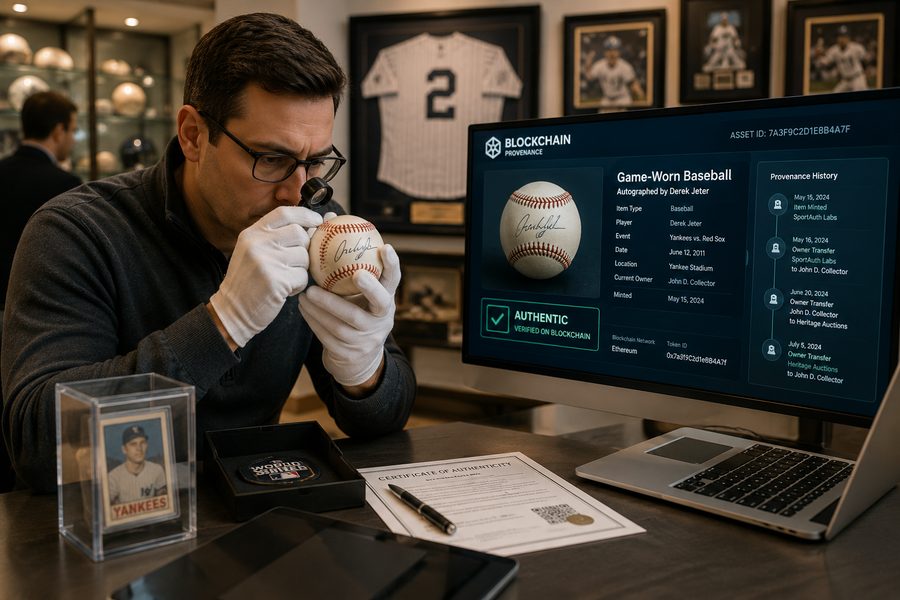
A baseball signed by a legendary player, a jersey worn during a championship game, a rookie card pulled from a pack decades ago, these objects can each be worth small fortunes, and their value rests almost entirely on a single fragile assumption, that they are genuine. A signature is just ink on leather, a game-worn jersey looks much like any other jersey, and the difference between an authentic artifact worth tens of thousands of dollars and a convincing fake worth nothing often comes down to a piece of paper, a hologram sticker, or the word of a single expert. This fragility has made sports memorabilia one of the most fraud-ridden corners of the collectibles world, a market where, by some law enforcement estimates, a large share of the items in circulation are counterfeit, and where buyers have lost enormous sums to convincing forgeries they could not detect.
The traditional defenses against this fraud have always carried a fundamental weakness. Certificates of authenticity can be forged as easily as the items they vouch for, holograms can be copied or transferred, and the centralized databases that record an item’s authentication can be altered, lost, or corrupted by the very people entrusted to maintain them. Even the most respected authentication services depend ultimately on trust in a single organization and its records, and history has shown repeatedly that such trust can be misplaced or betrayed. The collector is left in an uncomfortable position, asked to stake thousands of dollars on documentation that is itself no harder to fake than the memorabilia, and on the integrity of records they cannot independently verify.
Blockchain technology offers a different approach to this old problem. By recording an item’s identity and history on a distributed ledger that no single party controls and that cannot be secretly altered, blockchain promises to create provenance records that are genuinely tamper-resistant, permanently accessible, and independently verifiable by anyone. Rather than trusting a company’s private database, a collector could trust mathematics and a transparent public record that no single party has the power to quietly rewrite in its own favor. This article explains how blockchain-based authentication works, why the memorabilia market needs it, and what real companies have built so far. It examines the genuine benefits for collectors, athletes, and the broader industry, while being honest about the serious limitations and the central challenge of connecting a physical object to a digital record. The aim is to give a reader with no technical background a clear and balanced understanding of a technology that could reshape how trust works in collectibles.
The Persistent Problem of Memorabilia Fraud
To understand why blockchain authentication has attracted serious interest, one must first appreciate just how deep and persistent the problem of memorabilia fraud has been. The sports collectibles market is large and growing, with the broader memorabilia market estimated to generate revenues well in excess of five billion dollars annually, and within it the trade in autographed items and game-used artifacts commands premium prices precisely because of their claimed authenticity and rarity. This combination of high value and difficulty of verification creates an almost irresistible incentive for fraud, because a counterfeiter who can produce a convincing forgery stands to capture the full value of a genuine item at a tiny fraction of the cost, and the buyer often has no reliable way to tell the difference at the moment of purchase.
The scale of the resulting fraud has been documented by law enforcement in ways that are genuinely alarming. The most famous investigation, the FBI’s Operation Bullpen, ran from the late 1990s into the mid 2000s and uncovered a sprawling industry of forged autographs and fake memorabilia, ultimately documenting roughly one hundred million dollars in fraud and leading to numerous convictions and exposing the industrial scale on which forgeries were being manufactured and distributed. During and around that investigation, the FBI offered estimates suggesting that a startlingly high proportion of the autographed memorabilia in circulation was counterfeit, with figures ranging from roughly half of items in the general market to as much as seventy-five or eighty percent of items sold through certain online channels. More recent assessments have continued to place annual losses to such fraud in the hundreds of millions of dollars, affecting thousands of collectors who believed they were buying the real thing. Whatever the precise figures, the consistent message from those who have investigated the market is that fakery is pervasive rather than occasional.
The economics of the fraud help explain why it has proven so difficult to stamp out. A skilled forger can produce a counterfeit autograph in seconds at essentially no cost, and if that forgery passes for a signature worth thousands of dollars, the return on the effort is extraordinary, far higher than almost any legitimate enterprise could offer. Counterfeiters can also operate at scale, flooding the market with fakes that are individually plausible and collectively overwhelming, and they exploit the emotional nature of the purchases, since fans buying a memento of a beloved player are often motivated by sentiment and may not scrutinize an item as carefully as a purely financial buyer would. The most damaging frauds combine forged items with forged documentation, so that the fake comes complete with a convincing certificate of authenticity and a hologram, presenting the buyer with a package that appears fully legitimate. Because detecting a skilled forgery often requires specialized expertise that ordinary collectors lack, the burden of verification falls on a market that is poorly equipped to bear it, and the result is an environment in which even cautious buyers can be deceived and in which the mere suspicion of fakery depresses confidence and value across the board, harming honest sellers along with their customers.
The reasons traditional authentication has failed to solve this problem are instructive, because they reveal exactly what a better system would need to provide. The dominant method has long been the certificate of authenticity, a document issued by an authenticator attesting that an item is genuine, often accompanied by a tamper-evident hologram bearing a serial number that can be checked against the authenticator’s database. The trouble is that every link in this chain is itself vulnerable. Certificates of authenticity are paper documents that forgers reproduce with ease, holograms can be counterfeited or peeled from genuine items and applied to fakes, and the serial numbers depend on a centralized database controlled by a single company. If that company makes errors, goes out of business, suffers a data breach, or contains a dishonest insider, the records it maintains can be wrong, lost, or manipulated, and the collector relying on them has no independent way to know.
Beyond these technical vulnerabilities lies a deeper structural problem, which is that the entire system rests on trusting a small number of authentication authorities whose judgments cannot easily be questioned or verified. When an expert declares a signature genuine, the market largely takes that declaration on faith, yet experts can be mistaken, can disagree with one another, and in rare cases can be corrupted. The provenance of an item, meaning its documented history of ownership and the chain of custody establishing where it came from, is often incomplete, recorded inconsistently across different parties, or simply asserted without verifiable evidence. A jersey said to have been worn in a particular game may have no unbroken, trustworthy record connecting it to that game, leaving its value resting on claims that cannot be independently confirmed. This combination of forgeable documentation, alterable centralized records, and unverifiable provenance is the precise gap that blockchain technology aims to close, and understanding the depth of the problem makes clear why a fundamentally different approach to recording authenticity and history has drawn such attention.
How Blockchain Creates Unforgeable Provenance
Blockchain addresses the memorabilia problem by providing something the old system never could, a record of an item’s identity and history that is maintained collectively rather than by any single party and that cannot be secretly altered after the fact. A blockchain is, at its simplest, a shared digital ledger distributed across many computers, where entries are grouped into blocks and linked together cryptographically so that each block depends on the one before it. This linkage means that altering any past entry would require changing every subsequent block across the entire distributed network simultaneously, which is practically impossible on a well-designed blockchain. The result is a record that is effectively permanent and tamper-resistant, and crucially one that anyone can inspect, so that trust shifts from a private company’s word to a transparent and mathematically secured public history.
Applying this capability to physical memorabilia requires solving two distinct challenges, and the two subsections that follow address each in turn. The first challenge is binding a specific physical object to a specific digital record, so that the authenticity of the ledger entry actually corresponds to the authenticity of the item a collector holds in their hands. The second challenge is recording the item’s complete history, from its creation and initial authentication through every subsequent change of ownership, in a way that produces an unbroken and trustworthy chain of custody. Together these two capabilities, a reliable link between object and record and an immutable history of that record, constitute what blockchain authentication aims to provide, and each is essential, because a perfect digital history is worthless if it cannot be tied to the real object, and a perfectly tied record is worthless if its history can be faked.
Linking Physical Items to Digital Records
The foundation of any physical authentication system is the mechanism that connects an individual object to its unique entry on the blockchain, and several technologies have emerged to forge this link. The most basic approach uses a unique identifier physically attached to or embedded in the item, such as a tamper-evident tag carrying a serial number, a QR code, or a more sophisticated chip. When the identifier is scanned, it points to a specific record on the blockchain that describes the item and its history, allowing anyone to look up the authenticated provenance of the object in their possession. The security of this link depends heavily on how difficult the physical identifier is to copy or transfer, which is why simple printed codes, while convenient, offer weaker protection than tags designed to resist tampering and duplication.
More advanced implementations use near-field communication chips, the same technology behind contactless payments, embedded into or affixed to the item in a way that is difficult to remove or replicate without evidence of tampering. These chips can carry cryptographic credentials that prove their authenticity when scanned with a smartphone, making them far harder to counterfeit than a printed code, and they can be designed so that any attempt to detach and reapply them is detectable. Some approaches go further still, recording the unique physical characteristics of an item itself, such as the microscopic patterns in a material or the specific details of a signature, creating a kind of fingerprint that ties the digital record to the object’s intrinsic properties rather than to an attached tag that could in principle be moved. The trend across these methods is toward binding the digital record ever more tightly to features that cannot be transferred to a different object.
The concept that ties these approaches together is often called the digital twin, a digital representation on the blockchain that corresponds to and is paired with a specific physical item. The digital twin holds the item’s authenticated identity and history, while the physical link, whether a chip, a code, or a fingerprint, ensures that only the genuine object can claim that twin. When the pairing is strong, a collector can scan their item, retrieve its digital twin, and verify against the immutable ledger that the object is the authentic one described in the record, complete with its documented provenance. The robustness of this pairing is the single most important determinant of how trustworthy a blockchain authentication system actually is, because the whole edifice of immutable history rests on the integrity of the connection between the atoms of the physical object and the bits of its digital record, and weaknesses here undermine everything built on top.
A useful way to think about the strength of a physical link is to ask what an attacker would have to do to defeat it. With a simple printed serial number or QR code, an attacker need only photograph or copy the code and reproduce it on a counterfeit, a trivial task that offers little real protection. With a tamper-evident hologram, the attacker must either reproduce the hologram, which is harder but far from impossible for a determined operation, or carefully peel a genuine hologram from an authentic item and apply it to a fake, which destroys the original but transfers its identity. With a cryptographic chip that proves its authenticity through a secret it never reveals, the attacker faces a much steeper challenge, because copying the chip would require extracting a secret that the chip is specifically designed to protect, and any attempt to remove and reattach the chip can be made detectable. With a fingerprint based on the object’s own intrinsic features, there is in principle no tag to move at all, because the identifier is the object itself, though capturing and matching such fingerprints reliably introduces its own technical demands. Understanding this hierarchy helps a collector evaluate any system honestly, since the marketing language of immutability and blockchain security means little if the physical link can be defeated with a peeling tool and a steady hand.
The Immutable Chain of Custody
Once a physical item is reliably bound to a digital record, the second capability blockchain provides is an unbroken and unalterable history of that item, beginning at the moment of its creation or authentication and extending through every subsequent transfer of ownership. This is the chain of custody, the documented sequence of who has held an item and when, which is central to establishing both authenticity and value. In the traditional market, chains of custody were recorded inconsistently if at all, scattered across receipts, certificates, and memories that could be lost or fabricated. On a blockchain, each significant event in an item’s life, its initial authentication, its sale, its transfer to a new owner, can be recorded as a permanent entry that builds on all the entries before it, producing a complete and verifiable lineage.
The power of this approach is that it captures provenance at the moment events happen and preserves that record permanently rather than reconstructing it after the fact from unreliable sources. Consider a game-worn jersey. If it is authenticated and tagged at the moment it leaves the field, with that authentication recorded immediately on the blockchain by a trusted party such as the league or an official authenticator, then the very origin of the item, the most important and most often disputed link in its provenance, is captured at the source. Every subsequent sale or transfer then adds to the record, so that years later a prospective buyer can trace the jersey’s entire documented history back to that originating moment, with each step preserved in a form that cannot be quietly altered. This addresses the problem of unverifiable origin that plagues so much memorabilia, where the crucial claim about how and when an item came to be is precisely the claim hardest to substantiate.
Because the blockchain record is immutable, the chain of custody it produces carries a credibility that traditional documentation cannot match. No party can go back and insert a false transaction into the history, delete an inconvenient entry, or alter the recorded origin of an item, because doing so would require defeating the cryptographic linkage that secures the entire ledger. This permanence also means that the provenance survives the failure or disappearance of any individual company, since the record lives on the distributed network rather than in a single firm’s database, so a collector’s ability to verify their item does not depend on an authenticator remaining in business or maintaining its servers. The chain of custody thus becomes a durable, portable, and independently verifiable asset in its own right, traveling with the item across owners and years, and it is this combination of permanence and independence that distinguishes blockchain provenance from every authentication method that came before it.
The value of an unbroken chain of custody becomes especially clear in the case of items whose worth depends on a specific, hard-to-prove history. A bat is far more valuable if it can be shown to have been used to hit a milestone home run than if it is merely a bat of the same model, and a jersey commands a premium if it was demonstrably worn during a particular championship rather than simply issued to a player. In the traditional market, these claims often rest on photographs, testimony, and documentation that are themselves disputable, and the phenomenon of photo-matching, in which experts painstakingly compare an item to game footage to confirm its use, exists precisely because origin is so often uncertain. A blockchain record created at the source, capturing the authentication at the moment the item leaves play, can encode this crucial information permanently and make it instantly verifiable thereafter, transforming a contestable story into a fixed part of the item’s record. As leagues and official authenticators increasingly tag and record items at the point of creation, the most valuable and most frequently faked category of memorabilia, the game-used artifact tied to a specific event, stands to gain the most from provenance that is captured early and preserved immutably.
The Technology Stack Behind Authentication
Behind the user-facing experience of scanning a tag and seeing an item’s verified history lies a layered technology stack, and understanding its components clarifies both the capabilities and the limitations of blockchain authentication. At the foundation sits the blockchain itself, the distributed ledger on which records are stored. Implementations differ in the kind of ledger they use, with some building on large public blockchains that anyone can inspect and that derive their security from a vast network of independent participants, and others using private or permissioned ledgers controlled by a defined group, which offer more control and efficiency at the cost of some of the decentralization that gives public blockchains their tamper resistance. The choice involves real trade-offs, because a fully public ledger maximizes transparency and independence while a permissioned one may better suit a company that wants to manage costs and control who can write records, and the degree of genuine immutability depends substantially on this decision.
On top of the ledger sits the token, the digital representation of the item, typically implemented as a non-fungible token, meaning a unique and indivisible digital asset that stands for one specific object. The token carries or points to the item’s identifying information and metadata, including descriptions, images, authentication details, and the record of its provenance, and ownership of the token can be transferred on the blockchain to reflect changes in ownership of the physical item. The non-fungible nature of these tokens is what makes them suitable for representing unique collectibles, since each token is distinct and cannot be substituted for another, mirroring the uniqueness of the physical items they authenticate. The token serves as the digital anchor to which the chain of custody is attached and through which the item’s history is recorded and accessed.
A critical and often underappreciated component is the custody and verification layer that bridges the physical and digital worlds. For systems that aim to make a physical item tradeable as easily as a digital token, the item itself is frequently stored in a secure, insured vault operated by a trusted custodian, so that the physical object remains safe and unmoved while ownership of its digital token changes hands freely. This vaulting arrangement solves a real problem, because it allows collectibles to be bought and sold instantly worldwide without the cost, delay, and risk of shipping a fragile and valuable object with each transaction, while guaranteeing that the token always corresponds to a real item held in known, secure conditions. The custodian becomes a crucial trusted party in this design, responsible for verifying items on intake, safeguarding them, and honoring redemptions when a token holder wishes to take physical possession. The choice of a well-established custodian with a long reputation for securing valuables is therefore not incidental but central to the credibility of the whole arrangement, because the digital token is only as trustworthy as the promise that a real item sits behind it in a vault that will honor the holder’s claim.
The final essential element is the oracle, the mechanism by which information about the physical world enters the blockchain, and it represents both a necessity and a vulnerability. A blockchain cannot directly observe a physical object, so it must rely on some trusted external party or process to attest that a particular item is genuine, that it has the characteristics claimed, and that it corresponds to the token being created. This attestation, the bridge from physical reality to digital record, is performed by an authenticator, a custodian, or a verification process, and it is the point at which human judgment and trust re-enter a system otherwise designed to minimize them. The blockchain can guarantee that a record, once written, is never altered, but it cannot guarantee that the record was true when it was written, which means the integrity of the entire system ultimately depends on the honesty and competence of whoever performs this initial attestation. The verification interfaces that let collectors scan and check items, the marketplaces where tokens trade, and the standards that allow different systems to interoperate round out the stack, but it is the oracle problem, the unavoidable reliance on a trusted bridge between the physical item and its digital twin, that defines the deepest limitation of the technology and that any honest account must keep firmly in view.
Benefits and Challenges Across Stakeholders
Blockchain-based authentication offers meaningful advantages and faces real obstacles for the various participants in the memorabilia market, and a balanced assessment must weigh both. Collectors stand to gain confidence and liquidity, athletes and creators gain new ways to capture value and protect their legacies, and the industry as a whole gains the prospect of a more trustworthy market, yet these benefits depend on solving hard problems around the physical-digital link, custody, and the adoption of new technology by a tradition-bound hobby. The promise is substantial, but it is not unconditional, and the same features that make the technology powerful introduce their own risks and dependencies.
The analysis below organizes these considerations by stakeholder and by category, first examining the benefits that accrue to collectors, athletes, and the broader industry when the technology works well, then turning to the limitations, risks, and the central oracle problem that determine whether those benefits can be realized. Keeping these perspectives distinct helps avoid both uncritical enthusiasm for a technology often surrounded by hype and reflexive dismissal of an approach that addresses genuine and long-standing failures, arriving instead at a measured understanding of what blockchain authentication can and cannot do.
Benefits for Collectors, Athletes, and the Industry
For collectors, the central benefit is a dramatic increase in confidence about what they are buying and owning. A strong blockchain authentication system lets a collector independently verify an item’s authenticity and trace its complete documented provenance without relying solely on the word of a seller or the integrity of a single company’s database, reducing the risk of buying a forgery and the anxiety that has long accompanied high-value purchases. This confidence has real economic value, because items with credible, verifiable provenance command higher prices and sell more readily, and because the reduction in fraud risk lowers the effective cost of participating in the market. Collectors also benefit from the permanence of the record, which survives the failure of any individual company, so that the proof of their item’s authenticity does not evaporate if an authenticator goes out of business. A further and increasingly important benefit is liquidity, since systems that pair items with tradeable tokens and secure vaulting allow collectibles to be bought and sold quickly and globally, transforming traditionally illiquid assets into something far easier to trade.
For athletes, teams, and other creators of memorabilia, the technology opens new avenues to capture value and to protect the integrity of items associated with their names. By participating in the authentication of items at the source, athletes and leagues can ensure that genuine memorabilia is clearly distinguished from fakes that trade on their reputations, protecting both their legacies and the fans who buy in good faith. The token structure also enables ongoing royalties, a feature in which the original creator or athlete can automatically receive a percentage of every future resale of an item, allowing them to share in the long-term appreciation of memorabilia rather than capturing value only at the first sale. This represents a genuine shift in the economics of collectibles, because in the traditional market a creator saw nothing when an item later resold for many times its original price, whereas blockchain royalties can route a portion of each subsequent sale back to them perpetually.
For the industry as a whole, the prospect is a market with greater integrity, transparency, and efficiency than the fraud-ridden status quo. If authentic items can be reliably distinguished from fakes, the pervasive counterfeiting that has undermined trust and depressed confidence could be substantially reduced, expanding the market by drawing in buyers who were previously deterred by the risk of being defrauded. Greater transparency of provenance and ownership history also supports fairer pricing and reduces disputes, while the efficiency of digital transfer and vaulting lowers the friction and cost of trading. Auction houses, marketplaces, and authenticators that adopt these tools can differentiate themselves on trustworthiness, and the overall effect of a more credible market benefits nearly everyone except the counterfeiters, aligning the commercial interests of legitimate participants with the integrity that collectors have always wanted but rarely been able to verify.
There is also a generational and global dimension to these benefits worth noting. Younger collectors, comfortable with digital ownership and accustomed to verifying things through their phones, may find blockchain-authenticated collectibles more natural and trustworthy than older paper-based systems, and the global, borderless nature of a public ledger means that a collector anywhere in the world can verify an item without needing access to a particular national database or authentication office. This expands the potential market geographically and demographically, opening the hobby to participants who might have been excluded by the opacity and localization of traditional authentication. The same digital infrastructure that enables verification also enables new forms of engagement, such as displaying a verified collection digitally, connecting items to multimedia content about their history, or fractionalizing ownership of exceptionally valuable pieces so that multiple collectors can share in them. While not every such possibility will prove durable or desirable, the broader point is that anchoring authenticity in a flexible digital record opens room for innovation in how collectibles are owned, traded, and enjoyed, beyond the narrow question of verification that motivates the technology in the first place.
Risks, Limitations, and the Oracle Problem
The most fundamental limitation, which no amount of clever engineering fully eliminates, is the oracle problem, the unavoidable dependence on a trusted party to attest that the physical item is genuine and corresponds to its digital record. Blockchain can guarantee that a provenance record, once written, is permanent and unalterable, but it cannot itself determine whether the original claim was true, which means a dishonest or mistaken authenticator can record a fake as genuine, and the blockchain will then faithfully preserve that false attestation forever. This is a crucial point that enthusiasts sometimes obscure, because the immutability of the ledger can create a false impression of certainty, when in reality the system has merely moved the point of trust from the database to the authenticator without removing the need for trust altogether. A blockchain record of a fake is still a record of a fake, just a permanent and tamper-proof one, and the security of the whole system is therefore only as strong as the integrity of the verification performed at the moment an item enters it. The most credible implementations mitigate this by relying on authentication at the source, where a league or official body tags an item at the moment of its creation, narrowing the window in which a fake could be substituted, but even this source authentication ultimately rests on trusting the people and processes doing the tagging.
Closely related is the vulnerability of the physical-digital link itself, since the binding between an object and its token is only as secure as the tag, chip, or fingerprint that connects them. If a tamper-evident tag can be removed and reapplied to a counterfeit, or a chip cloned, or a code copied, then a fraudster can attach a genuine item’s authenticated identity to a fake, defeating the system at its weakest physical point. The custody arrangements that many systems rely on introduce their own trust requirements, because a collector whose item is held in a vault must trust the custodian to actually hold the genuine item, to keep it secure, and to honor redemption, reintroducing precisely the kind of centralized trust that blockchain was meant to reduce. These dependencies mean that blockchain authentication does not eliminate trust so much as relocate and concentrate it at specific points, the authenticator and the custodian, which must be chosen and overseen carefully.
Beyond these structural issues lie practical risks around technology, adoption, and the broader environment in which these systems operate. The collectibles hobby is deeply traditional, and many collectors are skeptical of or unfamiliar with blockchain, so adoption faces real cultural resistance, particularly given the reputational damage that speculative excess and high-profile failures in the broader digital asset space have inflicted on anything associated with the technology. There are technical risks too, including the possibility of losing access to the digital keys that control a token, the dependence on platforms and standards that may not endure, and uncertainty about how these digital representations are treated legally, especially the question of whether owning a token reliably confers ownership of the physical item it represents. The market has also seen hype outpace substance, with some projects promising more than they delivered, which has made discerning observers appropriately cautious. None of these limitations means the technology lacks value, but together they require that claims about blockchain authentication be evaluated soberly, with attention to who is trusted, how strong the physical link is, and whether a given implementation genuinely improves on the old system or merely wraps the same trust dependencies in new and more impressive-sounding technology.
Real-World Implementations and Measured Outcomes
The clearest way to judge blockchain authentication is to examine actual deployments, and several companies have built systems that bring these concepts into the real market for sports collectibles. The three implementations examined here illustrate different points along the spectrum, from a platform that tokenizes and vaults physical graded cards, to a major trading card company that built its own blockchain infrastructure for collectibles, to the authentication operation of the largest force in sports memorabilia. Each shows how the ideas described in this article translate into practice, and each comes with its own approach to the central challenge of linking physical objects to trustworthy digital records.
Courtyard.io offers one of the most concrete examples of physical collectibles being given a verifiable digital existence. The platform allows collectors to send in graded physical cards, which are then authenticated, stored in a secure and insured vault operated by Brink’s, the globally recognized custodian, and tokenized as non-fungible tokens on the Polygon blockchain. Once tokenized, a card can be bought, sold, and traded digitally and instantly worldwide without the physical object having to move, since it remains safely vaulted, and a token holder can redeem the token to take physical possession of the actual card when they choose. The design directly addresses both authentication and liquidity, because the vaulting and tokenization guarantee that each token corresponds to a real, verified item held in known conditions, while enabling a fluidity of trading that the physical market cannot match. The company reported reaching a record number of cards vaulted at Brink’s through its activity in 2023, and it built in a feature whereby the original owner earns a small commission, around one percent, on every future resale of their tokenized card, illustrating the royalty mechanics that blockchain enables. Courtyard demonstrates the vault-and-tokenize model in working form, with a respected custodian providing the physical trust anchor. Its reliance on professionally graded cards is significant, because the grading companies that encapsulate and rate cards already perform a form of source authentication, so the platform builds its blockchain records on top of an existing layer of physical verification rather than attempting to vouch for raw, unauthenticated items on its own. This layering of trusted physical verification beneath the digital record is a sensible response to the oracle problem, illustrating how a well-designed system stacks credible attestation at the point of intake with immutable record-keeping thereafter.
Panini, one of the largest producers of sports trading cards in the world, illustrates how an established industry incumbent has built blockchain infrastructure into its collectibles business. The company developed its own blockchain platform for digital sports collectibles, enabling secure ownership records and the minting of digital trading cards, and it has used this infrastructure to issue blockchain-backed collectibles and to link physical and digital products. Panini’s collaboration with FIFA Collect produced a collection known as Panini Legacy, which featured iconic Panini World Cup album covers spanning decades of tournaments from Mexico in 1970 through Qatar in 2022, bringing the company’s storied physical history into a blockchain-authenticated digital form. As a manufacturer that has long been at the center of the trading card hobby, Panini’s investment in blockchain demonstrates that the technology is being adopted not only by startups but by the incumbents whose products define the market, and its approach shows how a trusted brand can serve as the authenticating authority for collectibles issued on a ledger it controls, providing the source-level attestation that gives the records their credibility.
Fanatics, which has become the dominant power in licensed sports memorabilia, demonstrates the state of authentication at the largest scale and the direction the industry is moving. Through its authentication operation and a program branded as FanSecure, Fanatics authenticates items at the source by stationing recognized authenticators at games, signings, and events, so that memorabilia is tagged and documented at the moment of its creation, and it issues items with tamper-evident holograms carrying unique serial numbers registered in its database and verifiable by buyers. This source-level authentication, capturing the crucial originating moment when an item is created or signed, embodies exactly the principle that makes provenance trustworthy, and while Fanatics’ core system has relied on serialized holograms and database verification rather than a fully public blockchain, the company operates digital collectibles and authentication at a scale that positions it to extend toward immutable, ledger-based provenance. Its model underscores both the value of authenticating at the source and the reality that the most consequential authentication in the market still rests substantially on trust in a single large organization and its records. Taken together, these three implementations show the spectrum of approaches, from decentralized tokenization with third-party custody, to incumbent-operated blockchain platforms, to large-scale source authentication moving toward digital provenance, and they illustrate that the core idea of capturing and preserving verifiable provenance is being pursued seriously across the industry even as the precise technical means continue to evolve.
Final Thoughts
Blockchain-based authentication speaks to one of the oldest and most stubborn problems in the world of collectibles, the question of how to know that a treasured object is what it claims to be. For generations, the answer depended on documents that could be forged, holograms that could be copied, and the word of experts and companies that collectors had no choice but to trust, and the persistent prevalence of fraud was the predictable result of a system whose safeguards were no harder to fake than the items they protected. By offering a record of identity and history that is distributed, permanent, and independently verifiable, blockchain proposes to change the fundamental basis of trust in this market, shifting it from faith in a single fallible party to confidence in a transparent and tamper-resistant shared ledger. This is a genuine and meaningful advance, and the working implementations already in operation show that it is far more than a theoretical possibility.
The deeper significance of this shift lies in what it does to the nature of provenance itself. When an item’s origin and every subsequent transfer are captured at the moment they occur and preserved in a form that cannot be quietly altered, provenance ceases to be a fragile and reconstructable story and becomes a durable, portable asset that travels with the object across owners and years. This permanence benefits not only individual collectors seeking confidence in their purchases but the integrity of the entire market, because a hobby in which authentic items can be reliably distinguished from fakes is one that can attract participation, support fair pricing, and reward genuine artifacts over clever forgeries. The capacity to route ongoing value back to athletes and creators through automatic royalties, and to transform illiquid collectibles into globally tradeable assets, points toward a market that is not only more trustworthy but more dynamic and inclusive than the one it would replace.
Honesty requires holding these promises alongside their limits, and the central limit is one that no technology can fully dissolve. Blockchain can guarantee that a record is never altered, but it cannot guarantee that the record was true when written, which means the integrity of any authentication system still depends on the honesty and skill of whoever attests that a physical object is genuine and binds it to its digital twin. The technology relocates trust rather than eliminating it, concentrating it at the points of authentication and custody, and the security of the physical link between object and record remains a perpetual target for those who would defeat it. These are not reasons to dismiss the approach but reasons to evaluate each implementation soberly, asking who is trusted, how strong the binding is, and whether the system genuinely improves on what came before.
The most reasonable view is that blockchain authentication represents a powerful tool whose value depends on how thoughtfully it is built and deployed, capable of substantially reducing a fraud problem that has cost collectors enormous sums while never quite achieving the perfect certainty its more breathless advocates sometimes claim. As the technology matures, as the physical-digital link grows more secure, and as trusted authenticators and custodians integrate immutable provenance into their operations, the prospect of a collectibles market where authenticity can be verified by anyone rather than taken on faith moves steadily closer. That market would serve collectors, athletes, and honest dealers alike, and would represent a quiet but real victory for transparency in a domain long shadowed by deception, showing how a technology built to secure trust can protect the objects and memories that people treasure.
FAQs
- What is blockchain-based memorabilia authentication?
It is a method of verifying the authenticity and history of collectible items by recording their identity and provenance on a blockchain, a shared digital ledger distributed across many computers that cannot be secretly altered. A physical item is linked to a unique digital record through a tag, chip, or other identifier, and its authentication and every subsequent transfer of ownership are recorded permanently. This lets anyone independently verify that an item is genuine and trace its documented history, rather than relying solely on forgeable certificates or a single company’s database. - Why is sports memorabilia so prone to fraud?
The market combines very high values with items that are extremely difficult to verify, since a signature is just ink and a game-worn jersey looks much like any other, creating a powerful incentive for counterfeiters. Law enforcement investigations, most notably the FBI’s Operation Bullpen, documented tens of millions of dollars in fraud and estimated that a large proportion of autographed memorabilia in circulation was counterfeit. Traditional safeguards like certificates and holograms are themselves easy to fake, which has allowed fraud to remain pervasive. - How does blockchain prevent records from being altered?
A blockchain groups entries into blocks linked together cryptographically, so each block depends on the one before it. Changing any past entry would require altering every subsequent block across the entire distributed network of computers simultaneously, which is practically impossible on a well-designed blockchain. This makes the recorded history effectively permanent and tamper-resistant, and because the ledger is shared and inspectable, no single party can secretly rewrite an item’s provenance, unlike a private database controlled by one company. - What is a digital twin in this context?
A digital twin is a digital representation on the blockchain that corresponds to and is paired with a specific physical item, holding that item’s authenticated identity and provenance. A physical link, such as a tamper-evident chip or code attached to the object, ensures that only the genuine item can claim its twin. When a collector scans their item, they retrieve its digital twin and can verify against the immutable ledger that the object is the authentic one described in the record, complete with its documented history. - What is the oracle problem and why does it matter?
The oracle problem is the unavoidable need for a trusted party to attest that a physical item is genuine and corresponds to its digital record, because a blockchain cannot directly observe the physical world. Blockchain guarantees that a record, once written, is never altered, but it cannot determine whether the original claim was true. This means a dishonest or mistaken authenticator can record a fake as genuine, and the ledger will preserve that false attestation permanently. The system’s integrity therefore still depends on trustworthy authentication at the source. - Does owning the digital token mean I own the physical item?
This depends on the specific system and is an area of some legal uncertainty. In vault-based models, a token represents a real item held by a custodian, and the token holder can typically redeem it to take physical possession. The token is designed to track ownership of the underlying object. However, the legal force of this link varies, and collectors should understand the terms of any particular platform, including how redemption works and what rights the token actually confers, before relying on it. - Why do some systems store the physical item in a vault?
Vaulting lets a valuable, fragile collectible be bought and sold digitally and instantly worldwide without shipping the object with every transaction, which reduces cost, delay, and the risk of loss or damage. The item stays secure and unmoved in an insured vault operated by a trusted custodian while ownership of its digital token changes hands. This also guarantees that the token always corresponds to a real, verified item in known conditions, though it does require trusting the custodian to hold the genuine item and honor redemptions. - Can the physical-digital link itself be faked?
It can be attacked, which is why the strength of the link is so important. If a tamper-evident tag can be removed and reapplied to a counterfeit, or a chip cloned, or a code copied, a fraudster could attach a genuine item’s authenticated identity to a fake. This is why systems use increasingly sophisticated methods, such as cryptographic near-field communication chips or fingerprints based on an item’s intrinsic physical characteristics, to make the binding harder to defeat. No link is perfectly secure, so the robustness of this connection is a key measure of a system’s trustworthiness. - What are royalties and how do they work for memorabilia?
Royalties are automatic payments that route a percentage of every future resale of an item back to its original creator or owner. Because a blockchain token can carry programmed rules, a system can be set so that each time a tokenized collectible is resold, a small commission is paid to the original athlete, creator, or owner perpetually. This differs from the traditional market, where a creator saw nothing when an item later resold for many times its original price, and it allows them to share in the long-term appreciation of their memorabilia. - Which companies are using blockchain for sports collectibles?
Several. Courtyard.io tokenizes physical graded cards stored in a Brink’s vault on the Polygon blockchain and reported a record number of cards vaulted through 2023. Panini, a major trading card manufacturer, built its own blockchain platform for digital collectibles and partnered with FIFA Collect on a collection spanning World Cups through Qatar 2022. Fanatics authenticates memorabilia at the source through its FanSecure program using serialized holograms and registered records, operating at the largest scale in the industry. These show a range of approaches across the market.