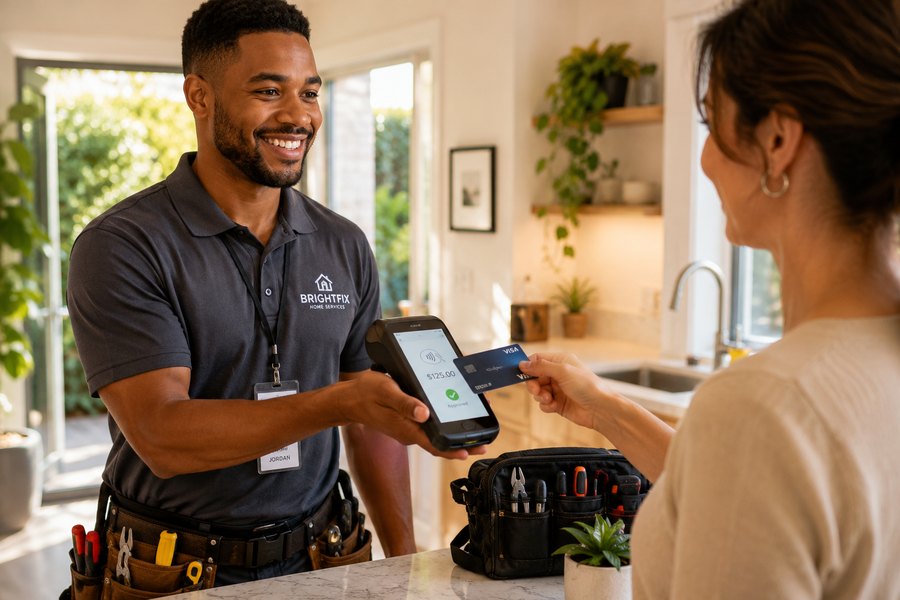
A plumber finishes repairing a leak under a kitchen sink, a hairstylist completes a cut at a client’s home, a food vendor serves the very last customer at a busy market stall, and in each of these cases the same small but surprisingly consequential moment finally arrives, the moment of actually getting paid for the work. For generations, businesses that operated away from a fixed counter faced a frustrating choice at this moment, either to accept only cash and checks, with all the inconvenience and risk that entailed, or to invest in expensive, cumbersome card-processing equipment that was never really designed for someone working out of a van or a tote bag. The fixed cash register and the bulky countertop terminal, the familiar furniture of traditional retail, simply did not fit the reality of a business that came to the customer rather than the other way around.
Mobile point-of-sale technology, commonly shortened to mPOS, emerged to solve exactly this problem, and over the past several years it has been transformed from a niche convenience into a mainstream necessity. At its core, mobile point-of-sale means the ability to accept payments and manage sales using a portable device, typically a smartphone or tablet, rather than a stationary terminal tethered to a checkout counter. What began with small card readers that plugged into a phone has evolved into a sophisticated ecosystem in which the phone itself can accept a contactless tap with no extra hardware at all, and in which payment acceptance is woven together with scheduling, invoicing, customer records, and inventory into integrated software built for the way service businesses actually work. The pace of this innovation has been remarkable, driven by steady advances in both hardware and software and by a broad wave of contactless payment adoption among ordinary consumers.
This article examines how mobile point-of-sale technology has evolved to meet the needs of service businesses and mobile commerce operators, written for a reader with no specialized knowledge of payments or retail technology. It explains what mPOS is and why traditional systems failed the businesses that operate beyond a fixed location, traces the evolution of the hardware and software that make it possible, and explores how these tools reshape the practical realities of running a field or mobile business. It weighs the benefits and the genuine challenges for operators, workers, and customers, and it grounds the discussion in documented developments from the companies leading the field. The aim is to show how a seemingly mundane technology, the means of getting paid, has become a powerful engine of opportunity for millions of small and mobile businesses.
Understanding Mobile Point-of-Sale and the Service Business Challenge
To understand the significance of mobile point-of-sale, it helps to begin with what a point-of-sale system actually is and how the traditional version fell short for businesses on the move. A point-of-sale system, or POS, is the combination of hardware and software a business uses to complete a sale, encompassing the acceptance of payment, the recording of the transaction, and often additional functions such as tracking inventory, managing customers, and generating receipts and reports. In conventional retail, this has long meant a fixed setup at a checkout counter, a cash register or computer connected to a card terminal, a receipt printer, and a cash drawer, all anchored in one place where customers come to pay. This model works well for a store with a physical counter, but it presupposes a fixed location and a customer who travels to it, assumptions that do not hold for a vast and growing category of businesses.
Service businesses and mobile commerce operators face a fundamentally different reality, because the transaction happens wherever the work is done, which is often at the customer’s location or at a temporary or changing site rather than at a permanent storefront. A home-services contractor completes a job in someone’s house, a mobile groomer works from a van, a market trader sells from a stall that moves from place to place, a personal trainer meets clients in parks and gyms, and a food truck operates from a different corner each day. For all of these, the point of sale is wherever they happen to be at the moment of payment, and a system designed around a fixed counter is not merely inconvenient but actively unsuited to their work. The mismatch between traditional point-of-sale technology and the needs of mobile and service businesses left a large segment of the economy poorly served for a long time.
The consequences of this mismatch were significant and shaped how such businesses operated. Many simply refused anything but cash and checks, which limited their sales by turning away customers who carried no cash, exposed them to the dangers and inconvenience of handling physical money, and made their bookkeeping and tax compliance harder. Those who wanted to accept cards often had to navigate a daunting landscape of merchant accounts, long-term contracts, expensive terminals, and confusing fees, a process designed for established storefronts and forbidding to a sole proprietor or a small crew. The barriers of cost, complexity, and inflexibility effectively excluded many small and mobile operators from the growing world of electronic payments, and as consumers increasingly carried less cash and expected to pay by card or phone, this exclusion became a real competitive disadvantage, costing businesses sales and credibility.
Mobile point-of-sale technology directly targets this gap by reimagining the point of sale as something portable, affordable, and simple enough for anyone to adopt. Instead of a fixed terminal and a complex merchant account, mPOS lets a business accept payments using a device it likely already owns, a smartphone, often paired with an inexpensive card reader or, increasingly, with no extra hardware at all. The model typically replaces opaque contracts and setup fees with transparent, pay-as-you-go pricing, and it bundles the payment function with software that handles the other tasks a small business needs. By collapsing the cost and complexity that had kept electronic payments out of reach, mobile point-of-sale opened card and digital acceptance to the enormous population of service providers, market traders, and mobile sellers who had been left behind, and in doing so it began to reshape how a significant part of the economy does business. Understanding this foundational shift, from the fixed counter to the portable device, is the key to appreciating everything that the technology’s subsequent evolution has made possible.
It is worth appreciating just how large and varied the population of businesses affected by this shift actually is, because the scale helps explain why mobile point-of-sale has grown so rapidly. The category of mobile and service operators encompasses an enormous range of work, from skilled trades such as plumbing, electrical, and landscaping, to personal services such as hairdressing, massage, and fitness training, to mobile retail such as food trucks, market stalls, and pop-up shops, to professional services delivered on location, to the vast and growing world of gig and independent work. What unites these otherwise disparate enterprises is that the moment of payment occurs away from any fixed counter, and that for most of them the people doing the work are also the people running the business, with no dedicated administrative staff to manage the back office of payments and records. This combination, work performed on the move and businesses run by their own practitioners, makes the simplicity and portability of mobile point-of-sale not a luxury but a precise fit for how these operators actually function, and it is the sheer breadth of this population, numbering in the many millions, that has made the technology’s market so large and its adoption so swift.
The Hardware and Software Evolution of mPOS
The transformation of mobile point-of-sale from a simple card reader into a comprehensive business tool has unfolded along two intertwined dimensions, the evolution of the hardware that accepts payment and the evolution of the software that surrounds it. On the hardware side, the trajectory has moved steadily toward eliminating dedicated equipment altogether, progressing from external readers that plug into a phone toward the remarkable point where the phone itself becomes the payment terminal. On the software side, the progression has moved from standalone payment apps toward integrated platforms that combine payment acceptance with the scheduling, invoicing, customer management, and reporting that service businesses depend on. Together these two strands of innovation have turned a narrow payment-acceptance tool into something approaching a complete operating system for a small or mobile business.
Understanding both dimensions is essential, because the value of modern mPOS comes not from payment acceptance alone but from the seamless combination of accessible hardware and capable software. A business that can take a tap on a phone but must juggle separate tools for booking appointments and sending invoices gains far less than one whose entire workflow flows through a single integrated system. The two subsections that follow examine each dimension in turn, first the hardware progression that culminated in software-only contactless acceptance, and then the software integration that ties payments into the broader operations of a service business, and together they explain how mPOS became as powerful and indispensable as it is today.
From Dongles to Software-Only Tap to Pay
The hardware story of mobile point-of-sale began with a deceptively simple innovation, the small card reader that plugged into a smartphone’s headphone jack or charging port and allowed it to accept card payments. These early readers, often called dongles, were inexpensive or even free, and they democratized card acceptance by letting any small business with a smartphone start taking cards without a traditional terminal or merchant account, paired with an app that handled the transaction. This first wave was revolutionary in its own right, because it shattered the cost and complexity barriers that had excluded small and mobile sellers, and it established the model of accessible, pay-as-you-go payment acceptance that defines the category. The early dongles read magnetic stripes, and as payment security evolved, the readers advanced to accept chip cards and then contactless taps, growing more capable while remaining small and portable.
The progression continued toward more sophisticated portable hardware that bundled greater capability into purpose-built devices. Compact wireless readers emerged that accepted chip and contactless payments and connected to a phone or tablet without cables, and beyond these came integrated smart terminals, handheld devices that combined a touchscreen, payment acceptance, receipt printing, and full point-of-sale software into a single portable unit designed to be carried anywhere. These devices brought the full functionality of a checkout counter into a handheld form, suitable for businesses that needed a more complete and durable tool than a phone with a reader. The hardware grew steadily more capable, more wireless, and more self-contained, progressively erasing the distinction between a mobile setup and a full point-of-sale system, while preserving the portability that mobile and service businesses required.
An important parallel development that made this progression possible was the broader shift toward contactless payment among consumers, which created the demand and the readiness that mobile point-of-sale could meet. As customers grew accustomed to tapping cards and phones to pay, propelled by the spread of contactless cards and digital wallets, the infrastructure and habits that software-only acceptance depends upon fell into place. A merchant accepting payment by tap is only useful if customers carry tappable cards and phones and are comfortable using them, and the dramatic rise in contactless and digital wallet use over recent years, with in-store digital wallet adoption among consumers climbing markedly, provided exactly this foundation. The hardware evolution toward phone-as-terminal and the consumer shift toward contactless payment thus reinforced one another, each making the other more valuable, and the convergence of capable merchant technology with widespread consumer readiness is a large part of why mobile point-of-sale reached a tipping point when it did rather than years earlier. The technology did not advance in isolation but rode a broader wave of change in how people expect to pay.
The most significant leap came with the arrival of software-only contactless acceptance, which eliminated the need for any additional hardware whatsoever by turning the smartphone itself into the payment terminal. Apple introduced Tap to Pay on iPhone in the United States in February 2022, a capability that uses the phone’s built-in near-field communication technology to accept contactless cards and digital wallets directly, with the customer simply tapping their card or phone against the merchant’s iPhone. This innovation removed the last piece of dedicated equipment from the equation, allowing a business to accept payments using nothing but a phone it already carried, with no reader to buy, charge, carry, or lose. Payment platforms moved quickly to support the capability, with major providers enabling it for their merchants and extending it across more countries through 2023 and 2024, and similar software-based acceptance became available on other devices as well. For service businesses in particular, the ability to take a payment on the spot with only a phone represented the culmination of the entire hardware evolution, reducing the barrier to accepting payment to essentially nothing and making the point of sale as mobile as the worker carrying the phone.
Integrated Software for Service Operations
While the hardware was shedding its bulk, the software surrounding mobile payments was growing in capability, evolving from simple transaction apps into comprehensive platforms that address the full range of a service business’s operational needs. The early mobile payment apps did one thing, accept a payment and record it, but it quickly became clear that the same device and software could do far more, integrating the payment with the other tasks that consume a small operator’s time and attention. This recognition gave rise to integrated platforms that combine payment acceptance with appointment scheduling, customer relationship management, invoicing, inventory tracking, and reporting, all accessible from the same mobile device and unified by the thread of the transaction. For a service business, this integration is transformative, because it replaces a patchwork of separate tools and manual processes with a single coherent system.
The particular value of integrated software for service operations lies in how it matches the actual workflow of businesses that schedule, perform, and bill for work over time rather than completing instantaneous over-the-counter sales. A service business often books an appointment in advance, performs work at a scheduled time and place, and then needs to bill and collect payment, sometimes immediately on completion and sometimes through an invoice sent afterward. Integrated mPOS software supports this entire arc, allowing a business to manage its calendar, store customer details and service history, generate and send invoices, accept payment on-site or remotely, and track the resulting revenue, all from a phone in the field. This continuity eliminates the friction and errors of moving information between disconnected systems and lets a small operator run a professional, organized business without administrative staff or specialized back-office software.
The integration also extends outward to connect the in-person, mobile point of sale with the broader digital presence that modern businesses maintain. A unified platform can tie together payments taken in person, payments collected online, and payments made through invoices, giving the business a single view of its sales across every channel, and it can connect to accounting software, e-commerce storefronts, and marketing tools to create a coherent operation. For a service business, this means that the work done in a customer’s home and the bookings taken through a website flow into the same system, with consistent records of customers, sales, and revenue. The progression of mPOS software from a simple payment app to this kind of integrated, omnichannel platform has been as important as the hardware evolution, because it transformed mobile point-of-sale from a way to accept a card into a comprehensive engine for running and growing a service business, and it is the combination of capable software with frictionless hardware that gives modern mPOS its power.
How mPOS Reshapes Field and Mobile Commerce
The practical effect of these hardware and software advances has been to reshape the everyday operations of field and mobile commerce in ways that extend far beyond simply offering customers another way to pay. The most immediate change is the ability to collect payment on the spot, at the moment a service is completed, wherever that may be, which fundamentally alters the cash flow and the customer relationship of a service business. When a contractor can accept payment the instant a job is finished, rather than mailing an invoice and waiting days or weeks for a check, the business is paid faster, its cash flow improves, and the risk of non-payment or slow payment diminishes substantially. For small operators who live close to their cash flow, this acceleration of payment is not a minor convenience but a meaningful improvement in financial stability, reducing the gaps during which they have done work but not yet been paid for it.
On-the-spot payment also transforms the customer experience and the professionalism of the transaction in ways that benefit the business. A customer who can tap a card or phone to pay immediately, receive an instant digital receipt, and avoid the hassle of cash or the delay of an invoice enjoys a smoother, more modern experience, and the business that offers this appears more established and trustworthy than one that fumbles with cash or sends paperwork later. The convenience of frictionless payment can itself influence purchasing decisions, since customers are more likely to complete a purchase, add a service, or leave a tip when paying is effortless, and the ability to accept the full range of modern payment methods means a business never loses a sale because a customer lacks cash. In an economy where consumers increasingly expect to pay by card or digital wallet and carry less cash than ever, the capacity to accept these payments anywhere has become essential to capturing the full value of every customer interaction rather than forfeiting sales to the simple absence of the right payment method.
Beyond the transaction itself, mobile point-of-sale generates valuable data and operational capabilities that help service businesses understand and grow their operations. Because every sale flows through the system, a business accumulates a record of its revenue, its customers, its most popular services, and its busiest times, information that was difficult to capture when payment was a matter of loose cash and handwritten records. This data enables a small operator to make informed decisions, to identify which services are most profitable, to recognize and reward loyal customers, and to manage their schedule and resources more effectively. The integrated nature of modern mPOS means this operational intelligence comes as a byproduct of simply doing business, requiring no separate effort to compile, and it gives small and mobile operators a degree of insight into their own businesses that was once available only to larger firms with dedicated systems and staff.
This data foundation also unlocks capabilities that extend the relationship with customers beyond the single transaction. With a record of who its customers are and what they have purchased, a service business can follow up after a job, remind a customer when a recurring service is due, offer loyalty rewards to its best clients, and reach out with relevant offers, all of which encourage repeat business that is far more valuable and less costly to win than constantly finding new customers. Some platforms layer marketing and customer-engagement tools directly onto the payment data, allowing a small operator to run the kind of retention efforts that were once the province of sophisticated retailers. For a mobile or field business that may see customers infrequently and across a wide area, this ability to stay connected and encourage return visits can be the difference between a one-time job and a long-term client relationship, and it turns the payment system from a passive collector of money into an active engine for building a durable customer base. The transaction, in this light, becomes the starting point of an ongoing relationship rather than its conclusion.
The reshaping extends to the structure of the businesses themselves and the opportunities available to those who run them. By lowering the barriers to accepting payment and managing a business professionally, mobile point-of-sale has enabled new kinds of enterprise and made existing ones more viable, allowing individuals to start service businesses, side ventures, and mobile operations with minimal upfront investment and complexity. A person can begin offering a service and accept professional payment for it almost immediately, using a phone they already own, which dramatically lowers the threshold for entrepreneurship and self-employment. This accessibility has contributed to the growth of independent and gig work, to the proliferation of small mobile vendors and service providers, and to the broader trend of individuals building businesses around their skills, and it represents one of the more democratizing effects of the technology, extending the tools of professional commerce to anyone with a phone and something to offer.
The reshaping is especially significant in the context of broader changes in how people work and earn. As more individuals piece together income from multiple sources, take on independent and freelance work, or build small ventures alongside or instead of traditional employment, the ability to accept payment professionally and immediately becomes a foundational tool of economic life rather than a specialized business function. A person turning a hobby into a side business, a tradesperson going independent, or a creative professional selling directly to clients all need to get paid cleanly and credibly, and mobile point-of-sale provides this without requiring them to become payments experts or to invest in infrastructure that their scale cannot justify. In this sense, the technology is woven into the fabric of the modern, more fluid economy, supporting the flexibility and self-direction that characterize how a growing share of people now work. It lowers not just the cost of accepting payment but the entire threshold of legitimacy, allowing a small or new operator to present themselves to customers as a real, trustworthy business from the very first transaction, which is often the difference between a tentative side effort and a venture that customers take seriously and return to.
Benefits and Challenges Across Stakeholders
Mobile point-of-sale technology produces distinct effects for the various parties involved in field and mobile commerce, and a balanced view requires weighing its substantial benefits against its real costs and limitations. Service businesses and their owners gain accessibility, speed, and professional capability, the workers who use the tools gain efficiency and improved earning potential, and customers gain convenience and choice, yet these advantages come alongside ongoing fees, dependence on technology and connectivity, security responsibilities, and reliance on the platforms that provide the service. The technology is broadly beneficial and has genuinely expanded opportunity, but it is not without drawbacks, and understanding both sides is necessary for any business considering how to adopt and use it.
The analysis below organizes these considerations by stakeholder and by category, first examining the benefits that accrue to service businesses, their workers, and their customers when the technology is used well, then turning to the risks, costs, and limitations that operators must weigh and manage. Keeping these perspectives distinct helps move past both uncritical enthusiasm for a transformative tool and undue focus on its costs, arriving at a grounded understanding of what mobile point-of-sale offers to the businesses that depend on it and what it asks of them in return.
Benefits for Service Businesses, Workers, and Customers
For service businesses, the foremost benefit is accessibility, the way mobile point-of-sale removes the cost and complexity barriers that once excluded small and mobile operators from accepting electronic payments. A business can now begin accepting cards and digital payments quickly and cheaply, often using a phone it already owns with no dedicated hardware, transparent pricing, and no daunting contracts, which means that even the smallest sole proprietor can offer the same payment options as a large retailer. This accessibility translates into more sales, since the business never has to turn away a customer who lacks cash, and into improved cash flow through immediate payment, as well as the professional capability that comes from integrated software handling scheduling, invoicing, and records. The combined effect is to let a small operator run a more capable, more profitable, and more professional business than was previously possible at their scale, leveling a field that long favored larger, established firms.
For the workers who use these tools, whether business owners themselves or employees in the field, mobile point-of-sale brings efficiency and improved earning potential. The ability to complete the entire transaction on the spot, from billing to payment to receipt, eliminates the administrative burden of chasing payments and reconciling cash, freeing time and attention for the actual work. The convenience of digital payment can also increase earnings directly, since effortless payment and the easy option to add a tip on a screen tend to raise the amounts customers pay, benefiting workers in tipped service roles in particular. The integrated software that tracks schedules, customers, and revenue also helps workers organize their day, manage their clients, and present themselves professionally, advantages that are especially valuable for the independent and mobile workers who make up a large share of the technology’s users and who must handle every aspect of their business themselves.
For customers, the benefits center on convenience, choice, and a better experience. Mobile point-of-sale lets customers pay however they prefer, whether by tapping a card or phone, inserting a chip, or paying through a digital wallet, and to do so quickly and securely at the point where the service is delivered, without the inconvenience of needing cash or the delay of being invoiced. The instant digital receipt, the smooth and modern interaction, and the assurance of secure payment all contribute to a superior experience that customers increasingly expect, and the ability to pay easily can make the difference in whether a customer completes a purchase or returns to a business. As consumers carry less cash and grow accustomed to contactless and digital payment in every part of their lives, the businesses that can meet this expectation anywhere, including in the field and on the move, offer customers the seamless experience they want, and this alignment between customer expectation and business capability is part of what has driven the technology’s rapid adoption.
Risks, Costs, and Limitations
The most persistent cost is the transaction fee, the percentage that payment processors charge on each sale, which represents an ongoing expense that accumulates over time and can weigh on businesses with thin margins. While mobile point-of-sale eliminates the large upfront costs and contracts of traditional systems, it replaces them with per-transaction fees that, though transparent and predictable, are not trivial, and for a high-volume business the cumulative cost of these fees can be substantial. Businesses must weigh the convenience and sales benefits of accepting electronic payment against this ongoing cost, and while for most the benefits clearly outweigh the fees, operators with very tight margins or high transaction volumes need to consider the expense carefully and compare providers, since pricing varies and the cheapest option at low volume may not be the cheapest at scale.
Dependence on technology and connectivity introduces a different category of risk that is particularly acute for mobile and field operations. Mobile point-of-sale relies on a working device, sufficient battery, and a network connection to process payments, and any of these failing in the field can prevent a business from getting paid at the critical moment. A dead phone battery, a location with no cellular signal, or a service outage at the payment processor can all interrupt a business’s ability to transact, which is a real concern for operators working in remote areas, in buildings with poor reception, or in conditions that drain batteries. While some systems offer limited offline capabilities and the reliability of networks and devices continues to improve, the fundamental dependence on functioning technology means that mobile businesses must plan for these contingencies in a way that a cash-only operator never had to, and the convenience of digital payment carries an inherent vulnerability to technical failure.
Security, data protection, and platform dependence round out the significant limitations. Accepting electronic payments makes a business responsible for handling sensitive payment information securely and for protecting customer data, obligations that come with the territory of digital commerce and that carry real consequences if neglected, even though modern mPOS platforms handle much of the security automatically. There is also the deeper dependence on the platforms and companies that provide the service, since a business that builds its operations around a particular provider’s hardware, software, and payment processing becomes reliant on that company’s pricing, policies, reliability, and continued existence, and a change in fees, a suspension of an account, or a service disruption can significantly affect the business. This concentration of dependence on a few major platforms is a structural feature of the modern payments landscape, and while these platforms provide enormous value, the reliance on them represents a loss of independence and a source of risk that operators should recognize. Account suspensions, in particular, can be disruptive, because payment providers sometimes freeze or hold funds when their automated systems flag unusual activity, and a small business that suddenly cannot access its revenue or accept payment can suffer serious harm even when the underlying concern proves unfounded. The very convenience of a single integrated provider managing payments, records, and deposits means that a problem at that provider affects every part of the business at once, a concentration of risk that the old patchwork of separate cash, checks, and independent merchant accounts did not carry in the same way. Prudent operators mitigate this by understanding their provider’s policies, keeping financial reserves, and maintaining at least a backup means of accepting payment, so that their livelihood does not rest entirely on the uninterrupted functioning of a single platform over which they have little control. None of these costs and limitations negates the transformative benefits of mobile point-of-sale, but together they make clear that the technology, for all its accessibility, brings ongoing expenses, technical dependencies, and responsibilities that businesses must understand and manage to use it well.
Real-World Implementations and Measured Outcomes
The evolution and impact of mobile point-of-sale are best illustrated through the companies and technologies that have driven the field forward, and several well-documented developments demonstrate how the technology has reached service businesses at scale. The examples here span the breakthrough of software-only payment acceptance, the platform that brought card acceptance to millions of small sellers, and the infrastructure enabling integrated payments across applications, set against the backdrop of a rapidly growing market. Each shows a different facet of how mobile payment hardware and software have evolved to serve field and mobile commerce, and together they illustrate both the maturity and the continuing momentum of the field.
The introduction of Apple’s Tap to Pay on iPhone marks the most significant recent milestone, representing the culmination of the hardware evolution toward eliminating dedicated equipment entirely. Apple launched the capability in the United States in February 2022, enabling merchants to accept contactless card and digital wallet payments using only an iPhone, with no additional reader or terminal required, by having the customer tap their card or phone against the merchant’s device. This was a genuine breakthrough for mobile and service businesses, because it reduced the hardware required to accept payment to a phone the merchant already owned, and its adoption was propelled by the payment platforms that integrated it for their merchants. The capability expanded internationally through 2023 and 2024, reaching markets including Canada in May 2024 and additional European countries by late 2024, extending software-only payment acceptance to service businesses across an ever-wider geography. For a mobile professional, the ability to take a payment with nothing but a phone embodies the entire promise of mobile point-of-sale realized in its simplest possible form, removing even the small friction of remembering to carry and charge a separate reader and leaving nothing between the completed work and the collected payment.
Square, the payments business now part of Block, illustrates how mobile point-of-sale brought card acceptance to the mass of small and mobile sellers and grew into a comprehensive platform. Square built its reputation on the simple card reader that let any small business accept cards with a smartphone, and it expanded into an integrated ecosystem combining payment acceptance with point-of-sale software, scheduling, invoicing, and business management tools serving a vast number of small businesses. Square moved quickly to adopt software-only acceptance, launching Tap to Pay on iPhone for its sellers following an early access program that began in June 2022, and it has been recognized as a market leader in point-of-sale systems for small businesses, with mobile professionals among the sellers finding particular value in the ability to conduct business with no additional hardware. Square’s trajectory, from a single card reader to a full business platform that field and mobile operators rely on, exemplifies the broader evolution of mPOS from a payment tool into an operating system for small enterprise, and its scale demonstrates how thoroughly the technology has penetrated the small-business economy.
Stripe and the broader market data illustrate the infrastructure enabling integrated payments and the scale of the overall shift. Stripe was the first payment platform to offer Tap to Pay on iPhone to its business customers when the capability launched, including through the point-of-sale applications it powers, exemplifying how payment infrastructure providers extend software-only acceptance to the many businesses and platforms built on top of them. This matters because much of the mobile point-of-sale used by service businesses is delivered not directly but through software platforms that embed payment acceptance, and providers like Stripe make that integration possible across countless applications. The scale of the resulting market underscores the magnitude of the transformation, with the global mobile point-of-sale market valued in the range of forty to forty-six billion dollars across 2023 and 2024 and projected to grow at double-digit annual rates toward roughly a hundred billion dollars within the following decade, driven by rising demand for cashless and contactless payment and for unified management of sales and operations. Industry data also shows contactless and digital wallet acceptance climbing steadily, with the great majority of merchants now accepting such payments and a substantial share of new adopters being first-time small-business merchants, confirming that mobile point-of-sale continues to draw new and previously excluded businesses into the world of electronic commerce. Taken together, these developments show mobile point-of-sale advancing on every front, in hardware, software, and reach, and steadily fulfilling its promise of accessible, professional commerce for businesses of every size and location.
Final Thoughts
Mobile point-of-sale technology represents one of the quieter but more consequential financial innovations of recent years, because it has fundamentally altered who can participate fully in the modern economy. The simple act of getting paid, long a barrier that separated established storefronts from the vast population of mobile and service businesses, has been transformed into something any individual with a smartphone can do professionally and immediately. By collapsing the cost, complexity, and inflexibility that once excluded small operators from accepting electronic payments, this technology has extended the tools of professional commerce to the countless workers whose business has always happened away from a fixed counter. The progression from clunky terminals to a card reader on a phone and finally to the phone itself as the entire point of sale has steadily erased the distinction between the smallest mobile operator and the largest retailer when it comes to the ability to transact.
The broader significance of this shift lies in its democratizing effect on entrepreneurship and economic participation. When the threshold to start a business and accept professional payment falls to nothing more than a phone someone already carries, the opportunity to build an enterprise around one’s skills opens to people who could never have navigated the cost and complexity of traditional systems. This accessibility has helped fuel the growth of independent work, side ventures, and small mobile businesses, allowing individuals to convert their abilities into livelihoods with minimal barriers, and it has been particularly meaningful for those whom the conventional financial and retail systems left underserved. The same technology that lets an established contractor get paid faster also lets a newcomer begin offering a service and accepting payment for it within minutes, and this lowering of barriers represents a genuine expansion of economic opportunity, extending the infrastructure of commerce to anyone with something to offer and a willingness to work.
The responsibility that accompanies this progress concerns ensuring that the benefits remain accessible and that the dependencies the technology creates do not become new forms of disadvantage. The ongoing fees, the reliance on connectivity and devices, and the concentration of the market in a few major platforms mean that the empowerment mobile point-of-sale offers comes with costs and vulnerabilities that fall most heavily on the smallest operators. The intersection of financial technology and social responsibility appears clearly here, in whether the providers who control this essential infrastructure will price it fairly, support it reliably, and treat the small businesses that depend on them as partners rather than captive customers. The promise of accessible commerce is fulfilled only when the tools remain affordable and dependable for those who can least absorb a sudden fee increase or an account disruption.
Looking ahead, the trajectory points toward payment acceptance becoming ever more seamless, more deeply integrated into the software businesses use, and more universally available, as software-only acceptance spreads across devices and geographies. This continuing evolution should further lower the barriers to commerce and extend professional payment tools into more parts of the world, including regions where access to traditional financial infrastructure has been limited. The enduring value of mobile point-of-sale lies in its capacity to put the means of professional commerce into the hands of anyone, anywhere, transforming a smartphone into a complete business and dissolving the old distinction between those who could accept modern payment and those who could not. In doing so, it stands as a clear example of technology widening participation in the economy, and the ongoing work of making that participation more accessible, affordable, and reliable represents a meaningful contribution to a more inclusive commercial world.
FAQs
- What is mobile point-of-sale?
Mobile point-of-sale, often shortened to mPOS, is the ability to accept payments and manage sales using a portable device such as a smartphone or tablet, rather than a fixed terminal anchored to a checkout counter. It typically pairs a mobile device with either a small card reader or, increasingly, no extra hardware at all, along with software that records transactions and often handles scheduling, invoicing, and customer management. It allows businesses to take payment wherever they are, which is especially valuable for service and mobile operators. - How is mPOS different from a traditional point-of-sale system?
A traditional point-of-sale system is a fixed setup at a checkout counter, typically a register or computer connected to a card terminal, receipt printer, and cash drawer, designed for customers who come to a physical location to pay. Mobile point-of-sale reimagines this as portable and affordable, using a smartphone or tablet that can accept payment anywhere. It replaces the large upfront costs and complex contracts of traditional systems with accessible devices and transparent, pay-as-you-go pricing suited to businesses that operate beyond a fixed counter. - Why do service businesses need mobile point-of-sale?
Service businesses complete their transactions wherever the work is done, often at the customer’s location or at temporary and changing sites rather than at a permanent storefront. A system built around a fixed counter does not fit this reality, leaving such businesses to rely on cash and checks or to navigate expensive, cumbersome equipment. Mobile point-of-sale lets them accept cards and digital payments on the spot, wherever they are, improving sales, cash flow, and professionalism while meeting the expectations of customers who increasingly carry little cash. - What is Tap to Pay on iPhone?
Tap to Pay on iPhone is a capability, introduced by Apple in the United States in February 2022, that lets merchants accept contactless card and digital wallet payments using only an iPhone, with no additional reader or terminal. The customer simply taps their card or phone against the merchant’s iPhone, which uses its built-in near-field communication technology to process the payment. It represents the culmination of the hardware evolution by eliminating dedicated equipment entirely, and payment platforms have extended it to their merchants across a growing number of countries. - Do I need special hardware to accept payments now?
Increasingly, no. While mobile point-of-sale began with small card readers that plug into or connect to a phone, software-only contactless acceptance now lets compatible smartphones accept tapped cards and digital wallets with no additional hardware at all. A business can accept payment using only a phone it already owns. Some businesses still choose dedicated readers or handheld smart terminals for greater capability, durability, or to accept chip cards, but for many service operators a phone alone is now sufficient to take payment. - How does mobile point-of-sale help cash flow?
It lets a business collect payment on the spot, at the moment a service is completed, rather than mailing an invoice and waiting days or weeks for a check. This means the business is paid faster, its cash flow improves, and the risk of slow payment or non-payment diminishes. For small operators who live close to their cash flow, this acceleration is a meaningful improvement in financial stability, reducing the gaps during which they have performed work but not yet been paid, and integrated invoicing also helps collect on any payments billed afterward. - What does integrated mPOS software do beyond payments?
Modern mobile point-of-sale platforms combine payment acceptance with the other tasks a service business needs, including appointment scheduling, customer relationship management, invoicing, inventory tracking, and reporting, all from the same device. This matches the workflow of businesses that book, perform, and bill for work over time, letting an operator manage their calendar, store customer details, send invoices, accept payment, and track revenue in one coherent system. It can also connect in-person, online, and invoiced payments into a single view and link to accounting and other tools.A practical advantage of this integration that operators quickly come to value is the elimination of double entry and manual reconciliation, the tedious and error-prone work of recording the same transaction in multiple places. In a fragmented setup, a payment taken in the field must be separately noted, matched against the appointment that generated it, entered into the accounting records, and reconciled against the bank deposit, with each step inviting mistakes and consuming time that a small operator can ill afford. When payments flow through an integrated platform, the transaction is recorded once and propagates automatically to the schedule, the customer record, and the financial reports, so the business’s books stay current without separate effort. This automation of routine record-keeping is precisely the kind of administrative relief that lets a sole practitioner spend their time on paid work rather than on paperwork, and over the course of a year it can save many hours while producing more accurate records for tax and planning purposes. The integration thus delivers value not only at the moment of payment but throughout the entire cycle of running the business, quietly removing friction that operators had long accepted as an unavoidable part of working for themselves. - What are the main costs of using mobile point-of-sale?
The most persistent cost is the transaction fee, a percentage that payment processors charge on each sale, which accumulates over time and can weigh on businesses with thin margins or high volumes. Mobile point-of-sale eliminates the large upfront costs and contracts of traditional systems but replaces them with these ongoing per-transaction fees. For most businesses the convenience and added sales outweigh the fees, but operators with very tight margins or high volume should compare providers carefully, since pricing varies and the best option depends on transaction patterns. - What happens if I lose internet or my battery dies in the field?
This is a real limitation, since mobile point-of-sale depends on a working device, sufficient battery, and a network connection to process payments. A dead battery, a location with no cellular signal, or a processor outage can interrupt the ability to take payment at the critical moment, which is a particular concern for operators in remote areas or buildings with poor reception. Some systems offer limited offline capabilities, and reliability continues to improve, but mobile businesses should plan for these contingencies, such as keeping devices charged and having a backup method. - Is mobile point-of-sale secure?
Modern mobile point-of-sale platforms handle much of the payment security automatically, using encryption and secure processing to protect transactions, and software-only acceptance on smartphones is built on the device’s secure hardware. However, accepting electronic payments does make a business responsible for handling sensitive payment information appropriately and protecting customer data, obligations that come with digital commerce. Reputable providers manage the core security, but businesses should use trusted platforms, keep their software updated, and follow good practices to protect themselves and their customers from fraud and data breaches.