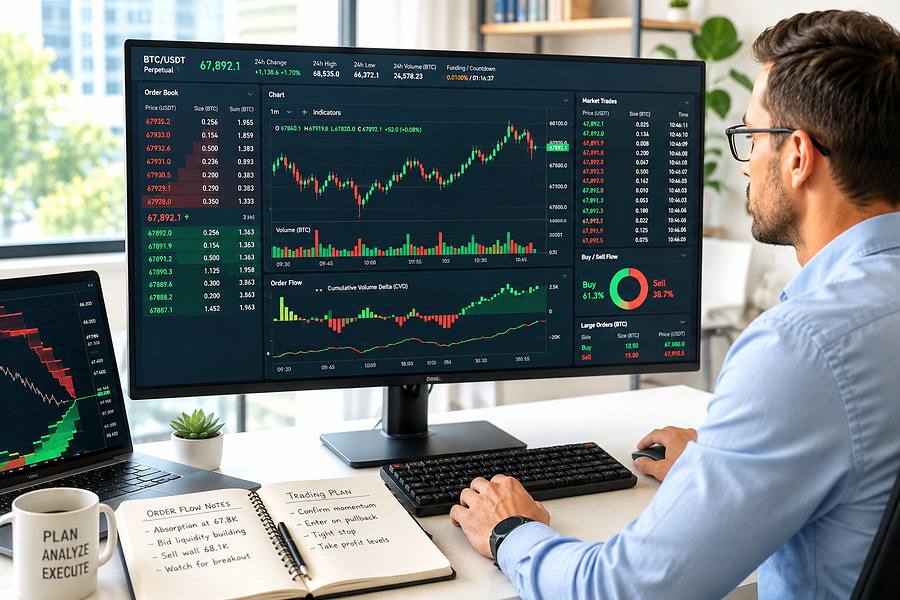
Every price in a financial market is the visible result of an essentially invisible negotiation, the constant pushing and pulling of countless buyers and sellers, each trying to transact on the best terms they can possibly get. Most people who follow markets see only the final outcome of this negotiation, the price ticking up and down on a simple chart, but beneath that chart lies a far richer and more revealing record of the negotiation itself, a continuously updating ledger of every standing offer to buy and to sell. This ledger, known as the order book, shows not just what price something last traded at but the full landscape of intentions surrounding it at this very moment, where buyers are willing to bid, where sellers are willing to offer, how much they want, and how aggressively each side is acting to get filled. For traders seeking an edge, this deeper layer of information holds the tantalizing possibility of seeing where prices might be heading before they actually begin to move.
Order flow analysis is the practice of studying this layer, the dynamics of the order book and the stream of executing trades, to anticipate short-term price movements. Cryptocurrency markets have become a particularly active arena for this kind of analysis, for several reasons. They trade continuously, twenty-four hours a day and seven days a week without any closing bell, generating a truly uninterrupted stream of data; many crypto exchanges make detailed order book and trade data freely and readily available, far more openly than traditional markets often do; and the markets are widely known for sharp, fast, and volatile movements that richly reward those who can anticipate them. These conditions have made crypto a natural home for order flow techniques, drawing both sophisticated quantitative firms with vast resources and a rapidly growing community of individual retail traders who use increasingly accessible specialized tools to read the flow for themselves.
This article examines how traders analyze order book dynamics and flow patterns to anticipate short-term price movements in cryptocurrency markets, written for a reader with no background in trading or market mechanics. It explains what an order book is and how prices actually form within it, the specific patterns and signals that order flow analysis seeks to identify and exploit, and the technology and methods used to extract them from the data. It weighs the benefits and the very real risks and limitations of this approach, with particular attention to the dangers facing less experienced traders, and it grounds the discussion in documented research and real tools used in the field. The aim is to make a sophisticated and often opaque area of trading understandable, while being honest about both its genuine insights and the serious pitfalls that accompany any attempt to predict short-term market movements.
Understanding Order Books and Market Microstructure
To understand order flow analysis, one must first understand the order book, the central mechanism through which most cryptocurrency and traditional markets operate. An order book is a real-time list of all the outstanding orders to buy and sell a particular asset, organized by price. On one side are the bids, the orders from buyers specifying the prices at which they are willing to purchase and the quantities they want, and on the other side are the asks or offers, the orders from sellers specifying the prices at which they are willing to sell and how much. The highest bid and the lowest ask sit closest together at the center of the book, and the gap between them is called the spread. This structure represents the standing supply and demand for the asset at every price level, a far more detailed picture than the single number of the current price.
The order book is populated by two fundamentally different kinds of orders, and the distinction is essential to understanding how prices form. A limit order is an order to buy or sell at a specified price or better, which rests in the order book waiting to be filled, providing liquidity by giving others something to trade against. A market order, by contrast, is an order to buy or sell immediately at the best available price, which executes right away by consuming the limit orders resting in the book, taking liquidity. When a market buy order arrives, it matches against the lowest available ask, and if it is large enough to exhaust that level, it moves up to the next, and so on, with each fill removing liquidity and potentially pushing the price higher. The interplay between resting limit orders that provide liquidity and incoming market orders that consume it is the fundamental engine of price movement, and order flow analysis is, at its heart, the study of this interplay.
The study of these mechanics falls under what is called market microstructure, the branch of finance concerned with how the specific rules and dynamics of trading affect prices, liquidity, and the behavior of market participants. Market microstructure recognizes that price is not set by some abstract equilibrium but emerges from the concrete process of orders meeting in the book, and that the details of this process, who is buying and selling, how aggressively, at what sizes, and where the liquidity sits, contain information about likely future movements. A market with deep liquidity, meaning many large orders resting close to the current price, can absorb substantial buying or selling with little price movement, while a thin market with little resting liquidity can move sharply on relatively small orders. Understanding the depth and shape of the order book is therefore central to anticipating how the market will respond to incoming flow.
The appeal of analyzing this microstructure rests on a simple premise, that the order book and the flow of trades reveal information about the intentions and pressures in the market before those pressures are fully reflected in the price. If far more buying interest is resting in the book than selling interest, or if aggressive buyers are repeatedly consuming the offers while sellers hold back, this imbalance may presage an upward move, and a trader who detects it early might position ahead of the crowd. This premise is supported by a substantial body of research in market microstructure, which has found that measures of order flow carry genuine predictive information about short-term price changes, particularly over very brief horizons. At the same time, the premise must be held with caution, because markets are adaptive and competitive, signals that work can be arbitraged away, and the order book can be deliberately manipulated to mislead, all of which means that reading order flow is far from a guaranteed path to profit. Understanding both the genuine information content of microstructure and the difficulty of exploiting it is the foundation for everything that follows.
It is also worth appreciating how the structure of cryptocurrency markets differs from traditional ones in ways that shape order flow analysis. In conventional equity and futures markets, trading is concentrated on a relatively small number of regulated exchanges, and detailed order book data is often expensive, restricted, or available only to professional subscribers. Cryptocurrency, by contrast, trades across many competing venues around the world, each maintaining its own order book, and most of these exchanges publish their order book and trade data openly through programming interfaces that anyone can access. This fragmentation across venues means that the true picture of supply and demand for an asset like Bitcoin is spread across many separate books, which complicates analysis but also creates opportunities, since liquidity and pressure on one exchange may not yet be reflected on another. The openness of the data, meanwhile, lowers the barrier to studying microstructure dramatically, allowing individuals to obtain the same raw feeds that professionals use. These structural features, fragmentation across many open venues, distinguish crypto order flow analysis from its traditional counterpart and explain both why the field has attracted such a broad community and why aggregating data across exchanges has become an important capability, since no single venue tells the whole story of where the market’s liquidity and pressure truly lie.
How Order Flow Generates Trading Signals
Order flow analysis seeks to extract signals about likely short-term price movements from two related but distinct sources of information, the state of the resting order book and the stream of executing trades. The resting order book reveals where liquidity sits and how buying and selling interest is distributed across prices, while the trade stream reveals which side is acting aggressively and consuming that liquidity. Together these provide a dynamic picture of the balance of pressure in the market, and the various signals that traders monitor are different ways of measuring and interpreting that balance, each attempting to detect the imbalances and shifts that tend to precede price moves.
The signals fall into two broad families, and the subsections that follow examine each. The first concerns the static or slowly changing state of the order book itself, particularly the imbalance between buying and selling interest and the depth of liquidity at various levels, which indicates the pressure and the resistance the price faces. The second concerns the dynamic flow of executing trades and the aggressive activity that drives price movement, including the absorption of orders, deceptive practices, and the cascading liquidations that are especially prominent in cryptocurrency markets. Understanding both the standing structure of the book and the active flow through it is necessary to appreciate how order flow analysis attempts to anticipate where prices are heading.
Order Book Imbalance and Depth
The most fundamental order flow signal is order book imbalance, a measure of the relative weight of buying versus selling interest resting in the book. At its simplest, order book imbalance compares the total quantity of bids to the total quantity of asks, often within some range of the current price, to assess which side is exerting more pressure. When the bids substantially outweigh the asks, there is more standing demand than supply near the current price, which suggests upward pressure, and when the asks outweigh the bids, the reverse. This imbalance is one of the most studied microstructure indicators, and research has consistently found that it carries genuine predictive information about short-term price changes, with the relationship between order flow imbalance and subsequent price movements being especially strong over very brief horizons measured in seconds.
The predictive value of imbalance arises from the underlying logic of how prices move through the book. If there is far more resting buying interest than selling interest, then incoming sell orders will be readily absorbed by the abundant bids while incoming buy orders will quickly exhaust the thinner asks and push the price up, creating an asymmetry that tilts the probability of the next move toward the upside. Traders monitor this imbalance continuously, looking for moments when it becomes pronounced enough to suggest a likely direction, and quantitative researchers have formalized it into precise measures, finding that aggregated over short intervals it retains a strong and nearly linear relationship with near-term returns. Some research has found that order imbalance carries predictive significance for cryptocurrency returns even over longer horizons of several days, though its power is greatest over the shortest time frames where the mechanical effect of the imbalance on price is most direct.
Closely related to imbalance is the concept of depth, the amount of liquidity resting at various price levels, which shapes how the market will respond to incoming orders and where prices are likely to find support or resistance. A large cluster of resting buy orders at a particular price acts as a kind of floor, since substantial selling would be needed to exhaust it and push the price below, while a large cluster of sell orders acts as a ceiling. Traders watch these concentrations of liquidity, sometimes called walls, as potential turning points, areas where the price may stall or reverse because of the standing liquidity that must be consumed to move through them. The shape of the depth across the book, where liquidity is thick and where it is thin, tells a trader where the price can move easily and where it will meet resistance, and combined with imbalance it forms a picture of both the direction of pressure and the terrain the price must traverse. However, traders must be cautious, because resting orders can be withdrawn as quickly as they appear, and a wall that looks like solid support can vanish the moment it is tested, a reality that complicates any naive reading of the static book and points to the importance of watching how the book actually behaves under pressure.
Trade Flow, Aggression, and Liquidation Dynamics
While the resting order book shows standing intentions, the stream of executing trades reveals which side is actually acting and how aggressively, providing a complementary and often more telling signal. Trade flow analysis distinguishes between aggressive buying, where market orders consume the asks, and aggressive selling, where market orders hit the bids, and the balance of this aggressive activity indicates the real-time pressure driving the price. A persistent stream of aggressive buying that keeps lifting the offers signals strong demand and often precedes continued upward movement, while heavy aggressive selling signals the opposite. This active flow can be more informative than the static book because it shows conviction, the willingness of participants to pay the spread and take liquidity immediately rather than waiting passively, which often reflects more urgent or better-informed intentions.
A particularly important concept in trade flow analysis is absorption, the phenomenon in which aggressive orders on one side are met and absorbed by resting liquidity on the other without the price moving much, revealing hidden strength. If heavy aggressive selling repeatedly hits a price level but the price fails to fall because large resting bids keep absorbing it, this absorption suggests a strong buyer defending that level, which can presage a reversal upward once the selling exhausts itself. The opposite pattern, where aggressive buying fails to push the price up because it is absorbed by persistent selling, suggests hidden supply. Reading absorption requires watching the interaction between aggressive flow and resting liquidity in real time, and it is one of the more sophisticated skills in order flow analysis, because it reveals the actions of large participants who may be quietly accumulating or distributing positions in ways that the raw price does not show.
The concept of delta, the running difference between aggressive buying and aggressive selling, gives traders a quantitative handle on this flow. By summing the volume of trades that executed against the offers, counted as aggressive buying, and subtracting the volume that executed against the bids, counted as aggressive selling, a trader obtains a measure of the net aggressive pressure over a period. A rising delta indicates that buyers are taking liquidity more forcefully than sellers, and a falling delta the reverse, and divergences between delta and price can be especially telling, as when the price makes a new high but the delta does not, suggesting that the upward move is losing the aggressive buying conviction behind it and may be vulnerable to reversal. Traders watch these relationships between aggressive flow and price as clues to whether a move is supported by genuine pressure or running on momentum that is fading. Like all order flow signals, delta is noisy and must be interpreted in context rather than mechanically, but it exemplifies how the discipline tries to quantify the otherwise impressionistic notion of buying and selling pressure into something a trader can track and act upon, turning the qualitative sense of who is in control into a measurable quantity.
Cryptocurrency markets add a distinctive and powerful dynamic to trade flow analysis in the form of liquidations, the forced closing of leveraged positions that can trigger cascading price movements. Because crypto markets offer high leverage, many traders hold positions that will be automatically closed by the exchange if the price moves against them beyond a certain point, and when the price reaches levels where many such positions sit, the resulting forced selling or buying can cascade, driving the price sharply in the same direction and triggering still more liquidations. Traders analyze the distribution of likely liquidation levels to anticipate these cascades, recognizing that areas with large concentrations of leveraged positions can act as magnets toward which the price is drawn and as accelerants once reached. This liquidation dynamic, more prominent in crypto than in most traditional markets because of the prevalence of high leverage, has become a major focus of order flow analysis, with specialized tools dedicated to mapping where liquidations are likely to occur. Alongside these genuine signals, traders must also contend with deliberate deception, particularly spoofing, the placement of large orders with no intention of executing them, designed to create a false impression of supply or demand and lure others into trading, which is illegal in regulated markets but remains a hazard, and which means that not every apparent signal in the flow reflects genuine intention.
The Technology and Methods of Order Flow Analysis
Order flow analysis depends heavily on technology, because the data involved is voluminous, fast-moving, and difficult to interpret without specialized tools, and understanding the technical apparatus clarifies how the analysis is actually performed. The foundation is data, specifically the real-time feed of order book updates and executing trades that exchanges provide. Cryptocurrency exchanges typically offer this data through programming interfaces that stream every change to the order book and every trade as it happens, often including many levels of depth on both the bid and ask sides, and this granular, high-frequency data is the raw material of all order flow analysis. The continuous, around-the-clock nature of crypto trading and the relative openness of exchange data feeds have made this raw material unusually accessible compared to many traditional markets, which is part of why order flow techniques have flourished in the crypto space.
Transforming this torrent of raw data into something a human can interpret is the job of visualization tools, the most distinctive of which is the order book heatmap. A heatmap displays the order book over time as a color-coded image, with price on one axis and time on the other, and the intensity of color at each point representing the amount of resting liquidity at that price and moment. This allows a trader to see at a glance where large orders are sitting, how the liquidity landscape is shifting, where aggressive trades are executing, and patterns such as walls of liquidity appearing and vanishing, absorption, and spoofing, all unfolding visually in real time. The heatmap turns the abstract numbers of the order book into an intuitive picture that reveals dynamics which would be invisible in a simple price chart, and tools built around this visualization have become central to how many discretionary order flow traders work, allowing them to watch the behavior of liquidity and flow as it happens.
At the more quantitative end of the spectrum, order flow analysis increasingly relies on machine learning and statistical modeling to extract predictive signals from the data systematically rather than through human interpretation. Researchers and quantitative trading firms build models that take order flow features, such as measures of imbalance, depth, and aggressive trade flow, as inputs and attempt to predict short-term price movements or volatility, training these models on historical data to learn the relationships between order flow patterns and subsequent returns. This approach can process far more data and detect more subtle patterns than a human watching a heatmap, and academic research has demonstrated that such models can extract genuine predictive signal from order flow, particularly for very short-term horizons. The systematic, model-driven approach is the domain of high-frequency trading firms and quantitative funds, which operate at speeds and scales far beyond individual traders, and it represents the cutting edge of order flow analysis, though it requires substantial technical sophistication, infrastructure, and data resources.
A notable strand of recent research has explored representing order flow as images and applying the same kinds of machine learning techniques that have proven powerful in computer vision. Because the order book over time, visualized as a heatmap, is essentially a picture, researchers have found that converting order flow into image representations and feeding them to neural networks designed to recognize visual patterns can help predict short-term volatility and price movements. This approach is intriguing because it allows the models to learn the spatial and temporal patterns in the flow, the shapes that experienced human traders learn to recognize on a heatmap, in an automated and systematic way. Other research has combined statistical time-series methods with neural networks to model the order flow, reflecting a broader trend of bringing increasingly sophisticated machine learning to bear on market microstructure. These developments illustrate that order flow analysis is an active and evolving research frontier, not a static set of techniques, and that the same advances transforming other fields of artificial intelligence are being applied to the problem of reading markets, though they also reinforce that the most powerful methods demand expertise and resources well beyond those of the typical individual trader.
The final element of the technical apparatus is execution, the ability to act on signals quickly enough to capture the fleeting opportunities that order flow analysis identifies. Because many order flow signals are most powerful over horizons measured in seconds, the ability to execute trades rapidly is often essential, which is why the most systematic order flow strategies are pursued by firms with low-latency infrastructure that can react in fractions of a second. For discretionary traders working on slightly longer horizons, fast and reliable execution remains important, and tools that integrate analysis with the ability to place orders directly, sometimes by clicking on a heatmap, help traders act on what they see. The combination of accessible high-frequency data, powerful visualization, sophisticated modeling, and rapid execution constitutes the technological foundation that makes modern order flow analysis possible, and the accessibility of this technology has expanded over time, bringing capabilities once confined to professional firms within reach of a broader community of traders, even as the most advanced systematic strategies remain the province of well-resourced specialists.
Benefits and Challenges Across Stakeholders
Order flow analysis offers distinct benefits and poses real challenges for the various participants in cryptocurrency markets, and a balanced assessment requires weighing both, with particular honesty about the risks to less sophisticated traders. Skilled traders and firms may gain a genuine analytical edge, market makers use these techniques to provide liquidity, and the markets as a whole may benefit from the activity, yet the approach is difficult, competitive, vulnerable to manipulation and noise, and capable of inflicting serious losses on those who misapply it. The information in order flow is real, but extracting value from it is hard and far from guaranteed, and a clear-eyed view must weigh the genuine analytical value against the substantial difficulty and danger, especially for individuals drawn in by the promise of predicting price movements.
The analysis below organizes these considerations by stakeholder and by category, first examining the benefits that can accrue to traders, market makers, and markets when the techniques are applied skillfully, then turning to the risks, limitations, and pitfalls that determine whether those benefits are realized or whether the trader instead suffers losses. Keeping these perspectives distinct helps move past both the overheated marketing that presents order flow as a crystal ball and the dismissal that treats it as worthless, arriving at a grounded understanding of what the analysis genuinely offers and the serious caution it demands.
Benefits for Traders, Market Makers, and Markets
For skilled traders, the central benefit is the possibility of a genuine informational edge, the ability to anticipate short-term price movements by reading pressures that are not yet reflected in the price. A trader who can accurately interpret order book imbalance, absorption, aggressive flow, and liquidation dynamics may position ahead of moves that others see only after they happen, and the substantial body of research confirming that order flow carries real predictive information lends credibility to the idea that such an edge is possible, at least over short horizons and for those with the skill and discipline to exploit it. This edge is not a guarantee of profit, but it represents a legitimate source of analytical advantage grounded in the actual mechanics of how prices form, distinct from the speculation and guesswork that characterize much retail trading, and for those who develop genuine expertise it can be a meaningful component of a trading approach.
For market makers, the participants who continuously quote both buy and sell prices to provide liquidity, order flow analysis is essential to their function and their survival. Market makers profit from the spread between their bids and offers but bear the risk that the price will move against the inventory they accumulate, and reading order flow allows them to manage this risk by detecting when pressure is building on one side and adjusting their quotes accordingly. By using order flow signals such as imbalance to anticipate short-term movements, market makers can avoid being run over by informed flow and can position their quotes to provide liquidity profitably, which is a sophisticated application of the same signals that directional traders use. This function is valuable to the market as a whole, because the liquidity that market makers provide, informed by their order flow analysis, makes it easier and cheaper for everyone else to trade, tightening spreads and deepening the book.
For the markets as a whole, the activity of order flow analysts and the competition among them contributes to market efficiency and the incorporation of information into prices. When many participants analyze order flow and trade on what they find, they collectively drive prices to reflect the underlying pressures of supply and demand more quickly and accurately, and the liquidity provided by market makers using these techniques makes markets function more smoothly. There is also a transparency dimension specific to cryptocurrency markets, in that the open availability of detailed order book and trade data, far greater than in many traditional markets, democratizes access to the raw material of order flow analysis, allowing a broad range of participants rather than only privileged insiders to study the microstructure. This relative openness means that the tools and data for order flow analysis are accessible to individual traders to a degree unusual in finance, which, while it does not eliminate the advantages of well-resourced firms, at least makes the playing field more open than in markets where such data is costly or restricted, representing a genuine if limited democratization of a sophisticated analytical domain.
Risks, Limitations, and Pitfalls
The most important risk to understand is that order flow analysis is extraordinarily difficult to apply profitably, and the great majority of those who attempt short-term trading, including with order flow techniques, lose money. The predictive signals in order flow are real but weak, noisy, and fleeting, often meaningful only over horizons of seconds and easily overwhelmed by random fluctuations, which means that extracting consistent profit requires not just understanding the concepts but applying them with speed, discipline, and sophistication that few possess. The competitive nature of markets compounds this difficulty, because any signal that reliably predicts price will attract participants who trade on it until it is arbitraged away, so the edges available are constantly eroding and the most powerful systematic strategies are dominated by well-resourced professional firms against whom individual traders compete at a severe disadvantage. The gap between understanding order flow in principle and profiting from it in practice is vast, and the casual trader who believes that reading a heatmap will let them predict the market is likely to be disappointed and to lose money.
Manipulation and deception form a second serious hazard, since the order book can be deliberately falsified to mislead those who read it. Spoofing, the placement of large orders with no intention of executing them to create a false impression of supply or demand, is designed precisely to lure order flow analysts into trading in the wrong direction, and although it is illegal in regulated markets, cryptocurrency markets have historically been less regulated and more prone to such practices. A trader who naively trusts the apparent signals in the book can be deliberately deceived, buying because a large bid suggests support only to have that bid pulled and the price drop. Other forms of manipulation, including coordinated activity to trigger liquidation cascades and the general prevalence of large players who can move thin markets, mean that the order flow a trader observes may be a trap rather than a genuine signal, and distinguishing real intentions from deception is one of the hardest and most dangerous aspects of the discipline.
The remaining limitations concern cost, complexity, and the psychological and practical dangers of short-term trading. Effective order flow analysis often requires expensive data, sophisticated tools, technical skill, and for systematic approaches, costly low-latency infrastructure, raising the barrier to serious participation, and the frequent trading that order flow strategies entail incurs substantial transaction costs and fees that erode returns. The leverage commonly used in crypto trading, while it can amplify gains, can equally amplify losses and lead to the very liquidations that order flow analysis studies, posing a grave risk to traders who use it carelessly. There is also the psychological toll and the risk of overconfidence, since the apparent precision of order flow tools can create a false sense of certainty that encourages excessive trading and risk-taking, and the addictive, fast-paced nature of short-term trading can lead to destructive behavior. For these reasons, anyone considering order flow trading should understand that it is a difficult, risky, and competitive endeavor in which losses are common, that the information it provides is no guarantee of profit, and that the prudent course is to approach it with caution, education, and risk that one can afford to lose, rather than as a reliable path to gains. This article describes how the analysis works rather than recommending it as a strategy, and the serious risks involved make professional guidance and careful self-assessment advisable for anyone tempted to pursue it.
Real-World Tools and Documented Findings
The concepts of order flow analysis are embodied in a substantial body of academic research and a set of widely used commercial tools, and examining these grounds the discussion in documented reality rather than abstraction. The examples here span rigorous research establishing that order flow carries predictive information, a leading visualization platform used by traders to read the flow, and specialized analytics platforms that map the liquidation dynamics distinctive to crypto markets, together illustrating both the validated foundations of the discipline and the practical tools through which it is applied. Each is grounded in real, documented work, demonstrating that order flow analysis rests on genuine findings and established technology rather than mere folklore.
The predictive value of order flow is supported by a robust and growing body of academic research, which provides the empirical foundation for the entire discipline. Studies of market microstructure have repeatedly found that order flow imbalance carries genuine predictive information about short-term price changes, with the relationship being especially strong over brief horizons, and recent research focused specifically on cryptocurrency markets has reinforced these findings using large datasets from major exchanges. Work analyzing Binance Futures order book and trade data at high frequency, covering extensive periods from 2022 onward, has demonstrated that engineered order flow features carry consistent predictive importance across multiple cryptocurrency assets, and other research has shown that order imbalance retains statistical significance in predicting Bitcoin returns even over multi-day horizons, while being most powerful over the shortest intervals. Studies have also applied order imbalance to nowcasting the crash risk of Bitcoin, using the real-time balance of orders to assess the immediate danger of sharp declines, a practical application that shows how the microstructure signal can be used not only to chase profit but to gauge the risk of sudden adverse moves. The breadth of this research, spanning multiple exchanges, assets, time horizons, and methods, gives the field an empirical grounding that distinguishes it from the many trading approaches that rest on little more than anecdote, and it is precisely this accumulation of rigorous, peer-reviewed evidence that justifies treating order flow as a genuine source of information rather than a fashionable but baseless technique. This research, conducted with rigorous methods and substantial data, establishes that the signals order flow analysts seek are not illusory, even as the same research underscores that the signals are strongest over very short horizons and that exploiting them is a demanding quantitative endeavor.
Bookmap exemplifies the visualization tools through which discretionary traders apply order flow analysis, and it illustrates how the abstract data is made interpretable. Bookmap builds a real-time, color-coded heatmap of the order book, continually importing the limit order book from major exchanges and displaying exactly where buy and sell orders are resting, how they change over time, and where aggressive market orders are executing. Its features allow traders to watch dynamics such as algorithmic activity, spoofing orders, aggressive buying and selling, and price absorption and exhaustion unfold visually in real time, turning the torrent of order book data into an intuitive picture, and its capability to aggregate liquidity across multiple cryptocurrency exchanges into a single view, combining order book data from venues such as major spot and derivatives exchanges, gives traders a consolidated picture of liquidity that no single exchange provides. The platform even supports placing orders directly by clicking on the heatmap, integrating analysis with execution so that a trader can act on what they observe without shifting their attention to a separate order screen. This tight coupling of perception and action reflects a broader principle of discretionary order flow trading, that the value of seeing the flow depends on the ability to respond to it before the fleeting opportunity passes, which is why the leading tools invest heavily in making the visualization both immediate and actionable. Bookmap demonstrates how the theoretical concepts of order flow, imbalance, absorption, and aggressive flow, are made tangible and actionable through visualization, and its widespread use among crypto traders shows the practical demand for tools that reveal the microstructure.
CoinGlass and Hyblock Capital exemplify the specialized analytics platforms that map the liquidation dynamics distinctive to cryptocurrency markets, addressing the leverage-driven cascades that are a major focus of crypto order flow analysis. These platforms provide liquidation heatmaps and related analytics that attempt to estimate the price ranges where large-scale liquidation events are likely to occur, calculating likely liquidation levels based on market data and the distribution of leveraged positions, and helping traders anticipate the cascades that can drive sharp price movements. CoinGlass offers widely used liquidation heatmaps and derivatives data that help estimate where large liquidations may cluster, while Hyblock Capital provides liquidation maps alongside derivatives analysis, order flow data, and average market position levels, helping users identify areas prone to large liquidations. These tools, popularized in the crypto market as a distinctive application of order flow thinking, reflect the importance of leverage and forced liquidations in crypto price dynamics, and they demonstrate how the discipline has developed specialized instruments for the particular characteristics of these markets. Taken together, the validating research, the visualization platforms, and the liquidation analytics show that order flow analysis is a real and substantial field, built on documented findings and established tools, even as the difficulty and risk of profiting from it, emphasized throughout this article, remain ever-present realities for anyone who attempts it.
Final Thoughts
Order flow analysis represents an attempt to see deeper into the workings of markets than the price alone allows, to read in the shifting landscape of orders and the stream of executing trades the pressures and intentions that drive prices before they fully move. The premise is genuine, supported by a substantial body of research showing that order flow carries real predictive information about short-term price changes, and cryptocurrency markets, with their continuous trading, open data, and sharp movements, have become a natural laboratory for the discipline. The tools that have developed around it, from intuitive heatmaps that visualize the flow to sophisticated models that extract signal systematically to specialized analytics that map the liquidation cascades distinctive to crypto, embody a real and substantial body of knowledge about how markets actually function at the most granular level, and they reveal a hidden layer of market activity that rewards careful study.
The broader significance of this field lies partly in what it reveals about the nature of markets and partly in questions of access and fairness. Order flow analysis makes vivid the reality that prices are not abstract quantities but the emergent result of a concrete, observable process of negotiation, and understanding this process deepens one’s grasp of how markets work in a way that benefits anyone seeking to comprehend finance. The relative openness of cryptocurrency market data, far greater than in many traditional markets, has democratized access to the raw material of this analysis, putting tools and information once confined to privileged professionals within reach of a broad community of individual traders, which represents a genuine if partial leveling of a domain long dominated by well-resourced insiders. This openness matters, because it allows ordinary participants to study the same microstructure that sophisticated firms analyze, even if it does not erase the advantages that superior resources and speed confer.
The responsibility that accompanies this accessibility is real and weighs heavily, because the same openness that democratizes order flow analysis also exposes inexperienced participants to a difficult and dangerous endeavor in which losses are the common outcome. The signals that order flow provides are weak, noisy, and fleeting, the markets are competitive and prone to manipulation, and the leverage that pervades crypto trading can turn mistakes into ruin, so the promise of predicting price movements can lure unprepared individuals into risks they do not understand and cannot afford. The intersection of accessible technology and personal financial wellbeing is sharply present here, in the gap between the sophisticated marketing of trading tools and the sobering reality that most short-term traders lose money, and the responsible framing of order flow analysis must emphasize education, caution, and honest acknowledgment of the risks.
The most balanced understanding is that order flow analysis is a legitimate and intellectually substantial field that offers genuine insight into market microstructure while presenting serious difficulties and dangers to those who would trade on it. For the researcher or the market professional, it is a rich and valuable domain grounded in real findings, and for the curious observer, it illuminates how prices form. For the individual tempted to trade on it, the appropriate posture is humility, careful education, rigorous risk management, and a clear-eyed recognition that understanding the concepts is far from sufficient to profit from them. The enduring value of order flow analysis lies in the genuine window it opens onto the inner workings of markets, and the responsible use of that window requires holding its real insights and its real dangers together, neither dismissing the knowledge it offers nor succumbing to the illusion that it provides an easy edge.
FAQs
- What is order flow analysis?
Order flow analysis is the practice of studying the dynamics of the order book and the stream of executing trades to anticipate short-term price movements. Rather than looking only at price, it examines where buyers and sellers are placing their orders, how liquidity is distributed, and which side is acting aggressively. The premise is that these microstructure details reveal pressures and intentions before they are fully reflected in the price, potentially giving a trader who reads them an edge, though extracting profit from this is difficult and far from guaranteed. - What is an order book?
An order book is a real-time list of all outstanding orders to buy and sell an asset, organized by price. The bids are orders from buyers at various prices and quantities, and the asks or offers are orders from sellers. The highest bid and lowest ask sit closest together, with the gap between them called the spread. The order book represents the standing supply and demand at every price level, a far more detailed picture than the single current price, and it is the central mechanism through which most cryptocurrency and traditional markets operate. - What is order book imbalance?
Order book imbalance measures the relative weight of buying versus selling interest resting in the order book, typically by comparing the total quantity of bids to the total quantity of asks near the current price. When bids substantially outweigh asks, it suggests upward pressure, and when asks outweigh bids, downward pressure. It is one of the most studied microstructure indicators, and research has consistently found it carries genuine predictive information about short-term price changes, with the relationship being especially strong over very brief horizons measured in seconds. - Why are cryptocurrency markets popular for order flow analysis?
Several features make crypto markets well suited to order flow analysis. They trade continuously, every hour of every day, generating an uninterrupted stream of data; many crypto exchanges make detailed order book and trade data freely and openly available, far more than traditional markets often do; and the markets are known for sharp, fast movements that reward anticipation. The prevalence of high leverage also creates distinctive liquidation dynamics. Together these conditions have made crypto a natural home for order flow techniques and the tools built around them. - What is the difference between a limit order and a market order?
A limit order is an order to buy or sell at a specified price or better, which rests in the order book waiting to be filled and provides liquidity for others to trade against. A market order is an order to buy or sell immediately at the best available price, which executes right away by consuming the resting limit orders and takes liquidity. When a market order is large enough to exhaust a price level, it moves to the next, pushing the price. The interplay between resting limit orders and incoming market orders is the fundamental engine of price movement. - What is absorption in order flow?
Absorption is when aggressive orders on one side are met and absorbed by resting liquidity on the other without the price moving much, revealing hidden strength. For example, if heavy aggressive selling repeatedly hits a price level but the price fails to fall because large resting bids keep absorbing it, this suggests a strong buyer defending that level, which can precede an upward reversal. Reading absorption requires watching the interaction between aggressive flow and resting liquidity in real time, and it is one of the more sophisticated skills in order flow analysis. - What are liquidations and why do they matter?
Liquidations are the forced closing of leveraged positions by an exchange when the price moves against them beyond a certain point. Because crypto markets offer high leverage, many positions sit at levels where they will be automatically closed, and when the price reaches these levels, the resulting forced buying or selling can cascade, driving the price sharply and triggering more liquidations. Traders analyze the distribution of likely liquidation levels to anticipate these cascades, recognizing that areas with many leveraged positions can act as magnets and accelerants for price moves. - What is spoofing?
Spoofing is the placement of large orders with no intention of executing them, designed to create a false impression of supply or demand and lure other traders into acting on the misleading signal. A spoofer might place a large bid to suggest support, encouraging others to buy, then withdraw it. Spoofing is illegal in regulated markets, but cryptocurrency markets have historically been less regulated and more prone to such practices, which means a trader who naively trusts the apparent signals in the order book can be deliberately deceived. Distinguishing real intentions from deception is one of the hardest aspects of the discipline. - Can order flow analysis reliably predict prices?
No. While research shows order flow carries genuine predictive information, the signals are weak, noisy, and fleeting, often meaningful only over horizons of seconds and easily overwhelmed by random fluctuations. Markets are competitive, so any reliable signal tends to be arbitraged away, and the most powerful systematic strategies are dominated by well-resourced professional firms. The gap between understanding order flow in principle and profiting from it in practice is vast, and the great majority of people who attempt short-term trading, including with these techniques, lose money. - What tools do traders use for order flow analysis?
Traders use several kinds of tools. Visualization platforms such as Bookmap display the order book as a real-time, color-coded heatmap showing where liquidity rests and how it changes, letting traders watch dynamics like absorption and spoofing unfold visually. Analytics platforms such as CoinGlass and Hyblock Capital provide liquidation heatmaps estimating where large liquidations may cluster. Quantitative firms use machine learning models to extract signals systematically from high-frequency data. These tools rely on detailed order book and trade data streamed from exchanges, and they range from accessible to highly sophisticated.