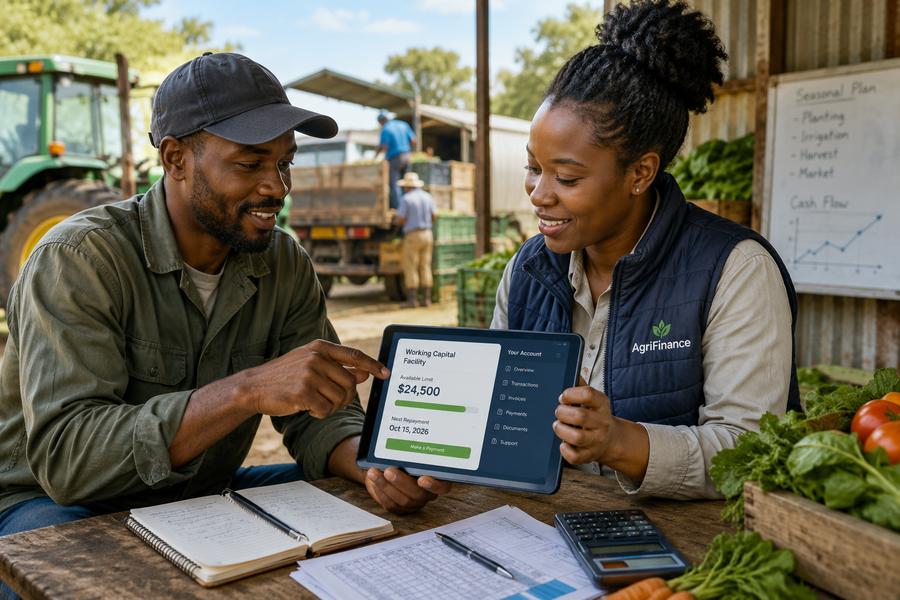
Farming is a business with a peculiar and unforgiving financial rhythm, in which money flows out of an operation long before it flows back in. A farmer must buy seeds, fertilizer, and other supplies at the start of a season, and pay for labor and equipment throughout the growing period, yet receives no income until the harvest is gathered and sold, many months later. This means that a farmer needs substantial money precisely when they have the least, at planting time, and earns money only at the very end of the cycle, creating a profound and unavoidable mismatch between the timing of expenses and income that is the single defining financial challenge of agriculture as a business. To bridge this gap, farmers need working capital, the money to fund the operation through the season until the harvest can finally pay it back, and access to that working capital very often determines whether a farmer can plant a full crop, use quality inputs, and ultimately succeed, or whether they are instead forced to scale back their planting, use inferior supplies, or fail altogether.
For a vast number of farmers, particularly the smallholders who produce much of the world’s food in developing regions, this working capital has been chronically difficult to obtain, leaving an enormous unmet need. Traditional banks have largely failed to serve these farmers, deterred by the lack of collateral, the absence of formal credit histories, the perceived riskiness of agriculture with its exposure to weather and price swings, and the high cost of reaching dispersed rural customers with small loans. The result is a massive agricultural credit gap, estimated in the many tens or hundreds of billions of dollars globally, that leaves farmers unable to access the working capital they need, forcing them to rely on expensive informal lenders, to underinvest in their farms, or to forgo opportunities, with consequences for their livelihoods and for the food systems that depend on them.
This article analyzes the fintech solutions designed to address this problem, examining lending and payment platforms built for the unique seasonal cash flow patterns of farming operations. It explains the nature of farm cash flow and the credit gap, the mechanisms by which fintech bridges the seasonal gap, including alternative credit scoring, input financing, and harvest-aligned repayment, and the technology and models that make these solutions possible. It weighs the genuine benefits and the real challenges for farmers, lenders, and the food system, and it grounds the discussion in documented platforms serving farmers around the world. The aim is to convey how financial technology is extending working capital to farmers long excluded from formal finance, and the difficulties and responsibilities that accompany lending to a sector as vital and as vulnerable as agriculture.
Understanding Farm Cash Flow and the Agricultural Credit Gap
To understand the fintech solutions for agricultural working capital, one must first understand the distinctive cash flow pattern of farming and why it creates such an acute need for credit. The fundamental feature of farm finance is its seasonality, the concentration of expenses at the beginning of a growing cycle and income at the end. A farmer incurs major costs up front, buying seeds, fertilizer, pesticides, and other inputs before and during planting, and paying for labor, fuel, and equipment throughout the season, but earns nothing until the crop is harvested and sold, often six months or more later. This produces a long period during which the farmer has spent heavily but received no return, a gap that must be financed somehow, and the size and timing of this gap, dictated by the biological reality of the growing cycle, is something the farmer cannot change, making the need for working capital to bridge it inherent to the nature of farming.
This seasonal mismatch creates a critical dependence on access to credit, since most farmers, particularly smallholders, lack the savings to fund a full season’s expenses from their own resources. A farmer who cannot finance the gap between planting expenses and harvest income faces a stark choice, either to scale back their operation, planting less or using cheaper, lower-quality inputs that reduce their yield, or to seek financing to cover the gap and farm at full capacity. Access to working capital therefore directly determines a farmer’s productivity and income, since adequate financing allows them to invest fully in their crop and maximize their harvest, while its absence forces underinvestment that perpetuates low yields and poverty. The ability to bridge the seasonal cash flow gap with credit is thus not a peripheral convenience but a central determinant of agricultural success, and the lack of it traps many farmers in a cycle of underinvestment and low productivity.
Despite this critical need, a large proportion of farmers, especially smallholders in developing regions, have been unable to access the working capital they require, resulting in a vast agricultural credit gap. Estimates place the unmet demand for smallholder agricultural finance in the range of many tens or even hundreds of billions of dollars across Africa, Asia, and Latin America, representing an enormous population of farmers who cannot obtain the credit they need to farm effectively. This gap reflects a systematic failure of traditional finance to serve agriculture, leaving farmers to rely on informal lenders who charge exorbitant rates, on their own inadequate resources, or on going without, and the consequences include not only individual hardship but reduced agricultural productivity and food production with implications for entire economies and food systems. The scale of the credit gap demonstrates that the failure to finance farmers is not a marginal issue but a massive and consequential gap in the global financial system.
It is worth dwelling on the human texture of this problem to understand what it means in practice, beyond the abstraction of a credit gap measured in billions. For a smallholder farmer with a few acres of land, the inability to obtain a modest loan, perhaps the equivalent of a few hundred dollars to buy quality seed and fertilizer, can be the difference between a harvest that lifts the family toward prosperity and one that barely covers subsistence. Such a farmer, lacking the cash to buy proper inputs at planting, may resort to saving seed from the previous harvest, applying too little fertilizer, or planting only part of their land, choices that predictably produce a smaller harvest and lower income, which in turn leaves them no better able to afford inputs the following season, perpetuating a trap of low productivity and poverty. The credit gap, in human terms, is this trap multiplied across hundreds of millions of households, a vast suppression of agricultural potential and human welfare caused not by any lack of land, effort, or skill but simply by the absence of the small amount of timely financing that would allow farmers to invest fully in what they already know how to do. Understanding the problem at this human scale clarifies why extending working capital to farmers, however modest each individual loan, carries such profound significance for poverty and food production alike.
The reasons traditional banks have failed to serve these farmers are instructive, because they reveal what fintech solutions must overcome. Banks have been deterred from lending to smallholder farmers by several formidable obstacles, including the lack of collateral, since many farmers do not have formal title to their land or other assets to pledge; the absence of credit histories, since farmers operating in informal economies have no formal record of borrowing and repayment for banks to assess; the perceived riskiness of agriculture, with its exposure to weather, pests, and volatile prices that can wipe out a harvest and a farmer’s ability to repay; and the high cost of serving dispersed rural customers with small loans, which makes the economics of traditional lending unattractive. These obstacles, the lack of collateral and credit history, the risk, and the cost, together made smallholder agricultural lending unappealing to traditional banks, leaving the credit gap unfilled, and it is precisely these obstacles that fintech solutions have set out to overcome, using technology and new models to assess risk, reach farmers, and structure credit in ways that traditional banking could not, addressing a need that the conventional financial system left unmet.
How Fintech Bridges the Seasonal Gap
Fintech solutions bridge the seasonal cash flow gap of farming by overcoming the obstacles that excluded farmers from traditional credit, using technology and new models to assess creditworthiness, deliver financing in usable forms, and structure repayment around the agricultural cycle. The approaches address the core problems directly, replacing the missing collateral and credit history with alternative data and new methods of risk assessment, delivering credit in the form of the inputs farmers actually need rather than cash that might be diverted, and aligning repayment with the harvest when farmers actually have income, rather than demanding regular payments they cannot make during the season. Together these innovations make it feasible and economical to extend working capital to farmers whom traditional finance could not serve.
The two subsections that follow examine the principal mechanisms. The first concerns alternative credit scoring and input financing, how fintech assesses the creditworthiness of farmers without collateral or formal credit history using new data and methods, and how it delivers credit in the form of farm inputs. The second concerns harvest-aligned repayment, bundled services, and payments, how fintech structures repayment around the agricultural season, bundles complementary services like insurance, and provides the digital payment infrastructure that supports the whole model. Understanding both how fintech assesses and delivers credit and how it structures repayment and bundles services is necessary to grasp how these solutions bridge the seasonal gap.
Alternative Credit Scoring and Input Financing
The foundational innovation that allows fintech to lend to farmers excluded from traditional credit is alternative credit scoring, the assessment of creditworthiness using new sources of data and new methods in place of the collateral and formal credit history that farmers lack. Because smallholder farmers typically have no collateral to pledge and no record of formal borrowing for a bank to evaluate, traditional credit assessment cannot serve them, but fintech lenders have developed ways to assess their creditworthiness using alternative data, such as information about the farmer and their farm, mobile phone usage and digital footprints, and crucially data about the land and crops gathered through technology. By analyzing such data with statistical and machine learning models, these lenders can predict the likelihood that a farmer will repay, building a credit profile from information that traditional lenders ignored or could not access, and thereby making it possible to extend credit to farmers who would have been rejected for lack of conventional creditworthiness.
A particularly powerful source of alternative data is satellite and remote-sensing information about a farmer’s land, which allows lenders to assess the farm itself as a basis for credit. Fintech lenders can use satellite imagery and data to verify the location and size of a farmer’s fields, to assess the condition and productivity of the land, and to monitor the growing crop, gaining objective information about the farm that informs the credit decision and reduces the risk of lending. By taking the coordinates of a farmer’s fields and analyzing satellite data about them, a lender can build a picture of the farm’s characteristics and prospects without ever visiting it, dramatically reducing the cost of assessing dispersed rural farmers and providing a basis for credit grounded in the actual productive asset. This use of satellite and farm data to assess creditworthiness is a distinctive innovation of agricultural fintech, turning the farm itself into a source of the information needed to extend credit, and it is central to making smallholder lending feasible at scale.
Equally important is the practice of delivering credit in the form of farm inputs rather than cash, which both ensures the financing is used productively and embeds the lender in the agricultural value chain. Rather than giving a farmer cash that might be spent on other needs, many agricultural fintech lenders provide credit in kind, supplying the seeds, fertilizer, and other inputs the farmer needs for the season, often along with training and advice on how to use them, with the cost of these inputs constituting the loan to be repaid after harvest. This input financing model ensures that the credit goes directly toward productive use, increasing the likelihood that the farmer’s investment will produce a successful harvest that can repay the loan, and it allows the lender to provide a bundled package of inputs, financing, and support that addresses the farmer’s needs holistically. By delivering credit as the inputs farmers actually need, often with guidance on their use, and arranging for repayment after the harvest, the input financing model aligns the lender’s interest in repayment with the farmer’s success, and it represents a distinctive approach that goes beyond simply lending money to actively supporting the productive use of the credit, which is central to how agricultural fintech bridges the seasonal gap effectively.
Harvest-Aligned Repayment, Bundled Services, and Payments
A defining feature of agricultural fintech is the structuring of repayment around the agricultural season, aligning the timing of repayment with the harvest when farmers actually have income, which is essential to lending that fits the reality of farming. Because a farmer earns income only at harvest, demanding regular monthly repayments during the season, as a conventional loan might, would be impossible for the farmer to meet, so agricultural lenders structure their loans with repayment schedules aligned to the agricultural cycle, often with little or nothing due during the growing season and the bulk of the repayment falling due after the harvest is sold. This harvest-aligned repayment is fundamental to making the credit usable, since it matches the obligation to pay with the moment the farmer has money, bridging the seasonal gap as intended rather than imposing an impossible demand for payment when the farmer has no income. The alignment of repayment with the harvest, allowing a farmer to pay a small deposit upfront and the balance after selling their crop, is a hallmark of agricultural fintech that distinguishes it from conventional lending unsuited to the farming cycle.
Agricultural fintech solutions increasingly bundle complementary financial services with credit, particularly insurance, addressing the risks that make agriculture so precarious and that threaten the farmer’s ability to repay. Because farming is exposed to weather, pests, and other hazards that can destroy a harvest and leave a farmer unable to repay, many agricultural fintech platforms bundle crop insurance with their lending, protecting both the farmer and the lender against the loss of the harvest, so that a farmer struck by a bad season is not left both without a crop and saddled with an unpayable debt. The bundling of insurance with credit addresses one of the central risks of agricultural lending and provides farmers with protection they could rarely access on their own, and platforms may bundle further services such as advice, market access, and other support, creating a comprehensive package that addresses the farmer’s needs holistically. This bundling of credit with insurance and other services reflects a recognition that farmers need more than just a loan, and that addressing the risks and needs around the credit makes the lending more sustainable and more valuable to the farmer.
Digital payment infrastructure underpins the entire model, providing the means to disburse credit, collect repayment, and serve farmers efficiently across dispersed rural areas. Agricultural fintech relies on digital payments, often through mobile money systems that are widely used in the developing regions where many of these farmers live, to disburse loans or pay for inputs, to collect repayments after harvest, and to handle the various transactions involved, reaching farmers who lack access to traditional banking infrastructure. The availability of mobile payment systems has been crucial to the feasibility of agricultural fintech, since it allows lenders to transact with dispersed rural farmers cheaply and efficiently without physical bank branches, and many platforms also provide payment and other financial services to farmers and rural enterprises as part of a broader offering. The digital payment infrastructure that enables low-cost transactions with rural farmers, combined with harvest-aligned repayment and bundled services, completes the model by which agricultural fintech bridges the seasonal gap, providing not just credit but the structuring, protection, and payment infrastructure that make lending to farmers viable and valuable, addressing the farmer’s needs comprehensively rather than offering credit alone.
The Technology and Models Behind Agricultural Fintech
The agricultural fintech solutions rest on a foundation of technology and business models that enable them to overcome the obstacles of cost, risk assessment, and reach that excluded farmers from traditional finance, and understanding these clarifies how the solutions function. At the technical core is the use of data and analytics to assess creditworthiness and manage risk, drawing on diverse sources including farm and satellite data, mobile and digital information, and other alternative data, analyzed with statistical and machine learning models. This data-driven approach is what allows lenders to evaluate farmers who lack conventional creditworthiness, building credit profiles and assessing risk from information that traditional lenders could not use, and the sophistication and quality of this data and analysis is central to the ability to lend to smallholders profitably and at scale. The development of these data and analytical capabilities, particularly the use of satellite and farm data, is a defining technical feature of agricultural fintech.
Mobile technology and digital payment infrastructure form a second essential pillar, providing the means to reach and transact with dispersed rural farmers efficiently. The widespread availability of mobile phones, even among smallholder farmers in developing regions, and the prevalence of mobile money systems for digital payments, are what make it feasible for fintech lenders to reach farmers, gather information, disburse credit, and collect repayment without the physical infrastructure that traditional banking requires. Farmers can interact with the lender through their phones, receive and repay credit through mobile payments, and access services digitally, allowing the lender to serve a large, dispersed population at low cost. This mobile and digital infrastructure, which has spread rapidly in many developing regions, is the foundation that makes reaching and serving rural farmers economical, and its availability has been a key enabler of agricultural fintech, without which the cost of serving dispersed smallholders would remain prohibitive.
The business models and partnerships through which agricultural fintech operates are crucial to its viability, since lending to farmers requires not just technology but ways to fund the loans, manage the risks, and integrate into the agricultural value chain. Agricultural fintech lenders must raise capital to fund the credit they extend, and they have used various means, including venture funding, debt facilities, and increasingly the securitization of their loan portfolios, by which the loans are packaged and sold to investors, providing the capital to lend at scale. Many also operate within the agricultural value chain, partnering with input suppliers, buyers of crops, and others, and some are deeply integrated, providing inputs, credit, advice, and market access together, which allows them to serve farmers comprehensively and to manage risk through their position in the value chain. The development of these business models and partnerships, and particularly the means of funding the loans, is essential to the sustainability and scale of agricultural fintech, since the social value of serving farmers must be matched by a viable model that can fund the lending and manage its risks.
The integration of these elements, the data and analytics, the mobile and payment infrastructure, and the business models and partnerships, into coherent operations is what distinguishes successful agricultural fintech and determines its impact. A successful platform combines the ability to assess and manage the risk of lending to farmers, the infrastructure to reach and transact with them efficiently, the means to fund the loans sustainably, and often an integrated position in the value chain that allows it to deliver inputs, credit, insurance, and support together, all structured around the agricultural cycle. The complexity of bringing these elements together, and of operating profitably while serving a challenging and risky customer base, is significant, which is why agricultural fintech requires substantial technological and operational capability, and why the leading platforms have invested heavily in building the data, the infrastructure, and the models needed to serve farmers viably. The technology and models behind agricultural fintech, comprising the data-driven risk assessment, the mobile and digital infrastructure, and the funding and value-chain integration, together constitute the foundation that has made it possible to extend working capital to farmers whom traditional finance could not serve, and the continued development of these capabilities shapes how far and how effectively the solutions can reach the vast population of underserved farmers.
Benefits and Challenges Across Stakeholders
Agricultural fintech produces distinct effects for the various parties involved, and a balanced assessment requires weighing its genuine benefits against its real challenges across farmers, lenders, and the broader food system. Farmers gain access to working capital and the productivity and income it enables, lenders gain a viable way to serve a large underserved market, and the food system benefits from increased agricultural production, yet these benefits come alongside the risks of weather and crop failure, the danger of over-indebtedness, the costs of credit, and the challenges of sustainability and scale. The solutions address a genuine and important need and have brought real benefits to many farmers, but they operate in a risky and difficult environment, so a clear-eyed view must hold the benefits and the challenges together, recognizing the value of extending credit to farmers alongside the responsibilities and risks of doing so.
The analysis below organizes these considerations by stakeholder and by category, first examining the benefits that accrue to farmers, lenders, and the food system when agricultural fintech works well, then turning to the risks, limitations, and sustainability challenges that determine whether those benefits are realized responsibly. Keeping these perspectives distinct helps move past both the promotion of agricultural fintech as a simple solution to rural poverty and the dismissal of it as exploitative lending, arriving at a grounded understanding of what these solutions genuinely offer and the real difficulties they face.
Benefits for Farmers, Lenders, and the Food System
For farmers, the central benefit is access to the working capital that enables them to farm at full capacity, invest in quality inputs, and increase their productivity and income, breaking the cycle of underinvestment that traps many in poverty. With access to credit structured around their season, a farmer can purchase the seeds, fertilizer, and other inputs needed to plant a full crop and maximize their yield, rather than scaling back or using inferior supplies for lack of financing, and the resulting increase in productivity can substantially raise their harvest and their income. The bundling of inputs, advice, insurance, and market access that many platforms provide further supports the farmer’s success, helping them use the credit productively, protect against risk, and sell their crop, and the overall effect can be a meaningful improvement in the farmer’s livelihood. For smallholder farmers long excluded from credit and trapped in low-productivity subsistence, access to working capital and the support around it can be genuinely transformative, enabling investment, raising incomes, and offering a path out of poverty that the lack of finance had foreclosed.
For lenders and the fintech companies that serve farmers, agricultural lending represents a large, underserved market that technology has made it possible to serve viably, creating a commercial opportunity alongside the social benefit. The vast agricultural credit gap represents an enormous population of potential customers whom traditional finance could not serve, and the fintech innovations in data, risk assessment, and delivery have made it possible to serve them profitably, opening a substantial market opportunity for the companies that can do so effectively. This commercial viability is essential, since it allows the provision of credit to farmers to be sustainable and to scale through private capital rather than depending solely on subsidy or charity, and it has attracted investment and entrepreneurship to the challenge of financing farmers. The alignment of commercial opportunity with social benefit, in which serving underserved farmers can be both profitable and impactful, is part of what has driven the growth of agricultural fintech, mobilizing private resources and innovation toward a problem of real social importance, though the viability depends on managing the genuine risks of agricultural lending.
For the broader food system and the economies that depend on agriculture, the increased productivity and production that agricultural finance enables carry significance well beyond the individual farmer. Agriculture is a foundation of food security and a major part of the economy in many developing regions, and by enabling farmers to invest fully and increase their yields, agricultural fintech can contribute to greater food production, more resilient food systems, and economic development in rural areas. The aggregation of many farmers gaining access to working capital and raising their productivity can translate into meaningful increases in agricultural output, supporting food security and rural prosperity, and the strengthening of agricultural value chains that some platforms facilitate can further improve the efficiency and resilience of food production. This contribution to food security and rural economic development represents a benefit of agricultural fintech that extends far beyond finance, touching the fundamental questions of how societies feed themselves and develop their rural economies, and it is part of what makes the financing of farmers a matter of broad importance rather than merely a commercial niche.
Risks, Limitations, and Sustainability
The most fundamental risk in agricultural lending is the exposure to weather, pests, disease, and price volatility that can destroy a harvest and leave a farmer unable to repay, a risk that is inherent to farming and that no amount of fintech innovation can eliminate. A drought, flood, pest outbreak, or collapse in crop prices can wipe out a farmer’s harvest and income, leaving them unable to repay their loan through no fault of their own, and this risk threatens both the farmer, who may be left with debt and no crop, and the lender, who faces losses. While insurance and other mechanisms can mitigate this risk, they cannot remove it, and the fundamental exposure of agriculture to forces beyond anyone’s control means that agricultural lending is inherently risky, that defaults will occur, and that both farmers and lenders bear the danger of seasons gone wrong. This irreducible risk is the central challenge of financing agriculture, and it shapes the cost and the sustainability of the credit, since lenders must price for the risk and manage the losses that bad seasons bring.
The danger of over-indebtedness and the burden of the cost of credit form a second serious concern, since extending credit to vulnerable farmers carries the risk of harming those it aims to help. If farmers borrow more than their harvest can support, or if a bad season leaves them unable to repay, they can fall into debt that deepens rather than relieves their poverty, and the consequences of default can be severe for a smallholder with little margin. The cost of agricultural credit, which must reflect the genuine risks and the costs of serving dispersed farmers, can also be high, and while it may be far cheaper than the informal lenders it replaces, it nonetheless imposes a real burden on farmers and can erode the benefits of the credit if it is too expensive. There is a genuine tension between extending credit broadly and protecting farmers from over-indebtedness, and the responsibility to lend in ways that genuinely benefit farmers rather than burdening them, assessing their capacity to repay and avoiding the predatory practices that have marred some lending to the poor, is a central ethical challenge of agricultural fintech that the social mission of the field makes especially important.
The remaining challenges concern the sustainability of the business models, the difficulty of reaching the most marginal farmers, and the limits of finance in addressing deeper problems. Serving smallholder farmers profitably is genuinely difficult, given the small loan sizes, the high costs of reaching dispersed customers, and the real risks of agricultural lending, and the sustainability of agricultural fintech models depends on managing these challenges, with some platforms still working toward profitability and depending on continued investment. Reaching the most marginal and remote farmers, who may be the most in need but the most costly and risky to serve, is especially difficult, and there is a danger that the solutions reach mainly the more accessible and creditworthy farmers while leaving the poorest still excluded. Finance also cannot by itself solve the deeper problems of agriculture, such as poor infrastructure, lack of market access, climate change, and structural disadvantages, and credit alone, while valuable, is not a complete solution to rural poverty. None of these challenges negates the genuine value of agricultural fintech, which addresses a real and important need and has benefited many farmers, but together they make clear that financing agriculture is difficult and risky, that the credit must be extended responsibly to genuinely help rather than harm vulnerable farmers, that the sustainability of the models is not assured, and that finance is a valuable but partial contribution to the larger challenge of agricultural development and rural prosperity, requiring careful management of the risks and a recognition of both its potential and its limits.
Real-World Implementations and Measured Outcomes
Agricultural fintech is embodied in real companies serving farmers around the world, and three examples illustrate the range of approaches and their impact, from smallholder input financing in Africa to bundled rural finance in India to supply-chain financing in the Americas. These cases span different regions, farmer populations, and models, together demonstrating how fintech extends working capital to farmers across the diverse landscape of global agriculture. Each is grounded in documented developments and figures, showing the solutions functioning in practice to bridge the seasonal cash flow gap for farmers long underserved by traditional finance.
Apollo Agriculture exemplifies the smallholder input financing model, using technology to extend working capital to small-scale farmers in Africa. The company provides smallholder farmers in countries including Kenya and Zambia with the inputs they need, such as seeds and fertilizer, on credit, along with advice and other support, assessing the farmers’ creditworthiness using mobile technology, satellite data about their fields, and machine learning models in place of the collateral and credit history they lack. The financing is structured around the agricultural season, with farmers paying a small deposit upfront and the bulk of the loan due after the harvest is sold, typically over a repayment schedule of around eight months aligned to the growing cycle. Apollo has reached a substantial number of farmers, serving over three hundred and fifty thousand by late 2023, and it has innovated in funding its lending, including through a pioneering securitization of its loan portfolio in Kenya backed by a pool of tens of thousands of smallholder farmers, many of them women, demonstrating a path to funding agricultural credit at scale. Apollo Agriculture illustrates the comprehensive smallholder model, combining alternative credit scoring, input financing, harvest-aligned repayment, and innovative funding to serve small-scale farmers whom traditional finance could not reach. Its securitization deal is particularly significant for the field, because the chronic challenge of agricultural fintech has been not only assessing and reaching farmers but funding the loans at a scale large enough to address the vast credit gap, and the ability to package smallholder loans into instruments that mainstream investors will buy points toward a path by which far larger pools of capital could flow into smallholder agriculture than philanthropy or venture funding alone could provide. The fact that such a transaction was concentrated among women farmers also speaks to the potential of these models to reach populations often doubly excluded from finance, both as smallholders and as women, whose access to credit has historically lagged.
Jai Kisan exemplifies the bundled rural finance model in India, providing farmers and rural enterprises with a range of financial services through a digital platform. The company operates a rural fintech platform that offers bundled services including microloans, crop insurance, and digital payments, using alternative data to enable instant, collateral-free lending to farmers who lack conventional creditworthiness, and serving not just individual farmers but the broader rural economy of enterprises and value-chain participants. Jai Kisan has reached a large population, reporting support for hundreds of thousands of farmers and rural enterprises through its platform, and it has attracted investment to fund its growth, reflecting the scale of the opportunity and the demand for rural financial services in India. By bundling credit with insurance and payments and using alternative data to extend collateral-free lending, Jai Kisan addresses the financial needs of the rural economy comprehensively, illustrating the model of integrated rural fintech that serves not just the working capital needs of farmers but the broader financial requirements of the agricultural value chain and the rural communities around it.
ProducePay exemplifies the supply-chain financing model, providing working capital and trade financing to produce growers and connecting them to markets. The company offers growers pre-season working capital and trade financing, advancing a portion of the value of their crop to fund their operations and providing financing through the supply chain, while also connecting growers to buyers and bringing predictability and transparency to the fresh produce trade. ProducePay has operated at substantial scale, facilitating billions of dollars in trade across many commodities and financing billions to farmers, and it raised significant funding, including a Series D round, to fuel its expansion, reflecting the demand for financing in the produce supply chain. Its model differs instructively from the smallholder-focused approaches, since it serves commercial growers who are larger and more established than subsistence smallholders but who nonetheless face the same fundamental seasonal cash flow gap between the costs of growing a crop and the income from selling it. By advancing a portion of a crop’s value before the harvest and tying the financing to the trade relationship with buyers, ProducePay uses its position in the supply chain to make working capital available against the security of the crop and its eventual sale, a structure well suited to commercial produce that flows through established trade channels. This illustrates that the seasonal working capital challenge spans the full range of farming operations, from the smallholder with a few acres to the commercial grower shipping across borders, and that fintech has developed models suited to each, with supply-chain financing addressing the needs of larger, market-connected growers as input financing addresses those of smallholders. By providing working capital tied to the produce trade and integrating financing with market access, ProducePay addresses the cash flow needs of growers through their position in the supply chain, illustrating a model focused on the value chain of fresh produce that extends working capital to growers while improving the functioning of the trade. Taken together, these three implementations, the smallholder input financier in Africa, the bundled rural fintech in India, and the supply-chain financier in the Americas, demonstrate the range of approaches through which fintech extends working capital to farmers across the diverse landscape of global agriculture, each addressing the seasonal cash flow gap in a manner suited to its context and farmer population, and together illustrating the genuine progress that financial technology has made in serving the working capital needs of farming operations long underserved by traditional finance.
Final Thoughts
Fintech solutions for agricultural working capital address one of the more consequential gaps in the global financial system, the chronic failure of traditional finance to provide the seasonal credit that farming requires, a failure that has trapped countless farmers in poverty and constrained the food production on which societies depend. By overcoming the obstacles of missing collateral and credit history, perceived risk, and the cost of reaching dispersed rural customers, through alternative credit scoring, satellite and farm data, input financing, harvest-aligned repayment, and digital payments, these solutions have extended working capital to farmers long excluded from formal finance, allowing them to invest fully in their crops and raise their productivity and income. The structuring of credit around the unique seasonal rhythm of farming, matching repayment to the harvest when farmers have income, reflects a genuine understanding of agriculture’s distinctive cash flow that conventional lending lacked.
The broader significance of this work lies in its potential to advance financial inclusion and food security simultaneously. By bringing credit to smallholder farmers who produce much of the world’s food yet have been denied the financing to do so effectively, agricultural fintech can raise the incomes of some of the world’s poorer populations while increasing agricultural production, linking poverty reduction and food security as few interventions do. The provision of working capital, bundled with the inputs, insurance, advice, and market access that farmers need, addresses the farmer’s situation holistically and can be genuinely transformative. The intersection of financial technology and social development is vivid here, in the use of data, mobile technology, and new models to serve a population whose financing has profound implications for human welfare and for how the world feeds itself.
The honest assessment must reckon with the genuine risks and the responsibilities that lending to vulnerable farmers entails. Agriculture is inherently exposed to weather, pests, and price swings that can destroy a harvest and a farmer’s ability to repay, a risk no innovation can eliminate, while the extension of credit to poor and vulnerable farmers carries the real danger of over-indebtedness that could deepen rather than relieve their poverty. The cost of the credit, the difficulty of reaching the most marginal farmers, the uncertain sustainability of the models, and the limits of finance in addressing agriculture’s deeper problems all temper the promise, and the responsibility to lend in ways that genuinely benefit farmers rather than burdening them is a central ethical imperative given the vulnerability of those served. These challenges demand that agricultural fintech be pursued with care, with attention to the risks and to the genuine welfare of farmers, and with humility about what finance alone can achieve.
The most balanced understanding is that fintech solutions for agricultural working capital represent a genuine and valuable advance in serving a critical need, capable of transforming farmers’ livelihoods and contributing to food security, while operating in a difficult and risky environment that demands responsible lending and realistic expectations. As the technology matures and the solutions extend their reach while managing the risks responsibly, the prospect grows of a future in which the working capital that farming requires is available to the farmers who need it, structured around their season and bundled with the support that helps them succeed. The enduring promise of this work lies in extending to farmers the financial access denied them, enabling them to invest in their farms and futures and thereby to raise their incomes and strengthen the food systems on which all depend, a contribution to financial inclusion and food security whose responsible realization serves some of the world’s most important and most underserved producers.
FAQs
- Why does farming create a unique cash flow problem?
Farming has a seasonal financial rhythm in which expenses come early and income comes late. A farmer must buy seeds, fertilizer, and other inputs at planting and pay for labor and equipment throughout the season, but receives no income until the harvest is gathered and sold, often six months or more later. This creates a long gap during which the farmer has spent heavily but earned nothing, a mismatch dictated by the biological reality of the growing cycle that the farmer cannot change. Bridging this gap requires working capital, which is why access to credit is so central to farming. - What is the agricultural credit gap?
The agricultural credit gap is the vast unmet demand for farm financing, particularly among smallholder farmers in developing regions, estimated in the range of many tens or even hundreds of billions of dollars globally. It reflects the failure of traditional banks to serve farmers, who are deterred by the lack of collateral, the absence of credit histories, the riskiness of agriculture, and the cost of reaching dispersed rural customers with small loans. The gap leaves farmers reliant on expensive informal lenders or unable to invest fully in their farms, with consequences for their livelihoods and for food production. - Why don’t traditional banks lend to smallholder farmers?
Several obstacles deter them. Many farmers lack collateral, having no formal title to land or other pledgeable assets; they lack credit histories, operating in informal economies with no record of borrowing for banks to assess; agriculture is perceived as risky due to weather, pests, and volatile prices that can wipe out a harvest; and serving dispersed rural customers with small loans is costly, making the economics unattractive. Together these obstacles made smallholder agricultural lending unappealing to traditional banks, leaving the credit gap unfilled, and they are precisely what fintech solutions have set out to overcome. - How does alternative credit scoring work for farmers?
Because smallholder farmers lack collateral and formal credit history, fintech lenders assess their creditworthiness using alternative data and methods. They draw on information about the farmer and farm, mobile phone usage and digital footprints, and crucially satellite and remote-sensing data about the land and crops, analyzing it with statistical and machine learning models to predict repayment. Satellite data lets lenders verify a farm’s location and size, assess its productivity, and monitor the growing crop without visiting it, dramatically reducing the cost of assessing dispersed farmers and grounding credit in the actual productive asset rather than conventional creditworthiness. - What is input financing?
Input financing is the practice of delivering credit in the form of farm inputs rather than cash. Instead of giving a farmer money that might be spent elsewhere, the lender supplies the seeds, fertilizer, and other inputs needed for the season, often with training and advice, and the cost of these inputs constitutes the loan to be repaid after harvest. This ensures the credit goes toward productive use, increasing the likelihood of a successful harvest that can repay the loan, and it lets the lender provide a bundled package of inputs, financing, and support. It aligns the lender’s interest in repayment with the farmer’s success. - How is repayment structured around the harvest?
Because a farmer earns income only at harvest, demanding regular monthly payments during the season would be impossible to meet, so agricultural lenders align repayment with the agricultural cycle. Loans typically have little or nothing due during the growing season and the bulk of the repayment falling due after the harvest is sold, often over a schedule of several months matched to the growing cycle, sometimes with a small deposit upfront and the balance after the crop is sold. This harvest-aligned repayment matches the obligation to pay with the moment the farmer has money, which is fundamental to making the credit usable. - Why is insurance bundled with agricultural loans?
Because farming is exposed to weather, pests, disease, and other hazards that can destroy a harvest and leave a farmer unable to repay, many agricultural fintech platforms bundle crop insurance with their lending. The insurance protects both the farmer and the lender against the loss of the harvest, so a farmer struck by a bad season is not left both without a crop and saddled with an unpayable debt. Bundling insurance addresses one of the central risks of agricultural lending, provides farmers protection they could rarely access alone, and makes the lending more sustainable, reflecting that farmers need more than just a loan. - What role does mobile technology play?
Mobile technology and digital payment systems are essential to reaching and transacting with dispersed rural farmers efficiently. The widespread availability of mobile phones even among smallholders, and the prevalence of mobile money systems in many developing regions, allow lenders to gather information, disburse credit, collect repayment, and provide services without the physical bank branches that traditional banking requires. Farmers interact with the lender through their phones and transact through mobile payments, letting the lender serve a large, dispersed population at low cost. This mobile and digital infrastructure is the foundation that makes serving rural farmers economical. - What are the main risks of agricultural fintech lending?
The most fundamental is agriculture’s exposure to weather, pests, disease, and price volatility, which can destroy a harvest and a farmer’s ability to repay, a risk no innovation can eliminate. There is also the danger of over-indebtedness, since extending credit to vulnerable farmers can deepen their poverty if they borrow more than their harvest can support or a bad season leaves them unable to repay. The cost of credit, while often cheaper than informal lenders, can be a real burden, and the sustainability of the business models and the difficulty of reaching the most marginal farmers are further challenges. Responsible lending is essential. - Which companies provide agricultural working capital?
Several, across different regions and models. Apollo Agriculture provides African smallholders with inputs on credit, using satellite data and machine learning for credit scoring and structuring repayment around the harvest, reaching hundreds of thousands of farmers. Jai Kisan operates a rural fintech platform in India offering bundled microloans, crop insurance, and payments using alternative data for collateral-free lending. ProducePay provides pre-season working capital and trade financing to produce growers in the Americas, integrating financing with market access. These illustrate the range of approaches to extending working capital across global agriculture.