In the ordinary digital world that most people inhabit, forgetting a password is a minor inconvenience, since almost every service offers a way to reset it, typically by sending a link to an email address or a code to a phone, restoring access within minutes. This convenience rests on a foundation of central authorities, the companies that run these services, who hold the ultimate control over accounts and can verify a user’s identity and grant them new access when they lose their credentials. The entire system of password recovery depends on someone in charge who can vouch for you and let you back in, a trusted intermediary standing behind every account. In the world of blockchain and self-custody, however, this safety net does not exist, because the entire point of these systems is that there is no central authority, no company holding your account, and no one who can reset your access if you lose it.
This creates one of the most serious and underappreciated problems in the world of decentralized technology, the catastrophe of lost access. In a self-custodial system, control over a blockchain account or identity rests entirely on possession of a cryptographic key, usually represented to the user as a seed phrase, a string of words that must be kept secret and safe, and if that key is lost, forgotten, or destroyed, the account and everything in it are gone forever, with no possibility of recovery. There is no forgot-password link, no customer service to call, no authority to appeal to; the funds or identity are simply inaccessible for all time. The scale of this problem is staggering, with estimates suggesting that millions of bitcoins, on the order of a fifth of all that will ever exist, have been lost forever to forgotten passwords, misplaced hardware, and destroyed keys, representing an enormous store of value rendered permanently inaccessible.
This article examines the mechanisms being developed to solve this problem, allowing people to recover access to their blockchain-based accounts and identities without relying on the centralized password resets of the traditional world. It explains the nature of self-custody and why the recovery problem is so acute, the methods being developed to enable recovery, including social recovery through trusted guardians and other approaches such as passkeys and cryptographic key-splitting, and the technology of smart accounts that makes these methods possible. It weighs the benefits and the trade-offs for users, developers, and the broader adoption of these technologies, and it grounds the discussion in documented implementations. The aim is to convey how the field is working to reconcile the self-sovereignty of decentralized systems with the basic human need for a way to recover from the inevitable loss of credentials, a reconciliation essential to making these technologies usable by ordinary people.
Understanding Self-Custody and the Recovery Problem
To understand the recovery problem, one must first understand self-custody and the cryptographic keys on which it rests. In blockchain systems, control over an account, its funds, and its associated identity is determined by possession of a private key, a secret cryptographic value that allows the holder to authorize transactions and prove ownership. Whoever holds the private key controls the account completely, and no one without it can access the account, which is the foundation of the self-sovereignty that decentralized systems prize, since it means a person can control their own assets and identity without depending on any bank, company, or government. This control is typically exercised through a wallet, software that manages the keys and lets the user interact with the blockchain, and the private key is usually backed up and represented to the user as a seed phrase, a sequence of words from which the key can be regenerated, which the user is instructed to write down and store securely.
The defining feature of this arrangement, and the source of both its power and its peril, is that the user alone holds the key, with no intermediary involved. This is what makes self-custody genuinely self-sovereign, since there is no third party who can freeze the account, seize its contents, censor its transactions, or deny the owner access, giving the user complete and unmediated control. But this same absence of any intermediary means there is no one to help if something goes wrong, no authority who can verify the user’s identity and restore their access if they lose their key, because the whole system is designed precisely to eliminate such authorities. The self-sovereignty that frees the user from dependence on intermediaries also strips away the safety net those intermediaries provide, leaving the user solely responsible for safeguarding the key on which everything depends, with no recourse if they fail.
The consequences of this arrangement for the loss of keys are uniquely severe, because the loss is permanent and irreversible. If a user loses their seed phrase, whether by misplacing the paper they wrote it on, forgetting where they stored it, losing the device that held it, or having it destroyed, they lose access to their account forever, with absolutely no way to recover it, since there is no one who can regenerate the key or grant alternative access. The blockchain itself cannot help, since it has no concept of the user’s identity apart from the key, and there is no company to appeal to, so the account and its contents become permanently frozen, visible on the blockchain but forever inaccessible. This is a fundamentally different situation from the traditional world, where a lost password is a temporary inconvenience resolved by a reset, and it represents a permanent and total loss that has no parallel in conventional finance or identity systems, a guillotine that falls the moment a key is irretrievably lost.
The scale of this problem demonstrates that it is not a rare edge case but a massive and ongoing source of loss, and it reveals self-custody’s greatest weakness as a barrier to broader adoption. Estimates that a large fraction of all bitcoin, amounting to millions of coins and an enormous sum of value, has been permanently lost to forgotten and destroyed keys illustrate the magnitude of the problem, and the same dynamic applies to any self-custodial account or identity, not just to cryptocurrency. The requirement that users perfectly safeguard a secret key, with catastrophic and permanent consequences for any failure, imposes a burden that ordinary people are poorly equipped to bear, since most people are not accustomed to managing critical secrets with no backup, and the fear of loss deters many from using self-custodial systems at all. This recovery problem, the absence of any way to regain access after losing one’s key, is widely recognized as one of the most significant obstacles to the broader adoption of decentralized technologies, since a system in which a single mistake can cause irreversible total loss is simply too dangerous and unforgiving for most people to use, and it is precisely this problem that the recovery mechanisms examined in this article aim to solve, by finding ways to provide a safety net without reintroducing the central authorities that self-custody was designed to eliminate.
It is worth noting that the recovery problem extends well beyond the storage of cryptocurrency to the broader vision of decentralized identity, where the stakes can be even higher. As people accumulate not just assets but credentials, reputation, relationships, and identity records tied to their cryptographic keys, the loss of those keys threatens not merely financial value but a person’s entire digital identity and standing, which could be far harder to reconstruct than a lost balance. A self-sovereign identity that a person has built up over years, holding their verified credentials and history, would be catastrophic to lose with no means of recovery, and the prospect of such loss is a serious obstacle to the adoption of decentralized identity systems, which depend on people being willing to entrust their identity to a key they alone control. This makes robust recovery not just a convenience for protecting funds but a prerequisite for the entire project of decentralized identity, since people cannot reasonably be asked to anchor their digital lives to a credential that, if lost, cannot be recovered. The same mechanisms developed to protect access to cryptocurrency wallets are therefore directly relevant to the larger ambition of giving people control over their own identities, and the importance of solving the recovery problem grows as the value anchored to cryptographic keys expands from money toward the full breadth of a person’s digital existence.
How Decentralized Recovery Works
Decentralized recovery mechanisms aim to provide a way to regain access to a lost account without reintroducing a central authority, solving the recovery problem while preserving the self-sovereignty that makes self-custody valuable. The fundamental challenge is to create a safety net that does not depend on any single trusted party who could control or seize the account, which requires distributing the ability to help recover access among multiple parties or mechanisms in such a way that no one of them has unilateral power over the account. The various recovery methods that have been developed represent different approaches to this challenge, each finding a different way to enable recovery while avoiding the concentration of control that would undermine self-custody, and together they offer users a range of options for protecting themselves against the catastrophe of lost keys.
The two subsections that follow examine the principal approaches. The first concerns social recovery, the method that distributes the ability to restore access among a group of trusted parties called guardians, requiring several of them to cooperate to recover the account, which has been the most influential and widely advocated approach. The second concerns the other methods that have emerged, including the use of passkeys backed up through familiar cloud services, the splitting of keys among multiple parties through cryptographic techniques, and other mechanisms, which offer alternative ways to provide recovery suited to different needs and preferences. Understanding both the social recovery model and the range of alternative methods is necessary to grasp how the field is working to solve the recovery problem.
Social Recovery and Guardians
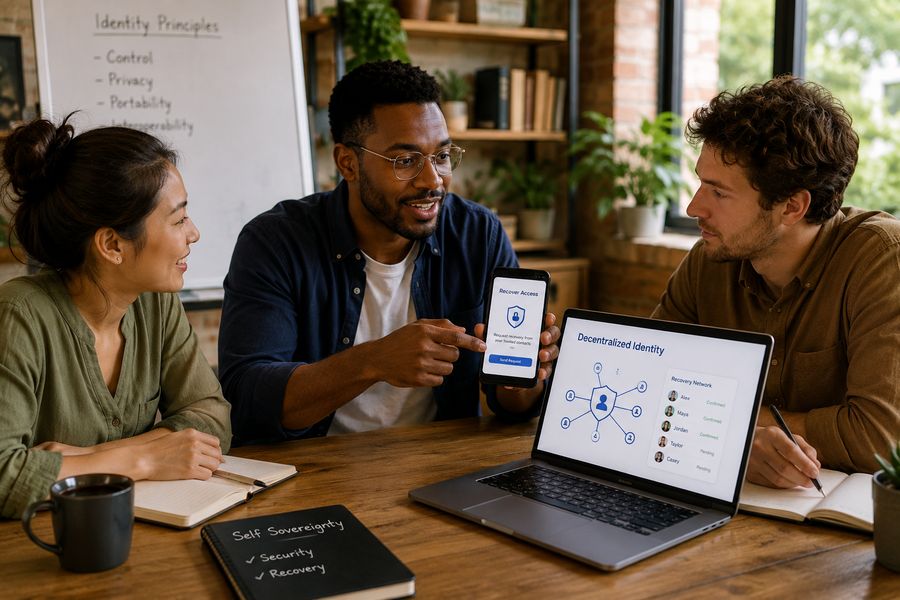
Social recovery is the most prominent approach to the recovery problem, and it works by entrusting the ability to restore access to an account to a group of trusted parties, called guardians, no single one of whom can control the account but a sufficient number of whom can together help the owner recover it. In a social recovery arrangement, the owner of an account designates a set of guardians, which might include trusted friends, family members, other devices the owner controls, or institutions, and the system is configured so that if the owner loses their key, a specified number of these guardians, such as a majority of them, can cooperate to authorize the assignment of a new key to the owner, restoring their access. During normal operation, the owner controls the account with their own key alone, and the guardians are not involved, but if that key is lost, the guardians provide the means to recover, acting as a distributed safety net.
The design of social recovery carefully avoids concentrating control in any single party, which is what allows it to provide recovery without undermining self-custody. Because recovery requires the cooperation of multiple guardians, no individual guardian can seize the account or act against the owner’s wishes, since no one of them has the power to change the account’s key alone, and the requirement for a quorum means that the owner is protected unless a majority of their guardians collude against them, which the owner can guard against by choosing trustworthy and independent guardians. At the same time, the loss of any single guardian, or even several, does not prevent recovery as long as the required number remain available, so the system is resilient to the loss of guardians as well as to the loss of the owner’s own key. This balance, requiring enough guardians to enable recovery but not so few that any one could abuse the power, is the essence of the social recovery design, and it provides a genuine safety net while preserving the owner’s ultimate control.
The conceptual appeal of social recovery is that it mirrors how trust and recovery often work in human life, distributing reliance across a network of relationships rather than concentrating it in a single institution. The approach was influentially advocated by prominent figures in the ecosystem, who argued that social recovery should become the default way that accounts are secured, replacing the dangerous reliance on a single seed phrase with a more resilient and forgiving model based on trusted relationships, and they made the case that the lonely burden of perfectly safeguarding a secret key should give way to a system in which one’s community provides a backstop. Social recovery thus represents not just a technical mechanism but a different philosophy of security, one that accepts that individuals will sometimes lose their keys and builds in a humane way to recover, drawing on the trust networks that people already have rather than demanding flawless individual key management. By spreading the ability to recover across multiple trusted parties while ensuring that no single party has control, social recovery offers a way to solve the recovery problem that preserves self-sovereignty, and it has become the leading model for making self-custody safe enough for ordinary people to use, though it requires users to have and to choose appropriate guardians, which is itself a consideration.
Passkeys, Multi-Party Computation, and Other Methods
Beyond social recovery, a range of other methods has emerged to address the recovery problem, each offering a different approach suited to different needs, and one of the most significant for mainstream adoption uses passkeys backed up through familiar cloud services. Passkeys are a modern authentication technology, increasingly adopted across the broader digital world, that replace passwords with cryptographic credentials tied to a user’s device and protected by biometrics or a device passcode, and crucially these passkeys can be automatically backed up and synchronized through the cloud services that people already use, such as those provided by major technology platforms. Applied to blockchain accounts, this means a user can control their account with a passkey on their phone, and if they lose the phone, they can recover access by signing into their familiar cloud account on a new device, which restores the passkey, eliminating the seed phrase entirely and making recovery as familiar as logging back into a phone. This approach leverages infrastructure people already understand and use, dramatically lowering the barrier to safe self-custody. Its great advantage is familiarity, since billions of people already rely on the cloud synchronization of major technology platforms to recover their photos, contacts, and passwords when they get a new device, and extending that same familiar recovery experience to a blockchain wallet asks nothing new of the user. The trade-off, which users should understand, is that this convenience comes at the cost of depending on the security of the cloud account and the platform behind it, partially reintroducing a reliance on a large company that pure self-custody sought to avoid, though the user retains control of the underlying wallet and the platform cannot directly seize their assets. For many ordinary users, this trade-off is a reasonable one, exchanging a measure of pure self-sovereignty for a recovery experience they can actually understand and use, which is far preferable to the alternative of a seed phrase they might lose forever.
Multi-party computation represents another important approach, splitting the key itself among multiple parties using advanced cryptography so that no single party ever holds the complete key. In a multi-party computation arrangement, the cryptographic key is divided into shares distributed among different parties or locations, such as the user’s device, a cloud service, and a backup, and transactions can be authorized through the cooperation of these shares without the full key ever being assembled in one place. Recovery is provided because the user can reconstruct their access from a sufficient combination of the shares they control, such as their device and a backup factor, even if one share is lost, and because no single party holds the complete key, the user retains control and security without depending on any one party. This method offers recovery and security while avoiding both the single point of failure of a seed phrase and, in well-designed systems, the need to trust any single party with the full key, and it has been used to provide user-friendly login and recovery experiences that feel familiar while preserving self-custody.
Other methods round out the toolkit of decentralized recovery, including arrangements that combine these approaches and mechanisms designed for particular needs. Multisignature schemes, in which an account is controlled by multiple keys and requires several of them to authorize actions, provide both security and a form of recovery resilience, since the loss of one key does not lose the account. Timelocked recovery mechanisms allow a backup method to take effect after a waiting period, giving the owner time to cancel an unauthorized recovery attempt, adding a layer of protection. Cryptographic techniques for splitting a secret into pieces, such that a certain number of pieces can reconstruct it, allow a user to distribute backup shares of their key among trusted locations or people. Many real systems combine several of these methods, offering users multiple factors and options for recovery to suit their preferences and circumstances. The diversity of these approaches reflects the recognition that different users have different needs and trust relationships, and that a range of recovery options, from social recovery to passkeys to key-splitting and their combinations, is necessary to make self-custody safe and accessible for the broad range of people the technology aims to serve, each method offering its own balance of security, convenience, and the distribution of trust.
The Technology Enabling Recovery: Account Abstraction and Smart Accounts
The recovery mechanisms described so far depend on a crucial technological development that makes them possible, the shift from simple accounts controlled by a single key to programmable accounts that can implement sophisticated logic, a development known as account abstraction. Understanding this technology clarifies why advanced recovery was difficult before and how it has become feasible. In the original design of many blockchains, accounts were of a basic type controlled directly by a single private key, with the rules for authorizing transactions fixed by the protocol and offering no flexibility, which meant that the account’s security depended entirely on that single key and there was no way to build in features like social recovery, since the account could not execute custom logic. This rigidity was the technical root of the recovery problem, because an account that could only be controlled by one key, with no programmable logic, had no way to provide alternative paths to access.
Account abstraction changes this by allowing accounts to be controlled by programmable smart contracts rather than by a single fixed key, enabling the account itself to implement custom rules for authorization and recovery. A smart contract account, sometimes called a smart account, can be programmed with arbitrary logic about how transactions are authorized and how access can be recovered, allowing it to implement social recovery, require multiple signatures, accept passkeys, enforce timelocks, or combine these and other mechanisms. This programmability is what makes the recovery mechanisms possible, since features like guardian-based recovery require the account to be able to execute the logic of checking for guardian approvals and changing its controlling key, which only a programmable account can do. By moving from rigid, single-key accounts to flexible, programmable smart accounts, account abstraction provides the foundation on which all the sophisticated recovery methods are built, transforming the account from a simple key-controlled construct into a programmable entity that can implement whatever security and recovery logic its owner chooses.
The practical realization of account abstraction has advanced significantly, with standards and infrastructure making smart accounts increasingly available and adopted. A key standard for account abstraction was deployed on a major blockchain in early 2023, providing a way to implement smart accounts without requiring changes to the underlying protocol, and adoption has grown substantially since, with many millions of smart accounts deployed across various networks and rapid year-over-year growth, particularly on newer, lower-cost networks where the transactions involved are cheap. This growth reflects increasing recognition that smart accounts, with their support for recovery and other user-friendly features, are essential to making blockchain technology usable by ordinary people, and major platforms and wallets have embraced the approach, building products around smart accounts that offer recovery and other improvements over the traditional single-key model. The maturation of account abstraction from a concept into deployed, widely adopted infrastructure has been the key enabler of practical decentralized recovery, turning the theoretical possibility of programmable recovery into real products that people can use.
The significance of this technological shift extends beyond recovery to a broader improvement in the usability of decentralized systems, of which recovery is a central part. Smart accounts enable not just recovery but a range of features that make self-custody more user-friendly, including the ability to have transactions paid for by others, to batch multiple actions together, to set spending limits, and to implement various security policies, all of which improve the experience of using blockchain technology. Recovery is perhaps the most important of these improvements, since it addresses the catastrophic risk of lost keys that has deterred so many potential users, but it is part of a larger transformation in which programmable accounts make decentralized systems more forgiving, more flexible, and more accessible. The combination of account abstraction as the enabling technology and the various recovery mechanisms built upon it represents a concerted effort to overcome the usability barriers that have limited the adoption of self-custody, and the recovery capabilities that smart accounts provide are central to the prospect of decentralized technologies becoming usable by a broad population rather than only by the technically sophisticated few willing to bear the risk of irreversible loss.
Benefits and Challenges Across Stakeholders
Decentralized recovery mechanisms produce distinct effects for the various parties involved, and a balanced assessment requires weighing their genuine benefits against their trade-offs across users, developers, and the broader adoption of decentralized technology. Users gain protection against the catastrophe of lost keys and a more usable experience, developers gain the ability to build accessible products, and the broader ecosystem gains the prospect of mainstream adoption, yet these benefits come with trade-offs around the trust placed in guardians or services, the complexity of the systems, and the risk of reintroducing forms of centralization. The mechanisms address a genuine and serious problem, but they involve compromises, so a clear-eyed view must weigh the protection they provide against the trust and complexity they require.
The analysis below organizes these considerations by stakeholder and by category, first examining the benefits that accrue to users, developers, and adoption when these mechanisms work well, then turning to the risks, trust trade-offs, and limitations that determine whether the protection they offer comes at an acceptable cost. Keeping these perspectives distinct helps move past both the enthusiasm that presents recovery as a simple solution and the purist objection that any recovery mechanism compromises self-custody, arriving at a grounded understanding of what these mechanisms genuinely offer and what they require in return.
Benefits for Users, Developers, and Adoption
For users, the central benefit is protection against the catastrophe of permanent, irreversible loss, transforming self-custody from a terrifyingly unforgiving system into one that can tolerate the inevitable mistakes people make. With a recovery mechanism in place, a user who loses their device or forgets their credentials is no longer doomed to lose everything forever, but can regain access through their guardians, their cloud backup, or another recovery path, removing the single most frightening aspect of self-custody. This protection makes self-custody dramatically safer and less stressful, allowing users to hold their own assets and control their own identity without the constant fear that a single mistake will cause total loss, and it makes the technology accessible to ordinary people who could never have safely managed the perfect, backup-free safeguarding of a secret key. The shift from a system that punishes any error with irreversible catastrophe to one that provides a humane way to recover is a profound improvement in the user’s position, making self-sovereignty safe enough to be practical.
For developers and the products they build, recovery mechanisms enable the creation of applications and wallets that ordinary people can actually use, removing a major barrier to building accessible decentralized products. A developer building a wallet or application can now offer users a familiar, forgiving experience with recovery options rather than confronting them with the daunting and dangerous seed phrase, allowing the product to reach users who would have been deterred by the risk and complexity of traditional self-custody. The availability of recovery, along with the other features that smart accounts enable, lets developers create products that feel more like the familiar applications people are used to, with the safety net of recovery built in, which is essential to building decentralized products with mainstream appeal. This ability to offer accessible, forgiving experiences expands the range of products that can be built and the users they can reach, benefiting developers seeking to bring decentralized technology to a broad audience and the users who can then access it safely.
For the broader adoption of decentralized technology, recovery mechanisms address one of the most significant obstacles standing in the way of mainstream use, the unacceptable risk of irreversible loss. The fear of losing everything to a lost key has been a major deterrent to the adoption of self-custodial systems, confining them largely to the technically sophisticated and risk-tolerant, and by providing a safety net, recovery mechanisms remove this deterrent and make the technology safe enough for a broad population. This is essential to the prospect of decentralized technology achieving its potential to give people genuine control over their assets and identities, since that potential cannot be realized if the technology is too dangerous for ordinary people to use, and recovery is a key part of making self-sovereignty practical at scale. The development of robust recovery mechanisms thus serves the broader goal of bringing the benefits of decentralization, including self-control, censorship resistance, and freedom from dependence on intermediaries, to the many people who could benefit from them but who cannot accept the risk of catastrophic loss that unmitigated self-custody entails, advancing the cause of a more accessible and inclusive decentralized future.
Risks, Trust Trade-offs, and Limitations
The most fundamental trade-off is that recovery mechanisms necessarily reintroduce some form of trust or dependency, which sits in tension with the pure self-sovereignty that self-custody was meant to provide. Social recovery requires trusting that a sufficient number of guardians will not collude against the owner and will be available when needed, passkey backup requires trusting the cloud service that synchronizes the passkey, and multi-party computation requires trusting the parties or services that hold the key shares, so each method involves placing some trust in others, even if that trust is distributed and limited. This means that recovery mechanisms represent a compromise of the absolute self-sovereignty of holding one’s own key alone, accepting some dependency in exchange for protection against loss, and while the trust involved is generally distributed and constrained so that no single party has control, it is not the same as the trustless ideal, and purists may object that any such dependency undermines the point of self-custody. The challenge is to provide recovery while keeping the trust involved as limited, distributed, and controllable as possible, but some trust trade-off is inherent in the very provision of a safety net.
Specific risks attend each recovery method, and users must understand them to use the mechanisms safely. Social recovery depends on the owner having chosen trustworthy and available guardians, and it can fail if too many guardians become unavailable, lose their own keys, or are compromised, and it carries the risk of guardians colluding to seize the account, so the security depends heavily on the choice of guardians. Passkey and cloud-based recovery depends on the security and availability of the cloud service, introducing a dependency on a major technology platform whose account, if compromised or lost, could endanger the wallet, partially reintroducing the kind of centralized dependency that self-custody sought to avoid. Multi-party computation and other methods have their own dependencies and potential points of failure, and all of these mechanisms add complexity that can itself introduce risks if not implemented and used correctly. The various methods thus trade the single, catastrophic risk of seed phrase loss for a different set of risks involving the trusted parties and the additional complexity, and while these new risks are generally less catastrophic and more manageable, they are real and must be understood.
The remaining challenges concern complexity, the maturity of the technology, and the broader difficulty of getting security right. The recovery mechanisms and the smart accounts that enable them are more complex than simple key-controlled accounts, and this complexity can introduce bugs, vulnerabilities, and user errors, since more sophisticated systems have more ways to go wrong, and the security of these mechanisms depends on their being correctly designed, implemented, and used. The technology, while maturing rapidly, is still relatively new, and the various approaches and standards are still evolving, so the long-term reliability and security of the mechanisms are not yet fully proven. There is also the perennial difficulty that security involves trade-offs between safety and convenience, and that mechanisms which are too cumbersome will not be used while those which are too convenient may be insecure, requiring careful balance. None of these challenges negates the genuine value of recovery mechanisms, which address a real and serious problem, but together they make clear that recovery is not a simple or cost-free solution, that it involves real trade-offs around trust and complexity, and that the various methods each represent a particular balance of protection, trust, and convenience that users must understand and choose among according to their needs, with the recognition that the goal is not the impossible one of eliminating all risk but the practical one of replacing the catastrophic, unforgiving risk of lost keys with a more manageable and humane set of trade-offs.
Real-World Implementations and Measured Outcomes
Decentralized recovery mechanisms are embodied in real products and standards, and three examples illustrate the range of approaches and their adoption, from a pioneering social recovery wallet to a mainstream passkey-based product to the underlying standard that enables them. These cases span the wallet that introduced modern social recovery, a major company’s effort to bring seedless self-custody to a broad audience, and the account abstraction infrastructure on which these mechanisms are built, together demonstrating that decentralized recovery has moved from concept to deployed, adopted reality. Each is grounded in documented developments, showing the technology functioning in practice to address the recovery problem.
Argent exemplifies the pioneering implementation of social recovery, having introduced the modern guardian-based model and refined it over years. The wallet implemented social recovery, allowing users to designate guardians who could help them recover access if they lost their key, pioneering the pattern that became the leading approach to the recovery problem and demonstrating that self-custody could be made safe through a distributed network of trusted parties rather than the lonely safeguarding of a seed phrase. Argent built its products around this model, offering users a more forgiving and user-friendly experience than traditional wallets, and it refined the approach across its successive products, including wallets for newer networks, contributing significantly to the development and popularization of social recovery. By demonstrating in a real, usable product that social recovery could work and could make self-custody safer and more accessible, Argent played a foundational role in establishing recovery as a central concern and a solvable problem, and its pioneering work shaped the broader development of recovery mechanisms across the ecosystem. Argent’s experience also surfaced practical lessons that informed later designs, including the importance of making the guardian setup and recovery processes simple enough for non-technical users to complete, the need to handle the cost and friction of on-chain recovery operations, and the challenge of helping users choose and maintain an appropriate set of guardians over time. These practical considerations, learned through real deployment rather than theory, proved as important as the underlying cryptography, since a recovery mechanism that is technically sound but too cumbersome or confusing to use will not actually protect the people it is meant to serve. The accumulation of such hard-won usability lessons from pioneering implementations has been essential to the gradual refinement of recovery into something genuinely practical, illustrating that solving the recovery problem is as much a matter of thoughtful product design as of cryptographic invention.
Coinbase Smart Wallet exemplifies the effort to bring seedless, recoverable self-custody to a mainstream audience through familiar technology. Launched by a major company in 2024, the wallet was designed from the ground up to eliminate the seed phrase, using passkeys as the means of control, so that users could create and use a self-custodial wallet with the familiar experience of a passkey protected by their device’s biometrics, without ever confronting a seed phrase. Crucially, recovery was provided through the cloud synchronization that already backs up passkeys, so that a user who lost their device could recover their wallet by signing into their familiar cloud account on a new device, which restored the passkey, and the wallet also offered the option to set up an additional recovery method for added protection. This approach leveraged the passkey infrastructure increasingly adopted across the broader digital world, making self-custody as familiar and recoverable as logging back into a phone, and it represented a serious effort by a major, mainstream company to make recoverable self-custody accessible to ordinary people, demonstrating how the recovery problem could be addressed using technology that people already understand and trust.
Account abstraction, embodied in the relevant standard and the broad adoption of smart accounts, exemplifies the underlying infrastructure that makes all these recovery mechanisms possible. A key standard for account abstraction was deployed on a major blockchain in early 2023, providing the foundation for programmable smart accounts without requiring changes to the underlying protocol, and the adoption of smart accounts built on this and related infrastructure has grown dramatically, with many millions deployed across various networks and rapid growth, particularly on newer, lower-cost networks. This infrastructure is what enables the recovery mechanisms, since the programmability of smart accounts is required to implement social recovery, passkey control, and the other methods, and the broad adoption of smart accounts reflects the growing recognition that programmable accounts with recovery and other user-friendly features are essential to making decentralized technology usable. The maturation of account abstraction from concept to widely deployed infrastructure, supporting a rapidly growing number of smart accounts and the products built on them, demonstrates that the foundation for decentralized recovery has been established and is being adopted at scale. Taken together, these implementations, the pioneering social recovery wallet, the mainstream passkey-based product, and the enabling account abstraction infrastructure, demonstrate that decentralized recovery has progressed from an identified problem to a set of working solutions being adopted in real products, marking significant progress toward making self-custody safe enough for ordinary people to use.
Final Thoughts
Decentralized identity recovery mechanisms address what may be the most fundamental obstacle to the broader adoption of self-custodial technology, the unforgiving and catastrophic consequence of losing one’s key, which has rendered enormous value permanently inaccessible and deterred countless people from using systems that demand flawless safeguarding of a secret with no possibility of recovery. The development of recovery mechanisms represents an effort to resolve the central tension of self-custody, between the self-sovereignty that comes from holding one’s own key with no intermediary and the basic human need for a way to recover from the inevitable loss of credentials. By finding ways to provide a safety net without reintroducing the central authorities that self-custody was designed to eliminate, these mechanisms aim to preserve the genuine benefits of self-sovereignty while making it safe enough for ordinary people, a reconciliation essential to the prospect of decentralized technology fulfilling its promise.
The broader significance of this work lies in its potential to make self-sovereignty genuinely accessible, extending the benefits of controlling one’s own assets and identity to people who could never have safely managed the unforgiving demands of traditional self-custody. The ideal of self-sovereignty, of people controlling their own digital lives without depending on intermediaries who can censor, seize, or deny them access, is a powerful one, but it has been largely confined to the technically sophisticated and risk-tolerant by the danger of irreversible loss, and recovery mechanisms hold the promise of bringing this ideal within reach of a broad population. The development of social recovery, passkey-based wallets, and other recoverable approaches represents real progress toward a future in which ordinary people can enjoy the benefits of self-custody without the terror of catastrophic loss.
The honest assessment must acknowledge that recovery mechanisms involve genuine trade-offs and do not perfectly resolve the tension they address. Every recovery method reintroduces some form of trust or dependency, whether in guardians, cloud services, or other parties, compromising the absolute self-sovereignty of holding one’s key alone in exchange for protection against loss, and each method carries its own risks and complexities that users must understand. The mechanisms replace the single catastrophic risk of lost keys with a different and generally more manageable set of risks, but they do not eliminate risk or the need for trust entirely, and the choice among them involves balancing protection, trust, and convenience according to one’s needs. This is not a failure of the mechanisms but a reflection of the inherent difficulty of providing a safety net without a central authority, and the appropriate response is not to demand an impossible perfection but to design and choose recovery mechanisms that keep the trust involved as limited and distributed as possible while providing genuine protection.
The most balanced understanding is that decentralized recovery mechanisms represent essential and genuine progress toward making self-custody practical, even as they involve real trade-offs that must be understood and managed. As the technology matures and products built around recovery bring safe self-custody to wider audiences, the prospect grows of a future in which the benefits of self-sovereignty are available to ordinary people without the unacceptable risk of catastrophic loss that has confined them to a narrow few. The enduring importance of this work lies in making genuine self-sovereignty accessible and safe, resolving the tension between control and recoverability in a way that preserves the essential benefits of decentralization while removing its most dangerous barrier, a crucial contribution to the broader project of giving people real, safe control over their own digital assets and identities.
FAQs
- Why can’t I just reset my password on a blockchain wallet?
Because there is no central authority to reset it. In ordinary digital services, a company holds your account and can verify your identity and grant new access when you lose your credentials. Blockchain self-custody is designed to eliminate such authorities, so control rests entirely on possession of a cryptographic key, usually backed up as a seed phrase. There is no company holding your account and no one who can reset your access. If you lose the key, there is no forgot-password link, no customer service, and no authority to appeal to. - What happens if I lose my seed phrase?
In a traditional self-custodial wallet, losing your seed phrase means losing access to your account and everything in it forever, with no way to recover it. There is no one who can regenerate the key or grant alternative access, the blockchain has no concept of your identity apart from the key, and there is no company to appeal to, so the account becomes permanently frozen, visible on the blockchain but forever inaccessible. This permanent, irreversible loss is fundamentally different from the temporary inconvenience of a forgotten password in the ordinary digital world. - How much value has been lost to lost keys?
An enormous amount. Estimates suggest that millions of bitcoins, on the order of a fifth of all that will ever exist, have been permanently lost to forgotten passwords, misplaced hardware, and destroyed keys, representing a vast store of value rendered forever inaccessible. The same dynamic applies to any self-custodial account or identity. This scale demonstrates that the recovery problem is not a rare edge case but a massive, ongoing source of loss, and it illustrates why the requirement to perfectly safeguard a key with no backup is such a serious barrier to broader adoption. - What is social recovery?
Social recovery is a method that lets you recover access to your account through a group of trusted parties called guardians, no single one of whom can control your account but a sufficient number of whom can together help you recover it. You designate guardians, such as trusted friends, family, or your own devices, and if you lose your key, a specified number of them can cooperate to assign a new key to you, restoring access. During normal use, you control the account alone, and the guardians are involved only in recovery, acting as a distributed safety net that preserves your control. - Can my guardians steal my account?
Social recovery is designed to prevent this by requiring the cooperation of multiple guardians, so no single guardian can seize your account. You are protected unless a majority of your guardians collude against you, which you can guard against by choosing trustworthy and independent guardians who do not all know one another. The system also tolerates the loss of some guardians, since only a required number need to cooperate. The security therefore depends heavily on choosing guardians wisely, but the design ensures that no individual guardian has unilateral power over your account. - How do passkeys help with recovery?
Passkeys are a modern authentication technology that replaces passwords with cryptographic credentials tied to your device and protected by biometrics, and crucially they can be automatically backed up and synchronized through familiar cloud services. Applied to blockchain accounts, this means you control your account with a passkey on your device, and if you lose the device, you can recover access by signing into your cloud account on a new device, which restores the passkey. This eliminates the seed phrase and makes recovery as familiar as logging back into a phone, leveraging infrastructure people already use. - What is multi-party computation in wallets?
Multi-party computation is a method that splits the cryptographic key into shares distributed among multiple parties or locations, such as your device, a cloud service, and a backup, so no single party ever holds the complete key. Transactions can be authorized through the cooperation of these shares without the full key being assembled in one place, and recovery is provided because you can reconstruct access from a sufficient combination of shares you control, even if one is lost. This offers recovery and security while avoiding both the single point of failure of a seed phrase and dependence on any one party holding the full key. - What is account abstraction and why does it matter for recovery?
Account abstraction allows accounts to be controlled by programmable smart contracts rather than a single fixed key, enabling the account to implement custom rules for authorization and recovery. This matters because advanced recovery methods like social recovery require the account to execute logic, such as checking guardian approvals and changing its key, which only a programmable account can do. Original blockchain accounts were rigid, single-key constructs with no way to provide alternative access, which was the technical root of the recovery problem. Account abstraction provides the foundation on which all sophisticated recovery mechanisms are built. - Do recovery mechanisms compromise self-custody?
They involve a trade-off. Every recovery method reintroduces some form of trust or dependency, whether in guardians, cloud services, or other parties, which compromises the absolute self-sovereignty of holding your key alone in exchange for protection against loss. However, the trust is generally distributed and constrained so that no single party has control of your account, and the methods aim to keep that trust as limited as possible. The choice is between the pure but unforgiving self-custody of a single seed phrase and a more forgiving model that accepts some limited, distributed trust in exchange for a safety net. - Are these recovery methods safe and proven?
They address a real and serious problem and represent genuine progress, but they are relatively new and involve their own trade-offs. The methods replace the single catastrophic risk of seed phrase loss with a different, generally more manageable set of risks involving the trusted parties and the added complexity of the systems. The technology is maturing rapidly and is being adopted at scale, with pioneering social recovery wallets, mainstream passkey-based products, and broad adoption of the underlying smart account infrastructure, but the long-term reliability is still being proven, and users should understand the specific trade-offs of whichever method they choose.