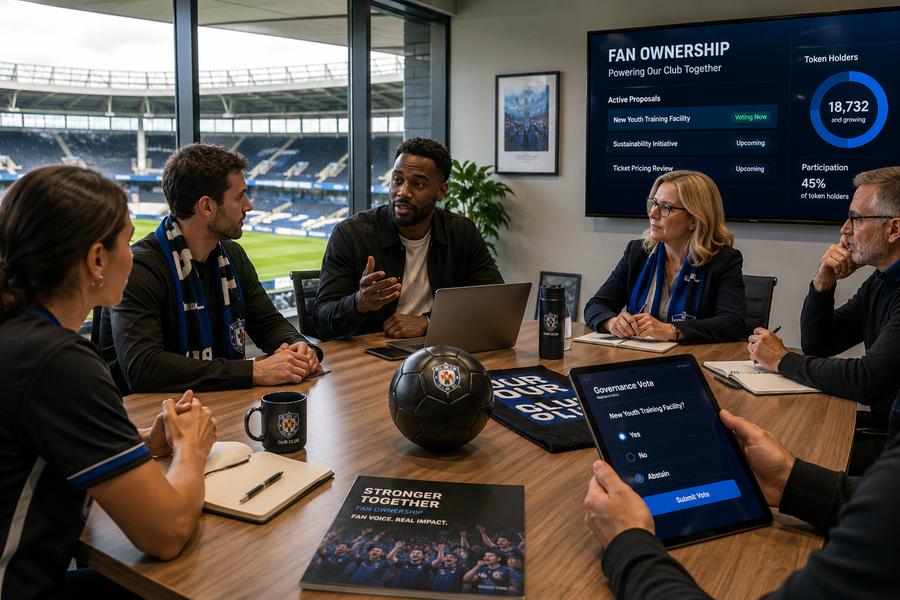
For as long as professional sports have existed, the relationship between a club and its supporters has carried a peculiar imbalance, since the fans provide the passion, the atmosphere, the loyalty across generations, and a great deal of the money that sustains the enterprise, yet they almost never have any say in how the club is run. A supporter may give a lifetime of devotion to a team, may organize their weekends and their identity around it, and may spend thousands of dollars over the years on tickets, shirts, and travel, and still have no more influence over the club’s decisions than a stranger, watching helplessly as distant owners hire and fire managers, raise ticket prices, or even, in the most painful cases, move or rename the team they love. This powerlessness has long been a deep and abiding source of frustration for committed supporters, who feel a profound sense of ownership over their clubs that the legal and financial structures of professional sport rarely recognize or reward.
Into this old tension has come a new technology promising to rewrite the relationship, as a wave of clubs and companies have begun experimenting with blockchain-based tokens that claim to give supporters a real stake and a genuine voice in the clubs they follow. Under the banner of what is often called Web3, the decentralized vision of the internet built on blockchains, these experiments take various forms, from fan tokens that let holders vote on club matters to more ambitious models in which supporters collectively buy and govern a club through digital ownership, all united by the promise of bringing fans, at last, into the boardroom. The appeal is obvious and emotionally powerful, since it speaks directly to the long-felt desire of supporters to matter, to be more than paying spectators, and to have their devotion translated into actual influence over the institutions they cherish. It is precisely because this desire runs so deep, and because the frustration of powerlessness is so widely shared, that the language of empowerment surrounding these tokens has found such a receptive audience, and it is also why a careful, honest assessment of what the tokens actually deliver matters so much, since supporters moved by a genuine longing for a voice are vulnerable to schemes that promise far more than they provide.
This article examines the phenomenon of token-based fan ownership for readers who may know little about either sports finance or blockchain, beginning with the long history of fan ownership that predates Web3 and provides the standard against which the new models should be judged. It explains how fan tokens and NFT-based ownership actually work and what rights they genuinely confer, then turns to documented real-world experiments that show what has happened when supporters have entered the boardroom, before weighing carefully where these tokens deliver real power and where they amount to little more than marketing. Throughout, it aims to cut through both the hype of promoters and the cynicism of critics, presenting the evidence so that readers can judge for themselves whether Web3 represents a genuine shift toward supporter power or a new way to monetize the loyalty fans have always given freely.
The Long History of Fan Ownership
The idea that supporters might own or control their clubs is far older than blockchain, and understanding this history is essential to evaluating the Web3 experiments, because fan ownership in various forms has existed for over a century and has produced some of the most stable and beloved institutions in sport. Long before anyone spoke of tokens, clubs in several countries were structured as membership organizations in which the supporters were, in a real legal sense, the owners, electing the leadership and holding ultimate authority over the club’s direction, and these arrangements demonstrated that fan ownership is not a futuristic fantasy but a proven model with a long track record. The existence of these traditional models means that the Web3 projects are not inventing fan ownership but proposing a new technological mechanism for something that has been achieved before through more conventional means, and they must be measured against what those conventional means have already delivered.
The traditional models of fan ownership matter not only as historical precedent but as a benchmark for genuine supporter control, since they show what real ownership looks like when it gives fans actual authority over the most consequential decisions a club makes. In these arrangements, supporters do not merely vote on trivial matters like the color of a kit or the song played after a goal, but hold the power to elect the people who run the club, to approve major financial decisions, and to prevent the club from being sold to owners they distrust, which represents a depth of control far beyond what most fan tokens offer. This distinction between superficial participation and genuine authority is the central lens through which the Web3 experiments should be viewed, and the traditional models provide the clearest illustration of where that line falls.
At the same time, the traditional models have their own limits and have not spread universally, which helps explain why there remains an appetite for new approaches that might extend fan ownership to clubs and contexts where the conventional models have not taken hold. Membership ownership requires particular legal structures, a culture that supports it, and often regulatory protection, and in many of the world’s largest sports markets the dominant model remains private ownership by wealthy individuals or investment groups, leaving the great majority of supporters with no ownership stake at all. It is into this gap, between the proven possibility of fan ownership and its limited actual spread, that the Web3 projects have stepped, claiming that blockchain technology can democratize ownership and bring supporter control to clubs that would otherwise never have it, a claim whose plausibility depends heavily on whether the tokens deliver the genuine authority that the traditional models prove is possible.
Member-Owned Models: 50+1 and the Packers
The most prominent example of institutionalized fan ownership is the German football model known as the fifty plus one rule, introduced in 1998, which requires that club members hold a majority of the voting rights in their clubs, specifically fifty percent plus one additional vote, ensuring that the supporters retain ultimate control over decision-making and that external investors cannot acquire a controlling stake in the top two divisions of German football. This rule embodies a philosophy that clubs are community institutions belonging fundamentally to their supporters rather than commodities to be bought and sold, and it has produced a football culture renowned for its passionate atmospheres, affordable tickets, and resistance to the kind of investor-driven changes that have transformed the sport elsewhere. The fifty plus one rule demonstrates that fan control can coexist with high-level competitive success, and it stands as a powerful example of what genuine supporter ownership can achieve when protected by regulation.
Across the Atlantic, the Green Bay Packers of American football offer a different but equally striking example of community ownership, having been owned by their fans since 1923, making them the only club in any major North American professional sports league owned by its supporters rather than by a wealthy individual or corporation. The Packers are owned by more than one hundred and twelve thousand shareholders who together hold roughly four point seven million shares, and crucially, these shareholders do not receive dividends and no individual is permitted to hold more than a small fraction of the shares, which means the ownership is genuinely distributed and cannot be concentrated or used for private profit. This structure has kept the team rooted in its small home city for over a century, immune to the relocation that has befallen other franchises, and it illustrates how distributed fan ownership can provide stability and protect a club’s connection to its community in ways that conventional ownership often does not. The Packers’ century of survival as a small-city team in a league dominated by major markets is itself a testament to the resilience that community ownership can provide, since a privately owned franchise in such a small market might well have been sold and relocated long ago in pursuit of greater profits elsewhere, whereas the fan owners have no incentive and no ability to move the team away from the community that constitutes them. The absence of a single profit-seeking owner has, paradoxically, produced one of the most stable and successful institutions in its sport, suggesting that removing the imperative of private gain can serve a club’s long-term interests rather than harming them.
It is worth noting that these traditional models achieve their results through legal and cultural structures rather than through any particular technology, which is precisely what makes them such a useful benchmark, since they isolate the essential feature of genuine fan ownership, namely real and protected authority, from the question of how that authority is administered. A German club member casts votes through ordinary democratic procedures and a Packers shareholder through conventional corporate mechanisms, with no blockchain involved, and yet both possess a depth of control that the most technologically sophisticated fan token has never matched, which demonstrates that the substance of fan ownership lies not in the mechanism of voting but in the scope and protection of the rights conferred. This insight is central to evaluating the Web3 experiments, because it reframes the question from whether blockchain can enable voting, which it plainly can, to whether the token models actually grant supporters authority over the things that matter and protect that authority from being undermined, which is a question about governance and intention rather than about technology.
What these traditional models share, and what makes them the proper benchmark for the Web3 experiments, is that they give supporters genuine authority over the matters that truly determine a club’s fate, combined with safeguards that prevent ownership from being concentrated or exploited for private gain. The fifty plus one rule prevents a single investor from seizing control, and the Packers’ rules prevent any shareholder from dominating or profiting at the expense of the community, so that in both cases the ownership serves the supporters and the institution rather than enriching individuals. These features, namely real control over major decisions and protection against concentration and exploitation, set a high standard, and they raise the key question that hangs over every Web3 fan ownership project, which is whether a token-based model can deliver the same depth of genuine, protected supporter authority or whether it offers only a shallow imitation dressed in the language of empowerment. It is against this benchmark that the new technological models must ultimately be judged.
How Web3 Promises to Change Fan Ownership
The Web3 approach to fan ownership rests on the use of blockchain-based tokens to represent some form of stake, membership, or voting right in a club, with the underlying claim that this technology can distribute ownership and influence to supporters more easily, more widely, and more transparently than traditional structures allow. Because blockchains can issue tokens to large numbers of people, record who holds them, and enable those holders to vote or transact without a central intermediary, proponents argue that the technology is naturally suited to creating broad, distributed communities of supporter-owners, potentially bringing fan ownership to clubs and contexts where the conventional models have never reached. The promise, in essence, is that anyone, anywhere, could buy a token and thereby gain a recognized voice in a club they support, dissolving the barriers that have kept ownership in the hands of the wealthy few.
In practice, the Web3 experiments have taken two broad forms that differ significantly in their ambition and in the rights they claim to confer, and distinguishing between them is essential to understanding the phenomenon and judging its substance. The first and more common form is the fan token, a tradeable digital asset that clubs sell to supporters and that grants certain participation rights and perks, while the second and more radical form involves using tokens, often in the form of non-fungible tokens, to represent actual ownership or governance stakes in a club, sometimes as part of an effort by supporters to collectively buy and run a club outright. These two models occupy very different positions on the spectrum from superficial engagement to genuine ownership, and examining each in turn reveals both the range of what Web3 fan ownership encompasses and the considerable gap between the most modest and the most ambitious versions of the idea.
Fan Tokens and What They Actually Grant
The fan token is the most widespread form of Web3 fan engagement, and it consists of a blockchain-based digital asset that a club issues and sells to its supporters, typically through a dedicated platform, granting the holder a bundle of participation rights, rewards, and perks that the club defines. The most prominently advertised of these rights is the ability to vote in polls on club matters, alongside access to exclusive content, rewards, experiences, and a sense of closer connection to the club, and because the tokens can usually be bought and sold, they also function as tradeable assets whose price can rise and fall. The model has been adopted widely, with numerous major clubs across football and other sports issuing such tokens, and it represents the commercial mainstream of the Web3 fan ownership movement, reaching large numbers of supporters.
The crucial question about fan tokens concerns what the voting rights they confer actually amount to, and here the reality tends to fall far short of the language of empowerment that surrounds them, because the polls that token holders vote on are generally confined to peripheral matters rather than the substantive decisions that determine a club’s direction. Token holders have been invited to vote on things like the design of a captain’s armband, the music played in the stadium, the message displayed on a digital screen, or the artwork for a mural, and while these polls generate engagement and a feeling of involvement, they conspicuously do not extend to the decisions that matter most, such as who owns or runs the club, how money is spent, which players or managers are hired, or how tickets are priced. The voting power of a fan token, in other words, is typically real but trivial, granting genuine influence over decisions of little consequence while leaving the supporter as powerless as ever over everything that truly shapes the club.
It is equally important to understand that a fan token, in this common form, is not ownership of the club in any meaningful sense, since it confers no equity, no share of the club’s value, no claim on its assets, and no authority over its governance beyond the trivial polls, distinguishing it sharply from the genuine ownership of the traditional models. The holder of a fan token does not own a piece of the club the way a Green Bay Packers shareholder owns a piece of that team or a German club member holds real voting power, but rather possesses a tradeable digital product that grants perks and the right to participate in minor polls, which is a fundamentally different and far lesser thing. This gap between the connotations of words like ownership and voting and the modest reality of what fan tokens grant lies at the heart of the criticism these products have attracted, and recognizing it is essential to evaluating the most common form of Web3 fan engagement honestly rather than accepting the empowering rhetoric at face value.
NFT-Based Ownership and Governance Rights
The more ambitious form of Web3 fan ownership uses tokens, frequently non-fungible tokens that represent unique digital items, to confer something closer to actual ownership or governance rights in a club, sometimes as part of a project in which a group of supporters or investors collectively acquires a club and uses tokens to distribute control among the participants. In these models, buying a token is presented not merely as purchasing perks but as acquiring a stake that carries voting rights over genuine club decisions, and in the most ambitious versions the tokens are sold to raise the capital needed to buy a club outright, with the promise that the token holders will then have a real say in how it is run. This approach aspires to the depth of the traditional ownership models, claiming to use blockchain technology to assemble a distributed community of genuine owner-supporters who collectively control their club.
The mechanics of these NFT-based models typically involve selling a fixed number of tokens at a set price, with the proceeds funding the acquisition or supporting the club, and with each token entitling its holder to participate in decisions through some form of voting, along with various perks such as exclusive merchandise, access, and digital content. The promise is that this creates a new kind of ownership structure in which the supporters who buy tokens become stakeholders with a voice, potentially able to influence matters that fan tokens never touch, such as strategic direction, branding, or even aspects of how the club competes, and the use of blockchain is meant to make this participation transparent and verifiable. Because these models involve real money raised from supporters and claims of real governance rights, they represent a more serious test of whether Web3 can deliver genuine fan ownership than the lightweight fan token does.
Yet the NFT-based ownership models also raise harder questions and carry greater risks, precisely because they involve supporters putting up significant sums in exchange for promises of control that may prove difficult to honor or enforce, and because the gap between the rhetoric of ownership and the practical reality can be even more consequential when real money and real governance are at stake. The voting rights attached to such tokens depend on the willingness and the structures of those actually in charge to respect them, and the value of the tokens as financial assets is subject to the same volatility and speculation that affects the broader crypto market, so a supporter who buys in hoping for both influence and a sound investment may find both expectations disappointed. The most ambitious experiments in this vein have provided the clearest real-world tests of the Web3 fan ownership idea, and their documented outcomes, examined next, reveal much about both the genuine potential and the serious pitfalls of bringing supporters into the boardroom through tokens.
Real Experiments: Where Supporters Entered the Boardroom
The clearest way to assess the reality of Web3 fan ownership is to examine documented cases in which it has actually been tried, since the experiences of real clubs and real supporters, with their specific outcomes, reveal far more than any promotional material or theoretical argument. Two cases in particular illustrate the two main forms of the phenomenon and the range of outcomes they have produced, one being the ambitious NFT-based acquisition of an English football club and the other being the widespread fan token model operated through a major platform, and together they offer concrete grounding for understanding what happens when the ideas described above are put into practice. These examples, with their verifiable details and results, allow the promise of supporter empowerment to be tested against the record rather than judged on aspiration alone.
The most prominent experiment in NFT-based fan ownership was the acquisition of Crawley Town, a club in the lower reaches of English professional football, by a group called WAGMI United in April 2022, the name being drawn from a slogan popular in crypto circles meaning that everyone involved is going to succeed. The group, composed of American businesspeople and Web3 investors with no prior football experience, including the entrepreneur and influencer Gary Vaynerchuk and Daryl Morey, an executive in American professional basketball, set out to democratize the club by minting NFTs that would raise money and give holders a voice, and the project reportedly sold around ten thousand two hundred of these NFTs to raise roughly five million dollars, with an early drop raising about three and a half million pounds and buyers who paid three hundred and fifty-five pounds for an NFT gaining voting rights on club decisions along with a special kit and digital content. This was a genuine attempt to use tokens to fund an acquisition and distribute some governance among supporters, representing the more ambitious end of the Web3 fan ownership spectrum.
The outcome of the Crawley Town experiment proved turbulent and instructive, illustrating both the perils and, eventually, a measure of the potential of the approach, because the early period was marked by serious difficulty before a dramatic later success. In the first season under the new ownership, the 2022 to 2023 campaign, the club struggled badly, finishing twenty-second, its worst result in twelve years in the Football League and just three points above relegation out of it, while cycling through five managers in the new owners’ first twelve months in charge, a record of instability that vindicated the skeptics who had questioned whether crypto investors without football experience could run a club. Yet the story did not end there, for the club subsequently engineered a remarkable turnaround, and in May 2024 Crawley Town won promotion to the third tier of English football, League One, by defeating Crewe Alexandra two to nil in the League Two playoff final at Wembley Stadium, the club’s first appearance at Wembley in its long history and its return to that level after nine years away, having surged up the table with a string of wins late in the season. This trajectory, from chaotic early failure to genuine sporting success, demonstrates that the model is neither the guaranteed disaster its critics predicted nor the effortless triumph its promoters implied, but a real and risky undertaking whose results depend heavily on execution.
In stark contrast to the all-in acquisition model stands the widespread fan token model, exemplified by the platform operated by the company behind the Chiliz blockchain and its Socios application, which has brought fan tokens to a large number of major clubs and reached millions of supporters with a far more modest form of participation. This platform signed its first club, the Italian giant Juventus, in 2019, and by the end of 2020 more than fifty sports organizations had launched tokens through it while the application had surpassed a million users, and it went on to partner with numerous major clubs, including six in the English Premier League such as Arsenal, Aston Villa, Crystal Palace, Everton, Leeds United, and Manchester City. The scale of engagement has been substantial, with the platform projecting nearly nine million unique votes to be cast in its fan polls in 2023 after voting hit record levels, yet these polls have overwhelmingly concerned the peripheral matters characteristic of fan tokens, such as merchandise designs, stadium artwork, and celebration songs, rather than any decision touching the actual running of the clubs, making this a case of enormous reach combined with minimal substantive power. The Crawley Town owners themselves have been candid in retrospect about the mistakes of the early period, acknowledging the difficulty of running a football club without prior experience and the friction that arose with sections of the traditional supporter base, some of whom resented the arrival of crypto investors and the novel ownership model. This tension between the existing match-going fans and the new token-holding community points to a recurring challenge for these projects, namely that bringing in a distributed body of online supporter-owners can sit awkwardly with the local, place-based fan culture that has always defined a club, and reconciling the two constituencies is a genuine difficulty rather than an afterthought. The eventual on-field success helped to ease these tensions, since winning has a way of uniting supporters regardless of how the club is owned, but the episode illustrates that the human and cultural dimensions of fan ownership can prove as challenging as the financial and technological ones.
The contrast between the two cases is instructive in another respect, because it shows that the depth of supporter power and the breadth of supporter reach tend to trade off against each other in the current landscape. The fan token platform reaches millions but offers each of them almost nothing of substance, while the Crawley Town model offered a few thousand token holders something closer to real ownership but reached only a tiny fraction of the audience the token platform commands, and no project has yet combined massive reach with genuine, consequential power. Whether such a combination is achievable, bringing real ownership to very large numbers of supporters, remains one of the central open questions of the entire phenomenon, and the answer will determine whether Web3 fan ownership can ever rival the traditional models in substance as well as in ambition.
Together, the ambitious but risky Crawley Town acquisition and the vast but shallow fan token platform map out the real landscape of Web3 fan ownership, showing both the genuine possibilities and the wide gap between reach and meaningful influence.
Real Power Versus Marketing
Having examined how these models work and what has happened when they have been tried, the central question can be confronted directly, namely where token-based fan ownership delivers genuine supporter power and where it amounts to little more than a marketing exercise dressed in the language of empowerment. The answer is not uniform, because the phenomenon spans a wide range from the trivial to the substantial, and a fair assessment must distinguish between the common fan token model, which generates engagement and revenue while granting almost no real influence, and the rarer ownership models, which can confer genuine, if risky, participation. Drawing this distinction clearly is the most useful thing that can be said about the whole phenomenon, since it cuts through both the promotional hype that presents every token as empowerment and the blanket cynicism that dismisses the entire idea as a scam.
It helps to organize the assessment around the gap between what is promised and what is delivered, examining first the large territory where token power is largely symbolic and the criticism most justified, and then the narrower ground where tokens have delivered or could deliver something genuinely meaningful. This separation matters because conflating the two, whether by promoters eager to borrow the legitimacy of real ownership or by critics eager to tar every project with the failures of the worst, obscures the reality that Web3 fan ownership is neither uniformly empty nor uniformly substantial. The supporters who are the intended beneficiaries of these schemes deserve a clear-eyed account of which versions offer them real influence and which offer only the feeling of it while extracting their money and their loyalty, and the following examination aims to provide exactly that.
Where Token Power Is Largely Symbolic
The large majority of Web3 fan engagement, embodied in the common fan token model, falls into the category of largely symbolic power, where the participation offered is real in form but trivial in substance, generating a feeling of involvement without conferring any meaningful control over the club. The polls that token holders vote on, concerning matters like celebration songs, kit details, and stadium decorations, are deliberately confined to the inconsequential, so that while the votes genuinely happen and the results are sometimes implemented, they never touch the decisions that determine a club’s fate, leaving the fundamental imbalance between supporters and owners entirely intact. This is participation as theater, in which the appearance of empowerment is offered as a product while the reality of power remains exactly where it was, and the principal beneficiaries are the clubs and platforms that collect revenue from selling the tokens and benefit from the heightened engagement.
This assessment is shared by many of the supporter organizations that exist precisely to defend fan interests, and their criticism has been pointed and well grounded, reflecting a widespread suspicion among committed fans that these schemes monetize loyalty under the guise of empowering it. Supporter groups have argued that fan tokens put a price on what should be a club’s basic duty to listen to its supporters, charging fans for a voice they ought to have for free, and have observed that most token holders are speculators attracted by the prospect of trading profits rather than match-going supporters seeking a say in their club, which undermines the claim that the tokens represent the authentic fan community. The concern that clubs have rushed into partnerships designed to extract money from fan engagement, rather than to genuinely share power, captures the essence of the criticism, and the controversies that have surrounded the leading fan token platform, including questions about its conduct and the volatility of the tokens as financial assets, reinforce the impression that for many supporters these products serve the clubs and the platforms more than the fans.
The financial dimension deepens the concern, because fan tokens are tradeable assets whose prices fluctuate, which means that supporters who buy them are exposed to the possibility of losing money, and the speculative trading that surrounds them can overshadow whatever engagement purpose they were meant to serve. A supporter persuaded to buy a fan token in the belief that they are gaining a voice in their club may find that the voice is trivial, that the token’s value can fall, and that they have effectively paid for a speculative crypto asset wrapped in club branding, an outcome far removed from the empowerment the marketing suggested. When the participation is confined to meaningless polls, the financial risk is real, and the principal benefit flows to the issuer rather than the supporter, the charge that this form of Web3 fan ownership is more marketing than substance becomes difficult to refute, and it applies to the great bulk of what currently operates under the banner of fan tokens.
Where Tokens Deliver Genuine Influence
Against this large territory of symbolic power lies a narrower but real ground where token-based models have delivered or could deliver genuine influence, primarily in the more ambitious ownership projects where tokens are tied to actual capital and actual governance rather than to peripheral polls. The Crawley Town case, for all its early turbulence, represents a genuine instance in which supporters and investors used tokens to fund the acquisition of a club and to distribute some real decision-making, and the eventual sporting success of the club, culminating in promotion at Wembley, demonstrates that such a model can produce tangible results when the underlying enterprise is run competently. In projects of this kind, where the money raised genuinely funds the club and the governance rights extend to matters of real consequence, the token holders possess something closer to authentic ownership than the fan token model ever offers, even if it remains riskier and less protected than the traditional membership models.
The genuine potential of token-based ownership lies in its capacity to lower the barriers to collective fan acquisition of clubs, particularly smaller clubs that might otherwise be vulnerable to neglect or collapse, by enabling supporters scattered across the world to pool their resources and acquire a stake that would be beyond any individual. For a small club struggling financially, a model that allows thousands of supporters and well-wishers to contribute capital in exchange for a genuine voice could provide both a financial lifeline and a structure of community ownership that aligns the club with its supporters, achieving through new technology something like what the traditional models achieve through regulation and culture. This is the version of the Web3 promise that has real merit, in which the technology is used not to sell trivial perks but to genuinely democratize ownership of clubs that the conventional system underserves, and where the transparency of the blockchain could in principle make the distribution of ownership and the conduct of governance more open than in many traditionally owned clubs.
Realizing this genuine potential, however, depends on conditions that have often been absent from the projects undertaken so far, namely competent management, governance structures that truly honor the rights the tokens claim to confer, protection of supporters from exploitation, and a focus on the club’s wellbeing rather than on speculative profit. The difference between a token model that genuinely empowers supporters and one that merely extracts their money lies in whether the governance rights are real and respected, whether the enterprise is run for the benefit of the club and its community, and whether safeguards exist to prevent the kind of concentration and exploitation that the traditional models guard against. Where these conditions are met, token-based ownership can deliver authentic influence and serve supporters genuinely, and the most encouraging cases point toward a future in which the technology might extend real fan ownership more widely, but where they are absent, even the ownership models risk replicating in a new form the old pattern of supporters bearing the costs while others hold the power, which is why the manner of implementation matters far more than the technology itself.
Benefits, Risks, and the Future of Fan Ownership
Drawing together the threads of this examination, the benefits and risks of Web3 fan ownership can be weighed in a way that points toward where the phenomenon may be heading and what would have to be true for it to fulfill its better promise rather than its worse one. The potential benefits are genuine where the models deliver real ownership, including the democratization of access to club ownership, the provision of capital and community support to clubs that need it, the alignment of clubs with their supporters’ interests, and the transparency that blockchain can bring to governance, all of which speak to long-standing desires within the world of sport. Where these benefits are realized, token-based ownership could extend to many more clubs the kind of supporter control that has made the traditional fan-owned institutions so admired, potentially strengthening the bond between clubs and communities and protecting clubs from the worst excesses of investor-driven ownership.
The risks, however, are equally real and have been amply demonstrated, ranging from the financial exposure of supporters who buy volatile tokens, to the gap between the rhetoric of empowerment and the triviality of the rights actually conferred in the common fan token model, to the danger that inexperienced or opportunistic operators mismanage clubs or exploit supporters under the cover of democratization. The history of the experiments so far shows that the technology guarantees nothing, that a token can be a vehicle for genuine ownership or a wrapper for a speculative product sold on false promises, and that the outcome depends entirely on the intentions and competence of those running the project and on whether the governance rights are real and respected. The criticism from supporter organizations, the controversies surrounding the major platforms, and the turbulent record of the ambitious acquisitions all serve as warnings that the field is full of pitfalls and that supporters should approach these schemes with caution and a clear understanding of what they are actually buying.
Looking to the future, the most likely trajectory is a continued coexistence of the two models, with fan tokens persisting as a commercial engagement and revenue tool whose empowerment claims should be treated skeptically, and with occasional more ambitious ownership projects testing whether tokens can genuinely democratize control, succeeding or failing according to how well they are run. The deeper question is whether the genuine potential of the technology to lower the barriers to collective fan ownership will be harnessed responsibly, with proper governance and protection for supporters, or whether the field will remain dominated by products that monetize loyalty while delivering little real power, and the answer will depend on the choices of clubs, operators, regulators, and supporters themselves. For the technology to fulfill its better promise, the lessons of the traditional models, namely real authority over consequential decisions and safeguards against concentration and exploitation, would need to be carried into the token-based world, and whether that happens will determine whether Web3 fan ownership becomes a meaningful extension of supporter power or merely a new chapter in the long history of fans paying for a club while others control it.
Final Thoughts
The arrival of blockchain technology in the world of sports ownership has reopened one of the oldest and most emotionally charged questions in the relationship between clubs and their supporters, namely whether the fans whose devotion sustains these institutions might finally gain a genuine voice in how they are run, and the answer that the evidence so far provides is a heavily qualified one that resists both the enthusiasm of promoters and the dismissiveness of skeptics. What the technology has unquestionably done is to channel and make visible a profound and legitimate desire among supporters to matter to their clubs as more than paying customers, a desire rooted in the deep sense of ownership that fans feel and that the financial structures of sport have so rarely recognized, and in giving form to that desire the Web3 experiments have tapped into something real and important even where the products themselves have fallen short.
The deeper significance of this movement lies in what it reveals about the broader question of who sports clubs are for and the possibility of a more democratic relationship between institutions and the communities that cherish them, a question that extends well beyond technology into the values that govern sport itself. The traditional fan-ownership models, from the German football culture protected by regulation to the century-old community ownership of the Green Bay Packers, demonstrate that genuine supporter control is not only possible but capable of producing stability, affordability, and a connection to community that purely commercial ownership often erodes, and the real value of the Web3 experiments may ultimately lie less in the specific technology than in their reminder that fans want and deserve such a relationship. The transparency that blockchain can offer and its capacity to assemble distributed communities of contributors hold genuine promise for extending fan ownership to clubs that the conventional models have never reached, but realizing that promise requires that the technology be wielded in service of supporters rather than as a means of extracting their money, which is a matter of intention and governance rather than of code.
The path forward, then, depends on whether those who deploy these tools choose to honor the substance of fan ownership or merely its appearance, and supporters themselves have a crucial role in distinguishing between the two and refusing to accept symbolic participation in place of genuine power. The most hopeful vision is one in which token-based models, learning from both their own failures and the proven traditional examples, are used to give supporters real authority over the clubs they love, with proper safeguards against exploitation and a genuine commitment to community over profit, extending to more fans the kind of meaningful ownership that has long been confined to a fortunate few. Whether that vision is realized will be determined not by the technology, which is merely a tool capable of serving good ends or bad, but by the choices of the people who use it and by the vigilance of the supporters it claims to empower, and the enduring lesson of this whole phenomenon is that the question of fan power was never really about blockchain at all, but about whether the institutions that depend on supporters’ love are willing to share with them the control that such devotion ought to earn.
FAQs
- What does fan-owned mean in the context of Web3?
In the Web3 context, fan ownership refers to using blockchain-based tokens to give supporters some form of stake, membership, or voting right in a club. This ranges from fan tokens, which grant participation in polls and perks but no real ownership, to more ambitious models using NFTs to represent genuine governance stakes, sometimes funding the collective purchase of a club. The term is used loosely, so it is essential to look past the label and examine what rights a given token actually confers, since these vary enormously. - What is a fan token and what does it let me do?
A fan token is a tradeable blockchain-based digital asset that a club sells to supporters, usually through a dedicated platform. It typically grants the right to vote in club polls, access to exclusive content and experiences, rewards, and a sense of closer connection to the club. However, the polls are generally confined to peripheral matters such as kit details, stadium music, or celebration songs, and the token confers no equity, no share of the club’s value, and no authority over how the club is actually run. - Do fan tokens give supporters real control over their clubs?
Generally no. The voting rights attached to fan tokens are typically real in form but trivial in substance, covering only minor decisions while leaving the consequential matters, such as ownership, finances, hiring, and ticket pricing, entirely in the hands of the actual owners. Supporter organizations have criticized fan tokens for charging fans for a voice they should have for free and for monetizing loyalty without sharing genuine power. The common fan token model is best understood as engagement and revenue generation rather than real ownership. - How do traditional fan-ownership models compare?
Traditional models offer far deeper control. The German football fifty plus one rule, introduced in 1998, requires that club members hold a majority of voting rights, preventing external investors from taking control of top-division clubs. The Green Bay Packers have been community owned since 1923, with over one hundred and twelve thousand shareholders, no dividends, and limits preventing any individual from dominating. These models give supporters genuine authority over major decisions and include safeguards against concentration, setting the benchmark that token models are measured against. - What happened with WAGMI United and Crawley Town?
WAGMI United, a group of American businesspeople and Web3 investors including Gary Vaynerchuk and Daryl Morey, bought the English club Crawley Town in April 2022, selling around ten thousand two hundred NFTs to raise roughly five million dollars, with buyers gaining voting rights and perks. The first season was chaotic, with the club finishing twenty-second and using five managers. However, in May 2024 Crawley won promotion to League One by beating Crewe Alexandra two to nil at Wembley, a dramatic turnaround after the troubled start. - How widespread are fan tokens in sports?
Very widespread. The leading platform, operated by the company behind the Chiliz blockchain and the Socios application, signed its first club, Juventus, in 2019, and by the end of 2020 more than fifty sports organizations had launched tokens while the app surpassed a million users. It has partnered with numerous major clubs, including six English Premier League clubs, and projected nearly nine million unique poll votes in 2023. The reach is enormous, even though the actual power conferred remains minimal. - Why do supporter groups criticize fan tokens?
Supporter organizations argue that fan tokens put a price on a club’s basic duty to listen to its supporters, charging fans for a voice they ought to have for free. They note that most token holders are speculators drawn by potential trading profits rather than match-going supporters, undermining claims that tokens represent the authentic fan community. They also warn that clubs have rushed into these partnerships to monetize fan engagement rather than to genuinely share power, and they point to the financial risks tokens carry as volatile assets. - Can I lose money buying fan tokens?
Yes. Fan tokens are tradeable assets whose prices fluctuate, so their value can fall, and supporters who buy them are exposed to financial loss much as with any speculative crypto asset. The speculative trading around these tokens can overshadow their stated engagement purpose, and a supporter who buys one expecting a meaningful voice may find both that the influence is trivial and that the token loses value. Anyone considering buying should understand they are purchasing a volatile financial product wrapped in club branding. - When does token-based ownership deliver genuine influence?
Genuine influence tends to appear only in the more ambitious models where tokens are tied to actual capital and actual governance, rather than to peripheral polls. When money raised genuinely funds a club and the governance rights extend to consequential decisions, token holders possess something closer to authentic ownership. This is most promising for smaller clubs, where pooling resources from many supporters can provide a financial lifeline and real community ownership, provided the governance is competent, the rights are respected, and safeguards protect supporters from exploitation. - Is Web3 the future of fan ownership?
It is too early to say, and the answer depends less on the technology than on how it is used. The most likely near-term future is a coexistence of widespread fan tokens, whose empowerment claims should be treated skeptically, and occasional ambitious ownership projects testing whether tokens can genuinely democratize control. For the technology to fulfill its better promise, it would need to carry over the lessons of traditional models, namely real authority over major decisions and safeguards against exploitation. Whether that happens rests with clubs, operators, regulators, and supporters themselves.