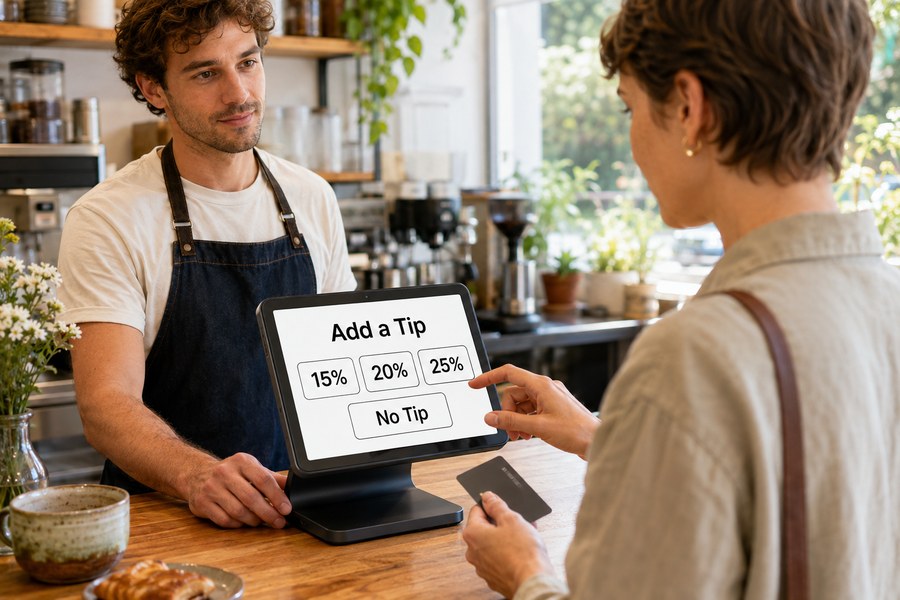
A decade ago, the moment of tipping was a quiet, private negotiation between a customer and their own sense of fairness. At a sit-down restaurant, the bill arrived on a small tray, the diner did some mental arithmetic or reached for a calculator, and wrote a number on a line. At a coffee counter, a glass jar with a handwritten label sat beside the register, and dropping in loose change was entirely optional and largely invisible. Tipping happened at the edges of a transaction, unprompted and unobserved, and the vast majority of everyday purchases — buying a bottle of water, picking up a sandwich to go, paying for a haircut — involved no tipping ritual at all. That world has quietly disappeared, replaced by one in which a screen swivels toward the customer at the end of almost any transaction and asks, in bright buttons, whether they would like to add fifteen, twenty, or twenty-five percent.
The instrument of this change is not a new social movement or a shift in generosity but a piece of hardware: the point-of-sale tablet. As mobile payment systems replaced cash registers and clunky card terminals, the software running on those tablets began offering merchants a simple, lucrative feature — a tip prompt that could be switched on with a toggle and configured to suggest whatever percentages the business chose. What had been a manual, discretionary act became a default step in the checkout flow, presented at eye level, often while a worker stood waiting on the other side of the counter. The tip prompt did not merely digitize an old behavior; it relocated the moment of tipping from a private calculation to a public, prompted decision, and in doing so it changed how much people tip, where they tip, and how they feel about the whole enterprise.
The consequences of this shift ripple outward in every direction. For workers, the spread of digital prompts has meant new streams of tip income in jobs where tipping was never customary, but also a growing dependence on the goodwill of customers rather than on stable wages. For business owners, the tip prompt is a way to supplement worker pay without raising prices on the menu, shifting part of the compensation burden onto customers who may not fully register that they are subsidizing wages. For customers, the experience has produced a now widely documented sensation of being asked to tip too often, in too many places, under a subtle pressure engineered into the interface itself. And for the broader culture, the episode has become a case study in how quickly a social norm can be reshaped not by argument or law but by the design of a screen.
This article examines the digital tipping economy from the ground up, aimed at a reader who has felt the awkwardness of the swiveling tablet but never stopped to consider the mechanics behind it. It traces how tipping went digital and why the pandemic accelerated the change, unpacks the specific behavioral psychology built into a well-designed tip prompt, and weighs honestly who gains and who loses as gratuity migrates onto screens. It then turns to the documented data — from payment platforms that process billions of transactions and from national surveys of public attitudes — to separate what has actually happened from the anecdotes that dominate the conversation. The goal is neither to defend tipping nor to condemn it, but to explain clearly how a small interface change rewired one of the most emotionally charged micro-moments in everyday commerce, and to consider where the resulting tension is likely to settle.
From Tip Jar to Touchscreen: How Tipping Went Digital
Before tracing the shift, it helps to remember that tipping is not a fixed or ancient rule but a custom that has always been in flux. It arrived in the United States in the decades after the Civil War, drew organized opposition in the early twentieth century when several states briefly attempted to ban it as an undemocratic practice, and gradually became entrenched in specific service sectors over the following generations. Its boundaries — who is tipped, in what settings, and how much — have never been stable, and the amounts considered standard have crept upward over time from ten percent toward fifteen and then twenty. This long history of instability matters because it means the digital prompt did not disrupt a timeless tradition so much as accelerate the kind of expansion and renegotiation that tipping has undergone repeatedly. What was different this time was the speed and the mechanism.
Tipping in America has always been a somewhat unstable custom, expanding and contracting over more than a century as social expectations shifted, but for most of that history the act of tipping was mediated by cash and by the customer’s own initiative. A diner left bills on the table, a bartender saw a few coins slid across the bar, and a barista might find a dollar in the jar if a customer happened to have one and felt inclined. The critical feature of this arrangement was that the customer had to take an affirmative action, often involving physical currency, to leave a tip, and no one stood over them prompting it. Tipping was woven into a handful of specific service relationships — full-service dining, bars, taxis, hairdressing, hotel service — and was essentially absent from the vast landscape of counter-service and retail transactions.
The transformation began with the hardware that businesses used to accept payment. For decades, small merchants relied on cash registers and simple card-swipe terminals that had no capacity to ask about tips in any structured way. The arrival of tablet-based point-of-sale systems changed the economics and the ergonomics of the checkout counter at once. These systems ran sophisticated software on consumer tablets, were inexpensive enough for the smallest businesses to adopt, and, crucially, faced the customer directly. Built into that software was an optional tip prompt: a screen the merchant could enable that presented the customer with suggested tip amounts before the payment was finalized. Turning it on cost the business nothing and could meaningfully increase worker income, so adoption spread rapidly across cafés, food trucks, bakeries, and countless other establishments that had never before had a mechanism to solicit tips.
The pandemic accelerated this shift dramatically and gave it a moral charge that lingered long after the emergency passed. As businesses shifted toward contactless payment and consumers were urged to support struggling local establishments and the workers risking exposure to serve them, tip prompts proliferated and default percentages crept upward. The scale of the change is captured in payment-platform data: according to figures reported from Square, the share of remote transactions that offered a tipping option rose to about 74.5 percent in February 2023, up from only around 43.4 percent in February 2020, a near-doubling in the span of three years. Prompting became not the exception but the norm, and it appeared in contexts — takeout counters, self-service kiosks, online orders — where the traditional justification for tipping was tenuous at best. What began as an emergency appeal to generosity hardened into a permanent feature of the checkout experience.
It is worth appreciating how thoroughly this reversed the physics of the old arrangement. In the cash era, leaving a tip required a customer to possess physical currency, to notice the jar or the tip line, and to take a deliberate action, so the default state of most transactions was no tip at all, and tipping was the exception that required effort. The digital prompt inverted that entirely. Now the default state of the transaction includes a tip request that the customer must actively navigate, and declining requires the deliberate action that tipping once did. This inversion is subtle but decisive, because human behavior tends to follow the path of least resistance, and the prompt made tipping that path. A change that looks merely like moving the tip jar onto a screen actually flipped the burden of action from the person who wanted to tip to the person who wanted to decline.
The cashless shift reinforced the effect. As fewer people carried cash, the old informal channels for tipping — the jar, the loose change, the bills left on a table — dried up, and the screen became not just the easiest way to tip but often the only way. A customer paying by card or phone who wanted to reward a worker had no alternative mechanism outside the prompt, which further concentrated the entire tipping relationship into the moment the tablet turned. This gave the prompt a kind of monopoly over gratuity that the tip jar never had, since the jar always competed with the option of simply doing nothing at no social cost, whereas the screen made doing nothing a visible, deliberate choice.
The final ingredient was the design flexibility these systems gave merchants over the prompt itself. The software let businesses choose whether to present tips as percentages or fixed dollar amounts, set the specific values shown, and decide where the prompt appeared in the flow. Some systems display percentage buttons only above a certain purchase amount and small fixed amounts below it, so that a customer buying a single coffee might see suggestions of one, two, or three dollars rather than percentages. Others default to suggestions that reach twenty-five or thirty percent, well above the historical norm for even full service. Each of these choices is a lever, and the sum of them determines how the tip question lands on the customer. The move from tip jar to touchscreen was therefore not a neutral digitization of an existing habit but the creation of a new, highly configurable system for prompting gratuity at a scale and frequency that had never before been possible.
The Psychology Built Into the Tip Screen
The reason the tip prompt changed behavior so effectively is that it is, whether by design or by accident, a nearly perfect instrument of behavioral influence. It intervenes at a specific vulnerable moment, presents a small set of pre-chosen options, and does so in a social context that makes the easy choice and the comfortable choice the same. Understanding why the screen works requires setting aside the assumption that tipping is a purely rational calculation of service quality and recognizing instead that it is a decision shaped heavily by context, framing, and social pressure — exactly the variables a well-designed prompt controls.
The core insight is that people do not approach the tip question with a fixed number in mind that they then enter. Instead, they arrive at the moment uncertain and a little anxious, and they look to the situation for cues about what is appropriate. The tip screen supplies those cues aggressively: it offers specific suggested amounts, it presents them in a particular order and prominence, and it does so while a worker often stands watching. Each of these features taps a well-documented tendency in human decision-making, and together they nudge the customer toward tipping more, and more often, than they would if left to their own devices with a blank line and a moment of privacy. The screen does not force anyone to tip, but it reshapes the choice architecture so thoroughly that the outcome is predictably different.
There is also a timing dimension that makes the tip screen especially effective. The prompt appears at the very end of the transaction, after the customer has already committed to the purchase and is in a hurry to complete it and move on. At that moment the customer’s attention is low, their desire to finish is high, and the cost of deliberating over the right tip feels larger than the cost of simply accepting a suggested amount. Behavioral research has long noted that decisions made quickly and under mild time pressure lean heavily on whatever cues are immediately available, which in this case are the suggested buttons. The prompt is thus positioned at precisely the point in the interaction where the customer is least equipped to resist its framing and most motivated to take the fastest route through it.
This is why the same person who might have dropped nothing in a coffee-shop jar will tap a twenty-percent button when the tablet turns toward them, and why prompts have succeeded in extracting tips in contexts where the practice was previously unknown. The influence is not primarily about generosity or its absence; it is about how the decision is framed and observed. The specific mechanisms at work — the anchoring effect of suggested percentages, the gravitational pull of a default, and the social discomfort of declining in front of another person — are worth examining individually, because each contributes something distinct to the prompt’s power and each points to why redesigning the prompt changes the result.
Anchoring, Defaults, and the Presenter Effect
Anchoring is the tendency for an initial number to shape a subsequent judgment, even when the number is arbitrary, and the tip screen is built around it. When a customer sees buttons offering eighteen, twenty, and twenty-five percent, those figures become the reference frame for the entire decision. The customer is no longer asking whether to tip and how much in the abstract; they are implicitly deciding among the presented options, or making the more effortful and conspicuous choice to reject all of them. By setting the suggested values, the merchant sets the anchors, and research on the practice has consistently found that raising the suggested percentages raises the amounts people actually tip. When default suggestions climbed toward twenty-five and thirty percent during and after the pandemic, they dragged the perceived normal tip upward with them, because the anchor is doing much of the work that a customer’s independent sense of fairness once did.
Defaults compound the effect. Any option that requires less effort or less deliberation to select carries an advantage, and prompts are frequently arranged so that tipping is the path of least resistance while declining requires finding and pressing a less prominent button, sometimes labeled in a way that feels slightly uncomfortable, such as “no tip” or “custom.” A customer in a hurry, holding a phone or a bag, with a small line forming behind them, is strongly inclined to tap one of the three big buttons rather than hunt for the way out. The design does not need to hide the no-tip option to be effective; it only needs to make tipping the smoother, faster, more obvious action, and the ordinary human preference for the easy path does the rest.
The most potent mechanism, though, is what might be called the presenter effect: the tip screen usually appears while a worker is standing directly across the counter, and often the worker physically turns the tablet toward the customer and then waits. This transforms tipping from a private decision into a public performance observed by the very person who will receive or be denied the tip. Declining to tip, or selecting a low amount, must now be done under the gaze of another human being, and most people find that social discomfort powerful enough to sway their choice. The screen converts what was once an anonymous act into a face-to-face micro-interaction with an implied audience, and the desire to avoid appearing cheap or ungrateful in front of a real person is one of the strongest forces in the entire system. Taken together, anchoring sets the reference points, defaults grease the easy path, and the presenter effect adds social stakes, producing a decision environment engineered — intentionally or not — to maximize the likelihood and size of a tip.
Who Wins and Who Loses in the Digital Tipping Economy
The spread of digital tipping is not a simple story of exploitation or of generosity but a redistribution of money, pressure, and risk among three parties whose interests only partly align: the workers who receive tips, the owners who deploy the prompts, and the customers who pay them. Each party experiences the digital tipping economy differently, and a fair account has to hold all three perspectives at once rather than casting any single group as villain or victim. The prompt moves money in ways that help some workers substantially while leaving others no better off, that relieve some owners of wage pressure while exposing them to customer resentment, and that support service workers’ incomes while straining the goodwill of the people footing the bill.
For workers, the effect depends heavily on their position. Those in traditionally tipped roles at busy establishments have seen digital prompts and rising default percentages translate into higher tip income, and workers in newly prompted contexts — counter service, quick-service food, various personal services — now receive tips they would never have collected in the cash-jar era. But this income is inherently variable and dependent on customer mood and traffic, and it often substitutes for, rather than supplements, the higher base wages those workers might otherwise command. The digital tipping economy can raise a worker’s earnings while simultaneously making those earnings less predictable and shifting the responsibility for adequate pay from the employer onto a rotating cast of customers.
For customers, finally, the shift has traded a small privacy and a moment of autonomy for a recurring low-level obligation. The pre-digital customer decided about tipping on their own terms, in their own time, and largely without observation; the digital customer is asked repeatedly, publicly, and at moments not of their choosing. This is not a catastrophic loss, and in traditional service contexts most customers do not mind, but multiplied across the many transactions of an ordinary week it adds a persistent friction to commerce that did not exist before. The customer pays not only in the tips themselves but in the accumulated small discomforts of navigating the ask, and that intangible cost is a central part of why the backlash has grown even as the dollar amounts involved in any single transaction are modest.
For owners, the prompt is an attractive tool precisely because it lets them address the persistent problem of worker pay without raising the visible prices of their goods. A café that leans on tips can advertise a lower coffee price while relying on the prompt to lift worker take-home, keeping menu prices competitive and pushing part of the compensation cost onto the checkout screen. This is a genuine short-term advantage, but it carries a long-term risk of customer backlash if patrons come to feel that the business is offloading its wage obligations onto them. The dynamics for workers and customers each deserve closer examination, because the tensions in the system concentrate at those two poles, and the two subsections that follow take them in turn before the broader picture is drawn together.
Workers, Owners, and the Shifting Wage Structure
The deepest effect of the digital tipping economy on workers is structural: it accelerates a shift in how service work is compensated, moving further from stable wages and toward variable, customer-funded gratuities. In the traditional tipped sectors, this trade-off was long established and understood, with tipped workers often earning a lower base wage on the expectation that tips would make up the difference. What the tip prompt has done is extend that logic into sectors where it did not previously apply, so that a barista or a counter clerk, historically paid a straight wage, increasingly finds a meaningful share of their income arriving through prompts rather than paychecks. For the worker, this can mean more money in good conditions and less in bad ones, with the volatility landing entirely on them rather than on the employer.
This shift also changes the psychological relationship between worker and pay in ways that are easy to overlook. A worker earning a predictable wage knows what each shift will yield and can plan around it, while a worker whose income depends heavily on prompt-driven tips faces a daily uncertainty that tracks factors entirely outside their control, such as customer mood, foot traffic, weather, and the broader economy. Platform data reflecting declining tip percentages during periods of weaker consumer confidence illustrates the point directly: when customers feel financially squeezed, they tip less, and that reduction lands on workers precisely when the surrounding economy is already difficult. A compensation model built on tips transfers macroeconomic risk onto some of the lowest-paid workers in the economy, who are among the least able to absorb it.
Tip pooling and distribution add another layer of complexity that the customer rarely sees. When a customer taps a tip on a screen, they usually have no idea whether that money goes to the specific person who served them, is split among the staff on shift, or is distributed according to some formula the business controls. Digital systems make pooling easier to administer, which can promote fairness by spreading tips among kitchen and support staff who never face the customer, but it also means the presenter effect — the pressure the customer feels toward the person in front of them — may be funding people the customer never interacts with, or in some arrangements may be subject to deductions and allocation rules the customer cannot observe. The transparency the digital record could in principle provide is not usually surfaced to the person deciding how much to give.
The owner’s incentive sits at the center of these dynamics and explains much of the system’s momentum. Because the prompt allows a business to raise worker income without raising posted prices, it creates a standing temptation to rely on gratuities as a compensation strategy rather than as a genuine reward for exceptional service. This is not necessarily cynical; many small operators run on thin margins and use tips as one of the few available levers to keep good staff without pricing themselves out of the market. But the cumulative effect across an economy is a service sector in which more and more pay is contingent on customer generosity mediated by a screen, and in which the question of who is really responsible for paying workers a living wage becomes increasingly blurred. The digital tip prompt did not create this ambiguity, but it has spread it into corners of the economy that were previously governed by straightforward wages, and that expansion is the most consequential effect it has had on the structure of service work.
Customers, Guilt, and Tipping Fatigue
From the customer’s side, the digital tipping economy has produced a distinctive and now widely shared emotional experience: a low-grade, recurring sense of being asked for more, more often, than feels reasonable, coupled with the guilt of declining under a worker’s gaze. The phenomenon has become common enough to earn its own labels in public discussion, most notably tipping fatigue and, when prompts appear in unexpected places, the sense that tipping has become a form of guilt-driven obligation rather than a reward. The core grievance is not usually that customers resent tipping in traditional contexts, where most continue to tip willingly and generously, but that the prompt now appears where it never used to and asks for percentages that once would have seemed extravagant.
The guilt mechanism is precisely the presenter effect experienced from the paying side. A customer who would happily leave nothing at a self-service counter feels a pang of social discomfort when the screen turns and a worker waits, and many tip against their own judgment simply to avoid the momentary awkwardness of pressing the no-tip button in front of another person. Over dozens of such micro-encounters a week, the small discomforts accumulate into a broader resentment, not necessarily aimed at the workers, who are usually seen as blameless, but at the system that keeps putting the customer in that position. The result is a sense that a mechanism designed to reward good service has been turned into a routine tax on ordinary transactions, extracted through social pressure rather than earned through anything the customer values.
There is a corrosive secondary effect worth naming, which is that the overuse of prompts risks devaluing tipping in the contexts where it genuinely matters. When a customer is asked to tip on a bottle of water from a self-service cooler, the request in that setting feels absurd, and the absurdity can bleed into their attitude toward tipping generally, making even legitimate requests feel like part of the same overreach. A system that asks for a tip everywhere trains people to treat the ask as noise to be dismissed rather than as a meaningful signal, which can ultimately harm the traditionally tipped workers whose livelihoods depend on the practice being taken seriously. In stretching tipping into every transaction, the prompt may be quietly eroding the social legitimacy that made tipping effective in the first place.
This fatigue has measurable consequences for attitudes and, increasingly, behavior. Survey research has documented that large majorities of Americans believe tipping is now expected in too many situations, that a substantial share feel actively pressured by tip screens, and that relatively few endorse the practice of businesses suggesting tip amounts at all. At the same time, platform data has begun to show tipping percentages in some newly prompted sectors drifting downward, suggesting that customers are gradually recalibrating and pushing back against the inflated anchors even as the prompts remain ubiquitous. The customer’s position in the digital tipping economy is therefore one of accumulated friction: still willing to reward genuine service, but increasingly worn down by the sheer frequency and aggressiveness of the ask, and beginning to reassert their own judgment against the design of the screen.
What the Data Shows: Documented Trends in Digital Tipping
Much of the public conversation about digital tipping runs on anecdote and outrage, which makes it especially valuable to look at what large-scale data actually documents. Two kinds of evidence are particularly useful. The first is the transaction data collected by the payment platforms that power the tip prompts themselves, which observe tipping behavior across enormous numbers of real purchases and can report how prompting prevalence and average tip amounts have changed over time. The second is nationally representative survey research on public attitudes, which captures how people feel about tipping even when their behavior at the screen does not always match their stated views. Together, these sources allow a grounded assessment of what has genuinely changed rather than what merely feels true.
One methodological point makes this evidence especially trustworthy. The platform data is not drawn from what people say they do but from what they actually did across enormous numbers of real transactions, which sidesteps the well-known gap between stated and revealed behavior. The survey data, conversely, captures attitudes and feelings that transaction records cannot, including the resentment and pressure people experience even when they end up tipping. Because the two sources measure different things — behavior on one side, attitude on the other — their agreement is more meaningful than either would be alone, and the places where they diverge, such as people tipping despite disliking the prompt, are themselves revealing about the gap between engineered behavior and genuine preference.
Both kinds of evidence point in a consistent direction while adding important nuance. The platform data confirms that prompting became far more widespread and that average tips in traditional settings held at elevated levels for a time before showing signs of decline in newer settings. The survey data confirms a deep and widening public discomfort with the expansion of tipping, even as most people continue to tip in established contexts. Examining the specific documented figures from payment platforms and from major survey research, with their dates and sources attached, gives the discussion an empirical spine and helps distinguish durable shifts from passing complaints.
Square and Toast Platform Data
The payment platform Square, part of Block, provides some of the clearest documentation of how prompting expanded. Its reported data shows that the share of remote transactions offering a tipping option rose to roughly 74.5 percent in February 2023 from about 43.4 percent in February 2020, capturing in a single comparison how the prompt went from present in a minority of such transactions to present in a large majority within three years. Square’s system design also illustrates how the anchoring and default mechanisms are implemented in practice: its smart tipping feature commonly presents percentage suggestions on larger sales while showing small fixed-dollar options such as one, two, or three dollars on smaller ones, and merchants can configure suggested values that in some cases reach into the twenties and thirties as percentages.
The design details Square exposes are themselves instructive about how the anchoring mechanism is operationalized. By switching between percentage suggestions on larger tickets and fixed-dollar suggestions on smaller ones, the system ensures that the anchor is always framed to feel reasonable relative to the purchase, so a small coffee prompts a one-, two-, or three-dollar suggestion rather than a percentage that would compute to loose change. That framing choice quietly raises the effective tip rate on small purchases, because two dollars on a five-dollar coffee is a far higher percentage than the twenty percent the same customer might leave on a larger check. The interface, in other words, does not present a single consistent standard but adapts its anchors to extract the most plausible amount in each context.
More recent Square data captures the subsequent recalibration. Reported figures for 2025 showed cafés receiving average tips of around 14.72 percent in the first quarter and about 14.57 percent in the second, a modest decline that is consistent with the idea that customers in newly prompted, lower-touch settings have been gradually tipping less even as the prompts persist. These café averages, notably well below the twenty-percent-plus figures that default buttons often suggest, indicate a gap between what the screen proposes and what customers ultimately do in casual contexts, a gap that reflects the pushback tipping fatigue produces.
The restaurant technology platform Toast offers a complementary view centered on food service. Toast’s data indicated that average tips at restaurants on its platform ran around 18.9 percent in the third quarter of 2023, holding steady from the prior quarter, a figure much closer to the traditional full-service norm and reflecting the more established tipping relationship in sit-down dining. More recent Toast data drew a sharp contrast between contexts, showing takeout customers who left a tip averaging around 13.7 percent while full-service tips ran closer to 19.3 percent, quantifying the intuition that customers apply very different standards to a full dining experience than to grabbing a bag at a counter. Read together, the Square and Toast figures document both the dramatic expansion of prompting and the emergence of a two-tier reality in which traditional service still commands robust tips while newly prompted, low-touch transactions draw markedly less, with the gap widening as customers reassert their own norms.
The Pew Research Findings on Public Attitudes
The most authoritative documentation of public attitudes comes from the Pew Research Center, which conducted a large survey of American adults on tipping and released its findings in November 2023, based on responses from 11,945 adults gathered in August of that year. The study captured a public that feels the landscape has shifted under its feet: a large majority of respondents said tipping was being expected in more places than it had been five years earlier, reflecting exactly the expansion the prompt enabled. At the same time, only about a quarter of adults said they favored businesses suggesting specific tip amounts to customers, a direct rebuke of the core mechanic of the digital prompt, and many described the proliferation of prompts as annoying or as inappropriate in at least some contexts.
The Pew findings also documented that traditional tipping norms remain strong even amid the discomfort, which is essential to a fair reading of the situation. The overwhelming majority of adults who eat at sit-down restaurants said they always or often tip in that setting, and service quality remained the factor most commonly cited as central to the tipping decision. Yet the same respondents reported tipping far less consistently in newer, counter-service and quick-service contexts, revealing a public that distinguishes sharply between the settings where it accepts tipping as legitimate and those where it experiences the prompt as an overreach.
Complementary survey work has reinforced and extended these findings, including research indicating that a majority of Americans feel pressured to tip more specifically because of the screens, which names the presenter effect and default-driven pressure directly. That a clear majority attributes its heightened tipping specifically to the screens, rather than to any change in their own values, is perhaps the single most telling data point in the entire discussion, because it is the public itself identifying the interface as the cause. The convergence of the platform data and the survey data tells a coherent story: the digital prompt succeeded enormously in expanding the reach of tipping and, for a time, its amounts, but it did so by leaning on social pressure and framing rather than on genuine shifts in what customers believe is fair, and that gap between engineered behavior and underlying attitude is now producing measurable resistance. The documented evidence, in short, shows a norm that was stretched rapidly by interface design and is now being pulled back by the accumulated frustration of the people subjected to it.
The Backlash and Where Tipping Norms Go Next
The friction that the digital tipping economy generated has curdled, in recent years, into a genuine backlash, and understanding its shape helps forecast where tipping norms may settle. The backlash is not primarily a movement against tipping workers in traditional roles, which retains broad public support, but a reaction against the perceived overreach of prompts into contexts where customers see no service worth rewarding, and against the sense of being manipulated by the design of the screen. It expresses itself in public complaint, in the drift downward of tips in low-touch settings visible in platform data, and in a growing willingness among some customers to press the no-tip button despite the social discomfort, treating the prompt’s pressure as illegitimate rather than binding.
A notable feature of this backlash is that it has largely spared the workers themselves, which distinguishes it from many consumer revolts. Customers overwhelmingly direct their frustration at the system, the software, and the businesses deploying the prompts, not at the baristas and clerks on the receiving end, whom they generally recognize as having no control over the screen and as depending on the income it generates. This targeting matters for how the tension resolves, because it means the pressure falls on business practices and interface design rather than on the social contract of tipping workers as such. The backlash is against manipulation, not against gratitude, and that distinction leaves room for a resolution in which prompts are moderated without tipping itself being abandoned.
Businesses have begun to respond to this friction in divergent ways, and the range of responses hints at the possible futures. Some establishments have doubled down on prompting, pushing default percentages higher and enabling prompts in more places, betting that the presenter effect will continue to work even as resentment builds. Others have moved in the opposite direction, either removing prompts from contexts where they feel inappropriate or, more ambitiously, adopting service-included or higher-wage models that fold compensation into prices and eliminate the tip question entirely. This second approach responds directly to the customer grievance by removing the awkward moment, but it requires raising visible prices, which carries its own competitive risk in a market where customers compare posted prices closely. The tension between these strategies is unresolved, and different segments of the service economy are likely to land in different places.
The policy environment adds another variable, as tipping has increasingly drawn the attention of lawmakers, including debates over how tip income is taxed and treated, which can shift the incentives for both workers and businesses in ways that interact with the prompt-driven system. Changes to the tax treatment of tips, for instance, can alter how attractive tip income is relative to wages for workers and how businesses structure compensation, and such policy shifts can accelerate or slow the movement toward or away from tip-dependent models. Because these debates are ongoing and their outcomes uncertain, they represent a genuine wildcard in how the digital tipping economy evolves, capable of reinforcing the current system or nudging it toward wage-based alternatives.
The most probable near-term future is not a wholesale abandonment of digital tipping nor its unchecked expansion, but a gradual sorting in which prompts persist and tips stay robust in contexts customers regard as legitimately service-oriented, while the inflated anchors and low-touch prompts face continued erosion as customers recalibrate and some businesses retreat. The equilibrium will likely be messier and more context-dependent than either the pre-digital cash-jar era or the peak-prompt moment, with tipping norms fragmenting by setting rather than following a single rule. What seems clear is that the period in which a screen could simply suggest thirty percent and reliably get it, on the strength of social pressure alone, is passing, as the customer side of the system develops the habits and the resolve to push back against a prompt they increasingly regard as an ask rather than an obligation.
Final Thoughts
The story of the digital tipping economy is, at its core, a demonstration of how powerfully interface design can reshape a social norm without changing anything about the underlying values of the people involved. Nothing about American generosity, gratitude, or sense of fairness shifted fundamentally when tablets began swiveling toward customers; what changed was the choice architecture surrounding a small, frequent, emotionally charged decision. By supplying anchors where there had been none, making tipping the easy default, and staging the decision under a worker’s gaze, the tip prompt extracted more tipping, in more places, than any appeal to conscience ever could. That a piece of point-of-sale software could accomplish in a few years what generations of etiquette guides never did is a striking testament to the leverage that sits in the design of the moments where money changes hands.
The transformation carries real weight for the people caught in it, and the ambivalence it produces is well earned. For many workers, the digital prompt has meant genuinely higher and more widely distributed tip income, extending gratuities into jobs that never had them and providing a lever for owners to lift pay without pricing themselves out of a competitive market. That is a real benefit, and it should not be dismissed by those who find the prompts irritating. But the same mechanism has accelerated a drift toward compensation that is variable, customer-funded, and dependent on social pressure rather than on stable wages, blurring the responsibility for paying workers fairly and spreading that ambiguity into ever more corners of the service economy. The prompt gives with one hand and unsettles with the other, and which effect dominates depends heavily on the worker, the setting, and the health of the underlying business.
For customers, the episode has been a slow education in recognizing engineered pressure and deciding how to respond to it. The accumulated fatigue documented in survey after survey is not a rejection of rewarding good service but a reaction against being routinely maneuvered into it by a screen, and the gradual downward drift of tips in low-touch settings suggests that customers are learning to distinguish the ask from the obligation and to reassert their own judgment. That reassertion is, in a sense, the norm reasserting itself against the interface, a reminder that behavioral nudges can bend behavior but cannot indefinitely override the underlying attitudes of the people they act upon.
Where all of this settles will say something about how societies absorb the influence of designed environments more broadly. The tip prompt is only one instance of a much larger phenomenon in which the defaults, framings, and small frictions built into digital interfaces quietly govern countless everyday choices, from what people watch to how they save to how they give. The digital tipping economy is valuable precisely because its mechanics are visible enough to feel and to name, which makes it a rare case where people can watch a nudge operate on themselves and choose whether to comply. The likely future — a fragmented landscape where tipping stays strong where it feels earned and fades where it feels imposed — would represent a kind of negotiated settlement between the power of interface design and the stubborn persistence of human judgment about what is fair, and that negotiation, more than any particular percentage, is the real legacy of the screen that turned to face us.
FAQs
- Why did tip prompts suddenly appear everywhere?
The spread was driven by tablet-based point-of-sale systems that included an optional tip prompt merchants could switch on at no cost. As these affordable, customer-facing systems replaced old cash registers and card terminals, and as the pandemic pushed contactless payment and appeals to support workers, prompting expanded rapidly into cafés, takeout counters, and many settings that never solicited tips before. - Does the design of a tip screen actually change how much people tip?
Yes, substantially. The screen sets anchors through its suggested percentages, makes tipping the easy default while pushing the decline option to a less prominent spot, and stages the choice while a worker watches. Each of these taps a documented tendency in human decision-making, and research and platform data both indicate that raising suggested percentages raises the amounts people actually tip. - What is the “presenter effect”?
It is the social pressure created when a worker turns the tablet toward the customer and waits while they choose a tip. This converts what was once a private decision into a face-to-face interaction observed by the person who will receive or be denied the tip. The discomfort of appearing cheap in front of a real human being is one of the strongest forces pushing customers to tip when prompted. - How much has prompting actually increased, according to data?
Reported Square data shows the share of remote transactions offering a tip option rose to about 74.5 percent in February 2023 from roughly 43.4 percent in February 2020, close to a doubling in three years. This platform-level figure documents that prompting shifted from being present in a minority of such transactions to a large majority in a short span. - Do people tip the same in a coffee shop as at a sit-down restaurant?
No, and the data shows a clear two-tier pattern. Toast reported full-service restaurant tips around 18.9 percent in the third quarter of 2023 and, in more recent data, takeout tips averaging around 13.7 percent against roughly 19.3 percent at full service. Square reported café averages near 14.7 percent in early 2025. Customers clearly apply different standards to a full dining experience than to a quick counter transaction. - Is tipping fatigue a real, documented phenomenon?
Yes. Pew Research Center’s November 2023 study, based on 11,945 adults surveyed that August, found a large majority believed tipping was expected in more places than five years earlier and that only about a quarter favored businesses suggesting tip amounts. Complementary research found a majority feel pressured to tip more because of the screens, confirming the fatigue is measurable, not just anecdotal. - Where does my tip actually go when I tap a screen?
It depends entirely on the business, and customers usually cannot see the arrangement. The money may go to the individual who served you, be pooled and split among the staff on shift including kitchen and support workers, or be distributed by a formula the business controls. Digital systems make pooling easier to administer but rarely surface to the customer how any given tip is allocated. - Why do businesses use tip prompts instead of just paying workers more?
The prompt lets a business raise worker take-home pay without raising the visible prices of its goods, keeping menu prices competitive while shifting part of the compensation onto customers at checkout. For operators on thin margins, this is one of the few available levers to retain good staff, though it risks customer resentment if patrons come to feel the business is offloading wage obligations onto them. - Am I obligated to tip when a screen asks me to?
There is no obligation, and the pressure you feel is largely a product of the prompt’s design rather than an actual social rule, especially in low-touch settings where tipping was never customary. Many people tip against their own judgment simply to avoid momentary awkwardness. Declining in contexts where no meaningful service was provided is increasingly common, and platform data suggests customers are gradually reasserting their own standards. - Will tip prompts keep spreading, or is the trend reversing?
The most likely path is a fragmented settlement rather than a single direction. Prompts and robust tips are expected to persist in contexts customers regard as genuinely service-oriented, while inflated anchors and prompts in low-touch settings face continued erosion as customers push back and some businesses retreat or adopt service-included pricing. The era in which a screen could reliably extract thirty percent through social pressure alone appears to be passing.