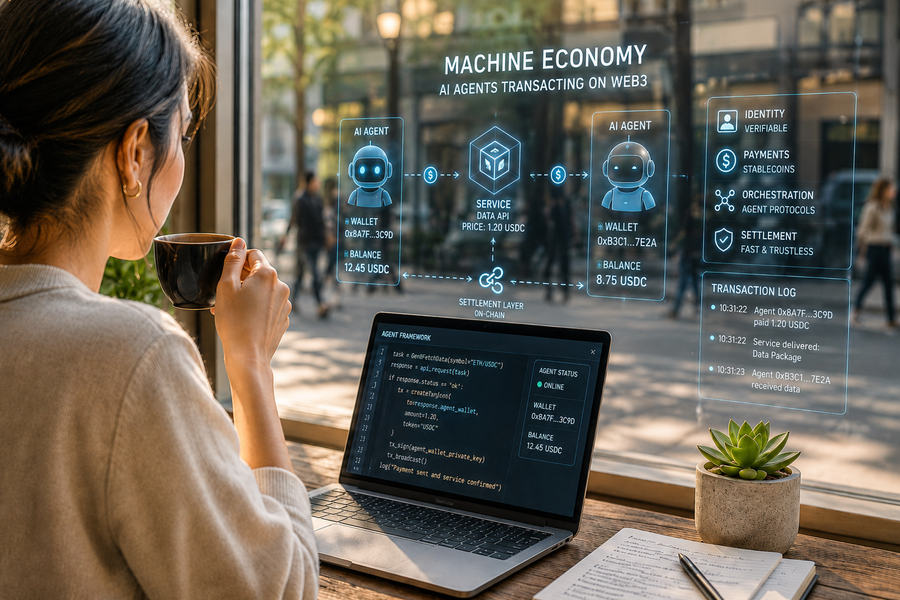
For most of the brief history of artificial intelligence in everyday life, the technology has been something people talk to, a clever assistant that answers questions, drafts text, and offers suggestions but ultimately hands every consequential decision back to a human, who must be the one to click the button, enter the payment, and complete the transaction. A profound shift is now underway, one in which artificial intelligence moves from talking to acting, from advising to executing, and at the heart of this shift lies a capability that sounds at once mundane and revolutionary, namely the ability of an artificial intelligence agent to hold money and to spend it on its own. When a software agent can carry a balance, pay for a service, hire another agent, and settle the bill without a person approving each step, the agent ceases to be a mere tool and becomes something closer to an economic actor, a participant in commerce that buys and sells in its own right.
This emerging arrangement, in which artificial intelligence agents transact with one another and with services autonomously, has come to be called the machine economy, and it is being built with surprising speed atop the rails of cryptocurrency and the open web. The reason these particular rails matter is that the financial system humans use, with its bank accounts, card networks, and human-centered checkpoints, was never designed for a world of software agents conducting vast numbers of tiny transactions at machine speed, and a different kind of infrastructure has proven necessary to let agents pay one another efficiently. Stablecoins, the dollar-pegged cryptocurrencies that move value across the internet as easily as data, have become the natural medium for these machine payments, and a cluster of new protocols and standards, backed by some of the largest technology and payment companies in the world, has emerged to give agents a way to discover services, agree on prices, and settle accounts without a human in the loop. What was a speculative idea only a short time ago has become a domain of live systems processing very real volumes of transactions.
This article examines the machine economy and the autonomous agents that animate it for readers who may understand artificial intelligence as a conversational tool but have not grasped its evolution into an economic actor, beginning with what an artificial intelligence agent actually is and how it differs from the chatbots that came before. It then explains why such agents need payment rails of their own, why the existing financial system serves them poorly, and how stablecoins and a revived web standard fill the gap, before surveying the concrete protocols and standards now being built, drawing on documented launches by major companies rather than speculation. It looks at how the established payment networks are responding, considers what a functioning machine economy could enable, and confronts honestly the serious risks and unresolved questions that autonomy in spending raises. The aim throughout is to render an unfamiliar and fast-moving development comprehensible, so that readers come away understanding not only what the machine economy is but why it is being built and what is at stake as it grows.
From Chatbots to Economic Actors: What an AI Agent Is
To understand the machine economy, one must first understand what is meant by an artificial intelligence agent, a term that marks an important departure from the conversational systems that introduced most people to modern artificial intelligence. A chatbot or conversational assistant responds to prompts, generating text or answers within the boundaries of a single exchange and leaving all action in the hands of the user, whereas an agent is designed to pursue a goal across multiple steps, making decisions, using tools, and taking actions in the world to accomplish a task it has been given. The distinction is the difference between an assistant that tells you how to book a trip and an agent that actually books it, navigating the necessary services, making the required choices, and completing the steps autonomously, and it is this capacity for independent, goal-directed action that transforms artificial intelligence from a source of advice into a doer of deeds.
The capabilities that define an agent build naturally toward the ability to transact, because many of the goals one might hand to an agent cannot be accomplished without acquiring something that costs money. An agent asked to research a topic may need to pay for access to data or specialized services, an agent asked to manage a workflow may need to purchase computing resources or call upon paid tools, and an agent asked to handle a practical task such as procurement may need to actually buy goods, so that the logical endpoint of agent autonomy is an agent that can pay for what it needs as it works. Once agents can act toward goals and once accomplishing those goals requires spending, the capacity to hold and disburse money becomes not an exotic add-on but a fundamental requirement, the missing piece that turns a capable assistant into a self-sufficient economic participant able to complete tasks end to end without returning to its human owner at every juncture that involves a payment.
The further and more striking development is that agents need not transact only with human-run services but increasingly with one another, giving rise to the prospect of an economy populated substantially by software. An agent specialized in one task might offer its services to other agents for a fee, an agent needing a capability it lacks might hire another agent that possesses it, and chains of agents might collaborate on complex tasks, each paying the others for their contributions, all without direct human involvement in the individual exchanges. This vision of agents discovering, hiring, and paying one another is what most fully deserves the name machine economy, a network of automated economic relationships in which value flows among software entities pursuing the goals their owners have set, and it represents a genuine novelty in economic life, the emergence of participants that are neither human beings nor the traditional firms and institutions that humans direct, but autonomous programs transacting at the speed and scale that software allows. It is worth pausing to appreciate how genuinely unprecedented this is, because economic history offers no real analogue to an autonomous, non-human participant that owns nothing in the legal sense yet transacts on its own initiative. Throughout history the actors in an economy have been people and the organizations people create and direct, such as firms, governments, and institutions, all of which ultimately trace their decisions to human beings, whereas an artificial intelligence agent that holds a balance and decides for itself how to spend it introduces a new category of economic actor that acts without a human deciding each move. This does not mean the agent is free of human influence, since it pursues goals its owner has set and operates within limits its owner imposes, but the moment-to-moment decisions of what to buy and from whom can be the agent’s own, and at the scale and speed that software permits, a great many such decisions can occur without any person being aware of them individually. Grasping this novelty is essential to understanding both the promise and the peril of the machine economy, since it is precisely the autonomy that makes agents useful that also makes them require careful design and oversight.
Realizing this vision, however, requires a financial infrastructure suited to the peculiar needs of software actors, which the existing system conspicuously fails to provide.
Why Agents Need Their Own Money Rails
The financial infrastructure that humans rely upon, built around bank accounts, payment cards, and the networks that connect them, was designed over decades to serve human patterns of commerce, and it turns out to be remarkably ill-suited to the needs of autonomous software agents transacting among themselves. The mismatch begins with the assumption, embedded throughout the conventional system, that a human is present to authorize and verify each significant payment, an assumption manifested in the passwords, one-time codes, fraud checks, and approval screens that punctuate ordinary online transactions. These human-centered checkpoints, sensible as protections for people, become obstacles for an agent meant to operate autonomously, since an agent that must pause to summon a human for every payment is not truly autonomous at all, and the entire premise of an agent completing tasks end to end collapses if a person must approve each purchase along the way.
A second and equally fundamental mismatch concerns the economics of small and frequent transactions, which the conventional payment system handles poorly but which the machine economy generates in abundance. Card networks and bank transfers carry fees and impose minimums that make sense for the occasional human purchase of meaningful size but become prohibitive when applied to the tiny payments that agents naturally make, such as a fraction of a cent for a single data lookup or a few cents for a brief use of a service. When an agent might make thousands of such micropayments in the course of a task, the per-transaction costs and delays of traditional rails render the whole pattern uneconomical, and the system simply was not built to settle enormous numbers of minuscule payments cheaply and instantly. The machine economy requires the ability to move very small amounts of value frequently and at negligible cost, a capability that the human financial system, optimized for larger and rarer transactions, does not naturally offer.
The third mismatch is one of speed and global reach, since agents operate at the pace of software and without regard to the national boundaries and banking hours that structure human finance. An agent may need to complete a payment in a fraction of a second to keep a task moving, and it may need to transact with a service or another agent located anywhere in the world, whereas conventional payments can take days to settle, especially across borders, and are entangled with the schedules and jurisdictions of the banking system. A machine economy operating around the clock and across the globe needs settlement that is similarly instantaneous and borderless, value that can move the moment an agreement is reached regardless of where the parties are or what time it is, and this requirement, like the others, points away from the traditional financial system and toward a different kind of infrastructure. A fourth mismatch, subtler but important, concerns the identity and trust mechanisms on which the conventional system relies, which are oriented toward verifying human beings rather than software. The existing apparatus of fraud prevention, built around recognizing human behavior patterns, physical cards, and personal credentials, has no natural way to establish that a particular agent is legitimate, is acting within the authority its owner granted, and is not an impostor or a compromised piece of software, and the question of how to verify a non-human actor at the moment of payment is one the human financial system was never designed to answer. This gap matters because trust is the foundation of any payment system, and a machine economy needs a way to establish that the agents transacting within it are who they claim to be and are authorized to do what they are doing, a requirement that has pushed the builders of agent payment systems to develop new forms of verifiable agent identity rather than relying on credentials meant for people. The need to reinvent trust for software actors is thus as fundamental as the need to reinvent the mechanics of payment itself.
The convergence of these mismatches, around autonomy, micropayments, instant global settlement, and machine identity, explains why the builders of the machine economy have turned to cryptocurrency rails and to a long-dormant feature of the web itself, examined in the section that follows.
Stablecoins, Micropayments, and the HTTP 402 Revival
The properties that make cryptocurrency poorly suited to some purposes make it remarkably well suited to the needs of autonomous agents, and the particular form of cryptocurrency that has become central to the machine economy is the stablecoin, the dollar-pegged token that combines stable value with the speed and programmability of crypto. An agent transacting needs a unit of value that does not swing unpredictably, since neither the agent nor its owner wants the cost of a service to fluctuate with a volatile market, and the stablecoin provides exactly this, a digital dollar that can move across the internet directly between parties without passing through the banking system or waiting on its schedules. Because stablecoin transactions can settle in moments, can cross borders without friction, and can be made in very small denominations at low cost, they answer the micropayment and speed requirements that defeat traditional rails, and they have accordingly become the natural medium of exchange for software agents, with the dollar-pegged token known as USDC featuring prominently as the settlement currency in the leading agent payment systems.
The programmability of these rails matters as much as their speed and low cost, because it allows payment to be woven directly into the logic of software in a way that human-centered systems do not permit. A payment that is itself a piece of code can be triggered automatically when conditions are met, attached to a request for a service, and settled without any interface designed for human eyes and hands, which is precisely what an autonomous agent requires, and this fusion of money and code is what lets an agent treat a payment as just another step in its task rather than an interruption demanding human attention. The result is that value can flow as fluidly as data through the systems agents inhabit, enabling the dense web of automatic micropayments that the machine economy depends upon, and removing the friction that would otherwise make autonomous transaction impossible.
A surprising and elegant piece of this puzzle has come from the revival of a feature that was built into the web decades ago but never used, the status code numbered four hundred two, labeled payment required, which the original designers of the web included in anticipation of a future in which web resources might be paid for directly but which lay dormant for want of a practical payment mechanism. The new agent payment protocols have resurrected this long-unused code as the foundation for a standard way for a service to request payment and for an agent to provide it, so that when an agent requests a resource that costs money, the service can respond with the payment-required signal, the agent can settle the small sum in stablecoin, and the transaction can complete in a single automated exchange woven into the ordinary workings of the web, all within the same request-and-response rhythm by which browsers and servers have always communicated, so that paying becomes simply another kind of web interaction rather than a separate process bolted on from outside. There is a certain poetry in the fact that the web’s original architects anticipated a future of paid resources and reserved a code for it, even though the mechanisms to make it practical would not arrive for decades, and that the rise of autonomous agents is what finally gives that long-dormant provision its purpose. The reason it lay unused so long is instructive, since the missing ingredient was never the idea of paying for a web resource but the practical means to settle very small payments instantly and cheaply between parties who might be strangers, exactly the capability that programmable stablecoins now supply. The convergence of an old standard waiting for a payment mechanism and a new payment mechanism waiting for a standard to organize it produced a fit so natural that the machine economy seems in retrospect almost to have been anticipated by the web’s design, and this convergence is a reminder that major technological shifts often arise not from a single invention but from the alignment of pieces that existed separately until the moment they could be joined.
This repurposing of a forgotten corner of the web’s original design gives the machine economy a native and standardized way to handle payment, turning the act of paying for a web service into a seamless part of how agents interact with the internet, and it illustrates how the infrastructure for autonomous commerce is being assembled from a combination of new cryptocurrency rails and old, unrealized possibilities finally finding their moment.
The Rails Being Built: Protocols and Standards
The machine economy has moved from concept to construction with remarkable speed, and the clearest evidence of this lies in the concrete protocols and standards that major technology companies have built and launched to let agents transact, systems that are already processing substantial volumes of real payments. The most prominent of these is a protocol developed by Coinbase and given the name x402, a reference to the payment-required web status code it revives, which was launched in May 2025 as an open standard for embedding stablecoin payments directly into web interactions. The protocol uses the stablecoin USDC as its primary settlement currency, settling payments directly on a blockchain, and is designed precisely for machine-to-machine payments, allowing agents to pay for services and to pay one another without traditional payment accounts or intermediaries, and it represents one of the first fully realized attempts to give software agents a native way to handle money on the open web.
The adoption of this protocol has been striking and offers concrete evidence that the machine economy is not merely theoretical but operational at meaningful scale. Activity on the protocol grew from essentially nothing in the middle of 2025 to more than one hundred million cumulative transactions by the first quarter of 2026, a figure documented by the blockchain analysis firm Chainalysis, with the protocol handling on the order of six hundred million dollars in annualized payment volume across its ecosystem. The composition of this activity has itself evolved in telling ways, with the share of transactions worth a dollar or more rising sharply to dominate the volume by early 2026 as the protocol matured beyond an initial phase driven partly by speculative and experimental activity, a shift that suggests the system is increasingly being used for substantive payments rather than mere novelty. These numbers, drawn from independent analysis of on-chain activity, demonstrate that agents transacting in stablecoins is a present reality with real momentum, not a distant prospect. It is worth reading such figures with appropriate care, since a portion of early activity in any new system reflects experimentation, testing, and speculation rather than durable economic use, but the maturation visible in the data, with larger and presumably more substantive payments coming to dominate over time, suggests that genuine utility is taking hold alongside the initial novelty, which is precisely the trajectory one would hope to see as a technology moves from curiosity toward infrastructure.
Equally significant is the entry of Google into this domain with its Agent Payments Protocol, known as AP2, which the company launched in September 2025 in collaboration with more than sixty leading payment and technology companies, including American Express, Mastercard, PayPal, Coinbase, the Ethereum Foundation, and Adyen, among many others. This protocol provides an open framework for transactions between artificial intelligence agents, and crucially it incorporated the stablecoin payment capability of the x402 protocol as an extension developed together with Coinbase, the Ethereum Foundation, and the wallet provider MetaMask, making x402 the stablecoin facilitator within Google’s broader framework and allowing agents to monetize their own services, pay other agents, or handle micropayments automatically on behalf of their users. The breadth of the coalition behind this effort, spanning technology giants, card networks, payment processors, and crypto-native organizations, signals that the construction of agent payment infrastructure is being treated as a serious and collaborative undertaking by the most established players in both technology and finance, rather than as a fringe experiment. The decision to move the protocol to neutral, foundation-based governance is more significant than it might appear, because the history of the internet suggests that the standards which endure and achieve the broadest adoption are typically those that no single company controls. A proprietary payment standard, however technically excellent, invites suspicion from potential competitors and adopters who fear being locked into one company’s ecosystem or subject to its commercial whims, whereas a standard governed by a neutral foundation with a broad coalition of backers can become a piece of shared infrastructure that everyone is willing to build upon. The transition of the agent payment standard toward this neutral model echoes the way foundational internet technologies became universal precisely by belonging to no one, and it signals that the most serious participants intend the machine economy’s payment layer to be common infrastructure rather than a battleground for proprietary advantage, an intention that, if sustained, would do much to encourage the wide adoption on which the machine economy depends.
Reinforcing this seriousness, the x402 protocol subsequently moved to the stewardship of the Linux Foundation through a newly created x402 Foundation, backed by a broad coalition including Google, Stripe, and Visa, a transition from a single company’s project to a vendor-neutral, community-governed standard that reflects an intention to make agent payments a durable piece of internet infrastructure rather than a proprietary product.
The Networks Respond: Visa, Mastercard, and Tokenized Trust
The established payment networks, which might have been expected to resist a development that threatens to route commerce around their traditional rails, have instead moved energetically to participate in agentic commerce, building their own systems to let artificial intelligence agents transact on behalf of users while preserving the networks’ central role. Mastercard launched a system called Agent Pay in April 2025, designed to enable artificial intelligence agents to transact safely on behalf of consumers, and it has reported live authenticated agentic transactions in markets including Hong Kong and Thailand in the spring of that year, demonstrating that the networks’ efforts are operational rather than merely announced. The system relies on digital tokenization and a mechanism the company calls payment passkeys, and it incorporates a principle that recurs throughout the responsible development of agentic commerce, namely that agents must be registered and verified before they can transact on the network, with each transaction cryptographically secured and traceable and with consumers retaining control over spending parameters and purchase authorization.
Visa has pursued a parallel path with its own initiative for intelligent commerce, including a product designed to give merchants, agent builders, and payment enablers a single integration into agentic commerce through the company’s acceptance platform. This product supports secure payment initiation, tokenization, spending controls, and authentication, and notably it is designed to connect both Visa’s own application interfaces and those of other networks, allowing agents to pay with Visa and non-Visa cards subject to availability, an approach that positions the network as a hub for agentic payments across different rails rather than confining itself to its own. The emphasis throughout Visa’s approach, as with Mastercard’s, falls on enabling agents to transact while maintaining the controls, security, and authentication that protect consumers, reflecting the networks’ attempt to extend their established strengths in trust and fraud prevention into the new context of autonomous agents rather than ceding that context entirely to crypto-native systems.
The common thread running through the responses of both networks is the centrality of verified identity and tokenized trust, the idea that an agent must prove who it is and what it is authorized to do before it can spend, and that the consumer must remain in ultimate control of the boundaries within which the agent operates. This represents a meaningfully different emphasis from the more open, permissionless ethos of the crypto-native protocols, and it points to a likely future in which multiple models of agentic payment coexist, some built on open stablecoin rails and others on the tokenized, identity-verified systems of the established networks, with the two approaches serving different needs and perhaps converging over time. The participation of the card networks in efforts like Google’s protocol, alongside crypto-native organizations, suggests that the boundary between these worlds is already blurring, and that the infrastructure of the machine economy is likely to be a hybrid, drawing on the speed and programmability of stablecoin rails and on the identity, security, and consumer protection frameworks that the traditional networks bring. The willingness of the card networks to embrace rather than resist agentic commerce reflects a shrewd reading of where their enduring value lies, which is less in the specific technical rails they operate than in the trust, security, and dispute-resolution frameworks they have built over decades. A consumer who lets an agent spend on their behalf will want assurance that fraudulent or erroneous charges can be challenged and reversed, that their spending limits will be respected, and that a trusted party stands behind the transaction, and these are exactly the assurances the established networks are positioned to provide and that the more permissionless crypto-native systems do not naturally offer. By extending their trust infrastructure into the agentic context, the networks aim to remain relevant even as the mechanics of payment change, betting that the demand for safety and recourse will be at least as strong in a world of autonomous agents as it is today, and perhaps stronger, given the novel anxieties that delegating spending to software provokes.
What unites all the participants is the conviction that autonomous agents will need to transact, and that whoever provides the trusted rails for that transaction will occupy a position of considerable importance.
What the Machine Economy Could Enable
If the infrastructure now being built reaches maturity, the machine economy could enable patterns of automation and commerce that are difficult to achieve under the current human-centered system, beginning with the seamless completion of complex tasks that today require constant human intervention at every point of payment. An agent managing a household, a business process, or a research project could acquire whatever resources, data, and services it needed as it worked, paying for each automatically and proceeding without interruption, so that a task which might today stall whenever a purchase is required could instead run to completion autonomously. This frictionless ability to transact would unlock the full promise of agent autonomy, allowing agents to be entrusted with genuinely end-to-end responsibilities rather than being limited to the steps that happen not to involve spending, and it would extend the reach of automation into the many activities that are inseparable from commerce.
A particularly significant possibility is the emergence of entirely new markets for digital services priced and sold at a granularity that human commerce cannot support, made possible by the capacity for cheap and instant micropayments. When payment can be made in fractions of a cent without friction, services that could never be sold profitably under the fee structures of conventional payment, such as a single data query, a moment of specialized computation, or access to a particular piece of information, become viable products that agents can buy and sell as needed. This could give rise to a rich ecosystem of micro-services, with providers offering precisely metered capabilities and agents assembling the exact resources they require on demand, paying only for what they use at the moment they use it, a model of commerce that matches the modular, composable nature of software and that the inability to make tiny payments has long suppressed. The data economy in particular could be transformed, as access to information becomes something an agent purchases in precise increments rather than through the blunt instruments of subscriptions and bulk licenses. This finer granularity could also reshape how creators and providers are compensated, since a writer, a database, or a specialized model could be paid a small amount each time its work is actually used by an agent, rather than relying on advertising or coarse licensing deals, potentially aligning payment more closely with genuine value delivered and opening revenue streams for providers too small to negotiate traditional commercial arrangements.
The prospect of agents transacting with one another opens still further possibilities, including the formation of dynamic networks of specialized agents that collaborate on tasks too complex for any single agent, coordinating and compensating one another automatically. A difficult problem might be addressed by an agent that breaks it into parts and hires other agents with the relevant specializations, each paid for its contribution, assembling on demand a temporary organization of software entities that disbands when the task is done, a fluidity of economic cooperation that has no real precedent. Such arrangements could make sophisticated capabilities accessible to anyone whose agent can find and pay for them, potentially lowering barriers and distributing the benefits of advanced artificial intelligence more widely, since an individual’s agent could draw on a global marketplace of specialized services rather than being limited to the capabilities built into it. It is worth grounding these possibilities in a concrete illustration to make them less abstract. Consider an agent tasked with planning and arranging a complex event, which today would require its human owner to intervene repeatedly to pay for venue research, to subscribe to a scheduling tool, to purchase access to a vendor database, and to settle deposits with the services it engages. In a mature machine economy, that agent could pay a tiny sum to a specialized research agent for a curated list of venues, a few cents to a data service for current pricing, and a larger amount to confirm a booking, assembling the entire arrangement through a sequence of automatic transactions and returning to its owner only with the finished plan and a clear record of what was spent. The same pattern could apply to managing a small business’s supply needs, conducting a research project, or handling routine personal administration, in each case replacing a series of human-mediated payment interruptions with a smooth, autonomous flow of value that lets the agent do the whole job. This is the kind of everyday transformation that the machine economy promises, less dramatic than science-fiction visions of autonomous machines but potentially far more pervasive in its effect on how ordinary tasks get done.
These possibilities remain partly speculative, and their realization depends on the infrastructure maturing and on the serious risks being managed, but they illustrate why the machine economy has attracted such intense investment and attention, for it promises not merely a new way to pay but a new way to organize economic activity itself.
Risks, Guardrails, and Hard Questions
The same autonomy that makes the machine economy powerful makes it dangerous, and a clear-eyed assessment must give serious weight to the risks that arise when software agents can spend money without a human approving each transaction. The most immediate concern is the danger of runaway or erroneous spending, the possibility that an agent, through a flaw in its reasoning, a misunderstanding of its instructions, or manipulation by a malicious party, spends money in ways its owner never intended, potentially rapidly and at scale. An agent operating at machine speed could, if something goes wrong, make a great many costly transactions before any human notices, and the irreversibility that characterizes many crypto-based payments means that such losses may not be recoverable, so the guardrails that constrain what an agent may spend, on what, and up to what limit are not optional refinements but essential safety mechanisms, and the emphasis that the payment networks place on spending controls and authorization reflects a recognition of exactly this danger.
Security presents a second and formidable cluster of risks, since a system in which agents hold value and authenticate themselves to transact creates a target of obvious appeal to attackers and introduces novel attack surfaces that the technology is only beginning to understand. An agent that can be tricked into making payments, an agent whose credentials or wallet can be compromised, or an agent manipulated through carefully crafted inputs designed to subvert its reasoning could become an instrument of theft, and the autonomy that removes the human checkpoint also removes the human judgment that might catch a fraud in progress. The challenge is compounded by the difficulty of verifying that an agent is what it claims to be and is acting within its authority, which is why the verification of agent identity features so prominently in the responsible designs, but establishing and securing such identity at scale, across open systems and many providers, is a genuinely hard problem that has not been fully solved, and the security of the machine economy will be tested continually as it grows and as the value flowing through it rises.
Beyond these technical dangers lie deeper questions of accountability, governance, and the proper role of human judgment that the machine economy raises but does not answer. When an autonomous agent makes a transaction that causes harm, whether through error or through being exploited, the question of who bears responsibility, the owner, the developer, the provider of the rails, or the agent itself, is far from settled, and existing legal frameworks were not written with autonomous software actors in mind. The prospect of agents transacting with one another at scale also raises systemic concerns, since interconnected automated systems can produce emergent behaviors and cascading failures that no participant intended, as other domains of automated finance have demonstrated, and a machine economy operating faster than human oversight could amplify both efficiency and instability. There is, finally, a profound question about how much economic agency societies wish to delegate to software, and about preserving meaningful human control and understanding over economic activity that increasingly occurs among machines, a question that touches values beyond the technical and that deserves deliberate attention rather than being settled by default as the technology advances. A particular hazard deserving emphasis is the vulnerability of agents to a form of manipulation unique to systems that act on the basis of their inputs, in which an attacker crafts information designed to subvert an agent’s reasoning and induce it to spend in ways that serve the attacker. Because an agent decides what to do partly on the basis of the data and instructions it encounters, a maliciously constructed message, web page, or service response could in principle deceive the agent into making a payment it should not, exploiting not a flaw in the cryptography or the wallet but the agent’s own judgment, which is far harder to secure than a password or a key. This class of risk is genuinely novel, since it targets the interpretive layer of an autonomous system rather than its technical defenses, and defending against it requires not only secure infrastructure but agents whose reasoning is robust against manipulation, a problem at the frontier of artificial intelligence safety that is far from solved. The combination of autonomous spending and manipulable reasoning is among the most serious concerns the machine economy raises, and it underscores why limiting what any single agent can spend remains an indispensable backstop regardless of how trustworthy the agent is believed to be.
These risks and questions do not negate the promise of the machine economy, but they make plain that its development must be accompanied by serious attention to guardrails, accountability, and human oversight if its benefits are to be realized without unacceptable costs.
Final Thoughts
The arrival of artificial intelligence agents that hold wallets and transact on their own marks a genuine threshold in the relationship between technology and economic life, the point at which software ceases to be merely an instrument that humans use to transact and becomes a participant that transacts in its own right. This is a development of real significance, because the delegation of economic agency to autonomous software represents a shift in what kinds of entities can act in the economy, extending participation beyond humans and the institutions they direct to programs that pursue goals and exchange value at a speed and scale no human commerce could match. The rails being built to enable this are assembling with a seriousness and momentum that mark the machine economy as one of the more consequential technological developments of the moment rather than a passing curiosity.
The transformative potential of this shift lies in the way frictionless, autonomous transaction could unlock forms of automation and commerce that the human-centered financial system has long suppressed, from the seamless end-to-end completion of complex tasks to entirely new markets for finely metered digital services and the dynamic collaboration of specialized agents. There is a democratizing possibility embedded in this vision, for if an individual’s agent can draw on a global marketplace of capabilities, paying precisely for what it needs, then sophisticated services once available only to those with scale could become accessible far more widely. The same infrastructure that lets machines pay one another could, if built well, lower barriers and broaden participation, turning the machine economy into a force for access rather than concentration, and the open, collaborative character of much of the underlying development offers some ground for hope that this more inclusive path remains possible.
Yet the intersection of this technology with social responsibility could hardly be more consequential, for delegating the power to spend to autonomous software raises questions of safety, security, accountability, and control that are central to whether the machine economy serves humanity or escapes it. The danger of runaway spending, the novel security risks of agents that hold value, the unsettled question of who answers for an autonomous agent’s harms, and the systemic hazards of interconnected automated commerce are not reasons to abandon the project but reasons to insist it be built with guardrails, verification, and human oversight woven in from the start. The emphasis that responsible designs already place on spending limits, agent verification, and consumer control is encouraging, but the hardest problems, around identity, accountability, and the preservation of meaningful human understanding of an economy increasingly conducted among machines, remain to be solved, and they will not solve themselves.
What seems clear is that the machine economy is no longer a question of whether but of how, since the systems are live, the volumes are real, and the most powerful institutions in technology and finance are committed to building it. The choices made now, about how much agency to delegate, how to keep humans meaningfully in control, and how to ensure the benefits are broadly shared and the harms contained, will shape whether this economy of machines extends human capability and widens opportunity or becomes a force that operates beyond human comprehension. The technology itself is neither, and its ultimate character will be determined by the wisdom and care with which it is built and governed, which makes the present moment, when the rails are still being laid and the norms still being formed, the time when thoughtful attention matters most to the shape of the economy that machines and humans will share.
FAQs
- What is the machine economy?
The machine economy refers to an emerging system in which artificial intelligence agents hold money and transact autonomously, paying for services, hiring one another, and settling bills without a human approving each step. It is being built largely on cryptocurrency rails, especially stablecoins, because these allow value to move instantly, globally, and in tiny amounts in ways the traditional banking system cannot. The defining feature is that software agents act as economic participants in their own right rather than as mere tools, exchanging value among themselves as they pursue the goals their owners have set. - What is an AI agent, and how is it different from a chatbot?
A chatbot responds to prompts within a single conversation and leaves all action to the user. An AI agent is designed to pursue a goal across multiple steps, making decisions, using tools, and taking actions in the world to accomplish a task. The difference is between an assistant that tells you how to book a trip and one that actually books it, navigating services and completing the steps autonomously. This capacity for independent, goal-directed action is what makes an agent able to transact, since accomplishing many goals requires acquiring things that cost money. - Why can’t AI agents just use regular bank accounts and credit cards?
The conventional financial system was built for humans and fits agents poorly in three ways. It assumes a person is present to authorize each payment, which defeats autonomy. Its fees and minimums make the tiny, frequent micropayments agents generate uneconomical. And its settlement can be slow and tangled in banking hours and borders, whereas agents operate instantly and globally. These mismatches around autonomy, micropayments, and instant settlement are why builders turned to stablecoins and new protocols designed specifically for machine-to-machine payments rather than retrofitting the human-centered system. - Why are stablecoins central to agent payments?
Stablecoins are cryptocurrencies pegged to a stable value, usually one dollar, and they combine that stability with the speed and programmability of crypto. An agent needs a unit of value that does not swing unpredictably and that can move directly between parties in moments, across borders, and in very small amounts at low cost, all of which stablecoins provide. Crucially, they are programmable, so payment can be woven directly into software logic and triggered automatically as a step in a task. The dollar-pegged token USDC features prominently as the settlement currency in the leading agent payment systems. - What is HTTP 402 and why does it matter here?
HTTP 402 is a web status code labeled payment required that was built into the web decades ago in anticipation of paid web resources, but it went essentially unused for want of a practical payment mechanism. The new agent payment protocols have revived it as a standard way for a service to request payment and for an agent to provide it: when an agent requests a paid resource, the service responds with the payment-required signal, the agent settles a small sum in stablecoin, and the transaction completes automatically. This gives the machine economy a native, standardized way to handle payment woven into how the web already works. - What real systems for agent payments actually exist?
Several are already live. Coinbase launched the x402 protocol in May 2025, an open standard using USDC for machine-to-machine payments, and it grew from nearly nothing to over one hundred million transactions by early 2026 according to Chainalysis, handling roughly six hundred million dollars in annualized volume. Google launched its Agent Payments Protocol in September 2025 with more than sixty partners, incorporating x402 for stablecoin payments. The x402 protocol later moved to the Linux Foundation as a neutral standard backed by Google, Stripe, and Visa, signaling serious, collaborative investment. - How are Visa and Mastercard involved?
Both card networks have built their own agentic commerce systems rather than ceding the field. Mastercard launched Agent Pay in April 2025, reporting live authenticated agent transactions in markets including Hong Kong and Thailand, using tokenization and payment passkeys and requiring agents to be registered and verified before transacting. Visa has built an intelligent commerce product offering a single integration with tokenization, spending controls, and authentication, designed to work across both its own and other networks’ rails. Both emphasize verified agent identity and keeping the consumer in control of spending limits and authorization. - What could the machine economy actually enable?
It could let agents complete complex tasks end to end, acquiring whatever data, computing, or services they need and paying automatically without stalling for human approval. Cheap, instant micropayments could create new markets for finely metered digital services, such as a single data query or a moment of computation, that conventional payment fees make impossible today. And agents transacting with one another could form dynamic networks of specialists that collaborate on hard problems and compensate each other automatically, assembling temporary organizations of software that could make sophisticated capabilities accessible to anyone whose agent can find and pay for them. - What are the biggest risks of agents spending money on their own?
The foremost is runaway or erroneous spending, where an agent, through a flaw, a misunderstanding, or manipulation, spends in ways its owner never intended, potentially fast and at scale, with losses that may be irreversible on crypto rails. Security is another major risk, since agents that hold value and authenticate to transact are attractive targets and can be tricked or compromised through novel attacks. There are also unsettled questions of accountability when an autonomous agent causes harm, and systemic dangers from interconnected automated systems producing cascading failures faster than humans can intervene. - How can autonomous agent spending be kept safe?
The key safeguards are guardrails that constrain what an agent may spend, on what, and up to what limit, so that even a malfunctioning agent cannot cause unlimited harm, which is why responsible designs emphasize spending controls and authorization. Verifying an agent’s identity and authority before it can transact is another central protection, helping ensure only legitimate, authorized agents spend. Keeping consumers in ultimate control of the boundaries within which agents operate, maintaining traceable and cryptographically secured transactions, and preserving meaningful human oversight are all essential, and these protections need to be built in from the start rather than added after harm occurs.