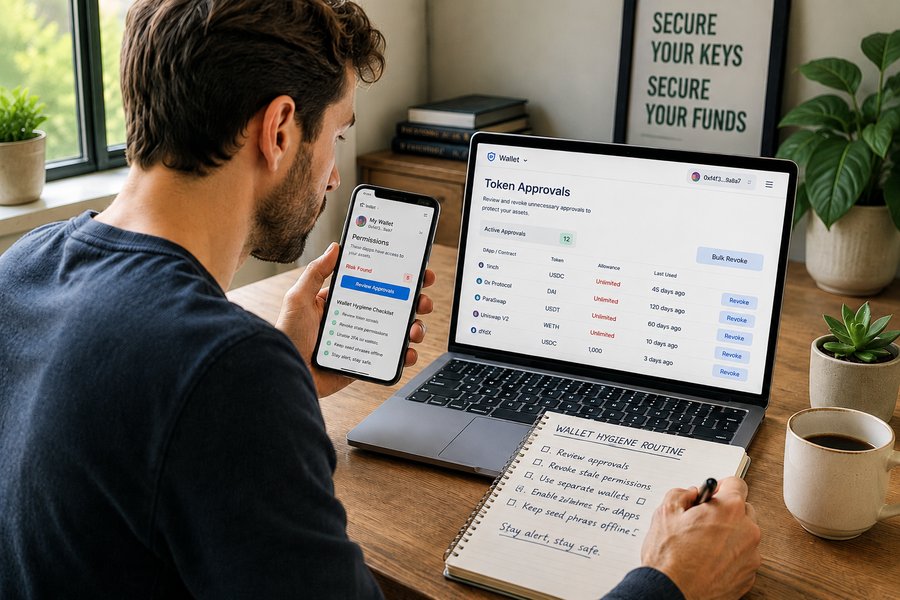
The world of decentralized finance, often shortened to DeFi, offers people the ability to trade, lend, borrow, and earn returns on their cryptocurrency without relying on banks or other traditional intermediaries, putting them in direct control of their own assets through software applications that run on blockchains. This control is the great appeal of DeFi, the promise that a person can be their own bank, holding their funds in a wallet that only they command and interacting with financial applications on their own terms, but it carries a corresponding burden that is easy to underestimate, because the same self-custody that frees a person from intermediaries also makes them solely responsible for the security of their assets. In the traditional financial system, a bank stands behind a customer’s account, reversing fraudulent charges and restoring stolen funds, but in DeFi there is no such backstop, and a person who loses their crypto to a mistake or an attack generally has no recourse, no one to call and no authority to make them whole, which makes the unglamorous discipline of keeping one’s wallet secure not an optional refinement but an essential practice.
Among the many security considerations that DeFi users face, one stands out for being both widespread and widely misunderstood, which is the matter of token approvals, the permissions that a person grants to the applications they use that allow those applications to move tokens from the person’s wallet. Every time a person uses a decentralized application to trade or stake or lend their tokens, they typically must grant that application permission to access those tokens, and these permissions, once granted, often persist indefinitely, sitting in the wallet as standing authorizations that the person quickly forgets they ever gave. These forgotten permissions are among the most dangerous vulnerabilities in DeFi, because a permission that allows an application to move a person’s tokens becomes a weapon in the hands of an attacker if that application is compromised or if the permission was malicious to begin with, allowing the attacker to drain the person’s tokens without any further action on the person’s part, a danger that has cost DeFi users enormous sums.
This article teaches the essential discipline of DeFi wallet hygiene, the set of unglamorous but powerful habits that prevent the great majority of DeFi losses, written for readers who use or are considering using decentralized applications and who want to protect their assets without needing to become security experts. It explains in plain language how token approvals work and why the convenient practice of granting unlimited approvals creates lasting danger, surveys the scale of the losses that approval-based attacks have caused and examines real cases in which forgotten approvals were exploited, and then turns to the practical routine of protecting oneself, including how to audit and revoke the approvals in one’s wallet, why and how to compartmentalize one’s holdings across multiple wallets, and the everyday habits that prevent most losses. The aim is to equip readers with a concrete and manageable safety routine, so that they can enjoy the benefits of decentralized finance while avoiding the costly mistakes that befall those who neglect the quiet but crucial work of wallet hygiene.
The Permission You Forgot You Gave: How Token Approvals Work
To understand why token approvals matter so much, it is necessary to understand what they are and why decentralized applications require them, beginning with the basic mechanics of how tokens move in the world of DeFi. Most of the tokens that people hold and trade in decentralized finance follow a common technical standard, the most prevalent being the standard known as ERC-20 on the Ethereum blockchain and its equivalents on other chains, and this standard includes a mechanism by which the owner of tokens can grant another party, typically a smart contract belonging to a decentralized application, permission to move a specified amount of those tokens on the owner’s behalf. This permission is called an approval or an allowance, and it exists because of the way decentralized applications need to interact with a person’s tokens, since for an application to execute a trade or a deposit involving a person’s tokens, the application’s smart contract must be able to move those tokens, which requires the owner’s prior authorization.
The reason this two-step structure exists, rather than a simpler arrangement in which a person directly hands tokens to an application, lies in the technical design of how smart contracts and tokens interact, a design that separates the granting of permission from the actual movement of tokens. When a person wants to trade a token on a decentralized exchange, they first grant the exchange’s smart contract an approval to spend that token, a transaction that authorizes the contract to move up to a certain amount of the token from the person’s wallet, and then, in a separate step, the person initiates the actual trade, during which the contract uses its approval to move the tokens and complete the exchange. This separation allows the application to move the person’s tokens at the moment of the trade without the person having to hand over the tokens in advance, preserving the person’s custody of the tokens until the actual transaction occurs, an arrangement that is in principle sensible but that creates the standing permissions whose risks are the subject of this article.
The crucial feature of these approvals, and the source of their danger, is that they persist after the transaction that prompted them is complete, remaining in effect as standing authorizations until the person explicitly revokes them, so that an approval granted for a single trade continues to authorize the application to move the person’s tokens indefinitely thereafter. A person who grants an exchange permission to spend their tokens in order to make one trade does not, by completing that trade, withdraw the permission, which instead remains active, allowing the exchange’s contract to move the person’s tokens at any time in the future until the person takes the deliberate step of revoking it. This persistence means that a person who uses many decentralized applications accumulates, over time, a collection of standing approvals, each one a permission granted to some application to move some token, and these permissions linger in the wallet, often long forgotten, as a growing set of authorizations that the person has given out and that remain in force.
The danger inherent in these persistent approvals becomes clear when one considers what an approval actually permits, which is the movement of the person’s tokens by the approved party, a power that is benign when the approved application is honest and functioning correctly but that becomes catastrophic if the application is compromised or was never trustworthy. An approval is, in effect, a key that the person has given to an application, allowing it to take the approved tokens from the wallet, and if that key falls into the wrong hands, whether because the application’s smart contract is exploited by an attacker, because the application was malicious from the start, or because the person was tricked into granting the approval to an attacker disguised as a legitimate application, then the holder of the key can use it to drain the approved tokens from the person’s wallet. This is the fundamental risk of token approvals, that a permission granted for a legitimate purpose and then forgotten can be turned against the person who granted it, and understanding this risk requires understanding why the approvals that people grant are so often far more expansive than the transactions that prompt them, a matter of the common practice of granting unlimited approvals.
Why “Unlimited” Approvals Became the Default
A critical aspect of token approvals that magnifies their danger is that the approvals people grant are frequently not limited to the amount needed for a particular transaction but are instead unlimited, authorizing the application to move not just the tokens involved in the immediate trade but all of the person’s tokens of that type, now and in the future. When a person grants an approval to a decentralized application, the application typically requests, and the person typically grants, an approval for an effectively infinite amount, so that the single approval covers not only the current transaction but any future transactions as well, eliminating the need to grant a new approval each time the person uses the application. This practice of unlimited or infinite approvals has become the default across much of DeFi, so common that many users do not realize they have granted such expansive permissions, assuming that the approval they granted was limited to the transaction they were making.
The reason unlimited approvals became the default is convenience, both for the user and for the application, because an unlimited approval, once granted, never needs to be renewed, sparing the person the friction and the transaction cost of granting a fresh approval each time they use the application. If approvals were limited to the exact amount of each transaction, a person would have to grant a new approval, and pay the associated network fee, every time they wanted to trade, which would make using decentralized applications more cumbersome and more expensive, and so applications request unlimited approvals to provide a smoother experience, and users grant them to avoid the repeated friction. This convenience is real, and it explains why the practice became standard, but it comes at the cost of a vastly expanded exposure, because the unlimited approval authorizes the movement of all of the person’s tokens of the approved type, not merely the amount they intended to transact, turning a permission meant to facilitate a single trade into a standing authorization over the person’s entire holding of that token.
The consequence of this default is that DeFi users routinely carry, in their wallets, unlimited approvals granted to numerous applications, each one authorizing the application to move the user’s entire balance of some token, and each one a potential avenue for catastrophic loss if the application is compromised. A person who has used a dozen decentralized applications may have granted a dozen unlimited approvals, any one of which, if the corresponding application is exploited or proves malicious, could be used to drain the person’s entire balance of the approved token, so that the person’s exposure is not limited to the small amounts they intended to transact but extends to their full holdings. This is the hidden risk that the convenience of unlimited approvals creates, an exposure that persists silently in the wallet and that most users are unaware of, and it is precisely this exposure that wallet hygiene aims to manage, by limiting the approvals one grants and by revoking those one no longer needs, practices that directly counter the dangers that the default of unlimited approvals has spread throughout DeFi.
When an Approval Becomes a Weapon: The Drainer Threat
The danger of token approvals is not theoretical but has been realized on an enormous scale, as attackers have systematically exploited approvals and related permissions to drain cryptocurrency from victims’ wallets, building an entire criminal industry around the practice that has cost DeFi users hundreds of millions of dollars. The tools of this industry are often called wallet drainers, malicious programs and schemes designed to trick users into granting approvals or signing permissions that the attacker then uses to empty the victims’ wallets, and the scale of the losses they have caused conveys the gravity of the threat. According to a report by the security firm Scam Sniffer, crypto users lost approximately four hundred ninety-four million dollars to phishing attacks that drained their wallets in 2024, a figure that represented an increase of sixty-seven percent over the previous year, indicating that the threat is not only large but growing rapidly as attackers refine their methods and target more victims.
The breadth of this victimization is reflected in the number of people affected, with the same report finding that around three hundred thirty-two thousand addresses were affected by wallet-draining phishing attacks in 2024, a vast number of individual victims, even as the report noted that the number of victims had grown only modestly compared to the prior year while the total losses surged, indicating that attackers were stealing more from each victim. The largest single theft documented in the report reached fifty-five and a half million dollars, and there were thirty cases of losses exceeding one million dollars, which together accounted for one hundred seventy-one million dollars, showing that while many victims lost smaller amounts, a number of individuals suffered catastrophic losses, their entire holdings drained in single incidents. These figures, drawn from analysis focused on the chains compatible with the Ethereum Virtual Machine where much DeFi activity occurs, convey the human scale of the threat, hundreds of thousands of people losing funds, some of them losing fortunes, to attacks that exploit the permissions their wallets had granted.
The same analysis revealed that the losses were not spread evenly across the year but clustered in periods of intense activity, with the first half of the year seeing frequent but smaller incidents in which individual losses ranged from roughly one to eight million dollars, while the peak period arrived in the late summer and early autumn, when the single largest thefts occurred, including the loss of fifty-five and a half million dollars in August and a further thirty-two and a half million dollars in September, two months that together accounted for more than half of the year’s large-scale losses. This concentration of major thefts in particular windows suggests that attackers mounted coordinated and especially effective campaigns at certain moments, and it underscores that the threat is not a steady background hazard but one that can surge suddenly, making the maintenance of good hygiene at all times, rather than only in response to a publicized incident, the prudent course for anyone who wishes to remain protected when the next wave of attacks arrives.
The role of approvals specifically within this broader landscape of theft is substantial, as analysis has attributed enormous sums to approval-based attacks in particular, the category of theft that exploits the token approvals at the center of this article. According to analysis cited from the security firm Chainalysis, approval-based phishing and scams accounted for over two hundred million dollars in losses in 2024 alone, and a cumulative total of more than four hundred ninety-three million dollars has been stolen since 2020 through approval-based exploits, figures that establish approval-based attacks as one of the most profitable avenues of theft in the entire DeFi ecosystem. These numbers demonstrate that the danger of token approvals is not an abstract possibility but a realized and ongoing catastrophe, with attackers continuously exploiting the approvals that users grant and forget, draining tokens from wallets whose owners had no idea they remained exposed.
What makes these losses particularly tragic is that they are largely preventable, because the approvals that attackers exploit are, in most cases, permissions that the victims no longer needed and could have revoked, or unlimited approvals that could have been limited, so that the discipline of wallet hygiene would have closed the very avenues that the attackers used. A person who regularly audits and revokes their approvals, who limits the approvals they grant rather than defaulting to unlimited, and who compartmentalizes their holdings so that no single approval exposes their entire wealth, dramatically reduces their vulnerability to the drainer threat, turning a catastrophic exposure into a manageable risk. The enormous losses that wallet drainers have caused are, in this sense, a testament to the importance of the hygiene practices this article describes, since the great majority of those losses flowed through the kinds of forgotten and excessive permissions that good hygiene eliminates, a point that the examination of specific exploited cases makes vivid.
Three Ways Approvals Have Been Exploited
Examining specific incidents in which token approvals were exploited illuminates the different ways that the danger materializes, showing that the threat comes not only from obviously malicious applications but also from the compromise of legitimate ones and from sophisticated attacks on the infrastructure that DeFi users rely upon. The first illustrative case is the exploit of the Li.Fi protocol in 2024, a decentralized finance protocol that suffered a loss of approximately nine million seven hundred thousand dollars when an attacker exploited a vulnerability in its smart contract, a loss that fell upon users who had granted the protocol the very approvals that the attack turned against them. The crucial detail of this incident is that the attack drained funds specifically from users who had existing unlimited approvals to the vulnerable contract, so that the victims were those who had granted the protocol expansive standing permissions, and the attacker, exploiting the contract’s flaw, used those permissions to move the users’ tokens. This case demonstrates that even a legitimate protocol can become the avenue for catastrophic loss if its contract is exploited, and that the users most exposed are precisely those who granted unlimited approvals and left them standing, exactly the exposure that limiting and revoking approvals would prevent.
A second instructive case is the exploit of the protocol known as Seneca in 2024, in which an attacker took advantage of a flaw in the protocol’s smart contract to drain approximately six and a half million dollars in tokens from users who had approved the contract, another instance in which standing approvals to a flawed contract became the mechanism of loss. As in the Li.Fi case, the victims of the Seneca exploit were users who had granted the protocol permission to move their tokens, and the attacker, exploiting the contract’s vulnerability, used those approvals to transfer the users’ tokens to the attacker’s control, draining the funds of those who had trusted the protocol with standing permissions. This case reinforces the lesson of the Li.Fi exploit, that the danger of approvals is not confined to applications that are malicious from the outset but extends to legitimate applications whose contracts contain flaws that attackers can exploit, so that the prudent user must regard every standing approval as a potential liability, since even an honest application can be turned into a weapon if its contract is compromised, and must therefore limit and revoke approvals to minimize the exposure that such compromises can exploit.
The third and perhaps most sobering case is the attack on the Ledger Connect Kit in December of 2023, an incident that illustrates how attackers can compromise the very infrastructure that many DeFi applications share, turning a single point of failure into a threat to users across numerous applications at once. The Ledger Connect Kit was a software component, a piece of code that many decentralized applications integrated into their websites to enable users to connect their wallets, and on the fourteenth of December 2023, an attacker compromised this component by gaining access to the account of a former employee and injecting wallet-draining malware into the widely used code. The injected malware, a drainer that prompted users to sign approval and permit messages, was thereby distributed through the websites of numerous prominent decentralized applications that had integrated the compromised component, including well-known exchanges and other services, so that users interacting with these legitimate applications were presented with malicious requests to grant approvals that would drain their wallets.
The Ledger Connect Kit attack is especially instructive for several reasons that bear directly on the practice of wallet hygiene. The attack succeeded by inducing users to sign approval and permit messages, the very permissions at the center of this article, demonstrating that the granting of approvals is the mechanism through which even sophisticated infrastructure attacks accomplish their theft, and the reporting on the incident noted that users who had active unlimited approvals during the attack were at significantly greater risk than those who had revoked their permissions earlier, a direct confirmation that the hygiene practice of revoking unneeded approvals reduces vulnerability even to attacks of this kind. While the total stolen in the Connect Kit incident, reported in the range of several hundred thousand dollars, was smaller than in some other attacks because the malicious code was detected and removed relatively quickly, the incident demonstrated the alarming reach of an attack on shared infrastructure, which exposed users across many applications simultaneously, and it underscored that the danger of approvals extends even to interactions with legitimate, trusted applications whose infrastructure has been compromised, reinforcing the case for limiting approvals, revoking those no longer needed, and scrutinizing every permission request even when it appears on a familiar and trusted application.
The New Frontier: Signature Phishing and Gasless Permits
As DeFi has evolved, a newer and in some ways more insidious variation on the approval threat has emerged, involving not the traditional on-chain approval transaction but the signing of off-chain messages that authorize the movement of tokens, a development that has shifted much of the danger from approvals that require a transaction to permissions that require only a signature. This shift arises from newer mechanisms, including a standard known as Permit and a related system called Permit2 associated with a major decentralized exchange, that allow a person to authorize the movement of their tokens by signing a message rather than by submitting an on-chain approval transaction, an arrangement designed to be more convenient and less costly because signing a message, unlike submitting a transaction, does not require paying a network fee. These gasless approvals, so called because they do not require the gas fee that an on-chain transaction incurs, were created to improve the user experience, but they have opened a new avenue for attackers, because a malicious message that a user is tricked into signing can authorize the draining of their tokens just as an approval can.
The danger of these signature-based permissions lies precisely in their gasless and off-chain nature, because a user accustomed to associating risk with transactions that cost a fee may let down their guard when asked merely to sign a message, not realizing that the signature can authorize the same token movements that an approval transaction would. Signature phishing, in which a malicious website tricks a user into signing a message that authorizes an attacker to move their tokens, has become a major vector of theft, and the absence of a gas fee removes one of the cues that might otherwise alert a user to the gravity of what they are authorizing, so that a user may sign a draining permission believing it to be a harmless step. The scale of this newer threat is substantial, with reporting indicating that in just the first half of 2024, around two hundred sixty thousand victims were phished on the chains compatible with the Ethereum Virtual Machine, suffering losses totaling around three hundred fourteen million dollars, much of it through the signing of phishing signatures of the kind that the Permit and Permit2 mechanisms enable.
A particularly treacherous feature of these signature-based attacks is the way they can separate the moment of the victim’s mistake from the moment of the theft, because a signed permission can authorize a transfer that the attacker relays to the contract at a later time, so that some drainers wait days after obtaining a signature before striking, making it harder for the victim to connect the eventual theft to the earlier signature they provided. This delay means that a user who signs a malicious message may see no immediate consequence and may believe that nothing went wrong, only to have their tokens drained days later when the attacker chooses to use the signature, an arrangement that both delays detection and obscures the cause, complicating the victim’s understanding of how they were robbed. The deadline-bound nature of some permit signatures provides a partial protection, since a permission that expires limits the window during which it can be used, but the fundamental danger remains that a single signature, given in a moment of inattention to a convincing fraudulent request, can authorize the loss of a person’s tokens.
The defense against signature phishing builds upon the same principles as the defense against approval-based attacks, with the added emphasis on treating signature requests with the same gravity as transactions and on understanding exactly what one is being asked to sign. The essential practice is to scrutinize every signature request as carefully as one would scrutinize a transaction, examining what the message authorizes, including the spender being granted permission, the amount, and any deadline, and refusing to sign messages whose purpose is unclear or whose source is not fully trusted, never assuming that a request is safe merely because it does not require a gas fee. Good wallets assist with this by rendering the contents of permit messages in human-readable form, showing the user the spender, the amount, and the deadline so that they can understand what they are authorizing, and the use of a wallet that displays this information clearly is an important protection, as is the practice of tracking one’s active permissions and revoking those that are no longer needed, extending the hygiene routine from traditional approvals to the newer world of signature-based permissions.
The Hygiene Routine: Auditing and Revoking Approvals
Having established the nature and the gravity of the approval threat, the discussion turns to the practical heart of wallet hygiene, the routine of auditing and revoking the approvals in one’s wallet, a discipline that directly eliminates the standing permissions that attackers exploit and that constitutes the single most important habit a DeFi user can adopt. The foundation of this routine is the recognition that every approval one has granted is a standing permission that persists until revoked, and that the accumulation of such permissions over time creates a growing exposure, so that the periodic review and revocation of approvals is necessary to keep that exposure in check. Auditing one’s approvals means examining the permissions currently active in one’s wallet, identifying which applications have been granted the ability to move which tokens and in what amounts, and revoking means deliberately canceling those permissions that are no longer needed, removing the standing authorizations that serve no current purpose but that continue to pose a risk.
The tools that make this routine practical are services and features that allow a person to see and manage the approvals associated with their wallet, of which the most widely known is a service called Revoke.cash, designed specifically to help users review and revoke their token approvals, along with similar features built into blockchain explorers and some wallets. Using such a tool, a person connects their wallet and is shown a list of the approvals they have granted, displaying the applications that hold permissions, the tokens those permissions cover, and whether the approvals are limited or unlimited, giving the person a clear picture of their standing exposure that would otherwise remain hidden. From this view, the person can revoke any approval they no longer need, with the tool guiding them through the revocation, which is itself an on-chain transaction that cancels the permission and removes the application’s ability to move the person’s tokens, so that the routine of auditing and revoking becomes a concrete and manageable process rather than an abstract aspiration.
The recommended practice is to conduct this audit regularly, treating the review and revocation of approvals as a periodic maintenance task much like any other routine of upkeep, so that approvals do not accumulate unchecked and standing permissions do not linger long after the transactions that prompted them. A prudent user reviews their approvals at regular intervals, revoking those associated with applications they no longer use, those granted for one-time transactions that are complete, and any that they do not recognize or that appear suspicious, keeping the set of active approvals as small as possible and limited to those genuinely needed for current activity. This regular pruning ensures that even if an application a person once used is later compromised, the person who has revoked their approval to that application is no longer exposed, having closed the avenue before the attacker could use it, a protection that the cases examined earlier show to be decisive, since victims in those incidents were precisely those who had left their approvals standing.
Beyond revoking unneeded approvals, the hygiene routine includes practices for limiting the approvals one grants in the first place, reducing exposure at the moment of granting rather than only correcting it afterward. Where a wallet or application permits, a person can grant a limited approval, authorizing only the amount needed for the immediate transaction rather than the unlimited amount that applications typically request, so that the standing permission, even if forgotten, exposes only a bounded amount rather than the person’s entire holding of the token. Some users also follow a practice of setting an approval back to zero before granting a new one, a pattern that ensures old approvals do not silently persist alongside new ones, and the general principle is to grant the minimum permission necessary for what one is doing, treating every approval as a liability to be minimized rather than a convenience to be maximized. Together, the practices of granting limited approvals and regularly revoking unneeded ones form the core of wallet hygiene, directly countering the exposure that the default of unlimited and forgotten approvals creates, and constituting the most powerful single defense against the drainer threat.
Compartmentalizing: Why You Need More Than One Wallet
A second pillar of wallet hygiene, complementing the discipline of managing approvals, is the practice of compartmentalization, dividing one’s holdings across multiple wallets so that the assets exposed to the risks of active DeFi use are separated from the assets one wishes to keep safe, limiting the damage that any single compromise can cause. The principle behind compartmentalization is that risk should be contained, so that a person does not expose their entire holdings to the dangers of every interaction, but instead structures their wallets so that the funds at risk in any given activity are limited to what that activity requires, keeping the bulk of their wealth in wallets that are not exposed to the approvals and signatures that active DeFi use entails. This separation means that even if a person falls victim to an attack that drains a wallet, the loss is confined to that wallet’s contents, while the assets held separately remain safe, a containment of risk that transforms a potentially catastrophic loss into a bounded one.
The most basic form of compartmentalization is the distinction between a wallet used for long-term holdings and a wallet used for active trading and DeFi interaction, sometimes described as the difference between a cold or savings wallet and a hot or trading wallet. The long-term holdings wallet, which holds the assets a person intends to keep and not actively trade, is kept separate from DeFi activity, granting no approvals and signing no permissions, ideally secured by a hardware wallet that keeps its keys offline, so that it is insulated from the approval and signature risks that active use entails. The active trading wallet, by contrast, is funded with only the amount a person is prepared to put at risk in their DeFi activities, and it is this wallet that interacts with applications, grants approvals, and signs permissions, so that the exposure inherent in active use is confined to the limited funds held there, while the larger long-term holdings remain untouched in their separate and protected wallet.
This division reflects a useful way of thinking about the funds in an active wallet, treating them as tactical savings deliberately placed at risk, an amount one has consciously decided to expose to the dangers of active DeFi use and whose potential loss one is prepared to accept, rather than one’s entire wealth carelessly left vulnerable. By funding the active wallet with only what one is willing to risk and keeping the rest in protected long-term storage, a person aligns their exposure with their risk tolerance, ensuring that the inevitable dangers of active DeFi participation cannot reach the assets they cannot afford to lose. Some users extend compartmentalization further, using additional wallets for particularly risky activities, such as interacting with new or unproven applications, sometimes called burner wallets because they hold minimal funds and can be abandoned if compromised, so that the riskiest interactions are isolated in wallets whose loss would be inconsequential, an additional layer of containment for the activities that carry the greatest danger.
The discipline of compartmentalization works in concert with the management of approvals to provide a layered defense, in which the limiting and revoking of approvals reduces the likelihood and the reach of a compromise while the separation of wallets contains the damage if a compromise nonetheless occurs. A person who both manages their approvals carefully and compartmentalizes their holdings has constructed two complementary protections, the first reducing the chance that any wallet is drained and the second ensuring that, if one is, the loss is limited to a wallet holding only what the person was prepared to risk. This layered approach embodies the broader philosophy of wallet hygiene, which does not rely on any single measure to provide perfect security, an impossibility in a domain where attacks are constant and sophisticated, but instead combines several practical habits that together reduce both the probability and the consequences of loss, allowing a person to participate in decentralized finance with their most important assets protected and their exposure consciously limited to what they can afford to lose.
Building Habits That Prevent Most Losses
The practices examined thus far, the management of approvals and the compartmentalization of holdings, are most effective when woven together with a set of everyday habits that govern how a person interacts with decentralized applications, habits that, once established, prevent the great majority of losses with little ongoing effort. The most fundamental of these habits is the careful reading of every prompt before approving or signing, because the moment of granting a permission is the moment of greatest vulnerability, and a person who pauses to understand exactly what they are authorizing, examining the application requesting the permission, the token involved, the amount, and the type of permission, can catch the malicious or excessive requests that careless clicking would approve. This habit of scrutiny is the first line of defense, since most attacks ultimately require the victim to approve or sign something, and the person who reads carefully and refuses to authorize what they do not understand closes the door through which most attacks must pass.
Closely related is the habit of granting only the minimum permission necessary, resisting the default of unlimited approvals in favor of limited ones wherever possible, and declining to grant permissions that an interaction does not genuinely require, so that the standing exposure a person creates is kept as small as the activity allows. A person who routinely limits their approvals accumulates far less exposure than one who reflexively grants unlimited permissions, and combined with the habit of regularly revoking unneeded approvals, this practice keeps the set of standing permissions small and current, dramatically reducing the avenues available to attackers. These habits of minimal granting and regular revocation reinforce one another, the first limiting what is created and the second removing what is no longer needed, together maintaining the wallet in a state of low exposure that good hygiene seeks.
The use of a hardware wallet, a physical device that stores the keys to a wallet offline and requires physical confirmation of transactions, is another habit that substantially improves security, particularly for the protection of long-term holdings and for the scrutiny of permissions. A hardware wallet keeps the critical secret that controls a wallet, the private key, isolated from the internet-connected computer or phone, so that even if the device a person uses to interact with DeFi is compromised, the keys remain protected, and the requirement to confirm transactions on the device provides an additional opportunity to review what one is authorizing. Good hardware wallets display the details of transactions and permissions for confirmation, allowing the person to verify on a trusted device exactly what they are approving, a protection that is especially valuable against the signature phishing attacks that rely on the victim not understanding what they are signing, and the use of such a device for one’s significant holdings is a widely recommended practice.
Finally, the cultivation of a general posture of caution and skepticism, treating unexpected requests, unfamiliar applications, and too-good-to-be-true opportunities with suspicion, rounds out the habits that prevent most losses, since many attacks rely on luring victims into interactions through deception, urgency, or the promise of reward. A person who approaches DeFi with the understanding that attacks are constant, that legitimate-seeming applications can be compromised, and that the responsibility for security rests entirely on themselves, develops the wariness that resists the social engineering at the heart of most attacks, pausing before acting, verifying before trusting, and declining to engage with what they cannot confirm to be safe. These habits, taken together with the management of approvals and the compartmentalization of holdings, constitute the complete routine of wallet hygiene, an integrated set of practices that, while requiring some effort and attention, prevent the overwhelming majority of the losses that befall DeFi users, and that allow a person to participate in decentralized finance with confidence grounded in genuine protection rather than in the hope that nothing will go wrong.
Final Thoughts
The discipline of wallet hygiene embodies a truth at the heart of decentralized finance, that the freedom of self-custody, the ability to control one’s own assets without reliance on intermediaries, is inseparable from the responsibility that self-custody entails, the obligation to protect those assets oneself in the absence of the backstops that the traditional financial system provides. This responsibility can seem daunting, and the enormous losses that attacks have caused, hundreds of millions of dollars drained from hundreds of thousands of victims, testify to its seriousness, but the practices that fulfill it are neither mysterious nor beyond the reach of ordinary users, consisting instead of a manageable routine of auditing and revoking approvals, compartmentalizing holdings, and cultivating careful habits, a routine that anyone can learn and maintain. The unglamorous work of wallet hygiene is, in this light, not a burden imposed by the technology but the natural and necessary counterpart of the control that decentralized finance offers, the price and the protection of genuine ownership.
What makes this discipline empowering rather than merely defensive is that it places the security of one’s assets within one’s own control, so that a person who adopts the habits of good hygiene is not at the mercy of forces beyond their influence but is actively protecting themselves through practices whose effectiveness the evidence confirms. The cases examined here, in which victims were precisely those who had left unlimited approvals standing and who signed permissions they did not understand, demonstrate that the losses flowed through avenues that hygiene closes, and that the person who manages their approvals, contains their exposure, and scrutinizes their permissions has eliminated the very vulnerabilities that the attacks exploited. The drainer threat is real and growing, but it is also, to a remarkable degree, a threat that disciplined users can defend against, turning what might seem an arena of helpless exposure into one of manageable and controllable risk.
The accessibility of these protections matters greatly for the broader promise of decentralized finance, because a technology that offers financial control to anyone is meaningful only if that control can be exercised safely, and the tools and practices of wallet hygiene, freely available and learnable by anyone willing to attend to them, make safe participation possible without requiring deep technical expertise. The existence of services that let any user audit and revoke their approvals, the availability of hardware wallets that protect significant holdings, and the simplicity of compartmentalizing one’s funds mean that the security DeFi requires is within reach of ordinary participants, so that the responsibility of self-custody, while real, need not exclude those without specialized knowledge from participating safely. The democratization of finance that DeFi promises depends on the democratization of the security practices that make it safe, and these practices, this article has shown, are accessible to all.
The habits of wallet hygiene, once established, become second nature, an ordinary part of participating in decentralized finance much as locking one’s door is an ordinary part of leaving one’s home, requiring little ongoing effort yet protecting against the great majority of the dangers that the careless face. The person who reads their prompts, limits their approvals, revokes what they no longer need, separates their holdings, and approaches the space with appropriate caution has built a defense that the evidence shows to be effective, through practices that demand attention rather than expertise. In the balance between the freedom that decentralized finance offers and the responsibility it imposes lies the practice of wallet hygiene, a discipline that turns the daunting prospect of self-custody into the manageable reality of self-protection.
FAQs
- What is a token approval in DeFi?
A token approval is a permission you grant to a decentralized application, allowing its smart contract to move a specified amount of your tokens on your behalf. It exists because applications need authorization to move your tokens when you trade, stake, or lend. Crucially, the approval persists after the transaction that prompted it, remaining active as a standing permission until you deliberately revoke it. - Why are unlimited approvals dangerous?
Applications often request, and users grant, unlimited approvals so the permission never needs renewing, which is convenient but risky. An unlimited approval authorizes the application to move your entire balance of that token, now and in the future, not just the amount you intended to transact. If the application is later exploited or proves malicious, an attacker can use that approval to drain your whole holding of the token. - How much have people lost to approval and phishing attacks?
The losses are enormous. A Scam Sniffer report found that crypto users lost about four hundred ninety-four million dollars to wallet-draining phishing in 2024, a sixty-seven percent increase over the prior year, affecting around three hundred thirty-two thousand addresses. Separately, approval-based phishing alone accounted for over two hundred million dollars in 2024, with more than four hundred ninety-three million dollars stolen through approval exploits since 2020. - How do I check and revoke my token approvals?
You can use a service such as Revoke.cash, or similar features in blockchain explorers and some wallets, by connecting your wallet to see a list of the approvals you have granted, the tokens they cover, and whether they are unlimited. From there you can revoke any approval you no longer need, which is itself an on-chain transaction that cancels the permission and removes the application’s ability to move those tokens. - How often should I audit my approvals?
Treat it as regular maintenance, reviewing your approvals at intervals rather than only after a problem. Revoke approvals tied to applications you no longer use, those granted for completed one-time transactions, and any you do not recognize. Regular pruning means that even if an application you once used is later compromised, you are no longer exposed, having closed the avenue before an attacker could use it. - What is signature phishing and how is it different?
Signature phishing tricks you into signing an off-chain message, using mechanisms like Permit and Permit2, that authorizes an attacker to move your tokens without an on-chain approval transaction. Because signing a message is gasless and carries no fee, users often let their guard down, not realizing the signature can drain their tokens. In the first half of 2024 alone, around two hundred sixty thousand victims lost roughly three hundred fourteen million dollars this way. - Why should I use more than one wallet?
Compartmentalization contains risk. By keeping long-term holdings in a separate, protected wallet that grants no approvals, and funding an active trading wallet with only what you are prepared to risk, you ensure that if an attack drains the active wallet, your main holdings remain safe. Some users add burner wallets holding minimal funds for the riskiest interactions, isolating those dangers further. - Does a hardware wallet protect me from approval attacks?
A hardware wallet greatly improves security by keeping your private keys offline and requiring you to confirm transactions on the device, which protects your keys even if your computer is compromised and gives you a chance to review what you are authorizing. Good hardware wallets display permission details clearly, which helps against signature phishing, but you must still read and understand each request, since approving a malicious permission on any device still authorizes it. - What happened in the Ledger Connect Kit attack?
In December 2023, an attacker compromised the Ledger Connect Kit, a software component many decentralized applications used to connect wallets, by accessing a former employee’s account and injecting wallet-draining malware. The malware, distributed through numerous legitimate applications, prompted users to sign approval and permit messages. Users with active unlimited approvals were at significantly greater risk, a direct demonstration that revoking unneeded permissions reduces vulnerability even to infrastructure attacks. - Can good wallet hygiene really prevent most losses?
To a remarkable degree, yes. The major attacks consistently drained victims who had left unlimited approvals standing or who signed permissions they did not understand, exactly the vulnerabilities that hygiene eliminates. By limiting and regularly revoking approvals, compartmentalizing holdings, reading every prompt, granting minimal permissions, and using a hardware wallet, you close the avenues that the overwhelming majority of attacks rely upon, turning catastrophic exposure into manageable, controllable risk.