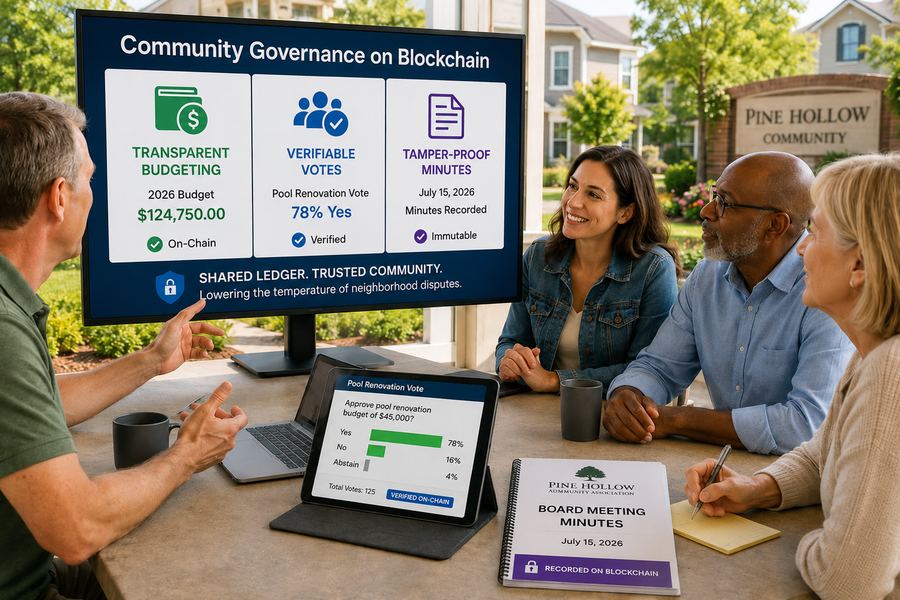
Few institutions in ordinary life generate as much friction, suspicion, and outright conflict as the homeowners association and the neighborhood community association, organizations that exist to manage the shared affairs of a residential community but that have become, in the experience of many residents, synonymous with disputes over money, contested elections, and the sense that decisions are being made behind closed doors by people who cannot quite be trusted. These associations collect dues from homeowners, maintain common areas, enforce rules, and make decisions that affect property values and daily life, and they do so through the familiar machinery of boards, meetings, votes, and budgets, a machinery that depends fundamentally on the trust of the residents in the people who run it. Yet that trust is frequently strained or broken, as residents come to suspect that the books do not add up, that an election was mishandled, that the minutes of a meeting were altered or lost, or that a board is serving its own interests rather than the community’s, and the resulting disputes can poison the atmosphere of a neighborhood and consume enormous amounts of time, money, and goodwill.
At the root of many of these conflicts lies a problem of records and verification, the simple but persistent difficulty of establishing what was actually decided, how the money was actually spent, and whether a vote was actually counted correctly, in a system where the records are kept by the very people whose conduct is in question and where residents have little ability to verify the accounts they are given. When a homeowner cannot independently confirm how their dues were spent, cannot be sure that the ballots in an election were counted honestly, and cannot trust that the minutes accurately reflect what occurred, the conditions are ripe for suspicion and dispute, and the absence of a trustworthy shared record becomes a constant source of friction. It is precisely this kind of problem, the need for records that all parties can trust without having to trust any single record-keeper, that a technology called blockchain was designed to address, which raises the intriguing possibility that the shared ledgers of the cryptocurrency world might have something to offer the troubled governance of neighborhood associations.
This article explores the application of blockchain technology to the governance of homeowners associations and neighborhood community associations, examining how the shared, tamper-resistant records that blockchains provide might address the recurring problems of opaque budgets, contested votes, and disputed records that plague these organizations. It is written for readers who may have experienced the frustrations of community association governance without any knowledge of blockchain, and it aims to explain in plain terms what the technology actually offers, how it could be applied to verifiable voting, transparent budgeting, and permanent minutes, and what real-world tools and examples already exist, while also confronting honestly the significant limits and hard problems that stand between the promise and its realization. The goal is neither to dismiss the idea as fantasy nor to oversell it as a panacea, but to help readers understand whether and how shared ledgers might genuinely lower the temperature of neighborhood disputes and make community governance more trustworthy. For the millions of people who live under the authority of a community association, the question is not abstract but bears directly on the cost, fairness, and civility of their everyday lives.
The Trouble with How Community Associations Are Run Today
To appreciate what blockchain might offer community associations, one must first understand the specific governance failures that make these organizations so prone to conflict, failures that recur with remarkable consistency across associations of all kinds and that share a common root in the difficulty of establishing trustworthy shared records. The most frequent and corrosive of these failures concerns money, as homeowners association budgets are often opaque to the residents who fund them, with dues collected and spent according to accounts that residents must largely take on faith, and the suspicion that funds are being mismanaged, misspent, or even misappropriated is among the most common sources of association conflict. When a homeowner receives a notice that their dues are increasing or that a special assessment is being levied, but cannot independently verify how the existing funds have been spent or whether the stated financial condition of the association is accurate, the stage is set for resentment and dispute, and the opacity of association finances becomes a standing invitation to suspicion.
Elections and votes form a second major arena of conflict, because the legitimacy of an association’s board and its decisions depends on the integrity of the voting process, yet that process is frequently conducted in ways that invite doubt, with ballots collected and counted by interested parties, proxies of uncertain validity, and results that the losing side has little ability to verify. Contested elections, accusations of ballot mishandling, and disputes over whether a quorum was met or a measure properly passed are common features of association life, and because the voting is often controlled by the very people whose positions are at stake, the losing parties may reasonably suspect that the count was not honest, a suspicion that is difficult to dispel when the records are not independently verifiable. The result is that even validly conducted elections can be tainted by doubt, and improperly conducted ones can entrench boards that lack genuine legitimacy, with both outcomes feeding the cycle of distrust.
The records of what an association has decided, embodied in the minutes of its meetings and the documentation of its decisions, constitute a third source of difficulty, because these records are typically kept by the board or its agents and can be incomplete, inaccurate, altered, or lost, leaving residents unable to establish with certainty what was actually decided and when. When the minutes of a meeting can be revised after the fact, when decisions are poorly documented, or when records simply disappear, the community loses the ability to hold its leaders accountable to what was agreed, and disputes arise over the basic question of what the association actually committed to do. The malleability and unreliability of these records means that the history of an association’s decisions, which ought to be a settled and authoritative reference, becomes instead a contested and uncertain matter, subject to the interests and memories of those who control the documentation.
The financial and human costs of these governance failures are far from trivial, and they help explain why the search for better tools is more than an academic exercise, since disputes within community associations routinely escalate into expensive litigation, prolonged hostility among neighbors, and the kind of dysfunction that can depress property values and make a community an unpleasant place to live. When residents lose confidence in their association’s handling of money or its conduct of elections, the conflict can consume years and substantial legal fees, divide neighbors into warring factions, and turn what should be the mundane administration of shared property into a source of chronic stress and acrimony. The stakes of association governance are therefore real and tangible, affecting not only the abstract question of trust but the concrete realities of property values, legal expenses, and the quality of daily life in a neighborhood, and any technology that could genuinely reduce these conflicts would address a problem of considerable practical importance to the millions of people who live under the authority of community associations.
Underlying all of these specific failures is the fundamental problem that community association governance depends on residents trusting record-keepers whose conduct the records are supposed to document, a circular arrangement in which the people responsible for the money, the votes, and the minutes are often the same people whose accountability those records are meant to ensure. This concentration of record-keeping in the hands of interested parties, combined with the limited ability of ordinary residents to verify the accounts they are given, creates a structural vulnerability to both genuine misconduct and unfounded suspicion, and it explains why community associations so reliably generate conflict even when their leaders act in good faith. The absence of records that all parties can trust without trusting any single record-keeper is the common thread, and it is exactly this absence that blockchain technology, with its promise of shared and tamper-resistant records, purports to address, making the technology a natural candidate for the governance problems that have long bedeviled neighborhood associations.
What Blockchain Actually Offers Governance
To understand why blockchain technology might be relevant to the governance problems of community associations, one must grasp what the technology actually does, setting aside the speculative frenzy of cryptocurrency trading with which it is popularly associated and focusing instead on its underlying function as a particular kind of record-keeping system. At its core, a blockchain is a way of maintaining a shared record, a ledger, that is held and verified collectively rather than by any single party, that is extremely difficult to alter once entries have been made, and that allows anyone with permission to verify the contents independently, properties that together address the central governance problem of needing records that all parties can trust without trusting any single record-keeper. These properties, rather than any connection to cryptocurrency or financial speculation, are what make blockchain potentially valuable for governance, and they map with striking directness onto the specific failures that plague community associations.
The first and most important property is immutability, the quality of being extremely difficult to alter once recorded, which derives from the way a blockchain links its entries together cryptographically so that changing any past entry would require altering everything that followed it and obtaining the agreement of the network that maintains the ledger, a feat that is practically infeasible in a properly designed system. This immutability directly addresses the problem of malleable records, because a vote, a financial transaction, or a set of minutes recorded on a blockchain cannot be quietly altered or deleted after the fact, providing a permanent and tamper-resistant record of what actually occurred that no interested party can revise to suit their purposes. For an association plagued by altered minutes, disputed vote counts, and questionable accounts, the prospect of records that cannot be changed once made offers a foundation of certainty that the current system conspicuously lacks.
The second property is transparency combined with verifiability, the capacity for the contents of the ledger to be inspected and independently confirmed by those with permission to view them, so that residents need not take the record-keeper’s word for what the records contain but can verify the contents for themselves. A blockchain can be configured to allow the members of an association to see and verify the financial transactions, the vote tallies, and the decisions recorded on it, transforming records that are currently opaque and controlled into records that are open and checkable, which addresses the suspicion that flourishes when residents cannot confirm the accounts they are given. This combination of openness and verifiability means that the trust which the current system asks residents to place in their leaders can be partly replaced by the ability to verify, reducing the dependence on faith in the record-keepers and the disputes that arise when that faith breaks down.
It is worth pausing to dispel a common confusion that may deter associations from considering the technology, namely the assumption that using blockchain requires involvement with cryptocurrency, speculative tokens, or the volatile financial instruments with which the technology is popularly associated. A blockchain used for governance need not involve any cryptocurrency at all, and the shared ledger that records votes, finances, and minutes can operate purely as a record-keeping system without any speculative or financial dimension, so that an association adopting blockchain for governance is not thereby exposing itself to the risks and complexities of the cryptocurrency markets. This distinction matters because the reputation of blockchain has been shaped by the turbulence of cryptocurrency, and residents understandably wary of speculative finance may resist a technology they associate with it, when in fact the governance application uses only the record-keeping properties of the underlying system and can be implemented entirely separately from any token or currency, a separation that responsible providers of these tools make clear.
The third property is decentralization, the maintenance of the ledger across multiple participants rather than by a single central authority, which removes the single point of control and failure that characterizes traditional record-keeping and ensures that no individual party can unilaterally alter or suppress the records. In the context of an association, this means that the records need not reside solely with the board or its management company but can be maintained in a way that no single interested party controls, so that the records survive changes in leadership, resist manipulation by those in power, and remain accessible to the community regardless of the conduct of any individual. Together, these three properties of immutability, transparency with verifiability, and decentralization constitute the genuine offering of blockchain to governance, a way of creating shared records that all parties can trust because no single party controls them and because their contents cannot be secretly altered, and it is this offering, properly understood, that underlies the various specific applications to community association governance that the following sections examine.
The Shared Ledger in Plain Terms
For a reader unfamiliar with the technology, the concept of a blockchain can be made concrete through a simple analogy that captures its essential workings without the technical jargon, beginning with the image of a shared notebook in which a community records its important transactions and decisions. Imagine that instead of the association’s treasurer keeping the only copy of the financial records in a private ledger, every member of the community holds an identical copy of a shared notebook, and that whenever a new entry is to be made, a transaction recorded or a decision documented, the entry is announced to everyone, checked for validity, and then written into every copy of the notebook simultaneously, so that all the copies remain identical and no single person can alter their own copy without the change being detected and rejected by all the others. This shared notebook, maintained collectively and kept identical across all its holders, is the essence of what a blockchain provides, a record that belongs to the community as a whole rather than to any individual.
The crucial features of this shared notebook are what give it its power, beginning with the fact that entries, once written, cannot be erased or altered, because each new entry is linked to the ones before it in a way that would reveal any tampering, so that the history recorded in the notebook is permanent and any attempt to change it would be immediately apparent to everyone holding a copy. Because every member holds an identical copy and any change must be agreed upon and reflected in all copies, no single person, not the treasurer, not the board president, not the management company, can secretly alter the record to hide a misspent sum or change the outcome of a vote, and the very structure of the shared notebook makes such manipulation detectable and therefore futile. The record becomes, in effect, a single shared truth that the whole community can see and verify, rather than a private account that residents must accept on faith.
This shared notebook also resolves the problem of who controls the records, because in the traditional arrangement the records are held by a central party who can be mistrusted, but in the shared-notebook system the records are held by everyone and controlled by no one, so that their integrity does not depend on the honesty of any single record-keeper. When a community wishes to verify how its money was spent, it can consult the shared record that all members hold and that none can alter, and when a vote is held, the tally can be recorded in the same shared notebook where everyone can confirm it, removing the need to trust the word of those who conducted the count. The genuine innovation of blockchain, stripped of its association with cryptocurrency and speculation, is precisely this capacity to maintain a shared record that a community can trust without trusting any individual, and it is this capacity, applied to the money, the votes, and the decisions of a community association, that constitutes the technology’s real and potentially transformative offering to the governance of neighborhoods, an offering whose specific applications the remainder of this article explores.
Verifiable Votes and Disputed Elections
The application of blockchain technology to the voting and elections of community associations represents perhaps the most developed and immediately practical use of the technology in this domain, addressing directly the disputes over ballot integrity and vote counting that so frequently undermine the legitimacy of association governance. The fundamental idea is to record votes on a tamper-resistant shared ledger so that the tally can be independently verified and cannot be altered after the fact, replacing the current system in which ballots are collected and counted by interested parties with one in which the integrity of the count is guaranteed by the technology and open to verification by all. A number of companies have developed precisely such blockchain-based voting platforms aimed at homeowners associations and similar organizations, moving this application from theory into commercially available practice.
Among these platforms, several have built their offerings explicitly around the verifiable, tamper-proof recording of association votes, demonstrating that the technology has progressed beyond concept to deployable product. The platform TrueHOA, for example, locks every ballot and tally into an immutable verification record on an independent blockchain ledger, and offers homeowners associations, condominium associations, and cooperative boards the ability to conduct online voting with verified, self-proving results for annual meetings and board elections across all fifty states, directly targeting the problem of disputed elections with results that can be independently confirmed. Another platform, Electis, leverages blockchain technology to ensure that every vote is securely cast, accurately counted, and permanently recorded on a tamper-proof ledger, while a further service, Follow My Vote, has built a voting platform that uses blockchain to maintain a system resistant to fraud or manipulation and that can publish votes publicly without revealing the identities of the voters, addressing the dual demands of verifiability and ballot secrecy.
The capacity to publish verifiable results while preserving the secrecy of individual ballots is a particularly important achievement, because it resolves an apparent tension at the heart of trustworthy voting, the need for the count to be open to verification while individual votes remain private. The cryptographic techniques underlying these platforms allow the tally to be independently confirmed and the integrity of the election to be established without exposing how any particular person voted, so that a homeowner can verify that the election was conducted honestly without sacrificing the privacy that secret balloting requires, a combination that the traditional paper-and-proxy system struggles to provide. This ability to deliver both verifiability and secrecy is what makes blockchain voting genuinely useful for associations, since an election that is verifiable but not secret, or secret but not verifiable, fails to meet the full requirements of legitimate community governance, and the platforms that achieve both offer a real advance over current practice.
The practical advantages of blockchain-based voting extend beyond the integrity of the count to the convenience and accessibility of participation, which themselves bear on one of the chronic weaknesses of association governance, the low turnout that allows small factions to control outcomes. Traditional association elections often depend on residents attending meetings in person or returning paper ballots and proxies, requirements that depress participation and that can be manipulated by those who control the process, whereas secure online voting recorded on a verifiable ledger allows residents to participate from anywhere within a defined period, potentially raising turnout and making the resulting decisions more genuinely representative of the community. When voting is both easy and trustworthy, more residents may take part, and a higher and more verifiable level of participation strengthens the legitimacy of the outcomes, addressing not only the integrity of the count but the breadth of the mandate behind it, though the technology must be implemented in ways that do not exclude those less comfortable with digital tools, a tension addressed later in this discussion.
The adoption of electronic and blockchain-based voting for associations is also being shaped by the evolving legal context, as states move to authorize and regulate electronic voting for community associations, a necessary step for these technologies to be used in legally binding elections. California, for instance, has pursued legislation to authorize homeowners associations to conduct elections using electronic secret balloting, reflecting a broader movement to modernize the legal framework within which associations operate, while Florida enacted a homeowners association measure in October 2023, often described as a bill of rights for homeowners, aimed at improving transparency between boards and residents. These legal developments matter because the usefulness of blockchain voting depends on its being permitted and recognized within the governing statutes and the association’s own rules, and the gradual movement of state law toward authorizing electronic voting creates the conditions in which verifiable blockchain-based elections can become a legitimate and binding part of association governance rather than a mere technical curiosity. The combination of available platforms and an evolving legal framework makes verifiable voting the most mature of the technology’s applications to community governance.
Transparent Budgeting and Tamper-Proof Minutes
Beyond voting, the application of blockchain to the financial records and decision documentation of community associations addresses the opacity of budgets and the malleability of minutes that constitute two of the most persistent sources of association conflict, offering the prospect of open books and permanent records that residents can trust and verify. The core idea for budgeting is to record an association’s financial transactions on a shared, tamper-resistant ledger that members can inspect, so that the collection of dues, the payment of expenses, and the state of the association’s reserves become transparent and verifiable rather than opaque accounts that residents must accept on faith. When every expenditure is recorded on a ledger that cannot be altered and that members can examine, the suspicion that funds are being mismanaged or misappropriated loses much of its purchase, because residents can see for themselves where the money has gone, and the board’s stewardship of the community’s funds becomes a matter of open record rather than private trust.
The principle that recording public or collective expenditures on a blockchain can enhance accountability has been demonstrated at scales far larger than a homeowners association, lending credibility to its application at the neighborhood level. Brazil, for example, launched a national blockchain network in 2022 through a partnership involving its federal accounting court and its national development bank, with one of the network’s stated goals being to provide greater accountability with respect to public expenditures, an initiative that illustrates how governments themselves have turned to blockchain to make the spending of collective funds more transparent and verifiable. At the more local level, the city of South Burlington, Vermont, has recorded property deeds with a reference tied to a blockchain transaction, demonstrating the use of the technology to create permanent, verifiable public records, and these governmental applications, operating at scales and stakes far exceeding those of a community association, demonstrate that the use of shared ledgers for transparent recording of collective finances and official records is not mere theory but established practice in the public sphere.
The application of the same principles to the minutes and decision records of an association addresses the problem of malleable and unreliable documentation, because recording the minutes of meetings and the decisions of the board on a tamper-resistant ledger creates a permanent record that cannot be quietly altered or lost, establishing with certainty what was decided and when. When the minutes of a meeting are committed to an immutable ledger, the community gains an authoritative and unchangeable record of its own history, so that disputes over what was actually agreed can be resolved by reference to a record that no interested party can revise, and the board can be held accountable to its documented commitments. This permanence transforms the minutes from a contested and uncertain account, subject to the control of those who keep them, into a settled and reliable reference that serves the whole community, removing one of the recurring sources of association dispute and providing a foundation of documentary certainty on which trust can be rebuilt.
A further benefit of recording financial transactions and decisions on a shared ledger is the creation of a continuous and authoritative institutional memory that survives the turnover of boards and management companies, addressing a problem that afflicts many associations as leadership changes and knowledge is lost. Community associations frequently suffer from discontinuity, as one board succeeds another and as management companies change, with records scattered, incomplete, or inaccessible, so that a new board may struggle to understand what its predecessors decided, what commitments the association has made, and how its finances have evolved over time. A permanent, shared record of the association’s transactions and decisions, maintained independently of any particular board or management company, would provide a continuous history that each new set of leaders could consult and that residents could rely upon, preserving the institutional memory that is so often lost in the transitions of association governance and giving the community a stable foundation of documented history on which to build, rather than forcing each new board to reconstruct the past from fragmentary and contested records.
The combination of transparent budgeting and tamper-proof minutes, taken together, offers the prospect of an association whose financial conduct and decision-making are conducted in the open and recorded permanently, a marked departure from the opacity and malleability that characterize current practice and a direct response to the suspicions that fuel association conflict. An association operating in this way would present its members with verifiable accounts of how their money is spent and unalterable records of what their representatives have decided, replacing the faith that the current system demands with the verification that the technology enables, and in doing so it would address at their root the financial and documentary disputes that so often poison community life. While the practical implementation of such systems for ordinary associations remains at an early stage, and the available examples are drawn more from governmental and large-scale applications than from widespread association adoption, the demonstrated viability of blockchain-based transparent recording at larger scales suggests that the same approach could, with appropriate tools, bring genuine transparency and permanence to the budgets and records of neighborhood associations.
Lessons from Online Communities That Govern Themselves
A rich and instructive source of insight into how blockchain-based governance might work for community associations comes from an unexpected quarter, the online communities of the cryptocurrency world that have used blockchain technology to govern themselves through structures known as decentralized autonomous organizations, which have spent years experimenting with exactly the kinds of collective decision-making that associations require. These organizations, often called by the abbreviation that stands for decentralized autonomous organization, are internet-native communities that manage shared resources and make collective decisions using blockchain-based tools, distributing decision-making power among their members rather than concentrating it in a central authority, and in doing so they have developed practical mechanisms for voting, treasury management, and governance that offer valuable lessons for any community seeking to govern itself through shared ledgers. Though these online organizations differ in important ways from neighborhood associations, their accumulated experience with digital self-governance is directly relevant to the question of how blockchain might serve community governance.
The tools that these online communities have developed for collective decision-making demonstrate the practical feasibility of conducting governance through shared ledgers, and they reveal the design choices and tradeoffs involved. One widely used governance platform, called Snapshot, allows communities to create proposals and collect votes without requiring members to pay the transaction fees that blockchain operations often entail, using a system in which members sign votes with their digital credentials, an approach that makes participation easy and free while still recording the outcomes verifiably. Another set of tools, associated with a platform called Aragon, provides communities with the means to create governance structures, configure how decisions are made, and manage shared funds through self-executing agreements known as smart contracts, offering a comprehensive framework for digital self-governance. These platforms have been used by numerous online communities to make real decisions about substantial shared resources, proving that the conduct of governance through blockchain-based tools is not merely theoretical but a functioning reality at considerable scale.
The experience of these online communities also offers practical wisdom about the design of governance systems, including the ways in which voting can be configured to suit different kinds of decisions and the challenges that arise in collective decision-making. These communities have experimented with various voting arrangements, requiring simple majorities for routine matters and larger supermajorities for more consequential or controversial decisions such as amending foundational rules, and they have adopted defined voting periods, often around a week, to give members adequate time to consider proposals and cast their votes. They have also experimented with alternative voting methods designed to produce fairer or more representative outcomes, exploring approaches that weight votes in different ways to prevent domination by the largest stakeholders, and this accumulated experimentation with the mechanics of digital governance provides a body of practical knowledge from which community associations could draw in designing their own blockchain-based decision-making.
An especially relevant lesson from these communities concerns the importance of clear and well-designed rules for how decisions are made, since the experience of digital self-governance has shown that the mechanics of decision-making, who can propose, who can vote, how votes are weighted, what threshold is required to pass, and how long voting remains open, profoundly shape the outcomes and the fairness of the process. Communities that gave inadequate thought to these design choices often found themselves with governance that was easily captured, gridlocked, or unrepresentative, while those that carefully tailored their rules to the nature of different decisions achieved more legitimate and workable outcomes, a lesson that applies directly to associations contemplating blockchain governance. The translation of an association’s existing governing documents and legal requirements into the precise rules of a blockchain-based system is itself a significant and consequential task, and the experience of online communities underscores that the technology is only as good as the governance design it embodies, so that thoughtful attention to these rules is as important as the technical implementation itself.
At the same time, the experience of these online communities offers cautionary lessons that are directly relevant to associations, particularly concerning the persistent challenge of low participation and the concentration of power despite decentralized structures. These organizations have frequently struggled with voter apathy, in which only a small fraction of members participate in governance decisions, allowing a committed minority to control outcomes, a problem that mirrors the chronic low turnout that afflicts community association elections and that technology alone does not solve. They have also discovered that decentralized structures do not automatically produce equitable governance, as power can concentrate among those with the largest stakes or the most engagement, a lesson that warns against assuming that blockchain-based governance will inherently be more democratic or representative than traditional arrangements. The experience of online self-governing communities thus offers both encouragement, in demonstrating the practical feasibility of blockchain-based collective decision-making, and caution, in revealing the human and structural challenges that persist regardless of the technology, and both lessons are valuable for any community association considering the path of blockchain governance.
The Hard Problems and Honest Limits
For all the genuine promise that blockchain technology holds for community association governance, an honest assessment must confront the substantial obstacles and limitations that stand between the appealing vision and its practical realization, obstacles that are partly technical but largely human and institutional. The most immediate of these is the digital divide within communities, the reality that the residents of a neighborhood association vary enormously in their comfort with and access to technology, and that a governance system requiring digital participation through blockchain-based tools risks disenfranchising the very residents, often older or less technologically equipped, who may be most vulnerable and most in need of a voice. A homeowners association includes people of all ages and technical abilities, and a shift to blockchain-based voting and record-keeping could exclude those who lack the devices, the connectivity, or the familiarity to participate, creating a new form of inequity even as it solves old problems of trust, and any responsible implementation would have to ensure that participation remains accessible to all residents regardless of their technological sophistication.
The question of privacy presents a second significant challenge, because the transparency that makes blockchain valuable for governance must be balanced against the legitimate privacy interests of residents, whose financial circumstances, voting choices, and personal information must not be exposed to the community or the public in the name of openness. While techniques exist to make records verifiable without revealing sensitive details, as the voting platforms that preserve ballot secrecy demonstrate, the design of a blockchain governance system must carefully navigate the tension between transparency and privacy, ensuring that the openness of financial and decision records does not compromise the personal information of individual residents. Striking this balance is a genuine technical and policy challenge, and a poorly designed system could expose private information or, conversely, could sacrifice the verifiability that is the technology’s main benefit in an effort to protect privacy, so that the careful calibration of what is revealed and what is concealed is essential and far from trivial.
The legal and institutional context poses a third set of obstacles, because community associations operate within a framework of state laws, governing documents, and established procedures that were written without blockchain in mind, and the use of blockchain-based voting and record-keeping must be reconciled with these legal requirements to have any binding force. An association cannot simply adopt blockchain governance by preference if its governing documents and the applicable state law require particular procedures for voting, record-keeping, and financial management, and while some states are moving to authorize electronic voting, the broader legal recognition of blockchain-based records and decisions remains incomplete and uneven. The need to operate within existing legal structures, to amend governing documents, and to ensure that blockchain-based processes satisfy statutory requirements represents a substantial practical barrier, and the resolution of these legal questions will proceed slowly through legislation and the development of governing documents that accommodate the new technology.
The complexity and cost of implementing and maintaining blockchain governance systems pose a fourth practical obstacle, because community associations are typically run by volunteer boards and modest budgets, and the adoption of sophisticated technology requires expertise, money, and ongoing maintenance that many associations may lack. Setting up a blockchain-based voting or record-keeping system, training board members and residents to use it, ensuring its security, and maintaining it over time all demand resources and technical capability that a small volunteer-run association may not possess, and the dependence on technology vendors to provide and support these systems introduces its own risks and costs. While commercial platforms aim to make these tools accessible without requiring associations to build their own systems, the reality remains that adopting and sustaining blockchain governance is not effortless, and the practical burden of implementation, particularly for smaller or less well-resourced associations, is a genuine consideration that tempers the appeal of the technology and that will shape how widely and how quickly it can realistically be adopted.
Perhaps the most important limitation to understand is that blockchain technology, however well designed, cannot by itself solve the fundamentally human problems of community governance, because the technology can ensure that records are honest and verifiable but cannot make people participate, cannot resolve genuine disagreements about how a community should be run, and cannot transform bad-faith actors into good ones. A blockchain can guarantee that a vote was counted correctly, but it cannot make residents care enough to vote, and it can ensure that financial records are accurate, but it cannot make a board spend money wisely or a community agree on its priorities, so that the technology addresses the problem of trustworthy records while leaving untouched the deeper challenges of participation, judgment, and genuine conflict that lie at the heart of community life. The realistic promise of blockchain governance is therefore bounded and specific, an improvement in the trustworthiness of records and the verifiability of decisions that can reduce one important category of dispute, the disputes that arise from opaque and untrustworthy records, while leaving the broader human work of community self-governance as difficult as it has always been, and the honest advocate of the technology presents it as a useful tool for a particular set of problems rather than as a cure for the perennial frictions of neighborhood life.
Final Thoughts
The application of blockchain to the governance of homeowners associations and neighborhood community associations represents a genuine possibility, one that addresses with unusual precision a persistent source of community conflict, the absence of records that all parties can trust without trusting any single record-keeper. The recurring disputes over opaque budgets, contested elections, and altered minutes that poison so many community associations share a common root in the malleability and concentration of records, and blockchain technology, properly understood as a means of creating shared, tamper-resistant, verifiable records, speaks directly to this root problem in a way that few other innovations could. The promise is not the elimination of conflict but the removal of one of its most reliable sources, the suspicion that flourishes when residents cannot verify the accounts, the votes, and the decisions on which their community’s governance depends.
The significance of this possibility extends beyond the technical to the social fabric of neighborhoods, because the trust that community associations require and so often lack is the foundation of the cooperative life of a residential community, and the erosion of that trust through disputes over money and votes damages not only the association but the relationships among neighbors. By providing records that the whole community can verify and that no interested party can alter, blockchain technology offers the prospect of replacing some of the faith that the current system demands with verification that the technology enables, and in doing so it could lower the temperature of the disputes that arise from mistrust, allowing communities to focus their energies on genuine questions of how to live together rather than on suspicions about whether they are being deceived. This rebuilding of trust through verifiable transparency is the deepest promise of the technology for community governance, modest in its mechanism but potentially significant in its effects.
Yet the realization of this promise depends on confronting honestly the substantial obstacles that remain, the digital divide that could exclude vulnerable residents, the privacy concerns that must be balanced against transparency, the legal frameworks that have yet to accommodate the technology, and above all the fundamental truth that no technology can solve the human problems of participation, judgment, and genuine disagreement that lie at the heart of community governance. The experience of the online communities that have governed themselves through blockchain offers both encouragement and caution, demonstrating that digital self-governance is feasible while revealing that the human challenges of apathy and concentrated power persist regardless of the tools, and the responsible application of blockchain to community associations must proceed with these lessons firmly in mind, treating the technology as a valuable instrument for a specific set of problems rather than a panacea.
The path forward for blockchain governance in community associations is likely to be gradual and partial, beginning with the most mature applications such as verifiable voting, where commercial platforms and evolving state laws are already creating real possibilities, and extending more slowly to transparent budgeting and permanent records as tools mature and legal frameworks adapt. Whether the technology ultimately transforms neighborhood governance or finds a more limited role, its genuine contribution lies in a simple but powerful idea: that a community can maintain records it collectively trusts without depending on the honesty of any individual. That idea’s value to the troubled governance of associations is real even as its full realization remains a work in progress, and the neighborhoods that approach it thoughtfully, attentive to both its promise and its limits, may find in it a useful means of building the trust on which community life ultimately depends.
FAQs
- What does blockchain actually do for community association governance?
Blockchain provides a shared record, or ledger, that is maintained collectively rather than by a single party, that cannot be easily altered once entries are made, and that members can independently verify. For an association, this means votes, financial transactions, and meeting minutes can be recorded in a way that no interested party can secretly change and that residents can confirm for themselves, addressing the trust problems at the root of most association disputes. - Why are homeowners associations so prone to conflict in the first place?
Most association conflicts trace back to records that residents cannot independently verify: opaque budgets they must take on faith, elections counted by interested parties, and minutes that can be altered or lost. Because the people who keep these records are often the same people whose conduct the records are supposed to document, the arrangement invites both genuine misconduct and unfounded suspicion, creating a structural vulnerability to disputes even when leaders act in good faith. - Are there real blockchain voting platforms for associations, or is this just theory?
Real platforms exist. TrueHOA locks every ballot and tally into an immutable record on an independent blockchain ledger and offers online voting with verifiable results for associations across all fifty states. Electis records votes on a tamper-proof ledger, and Follow My Vote uses blockchain to resist manipulation while publishing results without revealing voter identities. These are commercially available products, not merely concepts. - How can a vote be both verifiable and secret at the same time?
Cryptographic techniques allow the overall tally to be independently confirmed and the integrity of the election established without exposing how any particular person voted. This resolves a tension in trustworthy voting, since an election that is verifiable but not secret, or secret but not verifiable, fails the requirements of legitimate governance. Platforms that achieve both let a resident confirm the count was honest while keeping individual ballots private. - Can blockchain make association budgets more transparent?
Yes, in principle. Recording financial transactions on a shared, tamper-resistant ledger that members can inspect makes the collection of dues, payment of expenses, and state of reserves verifiable rather than opaque. Governments have demonstrated this at large scale, such as Brazil’s national blockchain network launched in 2022 to improve accountability for public spending, showing that transparent recording of collective finances on a ledger is established practice, not just theory. - What can community associations learn from cryptocurrency DAOs?
Decentralized autonomous organizations are online communities that govern shared resources through blockchain tools, and they have years of practical experience with collective decision-making. Tools like Snapshot allow gasless voting, and platforms like Aragon manage governance and shared funds. They demonstrate that blockchain governance is feasible, while also revealing persistent challenges like low participation and concentration of power that technology alone does not solve. - Will blockchain governance exclude residents who are not tech-savvy?
This is a genuine risk. Associations include residents of all ages and technical abilities, and a system requiring digital participation could disenfranchise older or less technologically equipped members who may most need a voice. Any responsible implementation must ensure participation remains accessible to all residents regardless of their technological sophistication, which is one of the most important practical obstacles to adopting blockchain governance. - Is blockchain-based voting legally valid for HOA elections?
It depends on state law and the association’s governing documents, which were generally written without blockchain in mind. Some states are moving to authorize electronic voting, with California pursuing legislation for electronic secret balloting and Florida enacting a homeowners measure in October 2023 to improve transparency. Broader legal recognition of blockchain records remains incomplete, so legality must be confirmed within the applicable statutes and documents. - Can blockchain stop a dishonest or self-serving board?
Only partly. Blockchain can ensure that records are honest and verifiable, making it far harder to hide misspent funds or alter vote counts, which removes some tools of misconduct. But it cannot make a board spend money wisely, cannot resolve genuine disagreements about priorities, and cannot transform bad-faith actors into good ones. It addresses the trustworthiness of records while leaving the deeper human challenges of governance untouched. - Should my association adopt blockchain governance now?
The realistic path is gradual and partial. Verifiable voting is the most mature application, with commercial platforms and evolving laws already making it viable, while transparent budgeting and permanent records will develop more slowly as tools and legal frameworks mature. An association should approach the technology thoughtfully, treating it as a useful tool for the specific problem of untrustworthy records rather than a cure for all the frictions of community life.