Anyone who has shared their life with a dog or cat knows the particular helplessness of caring for a creature who cannot say what is wrong, who cannot describe the ache in a joint, the nausea before a meal is refused, or the slow loss of energy that precedes a serious illness, and who relies entirely on a human’s powers of observation to notice when something has changed. Animals, moreover, have a well-known instinct to conceal their discomfort, a legacy of their wild ancestors for whom showing weakness invited predators, so that a pet may be genuinely unwell for some time before the signs become obvious enough for even an attentive owner to detect, and by the time a problem is plainly visible it may already be advanced. This combination of a patient who cannot speak and an instinct to hide suffering has always made the early detection of illness in pets a difficult and uncertain art, dependent on the vigilance and intuition of the people who love them.
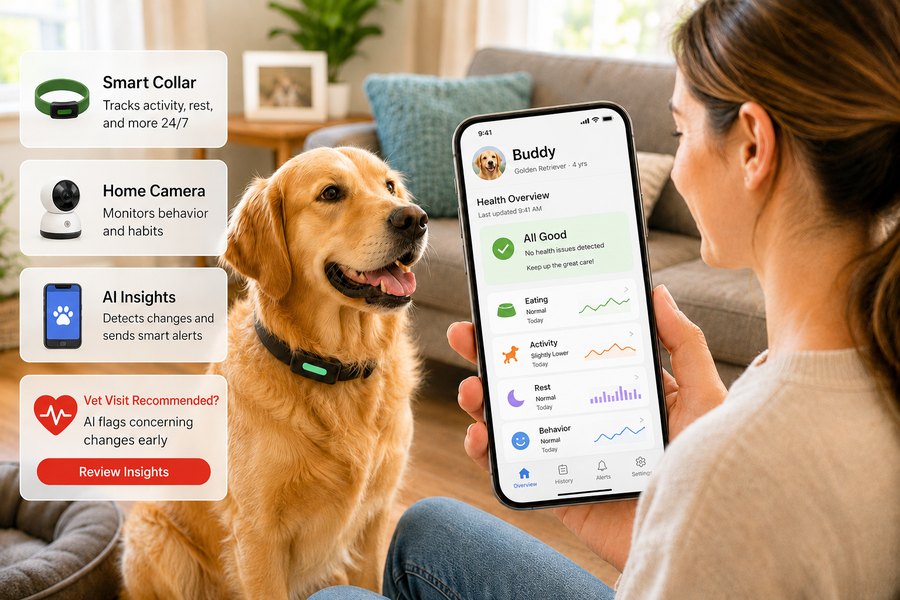
Into this longstanding challenge has come a wave of technology that promises to extend the owner’s powers of observation in ways that were unimaginable only a few years ago, as collars, cameras, smart litter boxes, and the applications that connect them now use artificial intelligence to monitor a pet’s movement, vital signs, eating, elimination, and behavior continuously, watching for the subtle changes that may signal a developing health problem. These devices track how much a dog moves and sleeps, measure a cat’s weight and bathroom habits, listen for distress in a bark, and even claim to monitor heart and breathing rates, and the artificial intelligence built into them learns what is normal for a particular animal so that it can flag deviations that might escape a busy owner’s notice. The promise is a kind of always-on attentiveness, a tireless watching that never tires or looks away, alerting the owner to changes that might otherwise go unnoticed until they became serious.
Yet this promise comes wrapped in real questions that every thoughtful pet owner must consider, beginning with the most practical one of all, which is how to tell the difference between an alert that genuinely warrants a trip to the veterinarian and one that reflects nothing more than a quiet day or a sensor’s imperfection. This article examines the growing world of artificial-intelligence-powered pet health monitoring for everyday owners, explaining what these devices track and how the technology works, surveying the real products available in the form of collars, cameras, and litter boxes, and addressing the central practical question of which insights justify a veterinary visit and which can be safely watched and noted. It also considers the limits, costs, and cautions that come with these tools, written for the ordinary owner who loves their pet and wants to know whether and how this technology can genuinely help, so that they can approach it with both openness and a clear-eyed understanding of what it can and cannot do.
The Rise of the Connected Pet
The arrival of artificial-intelligence-powered health monitoring for pets is part of a broader and rapidly growing phenomenon, often called pet tech, in which the devices and connected technologies once associated with human health and smart homes have been adapted for the animals who share those homes, reflecting both the deepening bond between people and their pets and the increasing willingness of owners to spend on their care. This expansion has been substantial and measurable, with the broader pet technology market growing considerably in recent years, expanding from around eight billion dollars in 2022 to roughly thirteen billion dollars in 2024 by one industry estimate, a pace of growth that reflects the rush of new products and the appetite of owners for tools that promise to keep their animals healthier and safer. The segment devoted specifically to wearable devices for pets has likewise grown, with the United States market for pet wearables alone valued at hundreds of millions of dollars in 2024 and projected to continue expanding for years to come.
Several forces have converged to drive this growth and to make sophisticated health monitoring for pets possible at a consumer price, beginning with the same advances in sensors, connectivity, and artificial intelligence that have transformed human health technology and smart devices generally. The miniaturized sensors that can measure motion, heart rate, and other signals have become small and cheap enough to fit in a collar, the wireless connectivity that links devices to smartphones has become ubiquitous, and the machine learning techniques that can find patterns in streams of data have matured to the point where they can be applied to the particular challenge of interpreting an animal’s behavior and vital signs. These technological foundations, developed largely for human applications and for the broader world of connected devices, have been adapted to pets, allowing a collar or a litter box to gather and interpret data about an animal’s health in ways that would have required expensive specialized equipment not long ago.
The deepening emotional and financial investment that people make in their pets has provided the demand that meets this technological supply, as the cultural status of pets has shifted toward their being regarded as full members of the family, deserving of the same attentiveness to health and wellbeing that people give to themselves and their children. Owners who think of their dogs and cats as family are willing to spend on technology that promises to protect their health, and they bring to their pets the same enthusiasm for self-tracking and quantified wellness that has driven the adoption of fitness trackers and smartwatches for humans, extending to their animals the desire to monitor, measure, and optimize health. This convergence of capable, affordable technology with motivated, willing owners has created the conditions for the rapid spread of pet health monitoring, and the result is a growing array of products competing to watch over the nation’s pets.
The growth of this market has also been shaped by the changing economics of veterinary care, which has become more sophisticated and more expensive over the same period, giving owners an additional incentive to seek tools that might catch problems early and thereby reduce the cost and severity of treatment. As veterinary medicine has advanced and as the price of treating serious illness has risen, the appeal of a device that promises to detect trouble before it becomes grave has grown correspondingly, since early intervention is often both more effective and less costly than treating an advanced condition. This economic logic, in which a modest investment in monitoring might forestall a large expense and a worse outcome later, has helped persuade owners to adopt the technology, and it forms part of the marketing case that manufacturers make, though the actual realization of such savings depends on the device working well and the owner responding wisely to its alerts. The promise of prevention through early detection is among the most powerful drivers of the market’s expansion.
The artificial intelligence at the heart of the newest products is what distinguishes them from the simpler activity trackers that preceded them, because where an early pet tracker might merely count steps or report location, the current generation applies machine learning to interpret the data, to learn what is normal for an individual animal, and to detect anomalies that might indicate a health problem. This shift from mere measurement to intelligent interpretation is the defining feature of the current wave of pet health monitoring, and it is what allows these devices to promise not just data but insight, not just a record of activity but an alert when something seems wrong. Understanding what these devices actually track, and how the artificial intelligence turns that tracking into meaningful insight, is essential to evaluating whether they can deliver on that promise, and it is to this question that the discussion now turns.
What These Devices Actually Track
The array of pet health monitoring devices on the market tracks a range of different signals about an animal’s body and behavior, and understanding the main categories of data these devices gather is the foundation for grasping what they can and cannot reveal about a pet’s health. The most basic and widespread category is physical activity and movement, the measurement of how much an animal walks, runs, plays, and rests, gathered through motion sensors much like those in a human fitness tracker, which allows the device to quantify a pet’s daily activity and to detect changes such as a sudden decline in movement that might signal pain or illness. Closely related is the tracking of sleep and rest, since many devices monitor not only waking activity but the quantity and quality of an animal’s sleep, on the principle that disturbances in sleep patterns can reflect discomfort or underlying problems.
A more advanced category of data, and one that distinguishes the most sophisticated devices, is the monitoring of vital signs such as heart rate and respiratory rate, physiological measurements that move beyond behavior into the direct assessment of the body’s functioning and that can reveal problems invisible to ordinary observation. Some smart collars now claim to measure an animal’s heart and breathing rates continuously, using sensors pressed against the body, and to analyze these measurements for signs of irregularity, with certain products even claiming to detect the irregular heartbeats that can indicate serious cardiac conditions. This monitoring of vital signs represents the frontier of consumer pet health technology, offering the prospect of catching cardiac and respiratory problems early, though it also raises the most pointed questions about accuracy and reliability, since the measurement of vital signs through a collar on a moving, furry animal is a genuine technical challenge.
Beyond movement and vitals, an important category of monitoring concerns eating, drinking, and elimination, the intake and output that are among the most reliable indicators of an animal’s health and that have traditionally been among the hardest for owners to track precisely. Smart feeding and watering devices can measure how much an animal eats and drinks, while smart litter boxes can weigh a cat and record the frequency and characteristics of its bathroom visits, capturing changes such as weight loss, increased urination, or altered elimination patterns that are often among the earliest signs of common diseases. These bodily functions are particularly valuable to monitor because changes in them frequently precede more obvious symptoms, and because they are difficult for an owner to observe accurately without technological help, especially in multi-pet households where it can be impossible to know which animal is eating, drinking, or using the litter box.
The particular value of monitoring eating, drinking, and elimination becomes especially clear in the context of the diseases that most commonly afflict aging dogs and cats, many of which announce themselves first through exactly these functions before producing any outward sign that an owner would notice. Kidney disease, for instance, one of the most common serious conditions in older cats, typically causes increased thirst and urination well before the animal appears visibly ill, while diabetes produces similar early changes in drinking and urination, and many cancers and metabolic disorders first manifest as a gradual loss of weight or a subtle change in appetite. Because these early signals are quantitative and gradual, they are precisely the kind of change that an owner observing casually is likely to miss but that a device measuring intake, output, and weight with consistency can detect, which is why the monitoring of these bodily functions is among the most genuinely useful applications of the technology, capable of surfacing the earliest evidence of conditions in which early treatment makes a real difference to the animal’s prospects.
The final major category is behavioral monitoring, the observation of what an animal does and how it acts, gathered increasingly through cameras equipped with artificial intelligence that can recognize specific behaviors and detect departures from an animal’s normal patterns. These systems can identify activities such as pacing, excessive licking, scratching, or waiting at a door, can detect vocalizations of distress, and can flag changes in an animal’s overall pattern of behavior, on the understanding that such behavioral shifts often accompany or precede illness, anxiety, or injury. Behavioral monitoring through intelligent cameras extends the watching into the realm of the qualitative, capturing not just how much an animal moves but what it actually does, and it is this combination of quantitative measurement and qualitative observation, interpreted by artificial intelligence, that gives the current generation of devices its power, a power that depends entirely on how well the underlying technology turns raw data into trustworthy insight.
From Raw Data to Health Insight
The transformation of raw sensor readings into a meaningful health insight is the central function of the artificial intelligence in these devices, and understanding how this transformation works in plain terms is essential to judging how much trust to place in the alerts they produce. The fundamental approach rests on the concept of a baseline, the pattern of normal behavior and physiology for a particular individual animal, which the device learns by observing the pet over a period of time and recording its typical levels of activity, sleep, heart rate, eating, and the other signals it monitors. Because what is normal varies enormously from one animal to another, a healthy lazy old cat behaving quite differently from a young energetic dog, the system does not rely on fixed universal thresholds but instead learns each animal’s individual norm, building a personalized picture of what is typical for that specific pet against which future observations can be compared.
Once a baseline has been established, the artificial intelligence watches for deviations from it, applying machine learning techniques that can recognize when an animal’s current behavior or physiology departs meaningfully from its established pattern, and it is these deviations, rather than any absolute measurement, that trigger the alerts intended to draw an owner’s attention. A dog that normally sleeps a certain amount and suddenly sleeps far more, a cat whose weight begins a steady decline, an animal whose activity drops sharply or whose bathroom visits become more frequent, all represent departures from baseline that the system is designed to detect, on the principle that a significant change in an individual’s pattern is more revealing than any single reading taken in isolation. This focus on change relative to an individual baseline is what allows the technology to be sensitive to the early signs of illness, since many health problems announce themselves first as subtle shifts in an animal’s normal patterns rather than as dramatic events.
The reliability of this process depends on several factors that the owner should understand, because the quality of the insight is only as good as the quality of the baseline, the accuracy of the sensors, and the sophistication of the algorithms interpreting the data. A baseline learned over too short a period, or during an atypical time, may misrepresent what is normal for the animal, and sensors that produce noisy or inaccurate readings will feed flawed data into the analysis, while the algorithms themselves vary in their ability to distinguish genuine health signals from meaningless fluctuations. The result is that these systems, however impressive, are probabilistic rather than certain, producing alerts that indicate a possible problem worth attention rather than a definitive diagnosis, and they are prone both to missing real problems and to raising alarms about changes that turn out to be harmless. The intelligent interpretation of pet health data is a genuine advance over simple measurement, but it remains an imperfect art, and the owner who understands that the technology offers informed suggestion rather than medical certainty is best positioned to use it wisely, a theme that runs through the practical guidance offered later in this discussion.
Collars and Wearables: Vital Signs on the Move
The smart collar and the wearable tracker represent the most direct adaptation of human fitness technology to pets, attaching sensors to the animal’s body to monitor activity, location, and increasingly the vital signs that indicate the state of its health, and the market for these devices has produced a range of products with varying capabilities and ambitions. At the more advanced end, some collars now combine location tracking with genuine health monitoring, using sensors to measure physiological signals and applying artificial intelligence to interpret them, offering owners a continuous stream of data about their pet’s body as it goes about its day. These wearable devices appeal to owners who want comprehensive monitoring that travels with the animal, capturing its activity and physiology whether at home, on a walk, or anywhere else, and they have become among the most visible products in the pet health technology market.
A prominent example of the advanced smart collar is the Minitailz device from the company Invoxia, introduced at the major consumer electronics trade show in January 2024, where it won an innovation award in the artificial intelligence category, and which combines location tracking with the monitoring of health metrics including respiratory and heart vital signs. The device claims to measure these vital signs with high accuracy, in the range of ninety-seven to ninety-nine percent by the company’s account, and to detect anomalous patterns, including signs of the irregular heartbeats associated with a serious cardiac condition called atrial fibrillation, while also logging activity such as play and walks, tracking sleep, and generating a daily wellness report viewable in a companion application. Sized to fit both dogs and cats, the device illustrates the ambition of the current generation of smart collars to move beyond simple activity counting toward genuine physiological monitoring, offering the prospect of catching cardiac and respiratory problems that might otherwise go undetected until they became severe.
Another example oriented explicitly toward veterinary-grade monitoring is the PetPace collar, which launched a second-generation version in March 2024 designed with veterinary expertise to provide continuous, real-time monitoring of a dog’s health metrics including vital signs and behavior, positioning itself as a tool for early detection of health issues for owners, veterinarians, and researchers alike. Other established products in this category include trackers focused primarily on activity and fitness, such as the FitBark devices, which attach to an ordinary collar and monitor a dog’s activity, sleep quality, distance, and calories burned through a mobile application, serving owners who want to track their pet’s fitness and activity patterns without necessarily monitoring vital signs. The range of products thus spans from fitness-oriented activity trackers to ambitious medical-grade monitors, reflecting the different needs and budgets of owners and the different levels of health monitoring they seek.
The practical experience of living with a smart collar reveals both its conveniences and its frictions, which prospective owners do well to anticipate before committing to one of these devices. The collar must be kept charged, a requirement that introduces the possibility of gaps in monitoring whenever the battery runs down and the device must be removed to recharge, and it must fit properly and remain comfortable on an animal that may resist wearing it, particularly cats and smaller pets that find a bulky collar intrusive. The sensors that measure vital signs generally need good contact with the skin, which can be complicated by thick fur, and the location-tracking features that many of these collars include depend on cellular or other connectivity that may itself carry fees and may not work everywhere. These practical considerations do not diminish the value of a well-chosen collar, but they shape the daily reality of using one, and an owner who weighs them in advance, considering their particular animal’s tolerance and their own willingness to manage charging and fit, will choose more wisely and be less likely to abandon a device that proves more troublesome than anticipated.
The smart collar market also offers a cautionary lesson about the risks of depending on a connected device and the company behind it, illustrated by the case of Whistle, a well-known maker of GPS-enabled pet trackers offering location services and health insights, whose smart collars were slated to be shut down by the end of August 2025, leaving owners who had relied on them needing to find alternatives. This shutdown underscores a vulnerability inherent in these connected products, which depend on the continued operation of the company’s servers and services to function, so that an owner who invests in a particular device and builds their pet care around it is dependent on the manufacturer’s continued support, a dependence that can be disrupted if the company changes course or ceases operations. The wearable category thus offers genuine and sometimes impressive monitoring capabilities, from activity tracking to ambitious vital-sign measurement, while also reminding owners that these devices are products of companies whose support is not guaranteed and whose claims, particularly about medical-grade accuracy, deserve to be weighed with appropriate care.
Cameras and Litter Boxes: Watching Behavior at Home
Alongside the wearables that travel with the animal, a second major category of pet health monitoring operates within the home, using cameras and specialized devices such as smart litter boxes to observe an animal’s behavior and bodily functions in the environment where it spends most of its time, often capturing information that a wearable cannot. The home-based monitors have the advantage of being able to watch an animal continuously without anything attached to its body, which suits cats and other pets that resist wearing devices, and they can observe behaviors and functions, such as litter box habits, that a collar cannot easily capture, making them complementary to the wearables rather than merely alternatives. For many owners, especially those with cats, the home-based approach is the more practical one precisely because it asks nothing of the animal, requiring no collar to be tolerated, no device to be kept charged on the pet itself, and no acceptance of a foreign object, so that the monitoring proceeds invisibly as the animal lives its ordinary life. This unobtrusiveness is a significant advantage for animals that would resist or be stressed by a wearable, and it allows monitoring to extend to pets for whom a collar would never be a realistic option. These devices have become increasingly sophisticated, incorporating artificial intelligence that can recognize specific behaviors and detect the changes that may signal a health or wellbeing problem.
The artificial-intelligence-equipped pet camera has emerged as a popular tool for behavioral monitoring, with products such as the Furbo camera offering, through a subscription service, the ability to recognize specific behaviors such as a dog pacing, licking surfaces, jumping on furniture, or standing at a door, and to detect vocalizations of distress such as whining or howling that might indicate a problem. These cameras can alert an owner who is away from home to unusual behavior in real time, and some extend their monitoring to household safety by detecting the sound of smoke or carbon monoxide alarms and the presence of unexpected people, broadening their function from health monitoring into general household awareness. Another camera-based system, the Petcube, similarly uses artificial intelligence to learn an animal’s patterns and to alert an owner to changes such as reduced movement or diminished interaction with the environment that might signal illness or stress, applying the same baseline-and-deviation logic to behavior observed through a camera.
The smart litter box represents a particularly clever application of home-based monitoring to the specific challenge of tracking a cat’s health, since changes in a cat’s weight and elimination habits are among the earliest and most reliable indicators of several common feline diseases, yet are notoriously difficult for owners to observe accurately. The Petivity Smart Litter Box Monitor, a product developed by Purina with the involvement of veterinarians, behaviorists, and data scientists and launched in 2022, uses artificial intelligence to track a cat’s weight and its urination and defecation events each time it uses the litter box, capable of monitoring multiple cats in a single household and generating reports that can reveal changes such as weight loss or increased urination before other symptoms appear. The value of this monitoring lies precisely in its ability to detect early the bodily changes that accompany diseases such as kidney disease, diabetes, and hyperthyroidism, conditions in which early detection can meaningfully improve the outcome, and the device addresses the genuine difficulty owners face in tracking these functions, especially in homes with more than one cat.
The challenge of attributing observations to the correct animal is one that the home-based monitors have had to solve with particular ingenuity, because in a household with more than one pet the value of monitoring depends entirely on knowing which animal a given observation belongs to, a problem that a collar on an individual animal solves automatically but that a shared camera or litter box does not. The smart litter box that simply records weight and elimination cannot, by itself, know which of three cats produced a given visit, which would render its data nearly useless for tracking an individual’s health, and the more sophisticated systems address this by weighing each animal and using that weight, along with artificial-intelligence-powered recognition, to identify the individual and attribute the visit correctly. This capacity to distinguish among the animals in a multi-pet home is essential to the usefulness of shared monitoring devices, and it represents one of the more impressive technical achievements of the category, allowing a single device to maintain separate health records for each animal in a household where the pets would otherwise be indistinguishable to the system.
The smart litter box category has attracted multiple competitors and continues to advance, with products such as the Litter-Robot devices from the company Whisker incorporating monitoring of a cat’s weight and litter box usage and adding artificial-intelligence-powered cameras with facial recognition that can identify and track individual cats in a multi-cat household, allowing the system to attribute observations to the correct animal. The scientific interest in this approach has been considerable, with researchers having analyzed enormous datasets of litter box visits to build artificial intelligence capable of monitoring cat health, demonstrating that the patterns captured by these devices can indeed carry meaningful health signals. The home-based monitors, whether cameras watching behavior or litter boxes tracking weight and elimination, thus offer a powerful complement to wearable devices, capturing in the animal’s own environment the behavioral and bodily changes that often provide the earliest warning of developing health problems, and together with the wearables they form a comprehensive net of observation around the modern monitored pet.
Which Insights Justify a Vet Visit
The most important and practical question facing any owner who uses these monitoring devices is how to respond to the alerts and observations they generate, specifically how to distinguish the insights that genuinely warrant a veterinary visit from those that reflect normal variation or sensor imperfection and can be noted and watched without alarm. This question matters enormously because the value of the technology depends entirely on the owner’s ability to act appropriately on its outputs, since an owner who rushes to the veterinarian over every minor fluctuation will waste money and time and may come to distrust the device, while an owner who ignores its alerts may miss the early warning the technology was meant to provide. Navigating between overreaction and complacency is the central skill of using pet health monitoring well, and it rests on understanding which kinds of signals carry real weight.
The most reliable principle is that sustained, significant changes in an animal’s established patterns deserve far more attention than brief or minor fluctuations, because a single unusual reading or a one-day dip in activity is likely to reflect normal variation or a quirk of the sensor, while a change that persists over days and represents a meaningful departure from the baseline is more likely to signal a genuine problem. An owner should therefore weigh the duration and magnitude of a change, treating a persistent decline in activity, a steady loss of weight, a sustained increase in urination, or a lasting change in eating or sleeping as signals that warrant veterinary attention, while regarding isolated or small fluctuations as worth noting and watching rather than acting upon immediately. The technology’s focus on deviations from baseline is most trustworthy when the deviations are clear and sustained, and the owner who learns to distinguish a real trend from momentary noise will use the device’s alerts far more effectively.
Certain specific signals carry particular weight and should prompt veterinary attention when the monitoring detects them, because they correspond to changes that veterinary medicine recognizes as important early indicators of common and serious conditions. A steady, unexplained loss of weight, which a smart litter box or scale can detect, is among the most significant of these, as it can indicate a range of serious diseases and is often an early sign that something is wrong, and a marked and sustained increase in urination, similarly detectable, can point to conditions such as kidney disease or diabetes that benefit greatly from early treatment. Indications of cardiac irregularity from a vital-sign-monitoring collar, a sustained and significant drop in activity that might reflect pain or systemic illness, a notable change in appetite, and behavioral signs of distress or discomfort all fall into the category of observations that, when sustained, justify professional evaluation, since they align with the kinds of changes that veterinarians regard as meaningful.
The context surrounding a change matters greatly in interpreting it, and the thoughtful owner considers an alert not in isolation but against everything else they know about their pet’s recent circumstances, since many deviations have innocent explanations that the device cannot see. A drop in activity during a stretch of hot weather, a change in eating after a switch of food, reduced movement following a tiring day, or altered behavior during a disruption to the household routine may all produce alerts that reflect ordinary causes rather than illness, and the owner who knows these circumstances can often account for a change without alarm. This is precisely where human knowledge complements the device, because the owner possesses the contextual understanding that the algorithm lacks, and the best use of the technology combines the device’s tireless quantitative observation with the owner’s awareness of the animal’s life and circumstances. When a sustained change cannot be explained by any such ordinary cause, however, its significance rises, and an unexplained persistent deviation is more concerning than one for which the owner can identify a benign reason, a distinction that sharpens the judgment about when professional attention is truly warranted.
At the same time, the owner must hold these alerts in proper perspective, understanding that the monitoring device is a tool to inform and prompt attention rather than a diagnostic authority, and that the appropriate response to a significant, sustained alert is to consult a veterinarian who can perform a proper examination, not to attempt a diagnosis based on the device alone. The technology’s genuine value lies in catching changes early and prompting timely professional care, turning the owner’s attention to a developing problem sooner than unaided observation might, but the device cannot diagnose the cause of a change or determine its seriousness, tasks that require veterinary expertise and examination. The wise owner thus treats a sustained, meaningful alert as a reason to seek professional advice, bringing the device’s data to the veterinarian as useful information, while recognizing that the judgment about what the change means and what should be done about it belongs to the veterinarian and not to the application on the phone. Used in this spirit, as an early-warning system that prompts timely professional care rather than as a substitute for it, the monitoring technology can genuinely improve a pet’s health by surfacing the subtle early signs that lead to earlier and more effective treatment.
Limits, Costs, and Cautions
For all their promise, the artificial-intelligence-powered pet health monitoring devices carry real limitations and costs that every prospective owner should weigh, beginning with the fundamental question of accuracy, since the impressive claims that some products make about measuring vital signs or detecting conditions are difficult for an ordinary owner to verify and may not hold up uniformly across all animals and circumstances. Measuring a heart rate or breathing rate through a collar on a moving, furry animal is a genuine technical challenge, and while manufacturers may cite high accuracy figures under favorable conditions, the real-world reliability of these measurements can vary, which means that owners should regard the vital-sign data and the alerts derived from it as informative but not infallible, and should be especially cautious about treating any device’s detection of a serious condition as a confirmed finding rather than a prompt to seek professional confirmation. The gap between a manufacturer’s claims and the messy reality of monitoring a living animal is a persistent source of uncertainty.
The financial cost of these devices extends well beyond the initial purchase price, because many of the most capable products depend on ongoing subscription fees to unlock their artificial intelligence features and to maintain the connectivity and data services on which they rely, so that the true cost of monitoring a pet can accumulate substantially over the animal’s life. An owner attracted by a device’s capabilities should examine carefully what features require a subscription, what the ongoing cost will be, and whether the device retains any usefulness without the paid service, since the business model of recurring fees means that the long-term expense can far exceed the sticker price and that the device’s most valuable functions may cease if the subscription lapses. This subscription dependence also connects to the broader vulnerability illustrated by the shutdown of certain products, in which the device’s continued functioning depends on the company’s continued operation and willingness to support it, a dependence that can leave owners stranded if a company ceases a product line or goes out of business.
A further limitation worth understanding is that no consumer device, however sophisticated, can monitor everything that matters to an animal’s health, and the data these products gather, while valuable, captures only a slice of the full picture that a veterinary examination provides. A collar that measures activity and vital signs knows nothing of the lump beneath the skin that a hand would feel, the dental disease in the mouth, the cloudiness in an eye, or the countless conditions that reveal themselves to examination but not to a sensor, and a litter box that tracks weight and elimination cannot assess the dozens of other systems a veterinarian evaluates. This partiality means that a reassuring stream of normal readings should not breed complacency about the need for regular veterinary care, since a pet can be developing a serious condition entirely invisible to its monitoring devices, and the owner who allows good data to substitute for periodic professional examination may be lulled into a false sense of security. The technology covers a portion of the health picture, and an important portion, but it is a portion only, and the regular veterinary visit remains necessary regardless of what the devices report.
The phenomenon of false alarms and the anxiety they can produce represents another genuine drawback, because a device that alerts an owner to possible problems will inevitably raise some alarms that turn out to be nothing, and the cumulative effect of these false positives can be both stressful and counterproductive, generating worry over harmless fluctuations and potentially eroding the owner’s trust in the device’s genuine warnings. An owner prone to anxiety about their pet’s health may find that continuous monitoring amplifies rather than relieves their worry, turning every minor deviation into a source of concern, and the challenge of calibrating one’s emotional response to a stream of alerts, taking the significant ones seriously without being consumed by the trivial ones, is a real psychological cost of the technology. There is also a risk that the data and alerts could lead an owner to over-rely on the device and to neglect the direct observation and intuition that remain irreplaceable, substituting a glance at an application for the attentive presence that is the foundation of good pet care.
Finally, the privacy and data implications of these devices deserve consideration, since the cameras, collars, and litter boxes that monitor pets also gather data about the homes and the people within them, with cameras in particular capturing video of the household and all devices transmitting information to company servers where it is stored and analyzed. An owner should be aware of what data a device collects, how it is used and protected, and what the company’s policies permit, recognizing that the convenience of cloud-connected monitoring comes with the surrender of information about one’s pet, one’s home, and oneself to a commercial entity. These limitations and cautions, the questions of accuracy, cost, false alarms, over-reliance, and privacy, do not negate the genuine value that the technology can offer, but they form an essential counterweight to the marketing claims, and the owner who approaches these devices with realistic expectations and a clear understanding of their costs and limits is far better positioned to benefit from them than one swept up in the promise of perfect, effortless protection.
Final Thoughts
The emergence of artificial-intelligence-powered health monitoring for pets represents a genuine and meaningful advance in the care of the animals who share our lives, extending the attentive observation on which their health depends and offering the real prospect of catching illness earlier, when it is most treatable, in creatures who cannot tell us what is wrong and who instinctively hide their suffering. The technology addresses a real and longstanding difficulty, the gap between a pet’s inability to communicate its distress and the owner’s need to know when something has changed, and at its best it can surface the subtle early signs of disease that even a loving and attentive owner might miss, prompting the timely veterinary care that can make the difference between an illness caught early and one discovered too late. This is a worthy purpose, and the devices that pursue it well deserve a place in the toolkit of the modern pet owner.
Yet the proper understanding of this technology is as a complement to attentive care and professional veterinary medicine rather than a replacement for either, and the owner who grasps this distinction will derive far more benefit than one who imagines that a collar or a camera can substitute for presence, observation, and expertise. The devices generate data and alerts, but data is not diagnosis, and the meaning of any change an animal exhibits must ultimately be interpreted by a veterinarian with the knowledge and the means to examine the patient, while the daily attentiveness of an owner who knows their pet intimately remains the irreplaceable foundation of good care that no algorithm can match. The technology serves best when it amplifies rather than replaces these human elements, drawing the owner’s attention to changes worth investigating and supplying the veterinarian with useful information, while leaving the essential work of care and judgment to the people and professionals who provide it.
The question of accessibility and cost also shapes the technology’s ultimate value, because the most capable monitoring devices, with their purchase prices and ongoing subscriptions, remain a significant expense that not every owner can afford, and there is a risk that the benefits of early detection could accrue disproportionately to those with the means to pay for sophisticated monitoring. The hope embodied in this technology is that, as it matures and spreads, its benefits will become more affordable and more widely available, extending the advantages of attentive monitoring to more of the animals who could benefit, rather than remaining a luxury for the few, and the trajectory of falling costs and expanding capability offers some reason for optimism on this front even as the present remains uneven.
The deeper significance of pet health monitoring lies in what it reveals about the bond between people and their animals and the lengths to which that bond now extends, as the same technologies of sensing and intelligence that have transformed human health are turned toward the wellbeing of creatures who cannot ask for them but who benefit from them nonetheless. The thoughtful owner embraces these tools for what they genuinely offer, an extension of attentiveness and an early warning of trouble, while holding them in proper perspective as aids to care rather than substitutes for it, and in doing so honors both the promise of the technology and the enduring truth that the health of a beloved animal rests, in the end, on the attention, love, and judgment of the humans who care for it and the veterinarians who treat it.
FAQs
- What do AI pet health monitors actually track?
They track several categories of data: physical activity and movement, sleep quantity and quality, vital signs such as heart and respiratory rate on advanced collars, eating and drinking, and elimination habits and weight through smart litter boxes. Camera-based systems add behavioral monitoring, recognizing specific actions like pacing or excessive licking and detecting vocal distress. The artificial intelligence then interprets this data to flag changes that may signal a developing health problem. - How does the AI know when something is wrong with my pet?
These devices learn a baseline, the pattern of normal behavior and physiology for your individual animal, by observing it over time. Because normal varies enormously between pets, the system builds a personalized picture rather than using fixed thresholds. It then watches for meaningful deviations from that baseline, such as a sustained drop in activity or steady weight loss, and raises an alert when current readings depart significantly from your pet’s established pattern. - Can these devices replace a trip to the veterinarian?
No. They are early-warning tools that inform and prompt attention, not diagnostic authorities. A device can flag that something has changed, but it cannot determine the cause or seriousness, which requires a veterinary examination. The right response to a sustained, significant alert is to consult a veterinarian, bringing the device’s data as useful information, while leaving the diagnosis and treatment decisions to professional expertise. - Which alerts actually justify a vet visit?
Sustained, significant changes deserve attention far more than brief or minor fluctuations. A steady unexplained weight loss, a marked and lasting increase in urination, a sustained drop in activity, a notable change in appetite, indications of cardiac irregularity, and persistent behavioral signs of distress all warrant veterinary evaluation when they persist over days. Isolated or small fluctuations are generally worth noting and watching rather than acting on immediately. - Are the vital-sign measurements accurate?
Measuring heart and breathing rates through a collar on a moving, furry animal is genuinely difficult, and while manufacturers cite high accuracy under favorable conditions, real-world reliability can vary. Treat vital-sign data and the alerts derived from it as informative but not infallible, and be especially cautious about treating any device’s detection of a serious condition as confirmed rather than as a prompt to seek professional confirmation from a veterinarian. - What examples of these products exist?
Smart collars include the Invoxia Minitailz, which won a 2024 innovation award and monitors heart and respiratory signs, and the vet-designed PetPace 2.0 launched in March 2024, while FitBark focuses on activity and sleep. Home devices include the Furbo and Petcube AI cameras for behavior, and smart litter boxes such as Purina’s Petivity and Whisker’s Litter-Robot, which track a cat’s weight and elimination, sometimes identifying individual cats by facial recognition. - Do these devices require ongoing subscriptions?
Many do. The most capable products depend on subscription fees to unlock their artificial intelligence features and maintain connectivity and data services, so the true cost accumulates over your pet’s life and can far exceed the purchase price. Before buying, examine which features require a subscription, what the ongoing cost will be, and whether the device retains usefulness without the paid service, since its key functions may stop if the subscription lapses. - What happens if the company shuts down the product?
Because these connected devices depend on company servers and services to function, a manufacturer that ends a product line can leave owners without monitoring, as happened when Whistle’s smart collars were set to be shut down by the end of August 2025. This is a real vulnerability of cloud-connected pet tech, and it is worth considering a company’s stability and track record before building your pet’s care around a particular device. - Can monitoring make me more anxious about my pet?
It can. A device that alerts you to possible problems will inevitably raise some false alarms, and the cumulative effect can generate worry over harmless fluctuations and even erode trust in genuine warnings. The skill is to calibrate your response, taking sustained significant changes seriously without being consumed by trivial ones, and to avoid over-relying on the device at the expense of the direct observation and intuition that remain central to good pet care. - Are there privacy concerns with these devices?
Yes. Cameras, collars, and litter boxes that monitor pets also gather data about your home and the people in it, with cameras capturing household video and all devices transmitting information to company servers for storage and analysis. Be aware of what data a device collects, how it is used and protected, and what the company’s policies permit, since cloud-connected monitoring involves sharing information about your pet, your home, and yourself with a commercial entity.