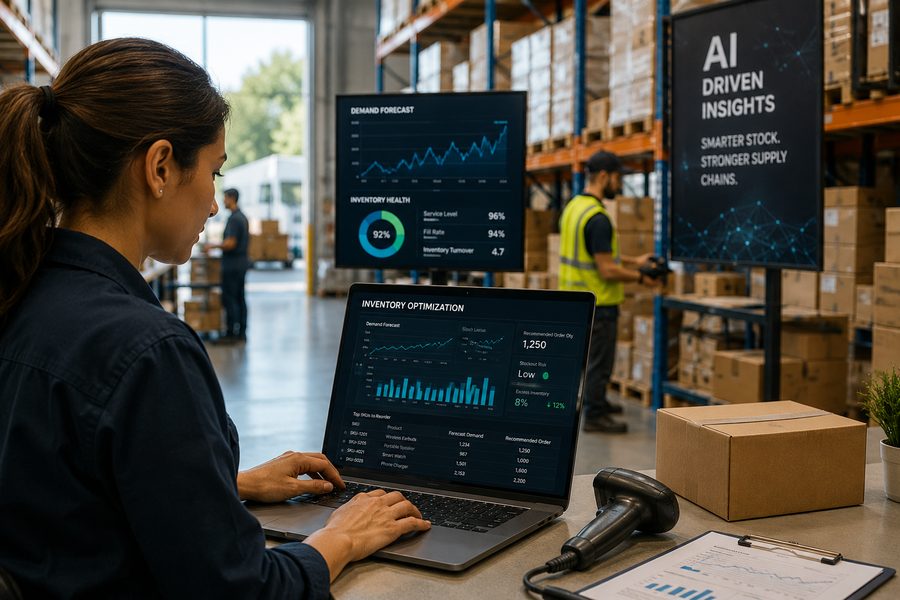
Every retailer lives with a quiet tension that shapes its profitability more than almost any other operational decision. Stock too little of a product and customers arrive to find empty shelves, walk away disappointed, and often buy from a competitor who never sees them again. Stock too much and the business ties up cash in goods that sit in warehouses, age toward obsolescence, and eventually sell at a steep discount or get thrown away. Between these two failures lies a narrow band of correctness that depends on accurately predicting how much of each item people will want, in each location, at each moment, across thousands or even millions of products. For most of retail history, this prediction was made through a combination of experience, simple historical averages, and educated guesswork, and the results were predictably imperfect. The consequences of those imperfections were not trivial, since they accumulated across millions of small decisions into billions of dollars of lost sales and wasted goods industry-wide, a steady tax on profitability that every retailer paid and few could escape.
Artificial intelligence has changed what is possible in this domain. Machine learning algorithms can now analyze enormous quantities of data, far beyond what any human planner could process, to forecast demand with a precision that older methods could not approach. These systems learn from years of sales history, but they also absorb signals that traditional forecasting ignored entirely, including weather patterns, local events, social media trends, promotional calendars, and the behavior of related products. From these patterns they generate predictions that adapt continuously as new information arrives, and they translate those predictions into concrete decisions about how much to order, where to position it, and when to replenish. The promise is a supply chain that keeps shelves full while holding far less excess, capturing sales that would otherwise be lost and freeing the cash and space that overstock consumes.
This article explains how AI-powered inventory optimization works, written for a reader with no background in either retail operations or machine learning. It describes the fundamental problem these systems solve, the techniques they use to forecast demand and optimize stock, and the data infrastructure that makes them function. It examines the benefits and the genuine challenges for retailers, suppliers, and customers, and it looks closely at how major companies including Walmart, the H&M Group, and Amazon have deployed these technologies and what results they have reported. The goal is to make a sophisticated and increasingly important technology understandable, and to give an honest account of both what it can achieve and where its limits lie.
Understanding Inventory Optimization and the Cost of Getting It Wrong
Inventory optimization is the discipline of holding the right amount of each product in the right place at the right time, balancing the competing costs of having too much against the costs of having too little. To understand why this is so difficult, it helps to appreciate that a modern retailer is not managing one inventory decision but an immense web of them simultaneously. A large grocery or general merchandise chain may carry tens of thousands of distinct items, each sold across hundreds or thousands of locations, each with its own pattern of demand that shifts by season, by day of the week, by local conditions, and in response to prices and promotions. Every one of these combinations represents a separate forecasting and stocking decision, and the sheer number of them places the problem far beyond the reach of manual planning.
The two failure modes at the heart of the problem are stockouts and overstock, and each carries its own kind of damage. A stockout occurs when a customer wants to buy a product that is not available, and its costs extend well beyond the single lost sale. The immediate revenue is gone, but so potentially is the customer, who may switch to a competitor and not return, and the retailer also suffers a harder-to-measure erosion of trust and loyalty when shoppers learn that a store cannot be relied upon to have what they need. Studies of retail consistently find that stockouts drive customers away and that the lifetime value lost when a shopper defects far exceeds the price of the missing item. The damage compounds in an age when an out-of-stock experience online is one click away from a purchase at a rival.
Overstock inflicts a different but equally serious set of costs. Excess inventory ties up working capital that could be deployed elsewhere, occupies warehouse and shelf space that carries its own expense, and exposes the retailer to the risk that goods will lose value before they sell. For perishable products, overstock means spoilage and outright waste, with food retailers discarding vast quantities of unsold product. For fashion and seasonal goods, it means markdowns, the deep discounts retailers apply to clear merchandise that did not sell at full price, which erode the profit margins that make the business viable. Holding costs, obsolescence, spoilage, and markdowns together make overstock a silent drain on profitability, and in industries with thin margins, the difference between disciplined and bloated inventory can determine whether a retailer thrives or struggles. The challenge is compounded by the fact that the two failures are not independent, because the crude defenses against one tend to worsen the other. A retailer terrified of stockouts will overstock to be safe, and one focused on lean inventory will court empty shelves, so without better forecasting the business is forced to choose which failure it prefers rather than escaping both. This is the trap that machine learning promises to break, by making the forecast accurate enough that the retailer no longer has to choose between the two failures at all.
The traditional methods used to navigate between these failures were limited in ways that left substantial value on the table. For decades, retailers relied on techniques such as simple moving averages of past sales, fixed reorder points, and the judgment of experienced buyers, supplemented by basic statistical forecasting. These approaches work reasonably well for stable, predictable products, but they struggle with the complexity of real demand, which is shaped by countless interacting factors that simple models cannot capture. They tend to react to changes rather than anticipate them, they handle the long tail of slow-moving and irregular items poorly, and they cannot easily incorporate the external signals, such as a heat wave or a viral trend, that often drive sudden shifts in what people buy. The result was chronic imbalance, with retailers simultaneously suffering stockouts on some items and drowning in excess of others, and it was this persistent gap between what was achievable and what was being achieved that created the opening for machine learning to transform the field.
It is worth dwelling on why the problem resists simple solutions, because the difficulty is structural rather than a matter of insufficient effort. Demand for any given product is the product of many interacting forces, some predictable and some not, and these forces vary not only from item to item but from store to store and week to week. A single promotion can triple demand for one product while cannibalizing sales of a similar item nearby. A weather forecast can swing demand for seasonal goods by large margins with only days of warning. A product’s demand may depend on whether a complementary item is in stock, so that a stockout of one good silently suppresses sales of another. These interdependencies multiply across a catalog until the number of relationships a planner would need to track exceeds any human capacity, and the traditional response, to simplify the problem with broad rules and generous safety margins, inevitably sacrifices either availability or efficiency. The mismatch between the true complexity of demand and the crude tools available to model it is the fundamental reason retailers accepted chronic imbalance as an unavoidable cost of doing business, and it is exactly this complexity that machine learning is designed to absorb.
How Machine Learning Predicts Demand and Optimizes Stock
Machine learning improves on traditional inventory methods by learning complex patterns directly from data rather than relying on fixed rules or simple formulas. At its core, a machine learning model for inventory is a system that examines historical examples, identifies the relationships between many input variables and the outcomes that followed, and uses those learned relationships to predict future outcomes. Instead of a planner deciding that a product’s reorder point should be a certain number of units, the model discovers from data how demand for that product actually behaves under different conditions and predicts what will happen next. This shift from rule-based to learning-based systems is what allows AI to handle the scale and complexity that defeat manual approaches.
The application of machine learning to inventory unfolds in two connected stages, and distinguishing them clarifies how the technology delivers value. The first stage is demand forecasting, the prediction of how much of each product will be wanted in each location over a given future period. The second stage is optimization, which takes those forecasts and translates them into concrete operational decisions about how much to order, how much safety stock to hold, and how to distribute inventory across the network. A forecast alone changes nothing until it is converted into action, and the optimization stage is where prediction becomes profit. The two subsections that follow examine each stage in turn, showing how raw data becomes a prediction and how a prediction becomes a well-stocked shelf.
Demand Forecasting with Machine Learning
Demand forecasting is the foundation on which everything else rests, because every stocking decision ultimately depends on an estimate of future demand. Machine learning models approach this task by ingesting historical sales data and learning the patterns within it, but their power comes from how much more they can consider than past sales alone. A well-built forecasting model incorporates a wide array of signals that influence what people buy, transforming forecasting from a backward-looking extrapolation into a forward-looking synthesis of many factors. The richness of these inputs is precisely what allows machine learning to anticipate shifts that simpler methods miss entirely.
Among the most important inputs are temporal patterns, including the seasonality that causes demand to rise and fall across the year, the weekly rhythms that make certain days busier than others, and the effects of holidays and special occasions. Layered on top of these are external factors that older systems struggled to use, such as weather, which strongly influences purchases of everything from beverages to clothing to seasonal supplies, and local events that create temporary surges in particular areas. The models also consider pricing and promotions, learning how discounts and marketing campaigns lift demand and how that lift varies by product and context, as well as the complex relationships between products, including how the sale of one item affects demand for complements and substitutes. Increasingly, these systems can also draw on signals of emerging trends, recognizing when interest in a product is accelerating before it shows up fully in sales.
The technical approaches used for this forecasting have grown increasingly sophisticated. Earlier machine learning applications often used tree-based methods that excel at capturing complex interactions among many variables, and these remain widely used because of their accuracy and interpretability. More recently, deep learning approaches based on neural networks have become prominent, particularly architectures designed to handle sequences over time, which can capture intricate temporal dynamics across thousands of related products simultaneously. A notable feature of modern forecasting is the shift toward probabilistic predictions, in which the model does not output a single number but a range of possible outcomes with associated likelihoods. This matters because inventory decisions depend not just on the most likely demand but on the uncertainty around it, since a retailer needs to know whether to prepare for the realistic high end of demand to avoid stockouts on critical items. By forecasting the full distribution of possible demand rather than a single point, machine learning gives the optimization stage the information it needs to make intelligent trade-offs between the risk of running out and the cost of holding too much.
A particularly valuable capability of modern forecasting models is their handling of new and intermittent products, which traditional methods struggle with badly. A brand-new item has no sales history of its own, so a simple model has nothing to extrapolate from, yet a machine learning model can estimate its likely demand by recognizing its similarity to existing products with known histories, drawing on attributes such as category, price, and features. Intermittent items, those that sell sporadically and unpredictably, pose the opposite challenge, because their sparse and lumpy demand defeats methods built around smooth averages, and here probabilistic models that can represent the irregular nature of the demand directly prove far more capable. The ability to forecast across the full spectrum of products, from fast-moving staples to brand-new launches to the long tail of rarely purchased items, is one of the most important practical advantages of the machine learning approach, because it is precisely in these difficult cases that traditional methods failed most often and left the most value uncaptured. A retailer that can keep its slow-moving niche items reasonably stocked without drowning in excess gains an edge in serving customers whose needs fall outside the predictable core, and it is the breadth of machine learning’s forecasting competence, not merely its accuracy on easy items, that makes it transformative.
From Forecasts to Replenishment and Stock Optimization
A forecast, however accurate, is only useful when it drives action, and the optimization stage is where predictions become the concrete decisions that fill shelves and warehouses. The central question this stage answers is how much of each product to have in each location, given the forecast of demand, the uncertainty around it, the cost of holding inventory, the cost of stockouts, and the practical constraints of the supply chain such as how long replenishment takes and how products must be ordered. This is a genuine optimization problem in the mathematical sense, one of balancing competing costs to find the best achievable outcome, and machine learning and related techniques are well suited to solving it at the scale modern retail demands.
A key concept in this stage is safety stock, the buffer of extra inventory held to protect against the inherent uncertainty of demand and supply. Because demand is never perfectly predictable and deliveries are never perfectly reliable, retailers hold a cushion to reduce the chance of stocking out, but every unit of safety stock carries a holding cost, so the goal is to hold exactly enough and no more. Probabilistic demand forecasts make this calculation far more precise, because they quantify the uncertainty directly, allowing the system to set safety stock at the level that achieves a desired service level, meaning a target probability of not running out, at the lowest possible inventory cost. Machine learning also helps by accounting for the lead time of replenishment, predicting not just demand but how long restocking will take, so that orders are timed to arrive before stock runs low rather than after.
Beyond setting stock levels at individual locations, optimization addresses the harder problem of allocation across a network. A retailer with many stores and distribution centers must decide not only how much total inventory to hold but where to position it, sending more of a product to locations where demand is forecast to be strong and less to those where it is weak, and shifting inventory between locations as conditions change. Advanced systems increasingly use techniques such as reinforcement learning, in which a model learns optimal ordering and allocation policies through repeated simulated experience, discovering strategies that balance the many competing objectives better than fixed rules could. The output of all this optimization is a continuous stream of recommendations, telling the supply chain how much to order from suppliers, how to distribute incoming goods, and when to move inventory, often executed automatically so that the system responds to changing demand in near real time. This closing of the loop, from data to forecast to optimized action and back again, is what allows AI-powered inventory systems to keep shelves stocked while holding dramatically less excess than traditional methods required.
The optimization stage must also reconcile competing objectives that pull in different directions, and the way it balances them reflects deliberate business choices rather than a single correct answer. A retailer might prioritize availability for its most important products, accepting higher inventory costs to ensure that flagship or essential items are virtually never out of stock, while tolerating occasional stockouts on less critical goods to keep overall inventory lean. The optimization engine encodes these priorities through parameters such as target service levels, which can be set differently for different product categories, allowing the business to express how it values availability against cost for each part of its assortment. This flexibility is important because no retailer wants to treat every product identically, and the ability to tune the system to reflect strategic priorities is part of what makes it useful in practice. The most effective implementations involve close collaboration between the data scientists who build the models and the merchants and supply chain leaders who understand the business, so that the mathematical optimization serves genuine commercial goals rather than optimizing an abstract objective that does not match what the company actually cares about. When this alignment is achieved, the system becomes a faithful executor of business strategy at a scale and speed no manual process could match.
The Data and Technology Infrastructure
The intelligence of an AI inventory system is only as good as the data and technology infrastructure that supports it, and building that foundation is often the hardest and most underestimated part of any deployment. At the base of the infrastructure sits data, vast quantities of it, drawn from many sources that must be collected, cleaned, integrated, and made available to the models. The primary input is detailed sales and transaction history, ideally at the level of individual products, locations, and time periods, but this is supplemented by inventory records, supplier information, pricing and promotion histories, and a growing array of external data such as weather feeds, economic indicators, and event calendars. The quality of this data matters enormously, because machine learning models learn whatever patterns exist in their training data, including the errors, and inaccurate or incomplete data produces forecasts that are confidently wrong.
The challenge of data quality and integration is frequently the decisive factor in whether an implementation succeeds. Retail data is notoriously messy, scattered across legacy systems that were never designed to talk to one another, riddled with inconsistencies in how products are coded and categorized, and full of gaps and anomalies such as the distortions that stockouts themselves introduce into sales records. A product that sold zero units last week may have had no demand, or it may have been out of stock, and a model that cannot distinguish these cases will learn the wrong lesson. Substantial engineering effort therefore goes into building data pipelines that gather information from disparate systems, reconcile it into a consistent form, correct for known distortions, and deliver it reliably to the models on a continuous basis. Many organizations discover that the bulk of an AI inventory project is this unglamorous data work rather than the modeling itself.
The problem of stockout-distorted history deserves particular emphasis because it illustrates how subtle data issues can quietly undermine an entire system. When a product is out of stock, its recorded sales fall to zero not because demand disappeared but because the product could not be bought, a phenomenon known as censored demand. A naive model that treats those zero-sales periods as genuine drops in demand will systematically underestimate how much customers actually wanted the product, leading it to recommend stocking too little, which causes more stockouts, which further distorts the data in a self-reinforcing cycle. Sophisticated systems correct for this by reconstructing the true underlying demand during stockout periods, using the patterns from times when the product was available to estimate what would have sold. This kind of careful correction, invisible to anyone looking only at the headline forecasts, is the difference between a system that steadily improves and one that quietly digs itself into a hole, and it exemplifies why deep expertise in both retail and data science is required to make these systems work reliably rather than merely appear to work.
On top of the data layer sits the modeling and computation infrastructure, the systems that train the machine learning models, generate forecasts, and run the optimization. Training sophisticated models on the scale of a large retailer’s product catalog requires significant computational resources, and many retailers rely on cloud computing platforms that provide this capacity on demand along with specialized services for machine learning. These platforms allow models to be trained and retrained frequently as new data arrives, which is essential because demand patterns shift and a model that is not regularly updated will gradually lose accuracy. The infrastructure must also be able to generate predictions and recommendations quickly enough to be useful, in some cases producing updated forecasts and stocking decisions in near real time as sales data flows in, which requires careful engineering to deliver results at the necessary speed and scale.
The final and often most challenging layer is integration with the actual operations of the supply chain, because a forecast that does not connect to ordering, warehousing, and logistics systems delivers no value. The recommendations produced by the optimization engine must flow into the systems that place orders with suppliers, direct the movement of goods through distribution centers, and manage replenishment to stores, and increasingly this happens through automation that lets the system execute decisions directly rather than merely advising human planners. This integration requires the AI system to work within the constraints of real supply chain operations, respecting supplier minimum order quantities, transportation schedules, warehouse capacities, and countless other practical limits. The most successful deployments treat the technology not as a standalone forecasting tool but as a component woven into the fabric of supply chain operations, where data, models, computation, and execution form a continuous, automated loop. Getting all of these layers to work together reliably is a substantial undertaking, which is why mature AI inventory capabilities tend to be found first at large, well-resourced retailers, though cloud services and specialized vendors are steadily making the technology accessible to smaller operators as well.
Benefits and Challenges Across Stakeholders
AI-powered inventory optimization produces distinct effects for the different parties involved in retail supply chains, and an honest assessment requires weighing the substantial benefits against the real challenges and costs. Retailers stand to gain improved margins and reduced waste, suppliers benefit from steadier and more predictable demand, and customers enjoy better product availability, but realizing these gains demands significant investment, high-quality data, organizational change, and careful management of the risks that come with relying on automated systems. The benefits are well documented and increasingly proven at scale, yet they are not automatic, and a poorly executed implementation can disappoint or even disrupt operations.
The discussion below organizes the analysis by stakeholder and by category, first examining the advantages that flow to retailers, suppliers, and customers when these systems work well, then turning to the costs, risks, and implementation challenges that determine whether those advantages are actually achieved. Keeping these perspectives distinct helps avoid both the overheated promises of technology marketing and the reflexive skepticism that dismisses a genuinely powerful tool, arriving instead at a grounded understanding of what AI inventory optimization offers and what it demands in return.
Benefits for Retailers, Suppliers, and Customers
For retailers, the central benefits are higher profitability through the simultaneous reduction of stockouts and overstock, which directly improves both revenue and costs. By keeping more products available, retailers capture sales that would otherwise be lost to empty shelves, and by holding less excess, they reduce the capital tied up in inventory, the costs of storage and handling, and the losses from markdowns, spoilage, and obsolescence. These two improvements reinforce each other, because better forecasting allows a retailer to be both more available and leaner at the same time, escaping the old trade-off in which improving one meant worsening the other. The freed-up working capital can be invested elsewhere in the business, and the reduction in waste improves margins in industries where every percentage point matters. Beyond these direct effects, AI systems reduce the labor spent on manual planning, freeing skilled employees to focus on judgment and exceptions rather than routine calculation.
Suppliers and the broader supply chain benefit from the improved demand signals that AI optimization generates. When a retailer forecasts demand more accurately and orders more intelligently, its suppliers receive steadier and more predictable orders, which allows them to plan their own production and inventory more efficiently and reduces the costly whipsaw effect in which small fluctuations in retail demand amplify into large swings further up the supply chain. This phenomenon, long known as the bullwhip effect, wastes resources throughout the chain, and better forecasting at the retail level dampens it, benefiting everyone from manufacturers to logistics providers. More collaborative arrangements, in which retailers share their improved forecasts with suppliers, can extend these benefits further, creating a more efficient and responsive supply chain overall that wastes less and adapts faster to genuine changes in demand.
Customers, though they never see the technology, are among its primary beneficiaries. The most visible benefit is simply that the products they want are available when they want them, reducing the frustration of empty shelves and the inconvenience of having to shop elsewhere. Better availability is especially valuable for essential goods and for the long tail of less common items that traditional methods handled poorly, where AI forecasting can keep niche products in stock that would otherwise be chronically unavailable. Customers also benefit indirectly from the cost efficiencies the technology creates, which can support more competitive pricing, and from the reduction in waste, which carries environmental benefits that matter to a growing number of shoppers. The environmental dimension is significant in its own right, since reducing overproduction and the discarding of unsold goods, particularly in food and fashion, addresses one of the more wasteful aspects of modern retail and aligns commercial efficiency with sustainability.
These benefits, while distinct for each stakeholder, ultimately reinforce one another in ways that make the whole supply chain healthier. A retailer that forecasts accurately serves its customers better and wastes less, which strengthens its margins and its reputation, and the steadier orders it places allow its suppliers to operate more efficiently and at lower cost, savings that can flow back to the retailer and ultimately to customers in the form of better prices and availability. The reduction in waste benefits the environment and increasingly the retailer’s standing with consumers who care about sustainability. This alignment of interests is part of what makes the technology so compelling, because unlike many efficiency measures that benefit one party at another’s expense, better forecasting tends to create value that is shared across the chain. A more accurate signal of what customers actually want, propagated from the shelf back through the entire network of replenishment and production, lets everyone involved plan against reality rather than against guesswork, and the cumulative effect of removing that guesswork is a system that delivers more while consuming less. It is this positive-sum quality, rather than any single metric, that explains why AI inventory optimization has attracted such sustained investment from the largest players in retail.
Risks, Costs, and Implementation Challenges
The most immediate challenge is the substantial investment and complexity that implementing these systems requires, which can place them out of reach for smaller retailers and can lead larger ones into costly failures. Building or buying the technology, integrating it with existing systems, assembling clean data, and retraining the organization all demand significant resources and expertise, and the data integration work in particular often proves far larger and more difficult than anticipated. Implementations can stall or disappoint when the underlying data is too poor to support accurate forecasting, when the technology does not integrate cleanly with legacy operations, or when the organization is not prepared to act on the system’s recommendations. The history of enterprise technology is littered with expensive projects that failed to deliver, and AI inventory systems are not immune to this pattern, which means the decision to adopt must be accompanied by realistic expectations and disciplined execution.
A subtler risk concerns over-reliance on models and the loss of human judgment, particularly in situations the models were not trained to handle. Machine learning systems learn from historical data, which makes them excellent at recognizing patterns that have occurred before but potentially blind to genuinely novel events that have no precedent in the training data. The disruptions of recent years, including pandemic-driven demand shocks and supply chain breakages, illustrated how forecasting systems can be thrown off when conditions depart radically from history, and a retailer that has fully automated its inventory decisions without maintaining human oversight can find itself badly served when the unexpected occurs. The prudent approach treats AI as a powerful aid to human decision-making rather than a complete replacement for it, maintaining the ability of experienced planners to recognize when the model is operating outside its competence and to intervene. This balance between automation and judgment is one of the central management challenges of deploying the technology.
Additional concerns include data quality and bias, the difficulty of interpreting complex models, and the organizational change the technology demands. Because models learn from data, biases or errors in that data propagate into forecasts, and the most sophisticated deep learning models can be difficult to interpret, making it hard for planners to understand or trust why a particular recommendation was made, which can slow adoption and obscure errors. Successfully deploying these systems also requires significant change in how an organization works, as planners shift from making decisions to overseeing and refining an automated system, and resistance to this change, or failure to redesign processes around the new capability, can undermine even a technically sound implementation. There are also ongoing costs and risks around maintaining and monitoring the models over time, since a system that is not watched can degrade silently as patterns shift, producing increasingly poor decisions until someone notices. There is a further strategic risk worth noting, which is the danger of optimizing too narrowly and losing sight of the broader customer experience. A system relentlessly focused on minimizing inventory cost might, if poorly governed, trim stock so aggressively that it undermines the sense of abundance and reliability that draws customers to a store in the first place, or it might fail to account for the value of having a product visible on a shelf even when it sells slowly. Inventory decisions interact with merchandising, marketing, and brand in ways that a narrow optimization objective can miss, and the most thoughtful retailers ensure that their AI systems serve the wider goals of the business rather than pursuing efficiency for its own sake. This requires keeping experienced merchants and operators involved in setting the objectives and reviewing the outcomes, so that the technology amplifies good judgment rather than substituting a mechanical metric for it.
None of these challenges negates the value of the technology, but together they explain why success depends as much on data, processes, and people as on the algorithms themselves, and why the retailers that benefit most are those that approach AI inventory optimization as an organizational transformation rather than a software purchase.
Real-World Implementations and Measured Outcomes
The clearest evidence for AI-powered inventory optimization comes from the major retailers that have deployed it at scale and reported on its effects, and three prominent examples illustrate both the methods and the results across different segments of retail. Walmart represents the application of machine learning to vast, multi-category store networks, the H&M Group shows its use in the demanding world of fashion where forecasting errors translate quickly into markdowns and waste, and Amazon demonstrates the technology at the scale of global e-commerce. Each company has invested heavily in these capabilities over recent years, and each provides a concrete picture of how AI inventory optimization functions in practice rather than in theory.
Walmart, as the world’s largest retailer, has built extensive machine learning capabilities into its inventory and supply chain management. The company uses machine learning models to forecast product demand across its thousands of stores, drawing on data that includes location, weather, local events, and seasonal trends to optimize inventory levels and reduce both stockouts and overstock. Walmart has reported substantial improvements in inventory accuracy through these systems, along with meaningful reductions in stockouts that keep more products available to customers, and it has paired demand forecasting with broader supply chain optimization, including route planning that the company has credited with eliminating tens of millions of unnecessary driving miles. The scale at which Walmart operates makes these improvements especially consequential, because even small percentage gains in availability or reductions in excess translate into very large absolute effects across such an enormous network, and the company’s continued investment signals its assessment that the technology delivers real returns. Walmart’s deployment illustrates how machine learning enables a retailer to manage the staggering complexity of demand across thousands of locations and tens of thousands of products in a way that manual methods never could, and it shows how forecasting connects to the wider supply chain, since better predictions of what each store will need also inform how goods move through distribution centers and along delivery routes, multiplying the efficiency gains well beyond the shelf itself.
The H&M Group, one of the world’s largest fashion retailers, demonstrates the technology in an industry where inventory mistakes are particularly costly, because fashion goods that do not sell at full price must be marked down steeply or written off, and overproduction carries a heavy environmental toll. H&M scaled AI-based demand forecasting across its global operations, having moved from pilots in earlier years to broad deployment by 2022, and it integrated these capabilities with automated fulfillment and assortment planning to better match supply with demand. The company has connected these investments to improved inventory management and stronger margins, reporting healthier gross margins and reduced reliance on markdowns as its forecasting and assortment decisions improved, with much of its capital expenditure directed toward digital and logistics upgrades including AI-based demand forecasting. For a fast-fashion retailer, the ability to forecast which styles will sell, in which markets, and in what quantities, directly addresses the sector’s chronic problems of overproduction and waste, and H&M’s experience shows AI inventory optimization being applied to one of retail’s hardest forecasting challenges, where trends shift rapidly and the cost of getting it wrong is unusually high.
Amazon operates AI-driven inventory and demand forecasting at a scale unmatched in e-commerce, managing the availability of an essentially unlimited catalog across a global network of fulfillment centers. The company’s forecasting systems analyze enormous volumes of data, from customer browsing behavior to climate signals, to align supply with anticipated demand before it materializes, and Amazon has developed machine learning methods that produce probabilistic predictions of both demand and supplier lead times, using confidence intervals to plan for a range of outcomes rather than a single estimate. The robustness of these systems was evident during high-demand events such as Prime Day in 2023, when Amazon’s automated systems processed tens of millions of goods movements daily and adjusted inventory allocations in near real time to meet demand spikes without widespread stockouts. Amazon also offers the underlying forecasting technology to other businesses through its cloud platform, packaging the same machine learning capabilities it uses internally into services that smaller retailers can adopt, which illustrates how the techniques pioneered by the largest players are gradually diffusing through the broader market. Taken together, these three implementations show AI inventory optimization functioning across physical stores, fashion retail, and e-commerce, each at massive scale, and each delivering the core benefit of better availability with less excess that defines the technology’s value.
Final Thoughts
AI-powered inventory optimization represents one of the most practically consequential applications of machine learning in the modern economy, because it addresses a problem that is universal, costly, and old. Every retailer has always faced the dilemma of balancing the risk of empty shelves against the burden of excess stock, and for the first time, technology offers a way to substantially escape the trade-off rather than merely manage it. By forecasting demand with a precision and adaptability that traditional methods could never achieve, and by translating those forecasts into optimized, often automated decisions about ordering and allocation, these systems allow retailers to keep more products available while holding less inventory, capturing lost sales and reducing waste at the same time. The documented experiences of major retailers confirm that this is not a speculative promise but a working reality delivering measurable gains at enormous scale.
The significance of this technology extends well beyond retailer profitability into questions of sustainability and resource use that matter to society as a whole. The waste embedded in traditional retail, the food discarded because it was overstocked, the clothing destroyed because it did not sell, the resources consumed producing goods that no one ultimately bought, represents an environmental cost that better forecasting can meaningfully reduce. When a fashion retailer produces closer to what will actually sell, or a grocer orders closer to what customers will actually buy, the reduction in overproduction and waste aligns commercial self-interest with environmental responsibility in a way that is increasingly important as the world confronts the consequences of overconsumption. AI inventory optimization is thus not only a tool for efficiency but a lever for reducing one of the more visible forms of waste in the consumer economy, offering a path toward retail that consumes fewer resources while serving customers better.
The honest accounting must also acknowledge the genuine challenges and the conditions under which the technology succeeds or fails. These systems demand high-quality data, substantial investment, organizational change, and ongoing vigilance, and they carry the real risk of failing badly when confronted with unprecedented events that lie outside their training, as the disruptions of recent years made painfully clear. The most responsible deployments treat AI as a powerful augmentation of human judgment rather than a replacement for it, preserving the capacity to recognize and respond to situations the models cannot anticipate. The technology is a tool of remarkable power, but it remains a tool, and its value depends on the wisdom with which it is built, integrated, and overseen by the people who remain ultimately accountable for the decisions it informs.
Looking ahead, the trajectory points toward inventory systems that are more accurate, more automated, and more widely accessible, as the techniques pioneered by the largest retailers become available to smaller operators through cloud platforms and specialized vendors. This democratization matters, because it means the benefits of better forecasting need not remain concentrated among a handful of giants but can reach the broader retail ecosystem, including the smaller businesses that have always struggled most with the costs of imbalance. As these capabilities spread, the cumulative effect could be a retail economy that wastes less, serves customers more reliably, and allocates resources more intelligently across the entire chain from producer to shelf. The enduring promise of this technology lies in its capacity to make the act of getting the right goods to the right people at the right time, one of commerce’s oldest challenges, dramatically more precise, and in doing so to benefit retailers, suppliers, customers, and the environment alike.
FAQs
- What is AI-powered inventory optimization?
It is the use of machine learning algorithms to forecast product demand and determine the ideal amount of inventory to hold in each location at each time. Rather than relying on simple historical averages or fixed rules, these systems learn complex patterns from large amounts of data, including sales history, weather, events, and promotions, and translate their forecasts into concrete decisions about ordering, safety stock, and allocation. The goal is to keep products available to customers while holding as little excess inventory as possible. - How is machine learning better than traditional forecasting?
Traditional methods such as moving averages and fixed reorder points work from limited information and react to changes rather than anticipating them, and they handle complex or irregular demand poorly. Machine learning can analyze far more data and incorporate signals that older methods ignored, such as weather, local events, pricing, and the relationships between products, learning patterns directly from data. This lets it produce more accurate, adaptive forecasts, especially for the many products whose demand is influenced by factors beyond simple seasonal trends. - What data do these systems need to work well?
At minimum they need detailed historical sales data, ideally at the level of individual products, locations, and time periods, along with inventory records, pricing and promotion histories, and supplier information. Many systems also incorporate external data such as weather feeds, economic indicators, and event calendars. The quality of this data is critical, because models learn whatever patterns exist in their training data, including errors, so inaccurate or incomplete data produces unreliable forecasts no matter how sophisticated the model. - What are stockouts and overstock, and why do they matter?
A stockout occurs when a customer wants a product that is not available, costing the immediate sale and potentially the customer, who may switch to a competitor and not return. Overstock is excess inventory that ties up cash, occupies space, and risks losing value through spoilage, obsolescence, or markdowns. Both are costly failures, and the central aim of inventory optimization is to minimize both at once, which machine learning makes possible by forecasting demand accurately enough to be both available and lean. - What is safety stock and how does AI improve it?
Safety stock is the buffer of extra inventory held to protect against the uncertainty of demand and supply, reducing the chance of running out. Holding too much wastes money while holding too little risks stockouts, so the goal is to hold exactly enough. Machine learning improves this by producing probabilistic forecasts that quantify uncertainty directly, allowing the system to set safety stock at the level that achieves a target availability at the lowest cost, and by predicting replenishment lead times so orders arrive before stock runs low. - Can AI inventory systems handle unexpected events?
This is one of their key limitations. Because the models learn from historical data, they are excellent at recognizing patterns that have occurred before but can be thrown off by genuinely novel events with no precedent, as the demand shocks and supply disruptions of recent years demonstrated. For this reason, the most responsible deployments maintain human oversight, treating AI as an aid to decision-making rather than a full replacement, so that experienced planners can intervene when conditions depart radically from what the model has seen. - Do these systems make ordering decisions automatically?
Increasingly, yes. Mature systems close the loop from forecasting to action, generating a continuous stream of recommendations about how much to order, how to distribute incoming goods, and when to replenish, and often executing these decisions automatically within the constraints of the supply chain. This automation lets the system respond to changing demand in near real time. However, well-run operations retain the ability for human planners to monitor and override the automation, particularly for high-value decisions or unusual situations. - Which companies use AI for inventory optimization?
Many large retailers have deployed these capabilities. Walmart uses machine learning to forecast demand across thousands of stores using data such as weather and local events, the H&M Group scaled AI-based demand forecasting across its global fashion operations to reduce markdowns and waste, and Amazon runs AI-driven forecasting across its e-commerce network and even offers the underlying technology to other businesses through its cloud platform. These deployments span physical stores, fashion, and e-commerce, each operating at very large scale. - How does inventory optimization help the environment?
By forecasting demand more accurately, retailers can produce and order closer to what will actually sell, reducing the overproduction and excess that lead to waste. In food retail this means less spoilage and fewer discarded products, and in fashion it means less unsold clothing that must be marked down or destroyed. Reducing this overproduction lowers the resources consumed making goods no one buys, aligning commercial efficiency with environmental sustainability and addressing one of the more visible forms of waste in modern retail. - Is this technology only for large retailers?
It has been most accessible to large, well-resourced retailers because of the investment, data, and expertise required, but this is changing. Cloud computing platforms and specialized software vendors increasingly package sophisticated forecasting capabilities into services that smaller businesses can adopt without building everything themselves, including technology that major companies developed for their own use. While significant data and process challenges remain for any adopter, the trend is toward broader accessibility, allowing the benefits of better forecasting to reach beyond the largest players into the wider retail market.