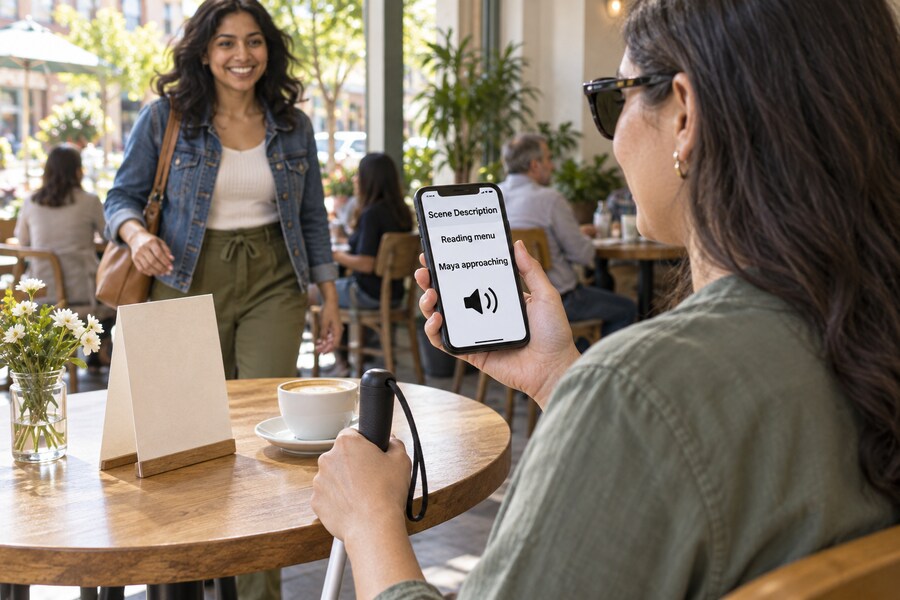
Picture the ordinary tasks that fill an average day: reading the expiration date on a carton of milk, checking whether a shirt pulled from the closet is navy or black, glancing at a restaurant menu to see what’s affordable, noticing that a friend across the room is waving hello. For someone with full sight, these moments pass without a second thought, so fast and so automatic that they barely register as decisions at all. For a person who is blind or has low vision, each of these small acts of visual confirmation has traditionally required a workaround: asking a family member, flagging down a stranger, carrying a magnifier, or simply doing without the information and hoping it did not matter. Multiply that gap across a single day, let alone a lifetime, and the cumulative effect is not a minor inconvenience but a persistent, structural barrier to the kind of casual independence that sighted people rarely notice they have.
Artificial intelligence, and specifically the branch of it known as computer vision, has begun to close that gap in a way that few assistive technologies before it managed to do at comparable scale or speed. Computer vision refers to the set of techniques that let a computer system interpret the content of an image or video, identifying objects, reading text, and increasingly describing entire scenes in flowing, natural language rather than a bare list of detected items. When paired with the large multimodal AI models that have matured rapidly since 2023, models trained not just to recognize what is in a photograph but to reason about it, answer follow-up questions, and explain context the way a knowledgeable human companion might, this technology has produced a new category of assistive tool generally described as AI scene description. A user points a smartphone camera, or increasingly a pair of camera-equipped smart glasses, at their surroundings, and within seconds receives a spoken description detailed enough to answer the specific question they actually had, not a generic caption, but a real answer to “what does this label say” or “is this outfit put together well” or “is there anyone in this room I should say hello to.”
The significance of this shift goes well beyond convenience. For the estimated more than 250 million people worldwide who are blind or have significant low vision, access to visual information has historically depended on the presence, patience, and availability of another person, whether a family member reading mail aloud, a coworker describing a whiteboard during a meeting, or a paid aide accompanying a grocery trip. AI scene description tools do not eliminate every one of those situations, and this article will examine honestly where the technology still falls short, but they have measurably reduced how often a blind or low-vision person has to wait for another human being to become their eyes for a routine task, a shift that multiple documented user studies and the companies building these tools themselves describe in terms of dignity and independence rather than mere efficiency.
The pace of this change has also been unusually fast by the standards of assistive technology generally, a field that has historically seen new categories of tool arrive and mature over the course of a decade or more. The core multimodal AI capability underlying most of the tools discussed in this article did not exist in any publicly usable form before 2023, meaning the entire arc from research preview to a documented user base in the hundreds of thousands, to integration into consumer hardware like smart glasses, has unfolded within a span of roughly three years. That speed is itself worth pausing on, both because it means the technology examined here is still actively evolving rather than settled, and because it means the accompanying research into the technology’s limitations, examined later in this article, has had to move just as quickly to keep pace with tools that were, in some cases, already in the hands of hundreds of thousands of users before rigorous independent study of their failure modes had been published.
This article traces that shift from the ground up. It begins with a plain-language explanation of how AI scene description actually works, what is happening computationally between the moment a photo is taken and the moment a description is spoken aloud, before surveying the specific, everyday tasks users report the technology unlocking. It then examines two of the most extensively documented real-world deployments of this technology, the partnership between the nonprofit Be My Eyes and OpenAI that introduced GPT-4-powered description to hundreds of thousands of users, and the subsequent move of that same technology onto camera-equipped smart glasses, enabling hands-free use for the first time. It also takes a clear-eyed look at a peer-reviewed academic study documenting where these tools still make mistakes and how blind users have learned to work around those mistakes, because an honest account of this technology requires acknowledging its real limitations alongside its real benefits. No background in artificial intelligence or assistive technology is assumed; the aim is a grounded, accurate picture of where this technology stands today and what it has actually been shown to change.
How AI Scene Description Actually Works
Understanding what makes modern AI scene description different from earlier assistive technology requires a brief look at what came before it. For years, the primary computer-vision tool available to blind and low-vision smartphone users was object and text recognition: an app could identify that a photograph contained a can of soup, or extract and read aloud the text printed on a label, using a category of technology called optical character recognition alongside basic image classification models. These tools were genuinely useful and remain in active use today, but they operated within a narrow, fixed vocabulary of things they had been specifically trained to recognize, and they could not explain relationships between objects, answer a follow-up question, or reason about context the way a human describing the same scene naturally would.
The technology that changed this is generally described as a multimodal large language model, a system trained not only on enormous quantities of text, the way earlier chatbot-style AI models were, but jointly on images paired with descriptive text, teaching the model to translate visual information into the same kind of flexible, context-aware language it already generates for text-only tasks. When a user submits a photograph to one of these systems, the model does not simply match the image against a fixed list of known objects; it generates a description essentially the same way it would generate an answer to a text question, drawing on patterns learned from vast training data that connect visual features to the language people use to describe them, which is what allows the resulting description to include inference, context, and follow-up reasoning rather than a flat list of detected items.
This distinction matters enormously in practice. An older object-recognition tool asked to process a photograph of a kitchen counter might report “bowl, spoon, box, counter,” technically accurate but practically useless for someone trying to figure out whether it is safe to start cooking. A modern multimodal model asked the same task, especially when the user can specify what they actually want to know, might respond that the box appears to be a nearly empty cereal box, the bowl has a small amount of what looks like dried cereal residue in it, and the counter otherwise appears clear and ready to use, a qualitatively different and more genuinely useful kind of description because it engages with the scene the way a sighted person naturally would when asked what is going on. Crucially, this same underlying model can then answer a follow-up question, such as whether the expiration date visible on the box has already passed, without requiring a second, separately designed tool, since the conversational, reasoning-based nature of the technology carries over from one exchange to the next within the same interaction.
The practical pipeline a user experiences, whether through a smartphone app or a pair of smart glasses, generally involves three steps that happen in rapid succession: capturing an image or short video frame through the device’s camera, transmitting that visual data to a multimodal AI model, typically running on remote cloud servers rather than on the device itself given the computational demands involved, and converting the model’s generated text response into spoken audio through text-to-speech technology that has itself improved considerably in naturalness over the same period. The entire round trip, from capture to spoken description, typically takes just a few seconds, fast enough to function as a genuinely usable substitute for a quick visual check in many everyday situations, though meaningfully slower than the near-instantaneous nature of actual human sight, a gap in speed that matters for some of the limitations examined later in this article.
The reliance on remote cloud processing rather than on-device computation is a deliberate engineering trade-off worth understanding, since it shapes both the capability and the constraints of the resulting tool. Running a full multimodal model directly on a phone or a pair of glasses would avoid the need for an internet connection and could reduce response time further, but the most capable models require far more computing power than a handheld or wearable device can currently provide, so nearly every widely used AI scene description tool as of 2026 depends on sending images to a remote server and waiting for a response. This is precisely why a reliable data connection becomes a genuine prerequisite for using these tools effectively, a dependency this article returns to later when examining who currently has reliable enough access to benefit from this technology and who does not. It also explains why response times, while generally fast, can vary noticeably depending on network conditions, an inconsistency that matters more for a user relying on the description for a safety-relevant task than it would for a purely recreational one.
The Daily Tasks These Tools Unlock
The range of specific tasks that blind and low-vision users report accomplishing with AI scene description tools is broad enough that cataloging every use case would be impractical, but several categories recur consistently across user accounts, company-published case studies, and academic research on the subject, and together they illustrate why this technology has been described by users and disability advocates alike as qualitatively different from earlier assistive tools rather than simply an incremental improvement.
Reading printed text remains one of the most frequently cited uses, but the scope of what counts as “reading” has expanded considerably beyond what earlier optical character recognition tools could manage. Users describe pointing a camera at a restaurant menu and receiving not just a transcription of every printed word but an organized summary of the appetizer and entree sections, at a piece of mail to determine quickly whether it is an advertisement or something requiring action, and at a medication bottle to confirm dosage instructions, a task where accuracy carries genuine safety consequences and where the conversational, clarification-capable nature of modern tools represents a meaningful improvement over a flat, unstructured text dump. Identifying and describing physical objects and their condition represents a second major category, encompassing everything from matching the color of a shirt to a pair of pants, to checking whether produce at a grocery store appears ripe or bruised, to confirming that a household object is oriented correctly before use, tasks that depend on nuanced visual judgment rather than simple text extraction and that earlier assistive technology genuinely could not perform.
Navigating unfamiliar physical environments constitutes a third significant category, one that intersects with genuine safety considerations rather than mere convenience. Users have reported using scene description tools to identify entrances and exits in an unfamiliar building, to determine whether a chair or other obstacle sits in a walking path, and, in a widely cited example from Be My Eyes’ own reporting on early GPT-4 testing, to receive point-by-point navigational guidance through a train station, combining object identification with the kind of spatial reasoning and step-by-step instruction that previously required either extensive advance memorization of a route or the direct assistance of another person physically present. A fourth, more socially oriented category involves recognizing people and interpreting social context, describing who is in a room, noting a person’s approximate expression or body language, or confirming that a photograph being prepared for social media actually shows what the user intended before it is shared publicly, a use case that touches on facial recognition capabilities examined in more detail, along with their attendant privacy considerations, later in this article. Across all of these categories, the throughline users consistently report is a shift from needing to specifically request another person’s time and attention for a visual task to being able to resolve the same question independently, in the moment, without a delay or a sense of imposing on someone else’s day.
A fifth category, somewhat less discussed than the others but consistently mentioned in user interviews, involves tasks tied specifically to employment and professional life, describing a printed handout distributed at a meeting, checking the layout of a slide before presenting it, or confirming that a work uniform or professional outfit is free of stains or visibly correct before a client-facing shift. These workplace-oriented tasks matter for reasons that extend beyond convenience, since the ability to independently resolve small visual uncertainties throughout a workday reduces a subtle but real source of friction that can otherwise affect a blind or low-vision employee’s confidence and perceived independence in a professional setting, a dimension of the technology’s impact that connects directly to the broader themes of dignity and independence explored in more depth later in this article.
Be My Eyes and the Leap to Be My AI
The most extensively documented real-world case of AI scene description reaching a large population of blind and low-vision users at scale comes from Be My Eyes, a Danish company founded in 2012 that built its original service around connecting blind and low-vision users with sighted volunteers through a live video call, allowing a volunteer to look through the user’s phone camera and describe whatever assistance was needed in real time. By the time the company began exploring AI-powered description, it had already built a substantial global user base, connecting a community the company describes as more than 250 million blind and low-vision people worldwide with a volunteer network that had grown to several million people.
In March 2023, coinciding with OpenAI’s public research preview of GPT-4’s new visual input capability, Be My Eyes announced it was building a GPT-4-powered feature called Virtual Volunteer, later renamed Be My AI, designed to generate a level of descriptive detail and conversational understanding comparable to what a human volunteer could provide, but available instantly and without needing to wait for a volunteer to become available. According to Be My Eyes’ own account of the rollout, the company began beta-testing the feature with a small internal group of employees in early February 2023, and the results were positive enough that the company expanded testing to outside beta users within weeks, including advocates such as Lucy Edwards, a blind content creator who became one of the tool’s earliest public testers. Michael Buckley, the company’s chief executive at the time, described the underlying capability as showing “unparalleled performance to any image-to-text object recognition tool out there,” specifically highlighting the model’s ability to hold a genuine conversation about an image rather than simply returning a static caption, and the company’s chief technology officer, Jesper Hvirring Henriksen, emphasized that the qualitative difference from earlier tools lay in the ability to reason about a scene, distinguishing, in one of the company’s own examples, between an object on the ground that was harmlessly a ball versus one that represented a genuine tripping hazard, and to communicate that distinction clearly.
Be My AI moved from limited beta testing into a broader open beta and then general public availability over the course of 2023, and adoption proceeded quickly once the feature reached a wider audience: reporting on the rollout described the feature being used a million times within weeks of its broader release, a scale of adoption that reflected both the size of Be My Eyes’ existing user base and the immediate, tangible utility users found in the tool for tasks they had previously needed to solve through a live volunteer call or simply had to do without addressing at all. This scale of usage also generated a large body of real-world feedback that fed directly back into how the company and OpenAI understood the technology’s strengths and shortcomings, feedback that later informed both product refinements at Be My Eyes and the broader academic research into AI visual assistance tools examined later in this article.
The specific example Be My Eyes has repeatedly highlighted from its own early testing, a user receiving point-by-point navigational guidance through a train station, a task the company itself has described as arguably difficult even for a sighted person unfamiliar with the station, illustrates why this rollout drew such immediate attention within the accessibility community rather than being received as merely one more incremental app update. Earlier assistive tools could, at best, tell a user what object was directly in front of them; a tool capable of synthesizing an entire navigational sequence, incorporating signage, spatial layout, and step-by-step sequencing, represented a genuinely new capability tier rather than a faster or more accurate version of an existing one, which is a large part of why the underlying technology attracted rapid, sustained interest well beyond the Be My Eyes user base itself, feeding into the multi-company landscape of tools examined later in this article. The Be My AI rollout is frequently cited in subsequent accessibility research and industry coverage as the moment multimodal AI description moved from a research demonstration into a tool genuinely embedded in the daily lives of a large, real user population, making it one of the clearest available case studies of what this technology looks like once it leaves the lab and reaches the people it was built to serve.
From Phone Screen to Face: Smart Glasses and Hands-Free Access
A meaningful limitation of smartphone-based scene description, even once the underlying AI model itself works well, is that it requires a user to physically hold up a phone, aim its camera reasonably accurately at whatever they want described, and hold that position steady enough for the photo or video capture to succeed, a set of physical requirements that can be awkward or genuinely difficult in situations that also require a free hand, a white cane, a guide dog’s harness, or simply both hands occupied with an everyday task like carrying groceries. Camera-equipped smart glasses address this specific limitation directly, since the camera is mounted on the user’s own head, activated by voice command, and requires no separate aiming or handling at all.
Be My Eyes and Meta announced a partnership bringing Be My Eyes’ technology to Ray-Ban Meta smart glasses on September 25, 2024, and the resulting integration launched to users on November 13, 2024, initially available in the United States, Canada, the United Kingdom, Ireland, and Australia. The feature allows a user to say “Hey Meta, call a volunteer on Be My Eyes,” which initiates the company’s existing live-volunteer video-call feature entirely hands-free, connecting the user to a sighted volunteer who can see through the glasses’ camera in a one-way video, two-way audio call and provide real-time guidance while the user’s hands remain completely free for a cane, a guide dog, or whatever task originally prompted the request. Be My Eyes described the integration as the first and, at the time of launch, the only accessibility technology of its kind available on Meta’s AI glasses platform, and company materials framed the significance specifically in terms of the physical freedom the hands-free design provides, citing use cases like identifying items on a store shelf, navigating a busy public space, or following a recipe step by step while a user’s hands are otherwise occupied with the physical task itself.
The move to smart glasses represents more than a change in form factor; it reflects a broader trajectory in how this category of technology is likely to keep developing. A smartphone-based tool, however capable the underlying AI model, still asks a user to interrupt whatever they are physically doing in order to retrieve a phone, unlock it, open an app, and aim a camera, a sequence of steps that adds friction and delay even when each individual step is quick. A voice-activated, head-mounted camera removes nearly all of that friction, moving the technology closer to the kind of instantaneous, ambient visual access that sighted people take for granted, and the specific choice to launch the integration around a live human volunteer call, rather than the fully automated Be My AI feature, in this initial glasses rollout suggests the companies involved wanted the highest-stakes, most safety-relevant hands-free interactions to still involve a human volunteer’s judgment rather than relying solely on an automated model for situations where a user’s hands being occupied often correlates with situations, like navigating a physical space, where an error carries a higher practical cost.
The choice of Ray-Ban as the specific hardware partner also carries a design implication worth noting: the glasses are built to look and function as ordinary eyewear, rather than as visibly specialized assistive equipment, an intentional design decision that reflects a broader and long-documented preference among many users of assistive technology for tools that do not visibly mark them as disabled in public settings. Earlier generations of dedicated assistive hardware, including some accessibility-specific smart glasses products, have sometimes faced adoption resistance tied specifically to their conspicuous, clinical appearance, and the deliberate use of a mainstream consumer fashion brand as the delivery vehicle for this accessibility feature represents a notable shift in how this category of hardware is being designed and marketed, treating discretion and mainstream aesthetic appeal as a meaningful product requirement rather than a secondary concern behind raw functionality.
Other Tools in the Landscape
Be My Eyes has drawn particular attention in accessibility research and mainstream coverage alike because of the scale and documentation of its rollout, but it operates within a broader landscape of AI-powered visual assistance tools that blind and low-vision users draw on, often using several in combination rather than relying on any single application. Microsoft’s Seeing AI, a free app the company has continued to develop and update since its initial release, focuses heavily on structured recognition tasks including reading documents aloud, describing scenes, recognizing currency denominations, and identifying products by scanning their barcodes, and it has built a substantial and loyal user base specifically among people who want fast, reliable recognition for well-defined, repeatable tasks rather than open-ended conversational description. Envision, a company offering both a smartphone app and its own dedicated smart glasses hardware, has similarly built a following by focusing on document reading, face recognition for identifying known contacts, and real-time scene narration, with its hardware-based offering giving users a hands-free option that, similar in concept to the Ray-Ban Meta integration, does not depend on a separate smartphone company’s glasses platform.
The existence of multiple, independently developed tools addressing overlapping needs is itself a meaningful signal about the state of this technology category: rather than a single dominant application, the accessibility technology landscape as of 2026 includes several actively maintained, well-resourced tools built by different organizations with different underlying technical approaches and different business models, ranging from Be My Eyes’ nonprofit-affiliated, volunteer-network-plus-AI hybrid model to Microsoft’s integration of Seeing AI as a free offering within its broader accessibility commitments to Envision’s dedicated hardware business. Blind and low-vision users interviewed in academic research on this topic frequently describe using more than one of these tools depending on the specific task at hand, treating them as a complementary toolkit rather than expecting any single application to handle every visual information need equally well, a pattern that mirrors how sighted people similarly rely on different tools, a dedicated translation app, a general search engine, a specific store’s own app, for different specific purposes rather than one single application designed to do everything.
This multi-tool landscape has also produced a degree of healthy competitive pressure that has likely accelerated improvement across the category as a whole, since a user who finds one tool’s description of a given scene unsatisfying can, and frequently does, cross-check the same scene with a second tool, feedback that companies in this space have described paying close attention to as they prioritize which capabilities to refine next. This competitive dynamic mirrors patterns seen in mainstream consumer technology more broadly, where the presence of multiple capable alternatives tends to spur faster iteration than a single, uncontested market leader typically produces, and it gives users a degree of practical leverage, the ability to simply switch tools when one underperforms for a specific need, that was largely unavailable during the earlier era of narrower, more specialized single-purpose assistive applications.
The Limits of AI Description: Errors, Hallucinations, and Trust
An honest account of AI scene description technology has to grapple directly with its documented failure modes, not as a minor caveat but as a central part of understanding how the technology actually functions in daily use, because the specific nature of these failures interacts in an unusually consequential way with the fact that the people relying on this technology often cannot independently verify whether a given description is accurate. A sighted person using an AI tool to describe an image retains the option of glancing at the image themselves to catch an obvious error; a blind user relying on the same tool’s spoken description generally has no equivalent independent check available, which means an error that would be a minor, quickly corrected annoyance for a sighted user can instead go completely undetected by the person who most needs the information to be right.
This dynamic was the specific focus of a rigorous academic study published at the 26th International ACM SIGACCESS Conference on Computers and Accessibility, held October 27 through 30, 2024, in St. John’s, Newfoundland and Labrador, Canada. The study, titled “Misfitting With AI: How Blind People Verify and Contest AI Errors” and authored by researchers Rahaf Alharbi, Pa Lor, Jaylin Herskovitz, Sarita Schoenebeck, and Robin Brewer, conducted in-depth qualitative interviews with 26 blind participants specifically about their experiences using AI-powered visual assistance technologies, including tools like Seeing AI and Be My Eyes, examining how these users identified, verified, and worked around instances where the AI’s description turned out to be wrong. The researchers documented that AI visual assistance tools are, as a category, embedded with errors that can be genuinely difficult for a blind user to catch non-visually, precisely because the entire premise of the tool is that the user cannot independently confirm the visual information the description is meant to convey, creating a structural vulnerability distinct from, and in some ways more consequential than, the kind of error a sighted user of the same technology would face.
The study documented specific strategies blind participants had developed to cope with this vulnerability, including cross-referencing a description from one AI tool against a second, independent tool or a human volunteer when a description seemed uncertain or internally inconsistent, developing an intuitive sense for the kinds of scenes or lighting conditions where a given tool tended to be less reliable, and, in some cases, simply accepting a higher degree of uncertainty for lower-stakes tasks while insisting on independent human confirmation for anything involving safety, medication, or financial information. This pattern of adaptive, effortful verification work, largely invisible to anyone who has not studied it directly, represents a significant and often underacknowledged burden that falls specifically on users of assistive AI technology, a burden that does not show up in a company’s own adoption statistics or user-satisfaction marketing but that shapes how the technology is actually experienced day to day. Separate research on generative AI tools more broadly, examining how blind users understand and reason about these systems’ capabilities, has similarly found that trust in AI-generated descriptions tends to be conditional and task-dependent rather than uniform, with users extending more confidence to a tool’s performance on tasks they have personally tested and verified repeatedly than to a completely novel kind of request, a pragmatic, earned form of trust rather than blanket confidence in the underlying technology.
The Alharbi et al. study also documented a related dynamic worth highlighting: participants described instances of what the researchers characterized as contesting an AI error, actively pushing back against or re-prompting a tool that had produced a description the user had reason to doubt, based on inconsistency with other available information, a description that did not match the user’s own tactile or contextual sense of a situation, or simply an answer that seemed implausible given what the user already knew. This active, skeptical posture toward AI-generated descriptions, rather than passive acceptance, emerged from the research as a learned skill blind participants had developed specifically because they had encountered enough errors to know blind trust was not warranted, and the researchers argued this points toward a design opportunity that most current tools have not fully addressed: building interfaces that proactively communicate a model’s own uncertainty, flagging when a description is based on a blurry image or an ambiguous visual cue, rather than presenting every description with identical, undifferentiated confidence regardless of how reliable the underlying detection actually was.
None of this research suggests that AI scene description tools are unreliable to the point of being unhelpful; the same body of research, and the adoption figures documented in the case studies above, make clear that users find substantial, genuine value in these tools despite their imperfections. What this research does establish clearly is that the honest framing of this technology is not “AI has solved visual accessibility” but rather “AI has meaningfully expanded what a blind or low-vision person can determine independently, while introducing a new category of verification work that responsible use of the technology requires users to perform,” a more precise and, ultimately, more genuinely respectful description of both the technology’s real value and its real, documented limitations.
Independence, Dignity, and What Users Say Actually Changes
Beyond the specific tasks and the specific technical limitations examined so far, a recurring theme across user accounts, company case studies, and academic interviews is that the value of AI scene description is not fully captured by counting the tasks it accomplishes, because a significant part of what users describe changing is more psychological and social than purely functional. Repeatedly needing to ask another person, even a willing and generous one, for help with a routine visual task carries a subtle but real social cost: it requires disclosing a need, it depends on someone else’s availability and patience, and over time it can reinforce a broader social dynamic in which a blind or low-vision person is cast in the role of someone requiring accommodation for even minor, routine activities that sighted people never have to ask anyone’s permission or assistance to complete.
Users who have adopted AI scene description tools consistently describe a shift in this dynamic that goes beyond simply saving time. Being able to independently confirm what is on a restaurant menu without asking a dining companion to read it aloud, or checking a piece of mail without waiting for a family member to be free, shifts these moments from a request for accommodation to an ordinary, private act, restoring a degree of autonomy over information that sighted people generally do not think of as something they have to actively manage. Be My Eyes’ own reporting on user reactions during the Be My AI rollout captured this repeatedly in testimonials describing not just what a task the tool accomplished but how it felt to accomplish it without needing to involve another person, language that mirrors findings from disability studies research more broadly, which has long documented that unnecessary dependence on others for basic tasks, however willingly that assistance is given, can measurably affect a person’s sense of autonomy and self-determination over time.
A related but distinct dimension of this dignity-oriented value concerns facial recognition and social awareness specifically, a capability several of the tools discussed in this article support in some form, letting a user identify a previously introduced contact or gauge the general composition of a room before entering a social situation. Users interviewed in accessibility research have described this capability as addressing a particularly acute source of social anxiety, the fear of failing to recognize or greet someone appropriately in a professional or social setting, a fear that sighted people rarely have to consciously manage. At the same time, this same capability raises its own distinct privacy and consent questions, since a facial recognition feature necessarily involves processing another person’s likeness without that person’s direct involvement in the interaction, a tension that responsible tool design has approached primarily by limiting recognition to contacts a user has specifically and deliberately added themselves, rather than attempting broader, unconsented identification of strangers, though the underlying tension between a blind user’s legitimate need for social information and a bystander’s reasonable expectation of privacy remains an active and unresolved area of discussion within accessibility technology design more broadly.
This does not mean AI scene description tools eliminate the value of human connection or that users uniformly prefer an AI description to a human volunteer in every circumstance; the continued, deliberate design choice by Be My Eyes to keep its live human-volunteer calling feature available and prominently integrated, including as the specific feature chosen for the initial hands-free smart glasses rollout described earlier, reflects an understanding within the accessibility technology community that AI and human assistance serve complementary rather than identical roles. A quick, low-stakes visual check benefits from the speed and always-available nature of an AI tool, while a more complex, ambiguous, or emotionally significant situation, navigating a distressing or confusing environment, for instance, may still benefit from a human volunteer’s judgment, empathy, and ability to reason about unusual circumstances the AI model was never specifically trained to handle. The overall picture that emerges from user accounts is one of an expanded toolkit rather than a replacement of one form of assistance with another, giving blind and low-vision users more options, and more control over which kind of assistance best fits a given moment, than existed before this technology matured.
Who Is Being Left Behind: Cost, Access, and the Digital Divide
The genuine benefits documented throughout this article depend on a set of preconditions that are not universally available to every blind or low-vision person, and a complete picture of this technology’s impact has to account honestly for who currently has access to it and who does not. Smartphone-based AI scene description tools require, at minimum, a reasonably modern smartphone capable of running current AI applications smoothly, a reliable data connection or Wi-Fi access sufficient to transmit images to cloud-based AI models without frustrating delay, and enough digital literacy and confidence to navigate an app’s interface using a screen reader, none of which can be assumed as universally available, particularly among older blind and low-vision individuals, who represent a substantial share of the overall blind and low-vision population globally and who may have lost vision later in life without the same lifetime of accumulated assistive-technology familiarity that someone blind from birth or early childhood might have developed.
Cost represents an additional, more direct barrier for some users, particularly for the smart glasses form factor examined earlier in this article, since a pair of camera-equipped smart glasses represents a meaningfully larger upfront purchase than a smartphone app most users already have installed on a device they own regardless, even when the underlying AI service itself is offered at no additional charge. This creates a two-tiered landscape within the assistive technology space itself, in which the most frictionless, hands-free version of this technology remains available primarily to users who can afford the additional hardware investment, while users without that means retain access to the software-only, smartphone-based versions of the same underlying capability, still a meaningful improvement over earlier technology but not the full hands-free experience described in the smart glasses case study above.
Some of the underlying AI capability itself also carries ongoing cost considerations that are less visible to an individual user than a one-time hardware purchase but matter for the technology’s long-term accessibility. Running a sophisticated multimodal model at the scale required to serve hundreds of thousands or millions of users is computationally expensive, and while companies including Be My Eyes and Microsoft have so far made their core AI description features available to users free of charge, often subsidized through corporate partnerships, grants, or a broader nonprofit funding model, that arrangement is not guaranteed to remain the permanent structure of this market as the technology matures and the underlying computational costs are eventually weighed against sustainable long-term business models, a consideration disability advocates have flagged as worth monitoring closely even though no major provider has yet moved toward a paid subscription model for these core accessibility features specifically.
Geography and infrastructure compound these barriers further, since reliable, affordable mobile data access, taken for granted in wealthier urban areas of high-income countries, remains considerably less consistent across much of the developing world, where a large share of the global population of blind and low-vision people actually lives. A tool that depends on transmitting images to a remote cloud server for AI processing simply does not function as designed without a sufficiently reliable data connection, meaning the population with arguably the least existing access to alternative accommodations and support services is also, in some cases, the population least able to reliably access this new generation of AI-powered assistance. Organizations working in global disability advocacy have specifically flagged this uneven distribution of benefit as a priority concern as this technology continues to mature, arguing that meaningful progress on accessibility requires deliberate attention to these access gaps rather than assuming that a technology’s benefits will naturally and evenly reach the full population it could theoretically help.
Language coverage represents a further, related access gap worth naming specifically. The multimodal AI models underlying these tools generally perform best in English and a handful of other widely represented languages in their training data, and while companies including Be My Eyes have continued expanding language support for both their AI and human-volunteer features, description quality and available language options are not yet uniform across the roughly seven thousand languages spoken worldwide, meaning a blind or low-vision person whose primary language has limited representation in these systems’ training data may receive noticeably lower-quality descriptions, or may be unable to use certain features at all, compared with a user working in a well-represented language. This gap compounds the geographic and economic barriers already discussed, since the regions with less reliable data infrastructure often overlap considerably with regions where locally dominant languages remain comparatively underrepresented in the large-scale training data that gives these models their descriptive capability in the first place.
Final Thoughts
AI scene description represents a genuine, well-documented expansion of independence for millions of blind and low-vision people, but its deeper significance lies in what it reveals about the relationship between technological capability and human dignity. For most of the history of assistive technology, meaningful progress arrived slowly and incrementally, a somewhat better screen reader, a marginally more accurate optical character recognition tool, each representing real but modest improvements over what came before. The shift to multimodal AI models capable of genuine conversational reasoning about visual information represents something closer to a step change, moving the technology from narrow, brittle recognition of a fixed vocabulary of objects to something approaching the flexible, context-aware description a knowledgeable human companion could provide, available on demand and without requiring another person’s time.
That capability carries real weight for financial inclusion and broader social participation, even though this technology’s primary domain is visual rather than financial. Independently reading a bill, confirming a price tag, or verifying that a check has been filled out correctly are the kinds of everyday financial tasks that, absent reliable visual access, have historically required either a trusted intermediary or acceptance of a meaningful degree of financial vulnerability, handing over a wallet’s contents to a cashier and trusting their honesty, for instance, rather than confirming the transaction independently. Tools that restore a blind or low-vision person’s ability to verify these details independently address a specific, practical dimension of the broader project of financial and economic inclusion that extends well beyond the more commonly discussed barriers of access to banking services or credit, and that connection between visual accessibility and genuine economic autonomy deserves more attention than it typically receives in conversations about either topic in isolation.
The technology’s continued development will need to hold two things in balance simultaneously, expanding the sophistication and reliability of the underlying AI models while honestly confronting the documented reality that these same models still make mistakes blind users cannot always independently catch, and that the burden of managing that uncertainty currently falls disproportionately on the users the technology is meant to serve. Genuine progress will look less like companies declaring the accessibility problem solved and more like the continued, iterative work reflected in the case studies throughout this article, expanding language support, improving accuracy, extending hands-free hardware options, and taking seriously the academic research documenting where the technology still falls short, rather than treating early adoption success as a finish line.
What makes this an unusually hopeful area of AI development, even amid its genuine and well-documented limitations, is the directness and clarity of the human benefit involved. Unlike many applications of artificial intelligence where the social value remains abstract, contested, or difficult to measure, the value here shows up in specific, human terms that are hard to dismiss: a person reading their own mail for the first time without asking for help, a parent confirming independently that their child’s shirt matches before a school photo, a traveler navigating an unfamiliar train station alone. Extending that kind of ordinary, previously inaccessible independence to more people, more reliably, and more equitably than the technology currently manages remains the clear and worthwhile task ahead.
FAQs
- What is AI scene description, and how is it different from older accessibility apps?
AI scene description uses multimodal AI models to generate natural, conversational descriptions of images or surroundings, allowing follow-up questions and contextual reasoning, unlike older object-recognition and text-reading tools that could only match against a fixed, limited vocabulary of known items. - When did Be My AI launch, and what technology powers it?
Be My Eyes announced its GPT-4-powered Be My AI feature, originally called Virtual Volunteer, in March 2023, beginning internal beta testing in early February 2023 before expanding to outside testers and then general availability later that year. - How many people have used Be My AI?
Reporting on the feature’s broader public rollout in 2023 described it being used a million times within weeks of release, reflecting Be My Eyes’ existing global user base of blind and low-vision people alongside its volunteer network of several million people. - How do Ray-Ban Meta smart glasses work with Be My Eyes?
Announced on September 25, 2024, and launched on November 13, 2024, the integration lets a user say “Hey Meta, call a volunteer on Be My Eyes” to start a hands-free video call with a sighted volunteer through the glasses’ built-in camera, initially available in the U.S., Canada, U.K., Ireland, and Australia. - Are AI scene description tools always accurate?
No. A 2024 academic study presented at the ACM ASSETS conference, based on interviews with 26 blind participants, documented that these tools regularly produce errors that can be difficult for a blind user to independently verify, requiring users to develop their own coping and verification strategies. - What tasks do blind and low-vision users most commonly use these tools for?
Commonly reported tasks include reading menus, mail, and medication labels, identifying and matching clothing or produce, navigating unfamiliar physical spaces, and describing photos or the people present in a room. - What other AI visual assistance tools exist besides Be My Eyes?
Microsoft’s Seeing AI focuses on structured tasks like document reading and currency recognition, while Envision offers both an app and dedicated smart glasses hardware built around document reading, face recognition, and scene narration. - Do these tools replace human volunteers entirely?
No. Be My Eyes has deliberately kept its live human-volunteer video call feature available alongside its AI tools, including as the primary feature integrated into its hands-free smart glasses rollout, reflecting an industry view that AI and human assistance serve complementary rather than identical roles. - Who might have difficulty accessing this technology?
Access barriers include the cost of smartphones or smart glasses, the need for reliable data connectivity, and the additional digital literacy required to navigate these apps, barriers that disproportionately affect older users, low-income users, and people in regions with less reliable mobile infrastructure. - Does AI scene description have applications beyond visual tasks, like financial independence?
Yes. The ability to independently read a bill, confirm a price, or verify a financial document addresses a specific dimension of economic inclusion, allowing blind and low-vision users to verify financial details independently rather than relying entirely on a trusted intermediary.