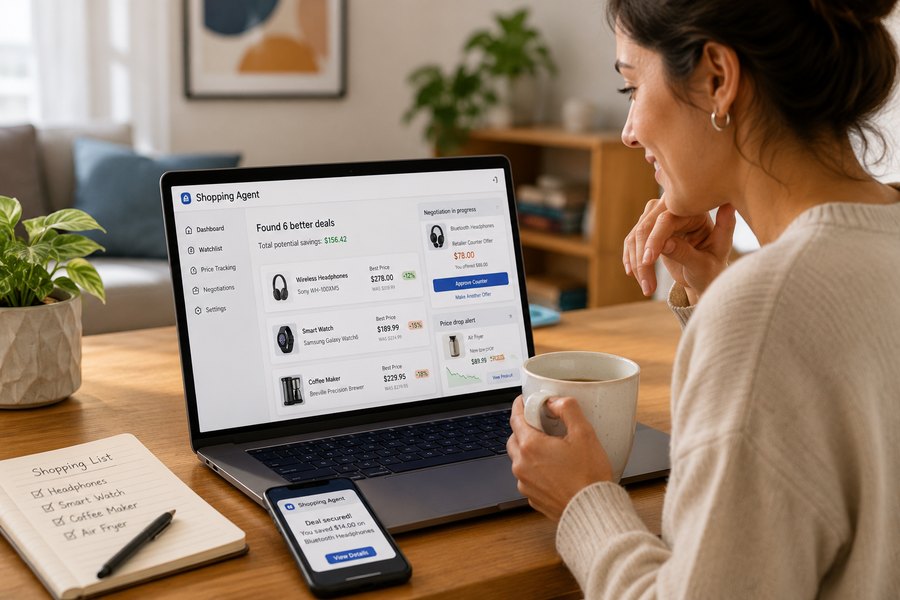
For most of the history of commerce, buying something well has demanded time, attention, and a certain amount of skill, as a shopper who wanted the best price had to compare sellers, watch for sales, read reviews, and, in some settings, summon the nerve to haggle, all of which rewarded those with the patience and knowledge to do it and quietly penalized everyone else. The internet promised to make this easier by putting every price within reach, yet in practice it often made shopping more bewildering, burying buyers under an avalanche of options, fluctuating prices, opaque discounts, and reviews of uncertain reliability, so that finding a genuinely good deal could feel like a part-time job. Into this landscape has arrived a new kind of tool, the AI shopping agent, a software assistant that can take over much of this work on a shopper’s behalf, searching for products, comparing options, tracking prices, applying discounts, and in some cases even negotiating with sellers to secure a better deal.
These agents represent a shift in how purchasing happens, moving from a model in which a person does the searching and deciding to one in which they delegate those tasks to an automated assistant that acts for them, a development that the technology industry has begun to call agentic commerce. Rather than typing queries into a search box and sifting through results, a shopper can describe what they want and let an agent do the hunting, returning with a recommendation, a price, or a completed purchase, and as these agents grow more capable, they are beginning to change not just the experience of shopping but the underlying economics of everyday purchases, altering how prices are discovered, how discounts are won, and how buyers and sellers relate to one another.
This article examines AI shopping agents that hunt deals and negotiate prices, written for a reader with no technical background in artificial intelligence or e-commerce. It explains what these agents are and how they work, the mechanics by which they discover deals and negotiate prices, and the ways they are reshaping the economics of everyday buying. It weighs the genuine benefits and the real risks for shoppers, retailers, and the broader market, and it grounds the discussion in documented, verifiable implementations rather than speculation, drawing on real platforms with measured results. The aim is to convey both the genuine power of these agents to save money and effort and the meaningful limitations, risks, and open questions that accompany their rise.
Understanding AI Shopping Agents and How They Work
An AI shopping agent is a software assistant powered by artificial intelligence that can perform shopping tasks on a person’s behalf, ranging from researching products and comparing prices to tracking discounts and, in the most advanced cases, completing purchases or negotiating terms. Unlike a traditional search engine or price-comparison website, which presents information and leaves the work of deciding and acting to the user, an agent is designed to take action, interpreting what a shopper wants, gathering and evaluating the relevant information, and carrying out steps toward a goal with varying degrees of autonomy. The defining feature is this capacity to act rather than merely to inform, which is what distinguishes an agent from the earlier generation of shopping tools that could compare prices but could not do anything about them.
The technology that makes these agents possible is the recent generation of large language models, the same kind of artificial intelligence that powers conversational assistants, which can understand natural language, reason about a shopper’s needs, and connect to other software systems to take action. Because these models can interpret a request phrased in ordinary language, such as a description of the kind of product a person wants and the price they hope to pay, and because they can be connected to retailers’ systems, payment services, and the wider web, they can translate a vague human intention into a concrete sequence of actions, searching for matching products, reading their details, comparing their prices, and proceeding toward a purchase. This combination of language understanding and the ability to act through connected systems is what has allowed shopping agents to move beyond the rigid, keyword-driven tools of the past toward something that can engage with the messy, open-ended nature of how people actually shop.
It is worth distinguishing the kind of agent described here from the simpler automated tools that have existed for years, such as browser extensions that apply coupon codes at checkout or websites that list prices from several stores, because while those tools automated narrow, fixed tasks, they could not understand an open-ended request, reason about a shopper’s particular situation, or carry out a flexible sequence of steps toward a goal. The earlier tools operated on rigid rules and could do only what they were explicitly programmed to do, breaking down when a situation departed from the expected pattern, whereas an agent built on a modern language model can interpret an ambiguous request, adapt to unexpected circumstances, and decide for itself how to proceed, which is why the current generation of agents can engage with the genuinely open and variable nature of shopping in a way their predecessors could not. This difference in flexibility is not merely a matter of degree but of kind, since it is the capacity to understand and reason that allows an agent to be trusted with a goal rather than a script, and it is this capacity that has made the delegation of shopping to software newly plausible.
The broader phenomenon that these agents belong to has come to be called agentic commerce, a term for the emerging model in which much of the work of shopping is delegated to autonomous or semi-autonomous software agents acting on behalf of buyers, and in some cases sellers. In this model, a customer’s agent might discover products, compare options across many sellers, evaluate features and prices, and complete a purchase, while a retailer’s agent might present structured information about products and respond to inquiries, with the two interacting to reach a transaction. The vision that the industry has articulated is one in which shoppers increasingly describe what they want and let agents handle the rest, and where the competition among retailers shifts toward being chosen by these agents rather than by human browsers, a change that carries significant implications for how commerce is organized.
From Search to Delegation
The most fundamental shift that AI shopping agents represent is a move from a model of search, in which the shopper does the work of finding and choosing, to a model of delegation, in which the shopper hands that work to an agent. In the search model that has dominated online shopping, a person enters queries, browses results, opens product pages, compares them in their head or across browser tabs, and ultimately makes a decision and completes a purchase themselves, doing all the cognitive labor of the transaction. This model places the burden of effort, attention, and judgment squarely on the shopper, rewarding those who have the time and skill to search well and leaving others to settle for whatever they happen to find, and it is the model that decades of e-commerce have refined but not fundamentally changed.
The delegation model that agents enable inverts this arrangement, allowing the shopper to specify a goal and entrust the agent with the work of achieving it. Instead of searching, the person describes what they want, perhaps in a sentence or two of natural language, and the agent takes over, conducting the searches, reading the results, comparing the options, and presenting a recommendation or even executing the purchase, so that the shopper’s role contracts from doing the work to setting the objective and approving the outcome. This shift promises to democratize good shopping, extending to everyone the kind of diligent comparison and deal-hunting that previously required time and expertise, since the agent performs that labor uniformly on behalf of whoever uses it.
This transition from search to delegation is not absolute, and in practice agents operate along a spectrum of autonomy that ranges from advisory tools that recommend but leave the decision to the person, to assistants that prepare a purchase for approval, to fully autonomous agents that can complete a transaction without further human input. Where a given agent sits on this spectrum depends on its design and on how much trust and authority the shopper chooses to grant it, and the appropriate degree of autonomy is itself a matter of ongoing debate, since handing more control to an agent increases convenience but also raises questions about oversight, error, and accountability. Understanding that agents vary in how much they do for the shopper, and that delegation can be partial as well as complete, is essential to grasping both their promise and the care their use requires, and it sets the stage for examining the specific mechanics by which they hunt for deals and negotiate prices.
The Mechanics of Deal-Hunting and Price Negotiation
AI shopping agents create value for shoppers through two related but distinct capabilities, the ability to discover deals by searching, comparing, and tracking prices across many sellers, and the ability, in more advanced cases, to negotiate prices and terms on a shopper’s behalf. The first capability addresses the problem of finding the best available price among a vast and shifting landscape of options, a task that agents can perform with a thoroughness and speed no human could match, while the second addresses the problem of doing better than the listed price by engaging sellers in a negotiation, a practice long common in some markets but rare in everyday online retail until automation began to make it feasible at scale.
The two subsections that follow examine these capabilities in turn. The first concerns deal discovery and price comparison, the work of scanning the market, comparing products and prices, and tracking changes over time so that a shopper can be presented with the best option or alerted when a price drops. The second concerns automated negotiation and haggling, the more novel and striking capability by which an agent can make offers, respond to counter-offers, and negotiate a price or terms with a seller’s own system, bringing the dynamics of bargaining to transactions that have long been conducted at fixed prices. Understanding both how agents find deals and how they negotiate them is necessary to appreciate the full scope of what these tools can do and how they are changing the act of buying.
Deal Discovery and Price Comparison
The foundational capability of an AI shopping agent is deal discovery, the ability to search across many sellers, compare products and prices, and identify the best available option for a shopper’s needs. Because an agent can rapidly query many sources, read the details of products, and evaluate them against the shopper’s stated preferences, it can perform a comparison far more comprehensive than a person browsing manually would undertake, considering more options, weighing more factors, and doing so in seconds rather than over the course of an exhausting search. This capacity to canvass the market thoroughly and quickly is the most immediately useful thing an agent does, since it directly addresses the difficulty of finding a good price among an overwhelming number of choices, and it forms the basis for everything else the agent might do.
Beyond simply comparing prices at a moment in time, agents can track prices over time and alert a shopper to discounts, drops, and deals, turning the episodic act of checking prices into a continuous, automated watch. A shopper interested in a particular product can have an agent monitor its price across sellers and notify them when it falls, or can ask the agent to find the best moment to buy, leveraging the fact that prices in online retail fluctuate frequently in response to demand, competition, and promotions. This temporal dimension of deal discovery, watching prices over time rather than only at the moment of searching, allows agents to capture savings that a one-time comparison would miss, and it relieves the shopper of the tedious vigilance that finding the best deal on a fluctuating price would otherwise require.
The quality of an agent’s deal discovery depends heavily on the breadth and reliability of the information it can access, which is why much of the development in agentic commerce concerns the connections between agents and sellers. An agent that can reach only a narrow set of sellers will offer a limited comparison, while one connected to a wide range of merchants can canvass the market more fully, and the accuracy of its recommendations depends on the quality of the product information, pricing, and availability data it receives. This dependence on data access and quality is a central practical constraint on what agents can do, and it explains why retailers, payment providers, and technology companies have invested in building the standards and integrations that allow agents to obtain reliable, structured information about products and prices, since the usefulness of an agent’s deal-hunting rises and falls with the breadth and accuracy of what it can see. As these connections proliferate, the comparison an agent can perform grows more comprehensive, and the discovery of genuinely good deals becomes more reliable, which is part of why the infrastructure of agentic commerce has become a focus of intense activity even as the consumer-facing agents capture more attention.
Deal discovery also extends beyond the headline price to the many factors that determine whether a purchase is genuinely a good one, including shipping costs, delivery times, return policies, warranty terms, and the reliability of the seller, all of which an agent can weigh together in a way that a hurried human comparison often neglects. A price that appears lowest may prove more expensive once shipping is added or may come from a seller whose reliability is doubtful, and an agent that considers the full cost and the full set of relevant terms can identify the option that is best on the whole rather than merely cheapest at first glance. This ability to evaluate the complete picture of a purchase, rather than fixating on a single number, is one of the more valuable aspects of agent-driven deal discovery, since it brings to every transaction the kind of thorough, multi-factor judgment that careful shoppers apply but that most people lack the time or patience to perform consistently, and it helps guard against the false economy of a low price that conceals high total cost or poor service.
Automated Negotiation and Haggling
The more novel capability of advanced AI shopping agents is negotiation, the ability to bargain with a seller over price or terms rather than simply accepting the listed price, bringing the dynamics of haggling to transactions that have long been conducted at fixed prices. In markets and settings where bargaining is customary, a skilled negotiator can often secure a better price than the one first quoted, but most online retail operates at fixed prices, partly because negotiating with every customer would be impractical for a human-staffed business. Automated negotiation changes this calculus by allowing a seller to deploy software that can negotiate with many customers at once, and by allowing a buyer to deploy an agent that can negotiate on their behalf, making bargaining feasible at a scale and speed that human negotiation never could.
On the seller’s side, automated negotiation typically works by allowing a customer to make an offer that a negotiation system evaluates and responds to, accepting, declining, or countering according to rules and limits the seller has set, so that the back-and-forth of bargaining happens through software in a matter of seconds. A shopper who would not have paid the listed price might be enticed by the chance to make an offer and reach a mutually acceptable figure, and the seller, rather than losing the sale or discounting indiscriminately, can capture a transaction at a price above its floor but below the list, tailored to what that customer is willing to pay. This dynamic allows sellers to recover sales they might otherwise lose and to discriminate prices in a controlled way, offering discounts to those who ask without lowering the price for everyone, while giving buyers the satisfaction and savings of a negotiated deal.
On the buyer’s side, the vision that agentic commerce has articulated extends negotiation further, to agents that bargain on a shopper’s behalf, potentially negotiating not only price but delivery windows, bundles, and other terms with a seller’s own agent or system. In this emerging model, a customer’s agent and a retailer’s agent might interact directly, with the buyer’s agent seeking the best price and terms and the seller’s agent responding within its limits, conducting a negotiation between two pieces of software that represents a genuine departure from the fixed-price norm of online retail. This buyer-side negotiation remains less developed than the seller-side systems already in use, and much of it is still emerging rather than widespread, but it points toward a future in which the price a shopper pays is increasingly the outcome of an automated negotiation rather than a figure simply accepted, a prospect that carries profound implications for how prices are set and how the gains from trade are divided. It is worth noting that automated negotiation, for all its novelty in online retail, also raises subtle questions about fairness and information that bargaining has always carried. When a seller’s system can tailor its responses to what it infers about a particular customer’s willingness to pay, the negotiation becomes a form of personalized pricing in which different buyers may end up paying different amounts for the same good, an outcome that can benefit price-sensitive shoppers who would not have bought at the list price but that also means the price a person pays depends increasingly on the sophistication of the agent representing them. A shopper with a capable negotiating agent might secure consistently better terms than one without, which could either democratize the gains from bargaining, by giving everyone access to skilled negotiation, or concentrate them among those with the best tools, depending on how widely capable agents become available. This tension, between negotiation as a leveling force and negotiation as a new axis of advantage, is one of the more interesting questions that automated haggling raises, and it underscores that the spread of negotiation agents will reshape not only how prices are set but how the gains from trade are distributed among buyers of differing means and tools.
The combination of agents that discover deals and agents that negotiate them suggests a coming world in which the everyday act of buying is mediated by software that works continuously to secure the best possible terms, transforming a process that has long rewarded human effort and skill into one that can be delegated and automated.
The Economics: How Agents Reshape Everyday Purchases
The rise of AI shopping agents carries economic implications that extend well beyond the convenience of any individual purchase, because by changing who does the work of shopping and how prices are discovered and negotiated, agents alter the fundamental dynamics of retail markets. When a substantial share of purchasing decisions is delegated to agents that comprehensively compare prices and relentlessly seek the best deal, the competitive pressure on sellers intensifies, since an agent has no brand loyalty, no fatigue, and no reluctance to switch, and will simply choose whatever option best satisfies the shopper’s stated goal. This prospect of a market in which buyers are represented by tireless, comprehensive, and dispassionate agents represents a meaningful shift in the balance of the shopping relationship, one that could reshape pricing, competition, and the behavior of both buyers and sellers in ways that are only beginning to be understood.
One of the most significant effects concerns price discovery and competition, since agents that thoroughly compare prices make it harder for sellers to charge more than competitors for equivalent goods, potentially compressing margins and intensifying price competition. In a market where many buyers use agents that always find the lowest price for a given product, the ability of a seller to command a premium through inertia, obscurity, or the friction of comparison shopping diminishes, since the agent strips away that friction and exposes the seller to direct, relentless comparison. This could benefit consumers through lower prices and greater efficiency, but it also pressures sellers, who must compete more directly on price and find other ways to differentiate, and it raises the possibility of a retail landscape in which margins on comparable goods are squeezed by the comprehensiveness of agent-driven comparison, a prospect that retailers regard with a mixture of opportunity and concern.
A related effect concerns loyalty and brand, since agents that choose based on a shopper’s stated criteria rather than on habit or marketing could weaken the brand loyalty and customer relationships that sellers have long cultivated. Much of retail strategy has been built on capturing and retaining customers through brand affinity, convenience, and the friction of switching, but an agent acting on a shopper’s behalf may disregard these factors, selecting whatever option best meets the specified goal regardless of brand, which threatens to commoditize products and to disintermediate the relationship between seller and customer. Retailers have responded to this prospect by seeking to ensure their products are well represented to agents and by investing in the data and integrations that allow agents to find and favor them, recognizing that in an agent-mediated market, being chosen by the agent becomes as important as being chosen by the human, and that the locus of competition shifts accordingly.
The behavior of shoppers themselves also changes as agents take over more of the work, since the relief from the effort of searching and comparing may alter what, when, and how much people buy. When finding a good deal no longer requires time and effort, shoppers may be more willing to make purchases they would otherwise have deferred, or may buy more deliberately, confident that the agent has secured a good price, and the continuous price-watching that agents enable may shift purchases toward the moments agents identify as optimal. At the same time, the delegation of purchasing to agents raises questions about the shopper’s own engagement and judgment, since a person who entrusts buying to an agent cedes some control and may be less aware of what they are paying and why, a trade-off between convenience and engagement that accompanies the broader shift toward delegation. There is also a longer-term dynamic worth considering, which is how sellers may adapt strategically once a large share of buying is mediated by agents, since markets rarely stay still in the face of a new force. If agents reliably select the lowest-priced equivalent option, sellers have an incentive to differentiate their products so that they are not directly comparable, to compete on dimensions the agent values beyond price, or to develop their own agents and systems that engage the buyer’s agent on more favorable terms, so that the equilibrium that emerges may be more complex than a simple race to the lowest price. Some sellers may find that the best response is to offer genuinely better value, while others may seek ways to obscure comparison or to influence the agents themselves, and the contest between buyers’ agents seeking the best deal and sellers’ strategies for resisting pure price competition could become a defining feature of agent-mediated markets. This strategic interplay means that the economic effects of shopping agents will not be determined by the technology alone but by the responses it provokes, and predicting the ultimate shape of these markets requires anticipating not just what agents can do but how the sellers they pressure will adapt in turn.
These changes in consumer behavior, combined with the pressures on pricing and loyalty, suggest that the economic consequences of AI shopping agents could be substantial and far-reaching, reshaping not only individual transactions but the structure of retail competition, even as the full extent of these effects remains to be seen as the technology matures and adoption grows.
Benefits and Challenges Across Stakeholders
The rise of AI shopping agents brings a range of benefits and challenges that fall differently on the various participants in the shopping ecosystem, and a clear assessment requires considering shoppers, retailers, and the broader market separately, since what benefits one may pressure another, and what reduces friction in one place may introduce risk in another. For shoppers, the agents promise savings, convenience, and access to a quality of deal-hunting once reserved for the diligent and skilled, while for retailers they offer new channels to reach customers but also intensify competition and threaten established relationships, and for the market as a whole they raise questions about efficiency, concentration, and fairness that are only beginning to be confronted.
The two subsections that follow organize this assessment by separating the benefits from the challenges, examining first the advantages that agents offer across stakeholders and then the risks, limitations, and concerns that temper their promise. The first subsection considers how shoppers, retailers, and the market stand to gain from the efficiency, access, and new possibilities that agents create, while the second considers the problems of bias, security, trust, data, and market power that accompany the delegation of shopping to software. Considering both the benefits and the challenges, and recognizing that they fall unevenly across participants, is necessary for a balanced understanding of what the spread of AI shopping agents means.
Benefits for Shoppers, Retailers, and the Market
For shoppers, the benefits of AI shopping agents are immediate and tangible, centering on savings, convenience, and the democratization of effective deal-hunting. An agent can find better prices than a person would find on their own, applying a thoroughness and persistence that consistently surfaces good deals, and it can do so without the time and effort that comparison shopping demands, relieving the shopper of tedious labor and freeing them from the need to be a skilled or diligent bargain-hunter. This means that the savings and good deals that once accrued mainly to those with the time, knowledge, and patience to find them become available to everyone who uses an agent, extending the benefits of careful shopping across a far wider population and reducing the penalty that busy or inexpert shoppers have long paid.
For retailers, the benefits are real but more conditional, centering on new channels to reach customers and tools to capture sales that might otherwise be lost. Agentic commerce opens new ways for retailers to present their products to shoppers, reaching customers through the agents they use rather than only through traditional storefronts and advertising, and the negotiation systems that some retailers deploy allow them to capture sales from price-sensitive customers who would not have paid the listed price, recovering transactions and increasing conversion without discounting for everyone. Retailers who adapt well to the agentic environment, ensuring their products are well represented to agents and using negotiation and personalization to compete, can find new demand and new efficiency, though these benefits depend on their ability to navigate a landscape that also intensifies the competitive pressure they face.
For the market as a whole, the broad benefit is efficiency, since agents that comprehensively compare prices and match shoppers to the products that best meet their needs can make the market work better, reducing the friction and information problems that have long impeded good outcomes. When buyers are well informed and effectively represented, the market can allocate goods more efficiently, rewarding sellers who offer genuine value and price competitively and reducing the rewards to obscurity, friction, and the exploitation of uninformed buyers, which in principle improves the functioning of retail markets and the welfare of consumers. This efficiency benefit is among the most significant promises of agentic commerce, suggesting that the spread of capable agents could make markets fairer and more competitive, though realizing this promise depends on the agents being trustworthy, unbiased, and broadly accessible, conditions that are not guaranteed and that connect directly to the challenges these tools also present.
Risks, Limitations, and Concerns
The most fundamental concern about AI shopping agents is bias and trust, since a shopper who delegates buying to an agent must rely on the agent to act in their interest, and an agent whose recommendations are skewed by undisclosed incentives could quietly harm the very person it claims to serve. An agent that favors certain sellers because of commercial arrangements, or that is designed to serve the interests of its operator rather than the shopper, could steer purchases toward options that are not the best for the buyer while appearing to be a neutral helper, a problem made worse by the opacity of how agents reach their recommendations. Because the value of an agent depends entirely on its acting faithfully on the shopper’s behalf, the question of whether an agent’s recommendations are unbiased and trustworthy is central, and some providers have emphasized that their recommendations carry no sponsored placements precisely because the credibility of an agent rests on this trust, which is fragile and easily undermined.
Security and accountability present a second set of concerns, since an agent that can spend money and complete transactions on a shopper’s behalf introduces risks of error, fraud, and unauthorized action that fixed, manual shopping does not. An agent entrusted with payment details and the authority to purchase could make mistakes, buy the wrong thing, fall victim to manipulation or fraud, or act in ways the shopper did not intend, and the question of who bears responsibility when an autonomous agent errs is unsettled, raising difficult issues of accountability and recourse. The more autonomy an agent has, the greater these risks, which is why the appropriate degree of autonomy and the safeguards around an agent’s authority to spend are matters of careful concern, and why many implementations keep a human in the loop to approve purchases rather than granting agents unchecked authority to transact.
Data, privacy, and market-power concerns round out the challenges, since agents depend on extensive information about shoppers and sellers, and the platforms that operate them could accumulate significant power. To serve a shopper well, an agent must know a great deal about their preferences, habits, and finances, which raises questions about how this sensitive data is collected, used, and protected, and about the privacy implications of delegating one’s shopping to a system that observes it intimately. At the same time, the companies that operate the most capable and widely used agents could come to occupy powerful positions as intermediaries between buyers and sellers, potentially gaining the ability to shape which products succeed and to extract value from both sides, which raises concerns about concentration and the fairness of a market mediated by a few dominant agents. A further limitation worth acknowledging is that agents, however capable, can still make mistakes of judgment that stem from the imperfections of the underlying technology, misunderstanding a request, misreading product information, or confidently recommending an option that does not in fact suit the shopper’s needs. The language models that power these agents are powerful but fallible, capable of errors that range from the trivial to the consequential, and a shopper who places too much faith in an agent’s recommendation may be led astray by a confident-sounding but mistaken suggestion, particularly for complex or high-stakes purchases where the right choice depends on subtle considerations the agent may not fully grasp. This fallibility argues for treating agents as capable assistants rather than infallible authorities, retaining a degree of human judgment especially for important decisions, and it reminds shoppers that the convenience of delegation should not become an abdication of attention, since the person, not the agent, ultimately bears the consequences of a purchase. Recognizing the limits of what the technology can reliably do, and calibrating trust accordingly, is part of using these tools wisely.
These risks of bias, insecurity, privacy erosion, and concentrated power, together with the agents’ own fallibility, temper the promise of agentic commerce, indicating that whether AI shopping agents ultimately benefit shoppers and the market depends not only on their capabilities but on how they are designed, governed, and held accountable, questions that remain very much open as the technology spreads.
Real-World Implementations and Measured Outcomes
The promise and the challenges of AI shopping agents are best understood through documented, real-world implementations, where capabilities can be assessed against measured outcomes rather than projections, and several prominent examples from recent years demonstrate both how far these agents have come and what they have actually achieved. The most significant deployments have come from major technology and retail companies as well as specialized startups, and examining a few verified cases with concrete results illustrates the genuine capabilities of these systems while grounding the broader discussion in evidence. The examples that follow span a large retailer’s conversational shopping assistant, a search company’s purchasing agent, and a specialized negotiation platform, together showing the range of what AI shopping agents are doing in practice.
The most prominent example is Amazon’s Rufus, a conversational AI shopping assistant that the company introduced in 2024 and expanded substantially through 2025, which allows shoppers to ask questions in natural language, get product recommendations, compare options, and navigate purchases, functioning as an AI agent embedded in the shopping experience of one of the world’s largest retailers. The measured outcomes Amazon has reported are striking in scale, with the company stating that Rufus was used by roughly 250 million customers during 2025 and helped drive on the order of eleven to twelve billion dollars in incremental annualized sales, alongside reported growth in monthly active users of around 149 percent and a statement that customers who use Rufus are meaningfully more likely to complete a purchase. These figures, reported by Amazon as part of its disclosures about the assistant through late 2025, indicate that conversational AI shopping assistance has moved well beyond experiment into mainstream use at enormous scale, and they demonstrate that shoppers in large numbers are willing to engage an AI agent as part of how they buy, even as the figures come from the company itself and reflect its framing of the assistant’s impact.
A second documented example is Perplexity’s shopping agent, which the search and AI company launched in the United States on November 18, 2024, under the name Buy with Pro, allowing its paying subscribers to research products and complete purchases directly within the platform through a one-click checkout that stores the shopper’s address and payment details and calculates taxes for their location. The feature presents shopping queries with visual cards showing product details, pricing, seller information, and pros and cons, and the company emphasized that its recommendations are unbiased in the sense of carrying no sponsored placements, a deliberate choice that speaks directly to the trust concerns that surround agentic shopping, while Pro subscribers purchasing through the one-click system received benefits such as free shipping. This implementation, documented at its November 2024 launch, illustrates the move from search to delegation in concrete form, since a tool whose core business is answering questions extended itself to acting on those answers by completing purchases, and it shows a provider explicitly addressing the bias-and-trust problem by foregoing sponsored results, the last verified milestone being the documented launch and its described features.
A third example, illustrating the negotiation capability specifically, is Nibble, a company providing AI-powered negotiation technology that retailers embed in their stores to let customers make offers and haggle over price through an automated chatbot, with the system evaluating offers and countering within limits the retailer sets. The company has reported operating with over 350 retailers and handling more than 1.5 million automated negotiations, and it has published case studies with measured results, including one for a retailer identified as Sweet Cheeks that reported a roughly 57 percent increase in average order value and a conversion rate within the negotiation tool of around 25 percent, achieved while discounting less than the retailer’s norm, with customers completing a negotiated purchase in under a minute. These documented outcomes demonstrate that automated negotiation is not merely a concept but a deployed reality on the seller’s side, capturing sales and increasing order values for hundreds of retailers, and they show that the bringing of haggling to fixed-price online retail through software is already happening at meaningful scale, even as buyer-side negotiation agents that bargain on the shopper’s behalf remain less developed. Together these three cases, a giant retailer’s conversational assistant, a search company’s purchasing agent, and a specialized negotiation platform, document that AI shopping agents have moved from promise to practice across discovery, purchasing, and negotiation, with real companies, dates, and measured results that substantiate the broader analysis.
Final Thoughts
AI shopping agents represent a genuine transformation in the act of buying, shifting purchasing from a model in which individuals do the work of searching, comparing, and deciding to one in which they delegate that work to capable software that hunts for deals and, increasingly, negotiates on their behalf, with the potential to extend to everyone the kind of effective, diligent shopping that once required time, knowledge, and skill. The documented implementations make clear that this is not a distant prospect but an unfolding reality, with conversational assistants used by hundreds of millions of shoppers, purchasing agents completing transactions on command, and negotiation systems already conducting millions of automated bargains, demonstrating that the technology has moved from experiment to mainstream practice across the major functions of shopping. This transformation carries the promise of real benefits, including savings and convenience for shoppers, new channels and efficiency for retailers, and a more competitive and well-functioning market in which the friction and information problems that have long impeded good outcomes are reduced.
The deeper significance of AI shopping agents lies in their potential to democratize effective shopping, dismantling the long-standing arrangement in which the best prices and deals went disproportionately to those with the time, expertise, and patience to find them and leaving busy or inexpert shoppers to pay more. By performing the labor of comparison and negotiation uniformly on behalf of whoever uses them, agents could extend the advantages of skilled buying across a far wider population, a form of financial inclusion in the everyday domain of consumption that, while modest in any single transaction, could aggregate into meaningful gains for ordinary households over time. This accessibility dimension connects the technology to a broader question of fairness, since markets work better and serve people more equitably when buyers are well informed and effectively represented, and capable agents, if they are trustworthy and broadly available, could move retail markets in that direction.
Yet the realization of this promise depends entirely on how these agents are designed, governed, and held accountable, because the same capacity that makes an agent valuable, its acting on a shopper’s behalf, makes it dangerous when its loyalties are compromised. An agent biased by undisclosed incentives, insecure in its handling of money and data, or operated by a platform that accumulates excessive power over the market could harm the very shoppers it purports to serve, turning a tool of empowerment into one of exploitation, and the trust on which the whole arrangement rests is fragile and easily lost. The responsibility to build agents that act faithfully, transparently, and securely on behalf of the people who use them, and to govern the powerful intermediaries that operate them, is therefore not incidental but central to whether agentic commerce serves the public good. The path ahead will be shaped by how well the technology’s stewards meet this responsibility, by how regulation and competition constrain the power of dominant platforms, and by how shoppers themselves balance the convenience of delegation against the value of their own engagement and judgment. What seems clear is that the delegation of shopping to intelligent agents has begun in earnest, and that its ultimate effect on the economics of everyday purchases, and on the fairness of the markets in which people buy, will depend less on the cleverness of the technology than on the wisdom and integrity with which it is deployed in service of the people it is meant to help.
FAQs
- What is an AI shopping agent?
An AI shopping agent is a software assistant powered by artificial intelligence that performs shopping tasks on a person’s behalf, such as researching products, comparing prices across many sellers, tracking discounts, and in some cases completing purchases or negotiating prices. What distinguishes it from a traditional search engine or price-comparison site is its capacity to take action rather than merely present information, interpreting what a shopper wants and carrying out steps toward that goal with varying degrees of autonomy. - How is an AI shopping agent different from a price-comparison website?
A price-comparison website gathers and displays prices but leaves the work of deciding and acting to the user, whereas an AI shopping agent is designed to act, interpreting a request in natural language, evaluating options against the shopper’s stated preferences, and proceeding toward a recommendation or a completed purchase. The agent can also track prices over time, negotiate in some cases, and complete transactions, making it an active participant in the shopping process rather than a passive source of information. - Can AI shopping agents really negotiate prices?
Yes, automated negotiation is a real and deployed capability, though it is currently more developed on the seller’s side than the buyer’s. Many retailers embed negotiation systems that let a customer make an offer the software evaluates and counters within set limits, conducting a haggle in seconds, and companies providing this technology have reported handling millions of automated negotiations. Agents that bargain on the buyer’s behalf with a seller’s system are an emerging extension of this, less widespread but pointing toward a future of automated price negotiation. - Will using an AI shopping agent actually save me money?
In many cases an agent can find better prices than a person shopping manually, because it can compare more options more thoroughly and track prices over time to catch discounts, surfacing good deals that a one-time search would miss. The savings depend on the breadth and reliability of the sellers the agent can access and on whether its recommendations are unbiased, so the benefit is real but conditional on the agent acting comprehensively and faithfully in the shopper’s interest. - Are AI shopping agents safe to trust with my payment details?
Agents that can complete purchases require access to payment details and the authority to spend, which introduces risks of error, fraud, or unauthorized action that manual shopping does not. Many implementations reduce this risk by keeping a human in the loop to approve purchases rather than granting full autonomy, and reputable providers invest in security, but the question of accountability when an agent errs remains unsettled, so shoppers should understand how much authority they are granting and what safeguards exist. - What is agentic commerce?
Agentic commerce is the emerging model in which much of the work of shopping is delegated to autonomous or semi-autonomous software agents acting on behalf of buyers, and sometimes sellers. In this model a customer’s agent might discover products, compare options, and complete purchases, while a retailer’s agent presents product information and responds to inquiries, with the two interacting to reach a transaction, shifting competition toward being chosen by agents rather than only by human browsers. - Could AI shopping agents be biased toward certain retailers?
Yes, this is one of the central concerns, because an agent whose recommendations are skewed by undisclosed commercial arrangements could steer purchases toward options that are not the best for the shopper while appearing neutral. Because the value of an agent rests entirely on its acting faithfully in the shopper’s interest, the trustworthiness and transparency of its recommendations are critical, and some providers have emphasized that their results carry no sponsored placements precisely to address this fragile trust. - How do AI shopping agents affect retailers?
Agents offer retailers new channels to reach customers and tools such as automated negotiation to capture sales that might otherwise be lost, but they also intensify competition by exposing sellers to relentless, comprehensive price comparison and by weakening the brand loyalty and switching friction that retail has long relied on. Retailers increasingly focus on ensuring their products are well represented to agents, since in an agent-mediated market, being chosen by the agent becomes as important as being chosen by the human. - Do I lose control when I let an agent shop for me?
Delegating shopping to an agent involves a trade-off between convenience and control, since handing the work to software relieves effort but cedes some oversight and may leave a shopper less aware of what they are paying and why. Agents operate along a spectrum of autonomy, from advisory tools that only recommend to fully autonomous ones that purchase without further input, and the appropriate degree depends on how much trust and authority a shopper chooses to grant, with partial delegation allowing convenience while retaining a human decision. - Are AI shopping agents widely used today?
Yes, adoption has grown rapidly and moved well beyond experiment, as documented implementations show. Major retailers have deployed conversational shopping assistants used by hundreds of millions of customers and reported to drive billions of dollars in incremental sales, search and AI companies have launched agents that complete purchases directly, and specialized platforms have conducted millions of automated negotiations for hundreds of retailers, indicating that AI shopping agents have become a mainstream part of how many people shop.