he sound of a familiar voice has long been one of the most reliable signals of authenticity in human communication. A phone call from a parent, a recorded message from a chief executive, a campaign speech from an elected official, an emergency request from a family member abroad. Each of these moments has historically carried an implicit guarantee that the voice on the line belongs to the person it appears to belong to. That guarantee has now collapsed. Generative artificial intelligence has reached a level of sophistication where a few seconds of recorded speech can be used to produce convincing synthetic audio that mimics not just a person’s pitch and timbre but their cadence, mannerisms, and emotional inflection. The democratization of these tools has occurred in parallel with their commercial misuse, transforming what was once a research curiosity into a category of fraud that costs businesses and individuals hundreds of millions of dollars each year.
The scale of the problem is staggering and accelerating. Industry researchers have documented a three thousand percent surge in deepfake fraud incidents during 2024, with voice cloning fraud rising more than six hundred and eighty percent in a single year. The Federal Bureau of Investigation logged more than twenty-two thousand artificial-intelligence-related fraud complaints with losses exceeding eight hundred and ninety-three million dollars in its 2025 Internet Crime Report, and analysts at Deloitte’s Center for Financial Services have projected that AI fraud losses in the United States could reach forty billion dollars annually by 2027. McAfee surveys have found that roughly one in four adults have already experienced an artificial voice scam personally or know someone who has. These figures represent only the reported cases. Congressional researchers estimate that fewer than five percent of voice clone scam victims ever come forward, suggesting the actual harm extends well beyond the official numbers.
Against this backdrop, neural networks have emerged as the primary technical line of defense. The same family of machine learning techniques that enables the generation of synthetic speech also enables its detection, and the field of audio deepfake detection has become one of the most active areas of applied artificial intelligence research. Detection systems analyze the subtle acoustic, prosodic, and statistical signatures that distinguish human speech from machine-generated audio, and the best of these systems now achieve detection accuracy above ninety-five percent on standardized benchmarks. Commercial products built on this research have moved from academic laboratories into the security infrastructure of banks, contact centers, news organizations, social media platforms, and government agencies. The technology is no longer experimental. It is operational.
What makes audio deepfake detection particularly interesting as a technical problem is the symmetry of the underlying methods. Generation and detection are two sides of the same coin, both grounded in deep learning, both improving rapidly, and both racing against one another in what researchers describe as an open-ended adversarial dynamic. Every advance in voice synthesis prompts a corresponding response in detection, and every improvement in detection prompts attackers to refine their generation pipelines or to seek out attack surfaces where existing detectors perform poorly. This back-and-forth shapes how the technology evolves and dictates the rhythm at which security teams must update their defenses. It also explains why the field has come to rely so heavily on standardized benchmarks and competitive challenges, which provide common reference points in an environment where the threat landscape can shift in months rather than years.
This article examines how neural networks detect deepfake audio, what makes the detection problem technically difficult, and how detection systems are being deployed in the real world. It begins with the threat landscape, including the techniques used to generate synthetic voices and the documented scale of audio-based fraud. It then explains the core technical approach to detection, covering feature extraction methods, the dominant neural network architectures, and the public benchmarks that have driven research progress. From there it turns to industry deployment, examining how financial institutions and content platforms are integrating detection into their security stacks. It closes with an assessment of the benefits and challenges that different stakeholders face, the regulatory environment shaping detection requirements, and the broader societal implications of an emerging technology whose effectiveness will determine how much trust can be preserved in voice-based communication. The goal throughout is to make a technical subject accessible to readers without a background in machine learning while preserving the precision that the topic demands.
Understanding Deepfake Audio Threats
An audio deepfake is a recording of speech that was generated or substantially altered by artificial intelligence to mimic a specific person or to create a convincing impression of a fabricated speaker. The term encompasses several distinct technical approaches. Voice cloning refers to the synthesis of new speech in a target person’s voice, typically by training or conditioning a generative model on recordings of that person. Voice conversion takes an existing recording in one person’s voice and transforms it so that the words appear to be spoken by someone else. Text-to-speech synthesis generates speech directly from written input using a neural model trained on large corpora of human recordings. Replay attacks, while not technically synthetic, are often grouped with deepfakes because they exploit similar weaknesses in voice authentication systems by playing back legitimate recordings to impersonate the original speaker. From the perspective of a detection system, all of these attack types share the goal of producing audio that a human listener or automated verification system will accept as authentic.
The democratization of these techniques is what has transformed audio deepfakes from an academic novelty into a mainstream security threat. Less than a decade ago, generating convincing synthetic speech required access to high-end computing hardware, specialized expertise in signal processing and machine learning, and substantial recordings of the target speaker. Today, multiple commercial and open-source platforms can clone a voice with eighty-five percent fidelity from as little as three seconds of source audio, and the entire workflow can be completed by someone with no technical training using free or low-cost software. Source audio is trivially easy to obtain. Social media posts, podcast appearances, corporate webinars, YouTube videos, and voicemail recordings all provide abundant material for cloning. The barrier to entry has collapsed across every dimension that previously constrained the technology: cost, skill, time, and data requirements.
The combination of accessibility and impact has made audio deepfakes attractive to a wide range of bad actors. Criminal organizations use voice cloning to defraud businesses and consumers, often by impersonating executives or family members in urgent financial requests. State-affiliated actors have used synthetic audio in influence operations targeting elections and public discourse. Romance scammers, kidnapping hoax callers, fraudulent investment promoters, and identity thieves have all integrated voice cloning into their playbooks. Understanding how these voices are produced, and how attackers acquire the data they need, provides the foundation for understanding how detection systems are designed to push back against them.
From Voice Synthesis to Voice Fraud
Modern synthetic voice systems are built on neural networks that learn to model the relationship between written or symbolic input and the acoustic waveform of human speech. The most common approach uses a two-stage pipeline. The first stage, called an acoustic model, predicts an intermediate representation of speech from a text or speaker input. This intermediate representation is typically a mel-spectrogram, which is a visual map of how the energy in a recording is distributed across frequencies and time. The second stage, called a vocoder, converts the mel-spectrogram into the actual audio waveform that a listener hears. Neural vocoders such as WaveNet, HiFi-GAN, and their successors have largely replaced earlier signal-processing methods because they produce dramatically more natural-sounding output.
Voice cloning systems extend this architecture by conditioning the generation process on a reference recording of the target speaker. A speaker encoder analyzes a short sample of the target voice and produces a numerical fingerprint, often called a speaker embedding, that captures the distinguishing characteristics of how that person speaks. The text-to-speech model is then asked to generate speech that not only matches the requested words but also matches this fingerprint, with the result that the output sounds like the target speaker reading new content. Voice conversion follows a similar logic but starts with an existing audio recording rather than text, applying transformations that preserve the linguistic content while substituting the speaker identity. Attackers harvest the source recordings they need from public sources, often automating the process at scale. A few seconds of clear speech is enough to generate convincing clones with current tools, and platforms like LinkedIn, YouTube, podcast directories, and conference recordings provide essentially unlimited supply. The detection systems described later in this article rely on the fact that generation pipelines, despite their sophistication, leave subtle technical signatures in their output. Prosodic patterns can be unnaturally smooth or rhythmically inconsistent. Spectral artifacts may appear in frequency bands that natural human speech rarely occupies. Phase relationships between harmonics can deviate from those produced by a real human vocal tract. These traces are imperceptible to most listeners but readable by appropriately trained neural networks.
The translation of generation technology into financial harm has been swift and well documented. In early 2024, a United Kingdom energy firm was defrauded of two hundred and twenty thousand euros after an employee received a phone call from someone who sounded indistinguishable from the company’s chief executive. The synthetic voice directed the employee to send funds to what was described as a trusted supplier, and the request passed every mental check the employee applied because the voice carried the executive’s familiar accent, intonation, and speech rhythm. By the time the deception was uncovered the funds had already moved through accounts beyond the company’s reach. The incident has become one of the most widely cited examples of how voice cloning has compressed the timeline between recognition and irreversible loss.
Aggregate statistics reinforce what individual cases reveal. According to public summaries of the Federal Bureau of Investigation’s 2025 Internet Crime Report, the agency received more than twenty-two thousand AI-related fraud complaints with documented losses exceeding eight hundred and ninety-three million dollars. Industry observers tracking the financial sector have noted that nearly sixty percent of United States companies reported an increase in fraud losses between 2024 and 2025, with AI-powered deepfakes identified as the leading driver. Regional figures show similar patterns. The Asia-Pacific region recorded a one hundred and ninety-four percent surge in AI-related fraud attempts in 2024 compared to 2023, with voice-based scams leading the rise. Group-IB analysis has found that more than ten percent of surveyed financial institutions have suffered deepfake voice phishing attacks resulting in single-incident losses exceeding one million dollars.
Misinformation has emerged as a parallel concern. In early 2024 residents of New Hampshire received robocalls featuring a synthetic voice resembling President Joe Biden, urging them not to vote in the state’s primary election. The incident prompted the Federal Communications Commission to ban AI-generated voices in robocalls and triggered broader debate about how synthetic audio might be weaponized against democratic processes. Detection systems that work in the financial fraud context are increasingly being deployed in election integrity and journalism workflows as well, signaling that the threat surface for audio deepfakes spans far beyond corporate wire transfers into the foundations of public trust.
The combined picture is one of accelerating attack volume, expanding attack surface, and consistent under-reporting of actual harm. These threats define the problem that detection technology has been built to address, and the technical foundations of that detection are the subject of the next section.
How Neural Networks Detect Deepfake Audio
At its core, audio deepfake detection is framed as a binary classification problem. A detection system is given a recording and must decide whether the recording is genuine human speech or synthetic content produced by some form of artificial intelligence. This framing is deceptively simple. The actual task is enormously difficult because the distinction the system is being asked to draw lies not in the content of the speech, which can be entirely innocuous, but in the manner of its production, which generative systems are explicitly designed to make indistinguishable from human output. A successful detector must therefore learn to read the residual technical signatures that generation pipelines leave behind, and it must do so reliably across a wide range of speakers, languages, recording conditions, and synthesis methods.
Detection systems are built using supervised learning. A model is trained on a large collection of labeled examples, with each recording marked as either real or fake, and the model learns to identify patterns that statistically separate the two classes. The training data may include hundreds of thousands of recordings spanning multiple synthesis methods, languages, and acoustic environments. Once trained, the model produces a numerical score for any new recording, typically a probability between zero and one, indicating how confident it is that the recording is synthetic. A threshold is applied to convert this score into a decision, and the choice of threshold reflects the tolerance an organization has for false positives versus false negatives. In a contact center, a false positive that blocks a legitimate customer call has different consequences than a false negative that allows a fraudulent transfer to proceed, and detection systems are tuned accordingly.
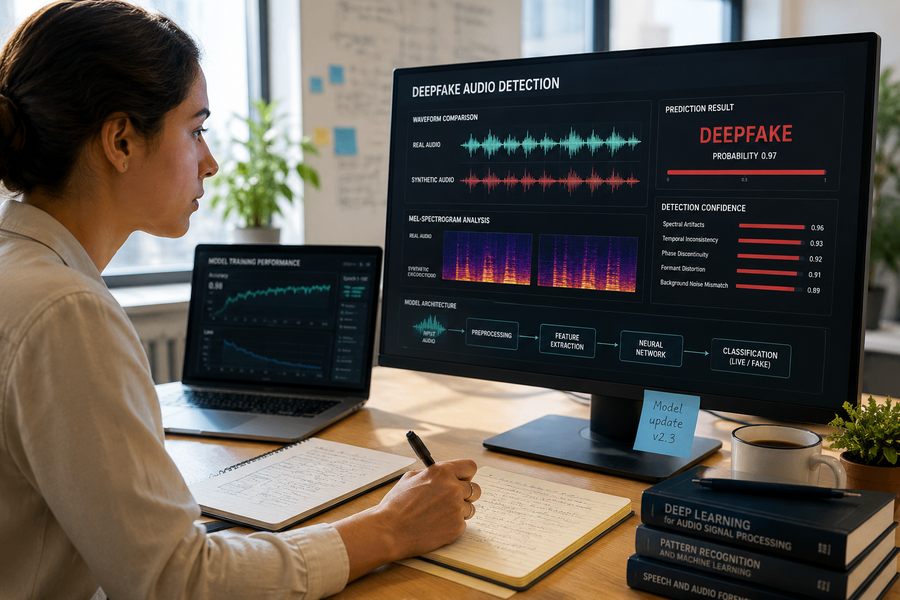
The pipeline from raw audio to detection verdict involves three conceptual stages. The first is preprocessing, in which the recording is normalized for volume, segmented into manageable units, and prepared for analysis. The second is feature extraction, in which the raw waveform is transformed into a representation that highlights the acoustic properties most useful for the classification task. The third is the neural network model itself, which takes the extracted features as input and produces the classification score. Each of these stages has been the subject of extensive research, and the choices made at each stage have substantial impact on detection performance. Modern systems increasingly combine multiple feature representations and ensemble several neural network architectures to maximize accuracy and robustness.
Traditional rule-based and signal-processing approaches to detecting synthetic audio have largely been abandoned in favor of deep learning. Earlier methods relied on hand-engineered tests for specific artifacts, such as discontinuities in pitch contours or implausible energy distributions, but these tests are easy for generation systems to circumvent once they become known. Neural networks, by contrast, learn discriminative features directly from data and can detect statistical patterns that human researchers might not anticipate. This adaptability has made deep learning the dominant paradigm in the field, and the remaining subsections describe how feature extraction, network architecture, and benchmark datasets each contribute to a working detection system.
Feature Extraction Approaches
The first technical decision in building a detection system is how to represent the audio signal itself. A raw audio waveform is a one-dimensional sequence of sample values, typically sixteen thousand or more samples per second of speech, and feeding this sequence directly into a neural network is computationally expensive and often inefficient because the relevant information for detection is distributed across patterns that are easier to expose with a more structured representation. Feature extraction is the process of transforming the raw waveform into such a representation, and the choice of feature has significant downstream consequences for detection accuracy.
Mel-frequency cepstral coefficients, commonly abbreviated as MFCCs, are among the oldest and most widely used features in speech analysis. They are derived by computing the short-time Fourier transform of the waveform, mapping the resulting frequency information onto a perceptually motivated mel scale that approximates how human hearing distributes sensitivity across frequencies, and then applying a discrete cosine transform to produce a compact set of coefficients per audio frame. MFCCs capture the spectral envelope of speech, which carries most of the information about phonetic content, and they have been used in deepfake detection systems for years. Linear-frequency cepstral coefficients, or LFCCs, follow a similar process but use a linear rather than perceptual frequency scale and have been shown to expose certain synthesis artifacts that MFCCs may miss.
Mel-spectrograms have become particularly popular for deep learning approaches because they can be processed by convolutional neural networks as if they were images. A mel-spectrogram is a two-dimensional grid in which one axis represents time, the other represents frequency on the mel scale, and the value at each cell encodes the energy at that time and frequency. This representation is dense, information-rich, and well suited to architectures originally developed for computer vision tasks. The constant-Q transform offers a related but distinct frequency analysis that uses logarithmically spaced filters and has been shown to be sensitive to certain types of voice conversion artifacts.
A growing number of state-of-the-art systems bypass handcrafted features entirely and operate directly on the raw waveform. End-to-end models such as the RawNet family use convolutional or residual layers to learn their own front-end representations from the audio signal, with the rationale that learned features can be optimized for the specific detection task rather than constrained by assumptions baked into traditional feature designs. The trade-off is that raw-waveform approaches require larger training datasets and more computational resources, and they are more vulnerable to overfitting on the specific synthesis methods present in the training data. Many recent systems combine multiple feature representations, using ensemble strategies that pool the strengths of handcrafted and learned features to produce more robust detection across diverse attack types.
Core Neural Network Architectures
The neural network architectures used for audio deepfake detection have evolved rapidly as the field has matured. Convolutional neural networks were among the first deep learning models applied to the problem and remain widely used. A CNN treats a spectrogram as a two-dimensional input and applies a hierarchy of learned filters that detect local patterns of increasing complexity, from edges and textures in early layers to combinations of features in deeper layers. Residual networks, or ResNets, extend the basic CNN with skip connections that allow gradients to flow more easily through very deep architectures, and ResNet variants with thirty-four or fifty layers have been standard in deepfake detection literature for several years.
Recurrent neural networks and their long short-term memory variants address the temporal nature of speech more directly than CNNs do. These models process audio frame by frame and maintain an internal state that captures dependencies across time, which is useful for detecting artifacts that manifest only at certain points in an utterance or that depend on the relationship between successive sounds. Hybrid architectures that combine convolutional front-ends with recurrent back-ends have been a recurring theme in the literature, attempting to capture both local spectral patterns and longer-range temporal structure.
More recent work has produced specialized architectures tailored to the deepfake detection task. A 2025 study by Shaaban and Yildirim, published in Engineering Reports, introduced a Siamese convolutional neural network architecture with a custom loss function and self-attention modules. The system was reported to achieve ninety-eight percent accuracy, an F1 score of ninety-six and a half percent, and an equal error rate of two point nine five percent on the ASVspoof 2019 logical access dataset, illustrating the level of performance that purpose-built architectures can reach on controlled benchmarks. Transformer-based models, which use attention mechanisms to weigh relationships across an entire input sequence rather than processing it sequentially, have also become prominent. Self-supervised learning approaches that build on pre-trained speech models such as Wav2Vec2 and WavLM have produced some of the strongest published results, leveraging the rich speech representations learned from massive unlabeled corpora to give downstream detection classifiers a substantial head start.
Training Datasets and Benchmark Challenges
The progress that detection research has made owes much to a series of competitive benchmark challenges that have provided standardized datasets, evaluation protocols, and metrics. The ASVspoof challenge series, organized by the international speech research community, has run periodically since 2015 and has become the de facto reference point for audio deepfake detection. Each edition has expanded the scope and difficulty of the task. The 2019 edition introduced separate logical access and physical access tracks, the 2021 edition added a dedicated deepfake detection task with adversarial conditions, and the ASVspoof 5 challenge in 2024 introduced a very large crowdsourced dataset of spoofed audio samples generated with diverse text-to-speech and voice conversion systems.
The 2024 ASVspoof 5 challenge produced several systems that defined the current state of the art. The AASIST3 architecture, developed by a team from Russian research institutes, enhanced the existing AASIST framework with Kolmogorov-Arnold networks, additional encoder layers, and pre-emphasis techniques, and reported a more than twofold improvement in performance over its predecessor. The system achieved a minimum detection cost function of zero point five three five seven in the closed condition, in which only the challenge training data could be used, and zero point one four one four in the open condition, in which external pre-trained models and additional data were permitted. These figures, while abstract to non-specialists, represent meaningful gains on a benchmark designed specifically to stress-test generalization.
Beyond ASVspoof, several other datasets and benchmarks have shaped the field. The In-the-Wild dataset captures synthetic audio in less controlled conditions than typical academic benchmarks, addressing the gap between laboratory performance and real-world deployment. The MLAAD dataset focuses on multilingual deepfake detection. The Audio Deep synthesis Detection challenge series, focused on Mandarin language speech, has explored attack types such as partial fakes in which only segments of an utterance are synthetic. The persistent theme across these benchmarks is that generalization to unseen attack types remains the central unsolved problem. A model trained on one set of synthesis methods may perform extremely well on test data drawn from the same methods and substantially worse on recordings generated by methods it has never seen before, and closing this gap is the focus of much current research.
The combination of effective feature extraction, expressive neural architectures, and rigorous benchmark evaluation has produced detection systems capable of operating in real deployments. The next section examines how these systems have moved from research papers into industry applications.
Real-World Applications and Industry Deployment
The translation of detection research into deployed products has accelerated as the threat landscape has intensified. Where academic benchmarks measure accuracy on curated test sets, real deployments must contend with messy production conditions including variable audio quality, network compression, channel mismatch between training and inference, adversarial behavior by attackers, and strict latency requirements that limit the size and complexity of the models that can be used in the loop. Vendors and security teams have responded by developing specialized products tailored to specific industries and use cases, each balancing detection accuracy against the operational realities of the environment in which the system runs.
The most mature segment of the market is voice-fraud detection for contact centers and financial services. In this setting, detection models are integrated into the audio processing pipeline of inbound calls, scoring each call in near real time for signs of synthesis and routing flagged interactions to human review or stepped-up verification. Adjacent markets include video conferencing security, where detection runs on the audio track of meetings to flag synthetic participants; content moderation for social media and broadcast platforms, where uploads or live streams are analyzed for synthetic audio; and forensic analysis for law enforcement and journalism, where suspect recordings are evaluated as part of investigation or fact-checking workflows. Each of these deployment contexts imposes different constraints on detection systems and has produced different technical and product designs.
A consistent pattern across deployments is the layering of detection with other security signals. Audio deepfake detection is rarely treated as the sole verification mechanism in a high-stakes workflow. Instead it is combined with caller authentication, device fingerprinting, behavioral analysis, anomaly detection on transaction patterns, and human review when scores cross intermediate thresholds. This defense-in-depth approach reflects the practical reality that no single model achieves perfect accuracy across all conditions, and that compounding multiple independent signals produces materially better outcomes than relying on any one signal alone. Adopters typically find that the operational maturity of a deployment matters at least as much as the underlying model accuracy, and that detection technology delivers its full value only when paired with thoughtful integration, ongoing measurement, and clear playbooks for handling flagged interactions.
Financial Services and Contact Center Defense
Banks, insurance companies, brokerage firms, and other financial institutions have been among the earliest adopters of audio deepfake detection at scale. The reason is straightforward: contact centers handle high volumes of voice interactions in which the financial stakes per call can be significant, and the asymmetric cost of a successful fraud relative to the cost of a false positive favors investment in detection. Pindrop, one of the most prominent vendors in this space, reported through its 2025 Voice Intelligence and Security Report that contact centers had collectively absorbed roughly twelve and a half billion dollars in fraud losses during 2024 across more than two and a half million reported fraud events, providing context for the substantial enterprise spending on voice security infrastructure.
Pindrop’s product portfolio illustrates how detection technology is packaged for enterprise use. The company combines acoustic fingerprinting, behavioral voice biometrics, device recognition, and synthetic voice detection into integrated authentication and fraud-detection offerings used in financial services, retail, and other industries. In November 2025 Pindrop announced the general availability of Pulse for Meetings, a product designed to bring deepfake detection to videoconferencing platforms including Zoom, Cisco Webex, and Microsoft Teams. According to Pindrop’s public statements, Pulse for Meetings detects synthetic audio with up to ninety-nine percent accuracy and a false positive rate of less than one percent, and the product was named to Time Magazine’s best inventions of 2025 list. Pindrop also reported in late 2025 that the system had outperformed competitors by forty percentage points in independent deepfake detection tests run by NPR and ranked as the top commercial solution in the ACM MM Deepfake Detection Challenge 2025 for video detection.
Enterprise adoption has been visible in partnership and distribution announcements alongside product releases. In late 2025 Pindrop announced a strategic partnership with BT Group through which BT will integrate Pindrop Protect and Pindrop Passport into its enterprise portfolio, making the technology available to BT’s business customers across the United Kingdom. The arrangement is intended to give contact centers an integrated authentication and synthetic voice detection layer without requiring them to build separate infrastructure. Outside the contact center market, Ant International disclosed in late 2025 that its systems were detecting roughly twenty thousand deepfake attack attempts per day globally, with attacks concentrated in the Asia-Pacific region, after recording the company’s first detected deepfake incident in January 2024.
Detection deployment in financial services has reached the point where it operates continuously at very large scale, screening millions of voice interactions per day across the global financial system. The combination of high-volume traffic, clear fraud loss metrics, and a relatively mature vendor landscape has made this segment the proving ground for the broader market.
Media Authentication, Journalism, and Government Use Cases
Beyond financial services, deepfake detection has been adopted across journalism, content moderation, and government applications, each driven by distinct concerns. News organizations have begun integrating detection tools into their verification workflows, particularly when handling audio submissions from anonymous sources or evaluating viral recordings of public figures. Social media platforms face pressure to moderate uploaded content that may include synthetic audio attached to misinformation campaigns. Government agencies use detection in counterintelligence, election security, and law enforcement investigations where the authenticity of a recording can be material to legal or operational outcomes.
A widely cited enterprise incident accelerated the broader market for detection across these adjacent sectors. In February 2024, a finance worker at the global engineering firm Arup authorized fifteen transactions totaling approximately twenty-five million dollars after participating in what appeared to be a routine multi-person video conference with the company’s chief financial officer and other senior executives. Reporting later confirmed that every executive on the call had been deepfaked, with synthetic audio matched to AI-generated video likenesses, and that the finance worker had been deceived by the apparent authenticity of the meeting. The Arup case became the most visible example of how synthetic audio could be combined with other deception techniques to bypass standard verification practices, and it prompted security teams across many sectors to reevaluate their controls.
Government responses to the threat have moved in parallel. The Federal Bureau of Investigation issued a public service announcement in April 2025 warning that attackers were using AI-generated voice messages and text-message pretexting to impersonate senior United States officials in a campaign targeting both officials and their contacts. The announcement underscored that voice cloning had moved from corporate fraud into the realm of national security concerns. On the regulatory side, the European Union’s AI Act entered force in August 2024 and includes transparency obligations and technical marking requirements for AI-generated content, and the United States enacted the TAKE IT DOWN Act in 2025 requiring platforms to remove explicit non-consensual deepfake content within forty-eight hours of notification. While neither law focuses exclusively on audio detection, both shape the compliance environment in which detection vendors and their customers operate.
Detection systems intended for journalism, content moderation, and government use cases tend to differ from financial-services products in their tolerance for latency and their need for interpretability. A news organization investigating a contested audio clip can afford to run a slower, more thorough analysis and benefits from output that explains why a recording was flagged, whereas a contact center needs sub-second decisions. Vendors including Pindrop, Reality Defender, Sensity AI, and McAfee have positioned different products against these distinct requirements, and the broader market has developed enough diversity that organizations can choose tools suited to their specific operational profile. The deployment ecosystem now spans cloud APIs, on-premise appliances, desktop applications, and embedded mobile detection, providing coverage across most of the contexts in which audio authenticity matters.
The combined picture across financial services, media, and government deployment is one of a maturing market in which detection technology has moved decisively out of the laboratory. The remaining question is how the benefits and limitations of this technology are distributed across the stakeholders who depend on it.
Benefits and Challenges by Stakeholder
The arrival of effective audio deepfake detection produces different consequences for different groups. A bank operations team and an elderly consumer face different threats, work with different resources, and stand to gain or lose different amounts from detection technology. A regulator and a platform executive interpret detection accuracy through different lenses. Researchers and product engineers contend with different versions of the same technical problem depending on whether they are pursuing benchmark records or operational reliability. Any honest assessment of detection technology has to account for the fact that the benefits and challenges are distributed unevenly and that a single summary cannot capture the full picture.
The benefits side of the ledger is real and substantial. Detection systems have prevented documented losses in financial fraud, enabled new categories of content authentication, given investigators and journalists a tool they did not previously possess, and shifted the cost-benefit calculation for attackers by raising the probability that a synthetic recording will be flagged. At the same time, detection is a moving target. Generation methods improve continuously, and detection systems can degrade quickly when faced with audio produced by methods that did not exist when they were trained. The technology is necessary but not sufficient, and treating it as a comprehensive solution risks producing a false sense of security that may itself become a vulnerability.
The challenges side of the ledger spans technical, operational, and ethical dimensions. Some challenges are inherent to the binary classification framing of the problem and the open-ended adversarial environment. Others are specific to the contexts in which detection is deployed. Still others concern the broader implications of building voice biometric infrastructure at scale and the disparate effects that detection accuracy can have on different demographic groups. Examining benefits and challenges by stakeholder category gives a more complete view than a flat summary would, and the two subsections that follow take each side in turn.
Stakeholder Benefits: Enterprises, Consumers, and Platforms
For enterprises, the most direct benefit of detection is the reduction of fraud loss exposure. Financial services firms that integrate voice deepfake detection into their contact center operations and authentication flows reduce the probability that wire fraud, account takeover, and impersonation-driven social engineering attacks will succeed against their customers and employees. The economic case for adoption is straightforward when the loss avoided per blocked attack is compared with the per-call cost of detection. Beyond fraud prevention, enterprises gain regulatory compliance support, as supervisory bodies in finance and other sectors increasingly expect documented controls against deepfake risk, and they benefit from reduced operational complexity when detection is integrated with existing security infrastructure rather than bolted on as a separate system.
Consumers benefit primarily through the indirect effects of enterprise adoption. When their bank, their employer, and the platforms they use deploy effective detection, consumers are less likely to be successfully impersonated and less likely to be victimized by impersonations of others. Detection technology has particular value for vulnerable populations, including elderly consumers who have been disproportionately targeted by grandparent scams that use cloned voices of family members in distress. In Suffolk County, New York, public reports during 2025 documented seniors losing thousands of dollars to AI voice scams that exploited cloned voices of grandchildren, and detection capability deployed by carriers, banks, and even consumer-facing applications can intercept some of these calls before they reach the intended target. Consumer-facing detection apps, including locally-running tools that analyze audio without uploading it to the cloud, give individuals direct access to detection capability for the first time.
Platforms and publishers benefit from the ability to verify the authenticity of audio content before distribution, reducing reputational and liability exposure tied to viral misinformation. Newsrooms can validate audio submissions before broadcast. Social platforms can flag or remove uploads that contain synthetic audio attached to misleading framing. Streaming services and podcasters can verify that contributor content is what it purports to be. Law enforcement agencies gain a forensic tool for evaluating recordings introduced as evidence and for investigating impersonation-driven crimes. Across each of these groups the common pattern is that detection extends the practical reach of existing authenticity practices rather than replacing them, and the gains are largest where detection is layered onto thoughtful operational workflows.
Technical, Ethical, and Operational Challenges
Technical challenges remain at the center of the field. Generalization to unseen synthesis methods is the most stubborn problem. A detection model trained on a particular generation of text-to-speech systems often performs substantially worse on audio produced by methods released after the training data was collected, and the rapid pace of generation research means that new methods are released continuously. Adversarial attacks, in which generation pipelines are deliberately modified to evade specific detectors, compound the problem. Detection systems also degrade under common audio processing conditions including codec compression, telephone-channel bandwidth limits, background noise, and reverberation, and maintaining accuracy across these conditions requires careful training-data design and ongoing model maintenance. Latency constraints in real-time applications limit the size and complexity of models that can be deployed in production, often forcing trade-offs between accuracy and responsiveness.
Operational challenges arise when detection technology is dropped into real workflows. False positives that block legitimate customer calls produce customer-experience harm and operational cost, and tuning detection thresholds to balance false positives against false negatives requires ongoing measurement and adjustment. Integration with existing security infrastructure can be technically demanding, particularly in heterogeneous contact center environments with multiple vendors and channels. The arms race dynamic, in which generation methods improve faster than detection methods, means that detection accuracy can degrade over time without active investment in retraining and model updates. Organizations that adopt detection often discover that effective deployment requires significant ongoing engineering attention rather than a one-time installation.
Ethical concerns add another dimension to the challenge picture. Voice biometric infrastructure built for detection purposes can also enable surveillance and tracking, and the data protection implications of large-scale voice analysis are not yet fully resolved in many jurisdictions. Detection accuracy can vary across demographic groups, with some studies finding lower performance on speech from non-native speakers, certain accents, and underrepresented dialects, raising fairness concerns about who is and is not adequately protected. Over-reliance on imperfect detection can produce a false sense of security and may even create new attack surfaces, as adversaries learn which detection tools an organization uses and tailor their attacks accordingly. Honest acknowledgement of these limitations is essential to deploying detection responsibly, and the most mature deployments treat detection as one component in a broader trust architecture rather than as a definitive answer.
Taken together, the benefits and challenges of audio deepfake detection sketch a technology that is genuinely useful, materially improving, and far from a panacea. The right framing is not whether detection works but where, for whom, and at what cost.
Final Thoughts
The arrival of practical neural network detection for synthetic audio represents one of the more consequential security developments of the current decade, not because the technology itself is revolutionary in isolation but because of what it preserves. Voice has been a fundamental medium of human trust for as long as humans have communicated, and the prospect of that medium becoming systematically unreliable would carry consequences far beyond the immediate fraud losses that dominate current statistics. Detection technology is the principal mechanism by which the integrity of voice communication is being defended against an attack surface that has expanded faster than almost any other in recent memory, and the work of building, deploying, and improving these systems amounts to an ongoing infrastructural commitment to maintain a category of trust that society has historically taken for granted.
The social responsibility dimensions of this work are substantial. Voice-based fraud disproportionately harms older adults, immigrants navigating unfamiliar institutions, and people whose digital literacy has not kept pace with the rapid commodification of synthesis tools. Effective detection deployed across consumer-facing channels can intercept attacks that would otherwise reach the most vulnerable users, and the choices made by carriers, banks, and platforms about how broadly to deploy detection have direct implications for financial inclusion. The same is true for journalism and democratic discourse. Synthetic audio attached to political messaging has already entered the playbook of bad actors, and the capacity of news organizations and election authorities to verify the authenticity of recordings determines whether public confidence in shared information can be sustained. The technology becomes a question of social infrastructure as much as commercial security.
The intersection of technology and social responsibility is also where the limits of detection become most visible. Algorithmic systems are not neutral. Detection accuracy can vary across demographic groups, and the decision of which contexts to deploy detection in carries distributive consequences. Vendors and adopters who treat detection as a purely technical procurement decision risk replicating inequities seen in other domains, while those who treat detection as a social technology, attentive to who is protected and who is left out, tend to make more defensible design and deployment choices.
The trajectory ahead is shaped by an open-ended adversarial dynamic. Generation methods will continue to improve and detection methods will continue to adapt, with neither side reaching a permanent advantage. Watermarking, provenance standards, and cryptographic content authentication are emerging as complementary defenses that may carry some of the load that detection alone has been asked to bear, and regulation is catching up unevenly across jurisdictions. None of these developments eliminates the need for neural network detection, but they reshape the landscape in which detection operates and clarify that no single layer of defense will be sufficient on its own. The broader picture is one of cautious confidence: the threat is real and growing, the technical response has matured to a point where detection is genuinely useful, and deployment across financial services, media, and government has reached enough scale to register meaningful effects on outcomes. The work of building neural networks that can hear what humans cannot, and integrating those networks into the systems that govern voice communication, is part of how that bound is established and defended.
FAQs
- What exactly is an audio deepfake?
An audio deepfake is a recording of speech that has been generated or substantially altered by artificial intelligence to mimic a specific person or to create the impression of a fabricated speaker. The term covers voice cloning, voice conversion, and synthetic text-to-speech, all of which can produce audio that sounds convincingly human and convincingly tied to a particular identity. Audio deepfakes are used in fraud, misinformation, harassment, and impersonation, and they have become a primary concern for security teams across finance, media, and government. - How do neural networks detect deepfake audio in plain terms?
A neural network is trained on thousands of examples of real and synthetic speech and learns the subtle technical signatures that distinguish them. When given a new recording, the network analyzes acoustic features such as the energy distribution across frequencies, the timing patterns of speech, and the relationships between harmonics, and it produces a score indicating how likely the recording is to be synthetic. The signatures the network identifies are often imperceptible to human listeners but reliably present in machine-generated audio, at least until generation methods evolve enough to mask them. - How much audio is needed to clone someone’s voice?
Modern voice cloning systems can produce convincing impersonations from as little as three to five seconds of source audio, with quality improving as the available sample grows. The source material can be drawn from social media posts, podcast appearances, voicemail recordings, conference talks, or any other public speech. The collapse of the data requirement is one of the main reasons audio deepfakes have moved from a research curiosity to a mainstream fraud vector. - Can consumers use detection tools themselves?
Yes, although the consumer-facing market is less developed than the enterprise market. Some vendors offer desktop or mobile applications that analyze audio locally on the user’s device, and certain phone carriers and banks have begun deploying detection on the backend so that consumers benefit without taking any action. For most consumers the best protection still comes from procedural habits, such as verifying urgent voice requests through a separate channel, but accessible detection tools are increasingly part of the picture. - What detection accuracy is realistic in practice?
Leading commercial systems report accuracy figures above ninety-five percent and in some cases approaching ninety-nine percent on their internal benchmarks and selected public datasets. Real-world performance depends heavily on the match between training data and deployment conditions, and accuracy can be substantially lower when a detector encounters synthesis methods, languages, or audio quality conditions that were not represented in training. Vendors typically publish ranges rather than single figures for this reason. - Why do detectors sometimes fail on new synthesis methods?
Detection systems learn statistical patterns from the training data they have been given. When a new generation method produces audio with a different statistical signature, a detector trained on older methods may miss the artifacts that previously gave away synthetic content. This is the fundamental challenge of generalization, and it is why detection vendors invest heavily in continuous retraining and in techniques designed to make detectors more robust to unseen attack types. - How can I protect myself or my organization from voice clone scams?
The most effective defenses are procedural rather than technical. For consumers, agreeing on a family pass-phrase, hanging up and calling the person back on a known number, and refusing to act on urgent voice requests without independent verification are the highest-value habits. For organizations, multi-person authorization for financial transactions, out-of-band verification for unusual requests, and ongoing employee training about voice clone risks are widely recommended. Detection technology supplements these practices but does not replace them. - What role does regulation play in addressing audio deepfakes?
Regulation is developing unevenly across jurisdictions. The European Union’s AI Act, in force since August 2024, includes transparency requirements for AI-generated content. The United States Federal Communications Commission has banned AI-generated voices in robocalls, and the TAKE IT DOWN Act enacted in 2025 requires platforms to remove certain non-consensual deepfake content within forty-eight hours. Federal legislation specifically targeting commercial deepfake fraud is still developing, while state-level approaches vary widely. The regulatory environment shapes liability and disclosure expectations but does not by itself prevent the underlying attacks. - How should organizations integrate detection into their security stack?
Effective deployment treats audio deepfake detection as one layer in a defense-in-depth architecture rather than a standalone solution. Detection is most commonly combined with caller authentication, device fingerprinting, behavioral biometrics, anomaly detection on transaction patterns, and human review when intermediate scores warrant it. Successful integrations also include clear playbooks for handling flagged interactions, ongoing measurement of false positive and false negative rates, and a process for retraining or replacing models as generation methods evolve. - What might the future of audio authentication look like?
The likely direction combines neural network detection with complementary approaches including cryptographic content provenance standards such as C2PA, watermarking technologies that embed identifiers into legitimate recordings at the source, and authentication infrastructure that ties voice content to verifiable identity claims. None of these layers will be sufficient on its own, and the resulting architecture will resemble the layered defenses already familiar from email and web security. The trajectory points toward audio communication being explicitly authenticated by default in high-stakes contexts rather than implicitly trusted as it has been historically.