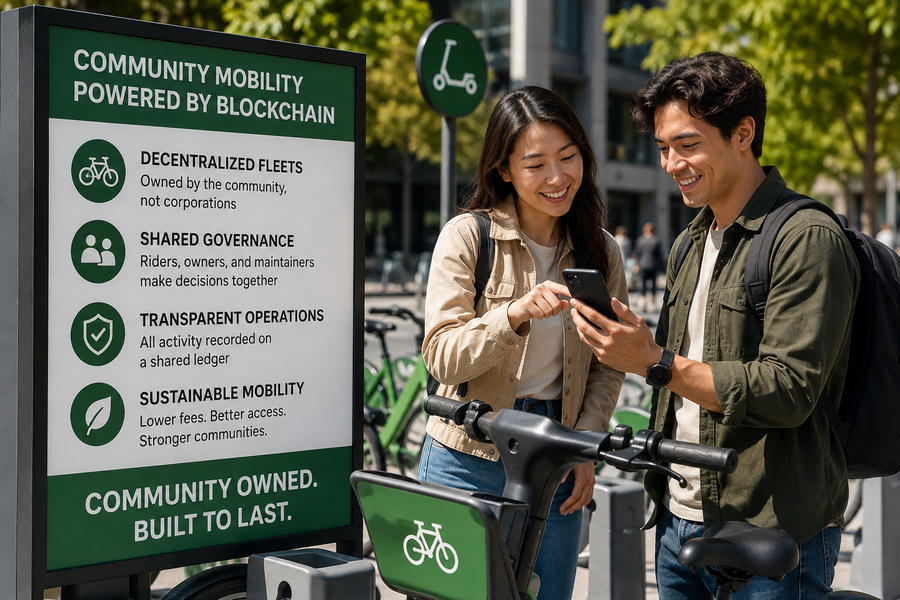
For most of the past decade, sharing a bike or scooter in a city has meant opening an app owned by a single, venture-funded company. That company bought the fleet, hired or contracted the people who charge and rebalance it, set the prices, and absorbed the losses when scooters were stolen, vandalized, or simply wore out faster than the business model assumed they would. The industry’s history is littered with the results: operators that raised hundreds of millions of dollars, expanded into dozens of cities at once, and then collapsed, sold off assets, or quietly withdrew from unprofitable markets once outside capital stopped flowing. The pattern repeated often enough that “scooter company shuts down” became its own minor genre of tech news, and city transportation departments grew used to permits changing hands or lapsing entirely within a year or two of being issued.
That instability was not an accident of bad management. It was baked into the economics. A single company had to own the hardware, run the software, manage the labor, and carry all of the risk, while competing on price against other companies doing the same thing in the same streets. Every scooter that got thrown in a river or cannibalized for parts was a loss the operator alone absorbed. Every city that raised permit fees or capped fleet sizes squeezed a margin that was already thin. When investors stopped subsidizing rides below their true cost, prices rose, ridership dropped, and the weakest operators failed first.
Blockchain-based coordination proposes a different structure for the same basic service. Instead of one company owning every vehicle and directing every worker, a shared ledger becomes the coordination layer: it records who owns which vehicle, who rode it and paid for the ride, who serviced it and when, and how the resulting revenue and token rewards get distributed among everyone who contributed. Individual owners can add a bike or scooter to a network the way a homeowner adds a solar panel to a grid. Independent mechanics and rebalancers can pick up maintenance tasks the way gig workers already do, but get paid automatically through a smart contract rather than waiting on a corporate payroll system. Riders interact with an app much like today’s, except the app is a client for a decentralized network rather than the entire business.
This is not a hypothetical exercise in blockchain enthusiasm. It draws directly on a category of real, currently operating projects known as Decentralized Physical Infrastructure Networks, or DePIN, which use token incentives and shared ledgers to coordinate physical hardware — vehicles, mapping cameras, wireless hotspots — contributed by thousands of independent participants rather than a single corporate balance sheet. Networks like DIMO, Hivemapper, and Helium have already demonstrated, with verifiable on-chain data, that this coordination model can attract real hardware deployment and sustain real usage at meaningful scale. None of them is a bike-share company, but each of them solves a version of the same problem that bike and scooter networks face: how do you get many independent owners of physical assets to cooperate, get paid fairly, and keep the network running without a single company footing the entire bill.
The scale of the instability is worth sitting with for a moment. Micromobility operators have collectively raised and spent billions of dollars in venture funding since the category emerged, deploying fleets across hundreds of cities on multiple continents, only to retreat from a large share of those markets once subsidized pricing gave way to fares that reflected the true cost of buying, charging, and repairing hardware at scale. Riders who grew used to a service being available in their neighborhood one summer often found it gone the next, not because demand disappeared, but because the company operating it had to choose between that market and a shrinking list of markets it could still afford to serve. Cities that built bike lanes and dedicated parking corrals around the assumption of a stable local operator had to adjust to permits changing hands, service areas shrinking, or fleets vanishing overnight when a company wound down operations.
The question this instability raises is not whether shared micromobility is worth having; ridership figures across most large cities suggest it plainly is. The question is whether the ownership and coordination structure underneath the service has to look the way it currently does, with one company’s fundraising calendar effectively determining whether a whole city’s fleet exists from one quarter to the next. That is a structural question, not merely a management one, and it is the reason a fundamentally different coordination mechanism is worth examining on its own terms rather than as a minor variation on the existing model.
The rest of this article works through what that coordination model actually looks like for micromobility specifically. It explains how today’s centralized operators function and why their economics are so fragile, breaks down the mechanics of ledger-based coordination among riders, owners, and maintainers, and examines the documented DePIN case studies that show these mechanics working in adjacent domains. It then weighs whether community-owned, token-coordinated mobility networks are genuinely positioned to outlast venture-funded incumbents, and what would have to go right — technically, economically, and legally — for that to happen in practice.
How Micromobility Fleets Are Coordinated Today
The dominant model for bike and scooter sharing since the category’s rapid growth phase has been vertically integrated and centrally financed. A single operator purchases or leases its entire fleet, contracts with a manufacturer for hardware, builds and maintains the rider-facing app, and either hires staff or contracts gig workers to charge, repair, and redistribute vehicles across a city each night. The operator sets prices, negotiates permits directly with municipal transportation departments, and carries all of the capital risk on its own balance sheet. Growth has historically been funded by venture capital rather than by ride revenue, meaning the company’s survival depends as much on continued investor confidence as on unit economics actually working out on any given street corner.
This structure creates a specific and recurring failure pattern. Because a scooter typically has a usable lifespan measured in months rather than years under heavy shared use, and because theft and vandalism losses are common in dense urban deployment, the replacement cost of a fleet is a continuous, large expense that must be covered before a company reaches profitability on operations alone. Early operators addressed this by raising large funding rounds and expanding aggressively into new cities, on the theory that scale would eventually produce network effects and pricing power. In practice, expansion frequently outpaced the unit economics, and when capital markets tightened, several major operators restructured, merged, exited markets outright, or shut down entirely. Cities were left managing the fallout: abandoned vehicles, unpaid permit obligations, and gaps in service that undermined the case for micromobility as reliable transportation infrastructure rather than a subsidized novelty.
The labor side of this model has its own tension. Rebalancing and charging work is frequently structured as gig contracting, paid per vehicle serviced rather than by the hour, with the operator setting the rate unilaterally and adjusting it based on its own margin pressure rather than any negotiation with the workers doing the physical labor. Maintenance quality varies accordingly: a worker paid a flat rate per scooter charged has little incentive to perform anything beyond the minimum inspection needed to get paid, and the operator’s central dispatch system has limited visibility into which vehicles genuinely need mechanical attention versus which ones simply need a battery swap.
City regulators, meanwhile, have had to develop trust in operators whose long-term presence is uncertain. Permit structures, data-sharing requirements, and fleet caps have all evolved partly in response to operators disappearing mid-contract or failing to honor commitments made during more optimistic funding periods. The result is a regulatory relationship built on skepticism as much as partnership, with cities requiring performance bonds, data escrow, and other protections precisely because the underlying operator has proven, repeatedly, to be a fragile counterparty.
The capital cycle behind this instability follows a fairly predictable arc. An operator raises a large round, uses it to buy or lease thousands of vehicles and enter as many cities as possible before a competitor can claim the same permits, and prices rides below the level that would actually cover hardware depreciation, labor, and city fees, betting that scale and eventual pricing power will close the gap. When a follow-on funding round arrives on schedule, the cycle continues. When it does not, the company has no fallback: it cannot simply pause hardware purchases and wait, because the fleet it already deployed keeps depreciating and requiring maintenance regardless of whether new capital is coming in. The result is a business that looks like it is growing right up until the moment it is forced to contract sharply or exit altogether, with little room for the kind of gradual, self-funded scaling that steadier industries rely on.
The gig labor underpinning day-to-day operations reflects the same short-term logic. Rebalancers and chargers are typically paid a flat rate per vehicle collected, charged, and redeployed, a structure that rewards speed and volume over careful inspection. A worker moving quickly through a nightly route to maximize earnings has little incentive to notice a hairline crack in a frame or a battery cell degrading faster than normal, because the pay structure does not distinguish between a five-second visual check and a thorough inspection. Centralized operators have periodically tried to address this with bonus structures or spot audits, but those fixes are themselves discretionary, set and adjusted by the company rather than negotiated with the workers actually performing the labor.
None of this means centralized operators lack advantages. A single company can move fast, standardize its hardware and software tightly, and make unilateral decisions about pricing and service areas without needing to coordinate a diffuse set of independent owners. But the fragility of the model — one balance sheet absorbing all the capital risk, and one company’s survival determining whether a city’s entire micromobility service continues to exist — is precisely the vulnerability that a differently coordinated network is designed to address.
What Blockchain-Based Coordination Means for Shared Fleets
Applying blockchain to a bike or scooter network does not mean simply recording ride receipts on a distributed database instead of a corporate one; that alone would add complexity without changing the underlying economics or the single-point-of-failure risk. The meaningful shift is structural: replacing a corporate owner-operator with a shared ledger that multiple independent parties can read, verify, and transact against directly, combined with a token or smart-contract system that automatically routes payment to whoever contributes vehicles, rides, or maintenance work. This is the core idea behind Decentralized Physical Infrastructure Networks, an approach that has already been tested — with real, measurable results — in wireless connectivity, mapping, and connected-vehicle data before being considered for shared mobility specifically.
In a DePIN-coordinated fleet, no single company needs to own every vehicle. An individual can purchase a bike or scooter, register its hardware identity to the network, and make it available for rides, earning a share of usage revenue or network tokens whenever someone rides it. A smart contract, rather than a company’s internal ledger, handles the accounting: it records that a ride happened, calculates what the rider owes and what the owner and any maintainer are due, and executes the payment without a back-office team reconciling invoices. This changes who bears financial risk. Instead of one operator absorbing every stolen or destroyed vehicle as a loss against its own capital, that risk is distributed across many independent owners, each of whom decided individually whether contributing a vehicle to the network was worth the potential return.
This structure also changes how disputes and errors get resolved. In a centralized network, a rider who is overcharged or an owner who believes a payout was calculated incorrectly has to contact a customer service team and trust the company’s internal records, which are not visible to anyone outside the company. In a ledger-coordinated network, the record of what happened — the ride’s start and end time, the fare charged, the split applied — is visible on the shared ledger itself, so a dispute is a matter of checking a public record rather than trusting one party’s private account of events. This does not eliminate disagreements, but it changes their character, from disputes over what happened to disputes over whether the rule that produced that outcome was fair in the first place, which is a question a network’s governance process, rather than a customer service representative, is meant to resolve.
The practical advantage over a purely centralized model is capital efficiency. A blockchain-coordinated network does not need to raise a venture round to buy ten thousand scooters before it can launch service in a city; it needs enough independent owners willing to contribute hardware in exchange for a share of the network’s ongoing revenue and token rewards. That is a fundamentally different growth mechanism than the subsidized-expansion model that has repeatedly failed centralized operators, because the network’s growth is now tied to how many independent participants find the economics attractive, rather than to how much outside capital a single company can continue to raise.
Shared Ledgers, Token Incentives, and Proof of Physical Work
The mechanism that makes this coordination trustworthy without a central authority is often called “proof of physical work”: a way of verifying, cryptographically or through corroborated sensor data, that a real-world contribution actually happened before rewarding it. In wireless DePIN networks, this takes the form of proof of coverage, where a hotspot must demonstrate it is genuinely providing connectivity in a specific location before it earns tokens. In a mapping network, it takes the form of verified camera footage tied to GPS data, confirming that a contributor actually drove the road segment being mapped. Applied to a bike or scooter network, proof of physical work would mean a vehicle’s onboard sensors — GPS, accelerometer, battery telemetry — feeding verifiable ride data to the ledger, so that payment is tied to rides that demonstrably occurred rather than to claims an operator or owner could otherwise fabricate.
Token incentives layer on top of this verification system to solve the cold-start problem every physical network faces: how do you get enough hardware deployed before there are enough users to make deploying hardware worthwhile on ride revenue alone. Early contributors — the first owners to add vehicles to a still-small network — are typically rewarded more heavily in network tokens than later contributors, compensating them for taking on the network’s early-stage risk. As the network matures and ride volume grows, revenue from actual usage is intended to become a larger share of what owners and maintainers earn, with token issuance tapering. This is precisely the mechanism that wireless and mapping DePIN networks have used to bootstrap large, geographically distributed hardware deployments without any single company purchasing and installing the hardware itself, and it is the same mechanism a bike or scooter network would need to attract independent owners without venture capital buying the entire fleet up front.
None of this verification is automatic in the sense of being free from engineering challenges. A blockchain can only be as trustworthy as the data fed into it, a limitation generally described as the oracle problem: the ledger itself cannot independently confirm that a GPS reading or a battery sensor value is genuine rather than spoofed by hardware tampered with to earn undeserved rewards. DePIN networks address this primarily through redundancy and cross-verification, comparing a given device’s reported data against nearby devices, historical patterns, or independent witnesses, and penalizing devices whose data looks statistically inconsistent with what a genuine deployment would produce. A mobility network adopting the same approach would need multiple independent signals — GPS, motion sensors, and possibly nearby vehicles or riders acting as witnesses — before treating a ride or repair as verified enough to trigger payment, since a single spoofable sensor would otherwise become the network’s weakest point.
Staking adds a further layer of accountability. In several existing DePIN designs, participants who want to run infrastructure or perform verification tasks must lock up a quantity of the network’s token as collateral, which can be forfeited if they submit fraudulent data or otherwise act against the network’s rules. Applied to a maintenance role in a mobility network, a similar mechanism could require a maintainer to stake tokens against the quality of their repair work, with the stake at risk if a vehicle they serviced is later reported as unsafe or unreliable, creating a financial incentive for quality that a flat per-vehicle gig rate does not provide.
Aligning Riders, Owners, and Maintainers On-Chain
A shared mobility network is inherently a three-sided marketplace, and any coordination system, blockchain-based or otherwise, has to solve for all three sides at once. Riders want vehicles that are available, charged, and safe, at a price they consider reasonable. Owners — whether that means individuals who purchased a single scooter or small businesses that operate a modest local fleet — want a return on their hardware investment that justifies the upfront cost and ongoing risk of damage or theft. Maintainers, the people who actually charge batteries, replace parts, and pull unsafe vehicles from service, want to be compensated fairly for labor that is often physically demanding and time-sensitive. A centralized operator resolves the tension among these three groups unilaterally, by setting rider prices, owner payouts, and maintainer wages according to its own internal profit targets. A ledger-coordinated network instead has to encode the rules for splitting revenue and rewards among all three groups directly into a transparent smart contract that every participant can inspect before choosing to join.
Encoding those rules is not a one-time task, either, because the right split among riders, owners, and maintainers is unlikely to stay fixed as a network grows. A network launching in a new city may need to offer owners a larger share of revenue, or heavier token incentives, to attract enough vehicles to make the service usable at all, then gradually shift that balance as ride volume rises and the network can sustain itself on usage revenue alone. Making that kind of adjustment in a centralized company is a matter of an internal decision, announced to contractors and never truly negotiated. Making it in a ledger-coordinated network generally requires some form of on-chain governance, where holders of the network’s token propose and vote on changes to the smart contract’s parameters, a process that is slower and more contentious than a unilateral corporate decision but that gives every stakeholder, not just company management, a documented say in how the network’s economics evolve.
This transparency is itself a meaningful shift from the status quo. Today, a rebalancer or mechanic working for a scooter operator typically has no visibility into what portion of a rider’s fare their payment represents, and an individual has no path at all to owning a share of the fleet itself. A smart-contract-based split, by contrast, is auditable by anyone: the rules for how a ten-minute ride’s payment is divided among the rider’s fee, the vehicle owner’s share, the maintainer’s share, and any network-level fee are fixed in code rather than set at a company’s discretion and subject to change without notice.
How Riders and Owners Participate and Earn
For a rider, the experience of unlocking and paying for a vehicle in a blockchain-coordinated network can look almost identical to using a conventional scooter app: scan a code, start a ride, pay a fare, end the ride. The difference is invisible to the rider but structurally significant — that fare is settled through a smart contract that immediately allocates portions of it to the vehicle’s owner and to whichever maintainer most recently serviced it, rather than being pooled into a single company’s revenue before eventual, discretionary payouts to contractors. Some networks built on this model also allow riders themselves to earn network tokens for actions that benefit the system, such as reporting a vehicle’s location, flagging a mechanical issue, or parking responsibly at a designated hub, turning riders into a lightweight second layer of the network’s data and maintenance infrastructure.
For an owner, participation starts with acquiring a compatible vehicle, which may come from a manufacturer partnered with the network or be independently outfitted with the sensor hardware the network requires for ride verification. Once registered, the owner earns a share of every ride’s revenue, plus, particularly in a network’s earlier growth phase, token rewards for simply keeping the vehicle available and in good working order. This creates an ownership model closer to that of a landlord renting out a single property than a corporate fleet manager: the capital outlay is smaller and more granular, spread across many independent owners rather than concentrated on one company’s balance sheet, and the risk of any single vehicle being stolen or destroyed is isolated to that vehicle’s owner rather than threatening the network’s overall solvency.
How Maintenance and Fleet Health Get Coordinated
Vehicle maintenance is where the coordination problem gets hardest, because unlike a ride, a repair is difficult to verify automatically. A decentralized network addresses part of this through the same onboard sensors used for ride verification: battery health data, unusual accelerometer readings suggesting a crash or mechanical fault, and GPS data showing a vehicle has stopped moving in an unexpected location can all be used to automatically flag a vehicle as needing attention and surface that task to nearby maintainers, in much the same way today’s centralized operators dispatch rebalancers, except the task and its associated payment are visible on a shared ledger rather than assigned through a proprietary internal system.
The dispatch logic itself can also be made more responsive than a centralized operator’s nightly routing schedule typically allows. Because sensor data streams continuously to the shared ledger rather than being batched and reviewed periodically by a central team, a vehicle showing early signs of battery degradation or an unusual fault pattern can be flagged for attention within minutes rather than waiting for the next scheduled rebalancing pass, and the task can be routed automatically to whichever registered maintainer is geographically closest and has the strongest completion record, rather than being assigned by a dispatcher working from an incomplete picture of where every vehicle actually stands.
Verifying that a maintenance task was actually completed, and completed well, is harder to automate than verifying a ride, since a maintainer could in principle mark a task complete without doing adequate work. Networks addressing this problem generally combine two mechanisms: a staking requirement, where the maintainer puts network tokens at risk that can be forfeited if a serviced vehicle is later found unsafe, and a reputation system, where a maintainer’s history of completed tasks and any subsequent rider complaints are recorded on the ledger and factored into how much future work, and at what pay rate, they are offered. Together, these create a financial incentive for quality service that does not depend on a central company’s supervisory staff physically inspecting every repair.
Ownership in this model can also be more granular than owning a single complete vehicle. Some DePIN-inspired designs allow fractional participation, where several individuals pool capital to co-own a small cluster of vehicles and split the resulting returns proportionally, lowering the entry barrier for someone who wants exposure to the network’s economics without covering the full cost of a scooter and its sensor hardware alone. This mirrors how some renewable-energy DePIN projects allow fractional ownership of a single solar installation or charging station, spreading both the cost and the return across a group rather than requiring one person to buy the entire asset outright.
Across both riders and owners, and the maintainers who keep the fleet running, the pattern that emerges is one of distributed accountability rather than centralized control. No single actor unilaterally sets prices, wages, or ownership terms; instead, those terms are fixed transparently in the network’s smart contracts and adjusted, when they need to change, through some form of governance that the network’s participants themselves have a stake in, rather than through a company’s internal decision-making process.
Real-World DePIN Case Studies Relevant to Micromobility Coordination
No blockchain-coordinated bike or scooter network has yet reached the scale or maturity of the DePIN projects operating in adjacent physical-infrastructure categories, which makes those adjacent projects the most useful evidence available for whether this coordination model actually works outside of a whitepaper. Three networks in particular — DIMO, Hivemapper, and Helium — have published verifiable, dated metrics on hardware deployment, token payouts, and usage that demonstrate token-incentivized, ledger-coordinated physical networks can attract real participants and sustain real activity. None of them is a bike-share network. DIMO coordinates data from personal vehicles rather than shared ones; Hivemapper coordinates mapping cameras; Helium coordinates wireless hotspots. But each solves the same underlying coordination problem a decentralized micromobility network would face: getting many independent hardware owners to contribute physical infrastructure, verifying their contributions are genuine, and paying them fairly and automatically through a shared ledger rather than a central company.
DIMO and Hivemapper: Decentralized Vehicle and Mapping Data
DIMO is a DePIN network that connects personal vehicles to a shared, blockchain-based data layer, allowing drivers to earn rewards for sharing telemetry such as location, diagnostics, and driving data, which insurers, ride-sharing platforms, and smart-city initiatives can then access. According to reporting compiled in 2025, the number of vehicles connected to DIMO’s network grew by more than 350 percent since 2023, surpassing 425,000 connected vehicles, with DIMO-compatible devices having been deployed in more than 1.5 million vehicles worldwide overall. The network also migrated its transaction infrastructure to a lower-cost layer-two blockchain, which reduced transaction costs by roughly 94 percent, a meaningful detail given that a mobility network processing large volumes of small, frequent ride or telemetry transactions needs those transactions to be cheap enough that fees do not erode the rewards owners actually receive. DIMO’s growth has not been without setbacks typical of early-stage DePIN infrastructure: in November 2025, the network disclosed a bridge security incident resulting in losses of approximately 900,000 dollars, a reminder that the smart-contract infrastructure underlying these systems carries its own operational risk alongside the coordination benefits it provides.
DIMO’s growth has also been driven by giving the data it collects a clear buyer, which is instructive for how a mobility network might eventually sustain itself beyond initial token incentives. Insurers have begun using DIMO-sourced driving data to underwrite usage-based policies priced on actual driving behavior rather than broad demographic categories, and electric-vehicle charging networks have offered discounts to DIMO users in exchange for access to charging and battery data, giving vehicle owners a second revenue stream layered on top of whatever the network itself pays for participation. A bike or scooter network built on a similar model could plausibly follow the same path, selling anonymized usage and maintenance data to city planners or insurers once the network has enough ride volume to make that data valuable, supplementing what riders pay directly.
Hivemapper takes the same basic model — reward independent contributors with tokens for verified physical-world data — and applies it to street-level mapping instead of vehicle telemetry. Contributors mount a dashcam that captures road imagery as they drive, and the network verifies that imagery against GPS data before issuing HONEY tokens as a reward, with enterprises and developers who want access to the resulting map data paying by burning tokens, a portion of which is redistributed back to contributors. By mid-2024, Hivemapper had mapped more than 17 percent of the world’s roads while having paid out only about 238 million HONEY tokens, roughly 6 percent of the total allocated to contributor rewards, suggesting a system with substantial room to keep scaling contributor incentives as coverage grows; over one 28-day measurement period around that time, the network paid out approximately 3.2 million dollars to contributors, averaging around 310 dollars per active driver. More recent reporting has put Hivemapper’s global road coverage at roughly 28 percent, up from about 10 percent in 2024, indicating the pace of decentralized data collection accelerated meaningfully as the contributor base grew. For a bike or scooter network, the relevant lesson from Hivemapper is less about mapping specifically and more about the underlying mechanic: independent individuals, using inexpensive consumer hardware, contributed enough verified physical-world data to build a resource that would otherwise require a company to operate its own fleet of mapping vehicles.
Helium Network: The Blueprint for Community-Owned Infrastructure
Helium is frequently cited as the reference case for community-owned DePIN infrastructure because it was among the first networks to demonstrate, at real scale, that individuals would deploy and maintain physical hardware in exchange for token rewards rather than a paycheck from a central operator. Helium coordinates a decentralized wireless network — originally built around long-range IoT connectivity and later expanded to include Helium Mobile, a cellular service — in which individual participants purchase and host hotspots that provide network coverage, earning the network’s HNT token based on a “proof of coverage” mechanism that verifies a hotspot is genuinely providing the connectivity it claims to provide, combined with usage-based rewards for data actually carried over the network. As of recent reporting from Helium’s own network data, the system had grown to more than 900,000 active hotspots providing wireless coverage, while Helium Mobile had surpassed 120,000 subscribers using cellular service partly carried over that community-deployed hardware, backed by carrier partnerships with AT&T and Telefónica that gave the network access to licensed spectrum and broader coverage than community hotspots alone could provide. Separately reported figures put Helium’s share of tracked DePIN network fees at roughly 94 percent of the category, with cumulative token burns tied to network usage reaching about 21.3 million dollars over a three-year period, evidence of sustained, paid usage rather than token rewards flowing to hardware that sits idle.
What makes Helium the most directly relevant precedent for the “community-owned versus venture-funded” question this article poses is that its model was explicitly built to avoid the capital-concentration problem that has repeatedly destabilized centralized micromobility operators. No single company had to buy 900,000 hotspots and install them one by one; instead, the network’s token incentives made it individually rational for hundreds of thousands of separate people and small businesses to buy and host hardware themselves, spreading both the capital cost and the operational risk across the entire base of participants rather than concentrating it on one balance sheet. That is precisely the structural shift a blockchain-coordinated bike or scooter network would need to replicate: turning fleet ownership from a single company’s liability into a distributed opportunity that many independent, smaller stakeholders find worth taking on.
Read together, these three networks make a consistent case rather than three isolated anecdotes. Each started with a coordination problem that had previously required one company to buy and operate the hardware itself, and each solved it by making individual, small-scale participation in physical infrastructure financially attractive enough that adoption happened without a centralized capital outlay. The specific hardware differs — a connected-car dongle, a dashcam, a wireless radio — but the underlying pattern, verified contribution paid automatically through a shared ledger, is the same mechanism a decentralized bike or scooter network would need to borrow. What none of these three networks has had to solve, and what any mobility-focused version of this model still has to prove out, is coordinating that same distributed hardware base around a safety-critical maintenance obligation, which is a materially harder problem than verifying that a hotspot is online or that a dashcam captured a road segment.
Community-Owned Mobility Versus Venture-Funded Operators
The central question this article set out to examine is whether a community-owned, ledger-coordinated mobility network can genuinely outlast a venture-funded operator, and the DePIN case studies above suggest a plausible, though not guaranteed, path to that outcome. The core structural advantage is capital durability. A venture-funded scooter company’s survival depends on a small number of investors continuing to believe the business will eventually turn profitable enough to justify further funding rounds; when that belief falters, the company can run out of money regardless of how much genuine rider demand exists in the cities it serves. A community-owned network distributed across thousands of independent vehicle owners does not have a single point of capital failure in the same way. If ride volume and token rewards make owning a single scooter worthwhile for an individual, that individual’s participation does not depend on a venture fund’s later-stage confidence; it depends on their own, much smaller, much more directly observable return on a single piece of hardware.
This durability comes with real trade-offs, though, and they are not evenly distributed across the network’s stakeholders. A centralized operator can standardize hardware quality, enforce consistent safety inspections, and respond immediately to a citywide problem — a battery recall, a wave of vandalism, a change in city regulation — because it controls every vehicle directly. A decentralized network coordinating thousands of independently owned vehicles has a harder time enforcing uniform standards, since no central authority can simply order every owner to swap a faulty battery model overnight; it has to rely instead on the incentive structure of the ledger itself, flagging affected vehicles and adjusting rewards or reputation scores to encourage owners to comply, which is a slower and less certain mechanism than a corporate recall.
Regulatory relationships also look different under the two models. Cities have built their permitting frameworks around the assumption of a single accountable operator that can be fined, required to carry insurance, or held to service-level agreements. A network with no central corporate entity complicates that framework: regulators need a counterparty to negotiate with, and “the protocol” is a much harder thing to hold accountable than a company with a named legal address and executives who can be summoned to a city council hearing. Some blockchain-coordinated networks address this by maintaining a nonprofit foundation or a lightweight operating company that handles regulatory relationships and legal compliance on the network’s behalf, even while ownership and day-to-day coordination of the actual vehicles remains distributed among individual participants — a hybrid structure that keeps the capital-efficiency benefits of decentralization while giving cities a legal entity they can still hold accountable.
Data transparency offers cities a practical advantage worth weighing alongside these regulatory complications. A ledger-coordinated network produces, by its own design, a continuous and independently verifiable record of ride volume, vehicle location history, and maintenance events, all of which today’s centralized operators typically treat as proprietary business data shared with city planners only on their own terms and often only after negotiation. A city evaluating where to expand bike lanes, add parking corrals, or adjust fleet caps could, in principle, query a public ledger directly rather than requesting a data-sharing agreement from a company with every incentive to present its own operations favorably. That shift, from negotiated disclosure to open record, is a meaningfully different relationship between a mobility network and the public infrastructure it operates on.
Benefits and Challenges by Stakeholder
For riders, the benefit of a community-owned network is potentially more consistent service, since the network is not exposed to a single company’s solvency, though this depends heavily on whether enough independent owners actually find the economics attractive enough to keep vehicles deployed and maintained in the specific neighborhoods riders want to use them. The challenge for riders is a less familiar interface into that reliability: instead of a company’s customer service line to call when something goes wrong, a rider may need to interact with a decentralized dispute-resolution process that is less immediate and less personal. Pricing may also behave differently than riders are used to. A centralized operator can subsidize fares below cost to win market share, something a network with no venture-backed war chest generally cannot sustain, meaning early ledger-coordinated networks may need to charge closer to the true cost of a ride from the outset rather than offering the promotional pricing riders have come to expect from a well-funded competitor.
For individual vehicle owners, the benefit is a genuinely new investment opportunity: a smaller, more accessible entry point into fleet ownership than buying into an entire company, with returns tied directly and transparently to their own vehicle’s usage. The challenge is that this shifts real financial risk — theft, damage, demand fluctuation — onto individuals who may be far less equipped than a well-capitalized company to absorb a bad month, and who have to trust that a decentralized network’s governance will not change the reward rules in ways that undercut the return they originally signed up for.
For maintainers, the benefit is transparent, automatically executed payment tied directly to verified work rather than a company’s discretionary contractor rates, plus the possibility of building a portable, on-chain reputation that follows them across networks rather than being locked inside one employer’s internal system. The challenge is that staking requirements, meant to guarantee quality, also introduce a capital barrier that a traditional gig-work role paid hourly or per task does not carry, and network governance disputes over reward rates could prove just as contentious as a company unilaterally cutting contractor pay.
For manufacturers and hardware suppliers, a decentralized network changes the customer relationship in a way that carries its own mix of upside and uncertainty. Instead of negotiating one large procurement contract with a single operator that dictates volume, specifications, and payment terms, a manufacturer selling into a token-coordinated network is effectively selling to thousands of individual buyers, each making an independent purchase decision based on expected returns. That can widen the addressable market considerably, since the buyer no longer needs to be a well-capitalized company, but it also means demand forecasting and after-sale support have to be built around serving many small, independent owners rather than one large institutional account with a dedicated relationship manager.
For city regulators, the benefit of a community-owned network is reduced exposure to a single operator’s sudden collapse leaving behind abandoned vehicles and an unpaid permit bill. The challenge is regulatory: enforcing safety standards, collecting data for city planning, and holding a diffuse network accountable for problems on public streets all require a legal and operational counterparty that a purely decentralized protocol does not naturally provide, making the hybrid foundation-plus-protocol structure described above less a nice-to-have and more a practical necessity for any such network to operate legally within a city’s existing regulatory framework.
Final Thoughts
The most honest answer to whether blockchain-coordinated mobility networks can outlast venture-funded scooter operators is that the technology has already cleared the harder bar: proving, with real and independently verifiable data, that token-incentivized shared ledgers can coordinate large numbers of independently owned physical devices without a single company footing the capital bill. DIMO’s connected-vehicle network, Hivemapper’s mapping contributors, and Helium’s hundreds of thousands of hotspot operators did not require a venture-backed fleet purchase to reach meaningful scale; they required an incentive structure compelling enough that individuals chose, on their own, to deploy hardware and keep it running. That is precisely the capital-efficiency problem that has repeatedly sunk centralized micromobility operators, and it is not a hypothetical solution — it is a documented one, even if it has not yet been applied specifically to a fleet of shared bikes and scooters at meaningful scale.
What remains genuinely unresolved is whether the messier, more physically demanding parts of running a mobility network — safety-critical maintenance, citywide recalls, real-time rebalancing to match demand, and above all, a legally accountable counterparty for city regulators — can be coordinated as smoothly through a decentralized ledger as data collection and connectivity have been. A dashcam that stops working simply stops contributing map data; a scooter with a failing brake left in service is a safety hazard sitting on a public sidewalk. The stakes of getting maintenance coordination wrong are categorically different in mobility than they are in mapping or wireless connectivity, and no DePIN network examined here has yet been tested against that specific bar.
This is where the “community-owned” framing matters most, and where it carries genuine social weight beyond the purely financial argument for capital durability. A network in which any individual can own a share of the infrastructure, earn transparent and verifiable income from contributing to it, and see exactly how revenue gets split among riders, owners, and maintainers is a fundamentally more inclusive economic structure than one where all of that value accrues to a venture-backed company’s shareholders while the workers doing the physical maintenance work are treated as replaceable contractors. Whether or not blockchain-coordinated fleets ultimately displace centralized operators, the transparency and distributed ownership they demonstrate are already putting pressure on the assumption that shared infrastructure has to be owned by whoever raised the most capital first.
The realistic path forward likely is not a clean replacement of one model by the other, but a gradual hybridization: centralized operators adopting more transparent, ledger-based accounting for how contractor payments are calculated, cities requiring the kind of verifiable, on-chain data that DePIN networks already produce as a condition of granting permits, and community-owned pilot networks proving out safety and maintenance coordination in smaller deployments before attempting to compete with incumbents at full city scale. Financial inclusion and physical safety do not have to be in tension in that process, but they will only stay aligned if the networks pursuing this model treat maintenance accountability with the same rigor DePIN projects have already brought to verifying a hotspot’s coverage or a dashcam’s mileage. The technology to distribute ownership of shared mobility infrastructure among the people who actually use, own, and maintain it already exists and is already running at scale elsewhere; what has not yet been proven is whether it can be run responsibly on a fleet of vehicles moving through real city streets carrying real passengers.
FAQs
- What does “blockchain coordination” actually mean for a bike or scooter network?
It means using a shared, tamper-resistant ledger and smart contracts, instead of a single company’s internal systems, to record who owns each vehicle, verify that rides and repairs actually happened, and automatically split payment among riders, owners, and maintainers according to rules anyone can inspect. - Is there currently a fully operating, blockchain-coordinated bike or scooter sharing network?
Not yet at the scale of major centralized operators. The clearest evidence that this coordination model works comes from adjacent DePIN networks like DIMO, Hivemapper, and Helium, which apply the same shared-ledger, token-incentive approach to connected-vehicle data, mapping, and wireless connectivity rather than to shared bikes or scooters directly. - What is DePIN, and how does it relate to micromobility?
DePIN stands for Decentralized Physical Infrastructure Networks, a category of projects that use blockchain-based token rewards to get independent individuals to deploy and maintain physical hardware. Applied to micromobility, the same approach would let independent owners contribute bikes or scooters to a shared network instead of one company owning the entire fleet. - How would an individual owner actually earn money by contributing a vehicle to a decentralized network?
An owner registers a compatible vehicle to the network and earns a share of the fare each time it is ridden, settled automatically through a smart contract, plus potential token rewards for keeping the vehicle available, particularly during a network’s earlier growth phase when it is trying to attract enough hardware to be useful. - How is vehicle maintenance verified without a central company inspecting every repair?
Onboard sensors can flag vehicles needing attention based on battery health, unusual movement data, or crash-like readings, and maintainers who complete tasks are held accountable through a combination of staked tokens, which can be forfeited for poor work, and an on-chain reputation record tied to their service history. - Can a decentralized mobility network really outlast a venture-funded operator?
The DePIN case studies referenced in this article suggest it is structurally plausible, since distributing capital risk across many independent owners removes the single point of failure that has repeatedly sunk venture-funded scooter companies, but no blockchain-coordinated bike or scooter network has yet been tested at that scale to confirm it in practice. - What happens if a rider is injured or a vehicle is unsafe in a decentralized network with no central operator?
This is one of the model’s genuine unresolved challenges. Most practical designs address it by pairing the decentralized ownership layer with a nonprofit foundation or lightweight legal entity that can carry insurance, respond to safety incidents, and serve as an accountable counterparty for regulators and injured parties, even while vehicle ownership itself stays distributed. - Are DIMO, Hivemapper, and Helium themselves bike-share or scooter-share companies?
No. DIMO coordinates data from personal vehicles, Hivemapper coordinates dashcam-based street mapping, and Helium coordinates wireless connectivity hardware. They are included here as adjacent, verifiable examples of the same shared-ledger, token-incentive coordination mechanism that a bike or scooter network would need, not as micromobility case studies themselves. - What risks does this model introduce that a centralized scooter operator does not have?
Smart-contract infrastructure carries its own security risk, illustrated by DIMO’s November 2025 bridge exploit resulting in roughly 900,000 dollars in losses; decentralized networks also have a harder time enforcing uniform safety recalls across thousands of independently owned vehicles compared with a company that can order a fleet-wide fix directly. - How do cities regulate a mobility network that has no single company to hold accountable?
Most viable designs pair the decentralized ownership and payment layer with a foundation or operating entity that handles permits, data-sharing requirements, and compliance on the network’s behalf, giving city regulators a legal counterparty to negotiate with even though day-to-day vehicle ownership and maintenance remain distributed among independent participants.