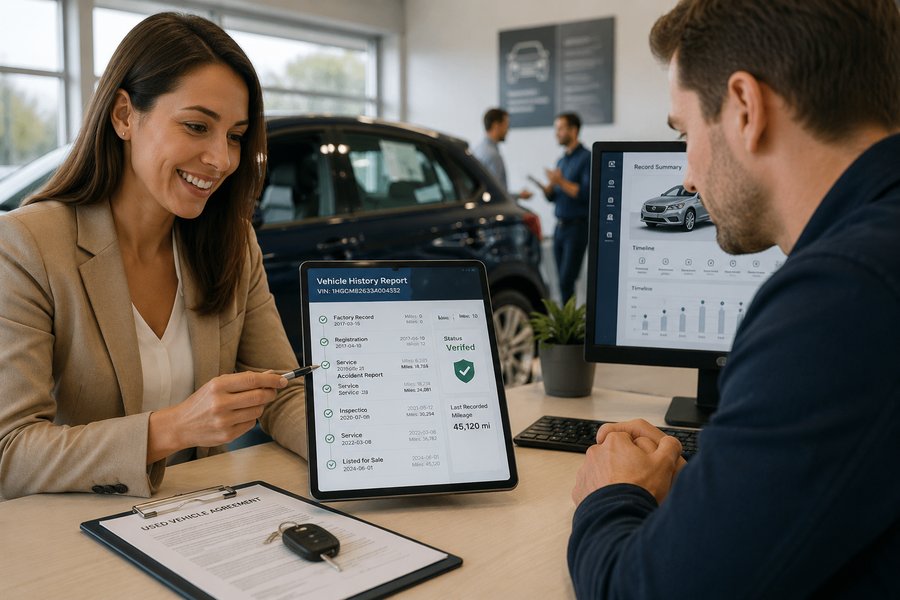
When someone buys a used car, they are buying not only the vehicle in front of them but its entire past, the miles it has traveled, the accidents it has survived, the repairs it has needed, and the care or neglect it has received, and yet this past is largely invisible, knowable only through documents that can be lost, altered, or forged. The single most important fact about a used car is often its mileage, since the distance a vehicle has traveled bears directly on its remaining life, its reliability, and its value, and it is precisely this number that fraudsters most commonly manipulate, rolling back odometers to make worn vehicles appear lightly used and charging unsuspecting buyers thousands more than the cars are worth. This practice, known as odometer fraud or clocking, is not a rare or marginal problem but a widespread and costly one, and it persists because the systems that record a vehicle’s history have long been fragmented, paper-based, or held in databases that a determined fraudster can circumvent.
Blockchain technology offers a way to address this problem at its root by creating a tamper-proof record of a vehicle’s history, a digital ledger that captures mileage, accidents, repairs, and ownership from the factory to each successive resale and that cannot be secretly altered once written. By recording the events of a vehicle’s life on a shared, immutable ledger, blockchain promises to make a car’s history trustworthy in a way that paper titles and isolated databases never could, so that a buyer can verify a vehicle’s mileage and past with confidence and a fraudster cannot quietly rewrite the record. This idea, often described as a digital passport for the vehicle, has moved from concept to implementation, with companies and industry consortia building systems that store vehicle data on blockchains and that aim to bring transparency to a market long plagued by fraud and mistrust.
This article examines blockchain vehicle histories and their potential to end odometer fraud, written for a reader with no background in blockchain technology or the used-car trade. It explains what vehicle histories are and why fraud has been so persistent, how blockchain creates tamper-proof records of mileage and a vehicle’s lifecycle, and how both buyers and sellers stand to benefit from a more trustworthy market. It weighs the genuine benefits and the real challenges, including the difficult problem of getting accurate data onto the ledger in the first place, and it grounds the discussion in documented, verifiable implementations with real data rather than speculation. The aim is to convey both the genuine promise of blockchain to make used-car histories trustworthy and the meaningful obstacles that stand between that promise and its full realization.
Understanding Vehicle Histories and the Odometer Fraud Problem
A vehicle history is the accumulated record of everything that has happened to a car over its life, including its manufacture, its successive owners, the mileage it has accrued, the accidents and damage it has suffered, the repairs and maintenance it has received, and the legal status of its title, all of which bear on what the vehicle is worth and how it is likely to perform. For a buyer of a used car, this history is essential information, because two vehicles of the same make, model, and year can differ enormously in value and reliability depending on how far they have been driven and how well they have been treated, and without a trustworthy account of that history, a buyer is left guessing or trusting the word of a seller who has every incentive to present the vehicle in the best possible light. The importance of vehicle history is why services that compile and report it have become a standard part of the used-car market, allowing buyers to check a vehicle’s past before committing to a purchase.
The most consequential element of a vehicle’s history is usually its mileage, because the distance a car has traveled is one of the strongest indicators of its wear, its remaining useful life, and its market value, with lower-mileage vehicles commanding substantially higher prices than otherwise identical higher-mileage ones. This centrality of mileage to value is exactly what makes the odometer a target for fraud, since rolling back the reading to show fewer miles than the vehicle has actually traveled can dramatically increase its apparent worth, allowing a fraudster to sell a worn, heavily used car at the price of a lightly used one and to pocket the difference. Odometer fraud, also called clocking, exploits the gap between the displayed mileage and the true mileage, and because the odometer reading has historically been easy to alter and difficult to independently verify, this form of fraud has been both common and lucrative, inflicting significant costs on buyers who pay too much and inherit vehicles more worn than they realized.
The persistence of odometer fraud and related deceptions, such as title washing, in which the record of a vehicle’s damaged or salvaged status is laundered across jurisdictions, and the concealment of accident damage, stems from the fragmented and alterable nature of the records on which vehicle history has depended. Mileage has traditionally been recorded on paper titles and in databases maintained by various authorities and service providers, but these records can be incomplete, inconsistent across jurisdictions, or vulnerable to manipulation, and the digital odometers in modern vehicles, far from solving the problem, can themselves be altered with readily available tools, so that the displayed mileage offers no guarantee of accuracy. Because no single, trustworthy, tamper-proof record of a vehicle’s mileage and history has existed, fraudsters have been able to exploit the gaps and inconsistencies, altering readings, washing titles, and hiding damage, and buyers have had to rely on history reports that, however useful, draw on data that can be incomplete or itself compromised. This fundamental problem, the absence of a record that cannot be secretly altered, is the one that blockchain technology aims to solve.
It is worth appreciating why the existing safeguards, despite decades of effort, have failed to eliminate the problem, because understanding their weaknesses clarifies what a new approach must accomplish. Regulations against odometer tampering exist in many jurisdictions and carry real penalties, and history-reporting services have grown sophisticated, yet fraud persists because enforcement is difficult, because detection often comes only after a sale has been completed and the fraudster has moved on, and because the underlying records remain alterable or fragmented enough that a determined deceiver can find a way through. A title that crosses from one jurisdiction to another may shed its salvage brand, a database may simply lack the readings that would reveal a rollback, and a digital odometer can be reset with equipment that is neither rare nor expensive, so that the deceiver enjoys structural advantages that punishment after the fact does little to remove. The lesson of this persistence is that combating vehicle-history fraud effectively requires not merely stronger penalties or better reporting on top of fragile records, but a change in the nature of the records themselves, making them whole and unalterable rather than scattered and editable, which is precisely the change that an immutable shared ledger proposes to deliver.
The Scale and Cost of Odometer and Title Fraud
Odometer fraud is not a marginal nuisance but a widespread and costly problem affecting a substantial fraction of the used-car market, as documented data make clear. The vehicle history company carVertical, which compiles and analyzes data on vehicles checked through its service, reported that of all the vehicles checked on its platform in 2023, some 7.5 percent had been clocked, meaning roughly one in twelve cars in the market it examined may carry an altered odometer reading, a proportion that translates into enormous aggregate harm given the size of the used-car market. The same analysis recorded a total of around 7.7 billion clocked kilometers across the vehicles it examined, a slight increase from approximately 7.4 billion in the prior year, illustrating both the vast scale of the mileage being fraudulently concealed and the persistence of the problem over time rather than its disappearance.
The financial impact of this fraud on buyers is substantial and measurable, since concealing a vehicle’s true mileage artificially inflates its price. According to carVertical’s analysis, buyers of clocked cars spend on average around 21 percent more for their vehicles than they would for the same cars with honest mileage, meaning that the fraud does not merely deceive but extracts a significant premium from its victims, who pay inflated prices for vehicles more worn than they appear. The harm compounds over the life of the vehicle, because a buyer who overpays for a car with concealed high mileage also faces the higher maintenance costs, shorter remaining life, and greater risk of failure that the true mileage implies, so that the cost of the fraud extends well beyond the inflated purchase price into the ongoing expense and risk of owning a vehicle misrepresented at sale.
The prevalence of odometer fraud varies considerably by region, reflecting differences in regulation, enforcement, and market structure, but it is a serious problem in many markets and shows signs of worsening rather than receding. The carVertical data found the problem most severe in certain Eastern European markets, with Latvia showing around 11.2 percent of checked vehicles clocked and other countries such as Ukraine, Lithuania, and Romania also showing high rates, while markets such as the United Kingdom and Switzerland showed much lower rates around 2.1 percent, indicating that the severity of the problem depends heavily on local conditions. In the United States, the vehicle history provider CARFAX reported in late 2025 that odometer rollbacks had risen sharply to affect an estimated 2.45 million vehicles, a roughly 14 percent increase, underscoring that the problem is not confined to any one region and that it has been growing rather than diminishing even in mature markets with established history-reporting services. It is important to read these figures with an understanding of their source and limits, because doing so strengthens rather than weakens the case they make. The percentages reported by a history-checking service reflect the vehicles that pass through that service, which may not be a perfectly representative sample of all vehicles in a market, and different providers using different methods and data may arrive at somewhat different numbers, so the precise figures should be taken as informed estimates rather than exact censuses. What is striking, however, is that multiple independent sources, using different data and operating in different regions, all find odometer fraud to be common and costly, with rates measured in the single-digit percentages of vehicles examined and price premiums measured in the tens of percent, a convergence that lends confidence to the broad conclusion even amid uncertainty about exact magnitudes. The consistency of the picture across carVertical’s European data and CARFAX’s American figures, both pointing to a substantial and growing problem, indicates that odometer fraud is not an artifact of any one provider’s sample but a real and pervasive feature of used-car markets, which is exactly why a structural solution to the trustworthiness of vehicle records has attracted serious interest.
These documented figures establish that odometer and title fraud impose large and growing costs on buyers across many markets, providing the concrete motivation for the tamper-proof records that blockchain aims to deliver.
How Blockchain Creates Tamper-Proof Vehicle Records
Blockchain technology addresses the problem of vehicle-history fraud through its defining property, the ability to maintain a shared record that, once written, cannot be secretly altered, which makes it possible to build a vehicle history that a fraudster cannot quietly rewrite. A blockchain is a kind of database, maintained across many participants rather than by a single authority, in which records are grouped into blocks that are cryptographically linked so that altering any past record would require an obvious and detectable change to the entire chain, rendering the history effectively immutable. Applied to vehicles, this property allows the events of a car’s life, its mileage readings, accidents, repairs, and ownership transfers, to be recorded on a ledger where they are permanently fixed and openly verifiable, so that the history becomes a trustworthy account rather than a set of alterable documents.
The two subsections that follow examine how this works in practice through two related capabilities. The first concerns the creation of an immutable record spanning a vehicle’s entire life from factory to resale, building a permanent, unalterable history of ownership and events that accumulates as the vehicle passes through successive owners and undergoes the events of its life. The second concerns the specific and crucial matter of verified mileage and trusted data capture, the ways in which mileage readings and other data are recorded at points such as servicing and registration so that the numbers entering the ledger are accurate and cannot subsequently be altered. Understanding both how blockchain builds an immutable lifecycle record and how the critical data of mileage is captured and protected is necessary to grasp how the technology can make vehicle histories trustworthy.
Immutable Records from Factory to Resale
The foundational capability of a blockchain vehicle history is the creation of an immutable record that spans the vehicle’s entire life, beginning at the factory and accumulating through every owner and event until the present. From the moment a vehicle is manufactured, its identity and origin can be recorded on the blockchain, and as it passes through dealers, owners, service centers, and inspections, each significant event can be added to its record, building over time a comprehensive and permanent account of the vehicle’s history that no single party controls and that none can secretly alter. This lifecycle record, sometimes called a digital passport for the vehicle, captures the manufacturing details, the chain of ownership, the mileage at various points, the accidents and damage, and the repairs and maintenance, assembling them into a single trustworthy history that travels with the vehicle.
The immutability of this record is what distinguishes it from the conventional systems it aims to replace, because once an event is written to the blockchain, it cannot be deleted or modified without detection, so the history cannot be quietly rewritten to conceal an inconvenient truth. In the traditional system, a fraudster might alter a paper title, exploit inconsistencies between jurisdictions, or manipulate a database to wash away a salvage title or roll back mileage, but a blockchain record resists these manipulations because changing a past entry would require altering the cryptographically linked chain in a way that participants would detect and reject. This resistance to alteration means that a vehicle’s recorded history, including its mileage and its accident and title status, becomes a reliable account that a buyer can trust, removing the gap between the recorded history and the true history that fraud has long exploited.
A further advantage of recording a vehicle’s history on a shared blockchain is that it can integrate data from many sources into a single, coherent record, overcoming the fragmentation that has plagued vehicle history. A vehicle’s history is generated by many parties, including manufacturers, dealers, service centers, insurers, and authorities, and in conventional systems this data is scattered across separate records that may be incomplete or inconsistent, but a blockchain can serve as a common ledger to which all these parties contribute, assembling a more complete and consistent history than any single source could provide. Companies building these systems have described gathering data from manufacturers, dealers, banks, insurers, registries, and owners to construct a unified vehicle record on the blockchain, and this integration, combined with immutability, is what allows the resulting history to be both comprehensive and trustworthy, capturing the full arc of a vehicle’s life from factory to resale in a form that resists the fragmentation and manipulation that have undermined trust in used-car histories.
A related strength of the blockchain approach is that the record travels with the vehicle rather than residing with any single owner, dealer, or jurisdiction, which addresses a longstanding weakness of systems where history is lost or reset each time a car changes hands or crosses a border. In conventional arrangements, the documentation of a vehicle’s past can fragment as it moves between owners and regions, with each transfer risking the loss of records or the introduction of inconsistencies that a fraudster can exploit, but a blockchain record is bound to the vehicle’s identity and persists continuously regardless of who currently possesses the car or where it is registered. This continuity means that a vehicle’s history accumulates without interruption across its entire life and across the boundaries that have traditionally fractured the record, so that a buyer purchasing a car that has passed through several owners or even several countries can still access a complete and unbroken account rather than a partial one beginning at the most recent transfer. The persistence and portability of the record, ensuring that history is neither lost nor reset as the vehicle moves through the world, is a significant advantage over the conventional systems whose discontinuities have given fraudsters opportunities and left buyers with incomplete information, and it is part of what makes the blockchain approach suited to the genuinely mobile and frequently traded nature of the vehicles whose histories it seeks to protect.
Verified Mileage and Trusted Data Capture
The most critical and difficult aspect of a blockchain vehicle history is ensuring that the mileage and other data entering the ledger are accurate at the point of capture, because the immutability of the blockchain protects data only after it is recorded and does nothing to guarantee that what is recorded is true. This is the central challenge of any system that aims to record real-world facts on a blockchain, often called the problem of getting trustworthy data onto the chain, and for vehicle histories it means that the value of the immutable record depends entirely on the accuracy of the mileage readings and other information that are written to it, since a false reading, once recorded, becomes a permanently fixed falsehood rather than a protected truth. Addressing this challenge is essential to the credibility of blockchain vehicle histories, and it is where much of the practical difficulty of these systems lies.
The approach that blockchain vehicle-history systems take to this challenge is to capture mileage readings at trusted points and from reliable sources, recording them frequently enough that fraudulent alteration becomes difficult to conceal. Mileage can be recorded on the blockchain at events such as routine servicing, inspections, registration, and other points where the vehicle’s odometer is read by a party other than the seller, so that the ledger accumulates a series of timestamped readings that should rise consistently over time, and any attempt to roll back the displayed mileage would conflict with the recorded history and be exposed. By capturing readings from service centers and other trusted sources at regular intervals, the system builds a record of mileage over time that makes clocking detectable, because a later reading lower than an earlier one, or a mileage inconsistent with the vehicle’s documented history, reveals the fraud that an isolated odometer reading would conceal.
The power of this approach grows with the frequency and diversity of the points at which readings are captured, because a denser record leaves less room for undetected manipulation. A vehicle whose mileage is recorded only once or twice in its life offers a fraudster wide gaps in which to insert a false figure, whereas one whose odometer is read at every service visit, inspection, registration renewal, and ownership transfer accumulates a tightly spaced sequence of readings against which any rollback stands out immediately, since the fraudulent low number would have to be reconciled with numerous higher readings already permanently recorded. This is why the systems that promise the greatest protection are those connected to broad networks of service centers and official touchpoints that feed readings into the ledger automatically and regularly, turning the occasional and easily falsified odometer check of the past into a continuous, corroborated record. The reliability of verified mileage, in short, depends not only on the immutability that protects each reading once recorded but on the density and trustworthiness of the network of sources supplying those readings, which is why building these data networks is as central to the effort as the blockchain itself.
This approach mitigates but does not entirely eliminate the data-capture problem, because the accuracy of the record still depends on the readings being honestly captured and on enough trusted data points being recorded to make manipulation evident. If readings are sparse, or if the parties capturing them are themselves dishonest or careless, gaps and errors can enter the record, and the system’s protection against fraud weakens, which is why the effectiveness of a blockchain vehicle history depends not only on the immutability of the ledger but on the breadth and reliability of the data feeding into it. The more comprehensively and reliably mileage is captured from trusted sources across a vehicle’s life, the harder fraud becomes and the more trustworthy the record, so that building these systems is as much about establishing reliable data capture from manufacturers, service networks, and authorities as it is about the blockchain itself, a point that connects directly to the practical challenges of implementing these systems at scale and to the benefits that a well-functioning system can deliver.
How Buyers and Sellers Both Benefit
A trustworthy vehicle history benefits not only buyers, who are protected from fraud, but also honest sellers and the market as a whole, because trust is a foundation on which markets function more efficiently and fairly for everyone who participates in good faith. The conventional problem of used-car sales is that buyers cannot easily verify a vehicle’s true condition and history, which creates a market plagued by suspicion in which buyers, unable to distinguish honest sellers from fraudulent ones, discount their offers to account for the risk of being deceived, harming honest sellers who cannot fully prove the quality of what they offer. A blockchain vehicle history, by making a vehicle’s mileage and past trustworthy and verifiable, addresses this problem at its source, allowing the quality of a vehicle to be credibly demonstrated and thereby improving outcomes for honest participants on both sides of the transaction.
For buyers, the benefit is direct and obvious, the protection from fraud and the confidence to purchase, because a buyer who can verify a vehicle’s true mileage and history through a tamper-proof record is shielded from the clocking, title washing, and concealed damage that have cost used-car buyers so much. With a trustworthy history, a buyer can know what they are actually purchasing, pay a fair price reflecting the vehicle’s true condition, and avoid the substantial premium that fraud extracts and the ongoing costs and risks of owning a vehicle more worn than it appeared, transforming the used-car purchase from a leap of faith into an informed decision. This protection is the most immediate and compelling benefit of blockchain vehicle histories, addressing directly the harm that the documented prevalence of odometer fraud inflicts on buyers.
For honest sellers, the benefit is subtler but no less real, the ability to credibly prove the quality and honest history of the vehicles they sell and thereby to command the prices those vehicles deserve. In a market clouded by the suspicion of fraud, an honest seller offering a well-maintained, accurately represented vehicle struggles to distinguish it from the misrepresented vehicles of fraudsters, and buyers, unable to tell the difference, may discount their offers or take their business elsewhere, so that the honest seller bears a cost imposed by the dishonesty of others. A trustworthy vehicle history allows the honest seller to prove the vehicle’s true mileage and good history, dispelling the suspicion and justifying a fair price, which rewards honesty and good stewardship rather than leaving them indistinguishable from fraud, and this benefit to honest sellers is an important and often overlooked consequence of making vehicle histories trustworthy.
The benefit to the market as a whole follows from these gains to buyers and honest sellers, because a market in which quality can be credibly verified functions more efficiently and fairly than one in which it cannot. When fraud is difficult and honesty is provable, the suspicion that depresses prices and deters transactions diminishes, buyers and sellers can transact with greater confidence, vehicles can be priced according to their true condition, and the market rewards genuine quality and honest dealing rather than the ability to deceive, all of which improves the functioning of the used-car market and the welfare of those who depend on it. The economic logic behind these mutual benefits has a name in the study of markets, the problem of information asymmetry, in which one party to a transaction knows more than the other, and understanding it illuminates why trustworthy histories matter so much. When sellers know the true condition of their vehicles but buyers cannot verify it, buyers rationally assume the worst and lower what they are willing to pay, which drives the best honest sellers out of the market because they cannot get fair value, leaving a pool increasingly weighted toward the very vehicles buyers feared, a downward spiral that economists have long recognized as a way that markets for used goods can deteriorate when quality cannot be verified. A trustworthy vehicle history attacks this dynamic directly by closing the information gap, letting buyers verify what sellers know so that quality can be priced accurately and honest sellers can remain in the market and prosper, which is why the benefit of these systems is not merely the prevention of individual frauds but the restoration of a healthy market in which information flows and prices reflect reality. This broad benefit, a more trustworthy and efficient market that serves honest participants on both sides, is the deeper promise of blockchain vehicle histories, extending beyond the protection of any individual buyer to the improvement of the market as an institution, and it explains why the technology has attracted interest from those who see in it not merely a tool against fraud but a means to make an entire market work better.
Benefits and Challenges Across Stakeholders
The promise of blockchain vehicle histories must be weighed against real challenges, and a clear assessment requires considering the various stakeholders separately, since the benefits and the obstacles fall differently on buyers, sellers, and the broader market and industry. The benefits center on trust, fraud reduction, and the more efficient market that a verifiable history enables, while the challenges center on the difficult practical problems of capturing accurate data, achieving broad coverage and adoption, protecting privacy, and coordinating the many parties whose participation a comprehensive system requires. Understanding both sides, and recognizing that the value of these systems depends on overcoming substantial obstacles, is necessary for a balanced view of what blockchain vehicle histories can realistically achieve.
The two subsections that follow organize this assessment by separating the benefits from the challenges, examining first the advantages that accrue to buyers, sellers, and the market, and then the risks, limitations, and adoption barriers that temper the promise. The first subsection considers how the various participants stand to gain from trustworthy, verifiable vehicle histories, while the second considers the data-entry problem, coverage gaps, privacy concerns, and coordination difficulties that stand between the concept and its full realization. Considering both the benefits and the challenges gives a realistic picture of a technology with genuine promise and genuine obstacles.
Benefits for Buyers, Sellers, and the Market
For buyers, the central benefit is protection and confidence, the assurance that the vehicle they purchase is honestly represented and the freedom from the fraud that has cost used-car buyers so dearly. A tamper-proof history allows a buyer to verify a vehicle’s true mileage and past, avoiding the inflated prices and inherited risks of clocked and misrepresented vehicles, and this protection translates directly into financial savings and peace of mind, given the documented premium that odometer fraud extracts and the prevalence of the practice. The buyer’s benefit is the most immediate justification for these systems, addressing a real and widespread harm with a concrete protection that empowers buyers to purchase with knowledge rather than hope.
For sellers, particularly honest ones, the benefit is the ability to prove quality and earn fair prices, dispelling the suspicion that clouds the used-car market and rewards deception over honesty. An honest seller with a trustworthy record can demonstrate a vehicle’s good history and true mileage, justifying a fair price and distinguishing the vehicle from the misrepresented offerings of fraudsters, which rewards good stewardship and honest dealing rather than leaving them indistinguishable from fraud. Dealers and businesses that adopt trustworthy history systems can also build reputations for transparency and trust, attracting buyers who value the assurance, so that the benefit to sellers extends from individual transactions to the standing and success of honest dealers in a market where trust is valuable.
For the market and industry, the benefit is greater efficiency, reduced fraud, and improved function, since a market in which quality can be verified works better for everyone who participates honestly. Reduced fraud lowers the costs and risks that suspicion imposes, allowing transactions to proceed with greater confidence and vehicles to be priced according to their true condition, while the industry as a whole benefits from a more trustworthy market that serves customers better and rewards honest participants. The broad gains in market efficiency and integrity represent a benefit that extends beyond any individual transaction to the health of the used-car market as an institution, and they explain the interest of manufacturers, dealers, and industry bodies in building the systems and standards that make trustworthy vehicle histories possible, an interest reflected in the real implementations and industry collaborations that have emerged.
Risks, Limitations, and Adoption Barriers
The most fundamental limitation of blockchain vehicle histories is the data-entry problem, the fact that the immutability of the blockchain protects data only after it is recorded and offers no guarantee that the data recorded is accurate in the first place. If false mileage or incorrect information is entered onto the ledger, whether through error, fraud at the point of capture, or compromised data sources, that falsehood becomes permanently fixed and carries the misleading authority of an immutable record, so the system’s protection against later alteration does nothing to ensure initial accuracy. This means that the value of a blockchain vehicle history depends critically on the trustworthiness of the parties and processes that capture and record data, and that the technology, far from automatically guaranteeing truth, shifts the challenge from preventing alteration to ensuring accurate capture, a challenge that is difficult and that the blockchain alone does not solve.
A second major obstacle is coverage and adoption, since a vehicle history is only as useful as it is complete, and building a comprehensive record requires the participation of many parties across the vehicle’s life and across jurisdictions. For a blockchain vehicle history to deliver its promise, manufacturers, dealers, service centers, insurers, and authorities must contribute data, and this requires coordination, agreement on standards, and the willingness of many independent parties to participate, which is difficult to achieve, especially across different countries with different systems and regulations. A system with sparse coverage, missing data for many vehicles or many periods of their lives, offers limited protection, and overcoming this requires the kind of broad industry coordination that is slow and challenging to build, which is among the principal reasons that comprehensive blockchain vehicle histories remain a work in progress rather than a universal reality.
Privacy and other concerns round out the challenges, since recording detailed vehicle and ownership data on a shared ledger raises questions about who can see what, and since the technology must coexist with existing legal and institutional systems. A comprehensive vehicle history contains information that owners may regard as private, and designing systems that provide the necessary transparency about a vehicle while protecting the privacy of its owners is a genuine challenge requiring careful balancing. The systems must also integrate with the legal frameworks of title and registration that vary across jurisdictions, work alongside or replace established history-reporting services, and earn the trust of buyers and sellers accustomed to existing arrangements, all of which involves practical, legal, and institutional hurdles beyond the technology itself. These challenges of data accuracy, coverage, privacy, and integration mean that the promise of blockchain vehicle histories, though real, depends on overcoming substantial obstacles, and that the technology should be understood as a powerful tool whose effectiveness rests on the difficult work of building reliable data capture, broad participation, and sound governance around it.
Real-World Implementations and Measured Outcomes
The promise and the challenges of blockchain vehicle histories are best understood through documented, real-world implementations, where the technology can be assessed against actual deployments and data rather than projections, and several examples from recent years illustrate both the genuine progress and the work that remains. These implementations span specialized companies that compile and verify vehicle histories using blockchain, industry consortia developing standards for vehicle identity and lifecycle data, and platforms building marketplaces for trusted vehicle data, and examining them with their documented details and results grounds the broader discussion in evidence. The examples that follow show how the concept of a tamper-proof vehicle history is being put into practice and what has been achieved.
The most prominent example of blockchain applied to vehicle histories at consumer scale is carVertical, a company that compiles vehicle history reports and stores vehicle data using blockchain technology to make the records tamper-proof, allowing users to check a vehicle’s history by entering its identification number and retrieving information including mileage, damage, and ownership. The company has not only built such a system but has used the data it gathers to document the very problem the technology addresses, reporting that in 2023 around 7.5 percent of the vehicles checked on its platform had been clocked, that roughly 7.7 billion clocked kilometers were recorded across those vehicles, and that buyers of clocked cars pay on average about 21 percent more, figures that both demonstrate the company’s active operation and quantify the fraud problem with concrete data through 2023. carVertical’s deployment illustrates blockchain vehicle histories functioning as a real consumer service, using an immutable ledger to make records tamper-proof while drawing on data from many sources to compile comprehensive histories, and its published research represents one of the most substantial documented bodies of evidence on the scale of odometer fraud and the role of blockchain-backed history reporting in combating it.
A second important example is the industry-standards work of the Mobility Open Blockchain Initiative, known as MOBI, a consortium of automakers and technology companies developing blockchain-based standards for vehicle identity and lifecycle data, whose membership has included major manufacturers such as BMW, Ford, General Motors, Honda, and Renault. MOBI has developed a Vehicle Identity standard intended to give each vehicle a secure digital identity on the blockchain as a foundation for recording its history and data, and in July 2024 it announced a significant milestone in its Web3 Global Battery Passport effort, completing the first phase of a minimum viable product that demonstrated the validation and exchange of battery identity and data among nine organizations including Honda, Mazda, Nissan, and DENSO using open standards. While the battery passport focuses on tracking battery provenance and state of health for regulatory and lifecycle purposes, it exemplifies the same underlying approach of recording a component’s or vehicle’s history immutably on a blockchain, and MOBI’s standards work, documented through this July 2024 milestone, represents the collaborative industry effort to build the shared infrastructure that comprehensive blockchain vehicle histories require, addressing precisely the coordination and standardization challenges that broad adoption demands.
A third example illustrating the marketplace dimension is VINchain, a project that has described itself as building a decentralized vehicle history database and the first blockchain-based marketplace for car data, gathering vehicle information from sources such as manufacturers, dealers, insurers, registries, and owners to construct records that, being stored on the blockchain, cannot be erased or modified. VINchain’s stated aim of eliminating fraud and reducing missing data by connecting the fragmented segments of the vehicle-data market and assembling them into a trusted, immutable record exemplifies the integration approach that comprehensive vehicle histories require, gathering data from many parties into a single trustworthy ledger and creating a means for the secure exchange of that data among participants. Together these three examples, a consumer-facing history service with documented fraud data, an industry consortium building shared standards, and a platform building a marketplace for trusted vehicle data, demonstrate that blockchain vehicle histories have moved beyond concept into varied real-world implementations, even as the documented challenges of data capture, coverage, and coordination mean that the technology’s full promise of ending odometer fraud remains a goal toward which these efforts are working rather than an accomplished fact.
Final Thoughts
Blockchain vehicle histories represent a genuine and promising response to one of the oldest and most persistent frauds in the used-car market, offering through immutable records the possibility of making a vehicle’s mileage and past trustworthy in a way that paper titles and fragmented databases never could. The documented prevalence of odometer fraud, with a substantial fraction of vehicles in many markets carrying altered readings and buyers paying significant premiums for the deception, establishes that the problem the technology addresses is real, widespread, and costly, and the real-world implementations, from consumer history services to industry standards efforts to data marketplaces, demonstrate that the response has moved from concept toward practice. The promise is a used-car market in which a vehicle’s history can be verified rather than merely trusted, protecting buyers from fraud, rewarding honest sellers, and improving the function of the market for everyone who participates in good faith.
The deeper significance of this technology lies in its potential to rebuild trust in a market long clouded by suspicion, because the harm of odometer fraud extends beyond the individual buyers who overpay to the entire market, which functions worse when quality cannot be verified and honesty cannot be proven. By making a vehicle’s history tamper-proof and verifiable, blockchain offers to dispel the suspicion that depresses prices, deters transactions, and penalizes honest sellers, replacing a market of guesswork and risk with one of knowledge and confidence, a transformation that serves not only buyers but the honest majority of sellers and the integrity of the market as an institution. This connection between trustworthy information and fair markets gives the technology a significance beyond fraud prevention, touching the broader question of how transparency can make commerce fairer and more efficient for ordinary people making one of the larger purchases of their lives.
Yet the realization of this promise depends on overcoming substantial and stubborn challenges, the most fundamental of which is that the immutability of a blockchain protects data only after it is recorded and cannot guarantee that what is recorded is true, so the technology’s value rests on the difficult work of capturing accurate data from trusted sources and achieving the broad participation that comprehensive coverage requires. A blockchain vehicle history is only as good as the data that feeds it and the breadth of vehicles and events it covers, and building reliable data capture, coordinating the many parties across jurisdictions whose participation a complete system needs, protecting the privacy of owners, and integrating with existing legal and institutional arrangements are formidable obstacles that the technology alone does not surmount. The path toward ending odometer fraud through blockchain therefore runs not only through the elegance of immutable ledgers but through the unglamorous work of building trustworthy data capture and broad industry cooperation, and the progress of recent years, real but partial, reflects both the genuine promise of the approach and the substantial distance still to travel. What seems clear is that the effort to make vehicle histories trustworthy through blockchain addresses a real and costly problem with a fitting tool, and that its ultimate success will depend less on the technology itself than on the determination and cooperation of the many parties whose honest participation can turn an immutable ledger into a genuinely trustworthy account of the vehicles on which so many people depend.
FAQs
- What is a blockchain vehicle history?
A blockchain vehicle history is a record of a car’s lifecycle, including its mileage, accidents, repairs, and ownership, stored on a blockchain so that once an entry is written it cannot be secretly altered. This immutability makes the history tamper-proof, allowing a buyer to verify a vehicle’s true mileage and past with confidence rather than relying on paper titles or databases that fraudsters can manipulate. The concept is often described as a digital passport that travels with the vehicle from factory to each resale. - What is odometer fraud and how common is it?
Odometer fraud, also called clocking, is the practice of rolling back a vehicle’s mileage reading to make it appear less used than it is, increasing its apparent value. It is widespread and costly: the company carVertical reported that around 7.5 percent of vehicles checked on its platform in 2023 had been clocked, roughly one in twelve, and in the United States CARFAX reported in late 2025 that rollbacks had risen to affect an estimated 2.45 million vehicles, a 14 percent increase, showing the problem is serious and growing. - How does blockchain prevent odometer fraud?
Blockchain prevents fraud by recording mileage readings at trusted points such as servicing, inspections, and registration onto an immutable ledger where they cannot be altered later. Because the ledger accumulates a series of timestamped readings that should rise consistently over time, any attempt to roll back the displayed mileage conflicts with the recorded history and is exposed. The tamper-proof nature of the record removes the gap between displayed and true mileage that fraudsters have long exploited. - Does blockchain guarantee that a vehicle’s history is accurate?
No, and this is an important limitation. A blockchain protects data only after it is recorded; it cannot guarantee that the data entered is true in the first place. If false mileage is recorded through error or fraud at the point of capture, that falsehood becomes permanently fixed. The accuracy of a blockchain vehicle history therefore depends on capturing data from trustworthy sources and recording enough readings that manipulation becomes evident, so the technology shifts the challenge from preventing alteration to ensuring accurate capture. - How do buyers benefit from blockchain vehicle histories?
Buyers benefit through protection from fraud and the confidence to purchase, because a tamper-proof history lets them verify a vehicle’s true mileage and past before buying. This shields them from the inflated prices that fraud extracts, documented at around 21 percent more for clocked cars on average, and from the higher maintenance costs and risks of owning a vehicle more worn than it appeared, transforming the used-car purchase from a leap of faith into an informed decision. - How do honest sellers benefit?
Honest sellers benefit from the ability to prove the quality and honest history of their vehicles, dispelling the suspicion that clouds the used-car market. In a market where buyers cannot easily tell honest sellers from fraudulent ones, honest sellers suffer because buyers discount their offers to account for risk; a trustworthy record lets an honest seller demonstrate true mileage and good history, justify a fair price, and build a reputation for transparency, rewarding honesty rather than leaving it indistinguishable from fraud. - What are the main challenges to adopting blockchain vehicle histories?
The main challenges are ensuring accurate data capture, achieving broad coverage and adoption, protecting privacy, and integrating with existing legal systems. A history is only useful if it is complete, which requires many parties, including manufacturers, dealers, service centers, insurers, and authorities, to contribute data across jurisdictions, a difficult coordination problem. Sparse coverage offers limited protection, and recording detailed data raises privacy questions, so the technology’s effectiveness depends on overcoming substantial practical and institutional hurdles. - Are companies actually using blockchain for vehicle histories?
Yes. carVertical compiles vehicle history reports and stores data using blockchain to make records tamper-proof, and it has published detailed research on odometer fraud through 2023. The Mobility Open Blockchain Initiative, whose members have included BMW, Ford, General Motors, Honda, and Renault, develops blockchain standards for vehicle identity and in July 2024 completed the first phase of a battery passport demonstration among nine organizations. VINchain has built a decentralized vehicle history database and data marketplace, showing varied real-world implementations. - How is a blockchain vehicle history different from a traditional history report?
A traditional history report compiles data from various databases that can be incomplete, inconsistent across jurisdictions, or vulnerable to manipulation, whereas a blockchain history stores records on an immutable ledger that cannot be secretly altered once written and can integrate data from many sources into a single coherent record. The key difference is tamper-resistance and the ability to combine fragmented data, though the accuracy of both still depends on the quality of the underlying data captured. - Will blockchain completely end odometer fraud?
Not on its own and not immediately. Blockchain makes recorded histories tamper-proof and makes well-documented clocking detectable, but its effectiveness depends on capturing accurate data from trusted sources and on achieving broad coverage across vehicles and jurisdictions, both difficult to accomplish. The documented implementations show real progress, but the challenges of data capture, coverage, and coordination mean that ending odometer fraud is a goal these efforts are working toward rather than an accomplished fact, and success depends as much on cooperation and reliable data as on the technology itself.