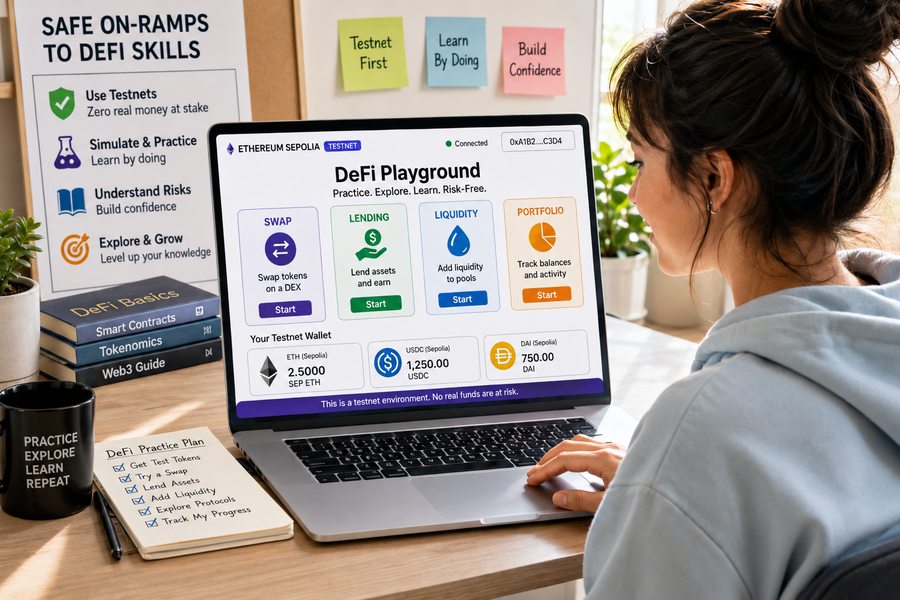
Decentralized finance promises a financial system that anyone can access without banks, brokers, or gatekeepers standing between a person and their money, allowing a newcomer to swap one token for another, lend out savings for interest, or supply liquidity to a trading pool using nothing more than a crypto wallet and an internet connection. Yet this same openness, the absence of customer service lines, account recovery options, and regulatory safety nets that traditional finance takes for granted, means that a beginner’s first mistake in DeFi is frequently also their most expensive one, since a wrong swap, a hasty approval granted to a malicious contract, or a liquidation triggered by unfamiliarity with collateral ratios can permanently destroy money that a more experienced user would have protected. For someone encountering decentralized exchanges, lending markets, and liquidity pools for the first time, the natural instinct to learn by doing collides uncomfortably with the reality that doing usually means risking real, often irreversible, financial loss.
Fortunately, the same blockchain infrastructure that makes DeFi possible also makes it possible to practice DeFi without any of that risk, through a set of tools collectively known as testnets, faucets, and simulation platforms, each of which lets a learner interact with authentic decentralized applications using tokens that carry no monetary value whatsoever. A testnet is, in essence, a parallel version of a blockchain network that behaves identically to the real one in every way that matters for learning, processing transactions, executing smart contracts, and settling swaps or loans, except that the assets moving through it are worthless test tokens obtained for free rather than money a person earned and could lose. This distinction transforms the experience of a first DeFi transaction from a nerve-wracking gamble into a low-stakes rehearsal, one in which a mistaken swap or a poorly understood liquidation simply becomes a lesson rather than a financial setback.
The path from complete unfamiliarity with decentralized finance to genuine competence runs through several distinct kinds of risk-free environments, each suited to a different stage of learning and a different kind of learner. Raw testnets, maintained by blockchain networks and populated with the same decentralized exchanges and lending protocols that operate on the real network, offer the most authentic practice, letting a beginner click through the exact interfaces they will eventually use with real money. Faucets, the services that dispense free test tokens, are the essential first step that makes testnet practice possible, since a wallet with no tokens cannot transact at all. Beyond these foundational tools, a growing ecosystem of hackathons, free university-style courses, and structured educational programs has organized testnet practice into guided curricula, giving newcomers not just a sandbox to explore but a sequence of steps to follow and, in many documented cases, a community and even prizes to sustain their motivation.
This article maps that landscape in the order a newcomer is likely to encounter it, beginning with why risk-free practice matters so much in a financial system with no safety net, then explaining how testnets work and how to obtain the test tokens needed to use them. It proceeds to the specific core actions, swapping, lending, borrowing, and providing liquidity, that make up the essential vocabulary of DeFi participation, showing how each can be rehearsed without financial exposure. It then turns to the simulation platforms, hackathons, and structured courses that have emerged around testnet practice, drawing on documented, real-world examples of programs that have guided thousands of learners through exactly this kind of hands-on education. Finally, it addresses the honest limitations of risk-free learning and the question every learner eventually faces, namely how and when to graduate from practice to the real market, equipping readers to make that transition deliberately rather than accidentally.
Why Learning DeFi Risk-Free Matters for Newcomers
Decentralized finance differs from a conventional brokerage account or a mobile banking app in a way that makes hands-on practice both more necessary and more dangerous, because the interfaces a newcomer must master, connecting a wallet, approving a smart contract to spend a token, confirming a swap at a particular exchange rate, or posting collateral to open a loan, are unforgiving of error in a way that traditional finance, cushioned by customer service representatives and reversible transactions, generally is not. A misdirected bank transfer can often be recalled or disputed, and a brokerage trade executed by mistake can sometimes be unwound, but a blockchain transaction, once confirmed, is final, and a token sent to the wrong address or approved for an unlimited spending allowance to a fraudulent contract is, in the overwhelming majority of cases, gone permanently. This finality is a deliberate feature of decentralized systems, prized by experienced users precisely because it removes the need to trust an intermediary, but it converts every beginner’s learning curve into a minefield in which the tuition for a mistake is measured in dollars rather than embarrassment.
The particular vocabulary of DeFi compounds this danger, since concepts like slippage tolerance, impermanent loss, collateralization ratios, and liquidation thresholds have no close equivalent in the banking apps or trading platforms most newcomers have used before, meaning that a person cannot simply transfer intuitions from familiar financial software into this unfamiliar territory. Setting a slippage tolerance too high on a swap can result in receiving dramatically less value than expected if the market moves during the transaction, while failing to understand a lending protocol’s collateralization requirements can lead to an unexpected liquidation that forfeits a portion of the collateral posted, and both of these outcomes are the kind of thing a learner typically discovers only by experiencing them. Practicing these exact actions on a network where the tokens involved are worthless converts what would otherwise be an expensive lesson into a free one, letting the underlying mechanics sink in through repetition without the anxiety of watching real money move.
Beyond the mechanical risk of clicking the wrong button lies a second, more predatory danger that disproportionately targets newcomers, namely the scams and malicious contracts that populate the DeFi ecosystem specifically because they know inexperienced users are more likely to approve a suspicious transaction or connect their wallet to a fraudulent site without recognizing the warning signs. A beginner who has never seen what a legitimate token approval request looks like is poorly positioned to recognize an illegitimate one, and the skill of pausing before every wallet interaction to verify what is actually being authorized is one that develops through repeated, low-stakes exposure to the genuine interfaces of real protocols rather than through reading a warning list in isolation. Practicing on a testnet, where the protocols involved are the identical, legitimate applications that operate on the real network, builds this pattern recognition safely, so that by the time a learner encounters an unfamiliar or suspicious prompt using real funds, they have already internalized what a normal, safe transaction looks like and are far better equipped to notice when something is wrong.
Risk-free practice also addresses a psychological dimension of learning that is easy to overlook, since the anxiety that accompanies handling real money tends to interfere with the calm, exploratory mindset that learning any complex system requires, causing beginners to rush through unfamiliar screens, avoid experimentation, or abandon a protocol entirely after a single confusing experience rather than working through the confusion. When the tokens at stake carry no real value, a learner can slow down, click into every menu, try a transaction and watch what happens, and even deliberately trigger an error to see how the system responds, building a genuinely thorough understanding rather than the shallow, fear-driven familiarity that often results from a person’s first and only encounter with real-money DeFi. This freedom to experiment without consequence is, in a meaningful sense, the entire value proposition of testnets and simulation platforms, and it is why the tools and programs examined in the remainder of this article have become the recommended starting point for nearly anyone serious about understanding decentralized finance from the ground up.
Testnets: The Foundation of Risk-Free DeFi Practice
At the center of nearly every risk-free DeFi learning path sits the testnet, a separate but structurally identical version of a blockchain network on which developers and learners alike can transact without spending anything of real value, and understanding what a testnet actually is and how to obtain the tokens needed to use one is the necessary starting point for any newcomer hoping to practice decentralized finance safely. Testnets exist primarily because software developers need a place to build and test smart contracts before deploying them where real money is at stake, but this developer infrastructure turns out to double as an ideal classroom for anyone learning to use DeFi applications, since the same decentralized exchanges, lending markets, and liquidity pools that operate on the main network typically maintain parallel deployments on one or more testnets. The two subsections that follow explain first how this technical mirroring works and then how a learner actually gets the free tokens needed to begin transacting.
How Testnets Mirror Mainnet Without Financial Stakes
A blockchain testnet is built using the same underlying software and consensus mechanism as the main, real-value network it mirrors, meaning that a smart contract deployed on a testnet behaves, executes, and responds to user input in exactly the same way it would on the network where real money circulates, with the sole difference being that the network’s native token and any tokens issued on it carry no market value and cannot be exchanged for currency. For Ethereum and the many blockchain networks built to be compatible with it, the most widely used testnet in recent years has been Sepolia, which replaced the older Goerli testnet as the primary environment for testing smart contracts and decentralized applications following Goerli’s deprecation, and Sepolia today hosts test deployments of many of the same decentralized exchange and lending protocols that operate on Ethereum’s real network. When a learner interacts with a lending protocol’s testnet deployment, they are not using a simplified mockup or an approximation built for teaching purposes but very often the same underlying smart contract code, the same user interface, and the same sequence of wallet approvals and confirmations that a user of the real protocol would encounter, differing only in that every token involved is a valueless test asset.
This authenticity matters enormously for the quality of learning that results, because a simplified simulation designed purely for education risks teaching habits and mental models that do not transfer cleanly to the real applications a learner will eventually use, whereas practicing on an actual testnet deployment of a real protocol builds muscle memory for the genuine interface, including its specific warnings, its particular sequence of confirmation screens, and the exact information it displays about fees, exchange rates, and collateral requirements. A learner who has connected a wallet to a testnet deployment of a decentralized exchange, approved a token for spending, and executed a swap has performed precisely the same sequence of actions, click for click, that they will perform when using real funds on the main network, with the crucial difference that any error made along the way costs nothing. Because testnets run on the same blockchain software as their corresponding main networks, they also expose learners to genuine blockchain concepts such as transaction confirmation times, gas fees denominated in the network’s native test token, and the irreversibility of confirmed transactions, all of which behave identically to how they would on the real network even though no real value changes hands.
Getting Test Tokens From Faucets
Before a newcomer can execute a single practice transaction, they need test tokens in their wallet, and obtaining these tokens is the job of a faucet, a service that dispenses small, free amounts of a network’s native test currency or test versions of popular assets to anyone who requests them. Faucets exist for essentially every actively used testnet, and the process of using one is typically straightforward, requiring a learner to provide their wallet’s public address, sometimes complete a simple verification step to deter abuse, and then receive a modest quantity of test tokens directly into that wallet within moments, ready to be used for gas fees and transactions. Alchemy, one of the major infrastructure providers supporting Ethereum development, operates a Sepolia faucet that distributes a set amount of test ether to registered developers each day, and similar faucet services are maintained by other infrastructure companies and by the teams behind individual protocols, giving learners multiple avenues for obtaining the test ether needed to pay for transactions on Sepolia.
Beyond the network’s native currency, which is needed to pay the gas fees that every transaction requires, a learner practicing DeFi specifically also needs test versions of the tokens actually used in swaps, lending, and liquidity provision, and here too the ecosystem has built dedicated tools. Circle, the company behind the widely used USD Coin stablecoin, operates a faucet at faucet.circle.com that distributes a set amount of test USD Coin on Sepolia and several other testnets each day, allowing learners to practice stablecoin swaps and lending without needing to first convert their test ether into a stable-value asset through an exchange. Lending protocols themselves frequently build faucet functionality directly into their testnet interfaces as well; Aave’s testnet deployment, for instance, allows a user to obtain a range of test tokens directly from within the application’s dashboard by selecting the desired asset, with the protocol limiting each faucet request to a set maximum per transaction to keep the system usable for everyone practicing on it. Together, these network-level and protocol-level faucets form the on-ramp that makes every subsequent step of risk-free DeFi learning possible, since without a wallet stocked with test tokens, a learner has no way to actually attempt the swaps, loans, and liquidity deposits that testnets exist to let them practice.
Practicing Core DeFi Actions: Swaps, Lending, and Liquidity
Once a learner has a testnet wallet funded through a faucet, the natural next step is to practice the small number of core actions that make up the overwhelming majority of everyday DeFi activity, namely exchanging one token for another, borrowing against posted collateral, and supplying assets to a liquidity pool in exchange for a share of trading fees. These three activities, while each involving its own interface and its own risks when performed with real money, share a common thread in that all of them require a learner to approve a smart contract to interact with their tokens, to understand the fees and rates being quoted before confirming, and to develop a feel for how the underlying protocol responds to their input, and testnets allow every one of these actions to be rehearsed as many times as needed. The two subsections that follow walk through swapping and then through lending, borrowing, and liquidity provision in more detail.
Executing Token Swaps on Decentralized Exchanges
A token swap, the act of exchanging one cryptocurrency for another directly through a decentralized exchange’s smart contract rather than through a centralized order book, is typically the first DeFi action a newcomer attempts, and practicing it on a testnet exposes a learner to nearly every important concept they will need for the rest of their DeFi education. The process begins with connecting a wallet to the exchange’s interface and selecting the two tokens to be exchanged, after which the interface displays an estimated exchange rate along with a figure representing the price impact the trade is expected to have, a number that grows larger as the size of a swap increases relative to the depth of the pool being traded against, and a learner practicing on a testnet can deliberately attempt a large swap purely to observe how dramatically the price impact figure changes, an experiment that would be needlessly costly to run with real funds.
Before the swap can execute, most decentralized exchanges require the user to first approve the exchange’s smart contract to access the specific token being sold, a separate transaction from the swap itself that exists because tokens on many blockchain networks require this explicit permission before any contract can move them on a user’s behalf, and newcomers frequently find this two-step process, approval followed by swap, confusing the first time they encounter it. Working through this sequence on a testnet, watching the approval transaction confirm and then submitting the actual swap, demystifies a process that can otherwise feel opaque, and it also gives a learner the opportunity to notice the slippage tolerance setting, a parameter that determines how much the final exchange rate is allowed to deviate from the quoted rate before the transaction automatically fails, protecting the user from receiving a much worse rate if the market moves between submission and confirmation. Setting this tolerance too tight can cause a transaction to fail entirely during periods of normal price movement, while setting it too loose exposes a user to receiving noticeably less value than expected, and only by adjusting this setting and watching the results on a testnet does the tradeoff become genuinely intuitive rather than a rule memorized from a guide.
Practicing swaps on a testnet deployment of a real decentralized exchange also builds a learner’s comfort with reading the transaction confirmation screen that appears in their wallet immediately before a swap executes, a screen that displays the specific tokens and amounts involved and represents the last opportunity to catch an error or a malicious request before it becomes irreversible. Because this confirmation screen looks identical whether a learner is using test tokens or real ones, the habit of actually reading it carefully rather than reflexively clicking confirm is one that testnet practice can instill just as effectively as real-money use, but without the cost of a mistake made while that habit is still forming. By the time a learner has executed several dozen practice swaps, adjusted slippage settings, and watched a handful of transactions fail or behave unexpectedly, they have typically absorbed the core mechanics of decentralized exchange trading thoroughly enough to approach their first real-money swap with genuine confidence rather than guesswork.
Simulating Lending, Borrowing, and Liquidity Provision
Beyond simple swapping, decentralized lending protocols allow users to supply an asset to a shared pool in exchange for interest, or to borrow an asset against collateral they have posted, and both of these activities involve concepts, collateralization ratios, interest rate curves, and liquidation risk, that are considerably more consequential to misunderstand than the mechanics of a swap, making testnet practice especially valuable here. On a testnet deployment of a lending protocol such as Aave, a learner can supply a test token as collateral, observe how the interface calculates their available borrowing capacity based on that collateral’s value and the protocol’s loan-to-value parameters for that asset, and then actually borrow a different test token against it, watching in real time how their health factor, the numerical indicator most lending protocols use to represent how close a position is to liquidation, responds to the size of the loan taken out. Because none of the tokens involved carry real value, a learner can deliberately push a position toward liquidation, an experiment that would be reckless and costly with real money, purely to see what a liquidation warning looks like and to understand viscerally why maintaining a comfortable buffer above the minimum collateralization requirement matters.
Liquidity provision, the practice of depositing a pair of tokens into an automated market maker’s pool in exchange for a share of the trading fees generated by swaps against that pool, introduces its own distinct concept that newcomers frequently find counterintuitive, namely impermanent loss, the phenomenon by which a liquidity provider can end up with less total value than they would have had by simply holding the two tokens separately, occurring whenever the relative price of the two pooled tokens shifts after the deposit is made. Practicing liquidity provision on a testnet allows a learner to deposit a pair of test tokens into a pool, observe the specific ratio the interface requires them to deposit in, and then, if the testnet environment allows enough time and price movement to occur, withdraw the position later and compare the result to what they would have had by holding the tokens instead, turning an abstract warning found in educational articles into a concrete, observed outcome. Some learners choose to accelerate this observation by researching how impermanent loss has affected real liquidity providers during periods of significant price divergence, but even without waiting for market movement, working through the deposit and withdrawal mechanics on a testnet clarifies the pool share tokens received, the fee accrual process, and the withdrawal procedure well enough that a learner approaching a real pool for the first time understands exactly what they are agreeing to.
Taken together, practicing swaps, lending and borrowing, and liquidity provision on a testnet gives a newcomer hands-on familiarity with essentially the entire vocabulary of everyday decentralized finance participation, and the value of this practice compounds because these three actions frequently combine in more advanced strategies, such as borrowing against a liquidity position or swapping to rebalance a lending portfolio, that a learner will only be prepared to attempt safely once each individual component feels routine. The testnet environment, precisely because it removes the cost of experimentation, allows a beginner to repeat these actions as many times as needed until the underlying logic of collateral, interest, and pooled liquidity stops feeling like a set of rules to be memorized and starts feeling like a system whose behavior can be anticipated, a threshold that marks genuine readiness to consider using real funds.
Simulation Platforms, Hackathons, and Structured Learning Programs
While raw testnets and faucets provide the essential building blocks of risk-free DeFi practice, a considerable amount of organized effort has gone into structuring that practice into guided programs, competitive events, and formal courses, each of which adds a layer of curriculum, community, or incentive on top of the same underlying testnet infrastructure. These structured programs matter because self-directed exploration of a testnet, while valuable, can leave a newcomer uncertain about what to try next or whether they are genuinely learning correctly, whereas a hackathon, a free coding bootcamp, or a university course provides sequence, feedback, and often peer support that make the same underlying testnet practice considerably more effective. The two subsections that follow examine, respectively, hackathons as a form of accelerated, deadline-driven learning and the university and structured online courses that have built entire curricula around testnet-based DeFi practice.
Hackathons as Guided, Accelerated Learning
Blockchain hackathons, time-limited events in which participants build projects using a given set of tools or protocols and compete for prizes, have become a well-documented and genuinely effective way for newcomers to gain intensive, hands-on DeFi experience in a compressed period, because the deadline pressure, the mentorship typically offered by organizing teams, and the requirement to actually ship a working project on a testnet push participants to move past passive tutorial-following into active building. The oracle network Chainlink, whose infrastructure many DeFi lending and price-feed applications rely on, has run a recurring series of these events, and its Spring 2023 Hackathon, which ran from April 28 to June 11, 2023, drew 2,393 participants who built projects using Chainlink’s services across categories that explicitly included a dedicated DeFi prize track, with the event distributing more than four hundred thousand dollars in total prizes. Notably, approximately forty percent of that hackathon’s registrants reported having little to no prior experience building with blockchain technology, a figure that demonstrates hackathons are not solely the province of experienced developers but have become a genuine entry point for newcomers willing to learn DeFi concepts under the structure and momentum a competitive deadline provides.
The educational value of a hackathon for a DeFi newcomer comes less from the prospect of winning a prize, which remains realistic for only a small fraction of participants, and more from the structure the event imposes, since a hackathon typically supplies starter documentation, sample code interacting with real protocols on a testnet, and access to mentors or community channels where a stuck participant can ask questions and receive guidance far more quickly than they would working alone. Because hackathon projects are almost always built and demonstrated on a testnet rather than the real network, participants get the experience of designing an application around swaps, lending, or liquidity provision, wiring up wallet connections, and troubleshooting failed transactions, all while working with test tokens that carry no financial risk even as the deadline pressure mimics the urgency of a genuine professional project. Chainlink’s later events built on this same model; its Chromion hackathon, for example, drew over three thousand participants who submitted more than four hundred completed projects, many deployed to testnets, reinforcing that this format has scaled successfully well beyond its early iterations and continues to serve as a proven, testnet-anchored on-ramp into applied blockchain and DeFi development.
For a newcomer who does not consider themselves a developer, hackathons still hold value even in a non-building role, since most events welcome participants who contribute through research, design, or product thinking alongside a team’s more technical members, giving a non-coder direct exposure to how a DeFi application is actually assembled, what decisions its builders had to make about collateral parameters or swap routing, and how the underlying testnet protocols behave under real, if compressed, development pressure. Whether participating as a builder or a contributing team member, a newcomer who works through even a single hackathon focused on decentralized finance typically emerges with a far more concrete understanding of how swaps, lending markets, and liquidity pools fit together than weeks of unguided, solo testnet exploration would likely produce on its own, precisely because the event compresses an entire learning arc, from confusion to a working, demonstrable result, into a matter of days.
University Courses and Structured Programs Built Around Testnets
Beyond the competitive intensity of hackathons, a second and complementary path into risk-free DeFi learning runs through structured courses explicitly designed to teach decentralized finance concepts using testnet practice as their hands-on component, and two documented examples illustrate how differently this can be implemented depending on whether the audience is aspiring developers or a broader general audience. Alchemy University, a free web3 developer education platform launched in October 2022 by the blockchain infrastructure company Alchemy, has grown into one of the largest programs of its kind, reporting more than 108,000 enrolled students who have collectively completed over 1.6 million individual code lessons and submitted more than 5,300 projects, with the program’s bootcamp track achieving a graduation rate above 86 percent among those who complete it and more than half of graduates reportedly finding roles at prominent blockchain companies within six months of finishing. While Alchemy University’s curriculum spans blockchain development broadly rather than DeFi exclusively, its Ethereum developer bootcamp includes substantial coverage of the smart contract patterns underlying decentralized exchanges and lending protocols, and because every coding exercise and project in the program is built and tested against testnets rather than the real network, students practice deploying and interacting with DeFi-style contracts without ever risking real assets.
A different, less code-intensive model is offered by the University at Buffalo, part of the State University of New York system, through its Decentralized Finance for Everyone specialization, a beginner-level program taught by instructor Bina Ramamurthy and offered through Coursera that is explicitly designed for learners without a programming background rather than aspiring smart contract developers. The specialization, structured to be completed over roughly twelve weeks at a pace of a few hours per week, walks students through the foundations of blockchain and decentralized systems before turning to decentralized exchange protocols specifically, and it builds in hands-on practice by having students develop simple digital tokens and deploy and interact with them on the Sepolia testnet, giving even non-technical learners a guided, low-pressure introduction to the exact testnet mechanics described earlier in this article. Where Alchemy University optimizes for producing job-ready developers through volume and repetition, the University at Buffalo program optimizes for conceptual literacy among a broader audience, and together the two illustrate that structured, testnet-anchored DeFi education has matured enough to serve meaningfully different kinds of learners rather than a single narrow audience of aspiring engineers.
What unites hackathons and these structured courses, despite their differing formats and audiences, is that all of them convert the raw capability of a testnet, the mere existence of a risk-free environment in which to transact, into an actual learning outcome by supplying sequence, feedback, and accountability that self-directed exploration often lacks. A newcomer who simply obtains test tokens from a faucet and opens a decentralized exchange’s testnet interface with no further guidance may well learn something through trial and error, but the documented outcomes from programs like Chainlink’s hackathons and Alchemy University’s bootcamp, measured in tens of thousands of participants, high completion rates, and, in Alchemy’s case, quantifiable job placement, suggest that pairing testnet access with structured curriculum or competitive events meaningfully improves how much and how reliably that learning actually occurs.
Moving From Practice to Small Real-World Stakes Safely
Testnet practice, however thorough, eventually reaches a point of diminishing returns, since a learner who has executed dozens of swaps, opened and closed several borrowing positions, and provided liquidity to a handful of pools using worthless test tokens has absorbed the mechanical vocabulary of DeFi but has not yet experienced the psychological weight, the genuine attentiveness that comes from knowing a mistake carries a real cost, that shapes how experienced users actually behave when using real money. Because of this gap, the natural and generally recommended next step is not to abandon caution and dive into DeFi with a significant sum, but rather to graduate deliberately to small amounts of real capital, sums a learner can genuinely afford to lose entirely without financial hardship, treating this stage as a second, distinct phase of the same learning process rather than the graduation into full competence.
The rationale for this intermediate step rests on a distinction that testnets, by their very design, cannot replicate, namely that real markets involve genuine price volatility, authentic liquidity depth that can shift unexpectedly during periods of stress, and the emotional pull of watching an actual account balance rise or fall, none of which a testnet, populated with tokens of fixed and worthless value, can convincingly simulate. A swap executed on a testnet always behaves according to the pool’s programmed logic, but a swap on the real network can be affected by other market participants acting simultaneously, by genuine supply and demand imbalances, and by the psychological pressure of watching a live number represent money the user actually owns, and only real, if modest, exposure teaches a learner to manage that pressure. Choosing an amount small enough that a total loss would be a minor inconvenience rather than a genuine hardship allows a learner to experience these authentic dynamics while keeping the potential downside firmly bounded, preserving much of the psychological safety that made testnet practice valuable in the first place.
Practically, this transition works best when a learner carries forward the specific habits built during testnet practice rather than treating the move to real funds as a fresh start, meaning that the same careful reading of transaction confirmation screens, the same deliberate attention to slippage settings, and the same caution around approving unfamiliar contracts that became routine on the testnet should be applied, if anything more rigorously, once real value is involved. It also helps to begin this real-money phase using the identical protocols practiced on the testnet, since a learner who rehearsed swaps and lending on a particular decentralized exchange’s or lending protocol’s testnet deployment will find that protocol’s real-network interface immediately familiar, differing only in the presence of live prices and the psychological reality of actual stakes, which minimizes the number of genuinely new variables a learner must confront at the same moment they are also managing real financial risk for the first time.
Choosing which small real-money actions to attempt first also benefits from sequencing, generally moving from the lowest-risk action toward more consequential ones, so that a learner might begin with a small real swap between two well-established assets, an action whose worst plausible outcome is a modest and immediately visible loss to slippage or price impact, before attempting a small collateralized loan, whose risks, including liquidation, unfold over time and require ongoing attention rather than resolving in a single transaction. This sequencing mirrors the order in which the core actions were introduced earlier in this article, and it reflects a broader principle worth carrying into every stage of real-money DeFi participation, namely that competence built through risk-free practice earns a learner the right to take on real financial risk gradually and deliberately, rather than serving as a substitute for the caution that real money always deserves.
Common Pitfalls and Limitations of Risk-Free Learning
Testnets, faucets, hackathons, and structured courses collectively offer a remarkably effective on-ramp into decentralized finance, but an honest accounting of their limitations matters just as much as an appreciation of their strengths, since overconfidence built on an incomplete simulation can itself become a source of real-money mistakes. The most significant limitation is that testnet markets do not reflect genuine liquidity conditions, since the pools and lending markets available on a testnet are typically populated sparsely, either by the protocol team itself or by other learners, meaning that the price impact, slippage, and interest rate behavior a learner observes there often bear little resemblance to how the same actions would play out in the deep, actively traded markets of the real network, where thousands of participants and substantially larger pools of capital shape prices in ways a quiet testnet simply cannot replicate. A learner who wants a more realistic sense of how a given protocol behaves under real trading volume can supplement testnet practice by studying published, publicly available data on that protocol’s actual pool depth and historical price impact, treating that research as a companion to hands-on practice rather than a replacement for it.
A second limitation concerns the absence of genuine gas market pressure, the competition among users to have their transactions processed quickly during periods of network congestion, which on the real network can cause transaction fees to spike dramatically and can even cause time-sensitive transactions, such as a large swap or a loan repayment made just ahead of a liquidation threshold, to fail or execute late enough to produce an unwanted outcome. Testnets, used by a comparatively small number of developers and learners rather than the full user base of a real network, rarely if ever experience this kind of congestion, so a learner accustomed to testnet transactions confirming quickly and cheaply may be caught off guard the first time they need to act urgently on the real network during a period of high demand, a scenario that has genuinely affected real users of major protocols during periods of market stress and that no amount of testnet practice alone fully prepares a learner to anticipate. Building a habit of checking current network conditions before submitting a time-sensitive real-money transaction, something rarely necessary on a quiet testnet, is therefore a separate skill worth deliberately cultivating once a learner begins using the real network.
Security risk represents a third and particularly important gap, since testnets, precisely because the tokens involved are worthless, attract essentially none of the phishing attempts, fraudulent token listings, and malicious smart contracts that specifically target the real network in pursuit of genuine financial gain, meaning that a learner who has practiced exclusively on a testnet has had no opportunity to encounter, and therefore no practical experience recognizing, the social engineering tactics and deceptive interfaces that pose the greatest actual threat to a real DeFi user’s funds. This gap is worth naming explicitly rather than assuming testnet familiarity with legitimate protocol interfaces automatically confers the separate skill of spotting illegitimate ones, and learners moving toward real funds do well to deliberately study documented scam patterns as a distinct topic rather than assuming their testnet experience alone has prepared them for this particular danger. Reading verified accounts of how real users lost funds to fraudulent contracts or fake token approvals, and comparing those accounts against the legitimate interfaces already made familiar through testnet practice, is one practical way to close this particular gap before it is tested with real money.
Finally, the emotional dimension already discussed in the previous section deserves restating as a limitation in its own right, because no amount of repetition using valueless tokens can fully substitute for the felt experience of real financial stakes, and a learner should enter their first real-money transactions expecting that the emotional weight of watching genuine money move will change how carefully, or how anxiously, they behave, even if the mechanical steps involved feel entirely familiar from testnet practice. Recognizing these limitations honestly, rather than treating extensive testnet experience as equivalent to real-market competence, is itself part of what responsible DeFi education requires, and it is precisely why the gradual, small-stakes transition described earlier serves as a necessary bridge rather than an optional extra step for anyone who has learned the fundamentals of decentralized finance through risk-free practice alone.
Final Thoughts
Decentralized finance carries a genuinely transformative potential, the possibility of a financial system in which lending, trading, and earning a return on savings do not require a bank account, a credit history, or proximity to a financial institution, and for the millions of people worldwide who remain underserved by traditional banking, that potential is not an abstraction but a concrete opportunity to participate in a financial system on more equal footing than they have ever had before. Realizing that potential responsibly, however, depends on newcomers being able to build genuine competence before they place real money at risk, and the testnets, faucets, hackathons, and structured courses examined throughout this article represent the infrastructure that makes such competence achievable without demanding that a person’s financial education come at the cost of their financial security.
The broader significance of this risk-free learning infrastructure extends well beyond the convenience it offers any individual learner, because it directly shapes who is able to participate in decentralized finance at all. A financial innovation that can only be learned by risking money that a person cannot afford to lose is, by its nature, accessible primarily to those who already have financial cushion, reproducing precisely the kind of exclusion that decentralized finance is often presented as an alternative to. Testnets and the educational programs built around them democratize the learning process itself, allowing a student with no disposable income, a worker in a developing economy, or anyone simply unwilling to gamble their savings on an unfamiliar system to build the same hands-on fluency as a well-resourced early adopter, and in this sense, the existence of robust, free, risk-free practice environments is not a peripheral convenience but a genuine precondition for decentralized finance to live up to its inclusive aspirations.
This intersection of technology and social responsibility deserves emphasis precisely because it is easy to overlook amid the technical detail of swaps, collateralization ratios, and liquidity pools that necessarily dominate any practical guide to DeFi. The organizations and educators who build and maintain faucets, who run hackathons welcoming newcomers with no prior blockchain experience, and who design university courses accessible to learners without a programming background are, in a meaningful sense, doing the work of financial inclusion, lowering the barrier to entry for a technology that could otherwise remain the preserve of those already comfortable with financial risk. The documented scale of these efforts, tens of thousands of learners moving through free bootcamps, thousands of hackathon participants building real projects on testnets, and university programs bringing decentralized finance into higher education, suggests that this infrastructure has grown well past its earliest, experimental days into something approaching genuine educational maturity.
Looking ahead, the durability of this on-ramp depends on testnets, faucets, and educational programs continuing to keep pace with an evolving DeFi landscape, since new protocols and new blockchain networks will require their own testnet deployments and updated curricula if newcomers are to keep learning safely rather than being forced to learn the newest tools directly with real money. The gap between testnet and real-market conditions, the absence of genuine security threats in a risk-free environment, and the emotional weight that only real stakes can teach are not reasons to distrust risk-free learning, but reasons to treat it as the essential first phase of a longer process, one that responsible newcomers complete by graduating deliberately into real participation. Approached this way, testnets and simulation platforms fulfill their fullest purpose, extending the opportunity to learn DeFi’s mechanics safely to anyone willing to try, regardless of what they can afford to risk.
FAQs
- What exactly is a DeFi testnet, and how is it different from the real network?
A testnet is a separate blockchain network that runs the same underlying software as a real, main network, so that smart contracts and applications behave identically to how they would with real money, except that every token used on it, including the network’s native currency, carries no actual monetary value and cannot be exchanged for currency. This lets a learner interact with authentic decentralized exchanges and lending protocols exactly as they would on the real network without any financial risk. - Do I need any coding experience to practice DeFi on a testnet?
No coding experience is required to use a testnet’s decentralized exchange or lending protocol interfaces, since these are ordinary web applications a wallet connects to, the same way a person would interact with the real network. Coding becomes relevant only if a learner wants to build their own applications, for example through a hackathon or a developer-focused course like Alchemy University. - How do I get free test tokens to start practicing?
Free test tokens come from services called faucets, which distribute small amounts of a testnet’s native currency or test versions of assets like stablecoins after a user submits their wallet address, sometimes completing a brief verification step. Alchemy, Circle, and many individual protocols including Aave operate faucets for the Sepolia testnet and others. - Is Sepolia the only testnet I should know about?
Sepolia has become the primary testnet used for Ethereum and many Ethereum-compatible networks following the deprecation of the older Goerli testnet, making it the most relevant starting point for most beginners, though other blockchain networks maintain their own separate testnets that would be relevant if a learner wanted to practice DeFi on those specific networks instead. - Can testnet practice fully prepare me for using real money in DeFi?
Testnet practice thoroughly prepares a learner for the mechanical steps involved in swapping, lending, borrowing, and providing liquidity, but it cannot replicate genuine market liquidity, real gas fee competition during network congestion, or the security threats that specifically target real funds, nor can it recreate the emotional weight of real financial stakes, all of which is why a gradual transition using small real amounts remains an important additional step. - What is a hackathon, and is it a good way to learn DeFi as a beginner?
A hackathon is a time-limited event in which participants build a project using specified tools or protocols, often on a testnet, competing for prizes while receiving mentorship and starter resources from organizers. Events like Chainlink’s Spring 2023 Hackathon, in which around forty percent of the roughly 2,400 participants reported little to no prior blockchain experience, demonstrate that hackathons can be a genuinely effective entry point even for newcomers, not just experienced developers. - Are there free structured courses that teach DeFi using testnets?
Yes, structured programs exist for different kinds of learners, including Alchemy University, a free developer-focused platform that has enrolled more than 108,000 students since launching in October 2022, and the University at Buffalo’s Decentralized Finance for Everyone specialization on Coursera, a beginner-friendly, non-technical program that has students deploy tokens on the Sepolia testnet. - What is impermanent loss, and can I really understand it without risking money?
Impermanent loss occurs when the relative prices of two tokens deposited into a liquidity pool shift after the deposit, potentially leaving a liquidity provider with less total value than they would have had by simply holding the tokens separately. Practicing liquidity provision on a testnet, including depositing and later withdrawing a position, helps a learner understand the deposit ratio and withdrawal mechanics concretely, even though observing genuine impermanent loss fully typically requires studying documented examples from real, price-volatile markets. - How much real money should I use when I move beyond testnet practice?
There is no fixed figure, but the widely recommended principle is to use only an amount a learner can afford to lose entirely without financial hardship, since the purpose of this stage is to experience genuine market conditions and psychological stakes in a bounded way, not to generate meaningful returns, and the amount should be small enough that a total loss remains a minor inconvenience. - What is the single biggest mistake beginners make even after practicing on a testnet?
The most common mistake is assuming that mechanical familiarity from testnet practice equals full readiness for real-money risks, particularly around security threats like phishing and malicious contract approvals, which essentially do not exist on testnets because there is nothing of value there to steal, meaning newcomers should study real-world scam patterns separately before relying on real funds.