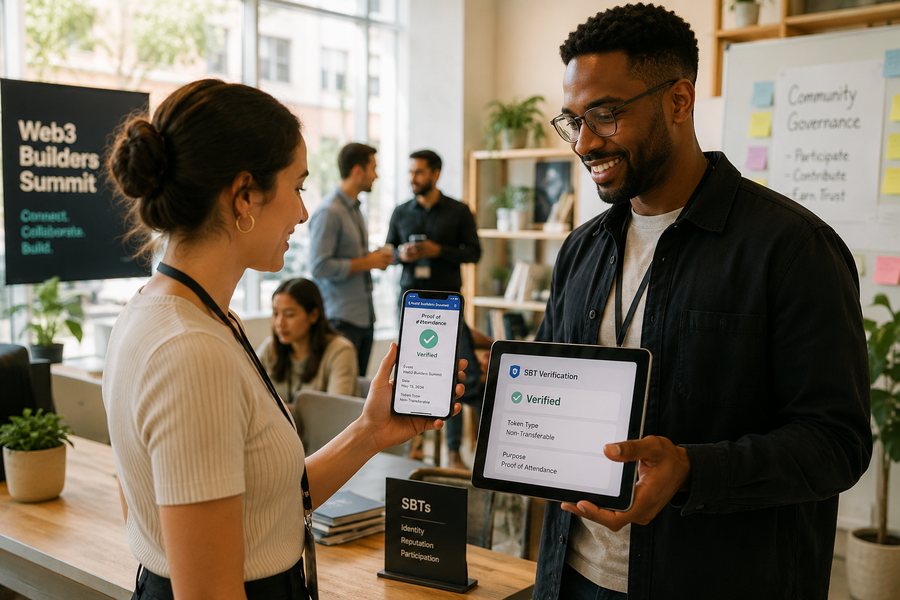
Most of what makes a person trustworthy in the real world cannot be bought or sold. A diploma represents years of study, a record of community service reflects genuine effort, and a reputation for showing up and following through is earned slowly through consistent behavior. These things matter precisely because they are tied to a specific person and cannot simply change hands. Yet the digital economy that grew up around blockchain technology was built almost entirely on assets designed to be transferred, from cryptocurrencies that move freely between wallets to non-fungible tokens that can be sold to the highest bidder. This created a strange gap. The technology was excellent at representing ownership of things, but poor at representing facts about people, because anything that can be transferred can also be faked, rented, or purchased by someone who did not earn it.
Soulbound tokens were proposed to fill that gap. A soulbound token, often shortened to SBT, is a digital token that is permanently bound to a single account and cannot be transferred to anyone else. The name borrows from a video game concept in which certain powerful items, once acquired, are locked to a character forever. The idea entered serious discussion in May 2022 with the publication of a widely read paper titled “Decentralized Society: Finding Web3’s Soul,” written by Ethereum co-founder Vitalik Buterin together with the economist Glen Weyl and the lawyer Puja Ohlhaver. The paper argued that a richer digital society would require tokens that represent commitments, affiliations, and history rather than just tradeable wealth, and that non-transferability was the key property making such representation meaningful.
Although soulbound tokens are frequently described as a tool for credentials such as diplomas or professional licenses, their most interesting applications reach well beyond that obvious use. This article examines what happens when non-transferable tokens are applied to proof of attendance at events, to records of participation and reputation in governance, and to the verification of relationships and identity between people. It explains how the technology works, what real organizations have built with it, and what benefits and risks the approach carries for individuals, communities, and institutions. The aim is to give a newcomer a clear and grounded understanding of why a token that can never be sold might turn out to be more socially useful than one that can.
Understanding Soulbound Tokens and Non-Transferability
To appreciate why soulbound tokens are different, it helps to understand the kinds of tokens that came before them. The blockchain world has long had two dominant categories of asset. Fungible tokens, such as most cryptocurrencies, are interchangeable, meaning one unit is identical to and exchangeable for any other, much like one dollar bill is equivalent to another. Non-fungible tokens, or NFTs, are unique, meaning each one carries distinct properties and can represent a specific item such as a piece of digital art or a collectible. Both categories share a defining feature that soulbound tokens deliberately reject, which is that they are freely transferable. Their entire economic logic depends on the ability to move them from one owner to another, because that transferability is what allows them to be priced, traded, and used as a store of value.
A soulbound token inverts this logic by being deliberately non-transferable. Once it is issued to an account, sometimes called a soul in this context, it stays there. This single change has profound consequences for what the token can represent. Because it cannot be sold, a soulbound token can stand for something that is supposed to be personal and earned rather than purchased. A token proving that a particular account attended a conference is meaningful only if that account actually attended, and non-transferability is what guarantees the link between the claim and the holder. If the same token could be sold, it would prove nothing, because anyone could acquire the appearance of attendance without the reality. The property that makes soulbound tokens less useful as financial assets is exactly what makes them useful as records of fact.
It is important to be precise about what non-transferability does and does not solve. Non-transferability ensures that a token cannot be moved between accounts, but it does not by itself prove that the right person controls the account in the first place, nor does it prevent someone from creating many accounts to accumulate many tokens. These are separate problems that require additional tools, and much of the engineering around soulbound tokens concerns how to address them. The token is best understood as a building block, a way to attach a permanent, verifiable marker to an account, rather than as a complete identity system on its own. The value emerges when many such markers accumulate around an account over time, gradually painting a picture of affiliations, accomplishments, and history that would be difficult to fabricate.
This accumulation is where the original vision becomes ambitious. The authors of the founding paper imagined a world in which accounts carry a rich constellation of soulbound tokens issued by schools, employers, communities, events, and other people, together forming a portable web of reputation that the holder controls. Such a web could let people prove things about themselves without relying on centralized authorities, could enable communities to recognize genuine members and filter out bad actors, and could support new forms of lending, governance, and cooperation based on demonstrated trustworthiness rather than collateral or wealth. Whether that full vision will be realized remains an open question, but the individual pieces are already being built and tested, and understanding non-transferability is the foundation for understanding all of them.
A useful way to grasp the distinction is to think about the difference between owning a concert ticket and having attended the concert. A ticket is transferable, because its value lies in granting future access and it makes sense for it to change hands. The memory and proof of having actually been at the concert, however, is not something that can sensibly be sold, because it describes a fact about a specific person’s past. Transferable tokens are good at representing the ticket, while soulbound tokens are designed to represent the attendance. This same pattern repeats across nearly every soulbound application. A degree, a vote earned through service, a verified friendship, and a history of contribution are all facts that lose their meaning the moment they can be detached from the person who earned them and handed to someone who did not. By refusing transfer, soulbound tokens preserve that essential link, and the entire edifice of applications built on them rests on this one deceptively simple property.
It is also worth clarifying that non-transferability does not mean a soulbound token is necessarily permanent or unchangeable in every respect. An issuer may retain the ability to revoke a token if the underlying fact changes, and some designs allow a token to expire after a set period. What remains constant is that the holder cannot pass the token to another account, which keeps the claim anchored to whoever earned it. This flexibility matters because real-world facts are not always permanent, and a credential system that could never reflect a lapsed membership or a corrected error would be brittle. The art of designing soulbound systems lies in preserving the anchoring property while still allowing the controlled updates that real institutions require.
Core Application Areas Beyond Credentials
The credential use case for soulbound tokens, representing diplomas, certifications, and licenses, is the easiest to grasp and is often cited first, but it is far from the only or even the most active area of experimentation. In practice, some of the most widely adopted applications have nothing to do with formal qualifications. They concern recording that a person was present somewhere, capturing a person’s history of participation and contribution in a community, and verifying the connections and trustworthiness of people relative to one another. These applications share the same underlying property of non-transferability but apply it to very different social purposes, and each has produced real-world deployments at meaningful scale.
What unites these non-credential applications is that they all use a permanent, account-bound marker to record something that should be tied to a specific actor and resistant to faking. Whether the marker proves attendance at a gathering, the right to vote in a community decision, or a verified relationship between accounts, the value comes from the same source, which is that the token cannot be transferred to someone who did not earn the underlying fact. The two subsections that follow examine the two most established of these areas, proof of attendance and governance participation, while the broader question of relationship and identity verification is significant enough to warrant its own dedicated treatment afterward.
Proof of Attendance and Event Participation
The single most widely adopted non-credential application of account-bound tokens is proof of attendance, and the technology that popularized it predates the soulbound terminology itself. The Proof of Attendance Protocol, universally known by its acronym POAP, lets event organizers issue unique digital badges to people who attend a gathering, whether physical or virtual. Someone who attends a conference, joins a community call, visits a booth, or participates in an online event can collect a POAP that serves as a verifiable memento proving they were there. While early POAPs were technically transferable, the concept embodies the soulbound spirit completely, because a proof of attendance only means something if it is tied to the actual attendee, and the protocol and its community have increasingly treated these badges as personal, non-financial records rather than tradeable collectibles.
The scale of POAP adoption demonstrates that there is genuine demand for this kind of record. By the middle of 2023, the protocol reported that well over six million POAPs had been minted, with some figures placing the total above seven million tokens issued by more than thirty-seven thousand unique issuers. These numbers represent an enormous range of events and organizations, from small online communities to major institutions. The badges have been used to certify participation in educational sessions, to reward loyal members of online communities, to grant access to follow-on events or benefits reserved for attendees, and simply to create lasting digital keepsakes of shared experiences. The breadth of these uses shows that proof of attendance is not a niche curiosity but a flexible primitive that many different groups have found valuable.
What makes attendance tokens powerful is that they accumulate into a verifiable history of where a person has genuinely been and what they have genuinely participated in. A long-time member of a community can demonstrate years of involvement through the badges they have collected, which is far more convincing than a simple claim of membership. Organizations have begun using this accumulated history to reward their most engaged participants, to gate access to opportunities based on demonstrated involvement, and to build a sense of belonging that persists across events. The attendance badge thus evolves from a souvenir into a component of reputation, an early and concrete illustration of how non-transferable tokens can capture facts about a person’s real-world and online life in ways that resist fabrication.
The appeal of attendance tokens to mainstream organizations deserves emphasis, because it shows the concept resonating well beyond a technical audience. Brands have used these badges to deepen relationships with customers, treating a badge as a marker of belonging that unlocks future perks and recognition for loyal participants. Cultural and educational institutions have used them to extend the experience of an event beyond its physical duration, giving attendees a lasting digital token that connects them to a shared moment and to one another. Even internal corporate uses have emerged, such as certifying that employees completed a training program, where the non-transferable badge provides a tamper-resistant record of who actually participated. In each case the organization is not chasing a speculative asset but solving a practical problem of recognition and record-keeping, which is precisely why attendance has become the most broadly adopted soulbound application. Its success suggests that the demand for verifiable, personal records of participation is genuine and widespread, and that people value having a portable proof of the experiences and communities that matter to them.
Governance Participation and Reputation Records
A second major application uses non-transferable tokens to record participation and standing within systems of collective decision-making. Many blockchain-based communities and organizations make decisions through voting, and a persistent challenge in such systems is determining who should have the right to vote and how much weight their voice should carry. When voting power is tied to transferable tokens, it can be bought, which means wealthy participants can simply purchase influence and the system drifts toward plutocracy. Soulbound tokens offer an alternative by binding governance rights or reputation to specific accounts based on demonstrated contribution rather than purchased holdings, so that influence reflects participation and trust rather than financial capacity alone.
The clearest and best-documented example of this approach is the governance structure of the Optimism Collective, an organization built around a major Ethereum scaling network. Optimism operates a body called the Citizens’ House, whose members, known as citizens, hold the right to help allocate funding to public goods that benefit the broader ecosystem. Crucially, citizenship is conferred through soulbound, non-transferable tokens, ensuring that the right to participate in these decisions cannot be bought or sold and instead reflects recognition by the community. This design directly addresses the plutocracy problem, because no amount of wealth can purchase a vote in the Citizens’ House when the voting credential is permanently bound to a chosen individual.
The practical stakes of this governance model are substantial. The Citizens’ House oversees rounds of what Optimism calls Retroactive Public Goods Funding, in which contributions that have already benefited the ecosystem are rewarded after the fact. The second such round, conducted in the first quarter of 2023, allocated ten million of the network’s OP tokens, while the third round, conducted in the fall of 2023, allocated thirty million OP tokens to reward projects and contributors. The decisions in these rounds were made by holders of the non-transferable citizenship and badgeholder tokens, with the third round involving on the order of one hundred and forty-six badgeholders, and with several hundred citizenships allocated to community members across the rounds. This demonstrates that soulbound tokens can underpin governance over real and significant resources, turning a record of trusted participation into concrete decision-making authority and showing how non-transferability can keep that authority aligned with contribution rather than wealth.
The reputation dimension of governance tokens extends beyond simple voting rights. As participants contribute to a community over time, the record of their contributions can itself become a soulbound asset, a verifiable history of work done and value created that informs how much trust and influence they should hold. This points toward a model of governance in which standing is earned gradually and visibly rather than purchased or assigned, and in which a person’s track record travels with them. Such reputation records could help solve a persistent weakness of token-based organizations, namely that transferable governance tokens reward those who can afford to accumulate them rather than those who have actually done the work. By anchoring influence to a non-transferable record of contribution, communities can in principle reward genuine commitment and discourage the accumulation of voting power purely as a financial play. The challenge, of course, lies in deciding which contributions count, who gets to issue the reputational tokens, and how to prevent the system from ossifying into a clique that rewards insiders, questions that governance experiments are actively grappling with as they refine these mechanisms.
Relationship Verification and Decentralized Identity
The third major application of soulbound tokens moves from recording individual facts toward verifying the connections and trustworthiness of people in relation to one another. This is in some ways the most ambitious use, because it touches the deep problem of digital identity, namely how to know that an account on the internet corresponds to a real, distinct human being and how to assess that person’s standing without relying on a single central authority. Non-transferable tokens are well suited to this challenge because relationships and identity are inherently personal and non-financial, and the entire value of a verified relationship collapses if the proof of it can be sold to a stranger.
A central problem that relationship and identity tokens aim to solve is what the field calls the sybil problem, the difficulty of preventing one actor from masquerading as many. In any open system where each account receives benefits, votes, or rewards, a single person who can cheaply create thousands of accounts can capture an unfair share or distort collective decisions. Soulbound tokens help by allowing accounts to accumulate verifiable attestations from independent sources, building up evidence that an account is controlled by a unique, genuine person. The more such attestations an account gathers from diverse and hard-to-fake sources, the more confident others can be that it is not one of a thousand puppets, and because the attestations are non-transferable, they cannot simply be pooled into a fake identity by buying them up.
Gitcoin Passport, more recently known as Human Passport, is a prominent implementation of this idea. It functions as an identity aggregation tool where a user collects verifiable attestations, called stamps, from a range of web2 and web3 sources, with each stamp contributing to an overall score that reflects how likely the account is to belong to a unique human. Easily faked signals such as a basic social media account contribute little to the score, while harder-to-fake signals such as a long-standing verifiable history contribute much more, and a user must reach a minimum cumulative score to be treated as verifiably human for purposes such as participating in a funding round or accessing a gated benefit. The system is designed to preserve privacy, with stamps generated by the user proving control of an account without exposing the underlying personal data, an approach that draws on the logic of zero-knowledge proofs. By July 2023, the tool had expanded its reach through integrations such as a campaign with the credential platform Galxe, illustrating how identity attestations increasingly interconnect across the ecosystem.
Beyond sybil resistance, relationship tokens point toward richer forms of social verification. An account that holds attestations from other trusted accounts, vouching for it as a colleague, collaborator, or community member, carries a web of relationships that is difficult to fabricate, because each attestation comes from an independent party with its own reputation at stake. This kind of mutual vouching could support new forms of trust on the internet, allowing people to extend credit, grant access, or form cooperative groups based on verifiable social connections rather than on centralized scores or self-declared claims. The original soulbound token vision placed great weight on this possibility, imagining communities that could recognize their genuine members and even support uncollateralized lending based on the reputational cost of betraying a web of relationships. While these richer applications remain earlier in their development than attendance or governance tokens, they represent the direction in which the technology’s most transformative potential is thought to lie, and they explain why so much engineering effort is being devoted to making account-bound identity both reliable and privacy-preserving.
The connection between relationship verification and real economic possibility is what gives this application its weight. In traditional finance, lending to someone without collateral requires either a credit history or a trusted intermediary willing to vouch for them, and people who lack both are simply excluded. A dense web of soulbound relationship attestations could, in principle, substitute for that missing history by making a person’s social standing legible and costly to fake. If borrowing depended partly on a verifiable network of people willing to stake their own reputation on a borrower’s reliability, then defaulting would carry a social cost that discourages bad behavior, recreating in digital form the community-based lending that has long operated through informal trust. This is speculative and unproven at scale, and it raises hard questions about privacy and about the fairness of tying financial access to social connections, but it illustrates why the founding vision treated relationship tokens as the gateway to genuinely new economic arrangements rather than merely a better login system. The same web of verified relationships that resists sybil attacks could also become the foundation for cooperation, credit, and coordination among people who have no other way to prove they are trustworthy.
The Technical Foundations of Soulbound Tokens
The applications described so far rest on a set of technical mechanisms that determine how soulbound tokens are created, stored, and verified, and understanding these foundations clarifies both the capabilities and the limits of the technology. At the most basic level, a soulbound token is implemented using token standards on a blockchain, often adapted from the standards used for non-fungible tokens but with the transfer functions disabled or restricted so that the token cannot move once issued. Various technical proposals have sought to formalize this non-transferability and to define how such tokens should behave, including how they can be issued by one party to another and how they might be revoked if circumstances change. The choice of standard matters because it affects how widely a token can be recognized and used across different applications and platforms.
A closely related and increasingly important mechanism is the attestation, a signed statement by one account asserting something about another. Rather than always minting a full token for every claim, many systems use lightweight attestations recorded through services designed for the purpose, which allow any party to make a verifiable, account-bound assertion about a subject, such as confirming attendance, vouching for identity, or recording a contribution. These attestation frameworks provide flexible infrastructure on which both soulbound tokens and simpler claims can be built, and they have become a backbone for relationship and reputation systems because they make it cheap and standardized to issue the kind of small, verifiable facts that accumulate into a reputation. The distinction between a heavyweight token and a lightweight attestation is partly a matter of engineering convenience, but both serve the same conceptual role of binding a verifiable claim to an account.
Two of the thorniest technical questions concern revocation and recovery, and they reveal genuine tensions in the design of soulbound systems. Revocation addresses the reality that some facts change, since a membership can lapse, a credential can be withdrawn, or an attestation can prove mistaken, which means a permanent token must often come with a mechanism for the issuer to mark it as no longer valid without violating the principle of non-transferability. Recovery addresses the even harder problem of what happens when a person loses access to the account that holds their soulbound tokens, because if those tokens represent a person’s accumulated reputation and identity, losing the keys to the account could mean losing a digital life’s worth of standing. The founding paper proposed social recovery schemes in which a person’s trusted community could collectively help restore access, and various approaches to guardianship and recovery continue to be explored, but no perfect solution exists, and the difficulty of recovery remains one of the most serious practical obstacles to widespread adoption.
Privacy forms the final pillar of the technical foundation, and it is essential because a transparent public ledger of everything a person has done would be a surveillance nightmare rather than an empowering identity system. If every soulbound token a person holds were openly visible to anyone, their complete history of affiliations, attendances, and relationships would be exposed, creating obvious risks of discrimination, profiling, and coercion. To address this, designers increasingly turn to privacy-preserving cryptography, particularly zero-knowledge proofs, which allow a person to prove that they hold a token or meet a condition without revealing the underlying details. A user might prove they are over a certain reputation threshold, or that they hold an attestation from a trusted source, without disclosing which specific tokens they hold or who issued them. The maturation of these privacy techniques is widely regarded as a prerequisite for soulbound tokens to fulfill their promise, because only with strong privacy can a rich account-bound identity be both useful to its holder and safe from exploitation by others.
Interoperability across platforms is a further technical consideration that shapes how useful soulbound tokens can become. A token or attestation is only valuable to its holder if other applications can recognize and verify it, which requires shared standards and a willingness among different platforms to honor claims they did not themselves issue. The growth of common attestation frameworks and credential platforms has helped here, allowing a credential issued in one context to be checked in another, but the ecosystem remains fragmented, with different networks, standards, and identity systems that do not always speak to one another. The vision of a portable reputation that follows a person everywhere depends on overcoming this fragmentation, and much of the practical engineering work in the field concerns building the connective tissue that lets attestations flow between contexts. Until that interoperability matures, a person’s soulbound tokens may remain useful within particular communities or platforms but fall short of the seamless, universal portability that the founding vision imagined, which is one reason adoption has progressed fastest in well-defined applications like attendance and governance rather than in the grander goal of a unified digital identity.
Benefits and Challenges Across Stakeholders
Soulbound tokens generate distinct advantages and concerns for the various parties who might use them, and a balanced assessment requires considering each group rather than treating the technology as uniformly good or bad. Individuals stand to gain a portable, self-controlled reputation, communities gain new tools for coordination and sybil resistance, and institutions gain efficient ways to issue and verify claims. At the same time, the very permanence and transparency that make these tokens powerful create serious risks around privacy, key loss, and the possibility of new forms of social stratification. The benefits are not automatic, and they depend heavily on thoughtful design and responsible governance.
The analysis below organizes these considerations by stakeholder and by category, first examining the benefits that accrue to individuals, communities, and institutions when the technology works well, then turning to the risks and design challenges that must be managed for those benefits to be realized safely. Keeping these perspectives distinct helps avoid the twin errors of dismissing soulbound tokens as a dystopian scoring system and of embracing them uncritically as a solution to every problem of digital trust, when the reality is that their value depends entirely on how they are built and used.
Benefits for Individuals, Communities, and Institutions
For individuals, the central benefit is ownership of a portable reputation that they control rather than one held captive by a single platform. In the conventional internet, a person’s history, reputation, and relationships are scattered across the databases of companies that own them, can change the rules at any time, and can lock the user out. Soulbound tokens offer the prospect of an account that belongs to the individual and carries their verifiable history with them across applications, so that the trust they build in one place can travel to another. This portability could be especially valuable for people who lack access to traditional institutions that confer status, since it allows reputation to be earned and demonstrated through participation and contribution rather than through gatekept credentials.
For communities, the principal benefit is a powerful new set of tools for coordination and for resisting manipulation. Sybil resistance, the ability to ensure that one person cannot masquerade as many, is foundational to fair voting, equitable distribution of resources, and honest collective decision-making, and soulbound attestations provide a privacy-respecting way to approach it. Beyond sybil resistance, non-transferable tokens let communities recognize and reward their genuine contributors, align governance with participation rather than wealth, and build durable membership that persists over time. The Optimism governance model illustrates how this can channel meaningful resources toward the public good while keeping decision-making in the hands of trusted, recognized participants rather than whoever holds the most tokens.
For institutions, including event organizers, employers, schools, and platforms, the benefit lies in efficient, verifiable issuance of claims that recipients can carry and prove independently. An organization that issues a soulbound attestation does not need to maintain a verification database that others must query, because the attestation itself is verifiable on the blockchain, reducing administrative burden and the risk of fraudulent claims. This efficiency, combined with the tamper resistance of blockchain records, makes the approach attractive for any institution that regularly issues facts about people, from a conference confirming attendance to a platform certifying that a user completed identity verification. The result is a reduction in the friction and cost of trust, allowing claims to be issued once and verified anywhere, which benefits both the issuing institution and everyone who later relies on the claim.
These stakeholder benefits reinforce one another in ways that strengthen the overall case for the technology. When institutions issue verifiable attestations efficiently, individuals accumulate richer portable reputations, and when individuals carry trustworthy reputations, communities can coordinate and resist manipulation more effectively, which in turn makes those communities more attractive places for institutions to engage. This virtuous circle is the mechanism by which the founding vision hoped a decentralized society would emerge, not through any single application but through the gradual interweaving of many account-bound claims into a fabric of trust that no central authority controls. The early implementations suggest the circle can begin turning, since a verified identity credential from one platform can serve sybil resistance in another, and an attendance record from one community can signal engagement to a third. Whether this reinforcement scales into the comprehensive system its proponents envision remains uncertain, but the interdependence of the benefits explains why advocates see soulbound tokens as more than a collection of isolated tools and instead as the connective infrastructure for a different kind of online life.
Risks, Privacy Concerns, and Design Challenges
The most serious risk is to privacy, and it follows directly from the transparency that makes blockchain useful. If a person’s soulbound tokens are publicly visible, they collectively reveal an intimate portrait of that person’s affiliations, beliefs, activities, and associations, which could be exploited for discrimination, profiling, targeted manipulation, or coercion. A potential employer, insurer, or government could in principle read a person’s entire token history and make consequential judgments based on it, and unlike a credential a person chooses to present, an open token registry exposes everything at once. This danger is why privacy-preserving techniques are considered essential rather than optional, and why a poorly designed soulbound system could easily become an instrument of surveillance rather than empowerment. The technology’s benefits and its worst dangers spring from the same source, which places enormous weight on getting the privacy engineering right. A system that exposes too much would not merely fail to help people but could actively harm the vulnerable populations it aims to include, turning a tool meant to expand opportunity into one that magnifies existing inequalities of power and information.
The problem of key loss and recovery represents a second major challenge with no fully satisfactory solution. Because soulbound tokens are bound to an account and cannot be transferred, a person who loses control of that account, through a lost key, a compromised device, or a forgotten password, faces the prospect of losing their entire accumulated identity and reputation with no easy way to reconstruct it. This is fundamentally different from losing a transferable asset, because there is no straightforward path to moving one’s tokens to a new, safe account. Social recovery schemes, in which trusted contacts help restore access, offer a partial remedy but introduce their own complications around who to trust and how to coordinate recovery securely. The permanence that gives soulbound tokens their meaning also makes the consequences of losing access uniquely severe, and until recovery is genuinely robust, this risk will deter many potential users.
A further and more subtle concern is the possibility of entrenching new forms of social stratification and exclusion. A society organized around accumulated reputation tokens could advantage those who started early or who belong to the right communities, while disadvantaging newcomers, the less connected, or those who for legitimate reasons prefer not to participate. If access to opportunities, lending, or community membership comes to depend on holding the right soulbound tokens, people without them could find themselves locked out in much the same way that the credit invisible are locked out of traditional finance, and negative or revoked tokens could create a kind of permanent digital record that follows a person. There is also the risk that such systems could be used coercively, for instance by authorities issuing tokens that mark people in undesirable ways. These concerns do not negate the technology’s promise, but they underscore that non-transferable reputation is a double-edged tool, capable of expanding opportunity or of cementing disadvantage depending on how it is governed, which is why the most thoughtful proponents emphasize voluntary participation, strong privacy, and careful attention to who holds the power to issue and revoke tokens.
Real-World Implementations and Measured Outcomes
Concrete deployments provide the best evidence of what soulbound tokens can actually do, and several organizations have built systems at meaningful scale with documented results. The three implementations examined here, drawn from a major exchange’s identity credential, a widely used proof of attendance protocol, and a large governance experiment, span the three application areas discussed throughout this article and demonstrate that non-transferable tokens have moved well beyond theory into practical use. Each comes with specific details and dates, and each illustrates a different facet of how the technology functions in the real world.
The first implementation is the Binance Account Bound token, known as BAB, which the cryptocurrency exchange Binance launched on its BNB Chain on September 8, 2022. Binance described it as the first soulbound token on that network, and it functions as a non-transferable identity credential issued to Binance users who have completed the exchange’s know-your-customer verification process. Because the token is bound to the user’s account and cannot be transferred, it serves as portable proof that the holder is a verified, real person who passed identity checks, which other applications can use for purposes such as airdrops, access control, and sybil resistance without each having to run its own verification. At launch, around fourteen projects had committed to recognizing and building on the BAB token, including the credential platform Project Galaxy and a range of games and decentralized applications, demonstrating immediate ecosystem demand for a reusable, account-bound proof of verified humanity. The BAB token is a clear example of relationship and identity verification, using non-transferability to make a single identity check portable across many services.
The second implementation is the Proof of Attendance Protocol, which represents the proof of attendance application at very large scale. By the middle of 2023, POAP reported that more than six and a half million badges had been minted, with some counts exceeding seven million tokens issued by over thirty-seven thousand unique issuers, a volume that places it among the most used non-financial blockchain applications. The range of issuers spans community organizations, educational programs, major brands, and cultural institutions, with documented uses including the auction house Sotheby’s distributing personalized attendance badges to visitors at a 2022 digital arts event in Riyadh, and the company Red Bull using an internal attendance badge to certify completion of staff training before extending the concept to public competitions. These examples show that proof of attendance has attracted not only blockchain-native communities but also established mainstream organizations, validating the idea that a non-transferable record of participation has broad practical appeal beyond any single niche.
The third implementation is the Optimism Collective’s Citizens’ House, which demonstrates governance participation tokens directing substantial resources. Citizenship in this body is conferred through soulbound, non-transferable tokens, and the citizens use that standing to allocate retroactive funding to public goods. The second funding round in the first quarter of 2023 distributed ten million OP tokens, and the third round in the fall of 2023 distributed thirty million OP tokens, with decisions made by holders of the non-transferable badges, numbering around one hundred and forty-six badgeholders in the third round and several hundred citizenships allocated across the rounds. The significance of this implementation lies in the scale of the resources governed and in the deliberate use of non-transferability to keep that power aligned with community recognition rather than purchasing power. It stands as a working demonstration that soulbound tokens can underpin real institutional decision-making over valuable resources, moving the concept from a theoretical proposal in a 2022 paper to a functioning governance mechanism within a single year. Taken together, these three implementations show non-transferable tokens operating across identity, attendance, and governance, each at a scale and with a concreteness that confirms the technology has practical traction.
Final Thoughts
Soulbound tokens represent an attempt to teach the digital economy something the physical world has always known, that the most important markers of trust are the ones that cannot be bought. By making tokens non-transferable, this technology aims to capture the affiliations, accomplishments, participation, and relationships that define a person’s standing, and to do so in a way that the individual controls and can carry across the fragmented platforms of the internet. The applications that have advanced furthest, including proof of attendance, governance participation, and identity verification, all share this common thread, using permanence and account-binding to represent facts about people that transferable assets never could. In doing so, they begin to fill a gap that the first generation of blockchain technology left wide open, between a system excellent at representing wealth and one capable of representing trust.
The documented progress is real and arrived quickly. Within roughly a year of the founding paper, millions of attendance badges had been minted across tens of thousands of issuers, a major exchange had issued non-transferable identity credentials adopted by an ecosystem of projects, and a governance body using soulbound citizenship had directed tens of millions of tokens toward public goods. These are not speculative promises but functioning systems with measurable activity, and they demonstrate that the core idea works in practice across very different domains. The technology has shown that non-transferable tokens can make a single identity check reusable, can turn participation into a durable and verifiable record, and can align decision-making power with contribution rather than capital, each of which addresses a genuine and previously unsolved problem.
Yet the path from these early successes to the expansive vision of a reputation-rich digital society runs through serious unresolved challenges, and intellectual honesty requires holding both the promise and the peril in view. The same transparency that makes the tokens verifiable threatens to expose the most sensitive details of people’s lives, the same permanence that gives them meaning makes the loss of access catastrophic, and the same reputational power that can expand opportunity could just as easily entrench exclusion or enable coercion. Whether soulbound tokens become a tool of empowerment or one of surveillance depends almost entirely on choices still being made, about privacy engineering, about recovery mechanisms, and about who holds the authority to issue and revoke the tokens that come to define people.
The most constructive way to view this technology is as a powerful and double-edged instrument whose ultimate character is not yet determined. Its capacity to give individuals ownership of a portable identity, to help communities coordinate honestly, and to let institutions issue trust efficiently points toward a more inclusive and self-directed digital life, especially for people poorly served by the centralized gatekeepers of today. Realizing that potential while avoiding its dangers will require sustained attention to privacy, to consent, and to the protection of those who would be harmed by a permanent and exposed record. The early implementations offer encouraging proof that the building blocks function, and the work ahead lies in assembling them into systems that widen participation and protect dignity rather than narrowing the first or eroding the second.
FAQs
- What exactly is a soulbound token?
A soulbound token, often abbreviated as SBT, is a digital token recorded on a blockchain that is permanently bound to a single account and cannot be transferred to anyone else. The term was popularized by a May 2022 paper co-written by Ethereum co-founder Vitalik Buterin. Because it cannot be sold or moved, a soulbound token can represent something personal and earned, such as a credential, an attendance record, a governance right, or a verified relationship, rather than functioning as a tradeable financial asset. - How are soulbound tokens different from regular NFTs?
The key difference is transferability. A regular non-fungible token can be bought, sold, and moved freely between owners, which is what allows NFTs to function as collectibles and tradeable assets. A soulbound token deliberately disables transfer, so it stays with the account it was issued to. This makes it useless as a financial asset but valuable as a record of fact, because a claim it represents, such as attendance or identity verification, only stays meaningful if it cannot be sold to someone who did not earn it. - What does non-transferability actually accomplish?
Non-transferability guarantees that a token, and the fact it represents, remains tied to the account that earned it, so it cannot be faked by purchasing it from someone else. This is what lets a soulbound token credibly stand for personal facts. However, it does not by itself prove that the right person controls the account or prevent someone from creating many accounts, which are separate problems addressed through additional tools such as identity attestations and sybil-resistance scoring. - Can soulbound tokens be used for proof of attendance?
Yes, and this is one of their most widely adopted uses. The Proof of Attendance Protocol, known as POAP, lets event organizers issue unique digital badges to people who attend events, whether in person or online. By mid-2023, well over six million such badges had been minted by tens of thousands of issuers. Accumulated attendance badges create a verifiable history of where a person has genuinely participated, which communities use to reward engagement and grant access to benefits. - How do soulbound tokens support governance?
They allow voting rights and reputation to be tied to specific accounts based on demonstrated contribution rather than purchased token holdings, which prevents wealthy participants from simply buying influence. The Optimism Collective’s Citizens’ House is a leading example, conferring citizenship through non-transferable tokens whose holders allocate retroactive funding to public goods, including thirty million OP tokens in its fall 2023 round. This keeps decision-making power aligned with trusted participation rather than wealth. - What is the sybil problem and how do these tokens help?
The sybil problem is the difficulty of stopping one person from creating many accounts to gain unfair advantages in voting, rewards, or resource distribution. Soulbound tokens help by letting an account accumulate verifiable, non-transferable attestations from independent sources, building evidence that it belongs to a unique, genuine person. Tools such as Gitcoin Passport aggregate these attestations into a score that reflects how likely an account is to be a real individual rather than one of many fake identities. - What happens if I lose access to my account?
This is one of the most serious unresolved challenges. Because soulbound tokens cannot be transferred, losing control of the account that holds them, through a lost key or compromised device, can mean losing your entire accumulated reputation and identity with no easy way to reconstruct it. Social recovery schemes, in which trusted contacts help restore access, offer a partial solution, but no fully robust mechanism exists yet, which is why recovery remains a major obstacle to widespread adoption. - Are soulbound tokens a privacy risk?
They can be, because blockchain records are typically transparent, and a publicly visible collection of someone’s tokens could expose their affiliations, activities, and relationships in ways that enable profiling or discrimination. This is why privacy-preserving cryptography, especially zero-knowledge proofs, is considered essential. These techniques let a person prove they hold a token or meet a condition without revealing the underlying details, allowing a rich account-bound identity to remain useful to its holder while staying protected from exploitation. - Have any major companies actually used soulbound tokens?
Yes. Binance launched its non-transferable Binance Account Bound token in September 2022 as proof of identity verification for users who completed know-your-customer checks, with around fourteen projects adopting it at launch. The auction house Sotheby’s distributed personalized attendance badges at a 2022 event, and Red Bull used attendance badges to certify staff training. These examples show adoption extending beyond blockchain-native communities into established mainstream organizations. - Could soulbound tokens create new forms of exclusion?
Yes, this is a recognized concern. A society organized around accumulated reputation tokens could advantage those who started early or belong to favored communities while disadvantaging newcomers or those who prefer not to participate, and negative or revoked tokens could create a lasting record that follows a person. There is also a risk of coercive use by authorities. These dangers do not negate the technology’s benefits, but they underscore the importance of voluntary participation, strong privacy protections, and careful governance of who can issue and revoke tokens.